Behind the Scenes: Selling “Zulu” (1964) – The Pressbook

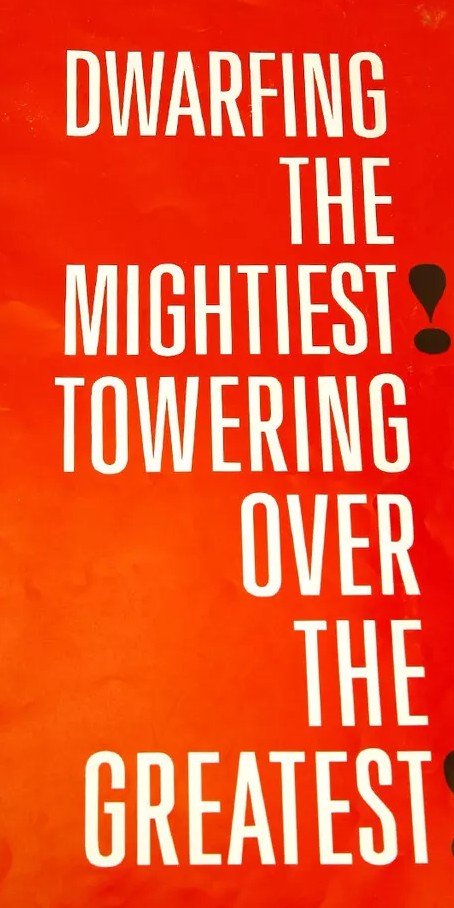
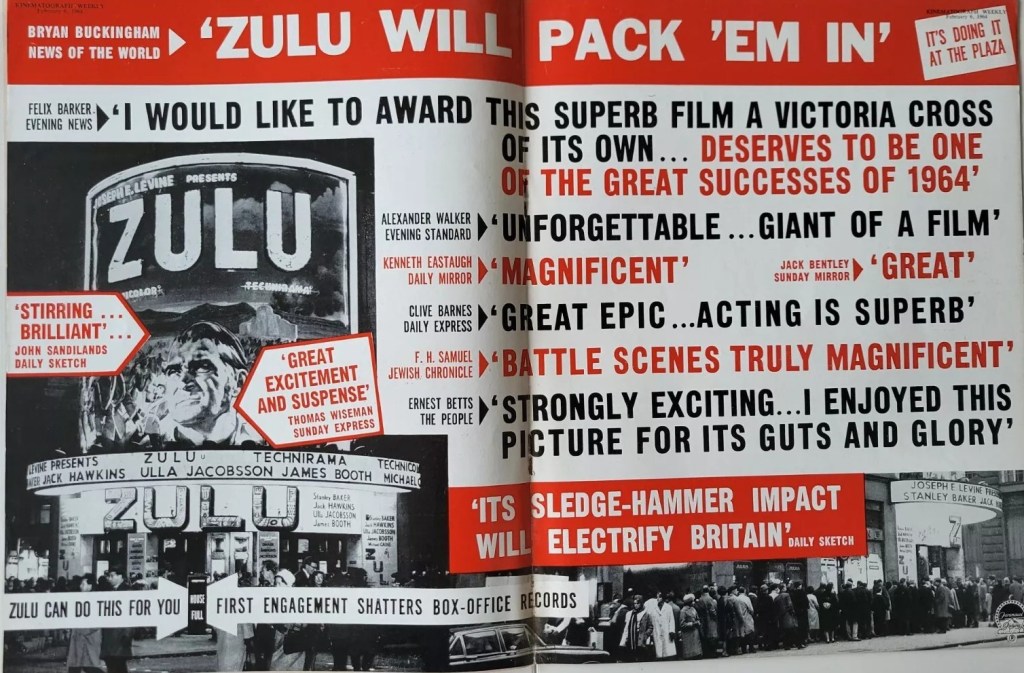
“Dwarfing the Mightiest! Towering over the Greatest!” wasn’t just the movie’s tagline. It could have easily been used to describe the Pressbook. This folded out into a colossal 40 inches wide  by 20 inches high, one of the biggest pressbooks ever produced.

The marketing team produced an impressive list of ideas. Cinema managers were urged to get war correspondents and war heroes involved and to blow up photos of the Victoria Cross. Hanging on the name of the star was a “Baker’s Dozen” competition, inviting people to list the thirteen movies featuring Stanley Baker. Quite how they thought a promotion involving banks would go down is anybody’s guess. Especially as this was the notion: “Zulus are allowed as many wives as they want, provided they can afford to pay for them. The price ranges between six and twenty head of cattle per wife. For an interesting tie-in, get local banks to display money and other barter materials. Give them a montage of still from the picture to display.” Culturally tone-deaf doesn’t cut it.

To attract children there was a coloring-in competition and a school study guide. The movie was available in 70mm Super Technirama so there was a special advertisement linked in to that for cinema going down that route.

Other taglines included: “The supreme spectacle that had to come thundering out of the most thrilling continent!” and “These are the days and nights of fury and honor and courage and cowardice that an entire century of empire-making and film-making can never surpass!”

And in case hyperbole wasn’t enough, one of the ads spelled out the exciting details. “The Massacre of Isandlwana! The Mating Song of the Zulu Maidens! The Incredible Siege of Ishiwane! Night of the 40,000 Spears! Days That Saved a Continent! Mass Wedding of 2,000 Warriors and 2,000 Virgins! Amid the Battle’s Heat…the Flash of Passion!”

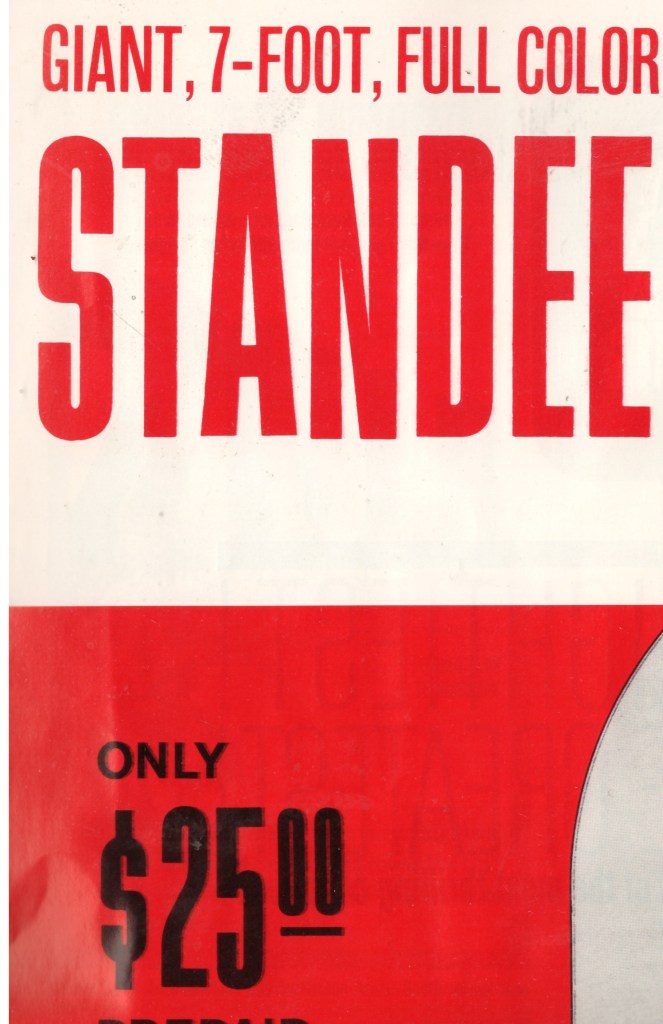
There was a seven-foot high standee and a three-foot 3D illuminated standee.

To help sell the picture to local journalists, little articles were planted that could hook an editor’s interest. For example, when director Cy Endfield glimpsed some soldiers firing their rifles left-handed, he stopped filming, because British soldiers were required to shoot right-handed. The film was shot in the shadows of the Darkensberg Mountains. The river which flowed past Rorke’s Drift was slower than it had been at the time of the battle so the course was altered and dammed to increase the flow. Out of sight of the cameras but essential to filming were the modern villages constructed to house cast and crew, stores, catering and compounds for horses and oxen.

The cast were on set at 6.30am for make-up. The Zulus spent more time in make-up than the British soldiers, as the costume department ensured every aspect of their outfits was historically correct. A total of 100lb of small colored beads was crafted by made by local women for the maidens to wear. A primitive method of making necklaces, strung together with animal sinew and rolled by hand, was employed incorporating a further 100lb of wild syringa seeds which were dyed.

The warrior loincloths of softened animal skins were made the traditional way using stones aqnd animal fat. Shields were also made from animal skin. The teeth of tigers and baboons formed their necklaces. They kept snuff in a small gourd worn round the waist. The purpose of a porcupine quill tucked into their hair was to extract thorns after a long march.

Three cameras were utilized to shoot the blaze that burned down the hospital. “Undress rehearsal” was the name given to the marriage ritual scenes of bare-breasted women.

Though Michael Caine was being touted for stardom, as far as the Pressbook was concerned he was relegated to section below Jack Hawkins, James Booth and Ulla Jacobsen who had smaller parts. The movie was a notable change for Jack Hawkins, who saw action in World War Two. Instead of playing his usual hero, he was a weakling and drunk. It was the second English-language film for Swede Jacobsen after Love Is a Ball / All This and Money Too (1963).

Zulu (1964) *****

The technical excellence is substantially under-rated. Not just the aural qualities – the approaching enemy sounding like a train – and the reverse camera and uplifted faces registering awe that later became synonymous with Steven Spielberg, but the greatest use of the tracking camera in the history of the cinema. So what could otherwise be a rather static movie given it revolves around a siege is provided with almost continuous fluidity.

It’s perhaps worth pointing out, in relation to accusations of jingoism, that the British had relatively few battles to celebrate – Agincourt in the Middle Ages, Waterloo in 1815, El Alamein in 1942. But the Crimean War, in which Britain was on the winning side, was remembered for the disastrous Charge of the Light Brigade. Dunkirk in 1940 was a defeat and in cinematic terms D-Day was seen as heavily favoring of the Americans. Although there had been a corps of British World War Two pictures, these generally focused on individual missions (The Dam Busters, 1955) or characters (Reach for the Sky, 1956). And in fact the defense of Rorke’s Drift was preceded by a resounding defeat at the hands of the Zulus at Isandlwana.

Tactically, too, the Zulus are smarter. Their leader is only too happy to sacrifice dozens of his troops in order to gauge the British firepower, their snipers probe for weaknesses in the British defences, their troops feint to attract fire and waste bullets.  The Zulus are too clever to attack where the British want.

This is not even your normal British army. Rorke’s Drift is a supply station and hospital. Its upper class commander Lt Bromhead (Michael Chard) idles his time away going big game hunting. The more down-to-earth Lt Chard (Stanley Baker) is there in his capacity as an engineer, erecting a pontoon bridge over the river. Neither has been in battle.

It’s surprisingly realistic in its depiction of the common soldier as having other interests beyond fighting. Private Owen (Ivor Emmanuel) is more concerned about the company choir, Byrne (Kerry Jordan) more focused on his cooking than bearing arms, and farmer Private Thomas (Neil McCarthy) spends his time cuddling a calf. Hook (James Booth) is a troublemaker and slacker and surgeon Reynolds (Patrick Magee) inclined to mouth off to his superior officers. The Rev Witt (Jack Hawkins) turns out to be a drunken hypocrite. His pious daughter (Ulla Jacobsen) is shocked when the men try to steal a kiss

Beyond a fleeting glimpse of victorious forces at Isandlwana, the Zulus are introduced in a sequence of harmony, a tribal ritual preceding a marriage ceremony, lusty singing and dancing scarcely setting up what is to come. It’s more like the by-now traditional section where the main characters in a movie set in an exotic land are introduced to aspects of local culture. Various characters attest to their military exploits.

But after that, tension cleverly builds. Witt raises the alarm, a bunch of cavalry irregulars refuse  to stay and fight, the sound of the pounding “train” of the approaching army (an idea imitated for the oncoming unseen German tanks in Battle of the Bulge, 1965) and then the awesome shot of the thousands of Zulus adorning a hilltop make it unlikely the garrison can survive, especially given the inexperience of Chard and Bromhead, the latter of the civil “old boy” old school, and their inherent rivalry. Nor are the commanders typical. Chard may be gruff but he’s not arrogant and the soft-spoken Bromhead is the antithesis of every British officer you’ve ever seen on screen.

As the camera continues its insistent prowl, many sequences stand out – the battle of the battle hymns (“Men of Harlech” from the Brits); the bandage unravelling from the leg of wounded Swiss; the blackened wisps of canvas on the burning wagons at Isandlwana; the trembling voice of Color Sgt Bourne (Nigel Green) in the post-battle roll call; “he’s a dead paperhanger now”; the frantic bayonets digging holes in the walls of the hospital to escape; the final “salute” by the defeated Zulus; the torrential firepower the defenders inflict when three units fire in turn.

There’s a scene you’ll remember from The Godfather (1972) when Michael Corleone and the baker’s son stand guard outside the hospital and the baker’s hand shakes when he tries to light a cigarette whereas Michael notes that his own is perfectly steady. That has its precedent here. Chard’s hand shakes loading bullets into his pistol but later, battle-hardened, it does not.

There’s no glory in war as the surgeon constantly reminds the leaders and Bromhead, expecting to exult in triumph, instead feels “sick and ashamed.”

Terrific performances all round, mighty score by John Barry, written by director Cy Endfield (Sands of the Kalahari, 1965) and Scottish historian John Prebble (Culloden, 1964). The high point of Endfield’s career. Despite his character’s prominence Michael Caine was low down the billing, and despite the movie’s success stardom did not immediately beckon and he had to wait until The Ipcress File (1965) and Alfie (1966) for that.

I hadn’t see this in a long while and expected to come at it in more picky fashion. Instead, I thought it was just terrific.

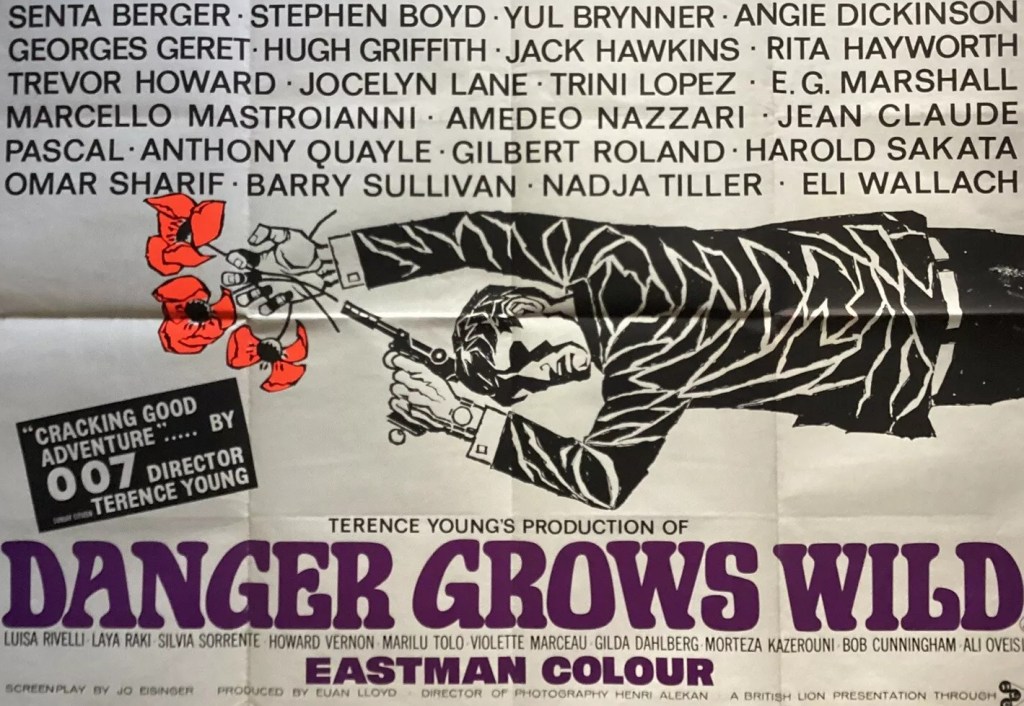
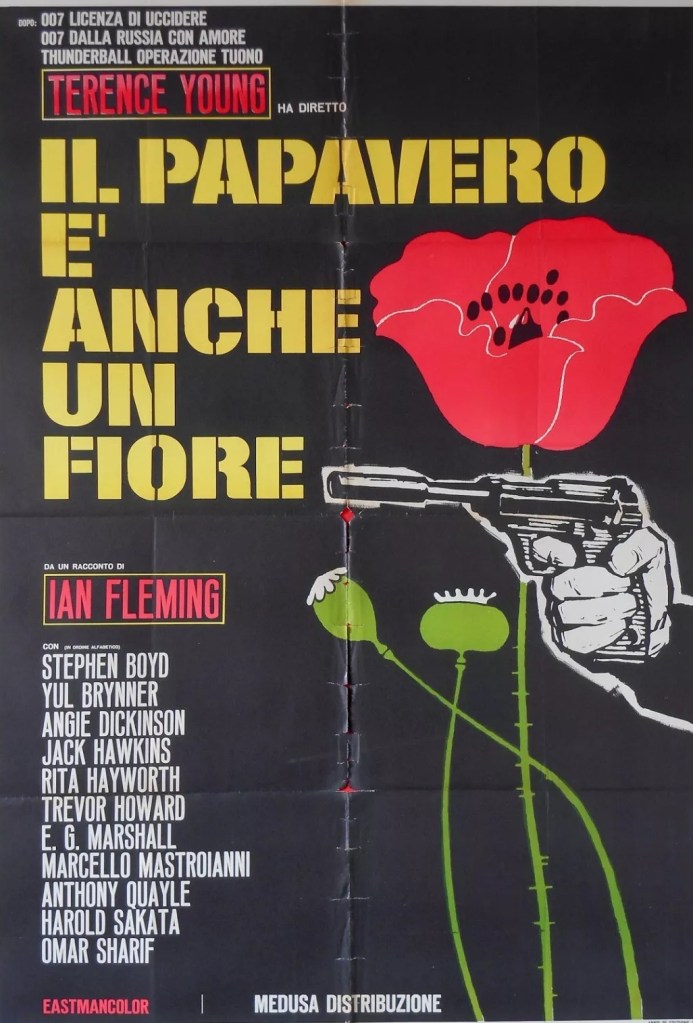
The Poppy Is Also A Flower / Danger Grows Wild (1966) ***

Audiences were likely disgruntled to discover that out of a heavyweight cast boasting the likes of Omar Sharif (Doctor Zhivago, 1965), Yul Brynner (The Magnificent Seven, 1960), Rita Hayworth (Circus World/The Magnificent Showman, 1964), Senta Berger (Cast a Giant Shadow, 1966) and Stephen Boyd (Genghis Khan, 1965), that the heavy lifting was done by a couple of supporting actors in Trevor Howard (Von Ryan’s Express, 1965) and E.G. Marshall (The Chase, 1966).

Most of the all-star cast barely last a few minutes, Stephen Boyd’s character killed in the opening sequence, Senta Berger and Rita Hayworth putting in fleeting appearances as junkies. Like many of the gangster pictures of the decade, it’s set up as a docu-drama, giving the down’n’dirty, courtesy of United Nations which funded the picture, on the international drugs trade.

Benson (Stephen Boyd) heads up an infiltration operation targeting drug suppliers in Iran, where poppies “grow wild as weeds.” Though quickly bumped off, and the goods he’s purchased stolen, he’s replaced by Col Salem (Yul Brynner) who has the Bond-esque notion of enriching the opium with radiation and then tracing it using Geiger counters.

When that scheme fails, it’s down to agents Sam Lincoln (Trevor Howard) and Coley Jones (E.G. Marshall) to hunt down the drugs. Considering themselves unlikely lotharios, they compete over women and play a neat game of stone-scissors-paper to decide who is assigned which task, varying from chatting up Linda (Angie Dickinson), the gorgeous widow of Benson, or searching her room. Linda isn’t all she seems, not least she may not be a widow, carries a gun, and turns up in too many unsavory dives to be on the side of the angels.

Given drug-dealing was not the rampant business it later became, audiences might not be so shocked to discover that opium was transported by cargo ship and refined in Naples before being shipped all over the world. Possibly as interesting is the use of ancetic anhydride in the refining process. As Sam and Coley trudge across half of Europe, from Naples to Geneva to Nice, the audience is filled in on the details of the drug business and they latch on to a Mr Big, Serge Marko (Gilbert Roland).

There’s a hard realism about the project – though not to the levels of The French Connection (1971) -: nightclub dancer needing make-up to hide the tracks on her arms; Marko’s wife (Rita Hayward) stoned out of her skull; director Terence Young (Dr No, 1962) pulling a fast one Hitchcock-style in killing off Sam; and, despite a climax which sees Coley collar Marko, it ends with a pessimistic air – “someone else to take his place.” There’s a good fistfight on a train, and you’ll have guessed what Linda is up to. But there’s an odd softer centre, the movie taking a couple of breaks to highlight the singing of Trini Lopez and female wrestlers.

Before virtue-signalling was invented this was a do-gooder movie, the cameo players signing up for a buck, Grace Kelly on hand for the introduction. These days it stands as an almighty alarm that was scarcely heeded, not as the drug-fuelled counter-culture was about to burst onto the world, and with middle-class drop-outs championing the illicit there was little chance of the warning being heeded.

More like The Longest Day (1962) than Lawrence of Arabia (1962) in its use of the all-star cast. Still manages to make its points with the least amount of lecturing and hectoring.

Terence Young comes into his own in the action highpoints. Written by Jo Eiseinger (Oscar Wilde, 1960) and Jack Davies (Gambit, 1966) from an idea by Ian Fleming.

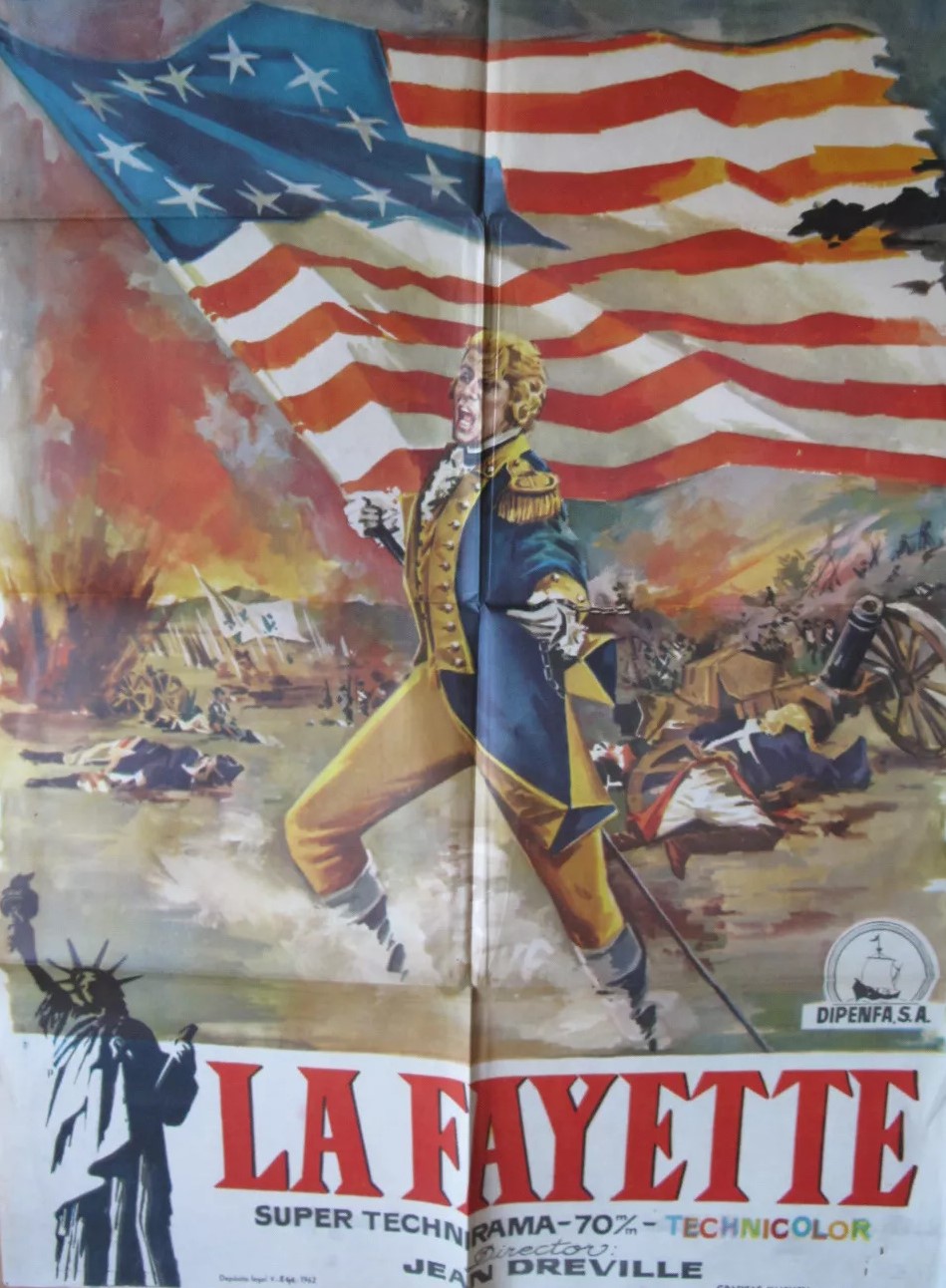
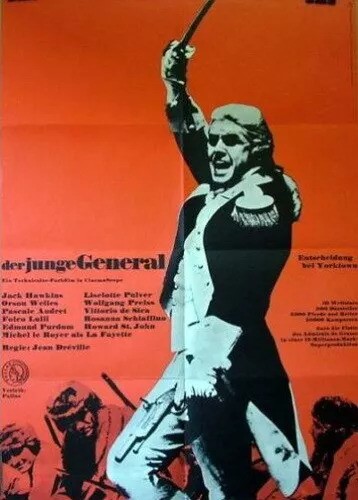
Lafayette (1966) ***- Seen at the Cinema in 70mm – Bradford Widescreen Weekend

We are so accustomed to Hollywood rewriting every other country’s history it comes as a something of a surprise when they get a taste of their own medicine. And in such elaborate style. At the time this was by some distance France’s most expensive movie, a roadshow production made in Super Technirama 70, the widescreen technology favored by productions as diverse as Walt Disney’s animated The Sleeping Beauty (1959), Biblical epic Solomon and Sheba (1960), British drama The Trials of Oscar Wilde (1960), Samuel Bronston’s  El Cid (1961) and Zulu (1964).

I wouldn’t have known from this picture how important a figure Lafayette was in French history. On a couple of forays to Paris I had placed no significance on shopping at the retail metropolis known as Galeries Lafayette. However, it turns out he was a major player in the French Revolution and helped to write the Declaration of the Rights of Man. But I wouldn’t have learned anything about his later career as this picture concentrates on his early life.

This long-lost restored picture was the official highlight of this year’s Bradford Widescreen Festival, mostly I assume because until the restoration it hadn’t been seen anywhere for half a century and because Bradford of all places is a sucker for restoration and its audience often includes more than a smattering of ex-industry professionals who can comment on its technical proficiency.

Although released in France in 1962 it didn’t cross the Atlantic or the English Channel until a few years later, but only for short selective engagements, during a period when there were was no shortage of roadshow material what with Its a Mad, Mad, Mad, Mad World still hogging Cinerama screens and My Fair Lady (1964) and The Sound of Music (1965) embarking on extensive runs.

This turned up in London in 1965 at the Casino Cinerama where How the West Was Won had played for over two years and it was also shown in Liverpool and enjoyed a couple of weeks in my home town of Glasgow at the Coliseum.

While the American alliance with France during the final stages of the War of Independence was critical to turning the tide against the British I suspect the exploits of the titular character (Michel Le Royen), an aristocratic stripling of 19 years of age, have become somewhat embellished in Hollywood  Errol Flynn style.

The movie also ignores the irony that the principles of freedom and independence from regal rule spouted by many of the main characters came back to bite them several years later when the French Revolution sought to separate the brains of the aristocrats from their bodies. The French Emperor helped fund the American Revolution, assuming notions of independence were fine for foreign countries rising up against the British, a particular thorn in the French side at that point.

There’s also a considerable tinge of entitlement and for all its democratic principles the nascent new nation bowing down to the aristocratic breeding of the Frenchman and giving this inexperienced soldier the title of Major-General and putting him in charge of their least-disciplined troops, the irregular starving militia.

Never mind his age, he can hardly speak English and his aristocracy is hardly going to endear himself to his raw troops. And you can hardly ignore the ironic entitlement that when all other wounded men are left to look after themselves, our hero is carted off to George Washington’s (Howard St John) palatial servant-heavy mansion.

Still, according to this story and presumably the legend the young commander did indeed snatch defeat from the jaws of victory, in one engagement when his men were racing away in ignominious retreat he seized the torn American flag and inspired his men to return to battle and victory.

For a near three-hour picture it’s short on military action, though presumably that’s in the interests of historical accuracy so that means wading through countless scenes of politics both in France and America. In his home country he’s treated as something of a traitor for embarking on his own private war against the British. In America Congress is always on the back of George Washington, refusing him the funds and help he needs, insisting such would be in ample supply should he win a battle, the future President retorting back that victory would be guaranteed should he be given funds.

The absence of military set pieces is in part in recognition of the strategy endorsed by Washington, of avoiding a pitched battle with a superior enemy in favor of a guerilla  war of attrition. There are more scenes of thousands of extras marching than of them engaging in any meaningful activity, though I’m assuming that could have been a budgetary restriction.

Whether’s it’s true or not there’s some clever stuff on the French political scene, the Emperor Louis XVI (Albert Remy) prone to taking advice from his wife Marie Antoinette (Liselotte Pulver) whose ear is being bent by La Fayette’s wife (Pascale Audret)  but the self-serving attitudes on both sides will be recognizable to everyone.

There’s a stab at an all-star cast, Jack Hawkins (Lawrence of Arabia, 1962) as the British commander Cornwallis though the director – or perhaps the star himself given his idiosyncratic ways – has rendered Orson Welles as American ambassador Benjamin Franklin virtually unrecognizable, even his noted diction smothered. 

The torch of freedom never had a more handsome advocate than in the hands of Michel Le Royer but it’s virtually a one-note performance though admittedly nobody expected much more from Errol Flynn. 

Directed by Jean Dreville (Queen Margot, 1954).

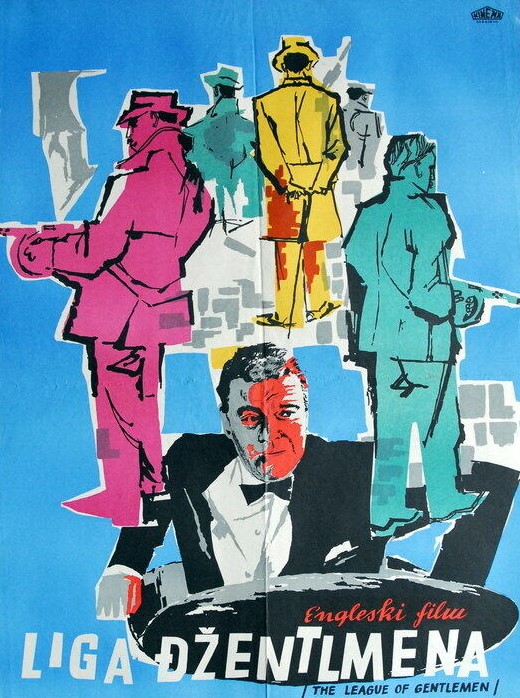
The League of Gentlemen (1960) ****

Cracking British heist film prefiguring titles as disparate as The Dirty Dozen (1967) and Heat (1995). Superb opening scene shows the lid coming off a manhole cover and after a short pause to avoid being drenched by a municipal street cleaner a man in a dinner suit emerges and makes his way to his Rolls Royce. Say hello to Lt-Col Hyde (Jack Hawkins).

Don’t be fooled by early reviews that tabbed this this an “action-comedy,” the humor is only incidental, while serving the important purpose of cutting the grandiose down to size, and not in the vein of, for example, Beverly Hills Cop (1984).

A group of ex-WW2 officers receive a mysterious parcel containing a pulp novel and £50 in notes torn in two, the other halves redeemed if they turn up for a meeting at the Café Royal in London. The opening section is almost a riposte to the recruitment sequence of The Magnificent Seven, out the same year, which strived for effect, and zipped along with one-liners.

This gang are all down-on-their-luck, any courage or leadership displayed during the conflict counting for nothing in peacetime. The sequence is surprisingly risqué for the period, virtually all the characters engaged with disreputable women. So, we have Major Race (Nigel Patrick) running some gambling scam with easy-come-easy-go confederate Peggy (Melissa Stribling), Lt Lexy (Richard Attenborough) a garage mechanic with a sideline in fixing the odds on one-arm bandits and inclined to steal other men’s girlfriends, and Captain Porthill (Bryan Forbes) a pianist playing in seedy dives and living off a middle-aged woman whom he cheats on.

Barely getting by emotionally or financially are Major Rutland-Smith (Terence Alexander) whose glamorous wife (Nanette Newman) takes a string of lovers while ritually humiliating him and Captain Mycroft (Roger Livesey) running a chaplain racket and selling erotic magazines. Hyde lives on his own in a mansion, his absent wife described as “the bitch.”

There’s an undercurrent here that’s barely explored of soldiers who have lost their way, but at the time it could remain underutilized because audiences would be filled with men whose post-war experiences chimed with these characters. Hyde has come up with a stunning plan to relieve a bank of close on a million pounds, the cash split equally, using the various skills his team had acquired through war service.

It’s a bold and, even if carried out with military precision, frankly terrifying exercise that intends to use machine guns and smoke bombs to scare the living daylights out of anyone who dares intervene, bringing New York-style gangsters to the streets of peaceful London. First stop is an army training where, in a ruse similar to that of the later The Dirty Dozen, Mycroft impersonates a commanding officer, inspects troops and deals out humiliation at the drop of a hat. Without doubt, this is an amusing sequence, especially when his superiors in the enterprise, Hyde and Race, are forced to eat disgusting Army slop, but it fulfils the same role as in the Robert Aldrich picture, the least likely soldier allowed to strut his stuff, tension undercut.

The heist itself follows the normal template of planning and execution and it’s brilliantly done, although the crooks are undone by a minor flaw in the procedure. Except for the opening section, and when Hyde exposes, as perhaps community therapy, the criminality of his gang, we learn little more about them, except, as if revisiting the past, how they respond (or not) to the discipline and hierarchy of the Army model on which the group operates. Scoring points off each other, or rebelling, or meting out punishment for misdemeanors, it’s like being back in the Army.

Nobody’s seeking redemption as in The Magnificent Seven or The Dirty Dozen, but it’s still easy to sympathize with an odd bunch whose expectations have been dashed. The scene where Race witnesses Hyde’s stark living conditions, and then offers to wash up the plates piled up in the sink, tells you a lot about how lost some of these men are.

Excellent acting all round from, by British standards, an all-star cast. At one time the number one British star, Jack Hawkins was an occasional Hollywood pick, leading role in Howard Hawks’ Land of the Pharaohs (1955), major supporting roles in Bridge on the River Kwai (1957) and Ben-Hur (1959). Richard Attenborough (The Angry Silence, 1960) had been a top name for over a decade, Nigel Patrick top-billed in director Basil Dearden’s previous outing Sapphire (1959). Kieron Moore (Day of the Triffids, 1963), Bryan Forbes (better known as a writer and director) and Nanette Newman (The Wrong Box, 1966) were rising stars, and you might want to include Oliver Reed (Hannibal Brooks, 1969) in that roster as he makes a camp entrance in a bit part.

Basil Dearden (Khartoum, 1966) is in top form with a script by Forbes from the John Boland bestseller.  

Worth seeing.

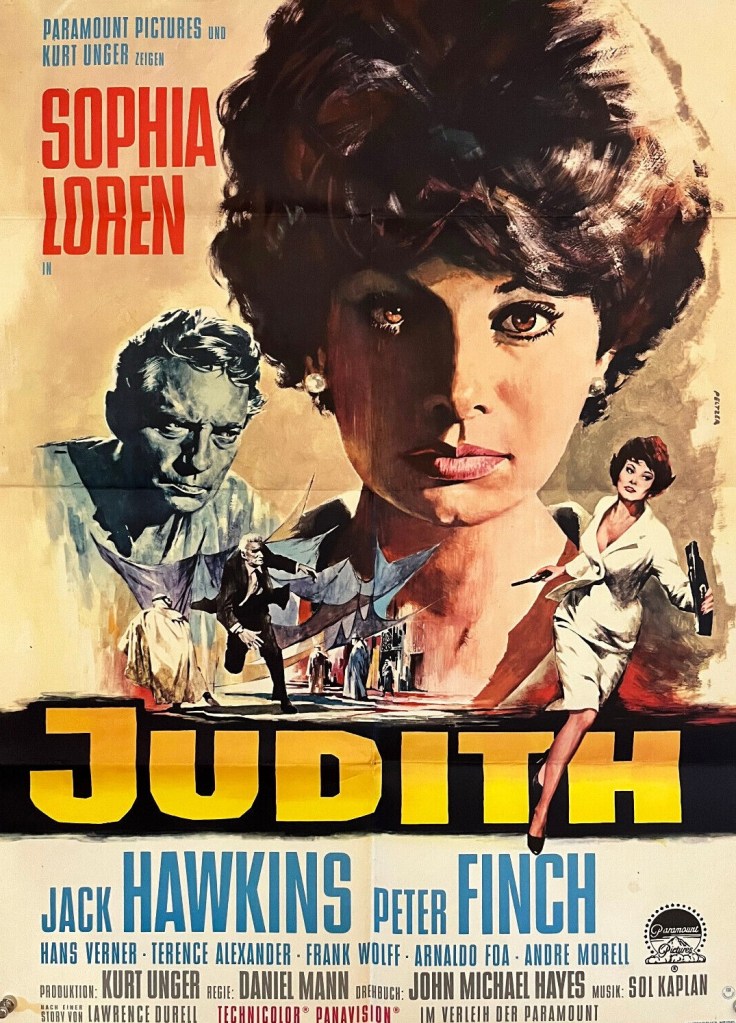
Judith (1966) ***

This is why you hire Sophia Loren. In the middle of a complicated story she provides the  emotional anchor.. And she can do it without words. A few close-ups are all you need to guess at her inner turmoil in a world where, as with Play Dirty (1968), the individual is disposable. The good guys here, Israelis fighting for survival at the rebirth of their country, are every bit as ruthless as the commanding officers in the World War Two picture.

And it’s just as well because the tale is both straightforward and overly complex. Like Cast a Giant Shadow, out the same year, or the earlier Exodus (1961), it’s about the early migrants staving off Arab attempts to destroy the tenuous foothold Jewish immigrants on the land with  the British, stuck in the role of maintaining law and order, cracking down on illegal landings of refugees and arms smuggling.  But where the earlier movies take the war to the enemy, this is all about defence, holding on to hard-won positions.

Israeli leader Aaron (Peter Finch) discovers General Schiller (Hans Verner), a former German WW2 commander wanted for war crimes, currently in charge of the Arab tank regiment, is planning imminent assault. After locating Schiller’s wife Judith (Sophia Loren), he smuggles her into Israel with the intention of using her as bait to kidnap the general.

This would be no romantic reunion. The general had abandoned his wife, a Jew, and she spent the war in Dachau where she survived as a sex worker. She wants nothing more than revenge. But it takes a fair while for the cloak-and-dagger elements to warm up. First of all she has to seduce British Major Lawton (Sophia Loren) into revealing details of her husband’s whereabouts.

Turns out Lawton is the only principled official on show, out of general decency and a British sense of fair play (unlike the soldiers, for example, in Play Dirty)  turning down the offer of her body in return for his aid.  But it also transpires that Judith also lacks any notion of fair play and stabs her husband at the first opportunity, making it virtually impossible for his captors to discover the specifics of the planned attack. You wouldn’t need much of a sense of irony to share the Israeli anger when uner interrogation the captured general tosses back at them the Geneva Convention.

Judith’s involvement in the hunt for the general had the potential to be a very fine film noir on its own, especially had the wife been required to show willing to the husband in order to lure him out into the open.

Unfortunately, that’s not the tack the movie takes. Instead, we follow a series of forgettable characters either espionage agents, or at the kibbutz or effectively just there in passing, on the edge of the action, even when they might be in the heart of the real action either being unloaded into the surf or under attack from Arabs. There’s a sense of trying to cram too much historical incident into what would have worked best as a straightforward thriller. How far would Judith go to extract revenge? And, can Aaron stop her ruining his delicately-balanced plans?

Plenty of room for maneuver too on the sticky point of country vs individual. Where Aaron is happy to sacrifice or exploit Judith to satisfy his agenda, albeit to the greater glory of his country, so, too, is Judith unwilling to surrender her individuality for that more beneficial cause.

So what we get is a riveting mess. When Sophia Loren (Operation Crossbow, 1965) is onscreen you can’t take your eyes off her. When the action switches to the sub-plots, you keep on wondering where she’s got to and when will she next turn up. Judith is a fascinating character, batting away contempt about the way she survived the concentration camp, arriving in an old-fashioned cargo container with the corpse of a companion who failed to last the journey, and before long sashaying through the kibbutz delighted to attract male attention.

Yet, despite the hard inner core, and keeping one step ahead of both Aaron and Schiller, as if she had long ago stopped trusting men, she is emotionally vulnerable and proves easily manipulated when either pierces the carapace.

That director Daniel Mann feels duty bound to attempt to tell the bigger story of the Israeli struggle is  somewhat surprising since he was best known as a woman’s director. Under his watch both Shirley Booth and Terry Moore were Oscar-nominated for  Come Back, Little Sheba (1953), both Susan Hayward and Anna Magnani Oscars winners for I’ll Cry Tomorrow and The Rose Tattoo, respectively.

John Michael Hayes (Nevada Smith, 1966) cooperated with Lawrence Durrell (Justine, 1969) on the screenplay.

Worth it for Sophia Loren’s stunning performance.

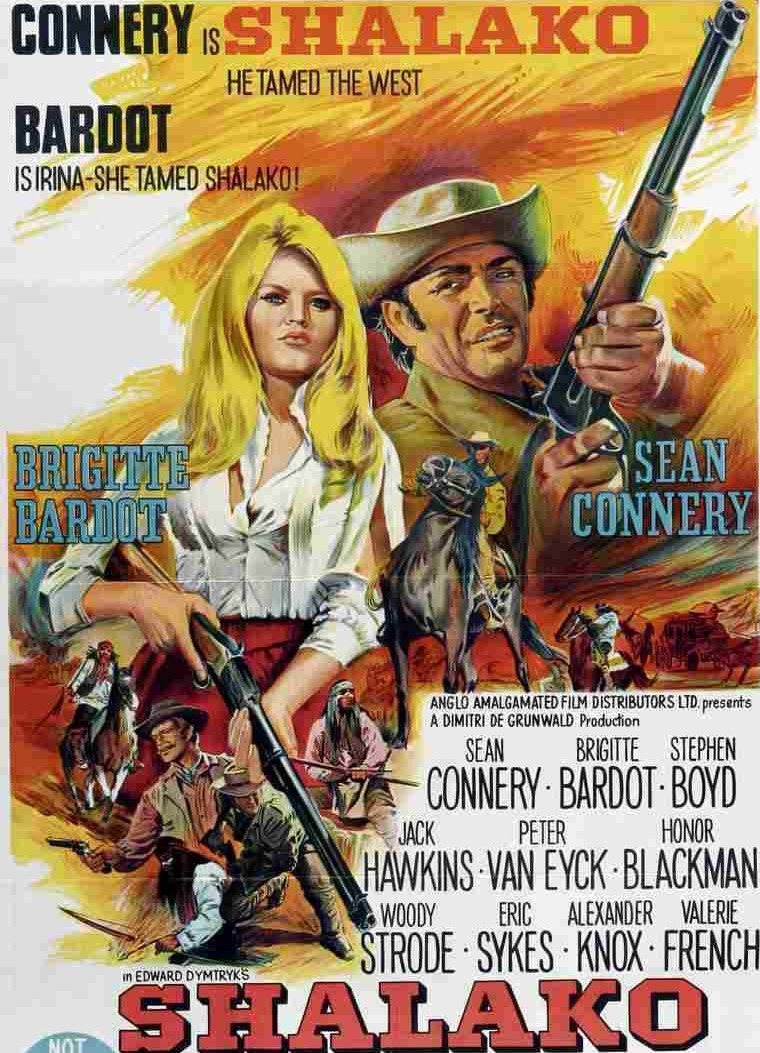
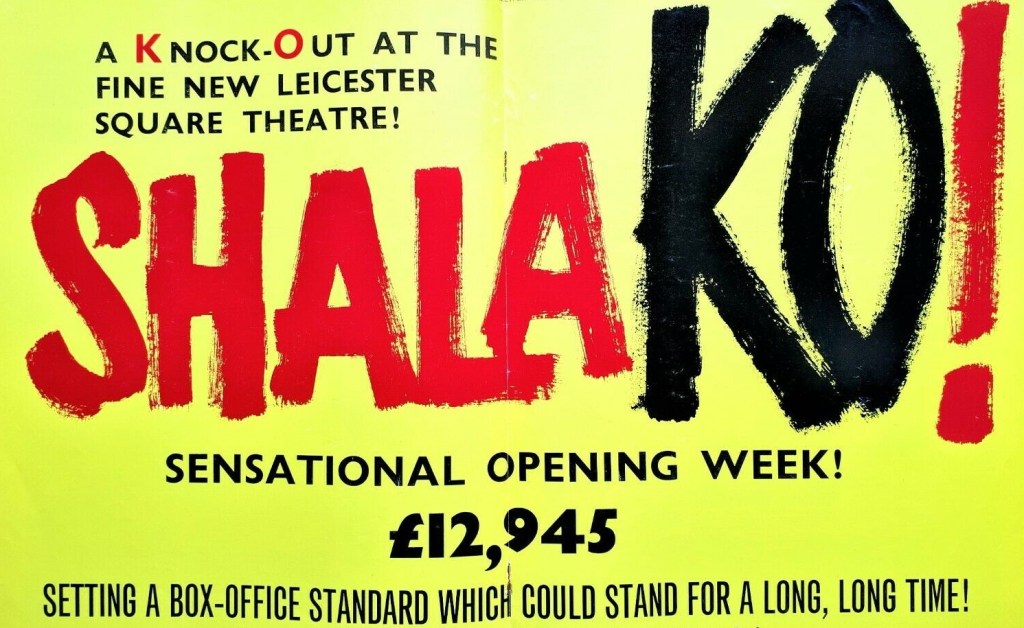
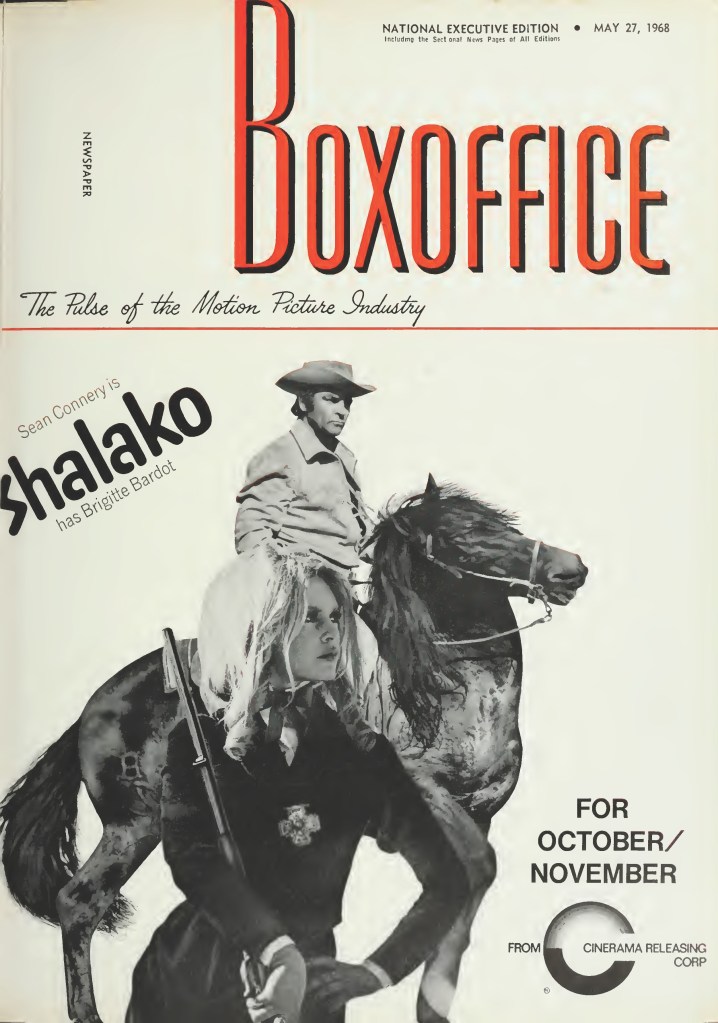
Shalako (1968) ***

It’s a gripping and unusual opening. The jangling noise of metal beating upon metal. A trapped mountain lion surrounded by a posse of unkempt men. The beast driven into a killing zone. The camera ends up on a classy blonde in a top hat, Irina (Brigitte Bardot), drawing a bead on the animal. But as she shoots so does rugged cowboy Bosky (Stephen Boyd) and you can be sure his aim is more deadly. It wouldn’t do to have an upper-class European lady to be mauled to death by a vicious creature just because her ego got the better of her.

Except that’s not the opening. Instead, that’s sacrificed for a dumb theme tune and a few minutes over the credits watching titular hero Shalako (Sean Connery) doing what exactly? Nothing exciting that for sure. We see him riding I guess to prove he can sit as tall in the saddle as the stars of the genre like Alan Ladd, John Wayne, Gary Cooper, James Stewart, as if nobody expected James Bond to be able to complete such a transition. There’s a bit of waking up, more riding, drinking from a dirty stream, and more riding while composer Jim Dale struggles to find lyrics that rhyme with Shalako.

There’s a bit more exposition before Shalako does anything meaningful. We are introduced to a fistful of Europeans on a hunting party complete with butler (Eric Sykes) and guzzling champagne and escorted by a bunch of mean-looking cowboys looking on in envy though I doubt any would acquire a taste for champagne.

Then the real action starts. A bit’s been missed out explaining just why Irina took off on her own with just one man as escort to continue hunting and nobody thought fit to warn her this was Apache country. We know she’s in trouble because her escort is just about dead and Apaches are gathering. Enter Shalako to save the day. The first piece of dialogue between the most handsome man in the world and the screen’s most beautiful woman, a movie made just so Connery, at his Bond peak, and Bardot, in her most expensive picture, could strike sparks off each other,  is hardly something to treasure. It’s almost priceless for its mundanity. “You all right?” grunts Shalako. “Yes,” replies the breathless heroine.

But trust the British to bring that epitome of British moviemaking, the class war, to that most democratic of movie species, the western. It’s ironic that in the country where freedom is a given  – slavery long since abolished in the period this movie was set – members of the hunting party are fettered. Irina is little more than bait. You might as well have staked her out, hoping to snare German aristocrat von Hallstatt (Peter van Eyck). Marriage would cure the financial woes of her debt-ridden sister Lady Daggett (Honor Blackman) and husband Sir Charles (Jack Jawkins). Von Hallstatt doesn’t believe in making romantic overtures, it would be, like so many aristocratic marriages, a contract of convenience; he acquires beauty, she gets wealth.

To complicate matters Lady Daggett has a roving eye which has settled on Bosky, and to complicate matters even further, nobody should be firing rifles, even if only for sport, in Apache territory. It’s not long before the Apaches take umbrage and launch an attack. And it takes even less time for Bosky and his buddies to take off, leaving their charges poorly defended in a makeshift fort.

It takes way too long to sort out all these plot machinations and get to the meat of the story which is finding a way of putting Connery and Bardot together and when they are not the movie trundles along without much in the way of screen sparks. It could have done with an entirely different scenario. Something akin to Soldier Blue (1970) would have worked a treat, with roles reversed of course back to the traditional of experienced male tending the inexperienced female as they battle through enemy territory.

You needed to get this pair together – and quick – for the movie to find any steam at all. As it is, it’s somewhat laborious. While the action sequences are well done and Shalako scores in the western lore department, you wouldn’t have thought a mountaineering subplot could have produced so few thrills, its only purpose, plot-wise, to ensure that von Hallstatt acquires some credibility (he’s the mountaineer) and that the group can reach a plateau whose main attraction, as lovers of westerns will already be aware, is a pool where in the great Hollywood tradition a woman can disport herself half-naked. Shalako, in sneaking up on her, comes across like a bit of a peeping tom.

Sean Connery (The Hill, 1965) is convincing enough as a cowboy. He certainly doesn’t look out of place on a horse but it takes far too long for the expected romance to begin. Brigitte Bardot (Viva Maria!, 1965) is better than you might expect as a sharpshooter, but not quite in the fiery class of a Claudia Cardinale (The Professionals, 1966) or even Maureen O’Hara (The Rare Breed, 1965) and she’s not really given the dialog necessary to fully establish the independence of her character.

Director Edward Dmytryk (Mirage, 1965) does his best with an overly-complicated script and some cumbersome set-pieces and it would have worked far better if a few characters and reams of sub-plot had been chucked aside to bring the stars together quicker. While Connery does the riding and shooting well enough he lacks the grizzled lived-in face of his famed western predecessors and I get a sense of him trying too hard. And, as I said, it wouldn’t have taken much to pep up Bardot.

Having complained about the subsidiary characters, they are all well-drawn. Stephen Boyd (The Big Gamble, 1961) makes on helluva mean cowboy, Honor Blackman (Moment to Moment, 1966) is excellent as a predatory female. Aristocratic pair Peter van Eyck (Station Six Sahara, 1963) and Jack Hawkins (Masquerade, 1965) are the kind of actors who can denote fallen status with facial expression rather than requiring lumps of dialog. But Eric Sykes (The Plank, 1967) is really a British in-joke.

James Griffith and screenwriting partner Hal Hopper had previously worked on Russ Meyer epics like Lorna (1965). The original story came from  a novel by Louis L’Amour (Catlow, 1971).

Out-with his guise as James Bond, Connery – excepting Robin and Marian (1976) and Cuba (1979) – was not one of the screen’s great lovers so this would have been the perfect chance  to hone those particular credentials. But like the entire picture this was a missed opportunity. When the best scene is the brutal suffocation of Honor Blackman and not the two stars canoodling, you can see the target was missed by miles.

No Highway in the Sky / No Highway (1951) ****

Having just read the Nevil Shute novel on which this movie is based, I was keen to see how it transferred to the screen. It got off to a great start with the casting. James Stewart was several classes above the author’s  description of the main character, but Marlene Dietrich more than fitted the bill of the Hollywood star as a passenger in the early days of Transatlantic air travel.

Widowed aeronautics research engineer Dr Honey (James Stewart), accent explained by him being a Rhodes Scholar who stayed on in Britain, is so absent-minded that he tries to enter a neighbor’s house and when he gets angry in a discussion with a visitor to his own house puts on his hat and coat and decides to leave. He has discovered a potential flaw in a new range of British airplanes and is despatched by boss Dennis Scott (Jack Hawkins) to Canada to examine the remains of a crashed prototype, the accident previously ascribed to pilot error.

It was called “No Highway” in Britain as that was the title of the novel.

However, once on board, he discovers the plane is perilously close to the danger level of flying time his research indicated. In between frightening the life out of stewardess Marjorie (Glynis Johns) and star Monica (Marlene Dietrich) with his predictions of doom and instructing them where best to hide in the plane in the event of crash-landing in the ocean, he tries to get the pilot to turn back. When that fails, he inadvertently charms the life out of stewardess and star.

When the plane lands, even closer to the danger zone in terms of flying hours, and still no one listening to his concerns, he manages to render the plane unflyable. The aeroplane company refuses to fly him home, leaving him stranded. That provides enough time for Monica and then Marjorie to turn up unannounced at his home in England to help look after his young daughter Elspeth (Janette Scott). When Honey finally returns, he faces an inquiry, and looks set to lose his job, virtually unemployable thanks to his antics in Canada. At the last minute, he is reprieved, fresh evidence from the crashed plane proving his research correct.

Meanwhile, Monica, forced to return to Hollywood, loses out in the battle for Honey’s affections. Marjorie, a former nurse and imminently more practical, is in any case better placed to help look after a growing girl, and eventually Honey sees sense and asks her to marry him.

Really well done with terrific performances all around, but vastly helped by the screenwriters who dumped three sub-plots in order to stick to the knitting of the tale. Honey, far removed from the man in the street persona that saw James Stewart through his Frank Capra movies, attracted female interest through his principled stand. Most importantly, the writers removed the section where Elspeth is seriously ill in her father’s absence. Secondly, in the book Scott was sent to Canada to find the crashed plane, involving a trek through perilous terrain, but that’s been excised, the search completed off-screen by others, the vital information relayed by letter. Thirdly, the remains of the tail, which had previously not been found, were located in the book by supernatural means, Elspeth being called upon to use a planchette to help find it.

In removing all this material, the movie is re-shaped partly as a Capra movie, with the downtrodden Honey achieving success through persistence, but, more importantly, allowing the movie to focus on the potential love interest. Needless to say that is determinedly old-fashioned, both women having forged successful careers now viewing work that was initially exciting rapidly pall. The book sets Monica thinking how much better life would have been if as a humble office girl she had married the kind but not handsome man who had caught her eye instead of now being thrice-divorced. Marjorie is even more old-fashioned, seeing a genius who needs looked after as much as his daughter requires a mother.

So there’s no point going anywhere near this if you’re not willing to accept a past where a woman’s role was primarily seen as a home-maker. But don’t jump to pointing the finger at the author as being equally old-fashioned because a later book, A Town Like Alice, not only turns the main character into a war hero but depicts her as a successful entrepreneur.

James Stewart (The Rare Breed, 1965) takes a considerable chance on playing the absent-minded professor but his endless well of screen charm allows him to pull it off brilliantly. Marlene Dietrich, top-billed when teamed with Stewart for Destry Rides Again (1939), has an excellent role as a rueful prima donna. Glynis Johns (Lock Up your Daughters!, 1969) is equally at home with a part that calls for her not to just fall at Honey’s feet. She was one of handful of British rising stars. Jack Hawkins (Masquerade, 1965) was on the cusp of being named Britain’s biggest box office attraction while Kenneth More (The Comedy Man, 1964) was a few years away from receiving that honor. Janette Scott (Day of the Triffids, 1963) gave notice of her talent.

As much as James Stewart’s career was linked to Frank Capra and Alfred Hitchcock, Henry Koster (Mr Hobbs Takes a Vacation, 1962) made five pictures with the actor, all excepting this comedies, including Harvey (1950). He does a fine job of keeping Stewart from spinning away too much in the direction of the geek professor and keeping the story pinned down.

Nevil Shute was an engineer to trade – he had worked in the British airship industry – so his books tend to be peppered with the scientific. That’s easy to digest when reading, but harder to absorb when watching a movie. R.C. Sheriff (The Dam Busters, 1955) and Oscar Millard (Angel Face, 1952) do an excellent job of condensing the novel, finding cinematic ways of getting across important material.

I had come at this, as I said, mainly to see how the author’s work was translated to the screen, but came away totally absorbed in a fine picture. What was left out helped the picture while the author’s later A Town Like Alice (1956) lost half its power by ending halfway through the original story which later saw the courageous heroine go onto to become a serial entrepreneur in a male-dominated society in Australia.

Obviously, I’ve deviated from my chosen field of 1960s pictures, but this is well worth a watch.

You can catch it on YouTube in a number of versions – the original, a colorized version, one with English subtitles and one where a musician has made his own edit and dubbed his own modern score on the picture.

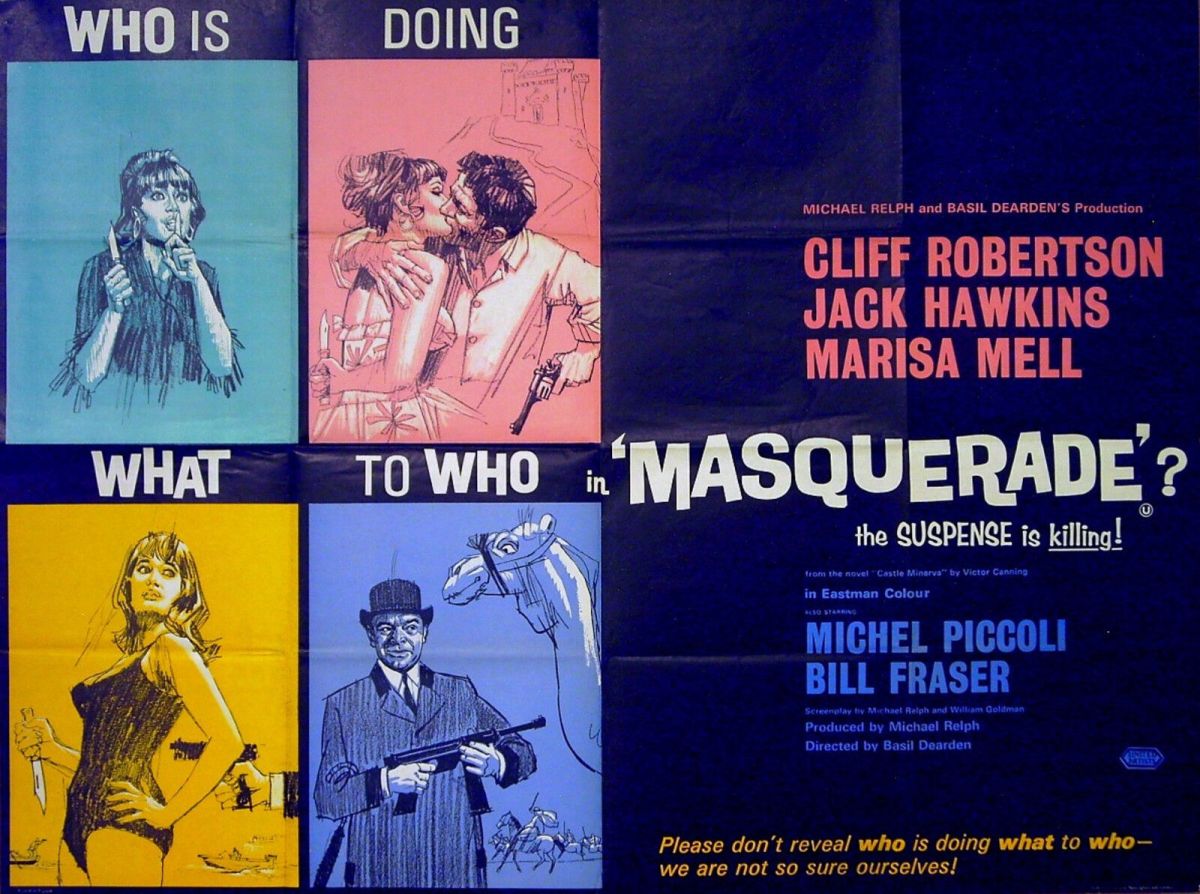
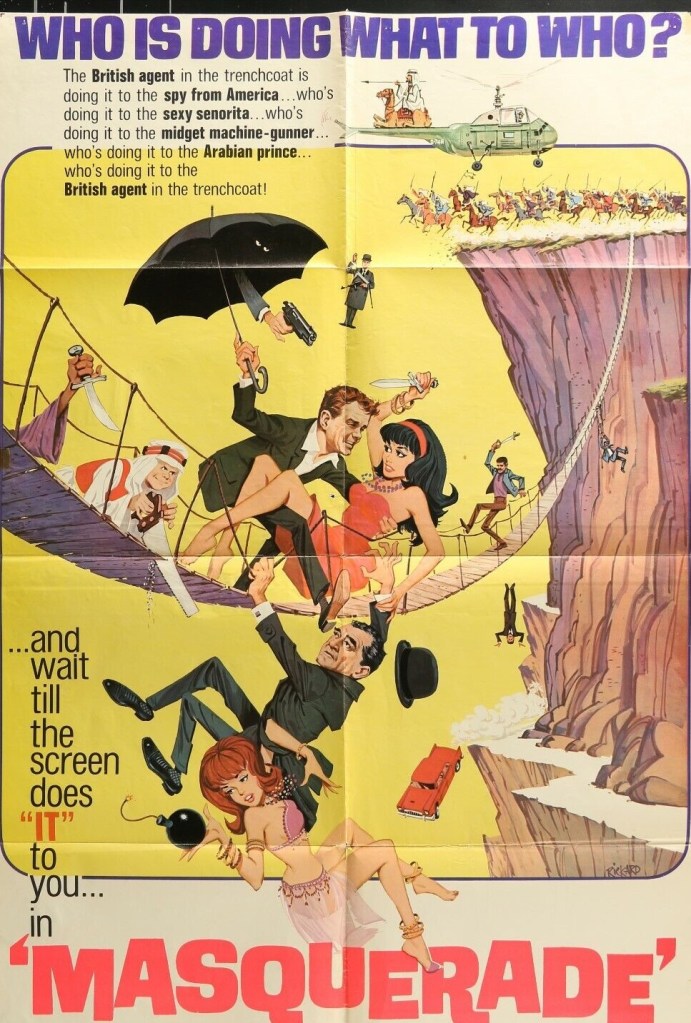
Masquerade (1965) ***

Made just before director Basil Dearden embarked on Khartoum (1965), this is probably best-known these days for being screenwriter – and ace self-publicist – William Goldman’s first credit. It’s based on Castle Minerva by Victor Canning whose previous filmed books included The Golden Salamander (1950) with Trevor Howard, The Venetian Bird (1952)  with Richard Todd, and The House of the Seven Hawks (1959) with Robert Taylor.

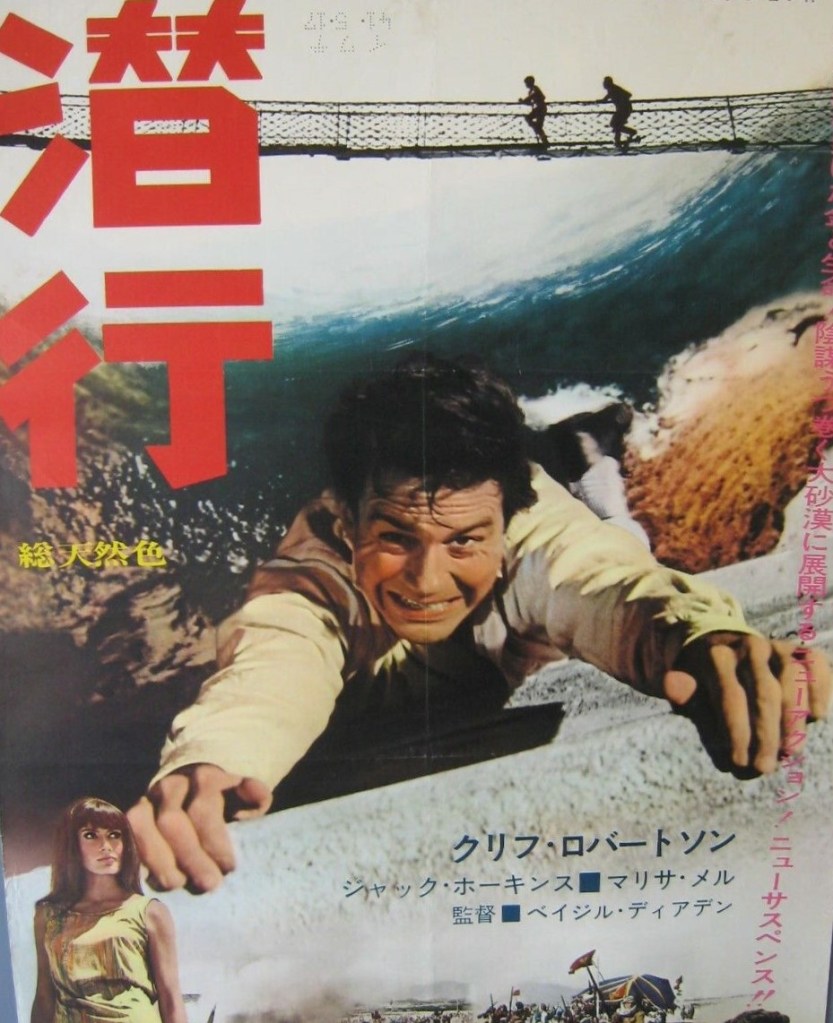
I’d like to say this is a self-aware thriller with spy and comedic elements but it veers awful close to either a cult film or a mess. Basic story has Frazer (Cliff Robertson) hired by former wartime commander and now British intelligence agent Col Drexel (Jack Hawkins) to look after an Arab princeling who has been kidnapped by the British (so much for Brits always being on the side of the angels) to help seal an oil concession in the Gulf.

Theoretically, the kidnapping is for the teenager’s own good, to prevent him being assassinated before he ascends to the throne…see it’s getting awfully complicated already. Anyway, it turns out he actually has been kidnapped by Drexel who has turned rogue in order to fund his retirement. The boy is held in some kind of fortress/castle in Spain and then another more sinister one.

Frazer meantime falls for the seductive charms of Sophie (Marisa Mell) who he thinks is a smuggler intent on stealing his boat but a) is part of the kidnap gang and b) in love with him enough to help him escape when he in turn is captured.

Did I mention the film also included a circus, a clown act, a gunfight on a dam, characters left dangling on a rope bridge, a lady in red, a balancing act along a perilous ledge, entrapment in a wine tanker (huh?) and an animal cage (double huh?), a vulture, men in bowler hats…

It is enlivened by visual gags – ultra-large footprints (from somebody wearing flippers). The dialogue sparkles as when the prince, with an overactive entitlement gland, says, “I am practically divine,” to which Hawkins deadpans “Your Highness, you are irresistible.” Add to that various cliché-twisting scenes – the double-dealing Sophie now overcome by love, says to Drexel: “Ask me anything you want and I will tell you the truth,” but every question he asks solicits the response, “I don’t know.” Then, imprisoned in a cage, after protracted cobbling together of lengths of bamboo to steal keys they turn out to be the wrong keys.

Throw in: British propriety  – Frazer’s  substantial fee for risking his life is reduced to a miserable sum once tax has been deducted; and a superb Arab charge on horseback with tracking cameras, either a rehearsal for Khartoum or the scene that got Dearden the gig.

Actually, the more I write about it the more fun it sounds and I wish it were, but it does not quite gel. Cliff Robertson (The Devil’s Brigade, 1968) and Marisa Mell (Danger: Diabolik, 1968) don’t convince – Robertson talks through gritted teeth without suggesting he has much inner grit – although Jack Hawkins (The Third Secret, 1964) and other British stalwarts like Charles Gray (The Devil Rides Out, 1968) and Bill Fraser (The Best House in London, 1969) and Frenchman Michel Piccoli (Danger: Diabolik) deliver the goods. It should have been a straightforward three-star job or – if qualifying as a cult – in the five-star class. It is definitely not an outright stinker. Perhaps best filed under “curiosity.”

Behind the Scenes: “Lawrence of Arabia” (1962) – 60th Anniversary

As unlikely as it sounds, John Wayne was once the leading contender to play Lawrence of Arabia. On January 14, 1953, the trade newspaper Variety reported that Cinerama, only known at the time for travelogs, was planning to move into feature filmmaking with productions of the hit Broadway musical Paint Your Wagon and Lawrence of Arabia, the latter with Wayne in the frame. Cinerama, as discussed in a previous Blog, was the sensation of the 1950s, the saviour of a movie industry eroded by television, prompting the boom in big-budget widescreen movies that were the hallmark of the next two decades.

It was a three-screen process, which meant filming with three cameras, somewhat unwieldy for working with actors. But This Is Cinerama, its first film, was the top earning film of 1952, even though it only played in a handful of cinemas. The driving force behind the idea was assistant board chairman Lowell Thomas, who, more than 30 years before, had single-handedly created the legend of Lawrence of Arabia.

Thomas had been a journalist covering the Middle East during the First World War. He had photographed the triumphant entry into Jerusalem in 1918 of the British forces led by General Allenby. The following year Thomas spun this event into a lecture that was launched in August in London to sensational results. Originally it was entitled ‘With Allenby in Palestine’, but after sensing the public was more interested in the unknown T E Lawrence, who he had photographed in Arab headdress, he changed the name to ‘With Allenby in Palestine and With Lawrence in Arabia’.

The show was so successful that when it came to the end of its run at the Covent Garden theatre, the owners offered 70% of the box office receipts to keep it on. Eventually, over five million people in Britain and the United States paid to see the lecture. And the Lawrence of Arabia industry was born. Thomas turned his lecture into a book which appeared in 1924 followed three years later by A Boy’s Life of Colonel Lawrence. Lawrence himself contributed to the legend with the publication of The Seven Pillars Of Wisdom (1926) and a shortened, easier-to-read, version called Revolt In The Desert (1926). Various best-selling biographies followed including Lawrence Of The Arabs (1928) by Robert Graves (Goodbye To All That), two tomes by military historian Capt Basil Liddell Hart, T E Lawrence: In Arabia And After (1934) and Colonel Lawrence, The Man Behind The Legend (1934) and Reginald H Kiernan’s Lawrence of Arabia (1935).

The first film on the subject was announced in 1929 by director Sydney Olcott for Supremacy Films, but the project came to nothing. In 1933 there was a US four-part serial by Jock Lawrence (no relation) called Flying Lawrence In Arabia, based on the exploits of Lawrence’s pilot during the war, Capt John H Norton. Two full-length feature films were announced the same year. First out of the gate was The Uncrowned King from RKO to feature top Hollywood star John Barrymore. Director Ernest Schoendanck spent several months in Mesopotamia shooting background material and by the time he returned the film had a new name, Fugitive From Glory.

In Britain movie magnate Alexander Korda’s London Films put Lawrence Of Arabia into production with Walter Hudd in the lead. Korda had acquired the rights to the biographies by Graves, Liddell Hart and Kiernan as well as Revolt In The Desert and an agreement from Lawrence’s trustees to use incidents from The Seven Pillars of Wisdom. After seeing British actor Walter Hudd in the George Bernard Shaw play The Apple Cart, Lawrence had declared Hudd was his personal choice for the part. But Korda agreed to delay production until after Lawrence’s death.

That came sooner than anyone expected, in a motorcycle accident in 1935 and generated such enormous public demand in the adventurer that publisher Doubleday Doran printed a limited edition of only a dozen copies of Lawrence’s last unpublished 76,000-word book The Mint for sale at an astonishing $500,000 each. U.S. producer Sherman S. Krellberg planned a serial based on Lawrence and a play was written by Mary K. Brookes. Korda moved quickly, getting financial backing from the Bank of America, acquiring the rights to the Thomas book and taking on the author as a technical adviser. The film was to be directed by Korda’s brother, Zoltan, who spent months in Jerusalem scouting locations, with a $400,000 budget. It was going to be momentous for another reason – it was planned as the first British film in color. In preparation, Korda sent to Hollywood for 8,000 items of color make-up and Natalie Kalmus of Technicolor was dispatched from the U.S. to supervise the process.  

But it took another two years before Korda received the go-ahead from the UK government to film in Palestine, where there was political unrest. In the meantime, the first British color film had been released, Wings Of The Morning starring Henry Fonda. Hudd had been replaced by movie star Leslie Howard and Zoltan by U.S. director William K. Howard and the film was now being produced for Paramount. By then The Uncrowned King, produced now by Transamerica, had reached the screen, but only as a 10-part serial starring Lionel Atwill and with a 16-voice choir instead of an orchestra supplying the music. More importantly, the delay also allowed other U.S. studios to catch up.

Twentieth Century Fox dispatched director Otto Brower to Britain to begin a rival production and MGM was planning a film to star either Clark Gable or Paul Muni. In the end a Fox subsidiary New World became involved in the Korda film, but the project was called off after, it was rumored, severe government pressure. In 1938, the situation changed again. The sensation of the year was a claim by an Egyptian woman Nour Dahabi in Cairo to have found 3,500ft of film showing Lawrence on maneuvers in Arabia.  MGM teamed up with Gaumont-British. And it was all change for Korda. His Paramount deal hit the rocks and he switched to United Artists, returned later in the year to the original studio, only to go back to UA who promised an increased budget. But, of course, in 1939 the beginning of the Second World War scuppered everyone’s plans.

After the war. Korda’s rights to Revolt In The Desert lapsed and he did not renew them. The American studios also gave up. John Sutro, who had helped found London Films, took over and, resurrected the project in 1947 at Rank under the banner of his Ortus Films. Although Rank was the biggest film company in Britain, involved in film production and exhibition, the film languished in development hell until 1953 when Cinerama appeared on the scene. Lowell Thomas had been instrumental in setting up the company in conjunction with Michael Todd. Thomas was the public face of the process and when projectors broke down in the middle of a Cinerama film, a short starring Thomas would fill the screen until the problem was solved.

But, as ever, the minute one company announced a Lawrence project, more popped up. David Rose claimed he was close to concluding a deal for the rights to Revolt In The Desert. British-based Anatole De Grunwald had a script by top British playwright Terence Rattigan who had written David Lean’s The Sound Barrier (1951).  

In 1953 De Grunwald did a deal with Paramount who wanted Gary Cooper or Gregory Peck, who bore a likeness to Lawrence, in the lead, while De Grunwald pressed for Richard Burton. In the end the John Wayne project was shelved.  By 1956 De Grunwald had approached American director King Vidor, and the film was due to roll in March 1957 but Vidor pulled out, Rank re-entered the equation, investing £2 million in a De Grunwald production with Anthony Asquith as directing Dirk Bogarde. In April 1958, Rank pulled the plug. Re-enter Twentieth Century Fox with Mark Robson helming.

But in July 1959 Columbia made a deal with Sam Spiegel and David Lean who had turned  Bridge On The River Kwai (1957)  into the studio’s biggest hit. Meanwhile, Rattigan had turned his screenplay into the play Ross with Alec Guinness in the title role. Spiegel targeted Marlon Brando for Lawrence with a start date of summer 1960.

Spiegel had hired blacklisted screenwriter Michael Wilson, incurring the wrath of Columbia. Lean hired playwright Robert Bolt (A Man For All Seasons) to rewrite it.  Meanwhile, Rank announced it had Alec Guinness for the lead.  

In July 1960 Brando pulled out. While Spiegel scoured Hollywood for a replacement, British producer Herbert Wilcox spent $364,000 on the rights to Ross with Laurence Harvey (Butterfield 8, 1960) to star. Lean went after British actor Albert Finney (Saturday Night And Sunday Morning, 1960) but the actor baulked at a long-term contract.  His replacement was unknown Irishman peter O’Toole.  Just as unknown, Omar Sharif was fifth choice for the pivotal role of Sherif Ali.

Filming was delayed until April 1961.  Oscar-winner Alec Guinness, albeit in a supporting role, was crucial to bring cachet to the picture. The presence of two other Oscar winners, Jose Ferrer and Anthony Quinn, bolstered the marquee.

Finally, filming got underway in May in Jordan, despite an incomplete script. But conditions were horrific. Swarms of locusts hampered transport, temperatures hit 116 degrees Fahrenheit,  the nearest water was 150 miles away. After a break, filming resumed in Spain on December 15 but Seville, chosen for its distinctive Arabian heritage, had just suffered the worst floods in a century, delaying production. The final location was Morocco and in July 1962 four planes flew 104 cast and crew there. Conditions there were as bad as in Jordan. After a few weeks in England, filming on the 313-day schedule ended on September 21, 1962. But with the world premiere set for December 10, it was panic all the way, especially after original composer Richard Rodgers of South Pacific fame quit.

Worse, ticket sales for the roadshow were poor, in part caused by the absence of a female in the cast. By mid-October sales for the U.S. opening stood at a paltry $11,424, compared to an advance of $700,000 for Exodus and $500,000 for How the West Was Won.

 The world premiere of Lawrence Of Arabia took place in front of Her Majesty the Queen on December 10 at the flagship Odeon Leicester Square in London’s West End. The American premiere occurred on December 16 at The Criterion in New York.

But the public and the critics responded. On its first Saturday in London with only two performances, it set a new one-day record of $7,200. The Criterion’s opening week in New York was $46,000 which Variety described as ‘little short of amazing.’ The film was edited shortly after  launch, the original prints cut by 20 minutes.

In the end it was both a box office and critical powerhouse, winning seven Oscars including Best Picture and Best Director, making stars out of O’Toole and Sharif, and for the past 60 years being acclaimed as one of the greatest films ever made.

Discover WordPress

A daily selection of the best content published on WordPress, collected for you by humans who love to read.

The Atavist Magazine

by Brian Hannan

WordPress.com News

The latest news on WordPress.com and the WordPress community.