The Innocents (1961) ***

One description of this film’s prequel The Nightcomers (1972) was that, even with the overt sex and violence, it was an arthouse picture masquerading as a horror movie. And obviously absent the sex and violence that’s how I feel about this one. I’m of the old-fashioned school when it comes to horror – once in a while I expect to jump. The biggest problem here is that fear is telegraphed in the face of governess Miss Giddens (Deborah Kerr). Instead of the audience being allowed to register terror, all the tension is sapped away by one look of her terrified face.

Atmospheric? Yes! Scary? No.

Certainly, the set-up is likely to spark the darkest imaginations. Orphans Miles (Martin Stephens) and Flora (Pamela Franklin) are abandoned by their uncle (Michael Redgrave) who wants to spent his time enjoying himself in faraway London without having to bother about the care of the minors. The governesses he installs are given carte blanche to deal with any situation that arises – as long as they don’t concern him with it. And he’s so disinterested in the children’s welfare that he hires a completely inexperienced governess in Miss Giddens despite the fact that the previous occupant of the post, Miss Jessel, had died in mysterious circumstances and a little digging would have revealed that she lived a hellish life under the thumb of valet Quint.

The kids appear somewhat telepathetic or telekinetic – Flora knows Miles is coming home before Miss Giddens does, Miles knows when the governess is standing outside his door. They’re maybe a too bit self-indulgent – Flora enjoys watching a spider munch on a butterfly and isn’t above finding out if her pet tortoise can swim, while Miles has Miss Giddens in a neck stranglehold.

But it’s unlikely the children are summoning ghosts – Quint appears to Miss Giddens at the top of a tower and again peering in through a window, Miss Jessel turns up, too, and I lost count of the number of disembodied voices. The ghosts it turns out have taken possession of the children in order to continue their relationship.

And while this is all very clever it does not chill you to the bone. The children are not as cute as they need to be to make this work. You get the impression, given half the chance, they would happily turn into little savages and experiment with all manner of cruelty. And that would occur whether there was the likes of Quint around to lead them astray because the adults in their lives are so selfish and set the wrong kinds of standards. But with the focus perennially on the trembling Miss Giddens, there’s little chance of getting inside the heads of the children.

Since jump scares are not in director Jack Clayton’s cinematic vocabulary, the best scenes are not visual, but verbal, housekeeper Mrs Grose (Meg Jenkins) filling the governess in on the unequal relationship between Quint and Miss Jessel, Flora imagining rooms getting bigger in the darkness (effectively more dark), Miles seeing a hand at the bottom of the lake.

There’s certainly an elegiac tone and the camera clearly sets out to destabilise the audience but that’s just so obvious it seems more an arthouse ploy than a horror schematic.

This was start of Deborah Kerr (Prudence and the Pill,1968) playing psychologically distorted characters. Over the previous decade she had revelled in a screen persona that saw her playing the female lead (sometimes the top-billed star) opposite the biggest male marquee names of the era – Burt Lancaster (twice), Cary Grant (twice), Yul Brynner (twice), Gregory Peck, William Holden, Robert Mitchum (three times), David Niven (twice), Gary Cooper. Now she turned fragile and that screen persona, introduced here, would see her through the next decade.

So she’s both very good and very bad here. Her character facially registers her inner thoughts but those too often get in the way of the audience. I found the kids more limited in their roles, not through acting inexperience, but through narrative restriction.

Jack Clayton (Dark of the Sun, 1968) directs from a screenplay by Truman Capote (In Cold Blood, 1967) and William Archibald (I Confess, 1953) from the celebrated Henry James story.

A bit too artificial for my taste. Probably heresy to admit it but I preferred the prequel.
Our Mother’s House (1967) ***

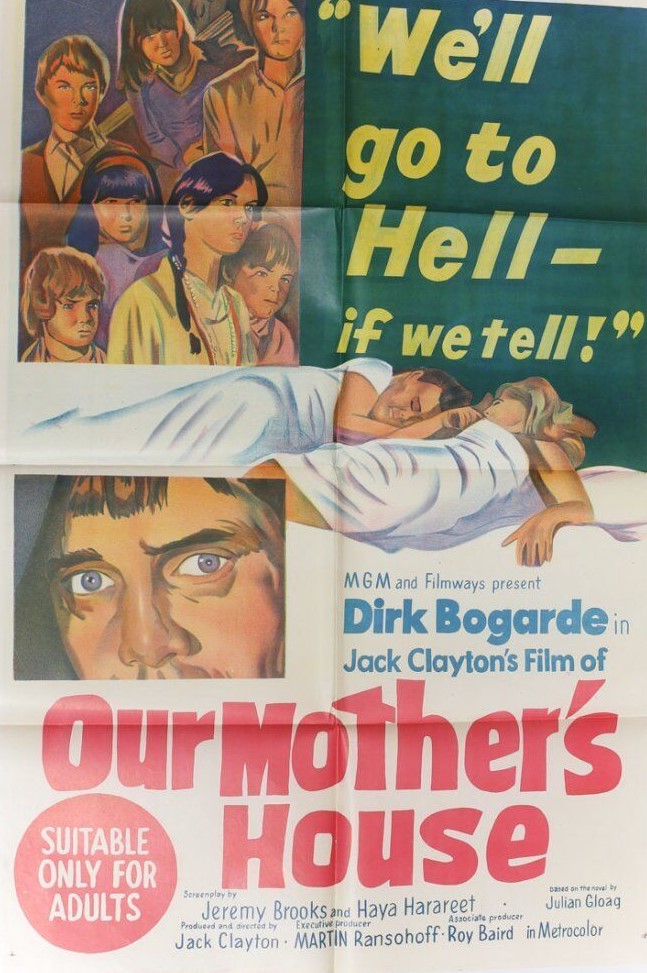
Lord of the Flies set in a sprawling London Victorian mansion. At its best when kids give rein to vivid imagination, not so strong when melodrama intrudes.

After the death of her invalid mother and dreading being sent to an orphanage, eldest child Elsa (Margaret Brooks), who has been with the help of a maid running the house anyway, determines that she and the rest of the brood will pretend their mother is still alive. They bury the body in the garden, manage financially after Jimimee (Mark Lester) discovers an aptitude for forging their mother’s signature on the monthly cheques she receives from a trust fund, and hold séances in the shed to commune with the deceased one.

To maintain the pretence, they get rid of the nosey and querulous maid Mrs Quayle (Yootha Joyce) and come up with all sorts of reasons to explain their mother’s absence to school teachers and neighbors. Child fears run rampant as they visualize the terrible lives they would lead in an orphanage. But the generally tolerant community lifestyle is disturbed by the dictatorial rule of Elsa, determining that Gerty (Sarah Nicholls), for example, must have her long hair sheared off for innocently breaking a house rule and, in keeping with their mother’s fundamentalist beliefs, refuses to call a doctor when the girl falls ill. But the séance takes on a creepier aspect, Elsa the one in communion with her mother and therefore using the supposed other-worldy presence to enforce her will.

So far, so Lord of the Flies, and excellent in its depiction of a world ruled by children according to their fears and beliefs and without adult intercession. But it loses its grip when melodrama takes hold.

Their mother’s dissolute husband Charlie (Dirk Bogarde) returns, romancing Mrs Quayle, and, initially, spoiling the children, who are delighted to see him. He soon reverts to form, spending all their money, getting Charlie to forge his mother’s signature on the house deeds, planning to pocket the proceeds and dispatch the kids to an orphanage. Worse, he breaks the spell their seemingly devout mother had over their children, informing them that their mother’s conversion to religion only came after a life of debauchery and that, in fact, every single one of them is illegitimate and not his offspring. That’s too much for Diana (Pamela Franklin) who kills him with a poker.

Too many twists for sure and by diverting a fascinating dissertation of childhood into adult melodrama robs the film of much of its power.

Director Jack Clayton had been here before with The Innocents (1961) but, there, less was spelled out. Dirk Bogarde (Justine, 1969) is surprisingly good as the charming rough layabout with an eye to the main chance but it’s the children who captivate especially Pamela Franklin (And Soon the Darkness, 1970) and Mark Lester (Oliver!, 1968). The children’s innocence in any case would have been despoiled as they challenged Elsa’s rule and it would have been more satisfying to go down that route.

It was based on the bestseller by Julian Gloag and for anyone wondering what happened to Haya Harareet (Ben-Hur, 1959, and The Secret Partner, 1961) she married Clayton and is credited with the screenplay of this along with Jeremy Brooks.

Slow-burn that trips the wrong way.

The Pumpkin Eater (1964) ***

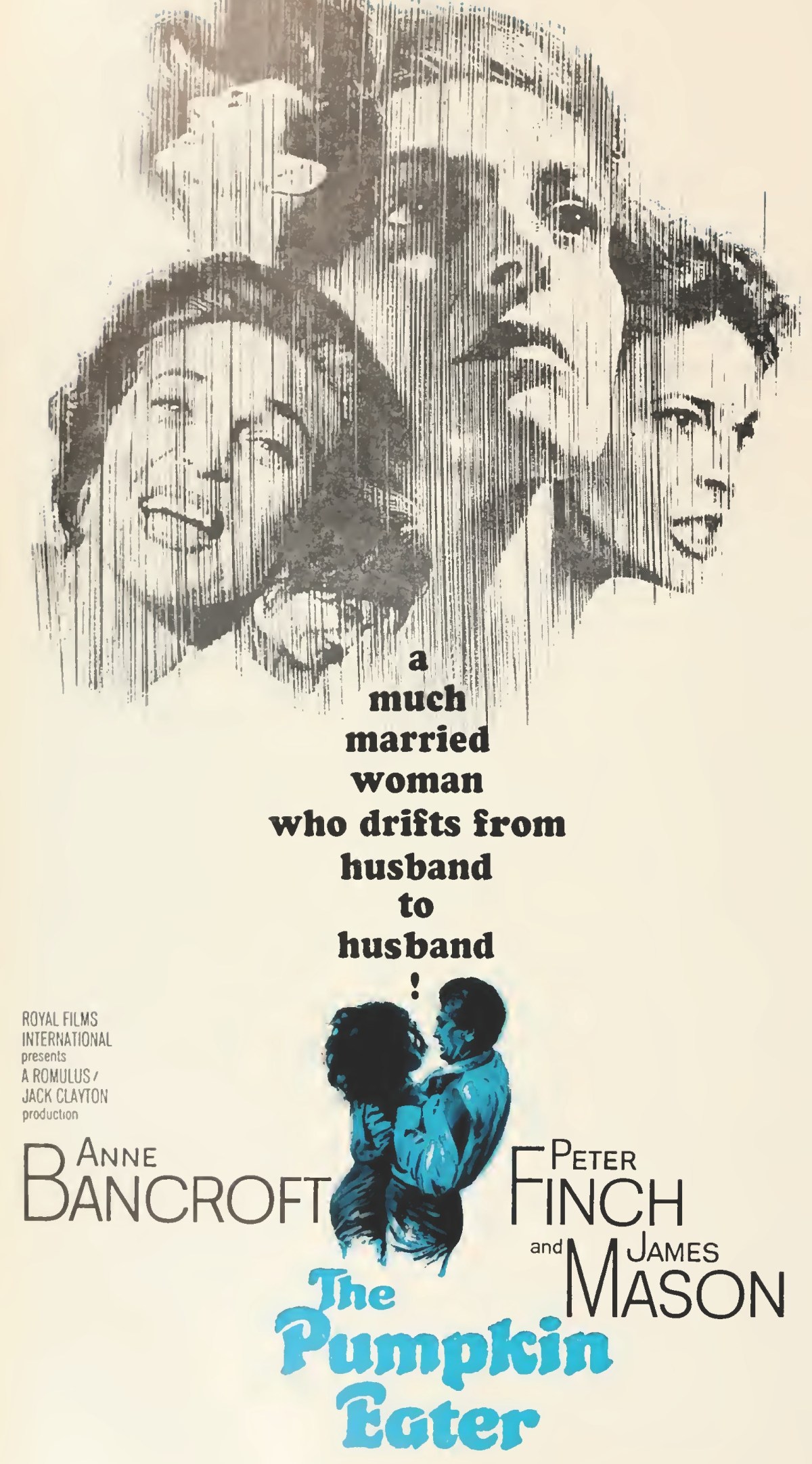
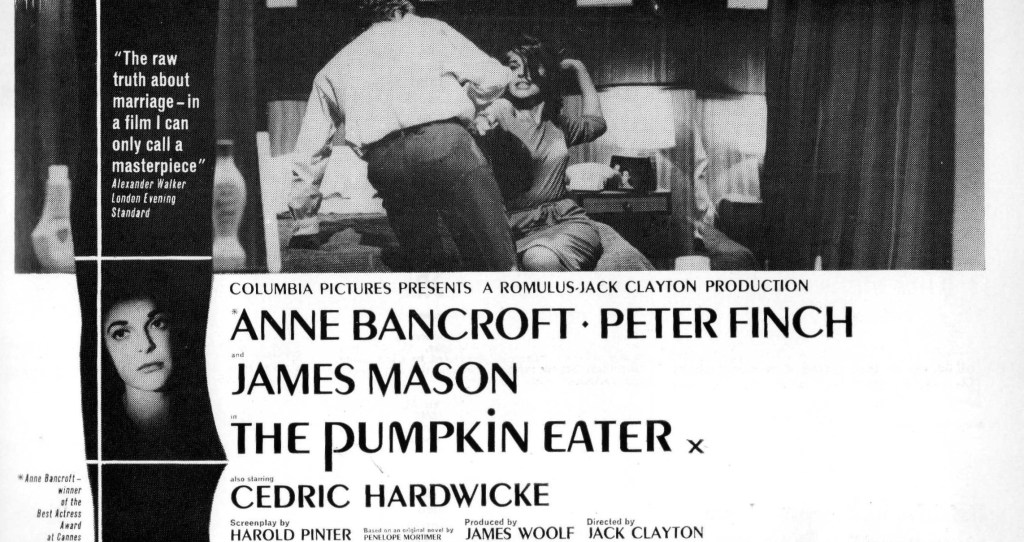
The reference point for Anne Bancroft in the 1960s is usually her cynical Mrs Robinson in The Graduate (1967) but she was Oscar-nominated here for a less ostentatious role as a woman who finds pregnancy – she has five kids by two husbands – almost a state of grace. Denied that role as a birth mother – husband number three (Peter Finch) wants an abortion – sees her tumble into depression.

This is more a character study than anything else and despite a whole bunch of marital confrontation, clever dialog from screenwriter Harold Pinter and some artistic black-and-white cinematography, it would have benefitted greatly from Bancroft actually explaining what ails her rather than everyone around her putting the words in her mouth. Hitchcock used to employ a subsidiary character to spell out the dangers of consequences for the leading actor, but that worked well in a thriller, and less so in a drama where you are desperate to get inside the mind of a woman who shows every signs of being neurotic.

While the unstated worked exceptionally well in director Jack Clayton’s previous picture The Innocents (1961), we really here need much more clarity. It is certainly richly atmospheric in places and the sequence prior to her nervous breakdown in Harrods where without dialog the camera shows her wandering around is very well done. But spending too much time on a self-obsessed person is less appealing.

Story has Finch (The Trials of Oscar Wilde, 1960) destroying her confidence by his philandering (although she dumped her previous husband for Finch) – but it is left to the woman (Yootha Joyce) setting next to her in the hairdresser to express the feeling that a woman needs to be desired by her husband and for a psychiatrist (Eric Porter) to suggest that for her “sex is sanctified by incessant reproduction.” To neither assessment does she respond. She clearly has a happy boisterous family, one to which Finch fits in, children lining up to wave him goodbye and rushing to greet his return.

Finch is on top form as the arrogant, competitive husband with Maggie Smith, delightfully kookie, among the notches on his bedpost. James Mason has a small role as a cuckold and Richard Johnson as a discarded husband. Adapting from a novel by film critic Penelope Mortimer, Pinter provides some distinctive Pinteresque moments, and, beyond the marital disputes, while most of the story is played out at a distance, there are excellent moments of spite, not least Mason choosing to read to Bancroft a love letter from his wife to Finch. In some respects it is a raw look at marriage, but in many ways it ducks out of proper examination of the principals, his character revealed by action, hers rarely explicated.

One particular aspect of the story is glossed over, with no reaction from Bancroft, which seems implausible given her previous attitude. Abortion was still illegal in the 1960s but permission could be granted were pregnancy to jeopardize a patient’s mental health. But to endorse such a sanction also involved sterilization to prevent future occurrence. Since Bancroft offers no insight one way or the other you are left with the impression she welcomes this which would run entirely against the character we have known.

I’ve no idea why the picture did not start at a point where Bancroft initiated action, when she dumped husband number two for Finch. At that point she was responsible for making a decision and clearly some kind of illicit affair had been taking place first. Unlike, for example, The Pawnbroker in which the main character has the same defeated attitude we are given access to his tortured past and he is forced into confrontation with the present. But here passivity is an obstacle to understanding.

Setting aside all my reservations which I guess are primarily structural, it is an absorbing film and Bancroft certainly deserved the Oscar recognition. Finch and Mason are also on top form and it’s worth a look if only to see what Maggie Smith could do with a part before people (perhaps herself) decided her career should go in a different direction.

Discover WordPress

A daily selection of the best content published on WordPress, collected for you by humans who love to read.

The Atavist Magazine

by Brian Hannan

WordPress.com News

The latest news on WordPress.com and the WordPress community.