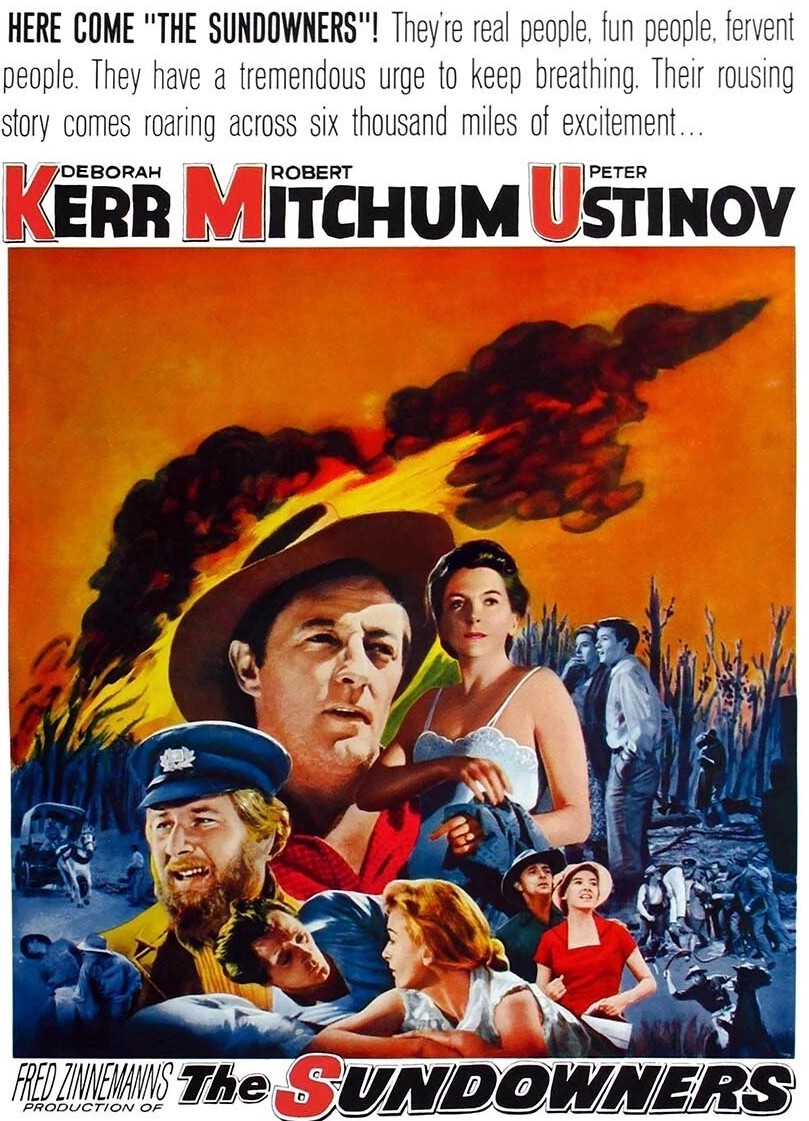
Whereas Deborah Kerr had always been first choice from the moment in 1957 Fred Zinnemann – he had directed her in From Here to Eternity (1953) – announced plans to film the Jon Cleary bestseller about itinerants in the Australian Outback, Robert Mitchum was third choice. Despite having been successfully paired with Kerr for John Huston’s box office hit Heaven Knows Mr. Allison (1957), he was passed over in favor of, initially, William Holden with whom she had starred in the equally successful The Proud and the Profane (1956). When Holden dropped out, he was immediately replaced by Gary Cooper who had scored a big success with William Wyler’s Oscar-nominated Friendly Persuasion (1956)
And rather than Peter Ustinov (Topkapi, 1964) and Glynis Johns (The Cabinet of Caligari, 1962) in the major supporting roles, Zinnemann had hoped to secure the services of Claudette Colbert and Errol Flynn, both of whom had once been substantial box office attractions, though Colbert had been offscreen since Texas Lady (1955) and Flynn’s marquee appeal was spotty to say the least, though he had just signed up John Huston’s Roots of Heaven (1958). That decision was taken out of Zinnemann’s hands by Flynn’s premature death in 1959.
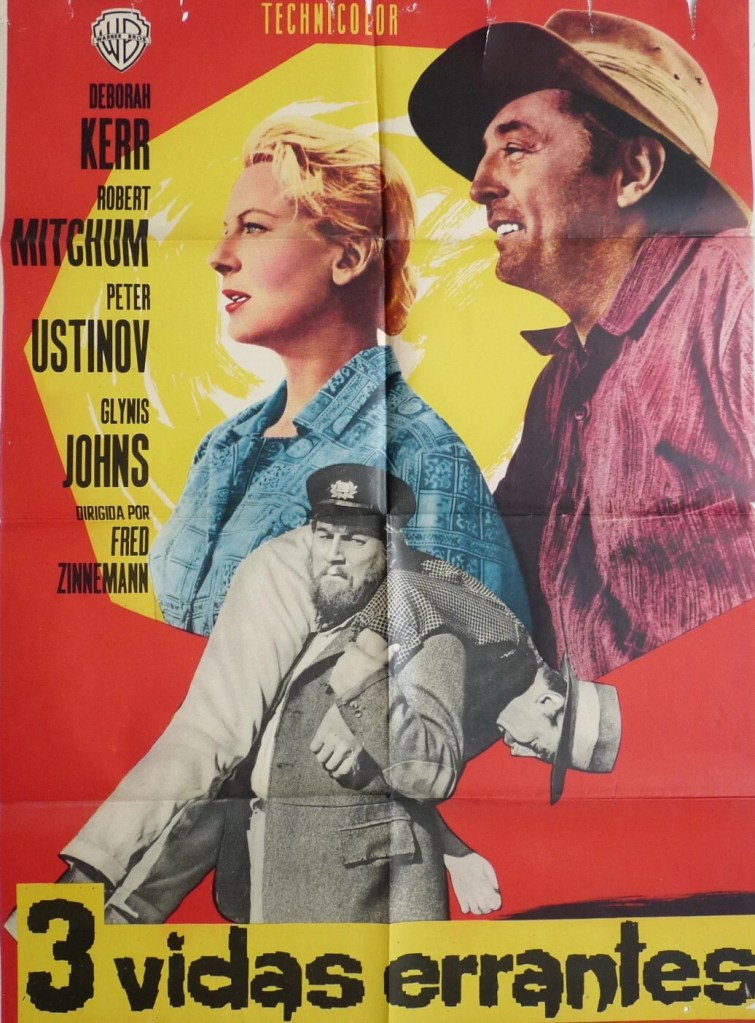
At this point Peter Ustinov was an all-purpose supporting actor and had not appeared in a major Hollywood production in six years but was just about to make a name for himself in Spartacus (1960) while Glynis Johns, at one time a major British star, had lost much of her marquee allure. Kerr and Johns had worked previously on Perfect Strangers (1945) and remained friends.
Nor was Zinnemann first to pounce on the tale. After the novel – based on the lives of the author’s parents – was published in 1952, rights were acquired by producer Joseph Kaufman who commissioned a screenplay from Kay Keavney. But when he failed to secure funding, Zinnemann scooped the rights after being persuaded by Tasmanian-born Dorothy Hammerstein, wife of the lyricist, that Australia would be a great location.
Screenplay duties then fell to Aaron Spelling (Guns of the Timberland, 1960), best known later as an uber-producer in television. After his draft was deemed “unsatisfactory,” he was replaced by Isobel Lennart (Please Don’t Eat the Daisies, 1960), though Zinnemann later claimed that her dialog was “not Australian enough” and author Jon Cleary (uncredited) was called in to solve “these problems.” .
Studio boss Jack Warner wanted Arizona to stand in for Australia but gave in to Zinnemann’s insistence on reality in part because the director had shot the successful The Nun’s Story (1959) in Africa, even though it added $500,000 to the budget. In fact, Warner gave in relatively easily. He understood that “were we to shoot in Arizona,” Zinnemann explained, “it would emerge as a half-assed Western with bars instead of pubs, cowboys instead of sheep-drovers – they move differently, walk and react differently.” It was the first major Hollywood film to be shot there.
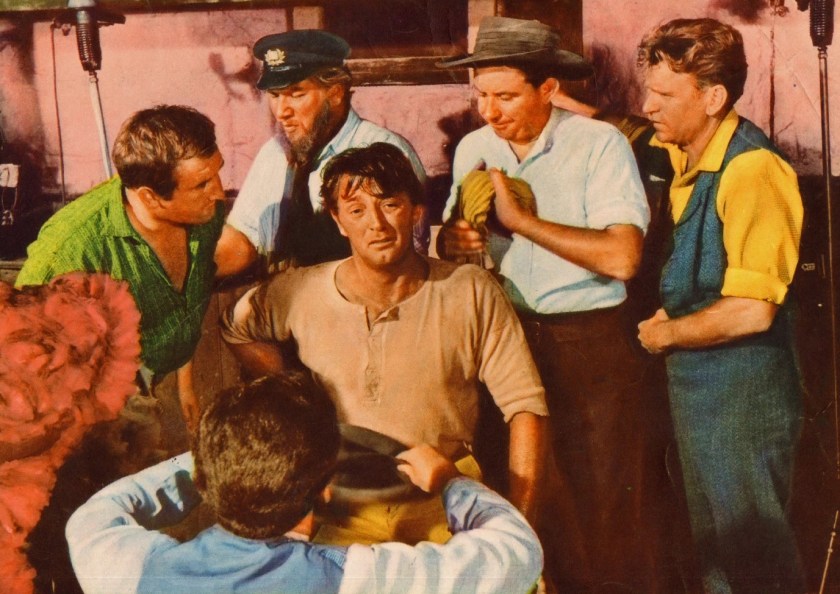
In the second half of 1959 the director spent 12 weeks in advance of the stars arriving filming scenery and most of the scenes involving the sheep – 2,000 of them transported 800 miles to the location. Rather than hiring them, Warner Brothers bought them wholesale and afterwards sold them for a profit. Despite their reputation for docility, sheep proved difficult to wrangle. A whole day was lost when the leader of the sheep just decided he would move no further and the entire flock did the same.
The crew was initially based in Cooma, a small town in New South Wales. Second unit camera operator Nicolas Roeg would return to Australia a decade later to director Walkabout (1971). The movie was hit by unseasonal bad weather – heavy rain and hailstones – which added several weeks to the schedule.
“There’s a good deal of Ida in me,” said Kerr, “I can settle anywhere and call it home.” Her second husband, screenwriter Peter Viertel (The Old Man and the Sea, 1958), made life more palatable by venturing out into the backs streets and finding German and Italian makers of foodstuffs and thereafter the stars took turns to cook for each other. “Bob Mitchum had a way with steaks,” noted Kerr, “but we all decided Peter was the best and most imaginative cook.”
It’s worth killing off the canard that Kerr only gained top-billing in this picture thanks to the generosity of Robert Mitchum. In fact, Kerr was by far the bigger star. She had been top-billed in Heaven Knows Mr. Allison ahead of Mitchum, The King and I (1956) ahead of Yul Brynner, Count Your Blessings (1959) ahead of Rosanna Brazzi, The Journey (1959) ahead of Brynner again, Bonjour Tristesse (1958) ahead of David Niven, Tea and Sympathy (1956) and The End of the Affair (1955) ahead of Van Johnson. She only ceded top billing to the likes of William Holden and Cary Grant (An Affair to Remember, 1957). Although many commentators these days assume that Elizabeth Taylor was the top British star of the decade, Kerr was easily her equal and outranked her – five versus two – in terms of Oscar nominations.
In fact, in terms of marquee appeal, Robert Mitchum could not compete with Kerr. Heaven Knows Mr. Allison was his biggest hit since River of No Return (1954) with Marilyn Monroe. The work with which he is most commonly associated, Night of the Hunter (1955), was a flop, and he was in the main reduced to a diet of westerns and war films.
He was more associated with the wrong sort of headlines than box office. His previous film The Night Fighters / A Terrible Beauty (1960) attracted more attention from journalists for his fight in a bar than from audiences. But Zinnemann was a fan and had tried to hire him for From Here to Eternity.
Mitchum’s notoriety went ahead of him and at the airport he was deluged by reporters, most determined to know, for such a renowned hard drinker, what he thought of Aussie beer. He crossed swords with journalists a few days later, complaining that he was misunderstood and nothing like his screen personality. “I’m no tough guy,” he argued, “all the public knows is some silver, chromium-plated jerk. How could they know what I’m really like?” When he pointed out that his marijuana bust had been expunged from the record, one frustrated newspaperman recorded, “He isn’t a jailbird, he isn’t a drunk, he isn’t a brawler.”
Mitchum had no trouble with cast and director. Zinnemann was astounded by the actor’s mastery of the accent, pronouncing it “perfect” and adding “he had the uncanny knack of making any accent sound as though he had been born with it.” Mitchum and Kerr renewed their non-sexual love affair. “It was an honor to feed her lines,” said Mitchum. Zinnemann summed him up, “He has a problem with people who take themselves too seriously.”
But Mitchum was hounded by fans and autograph hunters. An audience gathered to watch him eat in local restaurants, his mood not helped by the solitary confinement imposed when rain prevented filming. One journalist, having inveigled his way into Mitchum’s rented home, was astonished to discover the actor could cook. Jon Cleary sprung to his defense. “Robert Mitchum is anything but a droopy-eyed slob once you get to know him. He is extremely well read and writes beautiful poetry.
When it came to horses, Ustinov was the bigger problem. “He was scared of them and they of him,” said Zinnemann, “and the moment he got in the saddle he would forget all his lines.”
Shooting a bush fire was relatively straightforward since they were a “frequent and devastating occurrence”, so the second unit simply flew near to the area in question, hired a taxi and started shooting. But these fires, fueled by the eucalyptus trees they were burning, moved at terrific speed, jumping along the tops of trees “and scattering their burning fragments fast and wide like projectiles.” But if the fire suddenly switched direction – and it moved at 30 miles per hour – there was a danger, as once occurred, that the crew could be cut off.
When the unit headed for Port Augusta in the south, it was a 45-minute commute to the sheep station at Iron Knob where many scenes were shot. Mitchum had had enough of being an object of curiosity and chartered a luxury cruiser, although he was still fending off young ladies who took to swimming out to the boat.
There was little scenic in the journey to the location. “The dust flew along the whole road,” said co-star Dina Merrill, and Mitchum was taken aback by the size of the sheep and found daunting the task of shearing a 400lb Merino sheep in one go. One mistake and you could cut into a vein and the animal would bleed to death. Mitchum relied on Dutch courage. Interiors were filmed in the more hospitable atmosphere of a London studio. There was an unwelcome sting in the tail for Mitchum – he was sent a tax demand from the Australian authorities which he refused to pay.
Although Jack Warner had given his assent to the overseas shoot, he was incapable of directing the advertising department to produce a poster that didn’t focus on the notion that this was the frisky Deborah Kerr of From Here to Eternity, “a highly-sexed lady who could harldy wait for the sun to go down so she could lay her hands on Bob.” Audiences were naturally disappointed when the projected love affair failed to materialize.
While the critics were generally in favor of the movie and audiences in the U.S. big cities responded well, its attraction faded as it set out across the U.S. However, it did better abroad and not surprisingly was a massive hit in Australia. Mitchum and Kerr re-teamed for Stanley Donen comedy The Grass Is Greener (1960) – with Kerr again billed before Mitchum.
SOURCES: Eric Braun, Deborah Kerr (WH Allen, 1977) pp173-177; Lee Server, Robert Mitchum, Baby I Don’t Care (Faber & Faber, 2001) pp422-429; Fred Zinnemann, An Autobiography (Bloomsbury, 1992) pp173-183.


 The Magnificent 60s