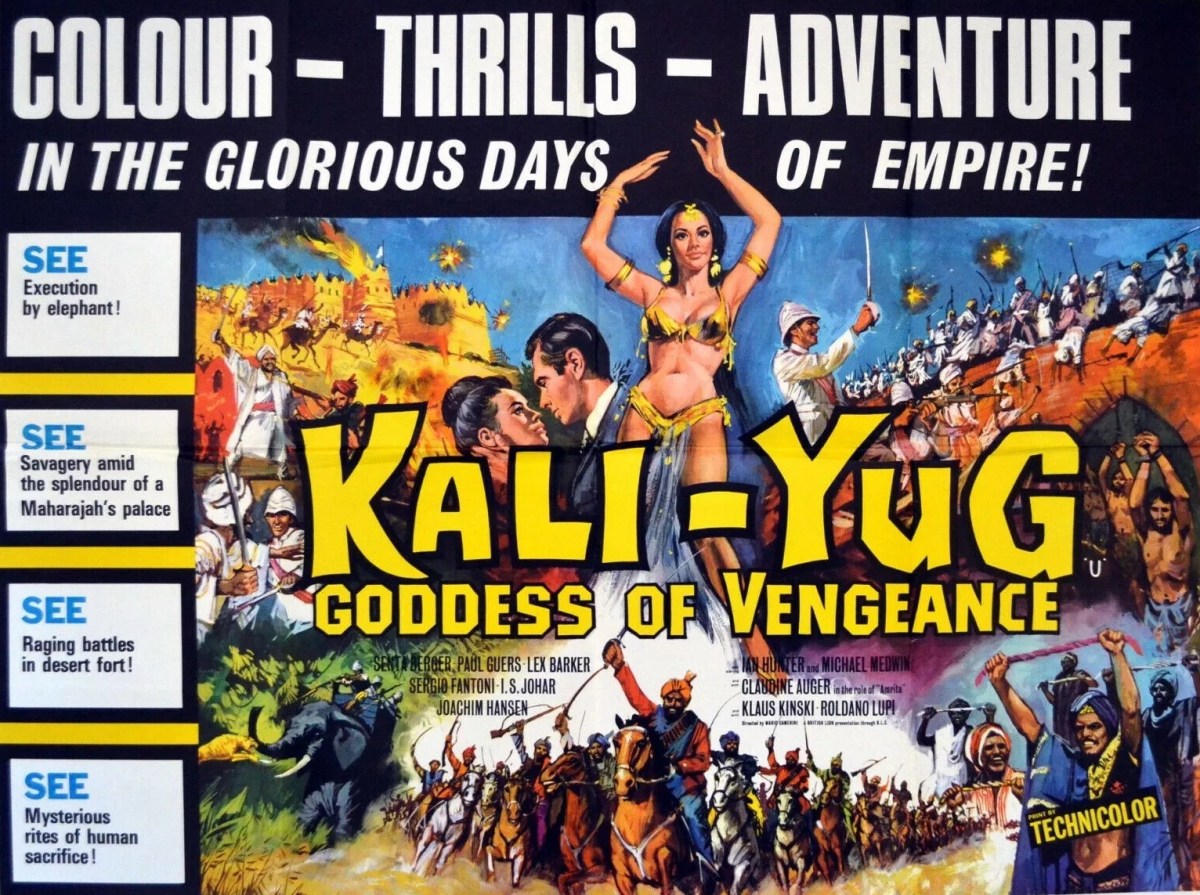
You can’t aspire to being Emeritus Professor of Senta Berger Studies unless you are willing to track down this early effort. Your curiosity can now be sated without much effort since it’s currently playing on YouTube. You’ll notice a preponderance of brownface (Klaus Kinski, Sergio Fantoni, Claudine Auger and eventually, though in legitimate disguise, Paul Guers) among a multicultural cast comprising actors from Germany, Poland, Switzerland, France, Italy, Austria, South Africa, the USA and Britain.
To avoid confusion, the title of this German-made Indian adventure requires some explanation and once again I have undertaken the necessary research. As long as you make the distinction between “Kali-Yug” and “Kali Yuga” you will be on safe ground. The former refers to a cult while the latter refers to Hindu cosmology and the final age of the yuga cycle – the one predominant at the time – defined as an age of darkness, of moral and spiritual decline.
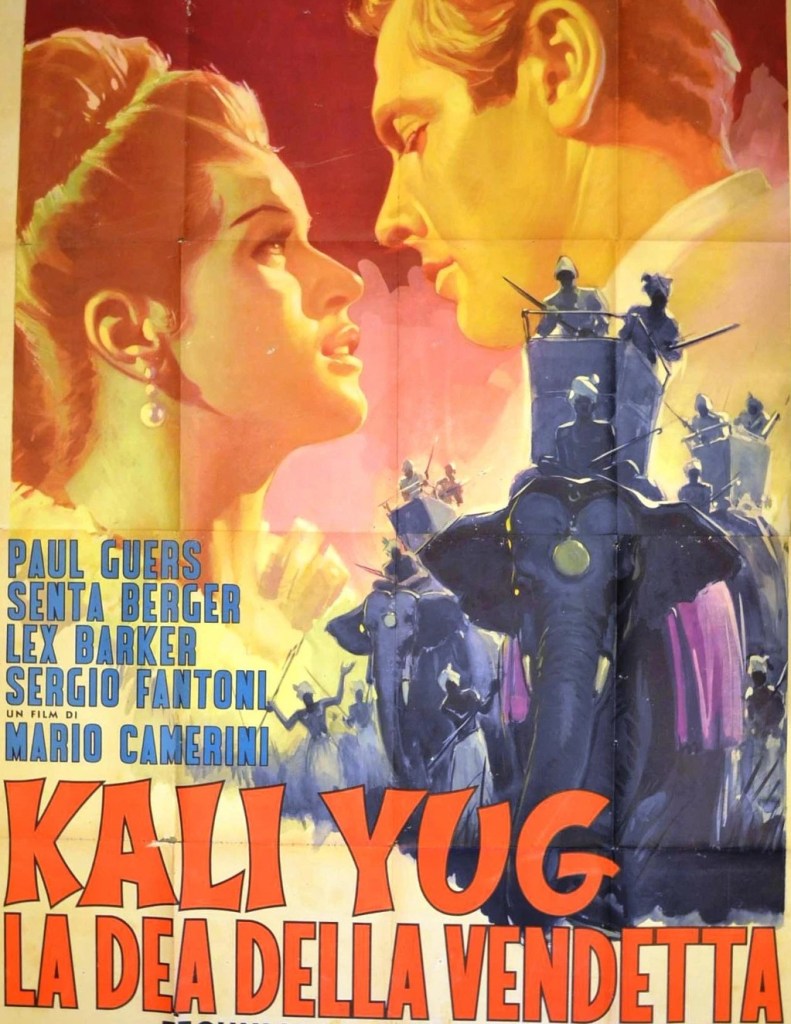
Even with that out of the way it takes quite a while to get your bearings here. This is India in the 1880s, four years after Queen Victoria has been declared Empress of India, at the height of British rule.
We begin in rather traditional style with the kind of tale that would provide an Englishman with good reason to be in an impoverished Indian village. Dr Simon Palmer (Paul Guers) is fighting an epidemic of smallpox. Running out of medicine, he despatches a servant with a small convoy to the capital of Madanpur to secure further supplies to combat the disease. On its return this group is ambushed, so Palmer takes it upon himself to personally plead with local Governor (known here as The Resident) Talbot (Ian Hunter) of Madanpur..
It’s worth pointing out that, as this is relevant to the later narrative, a Resident has been appointed in those states such as Madanpur which the British took by force. Other states, which gave in to the British without a fight, such as the neighboring state of Hasnabad continue to enjoy autonomous rule by a Maharajah or Prince, but only in return for paying massive tributes to their conquerors.
After a satisfactory meeting with the Resident, Palmer encounters drunken British officer Capt Walsh (Michael Medwin) and retaliates when insulted. He also meets old flame Catherine Talbot (Senta Berger) who married the Resident. She’s not a gold-digger in the standard sense. Palmer had met her in Calcutta but when he went off to London to complete his medical studies her father died, leaving her impoverished, so in his continued absence she married the older man for security.
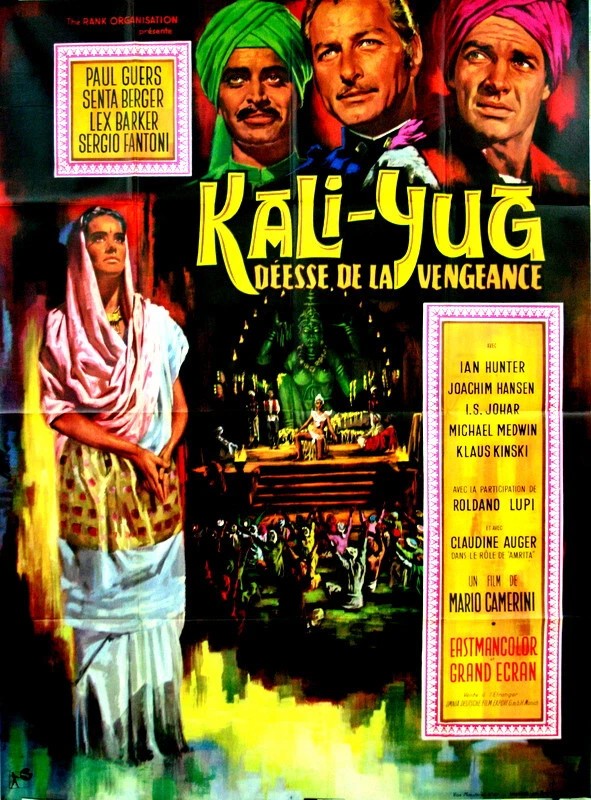
Capt Walsh is murdered and after their previous altercation blame falls on Palmer. He should get off scot-free. He has an alibi. At the time of the murder he was dallying with Mrs Talbot. But that wouldn’t go down well in British society. There would be a scandal. A good deal would be read into a moonlit assignation with a man other than her husband. And Palmer, in traditional stiff upper lip fashion, wouldn’t like to get her into trouble.
So Palmer contacts elite dancer Amrita (Claudine Auger) because he thinks she knows who killed Walsh. Although promising to help, Amrita, it turns out, apart from charming the pants off (possibly quite literally) everyone in sight, is secretly in league with the characters, led by Siddhu (Klaus Kinski), responsible for the robbery and murder. So while Palmer is ambushed yet again, she is sent to Hasnabad where she will undertake her “next mission.”
Which appears to be to dance for the Maharajah (Roldano Lupi) as entertainment for visiting merchants. Helped by servant Gopal (I.S. Johar), Palmer goes on the run and manages to fake his own death. In this regard, an entire corpse is not required as proof, just a torn limb, stolen from the local vultures, and a torn jacket. (Thus far the highlight of the show with white hunters and Mrs Talbot swaying in baskets atop elephants). To keep him safe, Gopal provides Palmer with brownface disguise. They witness a Kali ritual and follow Siddhu’s gang as they break into the palace to prevent the kidnap of his Maharajah’s grandson.
But Palmer is blamed for that too and condemned to death. That involves being buried up to your neck in the sand while an elephant stomps on your head. But he is released because the Maharajah doesn’t want trouble with the English. Meanwhile Catherine has fessed up to her husband which, as expected, does not go down at all well.
The End.
So you can imagine my puzzlement. YouTube promotes Klaus Kinski (Grand Slam, 1967) as the reason to watch this, but so far, he’s only appeared briefly, though clearly wielding significant power as chief thug. But we’ve seen as little of third-billed Lex Barker (Old Shatterhand, 1964) as Major Ford. His contribution is to prevent Capt Walsh get even drunker and, as a member of the shooting party, pick up Mrs Talbot when she faints at the thought of Palmer being dead. Sightings of fourth-billed Sergio Fantoni (Hornets’ Nest, 1970) have been as fleeting, his main role as Prince Ram Chand to try and score points off The Resident by arguing about the unfairness of British rule and to partner Catherine briefly on the dance floor.
So this is beginning to look as though it’s a small-scale version of those big-budget pictures featuring an “all-star cast” which consists either of marquee names long past their best or various foreign stars recruited to cover all the bases for the international release rollout.
The ending is so sudden and with so much unresolved, I also began to think it was one of those elaborate foreign jobs with stars who meant so little to British and American moviegoers that it was drastically edited to fit domestic distribution patterns.
On further research (the bane of any Emeritus Professor’s life) I got to the bottom of the problem.
This was only Part One. It wasn’t the end after all.
Luckily, I’ve found Part Two and will review that (as no doubt you’re delighted to hear) tomorrow.
 The Magnificent 60s