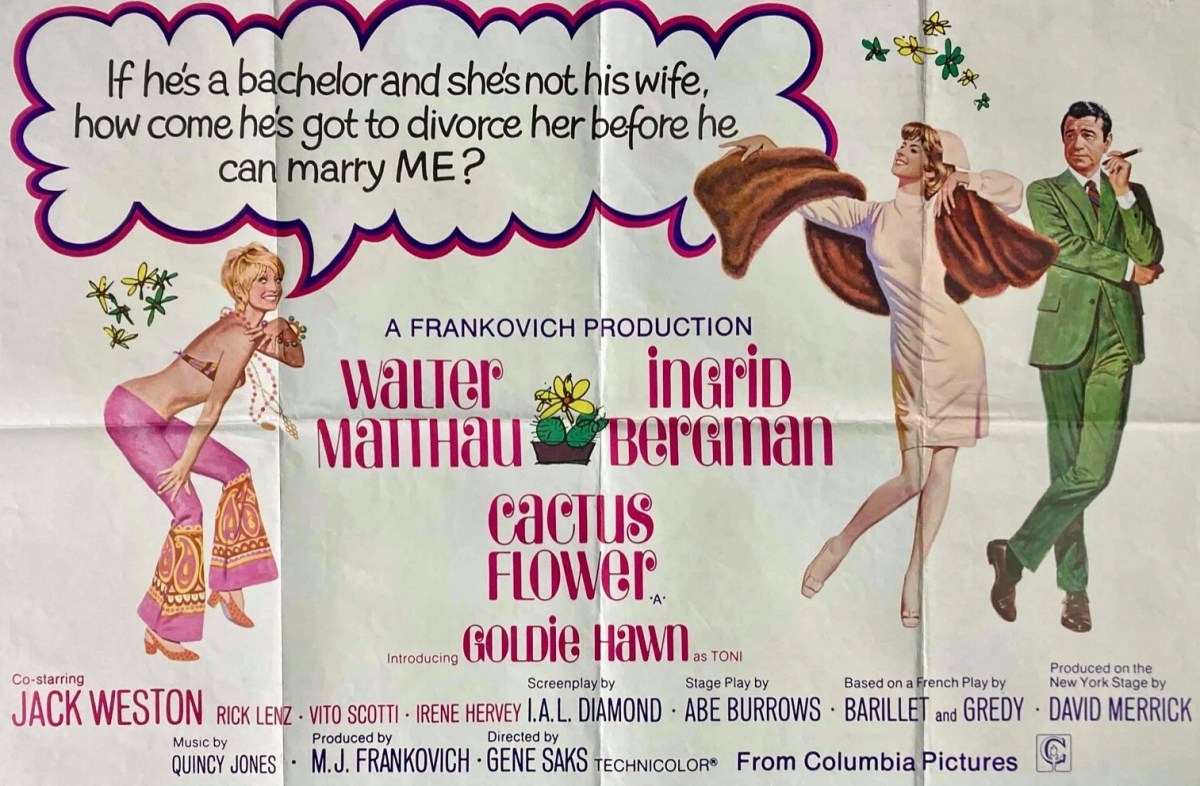
Cactus Flower (1969) ****

Television hadn’t produced the goods in terms of furnishing Hollywood with an abundance of new talent. We were still only talking about Steve McQueen (Bullitt, 1968) and James Garner (Buddwing/Mister Buddwing, 1966) in the 1960s as having made a successful transition from small-screen to big-screen stardom with occasional brief flurries from the likes of Clint Walker (The Dirty Dozen, 1967). Though Hollywood kept trying – Universal had tossed thirty-two of its contracted players into Airport (1970) in the hope one would catch audience attention.

But it turned out Hollywood had been looking in the wrong direction. Expecting to unearth actors who could carry dramas or thrillers or westerns, Hollywood had, in general, not considered comedy as a source of new talent. Dick Van Dyke (Chitty, Chitty, Bang, Bang, 1968) was considered an anomaly because he could morph into a song-and-dance man and his comedy was based on the physical.
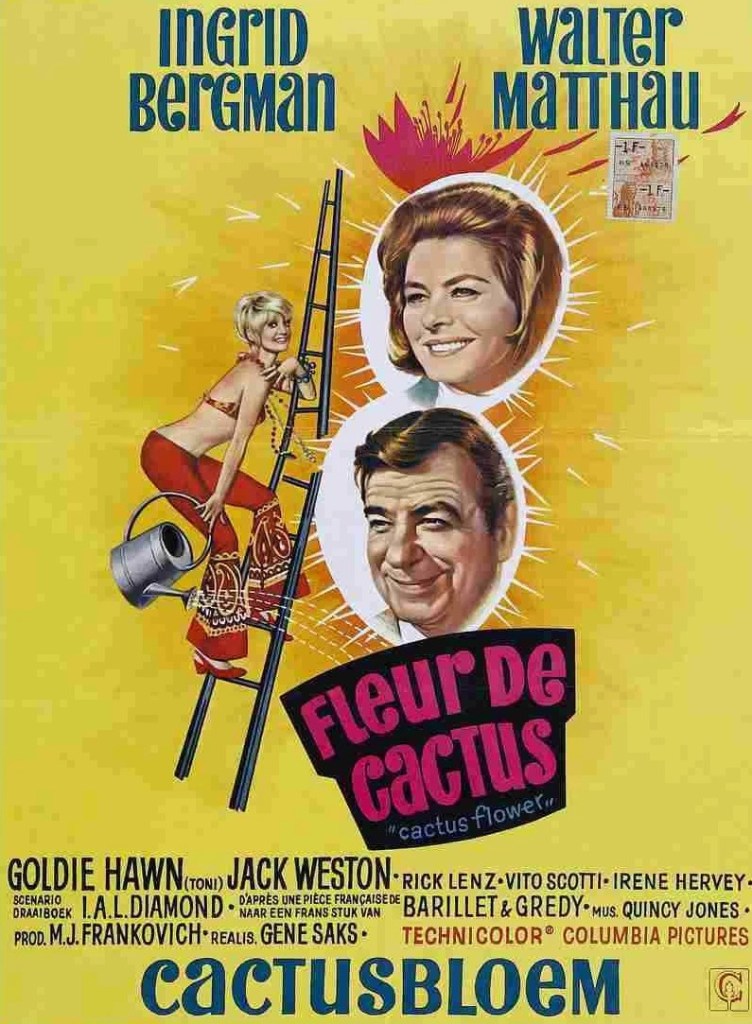
So the industry was astonished when Goldie Hawn emerged from what was essentially a comedy skit show, The Rowan and Martin Laugh-In, to become a genuine screen box office comedienne and over the next decades there would be an excellent harvest from television comedy including Robin Williams, Chevy Chase and a whole troupe of others.

But it’s a shame that Goldie Hawn got all the glory – she won an Oscar – because this was the picture that established Walter Matthau as a genuine star as opposed to part of a double act with Jack Lemmon (The Fortune Cookie, 1966, and The Odd Couple, 1968). John Wayne once made the point that most acting is actually reacting to what someone else has said and in that regard there’s a masterclass from Ingrid Bergman (The Visit, 1964), playing determinedly against type.

Deceit drives the narrative. Just like Dean Martin in Airport (1970), upscale dentist Dr Julian Winston (Walter Matthau) has cottoned onto the fact that he can keep marital interest from  mistress Toni (Goldie Hawn) at bay by the fact that he’s married. Except he isn’t and has to rustle up a fake wife to keep Toni on the hook. So he turns to spinster nurse Stephanie (Ingrid Bergman), a Swede cut from the repressed Bergmanesque cloth rather than the free loving spirit of popular (male) imagination, who has been carrying a torch for him for years, so, despite the notion that it’s not real, she goes full-tilt-boogie into the pretense. She’s even got a couple of nephews in tow who can masquerade, unknowingly, as Winston’s own kids.
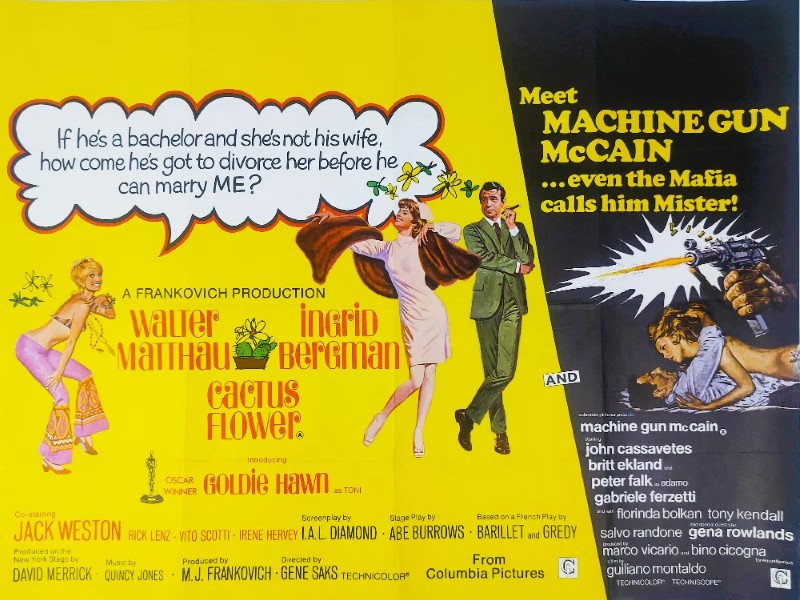
Meanwhile, Winston rethinks his position, realizes he doesn’t want to lose Toni and reckons the only way he can get himself out of the sticky situation of his own creation is to pretend that his imaginary wife is also having an affair, so he has to set Stephanie up on dates with some of his customers so Toni can get a peek at them.

Assuming from its stage origins – France before being adapted for Broadway – this had more farce in the original production, that aspect has been trimmed back to concentrate on the various degrees of deceit. Instead of trying to force laffs from opening and closing doors and men being caught with their trousers down, this follows the simpler plotline of maintaining the deceits while inserting a potential twist when Toni develops an interest in her neighbor, author Igor (Rick Lenz).

The three principals are excellent, all bringing something fresh to the table, Walter Matthau as a lothario rather than a crafty conniver a distinct change of pace, Goldie Hawn a refreshing new face who was soon able to carry pictures on her own, and, especially, to my mind Ingrid Bergman. She has two absolutely marvelous reactions to information received – in the first her elbow literally falls from a table, in the second she is overwhelmed at the thought of receiving a gift, and she has the best scene of all, cutting loose on the dance floor.

As you might expect, the romantic entanglements are resolved.

Director Gene Saks (A Thousand Clowns, 1965) sticks to the knitting, extracting weighted performances from the cast without resorting to insipid extras. I.A.L. Diamond (The Fortune Cookie) adapted the Broadway play by Abe Burrows (Can-Can, 1960) who in turn had borrowed the French play by Pierre Barillet and Jean-Pierre Gredy.

Most 1960s comedies have lost their verve but this still plays exquisitely.

The Fortune Cookie / Meet Whiplash Willie (1966) ***

It’s the miracle of cinema. A supporting actor whom you might have glimpsed in a variety of roles over the preceding years suddenly appears as if by magic in a new screen persona and is hailed as a new star. One such was Walter Matthau. From the lecherous neighbor in Strangers When We Meet (1960), good guy in Lonely Are the Brave (1962), bad guy in Charade (1963) and Mirage (1965) and tetchy arrogant analyst in Fail Safe (1964), as if undergoing metamorphosis he creates the slimy, grouchy, crouchy, greedy lawyer duping his brother-in-law in Billy Wilder’s too-obvious satire The Fortune Cookie, beating the top-billed  Jack Lemmon (How To Murder Your Wife, 1965) into a cocked hat.

It doesn’t help Lemmon that this most physical of actors is physically constrained for the bulk of the picture, trussed up within an inch of his life as the key ingredient in a million-dollar insurance scam. And Matthau makes the most of the opportunity, dominating the screen not just with his octopus-like arms, but with his facial expressions, his snarling and growling and snapping, as if this was in fact a one-man movie. He’s so dominant that you almost forget Lemmon, an unavoidable force in most of his movies, is there.

And it’s true that television cameraman Harry Hinkle (Jack Lemmon) is a patsy, duped by his adulterous wife Sandy (Judi West), conned by ambulance-chasing lawyer Willie Gringrich (Walter Matthau) into believing that exaggerating the injury he suffered from colliding with pro football player Boom Boom (Ron Rich) will bring her scurrying back. Never mind that while on the phone apparently going with her ex-husband’s fantasies, we can see her current boyfriend in the background lying abed or taking a shower.

But then Willie has everyone figured out. He can play highball or lowball, he knows every trick in the book and if you try to challenge him he can quote chapter and verse on every personal injury claim over the last century that would favor the victim. And he expects his opposite numbers to play dirty too, and uses to his own advantage the microphones and cameras they have planted in the apartment where Harry is purportedly recuperating.

There’s not much more to the picture than to enjoy Willie hoodwinking everybody in sight. But he’s such a performer to watch that you will be rooting for him rather than his sad sack brother-in-law who you know has paid-up membership of the Suckers Union.

Not for the first time, foreign distributors felt they were saddled with an unworkable title so in
the UK it became Meet Whiplash Willie even though the idea of the con of the whiplash
injuries in supposed car accidents was more prevalent in the US than Britain.

There’s some neat observations of the way law firms work, and the way medical experts refuse to commit in case they are later sued for a wrong diagnosis, and there’s some cute stuff about nuns with the gambling habit and seeing Boom Boom fall apart with guilt. But given the movie’s running time and the talent involved – script by Billy Wilder and I.A.L. Diamond (Some Like it Hot, 1959) and directed by the said Wilder –  it’s not as funny as it could be and sometimes it feels like they’re scraping the barrel to squeeze out an unfunny joke.

But it hardly matters. This could be Fail Safe and with this Walter Matthau persona on the loose you wouldn’t care tuppence if the Russians bombed the hell out of everyone as long as Matthau was in the middle of the action, working out how to chisel a bigger piece for himself, and playing everyone for the dumb schmucks they are.

After this Walter Matthau – as unlikely a mainline star as Lee Marvin or Charles Bronson – never looked back. Unlike other major stars he never had to be completely trustworthy and was almost virtually responsible for bringing a severe dose of cynicism to the forefront of American acting. He could charm you if he set out to do so, but you better keep your wits about you because the chances are he would be robbing you blind.

If The Odd Couple (1967) set the seal on one of Hollywood’s greatest comedy partnerships, The Fortune Cookie was where it all began. Lemmon isn’t bad, just out-acted, and we’ve seen his whiny/forlorn/dumb act many times before. Judi West (A Man Called Gannon, 1968) has the other plum role as the blonde who is anything but dumb and would have proved an ideal partner for Gringrich except he would have seen through her too easily. Ron Rich (Chubasco, 1968) plays the only other character who isn’t spun out of a cliché.

Below par Wilder redeemed by heavenly performance by Matthau.

Discover WordPress

A daily selection of the best content published on WordPress, collected for you by humans who love to read.

The Atavist Magazine

by Brian Hannan

WordPress.com News

The latest news on WordPress.com and the WordPress community.