Circus World / The Magnificent Showman (1963) **** – Seen at the Cinema

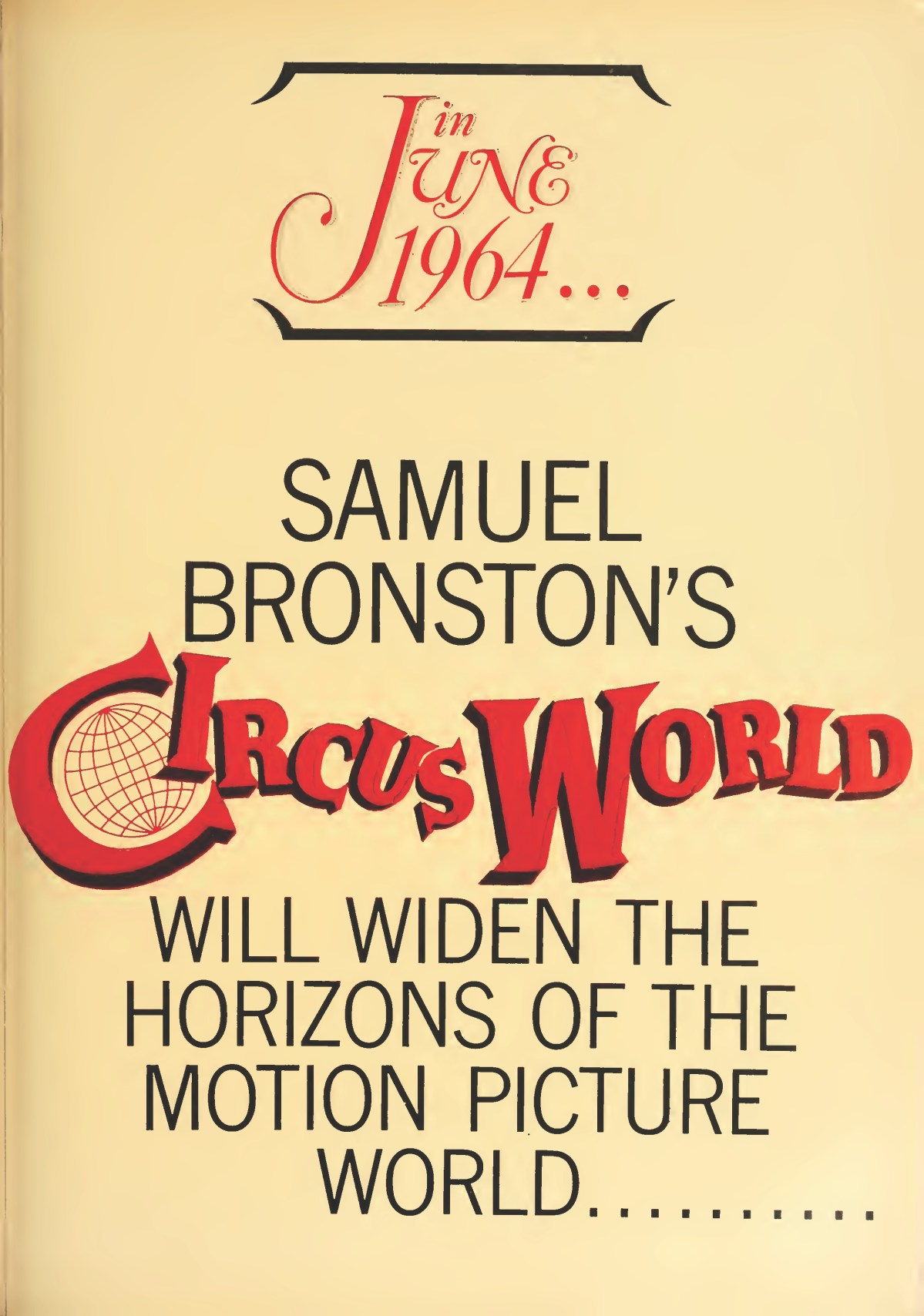
Bookended by disaster – a ship turning turtle, fire raging in the big tent – and kept aloft by giddy circus turns this long-ignored movie in the John Wayne canon is ripe for reassessment. In more down-to-earth mold, with no villains to rein in, no gun-toting required, this calls upon something more basic from the actor, the dramatic skill required to make the audience fix on a strong character within a spectacular screen event.

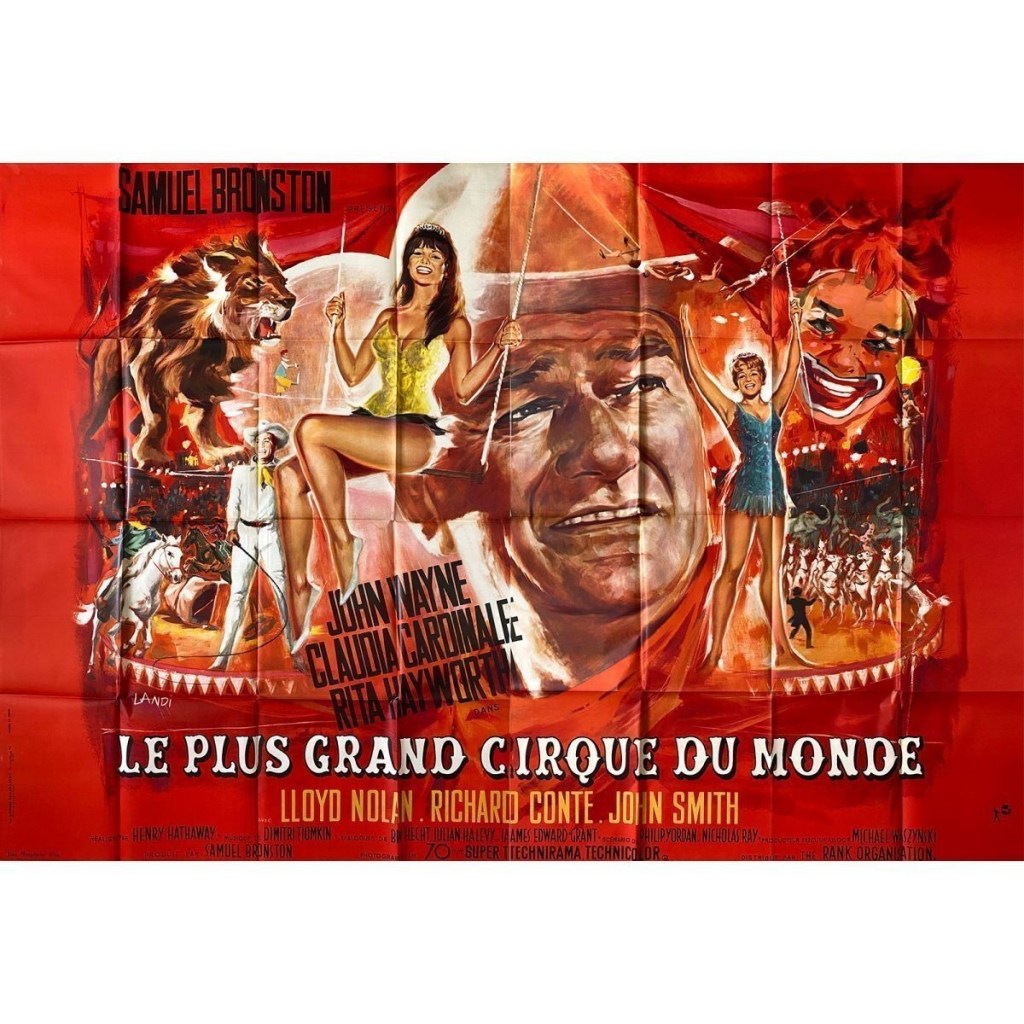
Presented in stunning Super Technirama, the swansong of maverick producer Samuel Bronston (El Cid, 1961), and mistakenly viewed as little more than a travelog or a compendium of circus acts, this dwells instead on transition and loss as Matt Masters (John Wayne) struggles to allow adopted daughter Toni (Claudia Cardinale) to grow up and to come to terms with the part he played in the romantic calamity – father a high-wire suicide, acrobatic mother Lili (Rita Hayworth) fleeing to Europe – that left her parentless.  

It’s no coincidence that sending his three-ring circus cum Wild West Show on a lucrative tour of Europe in the early part of the 20th century provides an opportunity to hunt for Lili, the love of his life. But the circus ship capsizes in Barcelona, leaving Masters penniless, forced to  work for a rival European promoter until he can scrape together enough dough to start again. Masters uses the opportunity of traveling through European capitals to scout new acts, including clown Aldo (Richard Conte), a lion-tamer turned tiger-tamer Emile (Hans Dante), and ballerina Katharyna (Giovana) who performs on the high wire while Toni wants to chance her arm against Matt’s objections as an acrobat and flex her romantic muscles in romantic dalliance with Matt’s new partner Steve (John Smith).

The subplots add dramatic heft, the lion-tamer is frightened of tigers, Aldo has vengeance in mind, so in between the scintillating circus acts the storyline is compressed around the drink- and guilt-sodden Lili and conflict on several fronts with Toni while old retainer Cap (Lloyd Nolan) is on hand to pep up or challenge Matt.

You wouldn’t be allowed to make this kind of film these days so it’s worth glorying in the glory days of the circus – dancing horses, lions, tigers, elephants, acrobats and genuinely hilarious clown sequences. It being a three-ring circus there’s always something going on, plus the Wild West element which comprises a stagecoach being attacked.

John Wayne is as befuddled as ever in romance, restricting his trademark double take to astonishment at Tony’s transition to womanhood. There’s an occasional reversal but mostly  it’s a battle against the odds, potential triumph leavened by gritty loss.
A modern producer would have switched the disasters – it didn’t really matter how Matt got into a fix. But the capsizing, appearing so early the effect is stunning, is brilliantly handled, not just the rescue of people and animals but Matt in lion-taming mode and ending with a clever coda. In every photograph Lili’s face has been scratched out but in among the saturated notes of Matt’s vital cash box is a picture of her.

Some critics have suggested John Wayne (In Harm’s Way, 1965), recovering from his own financial debacle caused by over-investment in The Alamo (1960), took the role for financial expediency. But I can see the attraction, as I’m sure the actor did. This is a far more rounded character than anything since The Searchers (1956) and he can’t even find redemption from a six-shooter. He’s more protective than aggressive, paternal instinct triggering character reaction, and it’s more of a James Stewart type of role, coming back from adversity, and nothing straightforward about a man whose love affair caused marital disaster.

Critics have also taken pot-shots at Claudia Cardinale (The Pink Panther, 1963) as if she was not already an accomplished actress (a favorite of Visconti, for example) in a compelling role and competing on even terms with a star of John Wayne’s charisma without being able to fall back on the old saw of the romantic interest. Although playing a character nearly a decade younger, Cardinale  brings an earthy feistiness to a character with a bucket of decisions to make, turning on its head her relationship with Matt and going through the dramatic hoops with Lili.

Rita Hayworth (The Happy Thieves, 1961) has shucked off the glamor, a worn-down relic of her former self, turning to drink and religion in equal measure in vain hope of finding peace. Veteran Lloyd Nolan (The Double Man, 1967) and Richard Conte (Assault on a Queen, 1966) hold their own, but John Smith (Waco, 1966) does not. Look out for former British star Kay Walsh (A Study in Terror, 1965).  

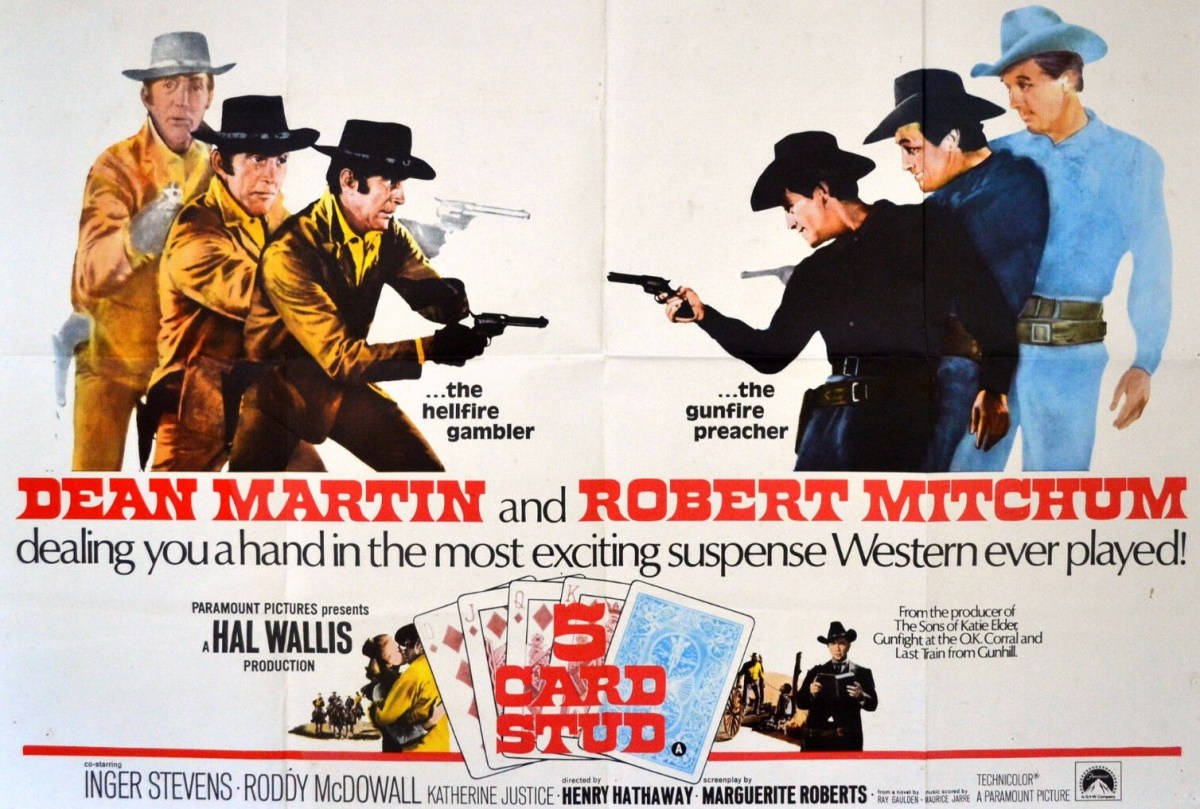
Henry Hathaway (5 Card Stud, 1968) does a terrific job marshalling all the elements, containing the core family drama within the wider action-oriented structure. While there’s never a dull moment, in among all the spectacular scenes are some exhibiting a particularly sensitive directorial touch such as when Matt discovers Lili’s hotel room and reflects on his own misdemeanors.

There were almost as many writers as circus performers – James Edward Grant (The Commancheros, 1961), Ben Hecht (Spellbound, 1945), Julian Zimet (A Place for Lovers, 1968), Bernard Gordon (55 Days at Peking, 1963), Nicholas Ray (The Savage Innocents, 1960) and Philip Yordan (El Cid).

Come at it from the fun perspective and you won’t go wrong. John Wayne completists will adore it.

I was lucky enough to see this is full glorious widescreen at the cinema where it was the Closing Film at this year’s  Widescreen Weekend in Bradford. What a way to end a show!

Seven Thieves (1960) ****

You wouldn’t figure director Henry Hathaway for a caper movie. He seemed more at home with action, whether that be war (The Desert Fox, 1951), adventure (Legend of the Lost, 1957) or western (Nevada Smith, 1966) although he was a dab hand at film noir (Kiss of Death, 1947). And before the big-budget all-star Oceans 11 entered the equation in the same year as Seven Thieves – and stole much of its thunder – the heist movie ran mostly on B-movie steam such as Rififi (1955), The Killing (1956) and Big Deal on Madonna Street (1958).

And probably judged against other glossy efforts of the 1960s like Topkapi (1964) and Gambit (1967) Seven Thieves would appear on the surface to come up a bit short. No doubt accounting for it being so under-rated. But while this is in itself a neat little thriller the kick comes in the emotional entanglements and a succession of twists at the end that sends it in my book into a higher category.

And it’s so outrageously clever that the mystery of why French-based criminal mastermind Theo Wilkins  (Edward G. Robinson) would reach out across the Atlantic Ocean to recruit former jailbird Paul Mason (Rod Steiger) to spearhead the heist of a cool four million dollars from a Monte Carlo casino is not resolved until the end, and in spectacular fashion.

Technically, there are actually only six thieves, the other is an inside man, Raymond (Alexander Scourby), who has fallen for the seductive charms of nightclub dancer Melanie (Joan Collins). Making up the rest of the septet are safe cracker Louis (Michael Dante) and muscle-cum-driver Hugo (Berry Kroeger) with Poncho (Eli Wallach) playing the key role of the pretend crippled, arrogant, irascible millionaire – and contrary to the claims of one poster he is the decoy not Melanie.

Distrust of his team makes Theo bring in Paul, who ruthlessly knocks them into shape, putting into seamless action the plan devised by Theo. Simply put, Poncho is going to act as a distraction by having a heart attack at the gambling table while Paul and Louis climb out a window along a ledge to the casino director’s flat which provides, by means of an elevator, direct access to the underground vaults. Once they’ve stolen the cash, they clamber back along the ledge and hide in the flat where, by this time, Theo, playing the role of Poncho’s personal physician, has taken him. The money will be hidden in Poncho’s wheelchair and removed to a waiting ambulance.

But Paul is a rather suspicious character and wants to know what he’s letting himself in for so in turn works out the weaknesses of his team. Melanie hides behind a façade of high birth, Pancho is too reckless, “measuring danger only in terms of profit,” Hugo prone to unnecessary violence, while Louis has omitted to mention he is terrified of heights, the ledge on which the operation depends standing on a 100ft high cliff.   

In some posters, this was promoted as Al Capone (Steiger)
vs Little Caesar (Robinson).

The plan relies on Poncho actually appearing to be dead, so dead that the casino director (Sebastian Cabot) will not hesitate, at Theo’s insistence, to shift him out of sight of the rest of the gamblers into his flat. But Complication No 1 is that Poncho doesn’t want to be dead, even if it is a ruse, skeptical of Theo’s plan to convincingly knock him out by means of a carefully measured dose of cyanide. Complication No 2 is that a night club client recognizes Melanie and casts doubt on her credentials as a lady of quality. Complication No 3 is that English physician Dr Halsey (Alan Caillou) questions whether Poncho is as dead as he seems.

But such complications are nothing compared an extraordinary range of twists that raise tension sky-high at the movie’s denouement. I challenge you to guess what these three superbly-conceived twists would be, all of them one by one turning the project on its head, and it rapidly shifts from one direction to another, ending with an unbelievable – and yet so in keeping with the premise – climax.

Attention to character detail lifts this out of the rut, whether it be Theo’s penchant for collecting seashells, Paul resplendent in a white suit, Melanie resisting the blandishments of becoming a kept woman, Raymond trying to climb out the murky depths into which the lure of Melanie has taken him, and a series of subtle relationships, some developing through the robbery, others which began long before the heist working themselves out.

The heist itself is well done, tension kept constant mostly through the failings of the crew and the suspicions of the dupes. All in all an excellent picture.

This was a critical film in the careers of most of the cast. Edward G. Robinson (The Cincinnati Kid, 1965) was handed his first top-billed role in four years. It was a deliberate change of pace for Rod Steiger (The Pawnbroker, 1964). For Eli Wallach, best known at the time for stage work, it was the first of three films that year that would launch him into the higher ranks of top supporting stars; it was followed by The Magnificent Seven and The Misfits. After being leading lady to the likes of Gregory Peck and Richard Burton, this spelled the end of Twentieth Century Fox’s belief in Joan Collins’ star qualities while for Michael Dante (The Naked Kiss, 1964) it was a step up.

Wallach and Dante could be accused of over-acting but Robinson, Steiger and Collins all act against type with considerable effect. Hathaway does a superb job working from a script by Sydney Boehm (Rough Night in Jericho, 1967) based on the Max Catto bestseller.

Nevada Smith (1966) ****

Half breed Max Sand (Steve McQueen) has little truck with the notion that revenge is a dish best served cold. But he’s too young and raw, far from Lee Marvin’s callous killer in Point Blank (1969), to properly avenge the slaughter of his family by three outlaws.

This is a coming-of-age tale with a distinct difference. Max’s development includes, apart from initiation into sex of course, learning to read and write so he can make sense of signposts in order to track down the murderers and receiving tuition from gunsmith Jonas Cord (Brian Keith) so that he can at least loose off some shots without doing himself damage. Vengeance burns so deep that he even stages a bumbled robbery so he can be sent to the prison where the second of his targets is incarcerated. Now that’s dedication for you. And along the way he learns the most important lesson of all, how to live, and not destroy himself through vengeance.

Even so, all Cord’s tuition counts for nought when Max needs a knife to dispatch his first victim Coe (Martin Landau). And he’s not yet so slick with a weapon to avoid serious injury himself. Kiowa saloon girl Neesa (Janet Margolin) nurses him back to health at her tribe’s camp. They become lovers but he rejects the wisdom of the elders and the opportunity to make a life with her.

Unfortunately, Bowdre (Arthur Kennedy)  is a jailbird. And worse, held prisoner in a swamp. Probably the worst bank robbery ever committed sends Nevada there. Max enrols another woman, Cajun Pilar (Suzanne Pleshette) working in nearby rice fields – fraternisation between the jailbirds and these women permitted – to steal a boat to help him and Bowdre escape. Bowdre gets his and this time it’s Pilar who is the collateral damage.

A genuine outlaw now, Max has no trouble joining a band of robbers headed by Fitch (Karl Malden), the final prey. By now calling himself Nevada Smith, Max’s plans are thrown into confusion when it becomes apparent Fitch is aware of his true identity. A surprise ending is on the cards whichever way you cut it, and especially thrilling since it occurs during a well-planned gold bullion robbery.

It’s a film of two parts but divided into three if you like, the unusual swamp setting fitting in between two sections of more straightforward western. Though in the hands of director Henry Hathaway (True Grit, 1969), there is little that’s so straightforward given his mastery of the widescreen and his hallmark extreme long shot. He’s capable of moving from the extreme violence of the vicious murder and rape of Max’s mother to the son’s discovery of the bodies shown just through Max’s physical reaction. And there’s some irony at play, too: gold triggers slaughter and climax; mental dereliction not as feared as its physical counterpart.

Although Hathaway was a true veteran, he was not best known for westerns in the manner of John Ford, more at home with film noir (Kiss of Death, 1947), war (The Desert Fox, 1951) and big-budget pictures like Niagara (1954) with Marilyn Monroe and Legend of the Lost (1957) teaming John Wayne and Sophia Loren. In a 30-year career he had only made three westerns of note – The Trail of the Lonesome Pine (1936), Rawhide (1951) and Garden of Evil (1954). So it was something of a surprise that in the 1960s over half his output was in the western genre. And unlike Ford and Howard Hawks who stuck to the formula of action within a defined community, Hathaway tended towards films of adventure, where the main character, often of a somewhat shady disposition, wandered far and wide.

Steve McQueen (The Cincinnati Kid, 1965) carries the picture with some aplomb, moving deftly from the wet-behind-the-ears youngster to a clever and calculated killer and still retaining enough humanity to enjoy a romantic dalliance. There’s enough action here to satisfy McQueen’s fans spoiled by The Magnificent Seven (1960) and The Great Escape (1963) and for those who had come to appreciate his acting plenty to enjoy. This and The Cincinnati Kid, where perforce as a poker player, he had to do a great deal of brooding, solidified his screen persona, a star you can’t keep your eyes off, wondering what on earth is going on in his mind. As much as he’s playing a character finding his feet, this is McQueen at very nearly the top of his game.

Brian Keith (The Rare Breed, 1966) is the pick of the support, adding a little softness to his usual more hard-nosed screen characters. The villains – Karl Malden (The Cincinnati Kid), Martin Landau (The Hallelujah Trail, 1965) and Arthur Kennedy (Claudelle Inglish, 1961) – are all good in their own different ways, and in the hands of excellent actors, easily differentiated. Suzanne Pleshette (Fate is the Hunter, 1964) shines in a too-brief role.

The sterling supporting cast includes Janet Margolin (Bus Riley’s Back in Town, 1965), Pat Hingle (Sol Madrid, 1968) and Raf Vallone (The Secret Invasion, 1964). John Michael Hayes (Harlow, 1965) fashioned the screenplay from The Carpetbaggers by Harold Robbins. 

Although Hollywood had been prone to sequels – Father’s Little Dividend (1951) following Father of the Bride (1950), Return to Peyton Place (1961), Return of the Seven (1966) etc – there had been no perceived market for prequels, so this was something of a first, Alan Ladd having essayed an older and considerably more sophisticated Nevada Smith in the 1964 film of Harold Robbins bestseller. 

Five Card Stud (1968) ****

Another western in sore need of re-evaluation. Largely dismissed as a routine oater trading on the gimmick of a whodunit and packed with old stagers, this is in fact about a serial killer, a treatise on law and order, and almost acts as a conduit between the decade’s previous westerns when the good guys and the bad guys are easily defined to the end of the decade when such distinctions were muddied after The Wild Bunch (1969) and Butch Cassidy and the Sundance Kid (1969) invited audiences to root for the bad guys. In this rather well-structured picture, full of action and romance, we don’t know who the bad guy is.

The whodunit, however, is really a MacGuffin. The movie is more concerned with investigating the changing mores and hypocrisies of the West and predicting the inherent dangers in the proliferation of weaponry. It’s worth remembering that the movie came out at time when mass murderers such as Charles Whitman (the subject of Peter Bogdanovich’s Targets, 1968) who went on a killing spree in 1966 were becoming the norm.

A card sharp is lynched for cheating at poker in the quiet town of Rinchon where late-night gambling is the height of entertainment. One of the players, professional gambler Van (Dean Martin), attempts to stop the hanging but is beaten up for his troubles. No surprise then, that he ambles off to Denver. Sometime later the hangmen begin dying off and Van returns not just to solve the mystery but to ensure that his name isn’t on the list. “If someone is out to kill you, you don’t sit around and let him pick the time,” he concludes. With the number of killings, not to mention brawls and shoot-outs, it’s almost continuous action.

On his return, Van discovers, with a gold strike nearby, the incipient boom town has attracted unsavory elements, not just the high murder quotient but a whorehouse and loud music in the saloon. Acting as counterbalance is gun-toting preacher Jonathan Rudd (Robert Mitchum) who announces his presence by spraying bullets in the saloon floor, emerging as the self-proclaimed “conscience” of the town.

For a sometime protector of law and order, Van is rather lax in the morals department, unwilling to commit to main squeeze rancher’s daughter Nora (Katharine Justice) when the likes of Lily (Inger Stevens), the unlikely proprietor of a barbershop-cum-whorehouse, are on hand. Van is an interesting study. Once he becomes aware that the only people likely to end up in an early grave are the six men who played poker with the lynched individual, it doesn’t occur to him to fess up to Marshal Dana (John Anderson) which would ease the fears of the ordinary public. Awareness the only corpses belonged to the guilty would have prevented further outbursts of violence among a disaffected population. Interestingly, too, Dana makes no attempt to investigate the lynching.

At the core of this picture are a couple of amazing scenes as paranoia takes hold. One miner, without the slightest sense of irony, complains that in the old days a gunfight took place face to face, not by a murderer slinking round in the dark. Rudd adds some prophetic advice: “wear a gun and use it fast, wear a gun and use it slow – I say don’t wear a gun and you won’t use it at all.”

Van likes to think he has the measure of women, when in fact they have the measure of him. The story avoids the obvious lure of a love triangle, of jealous women competing for Van’s affections. Both the young Nora and the more mature Lily are pretty well grounded. “One wore-out no-account kiss” is Nora’s dismissive description of Van’s attempts at romance while Lily lets Van know she has taken a shine to him as a matter of convenience, he’s just a man and she hasn’t had one in three years. Expecting to be treated as a pariah, Lily, expressing the notion that “women don’t usually like women who like men,” strikes up a friendship with Nora.

Marshal Dana finds it increasingly difficult to maintain any kind of peace since as the death count mounts, paranoia grows rife, exacerbated by the kind of greed gold fever brings, resulting in citizens determined to challenge authority and take matters into their own hands.

The most antsy character is Nick (Roddy McDowall), Nora’s brother and the leader of the lynch mob. Nick seems to stir up bad feelings, provoking the ire of both his father and Van. The guilty are despatched in original ways, one man “drowns” in a barrel of flour, another strangled by barbed wire, a third wakes the town at night when the church bell to which his neck is attached starts ringing out. It’s not too hard in the end to work out who the killer is, but as I said, that is not the point of the picture, although the ending is satisfactory.

There a mass of small detail of the kind that director Henry Hathaway (True Grit, 1969) tends to work into his pictures. Van is a cut above. He travels to Denver and back by stagecoach not on horseback. Citizens can purchase Pocahontas Remedies and beer from the Denver Brewery. Shaves and haircuts at the Tonsorial Parlor are reasonably priced but “miscellaneous” comes in at $20. After the preacher shoots up her floor, saloon owner Mama (Ruth Springford) smooths out the holes.

And there is some distinctive direction. Rudd’s sermon that lasts nearly 90 seconds is delivered in virtually one take, a fistfight is conducted in silence except for a soundtrack punctuated by grunts and punches hitting their target, a dying man tries to leave a physical clue about the identity of the mysterious killer. And there is a superb main street gunfight with Van trying to rescue the marshal and Rudd striding down the street in old-fashioned gunslinger mode.  

Dean Martin (Rough Night in Jericho, 1967) and Robert Mitchum (The Way West, 1969), both with apparently easy-going but magisterial screen personas, come off well together. Inger Stevens (Firecreek, 1968)  always a great screen presence, an ethereal beauty, is vulnerable and strong at the same time. Katherine Justice (The Way West, 1967) is sassy and independent-minded and has a terrific facial response to coming across the first murder.  John Anderson (The Satan Bug, 1965) leads a fine supporting cast including Yaphet Kotto (Live and Let Die, 1973), Denver Pyle (Shenandoah, 1965) and Whit Bissell (Seven Days in May, 1964).

Screenwriter Marguerite Roberts, adapting the novel by Ray Gaulden, contributes some classic lines. “If that is a Bible, read it,” Van instructs Rudd, assuming the preacher has a gun planted in the Holy Book, “If it ain’t a Bible, drop it.” There’s a nod to a James Coburn scene in The Magnificent Seven (1960). Congratulated on his marksmanship in hitting the spinning wheels of a windmill six times out of six, Rudd protests his shooting was a failure since he was aiming for the spaces in between. It was ironic that her next assignment concerned a lawman who took much the same no-holds-approach to the criminal fraternity (True Grit, 1969) as the killer in this picture.

I was so intrigued by this picture, realizing it had much more to offer than a whodunit, that I watched it again within a few days and was pleasantly surprised by its depths.

Discover WordPress

A daily selection of the best content published on WordPress, collected for you by humans who love to read.

The Atavist Magazine

by Brian Hannan

WordPress.com News

The latest news on WordPress.com and the WordPress community.