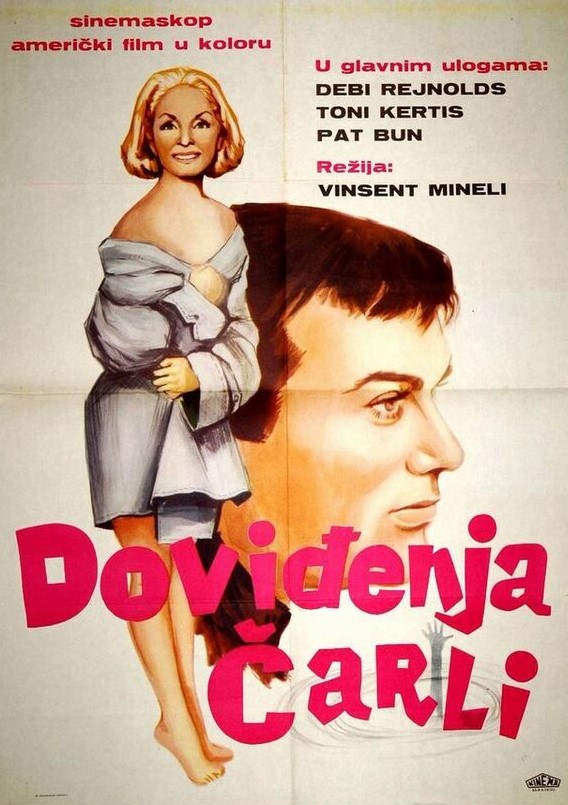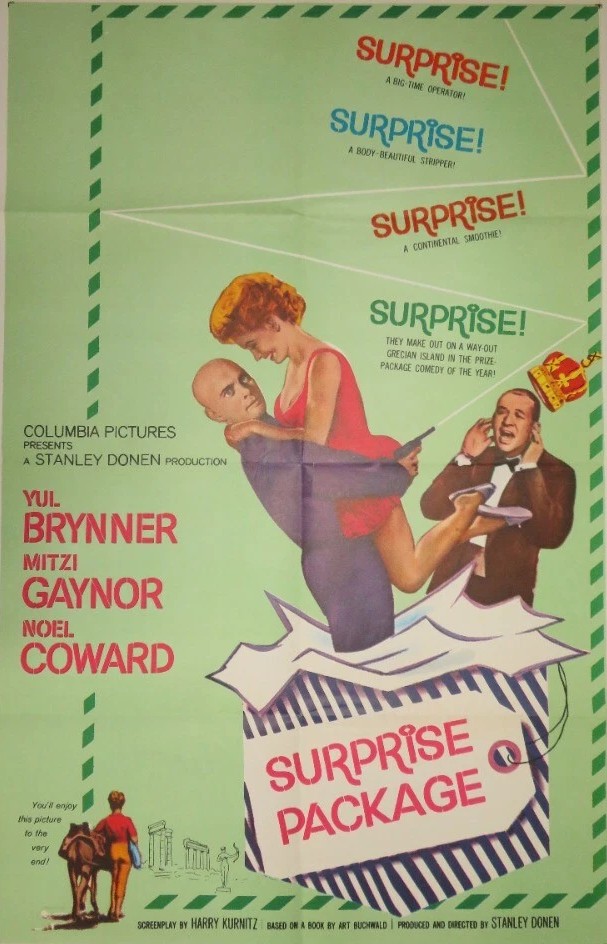
Surprise Package (1960) **

Poses two questions. Is this every bit as bad as Once More with Feeling, Stanley Donen’s previous picture? Yep, sorry, it’s every bit as wretched. The second question is: how on earth did Donen go from this mess to sublime romantic thriller Charade three years later? Well, the answer might simply be in the casting. Yul Brynner is no Cary Grant. And in this movie he’s not even Yul Brynner.

My guess is he’s meant to be a humorous twist on the Brynner screen persona. But playing a gangster with a thick Noo Yoik accent was always the preserve of the dumb supporting actor not the star. And since Yul Brynner isn’t any more convincing in this than in Once More with Feeling the project is in trouble from the start.
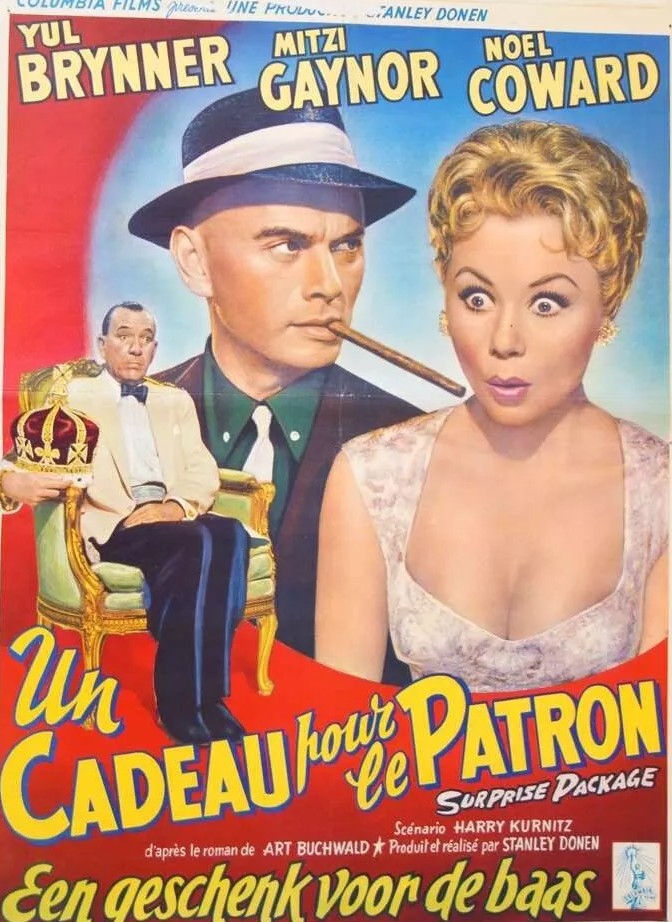
We’re given too much of this faux gangster drivel at the start when mob kingpin Nico (Yul Brynner) is collecting tributes from his underlings. Then, for no particular reason, he is deported, sent back into exile to his homeland of Greece. There he encounters the only smart guy in the picture, the corrupt chief of police Stefan (Eric Pohlmann) who’s so astute in the bribery department that all Nico receives in return for his thousand dollar bribe is to be told he won’t be arrested for bribery.

Stefan sets up Nico to meet another exile, deposed King Pavel II (Noel Coward), whose accent makes no sense either unless he was exclusively raised in high class British society, schooled at Eton, a member of upper class clubs etc etc, otherwise how to explain the plummy tones unless this is also meant to be as over-the-top gag as Nico’s Noo Yoik accent. Nico plans to buy the king’s crown for a million bucks. But the boys back home stiff him and instead of the cash send him instead his girlfriend – the surprise package of the title – mob moll Gabby (Mitzi Gaynor), and the ongoing gag here is that, what with Nico trying to elevate himself in society, Gabby’s table manners and speech let him down.

So with no cash forthcoming, what’s a gangster to do to pad out his exile? So Nico decides to steal the crown. And if there had been either a hint of the classic heist a la Grand Slam (1960) or Topkapi (1964) or its alternative, the totally inept thief, then we might have been onto something. But instead we’ve got much what we might expect from such a poor piece – not much. And in any case, the laffs are meant to come from another party, representing the king’s citizens, and led by Dr Panzer (George Coulouris) who wants the crown restored to its proper home. Two crooks chasing the same prize? What a crazy idea. But this works as well as the rest of the picture.

Thanks to Gabby’s principles, the crown goes in neither’s pockets. To make a buck, Nico and the king transform the latter’s villa into a casino with Gabby, now Mrs Nico, employed as the hat check girl.

Stanely Donen made three pictures in 1960 and then not another man for three years, which suggested he was a) working on too many projects at once and b) that break sure refreshed his cinematic skills. Just like Once More with Feeling he gets wrong virtually most of the directorial decisions, beginning with the accents and ending up with the storyline and characters you don’t care a button for, which wouldn’t have mattered if they could generate a laugh.

Yul Brynner followed this up with his iconic performance in The Magnificent Seven (1960) so perhaps he can be excused. This pretty much killed off the career of Mitzi Gaynor (South Pacific, 1958) – it was another three years till she appeared on screen again, and that was her final picture. It took Noel Coward (Bunny Lake Is Missing, 1965) four years to get another screen role.

Written by Harry Kurnitz (Once More with Feeling) from the Art Buchwald novel so I am assuming this was greenlit before the results of the previous Donen-Brynner teaming were known.

At least Charade revived Donen’s career.
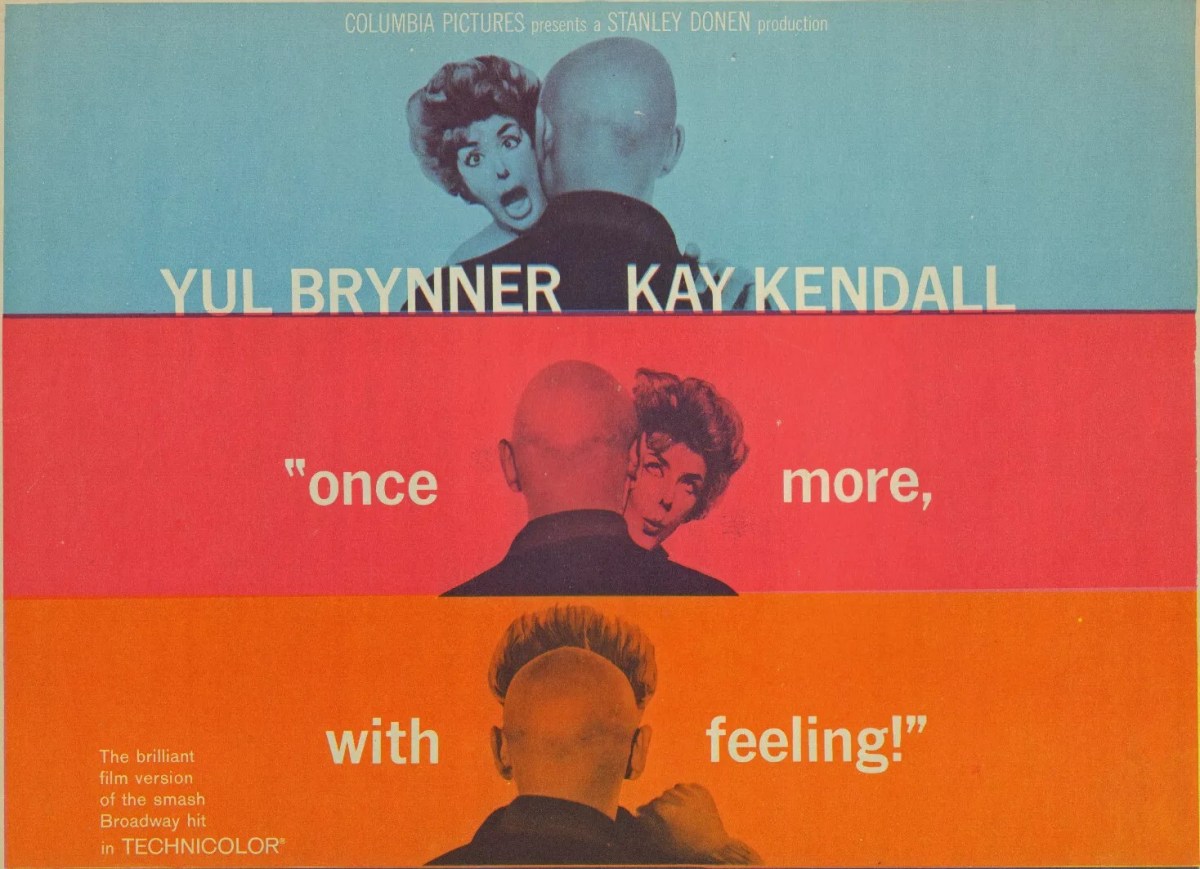
Once More With Feeling (1960) **

At the very least I had thought, given the involvement of classy director Stanley Donen (Charade, 1963) that this might go down as a glorious failure rather than just a straightforward glossy dud thanks to the woeful miscasting of Yul Brynner (The Double Man, 1967) and a bizarre plot. Am sure it must have appeared a welcome change of pace from a string of heavyweight dramas for the actor.

Adapted from the Broadway success by playwright Harry Kurnitz (Goodbye Charlie, 1964) this never escapes its stage origins, too many dramatic entrances, faked dramatic faintings, unwelcome guests ushered out. That would all have been manageable had Yul Brynner shown the slightest instinct for comedy. Bluster doesn’t compensate. Playing a tyrannical orchestra conductor would hardly take any acting for a performer who radiated intensity.

Victor Fabian (Yul Brynner), as egomaniacal and temperamental as you’d expect from a top conductor, is caught in flagrante by harpist wife Dolly (Kay Kendall) with young musician Angela (Shirley Anne Field). After she storms out, he loses his mojo. Worse, his orchestra loses its most efficient fundraiser, since Dolly is the one who keeps donors sweet.

Dolly has wasted no time acquiring a new admirer, esteemed physicist Richard (Geoffrey Toone), and wants a divorce in order to marry him. But wait, there’s a catch. Not the obvious one that Victor turns over a new leaf and determines to win her back, abandoning arrogance in favor of humble ardent wooing.

No, she can’t leave him because, wait for it, they never married. Well that’s not so jaw-dropping as the consequence. He insists that she can’t get a divorce unless she marries him and during an agreed short period together presumably that will give him time to flex his romantic muscles and win her back.

I can only assume that in the sophisitcated circles in which they run, the idea that they have been living in sin might cause her considerable embarrassment. But I’m perplexed at the notion, even for the less permissive times, that this would provoke sufficient scandal – more scandal than getting divorced in the first place? Or that they would expect nobody to notice the sudden marriage and wonder how they have managed to so openly live together? This seems nothing more than a jumbled-up head-over-heels barmy plot strand.

Anyway, she agrees, and he does his best to win her back even to the extent of playing a piece of music, beloved of a sponsor, that he detests.

The plot belongs to the golden age of the screwball comedy but the picture doesn’t play it that way. There’s more to being frenetic in pursuit of laffs than just being frenetic and this never takes off.

While Brynner is strictly one-note and never manages to bring a suggestion of genuine romance into the proceedings, the director is equally at a loss to inject any oomph or style and it looks as if he’s done little more than film a stage show with all its cinematic limitations.

Kay Kendall (Les Girls, 1957) in her final role – she died of leukemia – is equally constricted by a character who huffs and flounces and never embraces the comedy side of screwball.

This was the first of two straight comedies pairing Donen and Brynner and I’m dreading its successor Surprise Package (1960). Kurnitz adapted his own play which had been a decent success on Broadway, so the movie failure can’t all be blamed on him.

Goodbye Charlie (1964) ***

Gender switch comedies were a rarity in Hollywood at this point though of course Billy Wilder had scored big with Some Like it Hot (1959) and I’m guessing the possibility of Tony Curtis repeating his drag act was an audience lure for this one. Alas, that wasn’t to be. This goes the other way. Or several other ways. A woman playing a man who is a woman. That would be catnip these days were it a transgender thing, but it ain’t.

Confused? So sex predator Charlie (a male) drowns while escaping enraged husband Sir Leopold (Walter Matthau) only to reappear, re-born or reincarnated (as the producers decide after googling it, sorry, after they look it up in a book) as a naked woman walking along the highway, rescued by the wealthy Bruce (Pat Boone) and delivered to the nearest house, Charlie’s own pad, now occupied by old buddy George (Tony Curtis).

There’s some light comedy as George tries to safely manhandle the unknown woman, clad only in Bruce’s coat (necessitating his later return of course) and gradually the surroundings seem over-familiar to the woman and then, shazam, George works out from what she knows about him that actually she must have returned as a man, also called Charlie (Debbie Reynolds).

A cosmic joke, in other words. The man who preyed upon women returning as a woman. See how he likes it to be on the receiving end of misogyny. But, mostly, he/she lolls around with legs spread like a man, gulps down whisky and is a dab hand at cards. But that’s not where the humor lies, apparently, because the movie moves on quickly from the woman acting the man and into the man-woman discovering all the female tricks of the trade, visiting a beauty parlor and the hairdresser. Charlie discovers it’s not the same fun slapping a woman’s backside – what a revelation – if you’re a woman.

But, basically, the female Charlie decides to become a female version of the male Charlie, the predator, ripping off friends, chasing the big money, trying to seduce Bruce.  So, mostly, it’s one odd plot device after another.

But the sizzle is Debbie Reynolds, not so much the man-woman stuff, but turning into a mean Bette Davis character before your eyes, all hard-edge and shifty moves. There’s sexual tension as well, George initially resisting the woman he knows is or was a man, before finding the attraction too much, and the same going for Bruce. There’s a fair whack of sexual confusion, as the newborn Charlie still finds herself ogling women.

In those far more innocent times, it doesn’t know what it wants to say and lacks the narrative to say it. Audiences had terrific fun with Jack Lemmon and Tony Curtis in Some Like it Hot, but that narrative ploy was bang on, and Lemmon enjoying dressing up as a woman and Curtis having to keep his male instincts at bay while ogling Marilyn Monroe was pure catnip.

Here, Curtis is mostly the foil for Debbie Reynolds and by the time it looks as though they might get it together she is way past behaving like a man and is most definitely a desirable woman so it’s kind of difficult to make this work romantically or humorously.

Perhaps the oddest element is that the signs were already there that it wouldn’t work that well. It started as a Broadway play written by George Axelrod (The Seven Year Itch, which was a Broadway smash) but it barely lasted a dozen weeks on stage. By that time, though, Twentieth Century Fox had splashed out $150,000 for the rights. Still, bigger sums have been buried in the annual accounts.

And I guess when Vincente Minelli (Two Weeks in Another Town, 1962) came on board with a pretty decent cast it seemed at least doable. Like many a lightweight comedy from the decade – Dear Brigitte (1965) for example – it’s keep afloat by a terrific performance by the principal star, in this case Debbie Reynolds (Divorce American Style, 1967). You might spot Ellen Burstyn (The Exorcist, 1973) in an early role.

Take away Debbie Reynolds and it would limp along.

Discover WordPress

A daily selection of the best content published on WordPress, collected for you by humans who love to read.

The Atavist Magazine

by Brian Hannan

WordPress.com News

The latest news on WordPress.com and the WordPress community.