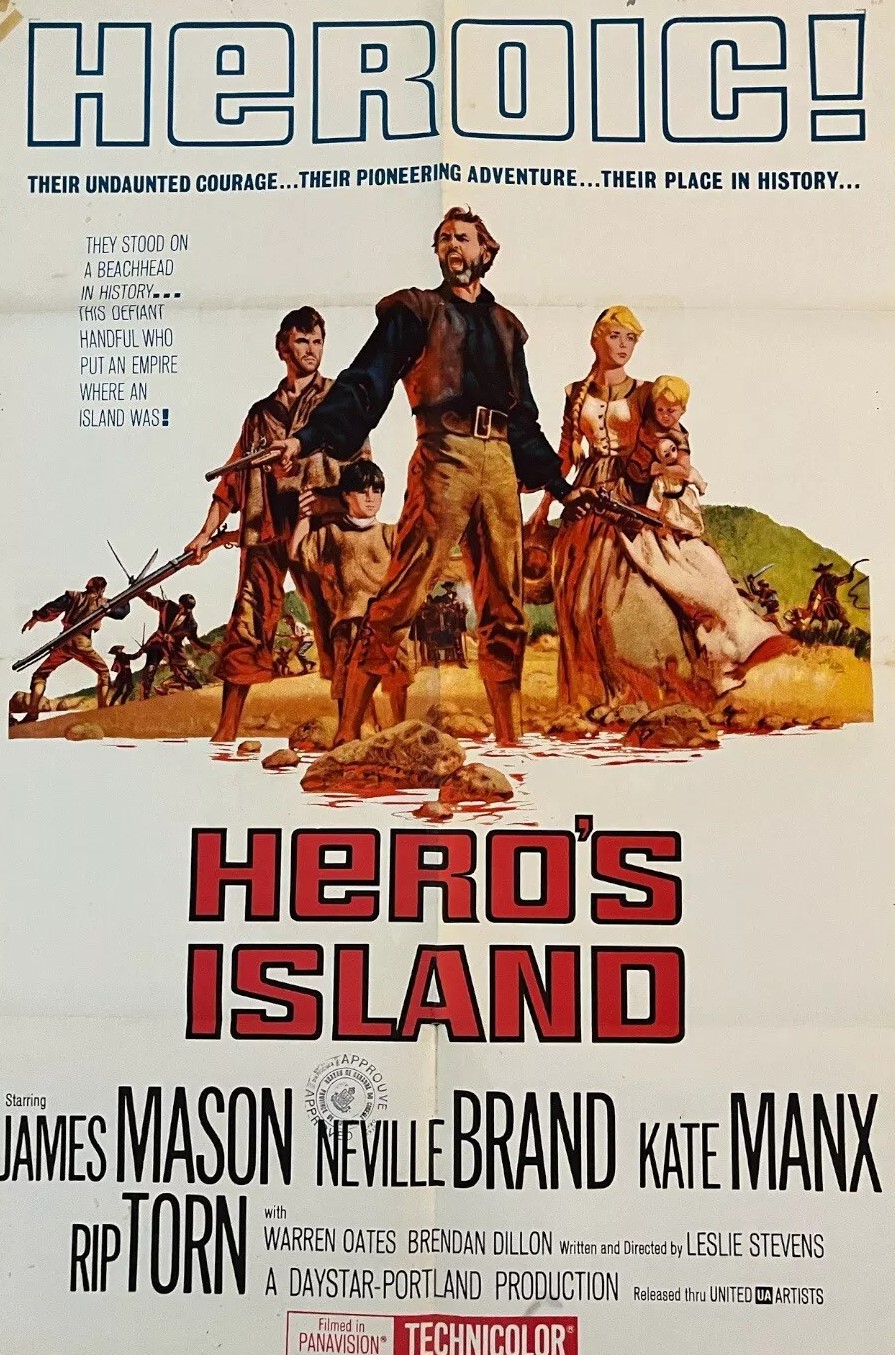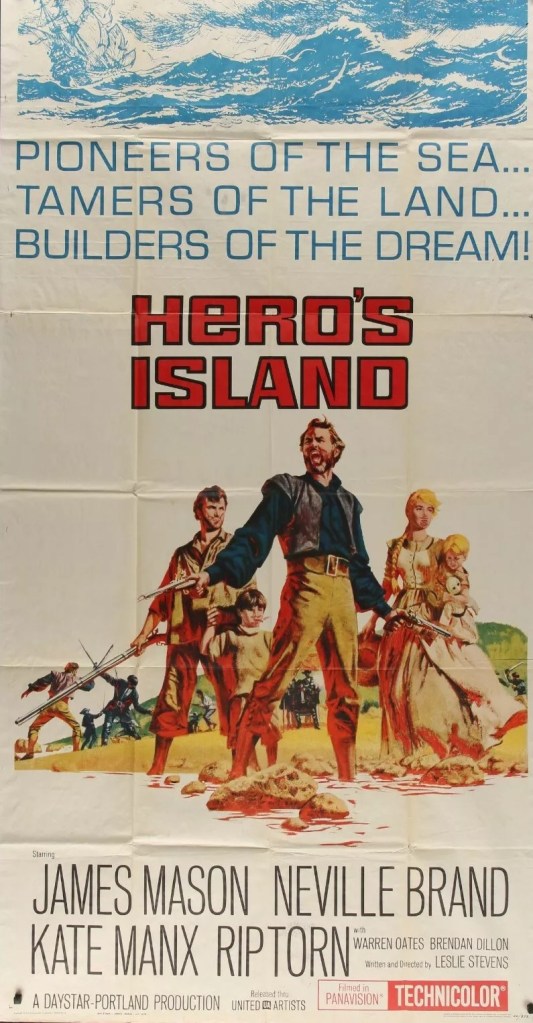
Hero’s Island (1962) ***

There’s a good reason you’ve never even heard of this famous lost film. A fabnulous cast – cult character actors (and occasionally stars) Warren Oates, Harry Dean Stanton, Rip Torn plus a top-billed James Mason – can’t prevent this relatively short film coming over as long drawn out. Proof, too, that cult television producers – in this case Leslie Stevens of The Outer Limits (1963-1965) and Stoney Burke (1962-1963) – shouldn’t always risk stepping into the director’s chair.  

But let’s stick for the time being to the good bits. It’s a historical Lord of the Flies, an almost primitive battle over territory, a small apparently uninhabited island off the coast of the Carolinas in the United States. There’s recognition of the British version of slavery, when, driven off their lands, or to escape dire poverty, people in the eighteenth century went willingly into indentured service in North America. After seven years, you could gain freedom – a contract torn up and rejoined at the indent the legal definition – and wives could equally be bought and if they were very lucky the husband might even agree to marry them in a church. You could buy children in similar fashion. There were other legal niceties, ownership could be challenged, since only a “full working family” could take command of land.

Freed from indenture, Thomas Mainwaring (Brendan Dillon), wife Devon (Kate Manx), two young sons and servant Wayte (Warren Oates) arrive on Bull Island, intending to live off the land, growing crops, fishing, building a house, and honoring God. But brothers – fishermen – Nicolas (Rip Torn), Dixey (Harry Dean Stanton) and Enoch (Robert Sampson) resent the intrusion, murder the husband and attempt to drive the others away, first invoking the law and then threatening violence.

The situation becomes more balanced when  Jacob (James Mason) washes up on the shore, tied hands and legs to a raft, though claiming to be the subject of a shipwreck. Gradually, he sides with the widow although he doesn’t take kindly to her giving orders, refusing to bear arms, and believing that faith in God will see them through. He’s so disenchanted that when pirates descend on the island, he stands back, refusing to help when the widow and then her children are kidnapped.

But eventually, thank goodness, he springs into action, revealing hmself handy with a cutlass, and a pirate, having sailed with Blackbeard, though his captaincy did not go so well, mutiny the true reason for ending up on a raft. Still, he wades into the pirates, retrieves the situation and the fisherman accept the widow’s rights to the island.

So, some interesting historical information, and a touch of swashbuckling. But that hardly makes up for the acres of time when nothing much occurs and the characters jaw about God, the law and life in general. A tinderbox of a set-up barely crawls along, scarcely catching fire.

And that’s despite the all-round good acting, Rip Torn (Sol Madrid, 1968), Harry Dean Stanton (Paris, Texas, 1984) and Warren Oates (The Wild Bunch, 1969) all at the beginning of their careers, their trademark acting styles not yet developed, so talent revealed as fresh, while James Mason (The Deadly Affair, 1967) acts very much against type. In her sophomore screen role, Kate Manx (Private Property, 1960), Leslie Stevens’ second wife (of five), only holds sway until Mason appears to blow her off the screen.

Writer-director Leslie Stevens (Private Property) has way too much to say but not the directorial skill to properly dramatize the material, which is crying out for greater tension, fiercer argument and more action.  

Now that I’ve brought this movie to your attention you may be wondering why, with this knock-out cast, you’ve never heard of it. And the reason is, as I’ve explained, it just doesn’t take off. More like a filmed play than a movie, the camera hardly ever moving. I’m not sure either why James Mason was tempted into becoming joint producer. He had just come off Tiara Tahiti (1962) and Stanley Kubrick’s Lolita (1962) so I would be guessing his career was in decent shape. Though sometimes it’s marquee power that pushes actors into the producing field. Whatever the plan, it backfired, the movie was a financial disaster and he wasn’t top-billed again for four years.

Worth a look for the cast but mostly just to see how even with the best cast a movie can miss the spot.

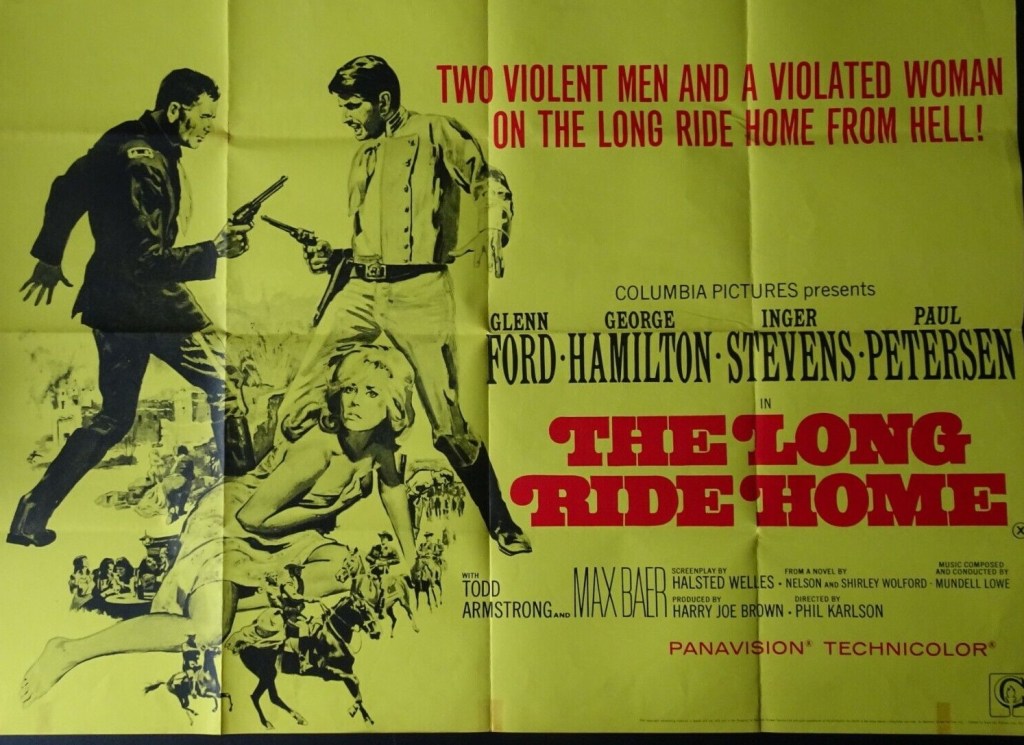
A Time for Killing / The Long Ride Home (1967) ****

The American Civil War is often slotted into the wrong genre. It is not a western. It is a war, with all the inherent wrongheadedness, viciousness and atrocity. We begin with senseless execution and end on a note of humiliating barbarity. Along the way we witness easily the greatest performances in the careers of George Hamilton (The Power, 1968) – a wonder after this how he was ever associated with playboy characters – and Inger Stevens (Firecreek, 1968).

At the tail end of the war in a Confederate POW camp, the disciplinarian commander orders raw recruits to execute an escapee. When they fail to find to the target Major Wolcott (Glenn Ford), witnessed by appalled missionary fiancée Emily (Inger Stevens), steps in to finish the job. In the wake of this Wolcott sends Emily away under escort.

POW leader Captain Bentley (George Hamilton), fully aware the war might end in days, but determined to escape to Mexico and continue the fight, organises a breakout. Instead of sneaking out quietly, in revenge he turns the Union cannons on his captors. And despite being better informed how close the war is to an end, the dutiful Wolcott sets off in pursuit.

Bentley ambushes Emily’s escort, killing the soldiers and stealing their mounts, but promising Emily that as befits a Southern gentleman he will respect her honor. She’s not so innocent of war, anyway, begging Bentley to kill a fatally wounded Union soldier rather than leaving him to the buzzards or, one assumes, marauding Apaches.

Unfortunately, his comrades don’t share that sentiment and when Emily makes the mistake of unloosing her blouse to wet her neck at a stream it inflames their lust. Equally, unfortunately, Emily doesn’t keep to her part of the deal and in attempting to escape hits Bentley a humiliating blow with his own saber.

While unfamiliar with the territory, Wolcott is a pretty good soldier, taking a shortcut over the mountains to cut off their retreat. “How come he knew what we were gonna do before we done it,” wails a Confederate soldier. “Before you even thought it,” snaps the over-confident Emily.

A few miles from the border, the Confederates hole up in a bordello where Bennett finds a despatch announcing the war is over. Ignoring the fact that for the ordinary soldier you couldn’t find a better place to celebrate peace than in a whorehouse, and determined to continue the war, Bennett conceals the information.

In revenge for losing face in front of his soldiers, he (luckily off camera) rapes the half-stripped and bloodied Emily. In the manner of every savage taking advantage of wartime conditions, Bennett tells her, “You think nothing like this can ever happen to you. But you’re lucky because your humiliation will be over soon. You and your major are going to know I won.”

Rape, as currently in the Ukraine and as in many previous conflicts, used as a weapon.

When Wolcott arrives, it’s obvious what has happened and while holding a lid on his own emotions (a Glenn Ford hallmark), once he has proof the war is over, he refuses to give chase. Brutally, he tells her,  “I can see (witness) men die for their country but I can’t see them die for your honor.” It’s Bennett who, oddly, comes to her rescue, opening fire on the Union soldiers, compelling Wolcott, in breach of the rules of war, to cross the border into Mexico in pursuit.

This isn’t a typical Glenn Ford (The Pistolero of Red River/The Last Challenge, 1967) picture where he plays the central character and is scarcely off screen. Here, he disappears for long stretches as the camera focuses on George Hamilton, his squabbling gang and the growing tension between him and Inger Stevens. If you’ve only seen Hamilton in his screen playboy persona, this is a revelation as honor and misguided duty turn into repulsive action.

And this is by far the best performance by Inger Stevens. What she achieved here launched her career, although admittedly as a female lead rather than top-billed star. The emotion her face portrays without the benefit of dialog is quite astonishing. Expecting to be an innocent bystander, unexpectedly thrown into the tumult, physically abused, and then, contrary to her Christian beliefs, she goes from stalwart to victim to, against her Christian principles, showing no sign of turning the other cheek but in full Old Testament mode urging revenge.

The scene when Emily enters a room full of soldiers, attempting to retain some dignity in the face of torn clothes and bloodied face, while acknowledging her humiliation, is stunning. The only scene that comes close to matching its power is at the end, the sequence shot from above, light streaming into a darkened cellar, when, having killed Bennett, Wolcott abandons his potential bride.  

Phil Karlson (The Secret Ways, 1961), a stand-in for original director Roger Corman, does an excellent job of focusing on the brutalities of war, not just the rape and violence, but the recruits, as dumb as they come on both sides, who fail to cope with the pressures. You would have to be fast to spot Harrison Ford (billed as Harrison J. Ford) making his screen debut, but Harry Dean Stanton (Cool Hand Luke, 1967) has a bigger role. Halstead Welles (The Hell with Heroes, 1968) wrote the screenplay based on the novel The Southern Blade by Nelson and Shirley Wolford.

A couple of later westerns might have raided this picture for ideas: continuing the fight in Mexico was the focus of The Undefeated (1969); a constantly carping pair who delight in slaughter evidenced in The Wild Bunch (1969); relentless pursuit a constant theme of 1969 westerns as diverse as Butch Cassidy and the Sundance Kid, True Grit, The Wild Bunch, Mackenna’s Gold and Once Upon a Time in the West.

Regard this as a western and you will be disappointed. Take it more seriously as a war picture and it offers far more. I’m probably being a tad generous in giving it four stars but I was knocked out by the performances of Hamilton and Stevens and a number of excellent scenes, the two in particular mentioned above for example, and the dialogue.

Discover WordPress

A daily selection of the best content published on WordPress, collected for you by humans who love to read.

The Atavist Magazine

by Brian Hannan

WordPress.com News

The latest news on WordPress.com and the WordPress community.