The Trouble with Angels (1966) ****

Shocking Fact No 1: director Ida Lupino was the only female director working in Hollywood at this time. And she hadn’t worked in features for over a decade. Her previous picture, The Bigamist (1953), was her fifth. And while she had continued to find work in television, the movie business shunned her. What was perhaps more shocking, as I pointed out in my book When Women Ruled Hollywood, was that in the period 1910-1919 more women worked as directors in Hollywood than at any time since and that it was a woman, Alice Guy, rather than Melies, who actually made the first narrative movie. Worst of all, despite being a major box office hit, this was Lupino’s last picture.

Shocking Fact No 2: this didn’t turn Hayley Mills into a major adult star. Oh yes, she made the transition – and how – in The Family Way later that year, a British romantic drama that saw her shed her clothes. Big hit in Britain, not so well-received in the USA. Her career then took an odd turn, into thrillers like Twisted Nerve (1968) and Endless Night (1972).

Not exactly demure. Marching band outfit takes the grey out of the convent uniform.

I say an odd turn because if there was any better demonstration that the actress had properly developed her comedy chops I’d yet to see it. Sure, Disney had used her in comedy, but that was mostly routine stuff. Here, she revealed an emotional maturity lacking in her previous work and, to some extent, in her future movies.

And, in part, because Lupino keeps her away from big dramatic moments, relying entirely on her facial expression to reveal character development. I am surprised that, at this point, with Doris Day’s box office allure dimming, that nobody saw Mills as her natural successor. She had the same puckish demeanor and she deftly handled comedy. Give her a few years and she would have been a natural for such polished items as Barefoot in the Park. You get the feeling there was more natural ability that was left untapped.

Anyway, on with the show.

This is just a delight. It shouldn’t work at all, certainly not for a modern audience accustomed to sharply-honed laugh lines. But it’s so cleverly constructed, in covering a three-year period, it could easily have been a string of loosely-connected episodes rather than a picture with an underlying narrative that mostly takes place beneath the surface.
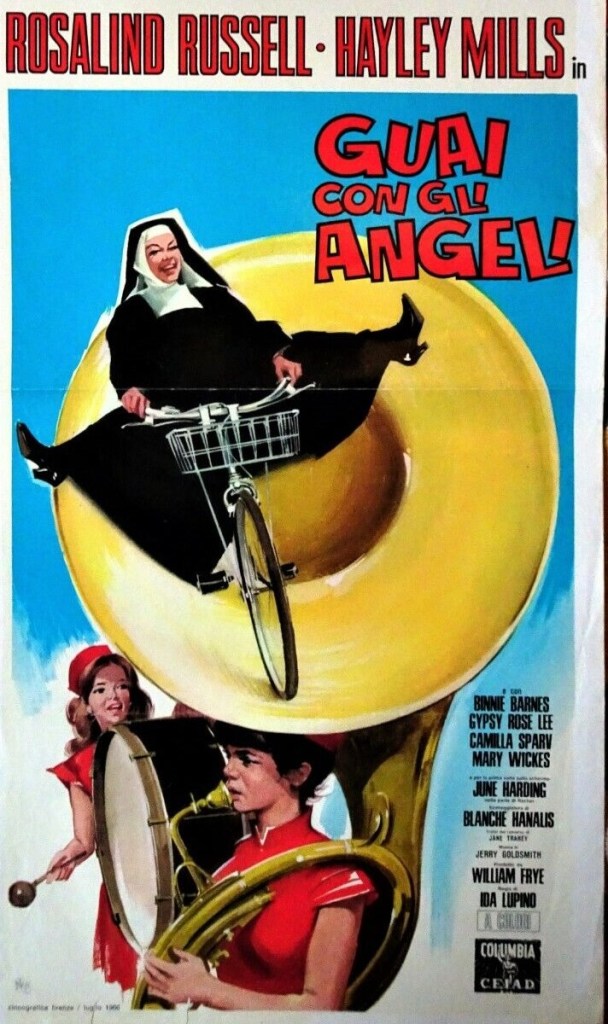
Orphan Mary (Hayley Mills) has been dumped by rich playboy uncle (Kent George) in a  convent boarding school that looks more like a medieval fortress than anything else. She teams up with the equally unhappy Rachel (June Harding), whose parents are at least indulgent, and together they torment the life out of the nuns and other kids, pouring detergent into tea-pots, setting off fire alarms, charging their schoolmates for an illicit guided tour of the convent, developing their smoking habits, breaking everything in sight. One scheme goes so badly awry the nuns have to take shears to a face mask.

Throughout all of this, she comes up against a tough Mother Superior (Rosalind Russell) who comes across like Miss Jean Brodie, minus her dangerously progressive side, but ever ready with a quip, able to tackle any emergency, though Mary drives her to distraction. While set in her ways, the nun does sail close to the wind, kitting out the girls in red cheerleader outfits in order to give them an unfair advantage in a marching band competition.

Any other director would have made the marching band competition the climax of the movie. I was fully expecting it to take up the final third, as pupils with little musical ability work hard and discover they can improve enough to win the competition and in so doing find out some platitudes about themselves. Instead, every episode is kept short and sweet, often the pay-off delivered in unexpected manner, for example, that we discover the girls have won when Mother Superior takes the opportunity to gloat over her rival headmaster (Jim Hutton). Or a section where teenage girls sent to buy their first bra go wild trying on all sorts of outrageous outfits that in other hands could easily have been expanded is ended sharply by Mother Superior holding up the plainest item and ordering two dozen of them.

It fairly skates along. But every now and then it dramatically slows down. And for what? Pretty much nothing at all. Just Mother Superior taking a quiet moment to herself amid all the hurly burly of running a school and dealing with mischief. But gradually, in those quiet moments, she is joined, at a distance, by a staring Mary, wondering about the nun’s inner  calm.

Ida Lupino’s color palette is extraordinary. Sure, it’s nuns, so we can expect a lot of black and white. But Lupino avoids the temptation to compensate with huge swathes of color. Instead, for most of the film, the girls are decked out in grey. So when splashes of yellow or pink or red appear they are distinctive. Only as the girls grow older does more color emerge.

The wry Rosalind Russell (Gypsy, 1962) is on top form. Instead of attempting to dominate, she nips in and steals scenes with her dry delivery. She shifts from indominable to maternal and eventually engages the psychological attention of Mary in a superb scene about her own life.

In that sense Hayley Mills has her work cut out to hold her own against such an accomplished professional, which she achieves through her own delivery, but much more through facial expression. This was June Harding’s only movie. But look out for Camilla Sparv (Assignment K, 1968) in her movie debut and a cameo from Gypsy Rose Lee.   

Terrific direction for Ida Lupino – watch for example how the camera closes in on characters – from screenplay by Blanche Hanalis (Where Angels Go Trouble Follows! 1968) from the bestseller by Jane Trahey.

As old-fashioned as they come and a joy to watch.

Catch it on YouTube – the first link is rent or buy, the second one is free but punctuated by adverts.

https://www.youtube.com/watch?v=37FnvNp2EYc
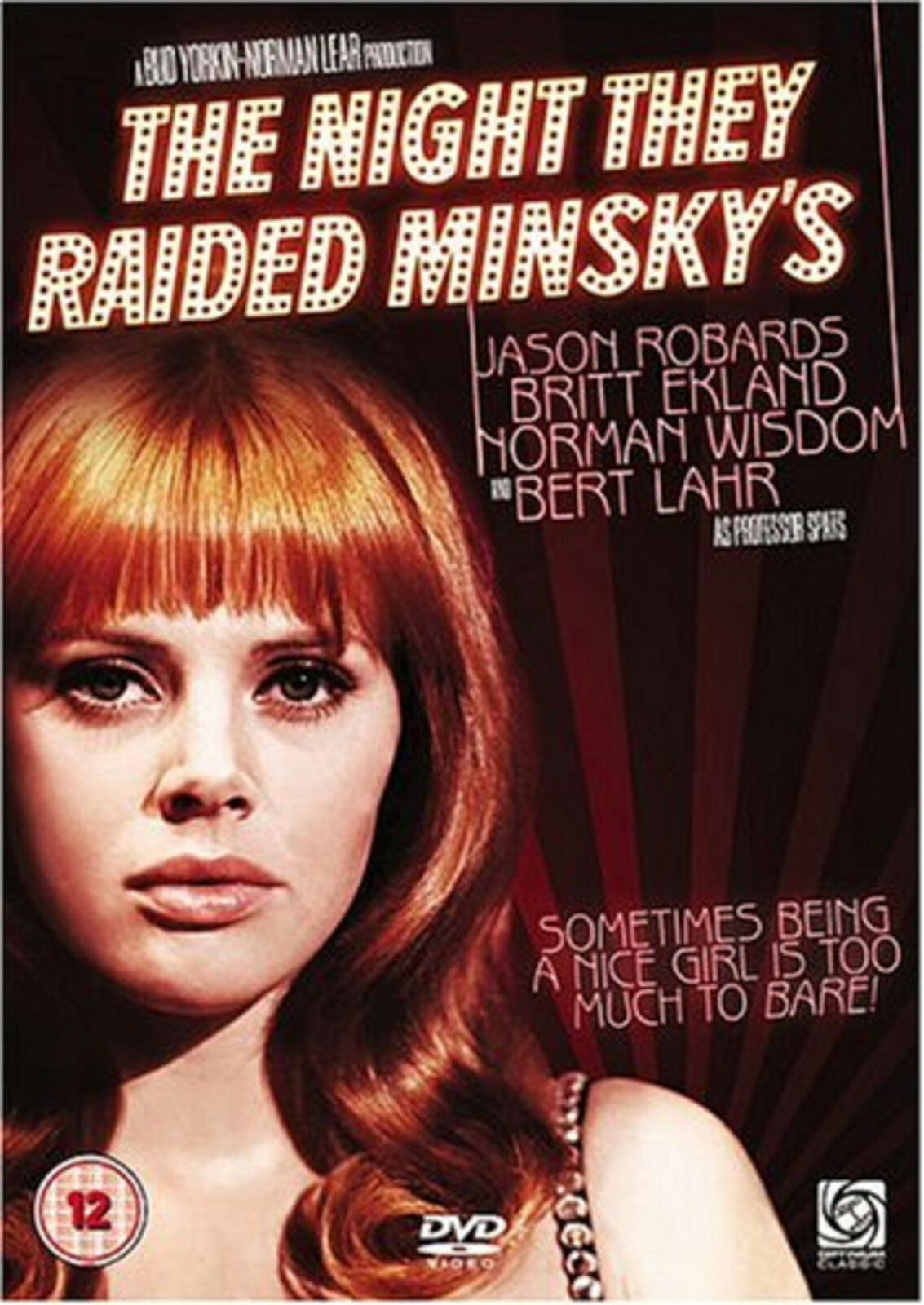
Behind the Scenes: “The Night They Raided Minsky’s” (1968)

Why films are flops is sometimes more interesting than why they become hits. That’s assuming no one’s memory plays them tricks. Originally, according to Tony Curtis, he was going to produce The Night They Raided Minsky’s and at that point it was more focused on the strippers working there. “Each stripper thought she was going to end up being a star like Gypsy Rose Lee” he wrote in his autobiography. However, in the star’s memory this film was going to be made after the completion of You Can’t Win ‘Em All (1970) and Suppose They Gave a War and Nobody Came (1970) when he was a dead duck Hollywood-wise – he did not appear in another picture until Lepke in 1975. The fact that The Night They Raided Minsky’s was made in 1968, two years before You Can’t Win ‘Em All, appears to have escaped his attention or that of the book’s editors and publishers and, strangely enough, also of Michael Munn whose later biography of the actor Nobody’s Perfect equally oddly attributed his involvement in Minsky’s to after You Can’t Win ‘Em All.

Director William Friedkin has a better recollection, but, also strangely enough, nothing like as detailed as that for the film that made his name The French Connection (1971). He had met Bud Yorkin at a private screening at the house of producer David L. Wolper (The Devil’s Brigade, 1968). Yorkin and partner Norman Lear had a two-picture deal at United Artists. (In his autobiography Friedkin called United Artists “newly-formed” which was a hell of a miscalculation since that studio had been on the go since 1919 and even the modernized UA had come into being in 1951 – he was probably referring to the takeover of the studio in 1967 by Transamerica). Even though at that point Friedkin’s only picture had been the Sonny and Cher flop Good Times (1967) he was offered $100,000 to direct on the grounds that he could “bring something original and contemporary to an older subject.” He was honest enough to admit the fee probably swayed him since he found the script “thin, superficial, not funny.”

Friedkin makes no mention of Tony Curtis potentially being involved on the production side. The first actor to be approached, Curtis agreed to do the film if the script was rewritten. According to Friedkin, Curtis was “at the peak of his popularity.”  That was wishful thinking. According to Variety, Curtis was one of the least successful stars in the business, his last four pictures averaging a lamentable $1.77 million in U.S. rentals. Curtis did not like the rewrite. He complained that between the two drafts, his role had “shriveled” and quit the production “due to differences in the concept of the male star role.” Or it could have been that he dropped out in favor of The Boston Strangler (1968).  

For a while it seemed his departure might benefit the planned production. Two rising Broadway stars – Alan Alda and Joel Grey – showed interest. Alda was in The Apple Tree directed by wunderkind Mike Nichols and Grey was attracting fabulous notices for his performance in the stage version of Cabaret. “It was a real coup to land those guys,” purred Friedkin. But it was a coup too soon – they could not get out of their stage contracts. “Unbelievably,” commented producer Norman Lear, whose job presumably it was to read the fine print, “nobody read the fine print.”

All roads then led to Jason Robards (“my first choice anyway” according to Lear) third-billed in Yorkin and Lear’s Divorce American Style (1967). Although Norman Wisdom had primarily a British moviegoing following, he had just finished a run in the Broadway comedy Walking Happy, so he was not entirely unknown. Bert Lahr fell ill a third of the way through production and died within a week so the pivotal role he was to play, “as a kind of tour guide to burlesque…left a hole in the film’s emotional center.” To try and minimize his loss, the producers “included every frame of Lahr including test footage.”

Worse, according to the director, Robards and female lead Britt Ekland proved a mismatch and had “no chemistry as lovers.” Danny Daniels took over the staging of the burlesque routines and Friedkin came close to being fired.

At least Friedkin was honest about the film’s failings. The biggest problem, he admitted, “was my own ineptitude…I was in over my head….Each time I set up a shot or talked to an actor about a scene I was filled with uncertainty….much as I’d like to absolve myself of blame for the film, I see my handiwork all over it, especially in the documentary approach to many of the scenes.” He didn’t help matters by almost sabotaging the release when he told a late-night talk show host that the picture was “terrible” and advised viewers not to “bother to see it.”

But for all Friedkin’s later downplaying of the picture, at the time he was giving it big licks, anticipating some kind of artistic breakthrough in part through innovative use of the hand-held camera. He aimed to achieve a “Brechtian flavor of casual seediness.” It was the biggest production ever filmed in New York with a budget in the $3 million-$4 million region. Friedkin had rejected the New York streets available on Hollywood studio lots in favor of the real thing. The producers found a block on the Lower East Side scheduled for demolition that fitted exactly the art director’s exterior design and successfully campaigned Mayor Lindsay to postpone demolition until shooting was completed. Friedkin confidently boasted to Variety that the Lower East Side so closely resembled what it was like half a century before that “all you have to do is rip out the parking meters and conceal the air conditioning” and line the streets with vintage cars.  

Cameraman Andrew Laszlo had developed a special camera that permitted much steadier handheld photography than before which would facilitate “Friedkin’s improvisational directorial style.”  Friedkin called it “the most expensive movie ever made with a hand-held camera.”

The picture finished shooting at the end of 1967 but that it did not appear in theaters until the tail end of the following year indicated the problems facing the producers. You might think Xmas an odd time to launch a movie about what was effectively a tawdry subject no matter how affectionately filmed. In a bid to shine a light on the more successful aspects of burlesque, United Artists publicists gave a major push to Dexter Maitland, a 40-year veteran of the business who had a small part in the picture.

SOURCES: Tony Curtis with Peter Golenbock, American Prince: My Autobiography (Virgin Books – paperback, 2009) p279 ; Michael Munn, Tony Curtis, Nobody’s Perfect (JR Books, 2011) p214; William Friedkin, The Friedkin Connection, A Memoir (Harper Perennial, 2014) p115-120; Lee Beaupre, “Rising Skepticism on Stars,” Variety, May 15, 1968, p1; “Tony Curtis, Britt Ekland To Co-Star in Minsky’s,” Box Office, June 26, 1967, p12; “A Minsky Burlecue Theme Needs N.Y.,” Variety, August 2, 1967, 18; “Tony Curtis Withdraws from Minsky’s Pic,” Box Office, August 7, 1967, pW-2; “Wreckers Refrain,” Variety, September 27, 1967, p28; Lee Beaupre, “Costliest Ever on Hand Held Camera; UA’s Calculated Risks As To Minsky’s,” Variety, December 6, 1967, 3; “Norman Lear Digs ABC,” Variety, December 4, 1968, p22); “Dexter Maitland Is Alive and Real,” Variety, December 11, 1968, 4.

William Friedkin’s autobiography pictured below is immensely informative of the director’s somewhat controversial career.

Discover WordPress

A daily selection of the best content published on WordPress, collected for you by humans who love to read.

The Atavist Magazine

by Brian Hannan

WordPress.com News

The latest news on WordPress.com and the WordPress community.