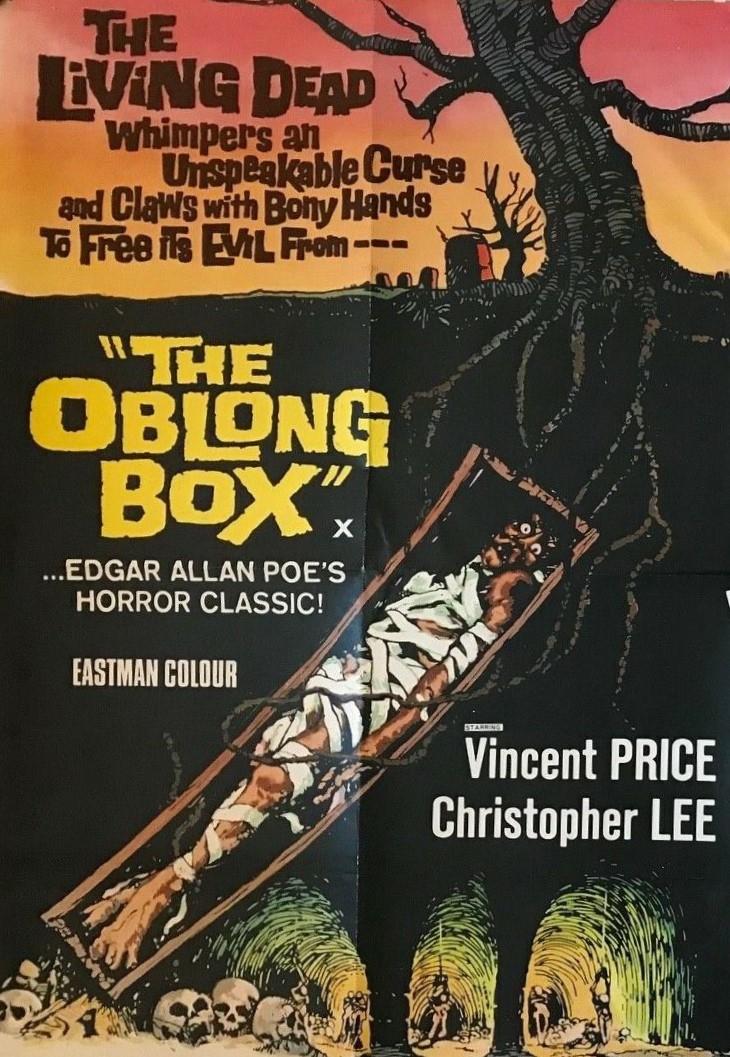
The Oblong Box (1969) ***

Vincent Price and Christopher Lee – two scions of 1960s horror – together, yet anyone expecting a clash of the giants would be sorely disappointed as they only share one short scene. This is a typical American International Pictures venture, based even more typically on an Edgar Allan Poe story, with some stylistic direction – the extreme close-up never more effectively utilized – from Gordon Hessler in his third feature.

Given that German-born Hessler (Catacombs/The Woman Who Wouldn’t Die, 1965) was a last-minute substitute for English director Michael Reeves (Witchfinder General, 1968), he made an exceptionally good job of a complicated plot. The production was even more complicated than that since it was originally intended as a Spanish co-production to be shot in Spain. And at one point writer Lawrence Huntingdon (The Vulture, 1966), who did have form as a director (Death Drums Along the River, 1963), was reportedly also carrying out producer-director duties.

What seems like a mishmash of different stories – African sorcery, grave-robbing, disfigurement, forgery, blackmail, lifetime imprisonment, medical experiment, buried alive, a monster in a scarlet mask – soon comes together in a tense tale of retribution and revenge.

Nineteenth century English aristocrat Julain Markham (Vincent Price) has withdrawn to his country manor, for unknown reasons distancing himself from his fiancée Elizabeth (Hilary Dwyer), but in reality to conceal from the world the fact that he has locked up his own brother, Sir Edward (Alister Williamson). When the brother, a disfigured monster, escapes he embarks on a murder spree.

The various storylines keep the narrative sufficiently entangled to sustain tension. Despite what may appear to a modern audience as primitive special effects, several scenes are bone-chilling largely through directorial manipulation. The Gothic look – graveyards, castles, the village – adds to the atmosphere. The violence was trimmed in America to avoid an “R” rating, but led to the film being banned in Australia.

There is more overt sexuality than normal, a scheming whore Heidi (Uta Levka) tempting a man with her bare breasts, and maid Sally (Sally Geeson) entranced by the monster.

The various plot strands appeared to confuse critics at the time and even now the film receives comments that it is “vague” but at a time when Hammer’s output usually comprised a straightforward – and somewhat limited narrative – I found AIP’s approach to this picture a welcome development. The slowly emerging story set the film up as much as a thriller as a horror.

It’s a bit of a reversal for Vincent Price (Witchfinder General, 1968) to be playing the good guy but that works to the movie’s advantage because you spent most of the time thinking this is just a scam and at some point he will show his true colors. Hilary Dwyer (Witchfinder General) is excellent and Sally Geeson (What’s Good for the Goose, 1969) is an example of the type of woman attracted to rather than revulsed by a killer.

Well worth a look if only to enjoy the distinctive Hessler style.

The Woman Who Wouldn’t Die/Catacombs (1965) ***

Gordon Hessler (The Oblong Box, 1969) makes his directorial debut with this neat horror thriller. It starts with a twist exceptional for the times.  Ellen (Georgina Cookson) is the shrewd and shrewish millionaire businesswoman, her husband Raymond (Gary Merrill), from whom she demands frequent sex, the eye candy, a kept man. “I married a lover, not a businessman,” she retorts when, bored out of his mind, he asks for the opportunity to play a  role in her business. In a further twist on the norm of the damsels decorating 1960s movies by displaying cleavage or disporting themselves in bikinis, Raymond is often seen with his chest bared in all its hirsuteness. In a further gender twist her secretary is also male, Dick  (Neil MacCallum), a former, unknown to her, jailbird.

Tall, beautiful, dominant and domineering Ellen appears to have occult power, able to read minds, which keeps the larcenous-minded Dick in check, and has command of her own physical frailty – she walks with a stick – and can put herself in a trance to overcome occasional pain from her injured hip.

Conspiracy of fear: Raymond (Gary Merrill) and Alice (Jane Merrow).

But when Raymond falls for Ellen’s niece Alice (Jane Merrow), an artist returned from a year in Paris, he puts into action a plan that had clearly only been a pipe-dream, blackmailing Dick into participating. It’s quite clever as murderous plans go. He hires an actress to impersonate Ellen, known to go off to Italy on her own for spa treatments and with a knack for reckless driving, various driving charges over the years. Meanwhile, he strangles Ellen, allows Alice at a distance from an airport viewing terrace, to see her aunt, complete with walking stick, climbing up the steps of a plane. Faked cables and postcards arrive from Italy purportedly showing Ellen enjoying herself, even visiting the famous catacombs. In Italy Dick fakes a car accident to kill the actress.

However, twist number one comes at the reading of the will. Raymond and Alice split the million-pound bounty but while the latter is given custody of the big house the former is condemned to live for life, on pain of forfeiting the inheritance, in the cottage, in whose potting shed Ellen’s body lies. Further twists naturally follow. The maid (Rachel Thomas) doesn’t quite so much smell a rat but adds to the killer’s incipient discomfort by proclaiming that with her hip problem and claustrophobia that Ellen would never descend into the catacombs.

Entitled “Catacombs” in the U.K. after the novel by Jay Bennett on which it was based, it was retitled
“The Woman Who Wouldn’t Die” for the U.S. market.

And Raymond might have lived happily ever after with Alice except for his guilt. Several creepy incidents, knocking, tapping, door handles turning, shadows, a depression the shape of a body in a bed, cigarettes smoking in ashtrays, lights going on and off indicate to the already nervous Raymond and the visibly frightened Alice that Ellen may not be dead after all. Virtually the entire third act is the pair of them reacting to real or imagined fears. Alice has a good line in looking scared witless. But Raymond, while trying to contain his inner demons, is equally rattled.

As you might expect there are further excellent twists to come. In fact, they are soon piling up and even at the very end the screen freezes on a final twist.

Georgina Cookson (The Picasso Summer, 1969) steals the show as the imperious businesswoman, with everyone cowering under her glare and not above stating the obvious, “I bought you body and soul,” she reminds Raymond. I’m not sure Gary Merill (The Power, 1968) is quite as good in the second half as he is in the first. Initially, he exudes charm, physical prowess, and, while under his wife’s thumb, still emotes a certain measure of confidence. He doesn’t appear to me to quite frightened enough in the second half as his plans go awry. Jane Merrow (The Lion in Winter, 1968) is excellent as the young woman caught in a mental trap and Neil MacCallum (The Lost Continent, 1968) is surprisingly effective.

But this is a low-budget B-picture that was destined for the lower half of a double bill so there was no particular reason why it should be as good as it is. Except for the Italian sequence, the action takes place on just two sets and for most of the time it’s a three-hander. But Hessler has a keen eye for composition and in a number of critical scenes makes bold choices. For Ellen’s murder, he concentrates on Raymond’s face rather than the victim’s, only showing her feet. There’s one super-shocker with a mirror. But mostly he is content to built up the tension, either by the various noises or by the reactions of Raymond and Alice. An old-fashioned gem of a picture.

Available on DVD from Network.

Discover WordPress

A daily selection of the best content published on WordPress, collected for you by humans who love to read.

The Atavist Magazine

by Brian Hannan

WordPress.com News

The latest news on WordPress.com and the WordPress community.