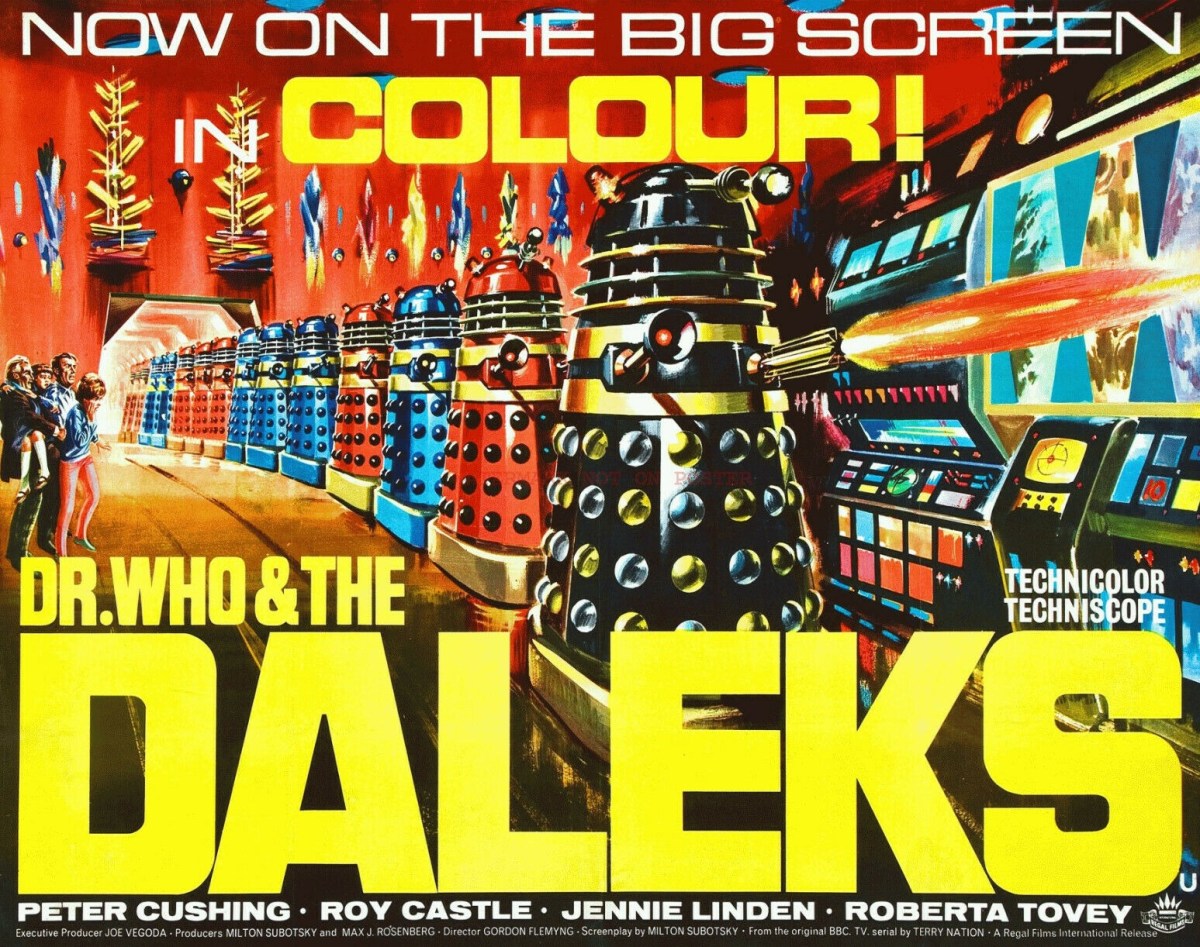
Dr Who and the Daleks (1965) ***

The maiden voyage of the time-travelling Tardis is triggered by some unexpected pratfall comedy. On board are the venerable doctor (Peter Cushing), his intrepid great-granddaughter Susan (Roberta Tovey) and a fearful pair, granddaughter Barbara (Jennie Linden) and accident-prone Ian (Roy Castle). They land on a petrified planet ruled by the robotic Daleks with menacing electronic voices.

The malfunctioning Tardis forces them to investigate an abandoned city but they are quickly imprisoned, the steel robots determined to discover why the earthlings should be immune to the radiation that has consumed this planet after nuclear war. Meanwhile, the planet’s remaining inhabitants, the Thals, are planning an uprising.
Budget restrictions ensure that menace is limited, even as the characters endure a heap of traditional obstacles such as swamp and rocky outcrop. Adults who did not grow up in the 1960s when the BBC television series took Britain by storm and apt to come at this without the benefit of nostalgia will certainly look askance at the sets and costumes. And it doesn’t possess the so-bad-it’s-good quality of some 1950s sci-fi pictures. But since it was primarily made for children, then perhaps it’s better to watch it with a younger person and gauge their response – of course, that may be equally harsh from someone brought up on the modern version of the series or already immersed in superheroes.

On the plus side, it does move along at a clip. Roberta Tovey (A High Wind in Jamaica, 1965) charms rather than annoys as the plucky grand-daughter even if her grandfather has mutated from the sterner figure of the television series into an eccentric inventor. Peter Cushing (The Skull, 1965) is only required to ground the production which he does adequately. The innate comic timing of comedian Roy Castle, in his leading man debut, brings a light touch to proceedings as the bumbling boyfriend and generates some decent laughs. Jennie Linden (Women in Love, 1969) has little to do except look scared.

Oddly enough, it was American Milton Subotsky who, in opportunistic fashion, brought the project to the big screen, although the BBC had a track record of providing product that might make such a leap, The Quatermass Experiment in the 1950s the leading example. He wrote the screenplay and acted as producer and had previously worked with Cushing on Dr Terror’s House of Horrors (1965) and was about to embark on horror masterpiece The Skull the same year. He has approached the material with some reverence and the fact that the budget allowed for hordes of Daleks rather than being seen one or two at a time as on the television probably made some child’s day.

Scottish director Gordon Flemyng (The Split, 1968) would make the leap to Hollywood on the back of this picture and its sequel the following year and you can see what made studios have faith in his ability – he deals with multiple characters, works quickly on a low budget and delivers an attractive picture that was a box office hit.

I suspect that audiences will divide into those who watch the film with nostalgia-colored spectacles, those who think it only as good as a bad episode of Star Trek and those who adore any low-budget sci-fi movie.
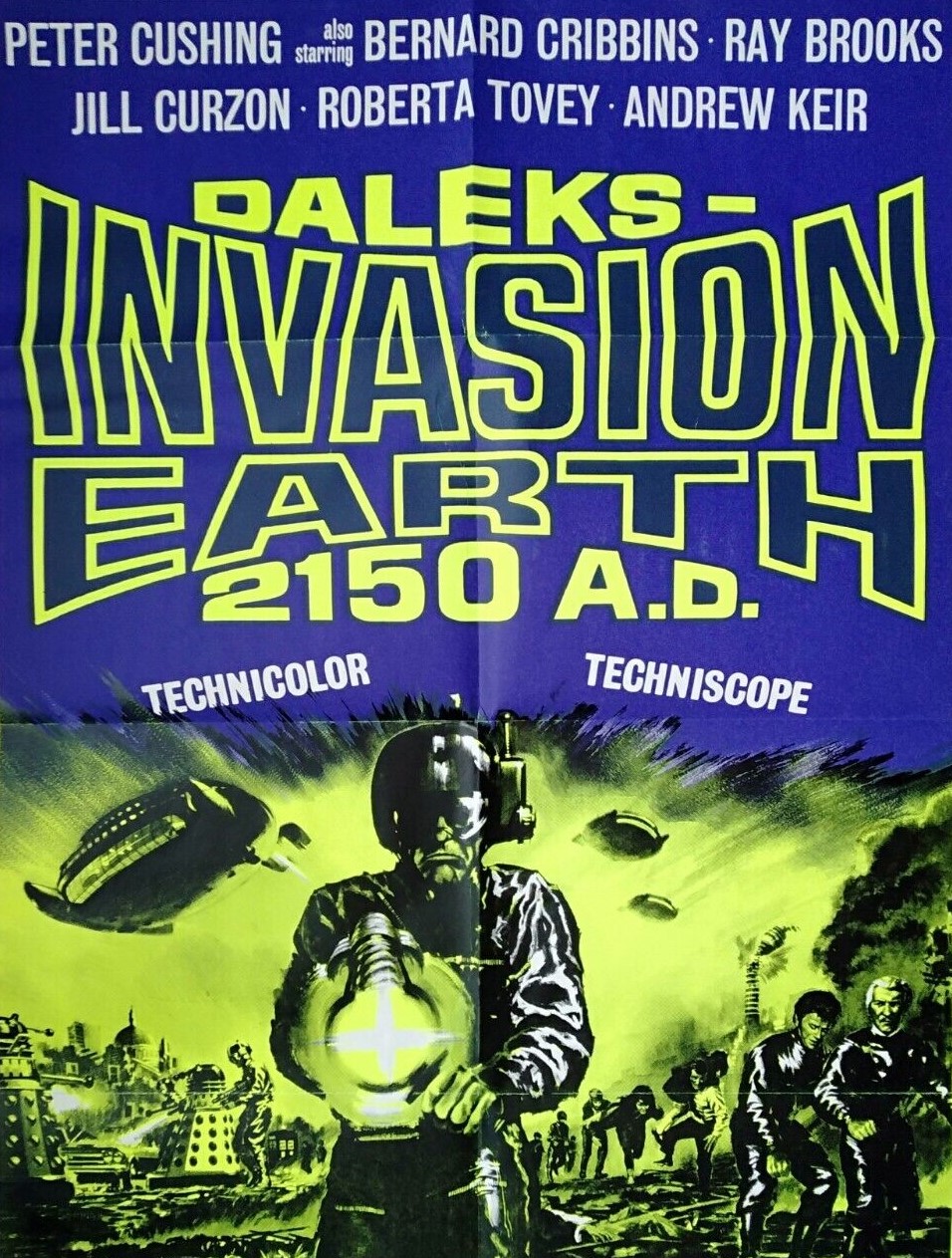
Daleks’ Invasion Earth 2150 A.D. (1966) ***

Sequels being all the rage – James Bond, Matt Helm, Derek Flint, The Pink Panther, The Magnificent Seven – in the 1960s it was no surprise that the success of Dr Who and the Daleks (20th top film at the British box office in 1965) suggested that a second go-round might be as profitable. As was standard, a recurring formula was the key.

In this case, Dr Who (Peter Cushing) and grand-daughter Susan (Roberta Tovey) repeated their previous roles though another grand-daughter Barbara (Jennie Linden) was replaced by a niece Louise (Jill Curzon) and hapless passenger Ian (comedian Roy Castle) was ousted in favour of  hapless London cop Tom (comedian Bernard Cribbins). But returning director Gordon Flemyng (The Split, 1968) upped the ante. Instead of waiting ages for the dreaded mechanical monsters with their electronic catchphrase (“Exterminate”) to appear, they turn up virtually in the first reel.

As if to emphasise the versatility of the Tardis, this time instead of space travel it’s time travel, Dr Who turning up in a blitzed London virtually two centuries ahead only to discover his nemesis rules the planet. It being set in a familiar locale, nobody is loaded down with information dumps, a tedious feature of the first picture, and it doesn’t take as long to get going, and our heroes, in various configurations, and while befriending the rebels – leader Wyler (Andrew Keir) and David (Ray Brooks) – endure a cycle of trap and escape while the good doctor tries to work out what brought the daleks to his home planet.

I’m giving this the benefit of the doubt and suggesting that the first appearance of the daleks is a homage to Dr No (1962) although one of the creatures emerging from the River Thames is hardly a patch in the sexy-entrance stakes as a bikini-clad Ursula Andress. Amidst all the mayhem, there are a couple of standout sequences, the best of which is a comedy skit involving Tom, disguised as a leather-clad member of the brainwashed automatons. This reminded me of Bob Hoskins in the first Super Mario Bros (1993 vintage) being trapped in an elevator with the Goombas. Tom is just too human to fit into this gang, constantly out of step with their actions.

Naturally, the Dr Who team are split up, allowing the action to move into two converging directions. The daleks plan to turn the planet into a giant spacecraft it can tow around, that storyline somehow involving a mining operation outside London while there’s some clever sci fi tomfoolery using the Earth’s magnetic poles to destroy the enemy.

Oops, I’ve given away the climax. Not that anybody cares that much, the main fun being the escaping formula – the daleks even use this as a plot twist, commending the intelligence of any human who can manage to escape – and watching the doctor outwit the enemy. Actually, the main fun is the dastardly daleks. Every time they appear you can imagine yourself back in a cinema crammed with thousands of kids yelling “Exteminate! Exterminate!”  

The plot keeps rolling along, no time to draw breath. And we’re not having to bother with any of the boring MCU claptrap intent on giving the super-villains a backstory or expiating their evil brains. The daleks represent alien domination, and they’re not here to give lectures on inhumanity or peace. In their determination to kill, they could almost be contemporary, given the number of serial killers and/or madmen clogging up cinema screens.

If not conspicuously inventive, Gordon Flemyng’s management of a large cast and a variety of action brought him to Hollywood attention. Given the storied career of Peter Cushing (The Skull, 1965) storied career, his performances as the doctor are generally overlooked, which is a pity, because he is certainly among the best to essay this character.  Carry On regular Bernard Cribbins livens up proceedings without needing to resort to slapstick in the Roy Castle mode. This must have seemed a bit of a come down for Ray Brooks after unexpected hit The Knack (1965) but he always seemed more at home on the small screen (although Flemyng hired him again for The Last Grenade, 1970).

The series ended here after the movie flopped on home territory. The original had bombed in the States, so the producers were heavily dependent on British box office. I guess just getting U.S. audiences aware there was such a thing in Britain as a “police box” would have been harder to grasp than the fact that it housed a time machine, and that the interplanetary craft was just there without a whole story about how it had come into being.

Made on a miserly budget by anybody’s standards, the sfx was never going to come up to scratch. But who cares.

“Exterminate! Exterminate!”

https://amzn.to/3FkXVJa

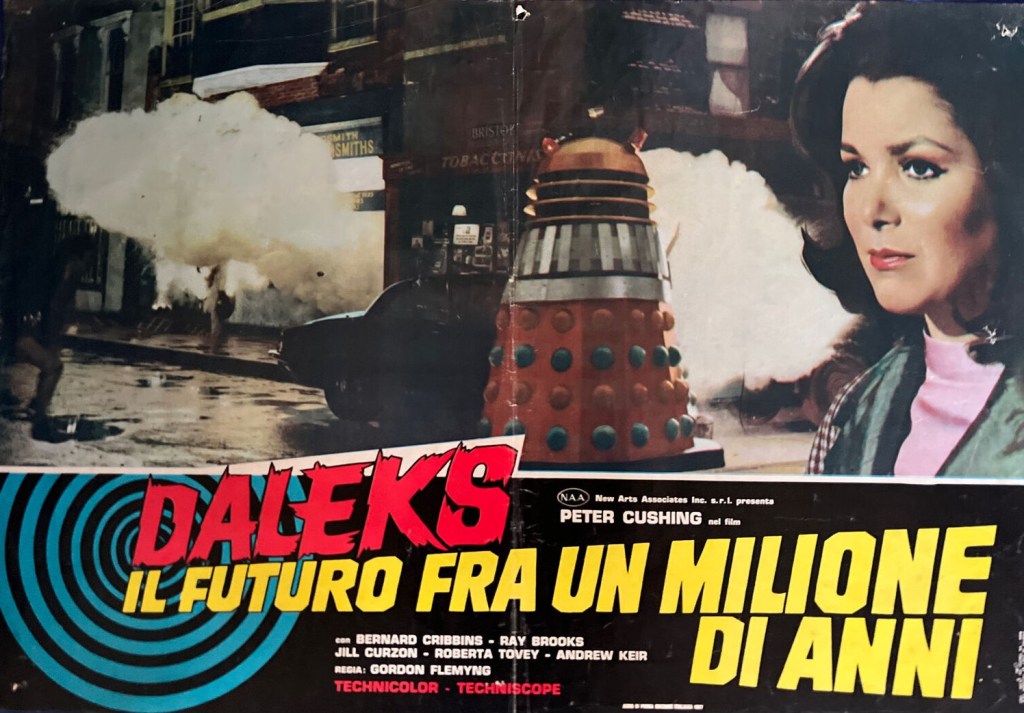
Dr Who and The Daleks (1965) ***

The maiden voyage of the time-travelling Tardis is triggered by some unexpected pratfall comedy. On board are the venerable doctor (Peter Cushing), his intrepid great-granddaughter Susan (Roberta Tovey) and a fearful pair, granddaughter Barbara (Jennie Linden) and accident-prone Ian (Roy Castle). They land on a petrified planet ruled by robotic Daleks with menacing electronic voices.

The malfunctioning Tardis forces them to investigate an abandoned city but they are quickly imprisoned, the steel robots determined to discover why the earthlings should be immune to the radiation that has consumed the planet after nuclear war. Meanwhile, the planet’s remaining inhabitants, the Thals, are planning an uprising.

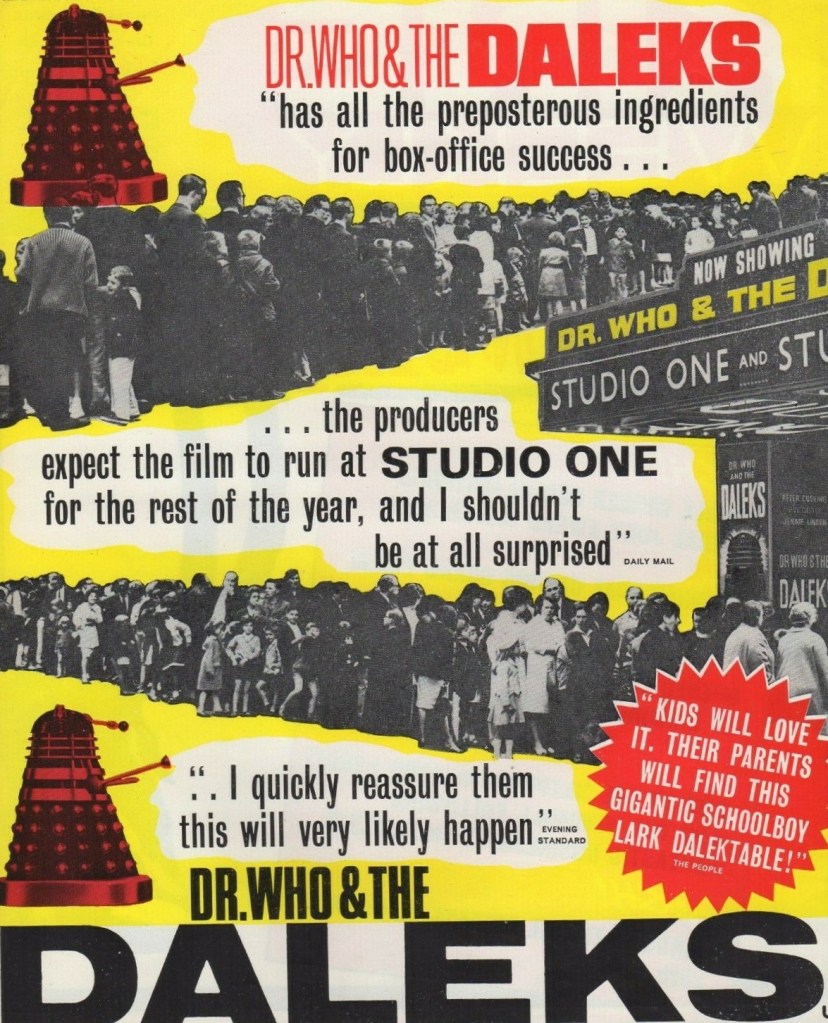
Studio One was one of the smallest cinemas in London’s West End and often used as the launch pad for Disney pictures. Limited capacity ensured that a hit film would run for months and the crowds queueing outside would attract the attention of other passersby.

Budget restrictions ensure that menace is limited, even as the characters endure a heap of traditional obstacles such as swamp and rocky outcrop. Adults who did not grow up in the 1960s when the BBC television series took Britain by storm and apt to come at this without the benefit of nostalgia will certainly look askance at the sets and costumes. And it doesn’t possess the so-bad-it’s-good quality of some 1950s sci-fi pictures. But since it was primarily made for children, then perhaps it’s better to watch it with a younger person and gauge their response – of course, that may be equally harsh from someone brought up on the modern version of the series or already immersed in superheroes.

On the plus side, it does move along at a clip. Roberta Tovey (A High Wind in Jamaica, 1965) charms rather than annoys as the plucky grand-daughter even if her grandfather has mutated from the sterner figure of the television series into an eccentric inventor. Peter Cushing (She, 1965) is only required to ground the production which he does adequately. The innate comic timing of Roy Castle, in his leading man debut, brings a light touch to proceedings as the bumbling boyfriend and generates some decent laughs. Jennie Linden (Women in Love, 1969) has little to do except look scared.

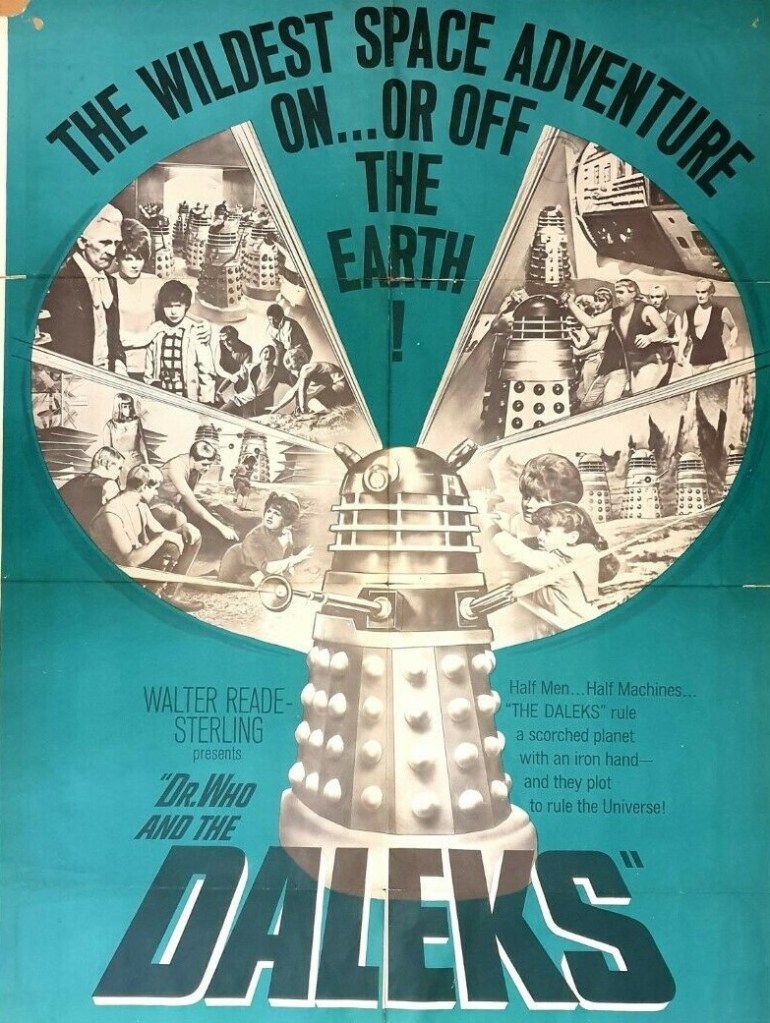
With no built-in audience, the U.S. distributors marketed it in typical fashion – “half men half-machine” – and possibly roped in a bigger adult audience unaware of its origins in children’s television.

Oddly enough, it was American Milton Subotsky who, in opportunistic fashion, brought the project to the big screen, although the BBC had a track record of providing product that might make such a leap, The Quatermass Experiment in the 1950s the leading example. He wrote the screenplay and acted as producer and had previously worked with Cushing on Dr Terror’s House of Horrors (1965) and was about to embark on horror masterpiece The Skull the same year. He has approached the material with some reverence and the fact that the budget allowed for hordes of daleks rather than being seen one or two at a time as on the television probably made some child’s day.

Scottish director Gordon Flemyng (The Split, 1968) would make the leap to Hollywood on the back of this picture and its sequel the following year and you can see what made studios have faith in his ability – he deals with multiple characters, works quickly on a low budget and delivers an attractive picture that was a box office hit.

I suspect that audiences will divide into those who watch the film with nostalgia-colored spectacles, those who think it only as good as a bad episode of Star Trek and those who adore any low-budget sci-fi movie.
You can catch this on Amazon Prime.

The Split (1968) ***

You could not have a more explosive start. In the wake of the seismic slap Sidney Poitier delivered to an arrogant white man in In the Heat of the Night (1967) heist mastermind McClain (Jim Brown) bursts out of the traps by: picking a down-and-dirty knuckle-duster of a fight with hardman Bert (Ernest Borgnine); ramming a limo driven by Harry (Jack Klugman); locking technical wizard Marty (Warren Oates) in an electronic cell; and bracing marksman Dave (Donald Sutherland). It turns out these are all auditions for a $500,000 robbery from the Los Angeles Coliseum during a football match. Nonetheless, the point is made. Despite explanation for the ferocity it scarcely masks the fact that here was a hero unwilling to take any crap from anybody.

The Split follows the classic three acts of such a major crime: recruitment, theft, fall-out. Gladys (Julie Harris) sets up the daring snatch, entrusting a down-on-his-luck McClain –   attempting reconciliation with divorced wife Ellie (Diahann Carroll) – with pulling together a gang with particular sets of skills. The clever heist goes smoothly, the cache smuggled out in a gurney into a stolen ambulance, itself hidden in a truck, and spirited away to Ellie’s apartment until the ruckus dies down.

But someone else has a different plan. The stolen money is stolen again. McClain, responsible for its safekeeping, is blamed for its loss, while he suspects all the others. Adding to the complications is a corrupt cop (Gene Hackman). So it’s cat-and-mouse from here on in, McClain dodging bullets as he attempts to clear up the mess, find the loot and evade the cops.  

British release in a double bill with “Woman without a Face
originally released in the U.S. as “Mister Buddwing.”

The title refers to the way the way the money is intended to be shared out but it could as easily point to a film of two halves – recruitment/robbery and fall-out. The first section has several stand-out moments – a split-screen credit sequence, Marty’s desperate strip inside the cell to prevent the electronic door closing, an asthma attack mid-robbery, the beat-the-clock element of the heist, Dave’s targeting of tires to create the massive gridlock that facilitates escape. Thereafter, the tension grows more taut, as the thieves fall out with murderous intent.

One of the joys of the picture is watching a bunch of actors on the cusp. Jim Brown (The Dirty Dozen, 1967) was in the throes of achieving a stardom that would soon follow for Hackman (Bonnie and Clyde, 1967), Sutherland (also The Dirty Dozen) and Oates (Return of the Seven, 1966). Brown is tough and cynical in the Bogart mold, a loner with lashings of violence in his locker. Of the supporting cast, Sutherland’s funny maniac, complete with mordant wit, is the pick and he has the movie’s best line (“The last man I killed for $5,000. For $85,000 I’d kill you seventeen times.”) Hackman reveals an intensity that would be better showcased in The French Connection (1971) and Borgnine, Oscar-winner for Marty (1955) reverts to his tough guy persona. Having said that, you only get glimpses of what they are capable of.

Making the biggest step-up is Scottish director Gordon Flemyng whose last two pictures were Dr Who and the Daleks (1965) and Daleks’ Invasion Earth A.D. 2150 (1966). He helms the picture with polish and confidence, allowing the young bucks their screen moments while wasting little time in getting to the action and pulling off a mean car chase.

Crime writer Richard Stark’s (pseudonym of Donald E. Westlake) was careful to sell the rights to his books one-by-one so that no single studio could acquire his iconic thief Parker. That accounted for him being renamed Walker in Point Blank (1967), Edgar in Pillaged (1967) and McClain in The Split, which was based on Stark’s The Seventh (that fraction being the character’s share of the loot).

Discover WordPress

A daily selection of the best content published on WordPress, collected for you by humans who love to read.

The Atavist Magazine

by Brian Hannan

WordPress.com News

The latest news on WordPress.com and the WordPress community.