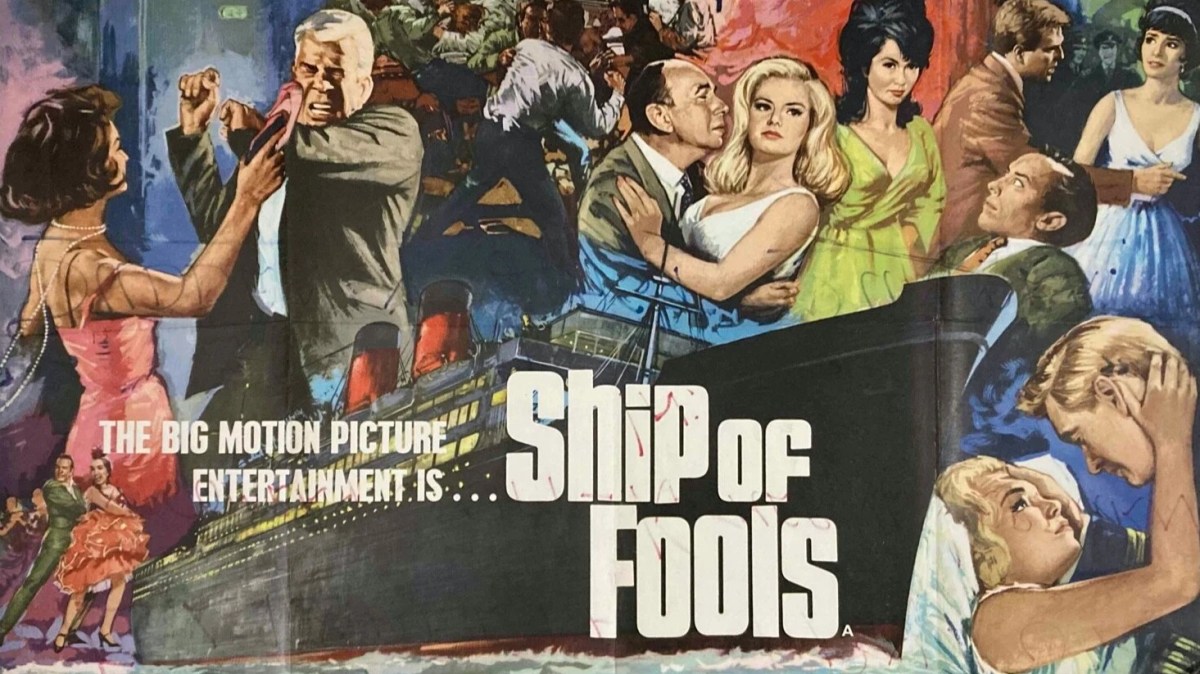
Ship of Fools (1965) ****

Too easily dismissed as soap opera masquerading as a movie making a serious point, this is redeemed and, in some respects, elevated by the performances. If anything, the two political aspects are underdone. The heavy air that hangs over proceedings given the German passengers are heading back to Nazi Germany at the start of Hitler’s reign in 1933 with no idea of the outcome is only there in the audience’s mind. That the racism is underplayed is in part due to the fact that those victimized, a Jew and a disabled man, refuse to act as victims and indeed bond.

The other political aspect, of Spaniards being deported from Cuba for economic reasons, would have more resonance today. But they, too, are heading for consequence and the Spanish Civil War which would break out a few years later. Director Stanley Kramer was noted, indeed often ridiculed, for tackling weighty subjects in movies like The Defiant Ones (1958), On the Beach (1959), Judgement at Nuremberg (1961) and Inherit the Wind (1961). That was tempered somewhat when he went off-piste for It’s a Mad, Mad, Mad, Mad World (1963) and although that’s generally remembered for its hilarity what’s often overlooked is the director’s dexterity in handling a busload of characters and narratives, his pacing and his understanding of character.
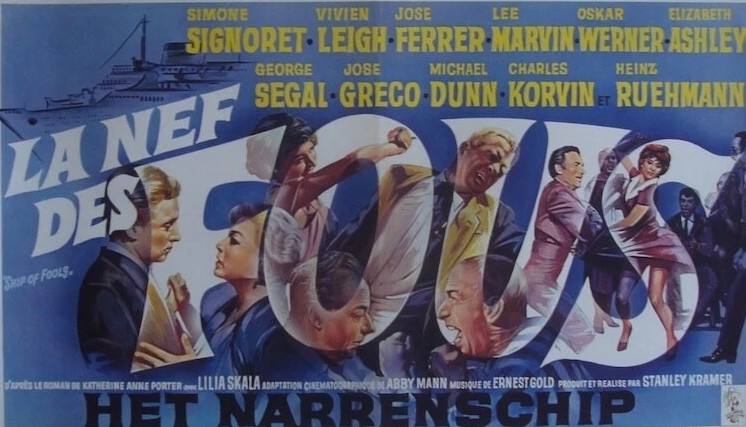
Deduct the comedy and you have a similar approach here, the meshing of various narrative arcs while allowing character to flourish so the general smorgasbord of, if I’m allowed such an obvious notion, ships passing in the night is what gives this more heft.  And the fact that the audiences knows more than the characters about what the future holds permits the director just to concentrate of character interaction.

Unusually, for a historical movie of the period, it’s the females who dominate and have the best storylines. The ship is so full that upscale single passengers who might otherwise have the choice of dining alone are thrown together thus divorcee Mary Treadwell (Vivien Leigh) shares a table with former baseball player Bill Tenny (Lee Marvin).

Their paths unexpectedly cross in unusual fashion. Both are seeking love, though in reality Tenny is happy to settle – and pay for – sex. Mary finds Captain Thiele (Charles Korvin) ignoring her subtle advances while in turn she dismisses the lieutenant. When a drunken Tenny without warning bursts into her cabin, she responds with ardor until she realizes he thinks she’s a prostitute.
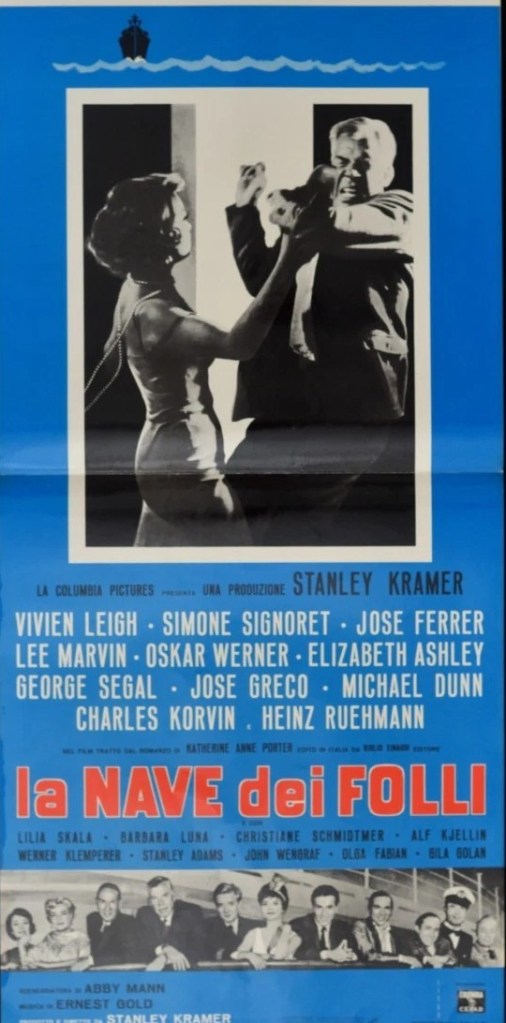
La Condesa (Simone Signoret) is a civil rights activist who finds a fellow traveler in Dr Schumann (Oskar Werner). Although, initially, she mines him to feed her opiate addiction, it’s soon apparent they  are falling in love, although that doesn’t end well. Not much ends well in the romance department, Jenny (Elizabeth Ashley), while initially supportive of artist David (George Segal), soon realizes that his art will take dominance in their relationship.

The older Rieber (Jose Ferrer), with the most pronounced Nazi sympathies, has taken up with younger blonde Lizzi (Christiane Schmidtmer), among whose physical attractions is that she’s a great table tennis player, until she discovers he’s married.

Flamenco dancer Elsa (Gila Golan) is pimped out by her father Pepe (Jose Greco). Social exclusion leads Jew Lowenthal to bond with Glocken who suffers from dwarfism and when German World War One hero Freytag is forced to join them that permits most of the discussion about the state of Germany.

Otherwise, the fact that a mastiff is permitted to sit at table is more to do with aristocratic entitlement than any other social condition. 

For once, Kramer is more interested in character than scoring points. So what might have been heavy going turns into an acting class. To accommodate its portfolio of ageing superstars Hollywood had returned to the subgenre of movies about ageing beauties. Double Oscar-winner Vivien Leigh’s previous outing The Roman Spring of Mr Stone (1961) belonged in that category but this latest reincarnation was a class above, a truly tender examination of loss. However, it was Simone Signoret (The Deadly Affair, 1967) who was Oscar nominated.

Michael Dunn (Justine, 1969) and Oskar Werner (Interlude, 1968) were nominated and while Lee Marvin (Point Blank, 1967) and George Segal (The Bridge at Remagen, 1968) were overlooked the latter two clearly scored points judging by their future acceptance in the Hollywood hierarchy, Marvin in particular alerting the industry to untapped talent, a point made more emphatically in his next picture Cat Ballou for which he won Best Actor. Ship of Fools missed out to The Sound of Music for Best Film. Nominated for eight awards it picked up two, ernest Laszlo for Cinematogrpahy and Robert clatworthy and Joseph Kish foir Art Direction

You might also spot Alf Kjellin (Ice Station Zebra, 1968), Barbara Luna (Firecreek, 1968) and Gila Golan (The Valley of Gwangi, 1969).

Even without the political overhang, this holds together as Grand Hotel on the high seas with Stanley Kramer in his element employing compelling characters to flesh out an interesting narrative. Written by Abby Mann (Judgement at Nuremberg) from the Katherine Anne Porter bestseller.

While the politics add a contemporary veneer, watch it for the acting.

The Valley of Gwangi ****

The special effects are in the five-star range while the movie into which they fit is really worth no more than three stars so I’ve compromised, hence the four-star rating. Actually, the story and characters are interesting enough, and there are some stunning cowboy stunts,  though where is a fur-lined bikini when you need one. Although we are treated to prehistoric monsters, humans fail to have managed the transition to the hidden valley where the creatures have kept out of sight for millions of years. Instead, we are in turn-of-the-twentieth-century Mexico.

However, one specimen, a miniature horse, known as El Diablo, has been found and now resides in a rodeo, property of T. J. Breckenridge (Gila Golan) whose showstopping turn involves leaping on horseback from a high platform through a ring of fire into a pool of water.  Ex-flame and sleek salesman Tuck (James Franciscus) and archaeologist Professor Bromley (Laurence Naismith) follow gypsies who aim to return the horse to the Forbidden Valley. T.J. and a band of cowboys are in pursuit.

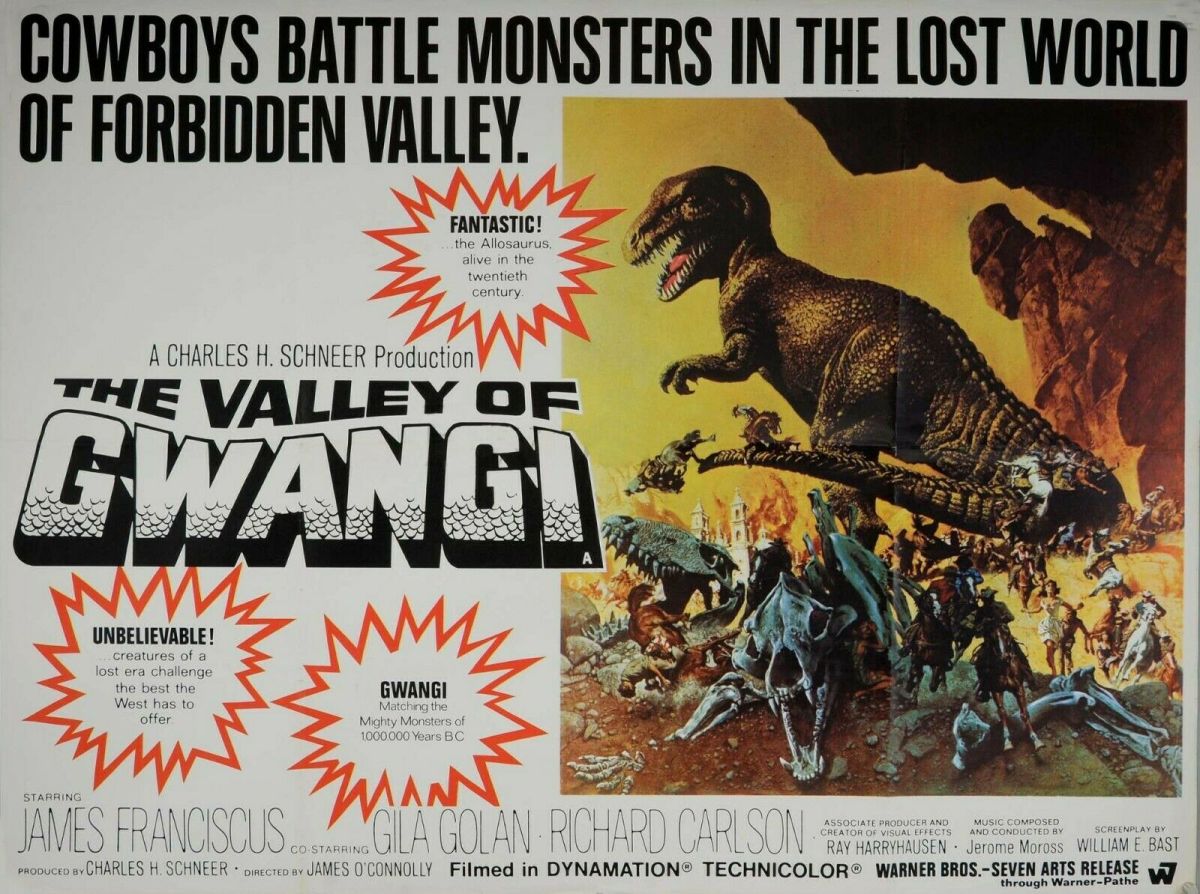
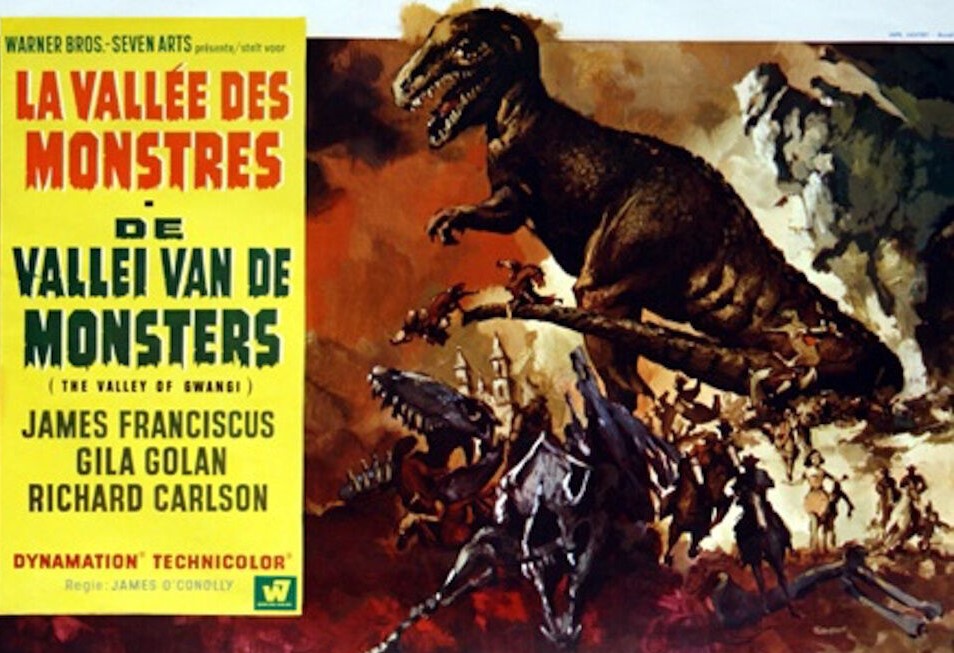
Widening a tiny gap into the unknown world also of course means it’s not big enough for the monsters to escape. The valley is ruled by Gwangi, an Allosaurus, which to most of the audience looks remarkably like a T. Rex. Various battles ensure. A Pteranadon swoops down from the sky and captures one of the cowboys but is killed by Carlos (Gustavo Rojo). Gwangi fights an Ornithomimus and a Styracosaurus. Even if your knowledge of prehistoric monsters  isn’t up to identifying each creature, no matter, the fights are very well done, and a step up in terms of special effects from similar tussles in Harryhausen’s previous venture in One Million Years B.C. (1966) especially as we are less distracted by females attired in fur bikinis.

Naturally, the intent is to capture Gwangi and put him on show a la King Kong (1933) and it’s equally obvious how this particular maneuver is going to work out. That the story follows this particular angle is down to the fact that this movie was the original idea of Willis O’Brien, the special effects genius to created King Kong. After considerable development, RKO shelved the project on the assumption the public was not interested in dinosaurs.

Meanwhile, back in the human tale, the previously principled T.J. lets greed get the better of her and begins resisting Tuck’s overtures. Even if you can guess the finale, it is pretty well done.

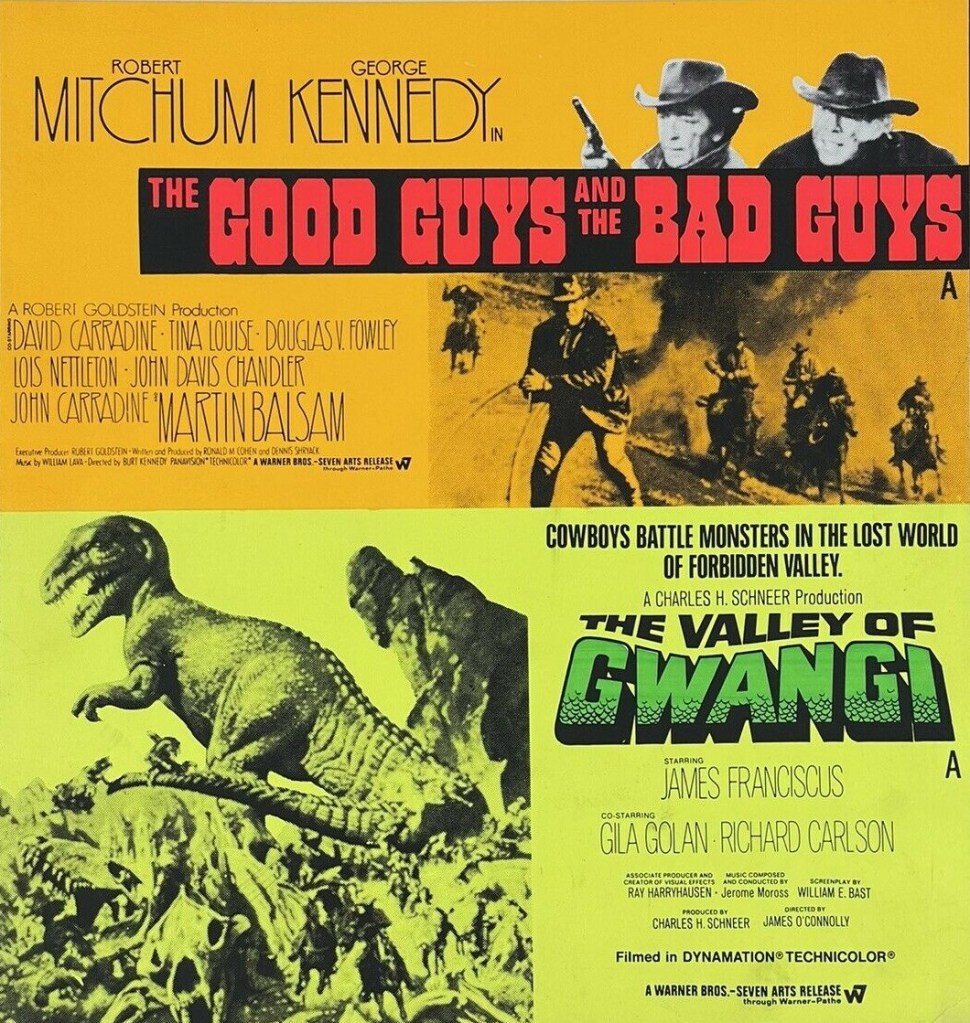
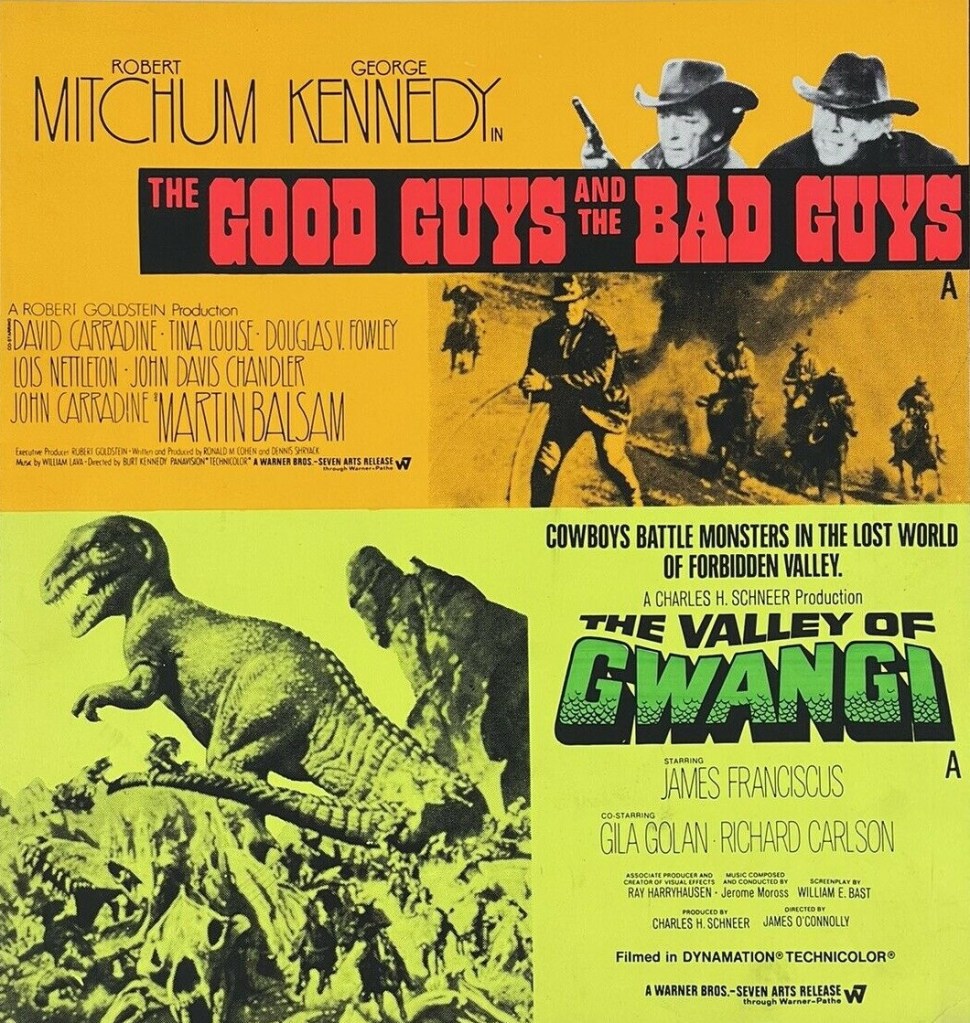
Ray Harryhausen only had a limited fanbase in the 1960s, otherwise this picture would not have done the rounds as the supporting feature to Robert Mitchum western The Good Guys and the Bad Guys (1969). You can tell it lacked the budget of One Million Years B.C. because the creatures fail to remain a consistent color. Even so, this ranks as one of the top special effects achievements and these days Harryhausen’s work is much more appreciated.

Unless you are Raquel Welch, it’s difficult for an actor to compete with prehistoric monsters. At least here, the stars had decent dialog and the tangled romance provides entertainment as do the host of stunning stunts in the rodeo and a bull running amok. Charlton Heston look-alike James Franciscus (Youngblood Hawke, 1964) is a plausible love interest who doesn’t let romance get in the way of a fast buck. The role of Gila Golan (Our Man Flint, 1966) extends to more than eye candy and there’s not a bikini in sight or disrobing of any sort. Richard Carlson (Creature from the Black Lagoon, 1954) was a sci-fi veteran and Laurence Naismith had appeared in Jason and the Argonauts (1963). British actress Freda Jackson (The Third Secret, 1964) plays a witch.

Director Jim O’Connolly (Vendetta for the Saint, 1969) keeps the human elements rolling along and once monsters join in the fun there’s scarcely time to draw breath. William Bast (Hammerhead, 1968) pulled together the human and monster elements for the screenplay.

Harryhausen fans will have a ball.

The Valley of Gwangi (1969) ****

The special effects are in the five-star range while the movie into which they fit is really worth no more than three stars so I’ve compromised, hence the four-star rating. Actually, the story and characters are interesting enough, and there are some stunning cowboy stunts,  though where is a fur-lined bikini when you need one. Although we are treated to prehistoric monsters, humans fail to have managed the transition to the hidden valley where the creatures have kept out of sight for millions of years. Instead, we are in turn-of-the-twentieth-century Mexico.

However, one specimen, a miniature horse, known as El Diablo, has been found and now resides in a rodeo, property of T. J. Breckenridge (Gila Golan) whose showstopping turn involves leaping on horseback from a high platform through a ring of fire into a pool of water.  Ex-flame and sleek salesman Tuck (James Franciscus) and archaeologist Professor Bromley (Laurence Naismith) follow gypsies who aim to return the horse to the Forbidden Valley. T.J. and a band of cowboys are in pursuit.

I saw this double bill in 1969 when it was shown on the ABC circuit in Britain.

Widening a tiny gap into the unknown world also of course means it’s not big enough for the monsters to escape. The valley is ruled by Gwangi, an Allosaurus, which to most of the audience looks remarkably like a T. Rex. Various battles ensure. A Pteranadon swoops down from the sky and captures one of the cowboys but is killed by Carlos (Gustavo Rojo). Gwangi fights an Ornithomimus and a Styracosaurus. Even if your knowledge of prehistoric monsters  isn’t up to identifying each creature, no matter, the fights are very well done, and a step up in terms of special effects from similar tussles in Harryhausen’s previous venture in One Million Years B.C. (1966) especially as we are less distracted by females attired in fur bikinis.

Naturally, the intent is to capture Gwangi and put him on show a la King Kong (1933) and it’s equally obvious how this particular maneuver is going to work out. That the story follows this particular angle is down to the fact that the movie was the original idea of Willis O’Brien, the special effects genius to created King Kong. After considerable development, RKO shelved the project on the assumption the public was not interested in dinosaurs.

Meanwhile, back in the human tale, the previously principled T.J. lets greed get the better of her and begins resisting Tuck’s overtures. Even if you can guess the finale, it is pretty well done.

Ray Harryhausen only had a limited fanbase in the 1960s, otherwise this picture would not have done the rounds as the supporting feature to Robert Mitchum western The Good Guys and the Bad Guys (1969). You can tell it lacked the budget of One Million Years B.C. because the creatures fail to remain a consistent color. Even so, this ranks as one of the top special effects achievements and these days Harryhausen’s work is much more appreciated.

Unless you are Raquel Welch, it’s difficult for an actor to compete with prehistoric monsters. At least here, the stars had decent dialogue and the tangled romance provides entertainment as do the host of stunning stunts in the rodeo and a bull running amok. Charlton Heston look-alike James Franciscus (Youngblood Hawke, 1964) is a plausible love interest who doesn’t let romance get in the way of a fast buck. The role of Gila Golan (Our Man Flint, 1966) extends to more than eye candy and there’s not a bikini in sight or disrobing of any sort. Richard Carlson (Creature from the Black Lagoon, 1954) was a sci-fi veteran and Laurence Naismith had appeared in Jason and the Argonauts (1963). British actress Freda Jackson (The Third Secret, 1964) plays a witch.

Director Jim O’Connolly (Vendetta for the Saint, 1969) keeps the human elements rolling along and once monsters join in the fun there’s scarcely time to draw breath. William Bast (Hammerhead, 1968) pulled together the human and monster elements for the screenplay.

Harryhausen fans will have a ball.

Discover WordPress

A daily selection of the best content published on WordPress, collected for you by humans who love to read.

The Atavist Magazine

by Brian Hannan

WordPress.com News

The latest news on WordPress.com and the WordPress community.