Homicidal (1961) ****

William Castle (The Tingler, 1959) was always a cult director but 60 years later this hits a contemporary bullseye with uncanny accuracy. It couldn’t be more Hitchcockian, down to the director making an appearance at the start and adopting the same lugubrious tones as Alfred Hitchcock did for his television series.

Bookended by two brilliant scenes, one of mystery, the other revelation, it’s only when you go back and unravel the way this has been put together you realise how fiendishly clever – and heartrendingly awful – it had been. Gender identity, in case you hadn’t guessed, is a central theme.
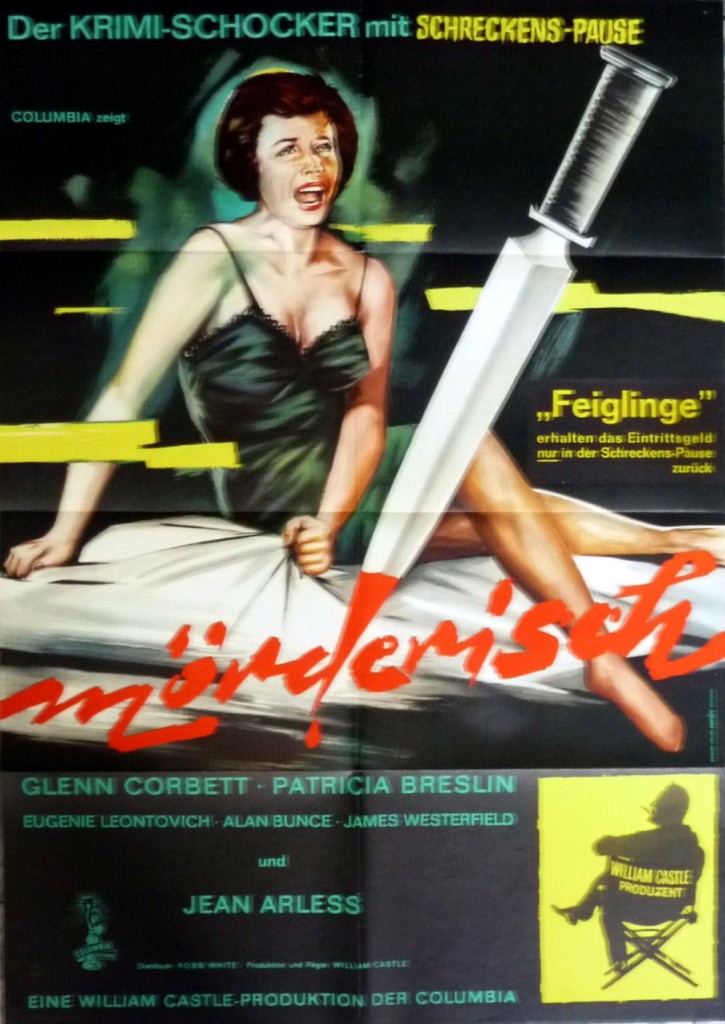
Castle wasn’t known for concentrating on any emotion beyond fear but this goes back to the most basic of all emotions. Who am I? How do I figure myself out? And even the acting – almost as black-and-white as the picture with one over-the-top character and one so weak he almost drains the picture of any life – makes more sense in retrospect.

Stunning blonde Miriam Webster (Jean Arless) checks into a hotel and offers bellhop Jim (Richard Rust) $2,000 to marry her that night on the understanding the marriage will immediately be annulled. Puzzled, and of course fancying his chances of sex as a tip, he drives her to local Justice of the Peace Alfred S. Adrims (James Westerfield) who demands an increased fee for getting dragged out of bed. In short order, Miriam murders him and his wife and escapes.

Turns out she’s not Miriam Webster. That’s the name of a florist in the town where Emily, her real name, looks after mute invalid Helga (Eugenie Leontovich). The real Miriam (Patricia Breslin) is half-sister to businessman Warren (George Marshall), returning home after a lengthy absence to claim his inheritance. At the age of 21, in a couple of days’ time, he falls heir to a $10 million fortune. Helga was his Danish nanny whom he resolved to provide care for after a heart attack.

But it’s soon clear that Emily hates her charge who can only communicate, and only to draw attention, by using a clacker to batter against her wheelchair. When Miriam visits Helga, Emily skips out, promising to return shortly, only to tell Miriam’s boyfriend Karl (Glenn Corbett) that she’s been detained and won’t be free to join him for a picnic.

Then she proceeds to smash up Miriam’s flower shop, in particular destroying anything that points to a wedding, and tearing up a photograph of Miriam’s half-brother. When Carl pops in, she knocks him out.

So what’s with all the wedding malarkey? You won’t be surprised to learn it’s something of a red herring, especially as Emily is already married to Warren, news that comes as a shock to Miriam.

Warren has the constitution of a weakling and looks the kind of boy who would have been trampled over as a child. Except, it turns out, he was bullied by his father, a driven businessman, and whipped by Helga to turn him into someone a lot sturdier, able to stand on his own two feet, and not get knocked around. If anything, he was inclined to be the bully.

Emily should have murdered the bellboy when she had the chance because of course he goes and rats on her and now there’s an illustration of her in the newspaper and the cops are on her trail having tracked down a Miriam Webster living in her town.

Naturally, Warren rejects the notion, but Miriam isn’t so sure. There was an incident in her bedroom and she had lied to Miriam about nipping out for a few minutes and something had been dropped among the debris in the florist shop that linked its destruction to Emily.

So if Emily’s married to a man who’s about to become a multi-millionaire and by far the richest guy in town and with who knows what influence that could buy…You see where this is going? Or if the deeply-in-love Warren could tolerate a wife with homicidal tendencies? Or if she would inherit should Warren have a nasty accident? You see where else this could be heading?

Well, it goes to none of those places. And I’m not going to spoil the climax by telling you exactly where it goes, but it’s a shocker for sure and just superbly done.

And once that revelation’s out in the open everything else makes sense – and doesn’t. For what is at its heart is something so jarring real and troubling, an emotion with consequence, that it neatly fits into one of the most compelling controversies of today.

Otherwise, it’s a perfectly good straight-up thriller, owing much to Psycho (1960), especially the knife-wielding killer, but with some thrilling moments and, in another contemporary salute, busting open the fourth wall with the “Fright Break” gimmick where at the height of proceedings the director literally stops the clock and gives the audience 45 seconds to get out of the theater if they can’t take any more.

If you think William Castle has managed some sleight-of-hand I’m going to have to fess up and say I’ve done the same but you’ll only understand what if you watch the film. Anyone who guesses it can let me know.

There’s a prize. A copy of my latest book, shipped to anywhere in the world, 1960s Movies Redux, Volume 1 – printed copy available now, e-book shortly.

The Blood Beast Terror (1968) ***

As the title suggests there’s a vampiric element, and there’s not a great deal unusual in that, Hammer having successfully revived interest in bloodsuckers. What is unusual, however, and a couple of years before that studio’s The Vampire Lovers (1970) is the idea of female empowerment. Previously, the sole purpose of a damsel in a horror picture was to lay bare a convenient bosom for a passing thirsty creature, or, have their clothing disarrayed and let out a scream when a monster pounced.

The twist here is that the vampire is a woman, Clare (Wanda Ventham), and men who are the victims except on the occasions when her father Dr Mallinger (Robert Flemyng) hypnotizes young women in order to give the creature a blood transplant. The beast exists as a creature and then morphs into Clare. For a time it looks as if Clare is merely possessed, but in reality appears much more as if she is enjoying being the beast, abandoning the enforced respectability of the times, luring men into the forest to have her rapacious way with them, the men naturally thinking they are in for a romantic tryst rather than being targeted by a predator.

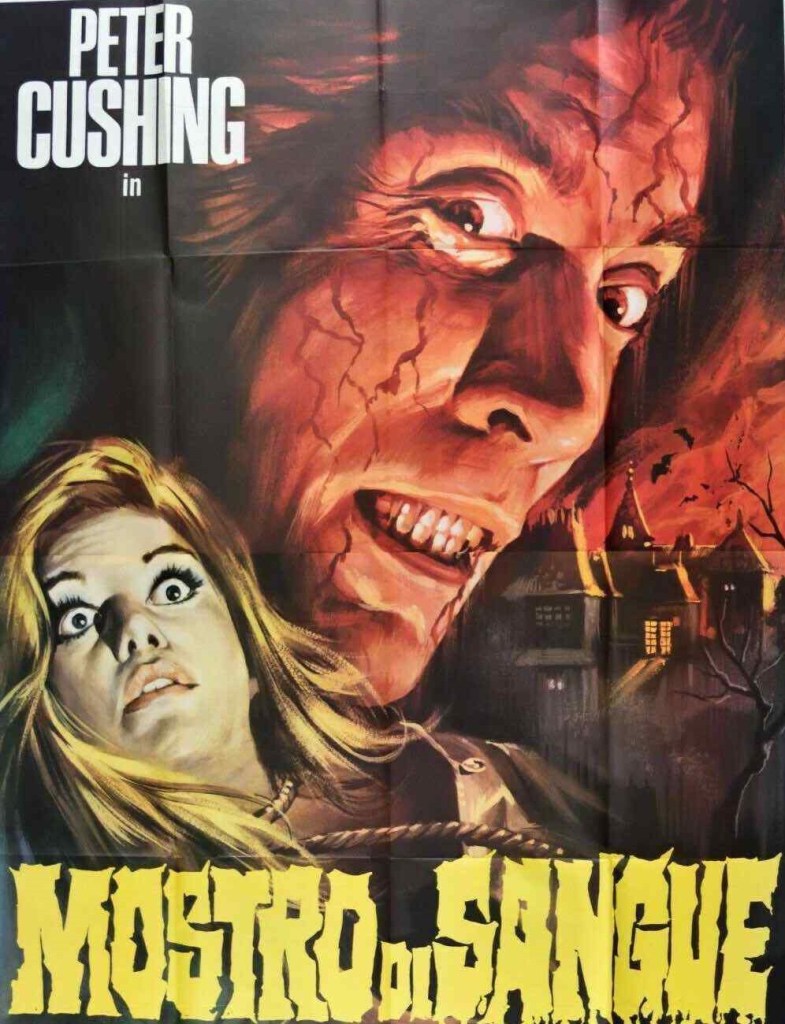
Continuing the theme of misleading the audience, this poster cleverly suggests that it’s a man who is the beast and the woman who are the victims.

There’s a wonderful scene that gives an insight into her mindset. Her friends put on a little play. Her role is the monster, a part she seizes with relish.

It’s one of those films you have to work out backward. In standard horror fashion it leaves the twist till close to the end and it would have been far more interesting if we had discovered at the outset that Clare was the beast, leading the men for the most part a merry dance, outwitting Inspector Quennell (Peter Cushing) and her adoring father Dr. Mallinger (Robert Flemyng).  

The inspector, faced with a growing pile of corpses drained of blood, is baffled throughout, no Sherlock Holmes clever deductions here, and it naturally would not occur to any of the males, beyond Dr Mallinger who is in on the secret, to imagine a woman capable of not just committing such crimes but of exerting such power over a man. The story glosses over the genetics, it’s a version of Frankenstein obviously, but the background to it is missing, and I can see why. There has to be some mystery.

Hitchcock could not have done a better job of misleading the audience. For a start the story is told entirely through the male perspective. And it’s set up as a murder mystery, Quennell our lead as he dances from one corpse to the other, helped along in his information accumulation by lugubrious mortuary attendant  (Roy Hudd), who is, ironically, as hungry as the beast, but for normal food rather than blood, always seen devouring something. Mallinger is not a mad professor either, but a distinguished one, celebrated in his field, giving lectures and attracting proteges like Britewell (William Wilde).

Initial British release double bill cleverly bringing together Peter Cushing and Christopher Lee –
though in separate pictures.

Although his daughter acts as laboratory assistant, Mallinger is hardly aware that his daughter is sizing up every male visitor as a potential victim.

The posters give away that the creature is a giant moth, and by and large the special effects (no CGI available of course) pull this off, the creature usually just glimpsed or seen from the distance, and the possibility that Mallinger is aware of what he is harbouring apparent when he enters a cellar wearing a leather hood and carrying a whip.

Tony Tenser’s production company Tygon has acquired cult status, in part for having the temerity to take on British horror giant Hammer at the height of its powers in the 1960s, and in part from the distinction of its output, making such films as The Sorcerers (1967) with Boris Karloff, Peter Cushing as Witchfinder General (1968) and Karloff, Christopher Lee and Barbara Steele in The Crimson Cult/ The Curse of the Crimson Altar (1968). Tenser ploughed a different furrow to Hammer at a time when that studio was also expanding into bigger-budgeted movies such as One Million Years B.C. (1966).

Capably not to say cleverly director by veteran Vernon Sewell (The Crimson Cult) it is miles ahead of its time and generally delivers the goods. Peter Cushing (The Skull, 1965) is excellent as usual, Robert Flemyng (The Deadly Affair, 1967) proves a more interesting scientist than usual, steering clear of any craziness.

Wanda Ventham in her first leading role provides a fascinating character study, but you have to work backwards as I said, to realize just how good she is, the way she has, for Victorian times, her father under her thumb, and the seductive glances she casts at men, not to mention the ease with which she assists her father in his diabolical experiments without him realizing why she is so enamored. Female monsters had evolved from creatures before – in Cat People (1942), Snake Woman (1961) and Hammer’s The Reptile (1966) – but this was a more rapacious example of the species. Vanessa Howard (Some Girls Do, 1969) has a small role and you can spot Scottish character actor Glynn Edwards (Zulu, 1963) and television comedian Roy Hudd in his movie debut.

Screenwriter Peter Bryan (The Brides of Dracula, 1960), something of an expert in the horror field, turns the whole genre on its head with the gender politics examined here.

Discover WordPress

A daily selection of the best content published on WordPress, collected for you by humans who love to read.

The Atavist Magazine

by Brian Hannan

WordPress.com News

The latest news on WordPress.com and the WordPress community.