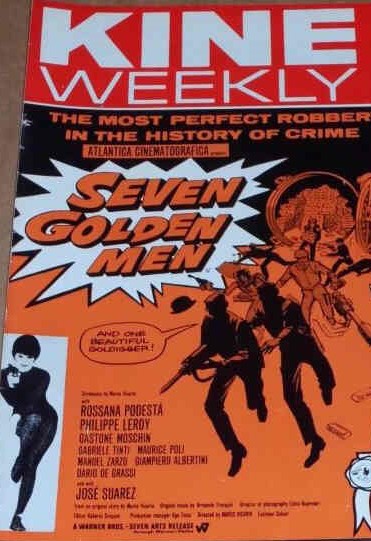
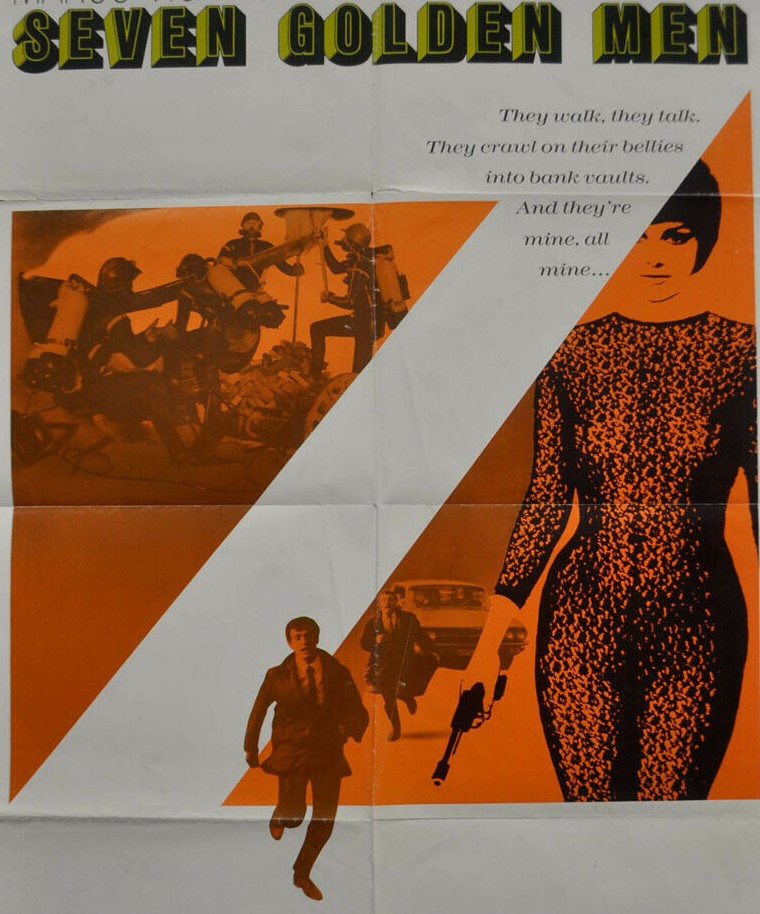
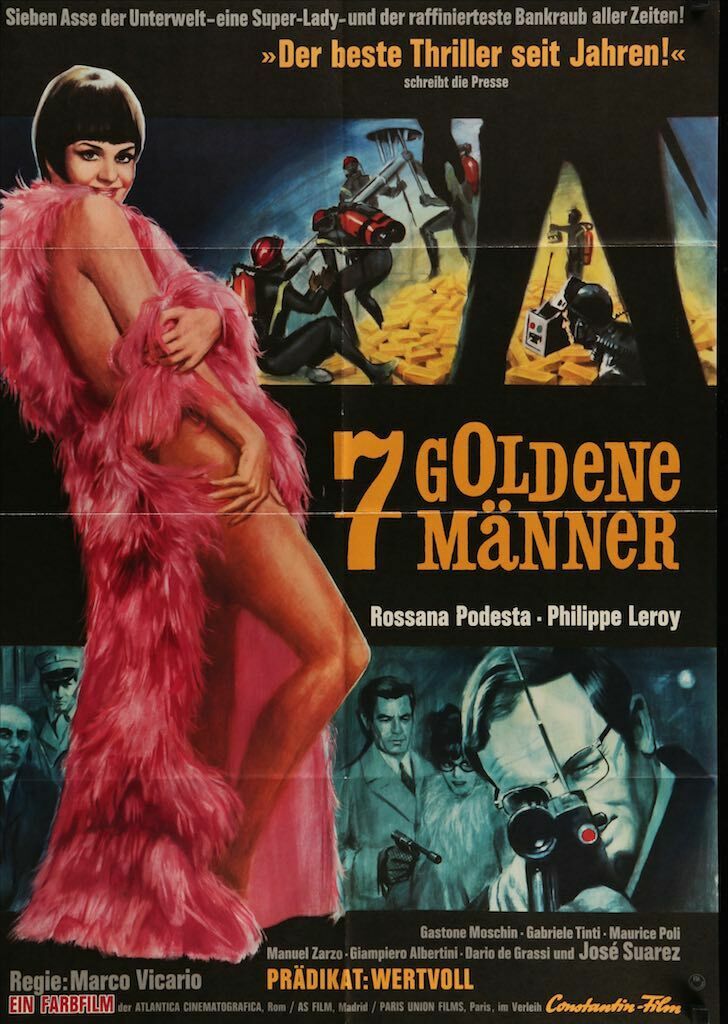
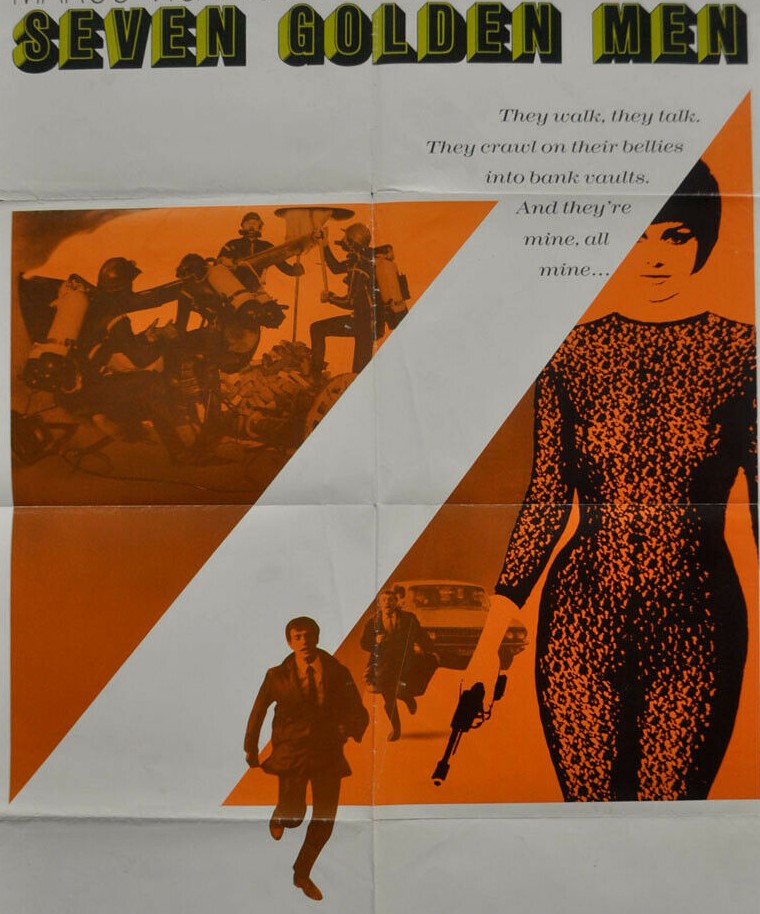
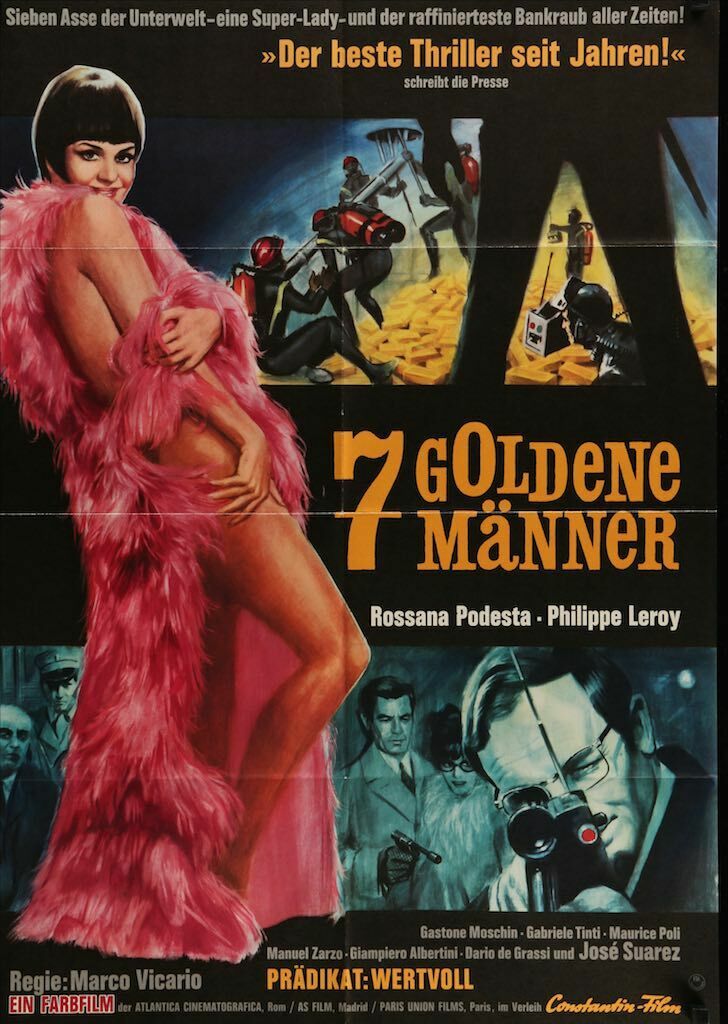
Very stylish caper picture that dispenses with the recruitment section, the ingenious hi-tech robbery accounting for the first half, escape and double-cross the second, a slinky Rosanna Podesta an added attraction/distraction. The Professor (Phillippe Leroy), in bowler hat and umbrella, orchestrates the gold bullion theft from an uber-secure bank using hidden microphones and cameras and a host of electronic equipment, the inch-perfect heist organized to mathematical perfection and timed to the second.
His team, disguised as manual workers, dig under the road, don scuba gear to negotiate a sewer, drill up into the gigantic vault and then suck out the gold bars using travelators and hoists. Giorgia (Podesta), sometimes wearing cat-shaped spectacles, a body stocking and other times not very much, causes the necessary diversions and plants a homing device in a safety deposit box adjacent to the vault. Occasionally her attractiveness causes problems, priests in the neighboring block complaining she is putting too much on show.
It’s not all plain sailing. A cop complains about the workmen working during the sacrosanct siesta, a bureaucrat insists on paperwork, a radio ham picks up communication suggesting a robbery in progress, the police appear on the point of sabotaging the plan.
But the whole thing is brilliantly done, the calm professor congratulating himself on his brilliance, Giorgia seduction on legs. The getaway is superbly handled, the loot smuggled out in exemplary fashion, its destination designed to confuse. Then it is double-cross, triple-cross and whatever-cross comes after that, with every reversal no idea what is going to happen next. It is twist after twist after twist. Some of the criminals are slick and some are dumb. As well as the high drama there are moments of exquisite comedy.
Italian writer-director Mario Vicario (The Naked Hours, 1964) handles this European co-production with considerable verve and although, minus the normal recruitment section, we don’t get to know the team very well except for the professor and Giorgia, each is still given some little identity marker and in any case by the time they come to split the proceeds we are already hooked.
Frenchman Phillippe Leroy (Castle of the Living Dead, 1964) is the standout as a mastermind in the British mold, stickler for accuracy, calm under pressure, working with military precision. Podesta (also The Naked Hours) has no problem catching the camera’s attention or playing with the emotions of the gang to fulfill her own agenda. The gang is multi-national – German, French, Italian, Spanish Portuguese, Irish – with only Gabriel Tinti likely to be recognized by modern audiences.
And there is a terrific score by Armando Trovajoli (Marriage Italian Style, 1964) that changes mood instantly scene by scene. One minute it is hip and cool jazz, the next jaunty, and then tense.
This is not the Charles Bronson you think you know, the mean, truculent, monosyllabic persona who turned into a box office powerhouse later in the decade. It took the French to recognize the leading man qualities Hollywood determinedly ignored. God forbid, he is actually pretty charming, although his methods for squeezing information out of a suspect are, well, suspect. And he turns up pretty late in the picture, just when you think the focus is going to be on the suspect, Mellie (Marlene Jobert) and it’s going to be one of those pictures where an innocent woman is suspected of a crime and the man has to clear her name.
Except Mellie isn’t innocent. She’s killed a rapist who broke into her house and then dumped his body over the cliff. And she isn’t, officially at least, a suspect, local cop Inspector Toussaint (Jean Gaven) more interested in getting a loan from her husband, pilot Tony (Gabriele Tinti), to pay off gambling debts. Needless to say, any time the cop does knock on her door, she jumps out of her skin.
And she would have got away with the murder, except for the arrival of Dobbs (Charles Bronson). He turns up at a wedding, ensures she gets to see a newspaper headline of the murder, insinuates his way into her life, not too difficult once her husband heads off on another flight. She runs a bowling alley with her mother Juliette (Annie Cordy) who scarcely has a maternal bone in her body.
Rather than helping the cops solve the case, Dobbs is more interested in the red bag the rapist was carrying. But when she hands over the bag, it doesn’t contain the $60,000 Dobbs wants. We never see what Dobbs gets up to when he’s not with Mellie. But we hear it. His investigations may be carried out off screen but he’s tailing her – knows she bought a ton of newspapers – and tells her what he’s found out by speaking to cops and neighbors. Even though she’s replaced the cartridges in the shotgun she used to kill the rapist, he knows the gun has been fired. When she claims she was aiming at rats in the cellar, he points to the marks on the wall, too high for even the most acrobatic rat.
Mellie is trapped in a claustrophobic world, assailed by her own guilt and a jealous husband with too much unexplained loose cash (drug smuggling is the implication), turns against her best friend, boutique owner Nicole (Jill) who had an affair with her husband, and against her mother whom as a child she caught in bed with another man, causing her father to dump the mother.
They started to get tricky with double bills in the 1970s, trying to suggest the films were equally attractive, ignoring the fact that if they had been such hits they wouldn’t have been paired in the first place.
Most of the tension is self-inflicted but Dobbs has thing about nuts and soon is whizzing shells across rooms, some trick where they break on impact with a window, but the noise is like a shot, too close to the blast of the shotgun.
Every twist ratchets up the tension. And by concentrating on the suspect the police are ignoring and making Dobbs, by default, the chief investigator, and nobody to turn to, Mellie is turned inside out by his mere presence, never mind, when exasperated, he employs his own interrogation method, akin to waterboarding, except the liquid is alcohol, forced down her throat until her lungs are full to bursting.
The last act is a bit murky, as the locale shifts to Paris, involving a brothel owner and a set of gangsters who are even more intent on humiliating Mellie. With echoes of Charade (1963) and Moment to Moment (1966), it’s superbly directed by Rene Clement (Is Paris Burning? 1965), who doles out clues and twists like he’s playing a hand at cards.
In spite of the concentration on tension, he takes the time to build up his characters. A series of emotional flashbacks show the fault-lines in Mellie’s character, no matter that she initially appears confident with fashionable short hairstyle and white outfits bound to attract attention. Dobbs’ obsession with suddenly chucking nut shells around maintains the tension and his cavalier tone, especially his jocular use of a nickname, suggests an interesting personality behind the tough guy pose.
Like his script for The Sleeping Car Murder (1965), screenwriter Sebastian Japrisot is as concerned with ordinary life as with the thriller elements.
Charles Bronson (Farewell, Friend / Adieu L’Ami, 1968) delivers the best performance of his entire career, tough guy with a charming underbelly, kind of Cary Grant with muscle. Marlene Jobert (Catch Me a Spy, 1971) is excellent as the victim turned suspect, and even Jill Ireland, for whom a part was always found in husband Charlie’s movies, shows a different side to her screen persona.
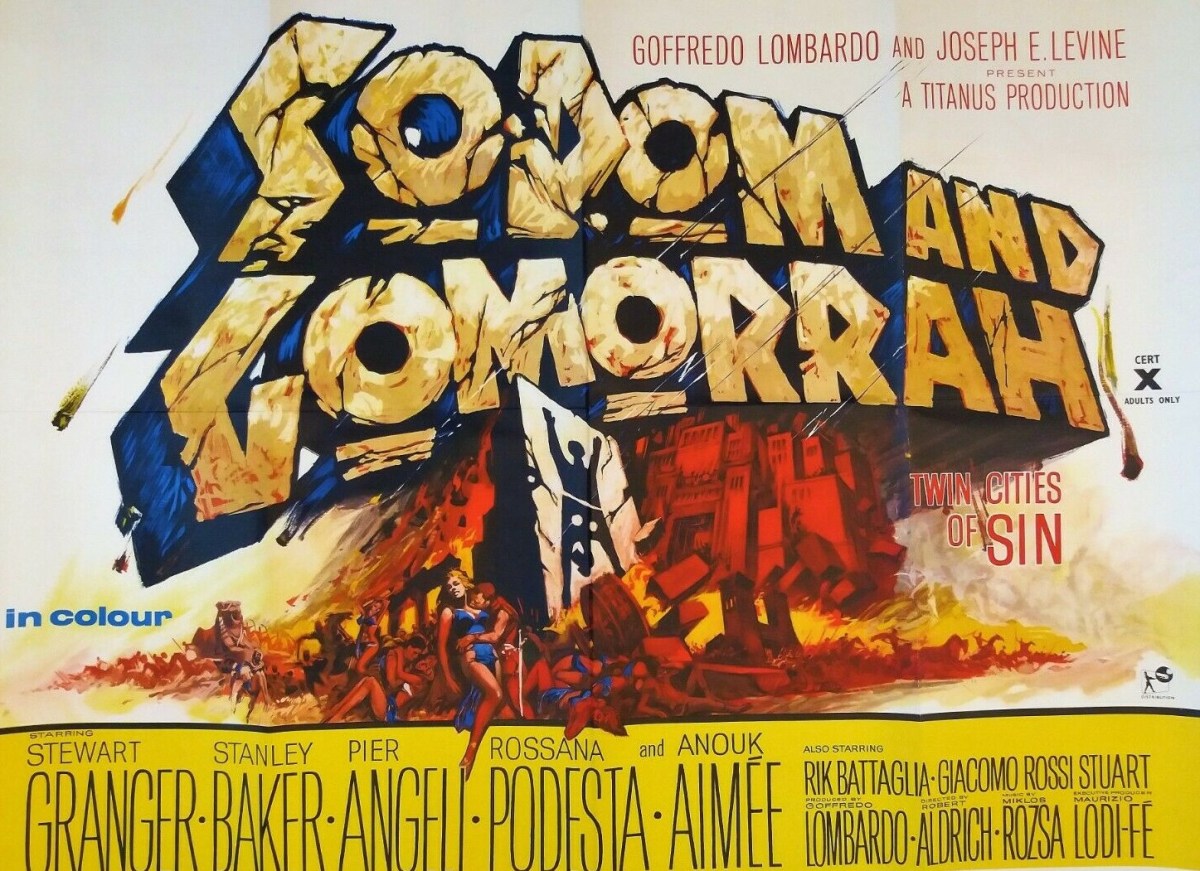
Setting aside the Biblical angle and the need to inject as much sin as the censor at that time would permit, this works very well as a historical drama filled with political intrigue, pivoting on the morality/sin axis, and with a terrific battle scene. The set up is superb. Bera (Anouk Aimee), Queen of the titular twin cities, allows Hebrew leader Lot (Stewart Granger) to settle his wandering tribe along the River Jordan in order to provide a buffer between her kingdom and the marauding Elamite tribe. Meanwhile, her treacherous brother Astaroth (Stanley Baker) intends using the Elamites to dethrone his sister.
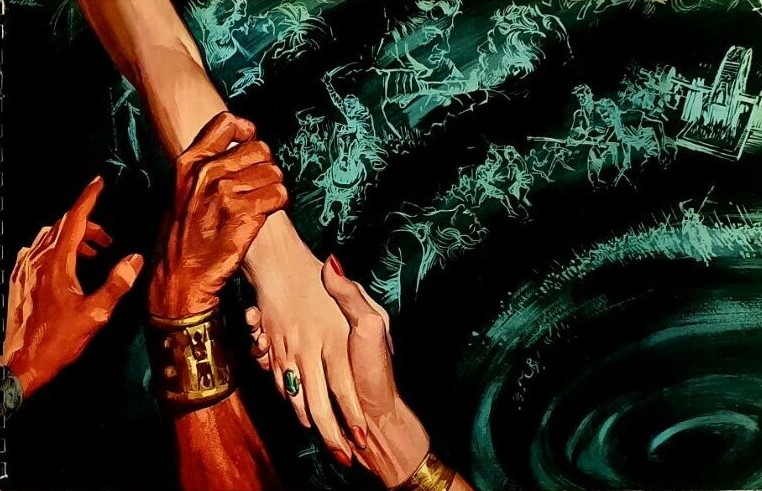
Stunning image from the Pressbook.
The Sodom-Hebrew arrangement is ugly from the start. Sodom owes its wealth to salt. And it relies for its salt mining and processing to thousands of slaves, literally worked to death, corpses piled high on wagons and dumped in the desert. The Hebrews abhor slavery. But having been homeless for so many years, Lot is in no position to argue and assumes that his people can live peacefully enough alongside the heathens, even accommodating Sodom to the point of returning fleeing slaves.
Another superb illustration from the Pressbook.
In fact, in agreeing to live in such close proximity to Sodom, Lot is already in the throes of seduction. In what appears a gesture to seal the deal, Bera presents Lot with her chief female slave Ildith (Pier Angeli). In reality this is a cunning move designed to undermine Hebrew culture. Naturally, Lot grants Ildith her freedom but her presence creates disharmony, Melchior (Rik Battaglia) leading the dissenters. Astaroth seduces both of Lot’s daughters Shuah (Rosanna Podesta) and Maleb (Claudia Mori).
Eventually, of course, the Hebrews succumb to many of the pleasures of Sodom, especially after discovering their own salt deposits which instantly make them wealthy, while Astaroth continues to stir up trouble. Lot the politician is more to the forefront than Lot the good and faithful servant, ignoring the slavery for the sake of peace. However, politics remain a sticky maneuver and, in the end, of course, it is God who intervenes, smiting the wicked.
There are surprising depths to the story. Ildrith initially rejects Lot’s overtures of marriage on the grounds that it will diminish his goodness. In trying to improve living conditions for the Hebrews, Lot does the opposite, jeopardizing their beliefs, his actions rendering virtually invisible the distinctions between the opposing cultures, especially when he is up close to the dancing female slaves and men being burned alive on a wheel. Queen Bera is a political genius, skilled at keeping her enemies closer, not just taking advantage of Lot’s weakness but ensuring that Astaroth never catches her cold.
It’s a very absorbing mix of power, politics, human weakness, the dangers of collaboration, sex and action. Although Lot takes center stage, it is only to watch his decline from man of principle to weak-willed politician, through the astute workings of Queen Bera, a far better manipulator of human emotions than her opposing number.
Images showing the capture of slave Tamar (Scilla Gabel)
Stewart Granger (The Secret Partner, 1961) is surprisingly good as the Hebrew leader. He might lack the physical presence of the likes of Charlton Heston but he proves himself no mean adversary in the various action scenes, two fights with Astaroth for example, the battle itself and in quickly dealing with dissent in the ranks. It would never have occurred to me that a shepherd’s crook was much of a weapon, but in Granger’s hands it proves very effective. He knows he is being seduced, first by Ildith, and then by Sodom, but, as a human being rather than figure of spirituality, is powerless to stop it. Stanley Baker (The Guns of Navarone, 1961) as the queen’s treacherous brother, on the other hand, just looks shifty and mean throughout.
Anouk Aimee (La Dolce Vita, 1960) is excellent as the politically astute monarch, and save for God’s intervention, would have got the better of everyone around her. Pier Angeli (The Angry Silence, 1960) is touching, initially angry at being cast out of Sodom, gradually warming to Lot, but only too aware that in succumbing to her charms he might spoil his own innate goodness, like a femme fatale only too wary of her own powers. Rosanna Podesta (Seven Golden Men, 1965) is good in a supporting role as is Rik Battaglia (Esther and the King, 1960) while Scilla Gabel (Colossus of the Arena, 1962) has a smaller part as the slave Tamar who meets a horrible death. Look out, too, for Gabrielle Tinti (Esther and the King, 1960), later best known for his marriage to Laura Gemser of the Black Emmanuelle series, and future spaghetti western anti-hero Anthony Steffen (Django the Bastard, 1969).
Novelisation of the screenplaywith a cover placing the focus strictly on sin.
Robert Aldrich (4 for Texas, 1963) creates an excellent addition to the genre, the pace of the drama, with various storylines, never slacking. As a historical picture this aims higher than mere pulp where sexiness and torture are the audience hooks. His battle sequence is outstanding, unusual in that the balance of power shifts throughout, in part through treachery, between the participants. Although Aldrich often disparaged this picture, he has done a really good job of working up the ingredients into a heady brew, notwithstanding the “deus ex machina” ending that met audience expectation. Ken Adam (Dr No, 1962) headed up the production design and Wally Veevers (The Guns of Navarone, 1961) among the half dozen experts contributing to the special effects. Mention also to Maurice Binder for the credit sequence and Miklos Rosza (Ben-Hur, 1959) for a nuanced score.
Catch-Up: Reviewed previously in the Blog are Robert Aldrich’s 4 for Texas (1963) and The Flight of the Phoenix (1965), Stewart Granger in The Secret Partner (1961) and The Secret Invasion (1964), and Stanley Baker in The Guns of Navarone (1961) and The Girl with a Pistol (1968).
Very stylish caper picture that dispenses with the recruitment section, the ingenious hi-tech robbery accounting for the first half, escape and double-cross the second, a slinky Rosanna Podesta (the eponymous Helen of Troy, 1956, in case you’ve forgotten, and also appearing in Sodom and Gomorrah, 1962) an added attraction/distraction. The Professor (Phillippe Leroy), in bowler hat and umbrella, orchestrates the gold bullion theft from an uber-secure bank using hidden microphones, cameras and a host of electronic equipment, the inch-perfect heist organized to mathematical precision and timed to the second.
His team, disguised as manual workers, dig under the road, don scuba gear to negotiate a sewer, drill up into the gigantic vault and then suck out the gold bars using travelators and hoists. Giorgia (Podesta), sometimes wearing cat-shaped spectacles, a body stocking and other times not very much, causes the necessary diversions and plants a homing device in a safety deposit box adjacent to the vault. Occasionally her attractiveness causes problems, priests in the neighboring block complaining she is putting too much on show.
It’s not all plain sailing. A cop complains about the workmen working during the sacrosanct siesta, a bureaucrat insists on paperwork, a radio ham picks up communication suggesting a robbery in progress, the police appear on the point of sabotaging the plan.
But the whole thing is brilliantly done, the calm professor congratulating himself on his brilliance, Giorgia seduction on legs. The getaway is superbly handled, the loot smuggled out in exemplary fashion, its destination designed to confuse. Then it is double-cross, triple-cross and whatever-cross comes after that, and with every reversal no idea what is going to happen next. It is twist after twist after twist. Some of the criminals are slick and some are dumb so as well as the high drama there are moments of exquisite comedy.
Italian writer-director Mario Vicario (The Naked Hours, 1964) handles this European co-production with considerable verve and although, minus the normal recruitment section, we don’t get to know the team very well except for The Professor and Giorgia each is still given some little identity marker and in any case by the time they come to split the proceeds we are already hooked. Frenchman Phillippe Leroy (Castle of the Living Dead, 1964) is the standout as a mastermind in the British mold, a stickler for accuracy, calm under pressure, working with military discipline. Podesta (also The Naked Hours) has no problem catching the camera’s attention or playing with the emotions of the gang to fulfill her own agenda. The gang is multi-national – German, French, Italian, Spanish, Portuguese, Irish – with only Gabriel Tinti likely to be recognized by modern audiences.
And there is a terrific score by Armando Trovajoli (Marriage Italian Style, 1964) that changes mood instantly scene by scene. One minute it is hip and cool jazz, the next jaunty, and then tense.
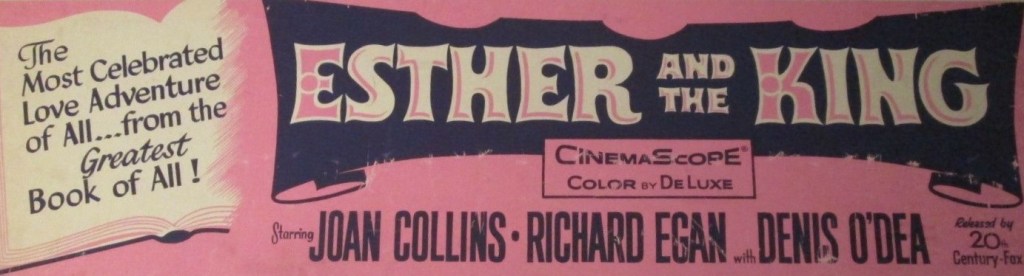
Taking a Biblical tale as a starting point, veteran director Raoul Walsh (White Heat, 1949) stirs up heady brew of intrigue, rebellion, politics and romance. Returning home victorious, King Ahasuerus (Richard Egan) discovers his wife Queen Vashti (Danielle Rocca) has committed adultery and that his minister Klydrathes (Renato Baldini) has been squeezing the people blind with punitive taxes, hanging them for non-compliance.
Casting his wife aside, the king seeks a new bride. Since he has conquered all the known world except Greece, marriage to make a political alliance is not an option, so, given women are treated as mere chattels and the king is all-powerful, all the likely virgins are rounded up including Hebrew Esther (Joan Collins) on her wedding day.
Her husband-to-be Simon (Rik Battaglia) kicks off, attacks Klydrathes and becomes a wanted man. The queen’s lover and the king’s chief minister Prince Haman (Sergio Fantoni) attempts to fix the bridal selection, inserting his hardly-virginal choice Keresh (Rosalba Neri) into the proceedings while attempting to murder clear favorite Esther. When that fails, Haman plots to usurp the crown. With the Hebrews facing possible annihilation, Esther is put in the position of giving in to the king in order to save her people. As her serenity soothes the savage beast, her initial hate turns to growing attraction.
Meanwhile, Simon is on a rescue mission and Prince Haman cooks up a devilish plot that will see the Hebrews blamed for passing on military secrets to the king’s enemies. Naturally, all hell eventually breaks loose.
More a drama than a typical big-budget DeMille offering, with battles taking place off-screen, action is limited to a few chases and skirmishes. There is a fair amount of sin on show what with a tribe of concubines at the king’s disposal, a whipping, a striptease by Vashti in a last gasp attempt to win back the king, and some very seductive dancing routines by female slaves who, at times, look as if they were coached by Busby Berkeley. Substantial amounts appear to have been spent on costumes and production design, so historical atmosphere is well captured.
Once you realize there’s not going to be any kind of big battle or major action centerpiece common to the Biblical genre, it’s easy to sit back and enjoy the political machinations, the initial torment of Esther, introduced as a rebellious soul, and the king, more at home with soldiers, shaking off his despondency at marital betrayal as he responds to Esther’s coaxing.
It was 1961 before it reached Britain.
Top-billed British actress Joan Collins (Seven Thieves, 1960) has a difficult role. Normally, you would expect expressions of passion or depths of anguish, but the rebellion she displays at the start soon disappears when she enters the palace and is helpless to change the situation except by, initially against her will, accepting the king’s desires. In that sense, her portrayal is understandable but the understated performance gets in the way of a woman who is supposed to be devastated by the loss of her husband and then trapped by the needs of her people into making the marriage.
Taking second billing, Richard Egan (300 Spartans, 1964) makes a thoughtful king, showing very little temper, possibly because he doesn’t need to with everyone, beyond the conspirators, cowering in his presence. Regal and stately suits him fine rather than the more common explosions we are accustomed to seeing from people in that line of work.
Both stars were in need of box office redemption. It should have been a screen pairing made in heaven, both Collins and Egan coming to the fore in the mid-1950s, and if they had sustained their early promise, it would have been a star-studded picture. As it was, Collins had been billed above Richard Burton in The Sea Wife (1957) and above Jayne Mansfield in The Wayward Bus (1957) but had gradually drifted down the pecking order, in her previous outing credited behind Edward G. Robinson and Rod Steiger in Seven Thieves (1960).
Egan’s career had followed a similar trajectory – top-billed in pictures as diverse as drama The View from Pompey’s Head (1955), western Tension at Table Rock (1956), film noir Slaughter on 10th Avenue (1957), and romance A Summer Place (1959) but for his previous film, Pollyanna (1960) billed behind both Jane Wyman and Hayley Mills.
While Egan would enjoy a career resurgence it was the end of the line, at least temporarily, for Joan Collins. She was coming to the end of her seven-year Twentieth Century Fox contract but fell out with the studio after being rejected for Cleopatra, and on the evidence here you can see why. After leaving Fox, she only made five more films during the decade. This was the final picture for Irish actor Dennis O’Dea (The Fallen Idol, 1948). Director Raoul Walsh made only another two.
Sergio Fantoni (Von Ryan’s Express, 1965) excels as the spurned lover and Rik Battaglia (The Conqueror of the Orient, 1960) as the schemer. Rosalba Neri (Top Sensation, 1969) and Danielle Rocca (Behold a Pale Horse, 1964) both make striking appearances. Look out also for Gabriele Tinti (Seven Golden Men, 1965).








 The Magnificent 60s