Restraint in a horror picture? Nary a scream? Scarcely a close up? More bloodletting in surgery than in the woods? Use of candlelight evocative of Stanley Kubrick? The classical composition of John Ford, long shot beloved of Henry Hathaway, in camera (minus the juddering cuts) treatment favored by Christopher Nolan? Where has this little gem been hiding?
Set in rural France in the nineteenth century, positing a Biblical reimagining of the werewolf legend, every scene so carefully measured by British director Sean Ellis (Anthropoid, 2016) that you would think this is a master sprung to life. Even more tantalizing, given the genre, is the ensemble acting. This isn’t one of those horror efforts where you’re trying to work out (or hope) who’s going to be bumped off next.
Marketing team do this picture a disservice with this poster which more or less gives the game away, even though this forms a tiny fraction of a classy film.
And you think – although the participants remain baffled – that you know what’s going on, so you let down your guard, until the feet are swept out beneath you by the late twist, that, too, with Biblical connotation. The first Biblical allusion seems far-fetched, I have to admit, linking Judas Iscariot’s 30 pieces of silver to the silver bullet traditionally used to kill werewolves, vampires and the like. But then it twists into left field, both thematically and intellectually, covering such wider ground as betrayal and confession. The second Biblical reference we are all familiar with – reaping what you sow.
Technically, the narrative revolves around a gypsy curse. Nothing unusual in that you might think. Gypsies – and teenagers for that matter – are known for handing out curses for any minor breach or discrepancy. In this case, you wonder how the curse was set, given every single gypsy within the vicinity has been slaughtered, buried alive or, hands and feet chopped off, turned into a human scarecrow.
But the gypsies, suspecting imminent malevolence, have fashioned from their horde of silver coins (maybe thirty, we are not told), a pair of silver false teeth, which are buried, but then found by the local children, directed to them by dream/nightmare. These aren’t of the distinct vampiric molar kind, but seemingly more akin to those employed by wolves for savaging purposes. It’s the children who are turned into werewolves or, as here, that rarer mythical entity shamans (though not in the strict understanding of the word).
Stuck for another poster – which shows how little of an initial release “Eight for Silver / The Cursed” received – I’ve taken the easy way and added the movie with which Kelly Reilly first attracted attention.
Victims appear chosen at random, and not for illicit sexual behaviour as was once the norm, and gradually a more apparent truth emerges. Eventually pathologist McBride (Boyd Holbrook) takes center stage, but that’s a slow time coming, and mostly what we have is nobody taking center stage, or focus shifting around a variety of characters, landowner Seamus (a traditional French name, don’t you know) Laurent (Alistair Petrie), submissive wife Isabelle (Kelly Reilly), their daughter Charlotte (Amelia Church) and a variety of young teenagers including Timmy (Tommy Rodger) and servants.
But, as I said, restraint is the watchword, and there are three just outstanding scenes. The movie opens – didn’t I mention this – in World War One, a field surgeon extracting bullets from a wounded soldier. The bullets don’t even, as would be the usual cliché, clang when tossed into a metal bowl. The surgeon finds two. The third is unusual. It’s much bigger for a start than your normal machine gun ammunition. And it’s silver.
And here’s the genius. Nobody exclaims, oh my goodness, a silver bullet, whatever can that mean, it just sits there dripping with blood from the operation, and the image filters down into the audience brain. Then we’re into flashback and gypsies making such a nuisance of themselves claiming ancient ownership of land that good old Seamus decides to call in the mercenaries. And that entire scene, of terrible slaughter, people shot and skewered and burned alive, is shown in extreme long shot, the camera never moving.
Third terrific scene. The Laurent’s son Edward is missing. Father, mother and daughter sit at the kind of long table you get in mansions, mother at one end father at the other. Mother is weeping scopiously, father is silently eating his dinner. Long shot again, no cuts, just the measured camera.
Virtually the only color in most scenes is a candle or a torch, and you would have to say a less showy and more effective treatment of light than in Kubrick’s Barry Lyndon (1975). And in audio terms it’s the same, scarcely a raised voice. And when McBride’s family tragedy is revealed, it’s done so visually and discreetly, though for the dumber audience member the ground is covered with dialog later on.
No showboating required from the actors so in that sense it’s the very best type of acting, as if everyone had learned from Anthony Hopkins how little you had to do to be effective. So top marks to Boyd Holbrook (Indiana Jones and the Dial of Destiny, 2023), Kelly Reilly (Yellowstone, 2018-2022) and Alistair Petrie (Rogue One, 2016). Sean Ellis didn’t just write and direct this but he handled the cinematography too. Had this been an arthouse number, Ellis would be praised to the skies.
If you require jump-out-of-your-seat moments and copious gore, then this isn’t one for you, but if you want to appreciate a story superbly told by a director in command of his craft, then seek this out. Strangest of all it’s turned up on Netflix, not known for harvesting little gems, and probably scarcely aware of what it has uncovered.
First half pure Walter Hill of The Driver vintage – virtually silent heist, blistering car chase – second half rachets up tension with corrupt cop, femme fatale, getaway stymied and a payoff you won’t see coming.
French jewel thieves led by Azad (Jean-Paul Belmondo) using electronic wizardry crack open a safe in Athens full of emeralds while the owner is away. Passing cop Abel (Omar Sharif) happens by but after conversing with Azad, who claims his car has broken down, seems to be satisfied nothing untoward is going on inside the house. But getaway plans are momentarily foiled when the ship they are due to leave on is unexpectedly berthed for repairs, leaving them with five days on their hands.
Azed’s disappointed girlfriend Helene (Nicole Coffen), who acts as watch for the gang, lolling about a swimming pool with too much time on her hands, attracts unwanted male gaze. Azad, followed by the cop, decides to outrun him, fast car style, and soon they are hurtling through the streets of Athens. Thinking that he’s shaken off his pursuer, and seeking a bit of relaxation himself, Azad chats up glamor model and night-club stripper Lena (Dyan Cannon) without realizing she is in cahoots with Abel. The cop wants in on the action and is willing to trade by letting Azad off scot-free while dumping the crime onto his confederate Ralph (Robert Hosein).
So, mostly, it’s cat-and-mouse stuff between Azad and Abel, as the latter closes the doors, and the former is unaware of just how cunning a corrupt cop can be. There’s some hair-raising action as Azad has to jump between two buses, and a pursuit in a fairground, Abel naturally on horseback, and as if this was one of those cheap films that always had a shoot-out in a quarry, Azad ends up in one, though, thankfully, not for climactic reasons. The climax takes place in a wheat warehouse (I guess the makers of the later Witness, 1985, took a few clues from this.)
Mostly, it’s the character interplay. Two big stars in one film often results in scenes involving both kept to a minimum – think Paul Newman and Steve McQueen in The Towering Inferno (1974) or Robert De Niro and Al Pacino in Heat (1995) – but here’s it’s the opposite and watching Belmondo and Sharif dancing around each other, one or other always in the ascendancy or with a neat trick in the back pocket or a get-out-of-jail-free card for later, works a treat.
Sharif, especially, had widened his scope, running away from the matinee idol tag and this came at the end of an impressive stint that included the villain in Mackenna’s Gold (1969), The Appointment (1969), The Last Valley (1971) and The Horsemen (1971). As shabby as Columbo, but with a bit more chic, he knows he’s got to keep one step ahead of Azad, though he could indulge in a few smirks, since he’s so far ahead of the criminal, Abel won’t know what hit him when he realizes he’s been played for a dupe by Lena.
Dyan Cannon (Bob and Carol and Ted and Alice, 1969) plays her role to perfection, hints of sadness that her life is not as glamorous as she might want, possibly considering betraying her real partner, but as seductive as all-get-out. This was a bold career choice, because she had mostly been allotted wife/girlfriend parts rather than, as here, central to the machinations.
Jean-Paul Belmondo (Breathless, 1960) never appealed as much to the American audience as countryman Alain Delon, mostly because he refused to take the Hollywood coin, preferring to do his own thing in France, but he is excellent here and he would have been ideal in plenty mainstream U.S. pictures.
Hats off once again to Henri Verneuil (Guns for San Sebastian, 1968). The heist is deftly done, running a full 24 minutes, give or take a few moments for tense conversation with the nosey cop. The second unit filmed the chase, of course, but Verneuil is a master at this particular tune. He co-wrote the script with Vahe Katcha (Two Weeks in September, 1967) from the novel by David Goodis (Shoot the Piano Player, 1960). Bonus of an Ennio Morricone score.
Derring-do and heroism were the 1960s war movie default with enemies clearly signposted in black-and-white. This one doesn’t fall into that category, in fact doesn’t fall into any category, being more concerned with the military and political machinations pervasive on both sides in war. Movies about revolutions generally succeed if they are filmed from the perspective of the insurrectionists. When they take the side of the oppressor, almost automatically they lose the sympathy vote, The Green Berets (1968) in this decade being a typical example, although the sheer directorial skill of Francis Coppola turned that notion on its head with Apocalypse Now (1979) when slaughter was accompanied by majesty.
In the 1950s-1960s the French had come off worse in two uprisings, Vietnam and Algiers. This movie covers the tail end of the former and the middle of the latter and it’s a curious hybrid, part Dirty Dozen, part John Wayne, part dirty tricks on either side, with a few ounces of romance thrown in.
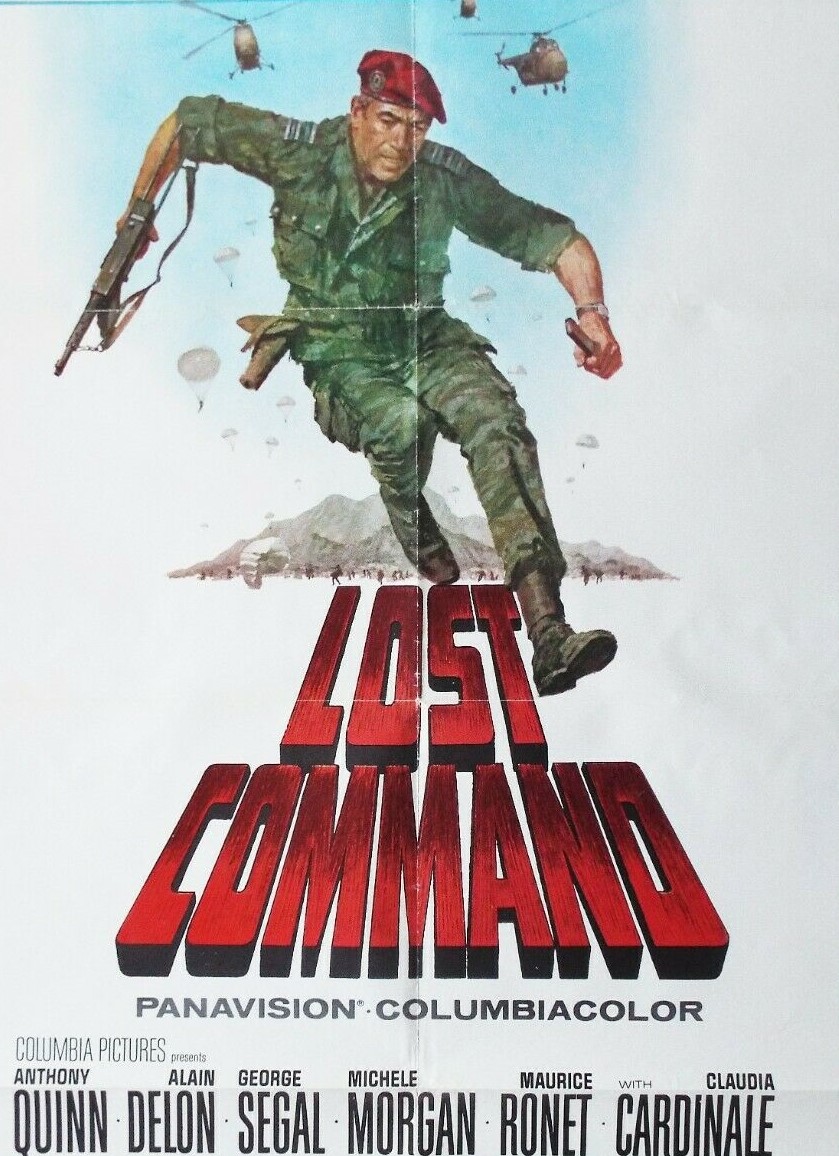
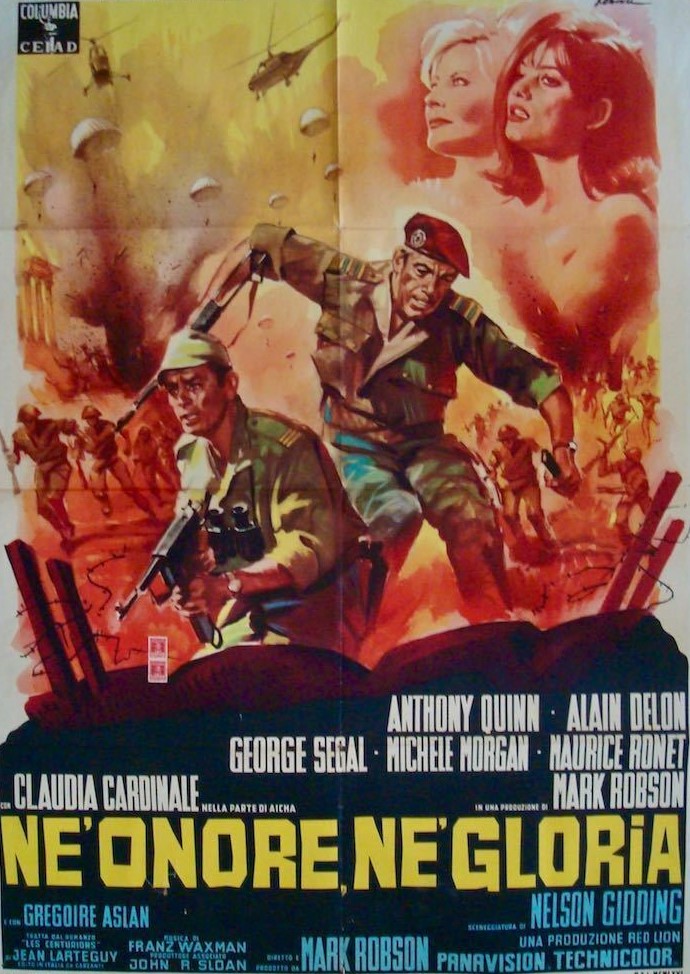
Col Raspeguy (Anthony Quinn, in unlikely athletic mode – that’s him leaping in the poster) is the officer of a paratroop regiment who sees out the debacle of the final battle of the French war in Vietnam, loses his commission, and then, reprieved, is posted to Algeria, where the fight for independence is in full swing, with a ragbag of rejects plus some faithful comrades from his previous command. In any spare moment, the colonel can be seen keeping fit, doing handstands, swinging his arms, puffing out his chest, and a fair bit of running (presumably to avoid the contention that Quinn was too old for this part). Sidekick Capt Esclavier (Alain Delon) is a bit too moralistic for the dangerous business of war, plays his sidekick. The colonel is an ideal anti-hero for a hero, an officer who ignores, challenges or just plain overrides authority, adored by his men, hated by the enemy, ruthless when it matters.
The brutal realism, which sometimes makes you quail, is nonetheless the best thing about the picture, no holds barred here when it comes to portraying the ugly side of battle. The training in The Dirty Dozen is a doddle compared to here, soldiers who don’t move fast enough are actually shot, rather than just threatened with live ammunition, and there’s no second chance for the incompetent – at the passing out ceremony several are summarily dismissed. The only kind of Dirty Dozen-type humor is a soldier who fills his canteen with wine. Otherwise, this is a full-on war.
Battles are fought guerilla style, the enemy as smart as the Vietnamese, catching out the French in ambushes, using infiltrators sympathetic to the cause and terrorism. Unlike Apocalypse Now where the infantry appeared as dumb as they come, relying on strength in numbers and superior weaponry, Lost Command at least has an officer who understands strategy and most of what ensues involves clever thinking. The battles, played out in the mountains, usually see the French having to escape tricky situations rather than blasting through the enemy like cavalry, although having sneakily pinched a mayor’s helicopter gives Raspeguy’s team the opportunity to strafe the enemy on the rare occasions when they can actually be found, their camouflage professionally done.
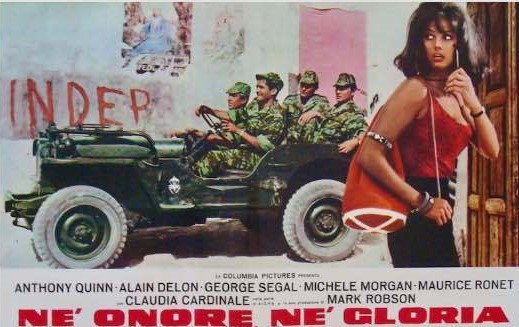
Arab rebel chief Lt Mahidi (George Segal, unrecognizable under a slab of make-up apart from his flashing white teeth), matches the French in terms of tactics and brutality, shooting one of his own men for disobeying orders. His sister Aicha (Claudia Cardinale) is the femme fatale making a play for Esclavier, though he’d have to be a lot dumber than the audience to fall for her obvious ploys (guess what, he is dumber). With both sides determined to win at all costs, atrocities are merely viewed as collateral damage, so in that respect it’s an unflinching take on war.
The picture could have done with another 15 minutes or so to allow characters to breathe and develop some of the supporting cast. The movie did well in France but sank in the States where my guess is few of the audience would even know where Algeria was. Gilles Pontecorvo’s The Battle of Algiers, out the same year, gave the revolutionaries the leading role.
For the most part Anthony Quinn (Guns for San Sebastian, 1968) is in bull-in-a-china-shop form but his character is more rounded in a romantic interlude with a countess (Michele Morgan), his ability to outsmart his superior officers, his camaraderie with his own soldiers and, perhaps more surprisingly, the ongoing exercise routines which reveal, rather than a keep-fit fanatic, an ageing soldier worried about running out of steam. Alain Delon (Texas Across the River, 1967) is entrusted with the morally ambivalent role. George Segal (The Quiller Memorandum, 1966) presumably didn’t realize how culturally inappropriate he would be.
Mark Robson (The Prize, 1963) lets worthy get in the way of action. Screenwriter Nelson Gidding (Nine Hours to Rama, 1963) had the same problem.
Set the politics aside and it becomes much more interesting.
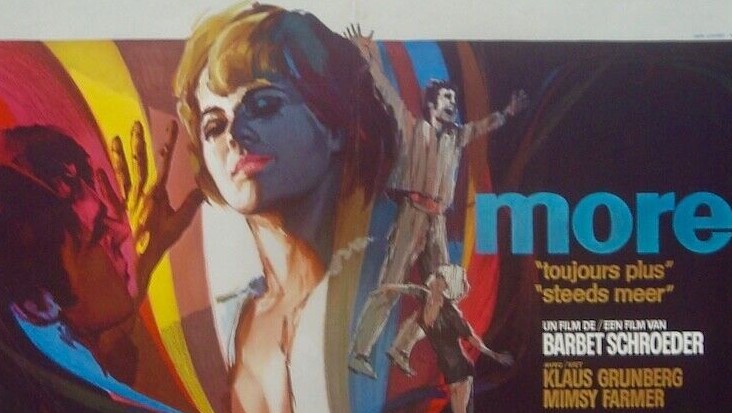
Hedonism gets a reality check but not before it’s done a pretty good job of marketing Ibiza as an idyllic setting and just the place to accommodate anyone wanting to get high on drugs. Despite being the directorial debut of French producer Barbet Schroeder (Reversal of Fortune, 1990), the movie’s better known for the soundtrack created by Pink Floyd.
Which is a shame because despite the focus on the beautiful people living in an exotic world, and plugging, it has to be said, the delights of marijuana as the drug du jour, and not wandering down any cinematic cul de sac like visually exploring in subjective fashion the effects of an LSD trip, it fairly captures the free love counter culture paradise of the time where you could chill out in the sun and you didn’t need to be a biker to do it.
Estelle (Mimsy Farmer) is the lissom siren who hooks the far from innocent Stefan (Klaus Grunberg) – an ex-student, he has indulged in a bit of burglary – and introduces him to pot, Ibiza and heroin in that order. He finds his own way to other indulgences like a menage a trois. There’s an older drug dealer (Heinz Engelmann) in the background and some pals, Charlie (Michael Chanderli) and Cathy (Louise Wink), fleetingly hover into vision, but mostly it’s a two-hander, and there’s none of the despair and nihilism of drug addiction nor the moralistic overtones of a Hollywood picture too frightened of even the more enlightened censor to dare suggest you can have your cake and eat it.
There’s not much story, just the pair falling in love and hanging out, and Stefan wanting to experience the “more” that has made Estelle so impervious to life’s downturns. When he discovers her secret is heroin he wants to turn on in similar fashion and loving lover that she is she obliges. He can’t handle it the way she can and he’s the one that goes over the edge and dies of an overdose. But the director doesn’t resort to any moralizing at the end, this is no wake up call for Estelle, and there’s no sense of guilt, he’s just another handsome ship passing in the night.
The film’s best at exhibiting the easy living, the relaxed lifestyle, of the drug community where ownership is forbidden and life is cheap. It’s filmed as a romance, glorious settings made more glorious by the cinematography of Nestor Almendros (Days of Heaven, 1978).
Mimsy Farmer (Spencer’s Mountain, 1963) is the standout, making the jump into adult roles with ease, presenting an amoral character whose main aim in life to find the deepest sensory experiences. Klaus Grunberg, on his debut, is really just swept along like some flotsam in her attractive wake. Even when Farmer is stoned and really out of it she captures the camera, and while her character is essentially unattractive, it takes some pretty good acting to keep the audience from coming to that conclusion.
The act of shooting up was innovative for the time – and censored in some countries – but it’s not presented as anything but an extension of freedom, liberation of self a la LSD, and even Stefan’s death, the grittiest scene, comes over as mere collateral damage.
That it works is mostly due to Farmer’s performance and Schroeder’s lack of prurience. While there’s abundant nudity, and Estelle makes out with a gal and then enjoys a threesome, there’s no sense of sexploitation, which creates quite a different atmosphere to the more sensational movies of the time. Best of all, in deliberately moving away from heightened drama and turgid instincts that might focus instead on such elements like jealousy or guilt, the director allows the audience to make up its collective mind.
And if you get bored, there’s always the soundtrack and scenery.
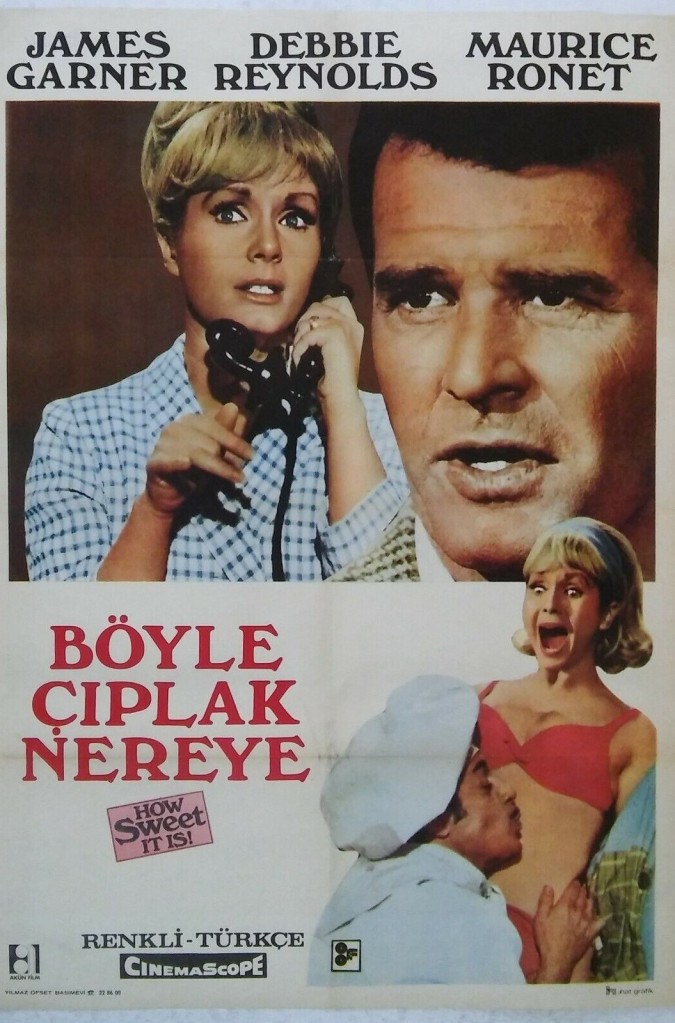
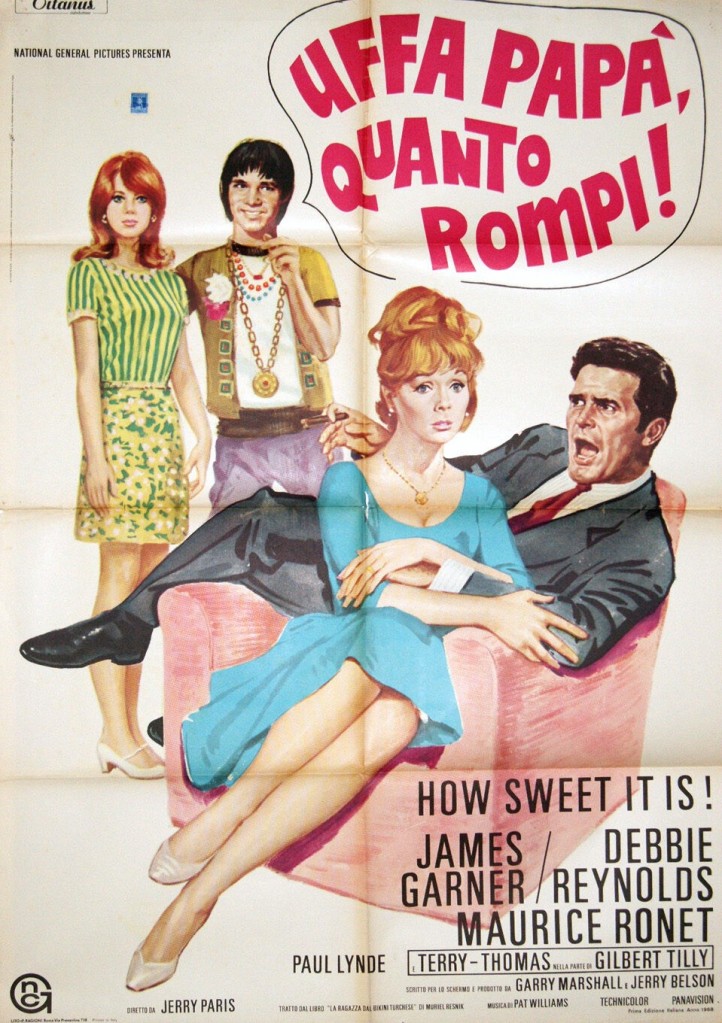
You’d have thought by now leading men would be running shy of Debbie Reynolds, aware just how easily she would steal the picture out from under the top-billed star (witness Goodbye Charlie, 1964). But she had producers clamouring for the fizz she brought. Her comic skills, and willingness to entertain slapstick, were matched only by Doris Day. Especially helpful when she’s saddled with a convoluted plot that’s one-third generation gap comedy, one-third If It’s Tuesday It Must Be Belgium and one-third the kind of creative thinking that determines that somehow or other the female star must end up in a brothel. Throw in some flower power, split-screen, stills montage and slow-mo and you’ve covered all the bases.
In this hit-and-miss line-up, by far the most amusing element is that it’s the adults – photographer Grif (James Garner) and wife Jenny (Debbie Reynolds) – who are sex-obsessed, sneaking away at every opportunity for a bit of hanky-panky, trying to avoid the disapproving eyes of their virginal teenage son Davey (Donald Losby).
An odd example of creative license here. Poster designers had decided that red was the color no matter what. In the last section of the movie Debbie Reynolds parades in a blue – not red – bikini and the book on which it is based is called “The Girl in the Turqoise Bikini.” I’m not sure the color of the bikini is that much of a plot point unless it’s to hook readers of the original novel, but it’s mighty strange for the poster people just to change the color.
The narrative determines that Davey joins girlfriend Bootsie (Hilarie Thomson) and her lithe gal pals on a tour of Europe accompanied by Grif who has been commissioned to photograph the trip. Much to Grif’s horror, Jenny decides she’s going to follow them and hires out a swanky pad where the grown-up lovebirds can make a nest at some undetermined point.
The picture quickly loses interest in Grif and the girls, beyond an attractive tour guide making a pass at Grif and of course their bus getting stuck in the mud. Not only is the Jenny segment more intriguing – turns out she’s been conned by Gilbert Tilly (Terry-Thomas) into handing over a thousand bucks for a chalet he’s not entitled to hire out – because she gets romanced in high French style (champagne and flowers in case you’re bursting to know) by legal lothario Philippe (Maurice Ronet) and every now and then finds herself wearing little more than a bikini and sometimes nothing at all.
Takes a heck of a long time for the two stories to dovetail so that Grif can flounce off in a huff, punch the living daylights out of the Frenchman, and give the screenwriter the excuse to plonk Jenny down in a brothel (that part, I have to admit, is neatly done). There’s also some unusual class comedy at the chateau, Philippe initially being mistaken for a butler, then having to bunk down with his servant because (guess what) this mansion has only one main bedroom.
For no apparent reason there’s an odd section at the start. Instead of flying to Europe, they take the ship and for no apparent reason they’re stuck on C-deck with a lip-pursing purser (Paul Lynde) who insists males and females must sleep apart and share cabins with strangers. Slot into the miss department the opening with the old trope of the husband coming home to find his wife in bed with another man, except it’s Davey and the parental lovers are enjoying some afternoon delight, though quite how you can stretch that to Davey taking a carving knife up the stairs beats me.
James Garner is no more convincing a photographer than he was in The Pink Jungle (1968) and he hardly gives Debbie Reynolds a run for her money, as if he doesn’t know how to bring this character to life. Except for excelling at the risqué, and she a willing accomplice, he’s coming over like the straight man to her comedienne. Debbie Reynolds is superb, reactions honed to the bone, throwing herself into the part, undergoing whatever humiliation will snare a laugh.
Garner briefly resurrected his career with Support Your Local Sheriff (1969) before he hit the slide (see the previous Behind the Scenes article) and to my astonishment this signalled pretty much the end of Reynolds’ screen career, nothing for the next decades except What’s the Matter with Helen (1971) and a bit part (as herself) in The Bodyguard (1992). You can hardly blame her for screenwriters not coming up with the right material to take advantage of her supreme comedic gifts. Alexandra Hay (The Model Shop, 1969) is wasted, you might just as well have dabbed her role “the sexy blonde.”
Director Jerry Paris (Never a Dull Moment, 1968) throws everything he can at the screen without much success. Future director Garry Marshall (Pretty Woman, 1990) and producer Jerry Belson (Fun with Dick and Jane, 1977) in his movie debut formulated the screenplay from the bestseller by Muriel Resnik.
Far from the last comedy hurrah you would have wished for the actress, but all you’re going to get.
Hollywood isn’t known for its sensitivity, and this is one of those major misjudgements. An incredibly rich family, ripe with entitlement, find World War Two tough going, in the main because as in Counterpoint (1968), they consider themselves exempt. Being Argentinians, they are neutral.
Unfortunately, it just so happens, with that wealthy person’s penchant for flaunting their wealth in the world’s richest cities, they end up in Paris on the eve of war, ignoring the warning of family patriarch (Lee J. Cobb) who is convinced the titular “four horsemen of the apocalypse” (war, conquest, death and pestilence, in case you don’t know your Bible) are on the march. Not that we see much of that in the French capital, except in newsreel, details of the war delivered in snippets of dialog (“haven’t you heard about Dunkirk?”), and street-loads of refugees.
Because, don’t you know it, our major players, the Desnoyers and Laurient families, are largely immune. Man-about-town and Argentinian art connoisseur Julio Desnoyers (Glenn Ford) – ignoring the entreaties of his father Marcelo (Charles Boyer) to scarper – is making a move on married Frenchwoman Marguerite Laurient (Ingrid Thulin), bored by newspaper editor husband Etienne (Paul Heinreid) who spends way too much time worrying about impending war.
Julio is so rich that even after the German invasion sends the poor of the city – and its Jewish population – racing about terrified for their lives, he can swan around, enjoying fine food in top-class restaurants much as before and even has the temerity to tell a high-ranking German General von Kleig (George Dolenz) that his wealth makes him immune. The general reckons that his rank gives him any woman he wants. “She’s mine,” is Julio’s rather misogynistic retort when the general attempts to appropriate Marguerite.
Meanwhile, though Julio is still slow to catch on, his sister Chi Chi (Yvette Mimieux) has only gone and joined the Resistance and Etienne has also upset the new masters, so Julio has to go begging cousin Heinrich (Carl Boehm), who has exploited his German origins to achieve military high rank, to provide them with a get-out of-jail-free card.
When Etienne is released, Marguerite is initially inclined to stick with Julio until guilt gets the upper hand. Julio, with no lover to keep him happy, eventually throws his lot in with the Resistance, but there’s no happy ending for anyone.
Director Vincente Minnelli (Two Weeks in Another Town, 1962) is terrific at marshalling his set pieces, using widescreen to excellent advantage, cramming extra bodies in at the edges, but since these sequences tend to be little more than extended talk-fests – the activities that got Chi Chi and Etienne imprisoned are ignored – no amount of directorial skill in the world is going to salvage a movie so weighted down with dead wood.
Glenn Ford (Rage, 1966) does his very best to give the viewer something to hold onto. He avoids every shade of angst in his determination to have as much as fun as possible regardless of any situation. He’s scarcely had the chance to be so carefree on screen and he is at his charming best, and he does lift what is otherwise a somber encounter.
Ingrid Thulin (Return from the Ashes, 1965) has her moments, especially when her diplomatic skills prevent a party being ruined, and she enjoys some flighty repartee with Ford, but once the romance gets heavy her personality undergoes a U-turn and she’s holding onto angst for dear life. And there’s a twist in her character that makes no sense. When Etienne emerges from prison a broken man, she gives him both barrels, and declares her love for Julio only for shortly after to recant and dump Julio. Seems mighty insensitive and bordering on cruelty to deal her husband such a blow when he has been tortured by the Nazis. Though she might not have been so forgiving had she worked out just why Etienne was freed and Chi Chi not.
After the colossal success of Ben-Hur (1959), which set the roadshow ball rolling, MGM was on a remake crusade. As well as Ben-Hur, it had remade Cimarron (1960) – the original 1931 version an Oscar-winner and hot box office. The fact that that flopped didn’t deter the studio. The silent version of The Four Horsemen of the Apocalypse (1921), set against the background of World War I, transformed Rudolph Valentino into a superstar and netted MGM a fortune. The new version sank like a stone, perhaps because it was too wordy for roadshow, or perhaps, more likely, Judgement at Nuremberg (1961) had taken a bolder look at World War Two.
A mis-hit.
REVIEWED PREVIOUSLY IN THE BLOG: Glenn Ford in Experiment in Terror (1962), Love Is a Ball (1963), Advance to the Rear / Company of Cowards (1964), Fate Is the Hunter (1964), The Money Trap (1965), Is Paris Burning? (1966), Rage (1966), The LastChallenge / The Pistolero of Red River (1967), A Time for Killing (1967), Day of the Evil Gun (1968), Heaven with a Gun (1969; Ingrid Thulin in Return from the Ashes (1965); Yvette Mimieux in The Time Machine (1960), TheWonderful World of the Brothers Grimm (1962), Diamond Head (1962), Joy in the Morning (1965), The Reward (1965), The Caper of the Golden Bulls (1967), Dark of the Sun (1968), The Picasso Summer (1969); VincenteMinnelli directed Two Weeks in Another Town (1962) and Goodbye Charlie (1964).
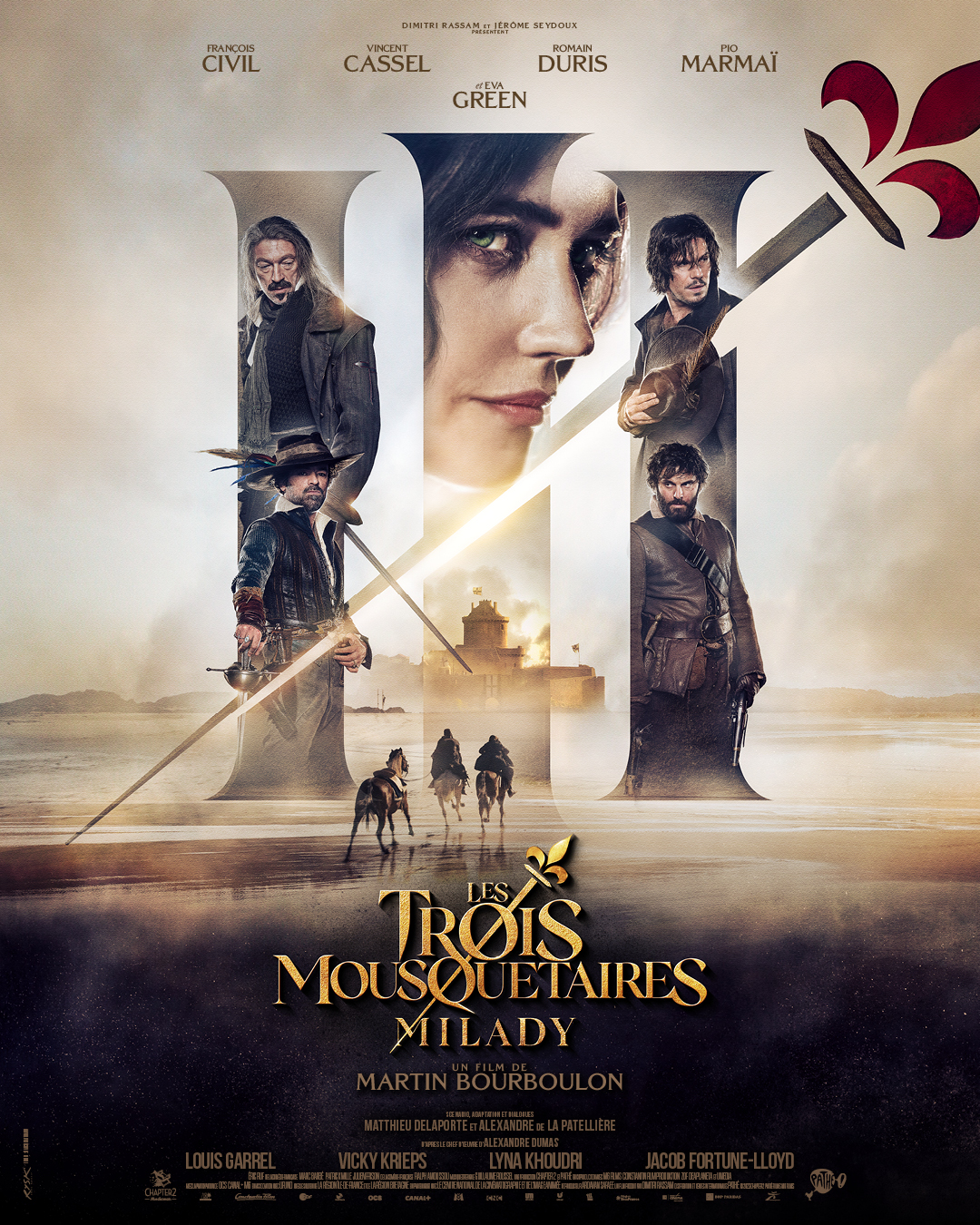
Cherchez la femme, as they say in French. Here, because everyone is doubling up (or doubling down, I never get that right, and it is of course a sequel), the narrative has our heroes (and these being four musketeers if you include D’Artagnan and not three) chasing all over France in pursuit of two women.
If you recall from episode one (and it doesn’t matter if you don’t because this starts with a neat re-cap), D’Artagnan’s (Francois Civil) girlfriend Constance (Lyna Khoudri) has been abducted after overhearing details of a plot to kill King Louis XIII (Louis Garrel), so he’s trying to find her. Meanwhile, everyone’s after Milady (Eva Green), the double-crosser’s double-crosser. In fact, to complicate matters, the movie begins with her being rescued by D’Artagnan.
As it turns out, that’s one of the easiest complications because unless you’ve got a PhD in French history, you won’t have a clue what’s going on, what with imminent English invasion, traitors inside the palace, eternal bad guy Cardinal Richelieu (Eric Ruf) and the French laying siege to their own port of La Rochelle. I’m guessing, because it’s not exactly plain, that the background is Catholic vs Protestant enmity.
I’d forgotten of course that our heroes are called musketeers for a reason and it’s not because they are swashbucklers, though they are pretty nifty with the sword, but the name indicates a certain dexterity with muskets. So, there’s rather a lot more guns being fired and buckles being swashed.
The 1932 version.
And you could be forgiven for thinking this is some kind of riposte to Downton Abbey because everywhere our heroes go there is sure to be some fabulous chateau or castle and all kinds of pomp and circumstance. It’s a tad overladen with characters and not all stand out enough. D’Artagnan doesn’t quite command the screen and of other trio it’s lusty Porthos (Pio Marmai) who steals the show, always ready with a chat-up line or falling down unconscious from alcoholic intake.
Milady is by the far the most interesting character, tying all the males in knots, escaping every type of peril, dodging the hangman’s noose and an inferno and setting up Part III with a clever climax. Although the period wasn’t rife with feminism, she is the poster girl, not just adept with any weapon (including teeth), but detailing what it’s like to be eternally molested by men.
Constance, on the other hand, is as dumb as they come. The scene that allows D’Artagnan to wallow in pathos, you can’t help howling with laughter because the stupid girl has brought on herself a pitiless fate.
Sets quite a pace, but sometimes it’s hard to keep up with the politics and who is romancing who, and why someone who has been helpful in the past now has to be bumped off.
I hope this has earned its big budget back in France because I doubt if it will do well anywhere else.
Feels like director Martin Bourboulon (Eiffel, 2021) has bitten off more than anybody can chew.
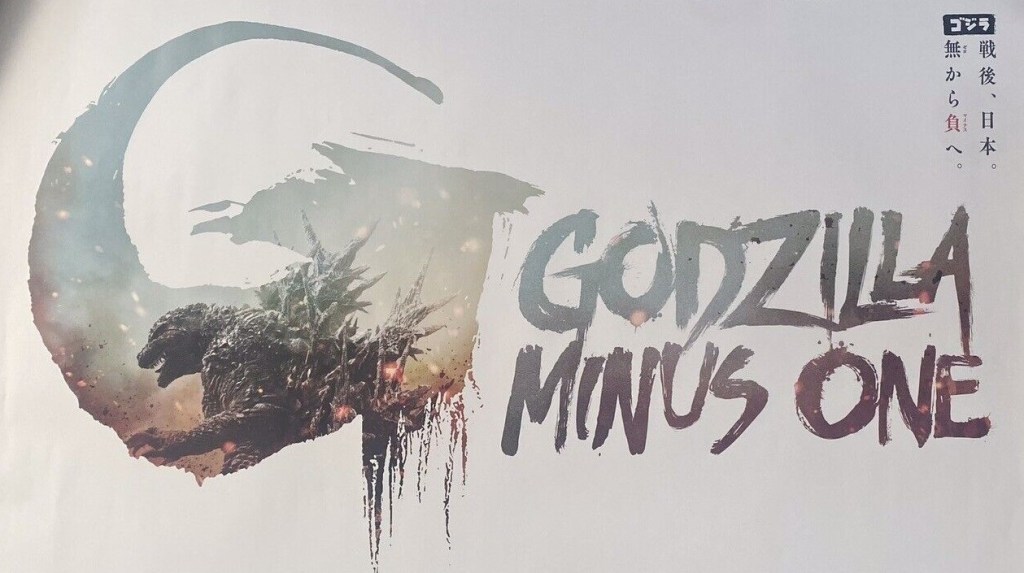
Godzilla Minus One
Not just a remake but, as it turns out, a prequel. It’s nipped in early, ahead of the next vehicle in the recycle business Kong vs Godzilla due out next year.
In this Japanese version, made by Toho Studios which was responsible for the 1954 original, the timeline is 1945-1947. It kicks off at the end of World War Two with cowardly Japanese kamikaze pilot Skikishima (Ryonusuke Kamiki) unable to pull the trigger as the monster emerges from the depths. Fast forward to U.S. nuclear tests on the Bikini Atholl, and the creature now mutates with devastating impact on the mainland.
By this point, Skikishima has acquired an orphaned baby and takes on a job on a minesweeper (his trigger finger now put to good use) destroying the thousands of mines left behind after the war so he’s in the front line when the monster re-emerges with an atomic heat-ray in its arsenal, never find those stomping feet and destructive tail.
There’s some clever scientific ruses to destroy Godzilla involving Freon tanks (whatever they are) and some jiggery-pokery to lower the water’s buoyancy (what now?) but basically as you might expect it’s mostly our favorite monster decimating cities and taking on every warship and airplane that the country can throw at it.
It’s pretty good fun but you might find it hard to sympathize with a kamikaze pilot.
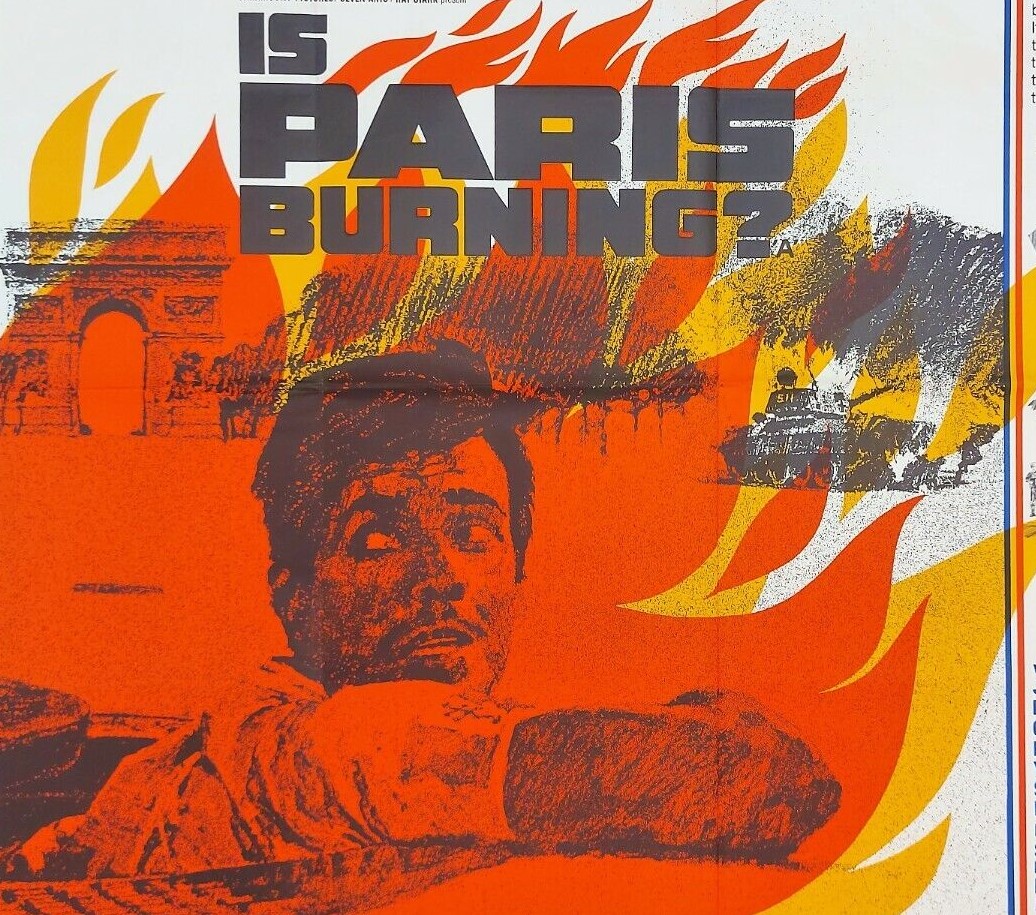
Politics didn’t usually play a part in war films in the 1960s but’s it’s an essential ingredient to Rene Clement’s underrated documentary-style picture. Paris had no strategic importance and after the Normandy landings the Allies intended to bypass the French capital and head straight for Berlin.
Meanwhile, Hitler, in particular vengeful mood after the attempt on his life, ordered the city destroyed. Resistance groups were splintered, out-numbered and lacking the weaponry to achieve an uprising. Followers of General De Gaulle, the French leader in exile, wanted to wait until the Allies sent in the troops, the Communists planned to seize control before British and American soldiers could arrive.
When the Communists begin the fight, seizing public buildings, the Germans plant explosives on the Eiffel Tower, the Louvre, and other famous buildings and all the bridges across the River Seine. The German commandant Von Choltitz (Gert Frobe), no stranger to slaughter having overseen the destruction of Rotterdam, holds off obeying his orders because he believes Hitler is insane and the war already lost.
The Gaullists despatch a messenger to persuade General Omar Bradley (Glenn Ford) to change his mind and send troops to relieve the city. Sorry for the plot-spoiler but as everyone knows the Germans did not destroy the city and the liberation of Paris provided famous newsreel and photographic footage.
Director Clement (Rider on the Rain, 1970) was also aware he could not extract much tension from the question of whether von Choltitz will press the destruct button, so he takes another route and documents in meticulous detail the political in-fighting and the actual street battles that ensued, German tanks and artillery against Molotov cocktails and mostly old-fashioned weaponry. The wide Parisian boulevards provide a fabulous backdrop for the fighting.
Shooting much of the action from above allows Clement to capture the action in vivid cinematic strokes. Like The Longest Day (1962), the film does not follow one individual but is in essence a vast tapestry. Scenes of the utmost brutality – resistance fighters thrown out of a lorry to be machine-gunned, the public are strafed when they venture out to welcome the Americans – contrast with moments of such gentleness they could almost be parody: a shepherd taking a herd through the fighting, an old lady covered in falling plaster watching as soldiers drop home-made bombs on tanks.
This is not a film about heroism but the sheer raw energy required to carry out dangerous duty and many times a character we just saw winning one sally against the enemy is shot the next. The French have to fight street-by-street, enemy-emplacement-by-enemy-emplacement, tank-by-tank.
And Clement allows as much time for humanity. Francophile Sgt Warren (Anthony Perkins), as an American grunt, spends all his time in the middle of the battle trying to determine the location of the sights he longs to see – before he is abruptly killed. An unnamed café owner (Simone Signoret) helps soldiers phone their loved ones.
Like The Longest Day and In Harm’s Way (1965), the film was shot in black-and-white, but not, as with those movies for the simple reason of incorporating newsreel footage, but because De Gaulle, now the French president, objected to the sight of red swastika. Even so, it permitted the inclusion of newsreel footage, which on the small screen (where most people these days will watch it) appears seamless.
By Hollywood standards this was not an all-star cast, Glenn Ford (as Bradley), Kirk Douglas (General Patton) and Robert Stack (General Sibert) making fleeting glimpses.
But by French standards it was the all-star cast to beat all-star casts – Jean-Paul Belmondo (Breathless, 1960), Alain Delon (Lost Command, 1966), Yves Montand (Grand Prix, 1966), Charles Boyer (Gaslight, 1944), Leslie Caron (Gigi, 1958), Michel Piccoli (Masquerade, 1965), Simone Signoret (Room at the Top, 1959) and Jean-Louis Trintignant (A Man and a Woman, 1966). Orson Welles, in subdued form, appeared as the Swedish ambassador.
Gore Vidal (The Best Man, 1964) and Francis Coppola (The Godfather, 1962) devised the screenplay based on the bestseller by Larry Collins and Dominic Lapierre
At $6 million, it was the most expensive French film ever made. It had a six-month shooting schedule and was shot on the streets of the city including famous locations like Etoile, Madeleine and the Louvre. It was a big hit in France but flopped in the United States, its box office so poor that Paramount refused to disclose it.
Purportedly, Frenchman Abel Gance got the idea for his film while walking down Broadway in New York in 1921. At that point he envisaged what we would these days term a “Napoleon Universe,” a series of six interlinked films (although early U.S. reports promised eight films) tracking the Emperor from his student days to exile in St Helena. Gance was a successful director, from La Droit a la Vie in 1917 to J’Accuse two years later each successive film had out-grossed the last. His La Roue / The Wheel (1923) was so lauded that French critics put it on a par with the later Citizen Kane.
He conceived each film to run about 5,500 feet for domestic release with a reduced version for the United States market. Unfortunately – or fortunately, depending – he could not contain his ambition. The film, eventually restricted to just the early part of Napoleon’s career, took two years to make, beginning in 1925. But his innovations included dolly shots, handheld camera, overhead camera, footage shot from the back of a horse, tracking, rapid editing and split screen. It’s worth remembering just why cameras were so static during that period – moving them was extremely laborious and time-consuming, which meant it cost too much money to do. And when it did move, the unsteady camera attracted too much attention. Gance wanted movement to be discreet, not just for its own sake.
He also invented an extremely wide-angle lens and then the camera employed for the triptych. Anticipating the arrival of sound, and although they could not be heard, he made his actors speak dialog, which facilitated later dubbing. And if that wasn’t enough, he conducted tests in 3D – used in the battle scenes it was discarded for distracting the eye. Rock salt substituted for hail and filming proved so dangerous there were 220 insurance claims.
Gance took another swipe at the legend in 1960 with an all-star cast but no better results at the box office.
It cost $500,000 – equivalent to $8.7 million today – a hefty sum for those days but nothing compared to MGM’s Ben-Hur which cost eight times as much. However, Gance had anticipated box office returns of $4.4 million. As well as his technical skills, Gance was a whiz at salesmanship and eventually secured the bulk of his funding from Russian entrepreneur Vladimir Wengeroff who had previously invested in German films. Wengeroff had earmarked Gance as a potential director for a projected movie version of War and Peace.
But with little finance from the major French studios, Gance retained control. Initially, he promised the first part would be completed by the end of 1924 with the rest two years later. In the end, part one was as far as he got. Initially, he planned to use four actors to play the Emperor at different stages of his life. Oddly perhaps from the modern perspective, he placed more emphasis on physical resemblance to Napoleon than acting ability and screen-tested over a dozen actors. In fact, the actor who won the part of the adult Napoleon was a “rank outsider,” considered too old and too fat. When tested Albert Dieudonne “looked rather like an old woman.” But when Gance’s original choice rejected the role, he returned to Dieudonne who had transformed himself into a slimmer person after undertaking an extreme diet.
The first of the innovative multi-screen images – nine in total – occurs early in the picture, in the snowball fight. Later, as many as 16 images would be superimposed. All this was achieved through technical drudgery, repeating shots endlessly until they fitted into a pattern, and Gance likened the effect to listening to an orchestra, not necessarily taking in each instrument but enjoying the accumulated effect. The snowballs were actually made from cotton wool so didn’t fly far. To achieve authenticity, the sequence took place in winter, parents outraged that their children in the conditions risked flu or bronchitis.
The chase scene filmed in Corsica employed camera cars, with other shots from cameras placed in pits, while extreme long shots over the hills and the use of wide angle lens enhanced the experience. But there were three cameras on the one car, one facing back, one sideways and another fixed to the running board. He also filmed from the back of a horse devising his own means of working the camera.
Ambition cost money. And soon the movie was in financial trouble, filming put on hold while the director sought new backers. Eventually, funding came from a new source. Despite its name, the Societe Generale du Films, originally set up to develop film itself, was actually owned by a Russian. The SGF funding came with a proviso – that if necessary it was entitled to edit the film to bring it down to the contractual length.
Gance’s boldest innovation was without doubt the triptych (more easily explained as film projected on three screens simultaneously in the manner, a quarter of a century later, of Cinerama). “I felt in certain scenes I lacked space,” he said, “That the picture was too small for me. Even a big picture was too small…I had the idea of stretching the screen. I didn’t know how. I vaguely thought if I put one camera on the right, one in front and one on the left I would have an enormous panorama.” To achieve this effect – his name is on the patent – he intended to mount three cameras on top of each other, in a pyramid linked by a motor.
There was no time to test the new equipment, manufactured by Debrie. It was completed just in time for the filming of the battle scene on 11 August 1926. When shooting ended in October 26 (though editing and post-production would continue into the following year), the producers had cause for celebration, the signing of a distribution deal with MGM, which promoted it in Variety as a “celebrated world epic.”
The version that premiered in Paris ran for 210 minutes although the following month the trade press were treated to a longer version. But it proved a flop. Even in France where audiences had been reared on the myth of Napoleon, and revered him, it was too long. Though MGM purchased it for American consumption, and some critics enthused (Variety deemed it an “extremely impressive job”) they cut it down (Variety was in agreement – noting “it would have to be sliced” while conceding “no picture producer can picture Napoleon in 70 minutes”) and it was given a very restricted number of showings. It was expected to attract most attention from the “sure-seaters” (i.e. arthouses).
Response was poor. Although shown in New York, it didn’t warrant information on the box office, suggesting it had been such a disappointment the figures were not revealed. At the 600-seat Arcadia in Philadelphia box office was “very bad.” However, returns at the 3,200-seat Loews in Montreal the returns were “above average.” That could possibly explained by Canadian affinity with France except that in Toronto the 2,300-seat Loews “took one in the jaw” at the box office. In Baltimore audiences “let it alone.” In Havana, exhibitors complained of Napoleon overload, this being the third film on the subject in as many months.
Although most U.S. exhibitors contended that interest from “the horde” in Napoleon was extremely limited that didn’t stop studios from churning out rivals. Films that may have got in its way included Frank Lloyd’s The Eagle of the Sea (1926), Napoleon (1927) with Lionel Atwill, Glorious Betsy (1928) with Dolores Costello, the German Queen Louise and Napoleon (1928) and Napoleon’s Barber (1928), one of the first talkie shorts.
In Britain, while critics doubted the effect of the triple screen, it was shown to “great success” at the Tivoli in London’s West End. But the promised general release failed to materialize.
The cost of creating “a new alphabet for the cinema” proved excessive. That the film sank into the vaults, quickly forgotten, ensured that when critics came to assess foreign silent pictures inevitably they alighted instead on Battleship Potemkin (1925) and Metropolis (1927). To all intents and purposes, Abel Gance’s Napoleon was gone – but it turned out not to be quite so forgotten and its resurrection ushered in a new experience in cinema-going.
SOURCES: Kevin Brownlow, Napoleon, Abel Gance’s Classic Film (Threefold Music, 2009); “French Napoleon,” Billboard, March 21, 1925, p85; Review, Variety, April 27, 1927, p20; Advertisement, Variety, October 26, 1927, p14; “Napoleon,” Kinematograph Weekly, December 15, 1927, p59; “Napoleon,” Variety, March 7, 1928, p50; Review, Kinematograph Weekly, July 5, 1928, p41; “Scenes From,” Kinematograph Weekly, July 26, 1928, p4; “Theatre Atmosphere,” Kinematograph Weekly, August 2, 1928, p50; “Too Many Napoleons,” Variety, October 24, 1928, p2; “Picture Grosses,” Variety, November 14, 1928, p9; “Picture Grosses,” Variety, December 5, 1928, p10; “Picture Grosses,” Variety, January 9, 1929, p7; “The Empire 13,” Kinematograph Weekly, January 17, 1929, p34; “Advertising Cost Biz for Stanleys,” Variety, February 6, 1929, p9.
Behind the Scenes: Napoleon (1927)
Purportedly, Frenchman Abel Gance got the idea for his film while walking down Broadway in New York in 1921. At that point he envisaged what we would these days term a “Napoleon Universe,” a series of six interlinked films (although early U.S. reports promised eight films) tracking the Emperor from his student days to exile in St Helena. Gance was a successful director, from La Droit a la Vie in 1917 to J’Accuse two years later each successive film had out-grossed the last. His La Roue / The Wheel (1923) was so lauded that French critics put it on a par with the later Citizen Kane.
He conceived each film to run about 5,500 feet for domestic release with a reduced version for the United States market. Unfortunately – or fortunately, depending – he could not contain his ambition. The film, eventually restricted to just the early part of Napoleon’s career, took two years to make, beginning in 1925. But his innovations included dolly shots, handheld camera, overhead camera, footage shot from the back of a horse, tracking, rapid editing and split screen. It’s worth remembering just why cameras were so static during that period – moving them was extremely laborious and time-consuming, which meant it cost too much money to do. And when it did move, the unsteady camera attracted too much attention. Gance wanted movement to be discreet, not just for its own sake.
He also invented an extremely wide-angle lens and then the camera employed for the triptych. Anticipating the arrival of sound, and although they could not be heard, he made his actors speak dialog, which facilitated later dubbing. And if that wasn’t enough, he conducted tests in 3D – used in the battle scenes it was discarded for distracting the eye. Rock salt substituted for hail and filming proved so dangerous there were 220 insurance claims.
It cost $500,000 – equivalent to $8.7 million today – a hefty sum for those days but nothing compared to MGM’s Ben-Hur which cost eight times as much. However, Gance had anticipated box office returns of $4.4 million. As well as his technical skills, Gance was a whiz at salesmanship and eventually secured the bulk of his funding from Russian entrepreneur Vladimir Wengeroff who had previously invested in German films. Wengeroff had earmarked Gance as a potential director for a projected movie version of War and Peace.
But with little finance from the major French studios, Gance retained control. Initially, he promised the first part would be completed by the end of 1924 with the rest two years later. In the end, part one was as far as he got. Initially, he planned to use four actors to play the Emperor at different stages of his life. Oddly perhaps from the modern perspective, he placed more emphasis on physical resemblance to Napoleon than acting ability and screen-tested over a dozen actors. In fact, the actor who won the part of the adult Napoleon was a “rank outsider,” considered too old and too fat. When tested Albert Dieudonne “looked rather like an old woman.” But when Gance’s original choice rejected the role, he returned to Dieudonne who had transformed himself into a slimmer person after undertaking an extreme diet.
The first of the innovative multi-screen images – nine in total – occurs early in the picture, in the snowball fight. Later, as many as 16 images would be superimposed. All this was achieved through technical drudgery, repeating shots endlessly until they fitted into a pattern, and Gance likened the effect to listening to an orchestra, not necessarily taking in each instrument but enjoying the accumulated effect. The snowballs were actually made from cotton wool so didn’t fly far. To achieve authenticity, the sequence took place in winter, parents outraged that their children in the conditions risked flu or bronchitis.
The chase scene filmed in Corsica employed camera cars, with other shots from cameras placed in pits, while extreme long shots over the hills and the use of wide angle lens enhanced the experience. But there were three cameras on the one car, one facing back, one sideways and another fixed to the running board. He also filmed from the back of a horse devising his own means of working the camera.
Ambition cost money. And soon the movie was in financial trouble, filming put on hold while the director sought new backers. Eventually, funding came from a new source. Despite its name, the Societe Generale du Films, originally set up to develop film itself, was actually owned by a Russian. The SGF funding came with a proviso – that if necessary it was entitled to edit the film to bring it down to the contractual length.
Gance’s boldest innovation was without doubt the triptych (more easily explained as film projected on three screens simultaneously in the manner, a quarter of a century later, of Cinerama). “I felt in certain scenes I lacked space,” he said, “That the picture was too small for me. Even a big picture was too small…I had the idea of stretching the screen. I didn’t know how. I vaguely thought if I put one camera on the right, one in front and one on the left I would have an enormous panorama.” To achieve this effect – his name is on the patent – he intended to mount three cameras on top of each other, in a pyramid linked by a motor.
There was no time to test the new equipment, manufactured by Debrie. It was completed just in time for the filming of the battle scene on 11 August 1926. When shooting ended in October 26 (though editing and post-production would continue into the following year), the producers had cause for celebration, the signing of a distribution deal with MGM, which promoted it in Variety as a “celebrated world epic.”
The version that premiered in Paris ran for 210 minutes although the following month the trade press were treated to a longer version. But it proved a flop. Even in France where audiences had been reared on the myth of Napoleon, and revered him, it was too long. Though MGM purchased it for American consumption, and some critics enthused (Variety deemed it an “extremely impressive job”) they cut it down (Variety was in agreement – noting “it would have to be sliced” while conceding “no picture producer can picture Napoleon in 70 minutes”) and it was given a very restricted number of showings. It was expected to attract most attention from the “sure-seaters” (i.e. arthouses).
Response was poor. Although shown in New York, it didn’t warrant information on the box office, suggesting it had been such a disappointment the figures were not revealed. At the 600-seat Arcadia in Philadelphia box office was “very bad.” However, returns at the 3,200-seat Loews in Montreal the returns were “above average.” That could possibly explained by Canadian affinity with France except that in Toronto the 2,300-seat Loews “took one in the jaw” at the box office. In Baltimore audiences “let it alone.” In Havana, exhibitors complained of Napoleon overload, this being the third film on the subject in as many months.
Although most U.S. exhibitors contended that interest from “the horde” in Napoleon was extremely limited that didn’t stop studios from churning out rivals. Films that may have got in its way included Frank Lloyd’s The Eagle of the Sea (1926), Napoleon (1927) with Lionel Atwill, Glorious Betsy (1928) with Dolores Costello, the German Queen Louise and Napoleon (1928) and Napoleon’s Barber (1928), one of the first talkie shorts.
In Britain, while critics doubted the effect of the triple screen, it was shown to “great success” at the Tivoli in London’s West End. But the promised general release failed to materialize.
The cost of creating “a new alphabet for the cinema” proved excessive. That the film sank into the vaults, quickly forgotten, ensured that when critics came to assess foreign silent pictures inevitably they alighted instead on Battleship Potemkin (1925) and Metropolis (1927). To all intents and purposes, Abel Gance’s Napoleon was gone – but it turned out not to be quite so forgotten and its resurrection ushered in a new experience in cinema-going.
SOURCES: Kevin Brownlow, Napoleon, Abel Gance’s Classic Film (Threefold Music, 2009); “French Napoleon,” Billboard, March 21, 1925, p85; Review, Variety, April 27, 1927, p20; Advertisement, Variety, October 26, 1927, p14; “Napoleon,” Kinematograph Weekly, December 15, 1927, p59; “Napoleon,” Variety, March 7, 1928, p50; Review, Kinematograph Weekly, July 5, 1928, p41; “Scenes From,” Kinematograph Weekly, July 26, 1928, p4; “Theatre Atmosphere,” Kinematograph Weekly, August 2, 1928, p50; “Too Many Napoleons,” Variety, October 24, 1928, p2; “Picture Grosses,” Variety, November 14, 1928, p9; “Picture Grosses,” Variety, December 5, 1928, p10; “Picture Grosses,” Variety, January 9, 1929, p7; “The Empire 13,” Kinematograph Weekly, January 17, 1929, p34; “Advertising Cost Biz for Stanleys,” Variety, February 6, 1929, p9.
Behind the Scenes: Napoleon (1927)
Purportedly, Frenchman Abel Gance got the idea for his film while walking down Broadway in New York in 1921. At that point he envisaged what we would these days term a “Napoleon Universe,” a series of six interlinked films (although early U.S. reports promised eight films) tracking the Emperor from his student days to exile in St Helena. Gance was a successful director, from La Droit a la Vie in 1917 to J’Accuse two years later each successive film had out-grossed the last. His La Roue / The Wheel (1923) was so lauded that French critics put it on a par with the later Citizen Kane.
He conceived each film to run about 5,500 feet for domestic release with a reduced version for the United States market. Unfortunately – or fortunately, depending – he could not contain his ambition. The film, eventually restricted to just the early part of Napoleon’s career, took two years to make, beginning in 1925. But his innovations included dolly shots, handheld camera, overhead camera, footage shot from the back of a horse, tracking, rapid editing and split screen. It’s worth remembering just why cameras were so static during that period – moving them was extremely laborious and time-consuming, which meant it cost too much money to do. And when it did move, the unsteady camera attracted too much attention. Gance wanted movement to be discreet, not just for its own sake.
He also invented an extremely wide-angle lens and then the camera employed for the triptych. Anticipating the arrival of sound, and although they could not be heard, he made his actors speak dialog, which facilitated later dubbing. And if that wasn’t enough, he conducted tests in 3D – used in the battle scenes it was discarded for distracting the eye. Rock salt substituted for hail and filming proved so dangerous there were 220 insurance claims.
It cost $500,000 – equivalent to $8.7 million today – a hefty sum for those days but nothing compared to MGM’s Ben-Hur which cost eight times as much. However, Gance had anticipated box office returns of $4.4 million. As well as his technical skills, Gance was a whiz at salesmanship and eventually secured the bulk of his funding from Russian entrepreneur Vladimir Wengeroff who had previously invested in German films. Wengeroff had earmarked Gance as a potential director for a projected movie version of War and Peace.
But with little finance from the major French studios, Gance retained control. Initially, he promised the first part would be completed by the end of 1924 with the rest two years later. In the end, part one was as far as he got. Initially, he planned to use four actors to play the Emperor at different stages of his life. Oddly perhaps from the modern perspective, he placed more emphasis on physical resemblance to Napoleon than acting ability and screen-tested over a dozen actors. In fact, the actor who won the part of the adult Napoleon was a “rank outsider,” considered too old and too fat. When tested Albert Dieudonne “looked rather like an old woman.” But when Gance’s original choice rejected the role, he returned to Dieudonne who had transformed himself into a slimmer person after undertaking an extreme diet.
The first of the innovative multi-screen images – nine in total – occurs early in the picture, in the snowball fight. Later, as many as 16 images would be superimposed. All this was achieved through technical drudgery, repeating shots endlessly until they fitted into a pattern, and Gance likened the effect to listening to an orchestra, not necessarily taking in each instrument but enjoying the accumulated effect. The snowballs were actually made from cotton wool so didn’t fly far. To achieve authenticity, the sequence took place in winter, parents outraged that their children in the conditions risked flu or bronchitis.
The chase scene filmed in Corsica employed camera cars, with other shots from cameras placed in pits, while extreme long shots over the hills and the use of wide angle lens enhanced the experience. But there were three cameras on the one car, one facing back, one sideways and another fixed to the running board. He also filmed from the back of a horse devising his own means of working the camera.
Ambition cost money. And soon the movie was in financial trouble, filming put on hold while the director sought new backers. Eventually, funding came from a new source. Despite its name, the Societe Generale du Films, originally set up to develop film itself, was actually owned by a Russian. The SGF funding came with a proviso – that if necessary it was entitled to edit the film to bring it down to the contractual length.
Gance’s boldest innovation was without doubt the triptych (more easily explained as film projected on three screens simultaneously in the manner, a quarter of a century later, of Cinerama). “I felt in certain scenes I lacked space,” he said, “That the picture was too small for me. Even a big picture was too small…I had the idea of stretching the screen. I didn’t know how. I vaguely thought if I put one camera on the right, one in front and one on the left I would have an enormous panorama.” To achieve this effect – his name is on the patent – he intended to mount three cameras on top of each other, in a pyramid linked by a motor.
There was no time to test the new equipment, manufactured by Debrie. It was completed just in time for the filming of the battle scene on 11 August 1926. When shooting ended in October 26 (though editing and post-production would continue into the following year), the producers had cause for celebration, the signing of a distribution deal with MGM, which promoted it in Variety as a “celebrated world epic.”
The version that premiered in Paris ran for 210 minutes although the following month the trade press were treated to a longer version. But it proved a flop. Even in France where audiences had been reared on the myth of Napoleon, and revered him, it was too long. Though MGM purchased it for American consumption, and some critics enthused (Variety deemed it an “extremely impressive job”) they cut it down (Variety was in agreement – noting “it would have to be sliced” while conceding “no picture producer can picture Napoleon in 70 minutes”) and it was given a very restricted number of showings. It was expected to attract most attention from the “sure-seaters” (i.e. arthouses).
Response was poor. Although shown in New York, it didn’t warrant information on the box office, suggesting it had been such a disappointment the figures were not revealed. At the 600-seat Arcadia in Philadelphia box office was “very bad.” However, returns at the 3,200-seat Loews in Montreal the returns were “above average.” That could possibly explained by Canadian affinity with France except that in Toronto the 2,300-seat Loews “took one in the jaw” at the box office. In Baltimore audiences “let it alone.” In Havana, exhibitors complained of Napoleon overload, this being the third film on the subject in as many months.
Although most U.S. exhibitors contended that interest from “the horde” in Napoleon was extremely limited that didn’t stop studios from churning out rivals. Films that may have got in its way included Frank Lloyd’s The Eagle of the Sea (1926), Napoleon (1927) with Lionel Atwill, Glorious Betsy (1928) with Dolores Costello, the German Queen Louise and Napoleon (1928) and Napoleon’s Barber (1928), one of the first talkie shorts.
In Britain, while critics doubted the effect of the triple screen, it was shown to “great success” at the Tivoli in London’s West End. But the promised general release failed to materialize.
The cost of creating “a new alphabet for the cinema” proved excessive. That the film sank into the vaults, quickly forgotten, ensured that when critics came to assess foreign silent pictures inevitably they alighted instead on Battleship Potemkin (1925) and Metropolis (1927). To all intents and purposes, Abel Gance’s Napoleon was gone – but it turned out not to be quite so forgotten and its resurrection ushered in a new experience in cinema-going.
SOURCES: Kevin Brownlow, Napoleon, Abel Gance’s Classic Film (Threefold Music, 2009); “French Napoleon,” Billboard, March 21, 1925, p85; Review, Variety, April 27, 1927, p20; Advertisement, Variety, October 26, 1927, p14; “Napoleon,” Kinematograph Weekly, December 15, 1927, p59; “Napoleon,” Variety, March 7, 1928, p50; Review, Kinematograph Weekly, July 5, 1928, p41; “Scenes From,” Kinematograph Weekly, July 26, 1928, p4; “Theatre Atmosphere,” Kinematograph Weekly, August 2, 1928, p50; “Too Many Napoleons,” Variety, October 24, 1928, p2; “Picture Grosses,” Variety, November 14, 1928, p9; “Picture Grosses,” Variety, December 5, 1928, p10; “Picture Grosses,” Variety, January 9, 1929, p7; “The Empire 13,” Kinematograph Weekly, January 17, 1929, p34; “Advertising Cost Biz for Stanleys,” Variety, February 6, 1929, p9.
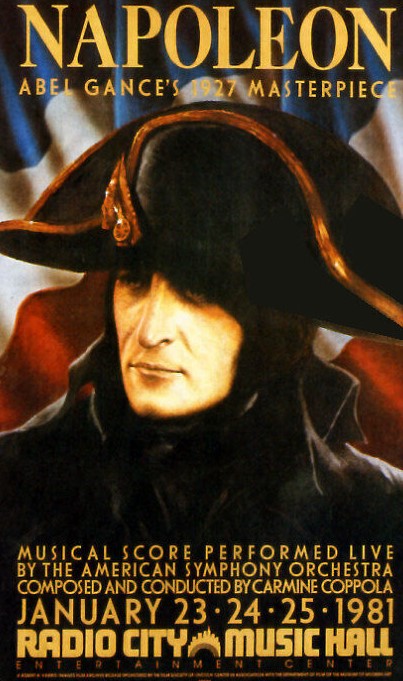
That Fritz Lang’s Metropolis (1927) dominated the foreign film scene in the silent era was only because Abel Gance’s majestic Napoleon the same year was butchered on release and rarely seen outside its native France. Audiences who might fancy waiting for streaming to view Ridley Scott’s new epic on the grander four-hour scale might prefer to test their stamina against this early masterpiece that broke incredible new cinematic ground.
You could easily get the impression from the vast amount of innovation on display here that one man – and a Frenchman at that – had single-handedly decided to revolutionize the entire medium. Of course, France had been instrumental in the birth of cinema. Alice Guy was key to the development of narrative cinema although the world being male-dominated that singular achievement was erroneously handed over to George Melies.
Here’s the list of Abel Gance’s innovations: split screen (in fact, triple images), underwater shots, tinting, fast cutting, hand-held shots, extensive close-ups, point-of-view shots, superimposition, use of multiple cameras, mosaic shots and multiple exposure. Perhaps even more astonishing was that at the time the bulk of movie cameras were static. Even if the result had been, dramatically speaking, as dull as ditch water, it would have been of historical cinematic importance, possibly on a par with This Is Cinerama (1952) or House of Wax (1953), the first 3D.
And it if had been as visually striking and cinematically interesting as The Robe (1953), Twentieth Century Fox’s first demonstration of Cinemascope, it would have more than passed muster as a cinematic footnote.
Instead, it is just stunning. You couldn’t ask for a bolder storyline, the biopic of one of the most fascinating characters who ever lived, Napoleon Bonaparte, who resurrected France after the Revolution of 1789, conquered most of Europe, and rose from defeat and captivity to rally his troops for one final battle at Waterloo in 1815. Wisely, Abel Gance doesn’t attempt to cover all that territory, only going as far as the invasion of Italy, which marked the Little General’s rise as a battle master.
Unlike other directors such as Orson Welles who scarcely made another movie after one of his first efforts was butchered on release, Gance kept plugging away despite the debacle of Napoleon. “Venus of Paris” was shown in 1941.
Which version you see – the most common one comes in at around the four-hour mark but if you have the stamina there’s enough in the longer version to keep you engrossed for another couple of hours – will inform your assessment of the authenticity of the narrative and attest to the compelling nature of the tale.
Beginning with a young Napoleon revealing his military skills just to engage in a snowball fight, it moves with narrative focus and cinematic flair through his difficult time at school to the invasion of Italy. Some of the imagery is haunting, a freed pet eagle returning out of choice to his side, the French flag used as a sail, lightning illuminates hand-to-hand combat (that battle taking place in the kind of driving rain Kurosawa would employ in Seven Samurai, 1954), scenes change color, and the final unfurling of the triptych (three connected screens a la Cinerama) is one of the most visual climaxes in cinema.
But even the shortest version contains the bulk of the innovation, perhaps proving that dialog was the most redundant of all the cinematic developments. The trailer, which you can catch on YouTube (see link below), is almost jukebox cinema, a compilation of many of the greatest scenes. Unless you are familiar with silent cinema style, you might recoil at some of the acting, but, once you get into the swing of it, that seems to jar less.
Much as I am a huge fan of Ridley Scott (the extended version of Kingdom of Heaven, 2005, a long-time fave), I doubt if his version (even the longer one promised for the Netflix screening) will come anywhere close to the almost cinematic perfection of Abel Gance.
Don’t take Stanley Kubrick and martin Scorsese’s word for it, this is a must watch.









 The Magnificent 60s