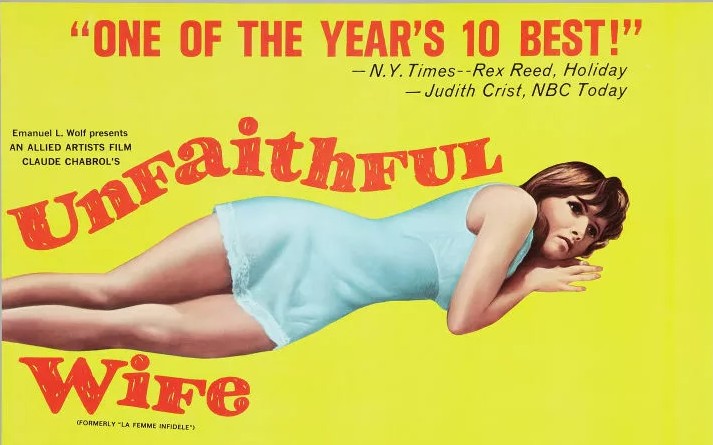
La Femme Infidele / Unfaithful Wife (1969) ****

Not surprising since French critics worshipped Alfred Hitchcock – the only ones who gave him their wholesale approval in the 1960s – that a French director would attempt to pick up his mantle. But where Hitchcock majored on mystery and suspense and generally an innocent entrapped in conspiracy or crime, here director Claude Chabrol mostly dispenses with mystery concentrating instead on suspense. And it’s of the kind exhibited in To Catch a Thief (1955), Vertigo (1958), North by Northwest (1959) and Marnie (1964) where you are willing a character to get away with their crime or at least find redemption. And where Hitchcock places that load on the glamorous femme fatale, here Chabrol throws us into that most mundane of crimes, the jealous husband wanting revenge on his wife’s lover.

Successful businessman Charles (Michel Bouquet) should be enjoying life, glamorous trophy wife Helene (Stephane Audran) way out of his league, big house in the country, adorable son. But there’s something amiss. When his wife, who appears loving, makes sexual overtures in bed he turns over. He has grown suspicious of the amount of time she wife spends in Paris, ostensibly visiting her hairdresser or having beauty treatments or going to the cinema. Eventually, he hires a private detective and discovers his wife has a lover, Victor (Maurice Ronet). He decides to confront the lover rather than the wife. But instead of playing  the outraged husband card, he pretends to be a man of the world, suggesting that Helene and he have an open marriage and that Victor is the latest in a long line of lovers. What he hopes to achieve from this is unclear, perhaps put Victor’s nose out of joint, perhaps cover up his own anger.

But it doesn’t go the way he planned. He spies an over-large cigarette lighter in the bedroom, a present he gave his wife for their third anniversary and kills Victor. This being the 1960s before forensics determined that you could never entirely eliminate a blood stain on a floor,  Charles, with considerable diligence, cleans up the blood, remembering to wash out the bucket and cloth, wiping his fingerprints from everything he touched, bagging up the man in bed linen and dragging him out to his car.

On the way to disposing the body he is involved in a minor road accident. Police are called. He is saved from opening the car trunk because it is damaged. But when he tries to get rid of the body, the trunk proves impossible to open. Victor had appeared such a smarmy character, you’ve got no compunction about his death, you just want Charles to get away with the murder. Eventually, he forces the trunk open and drops the body in a small algae-covered pond. For a moment air trapped in the package makes it appear unsinkable. But, then – audience enjoying a sigh of relief and perhaps a homage to Psycho (1960) – it disappears.

Whether he revels in the discomfort of his wife who is no longer able to enjoy her twice-weekly assignations with Victor and unable, of course, to explain her bouts of distress to her husband and must keep up a façade, is unclear.

This is only a perfect crime to someone who has never been involved in crime, unaware of all the means of investigation at the disposal of Inspector Duval (Michel Duchaussoy) and his evil-eyed colleague Gobet (Guy Marley) who has the kind of look that says I know you’re guilty.

Turns out Helene’s name is in Victor’s address book and she can come up with no plausible reason for it being there. Charles denies ever having met Victor. The police are not convinced and return to interrogate the pair. Any viewer will quickly realize that it’s virtually impossible for either of the pair to remain undetected, the regularity of Helene’s visits can hardly have gone unnoticed, and even on a quiet street someone might have noticed Charles’s parked car and possibly him lifting the bulky package.

Nor does Charles dissolve in a bout of guilt. There’s an air of inevitability about him. You have no idea whether he might divorce Helene. The notion that she might not just take another lover doesn’t seem to occur to him and he’s not offered the opportunity to air his suspicions. Is he just going to bump off every lover his wife takes?

His wife finds a photograph of her lover in her husband’s pocket. But instead of denouncing him to the police, she burns it, either to protect her marriage or protect herself from the humiliation of being linked to the dead man, or because she has realized the folly of her betrayal.

We never find out her intentions because at that moment the police return and take Charles away.

A marvellous pivot on Hitchcock, with none of the B-film seediness that might have attended such a femme fatale, as Chabrol sets out his stall as a purveyor of the ordinary criminal, the one who didn’t run in high-class circles or was involved in international intrigue. The crime is so commonplace, that’s the beauty of it, and Charles such an ordinary character it all works superbly.

While Stephane Audran (Les Biches, 1968) is luminous, Michel Bouquet (The Road to Cornith, 1967) is her down-to-earth opposite. Written by the director and Sauro Scavolini (Any Gun Can Play, 1967).

A director finds his metier.

Squad 36 / Bastion 36 (2025) **

Netflix appears to be going through the gears – the wrong way. But that’s what happens when you’re so dependent on content – any content. But no different really from old Hollywood, always a bucket of stinkers in the days when studios had to each greenlight 20-25 pictures just to stay in the business.

I’d been encouraged by Toxic Town (2025) and my love of French policiers to take a chance on this one. It shouldn’t have been much of gamble. Even though French gangster/crime movies don’t travel all that well, for aficionados like me, growing up on the likes of Gabin, Belmondo and Delon (and intruder Bronson)  that doesn’t matter. Still lingering in my memory are Mesrine (2008) and 36 Quai des Orfevres (2004) with Daniel Auteil and Gerard Depardieu, for example, directed by Olivier Marchal, who helms this one.

This at least gets off to a good start, a blistering chase through a rain-sodden Paris, clever interchange of personnel in cars and on motorcycle, hounding target Mahmoud through the streets. Eventually, Antoine (Victor Belmondo) has him trapped. But in the first of a series of bizarre twists the criminal gets away. How? Well, it’s simple. It’s down to bureaucracy. Instead of putting a bullet through a guy armed with a gun, presumably a crime in itself, Mahmoud effectively reminds Antoine that he doesn’t want to be seen shooting an armed man in public.

What? Double what? Mahmoud might not be resisting arrest but he’s clearly armed and dangerous. But of course there’s another reason Mahmoud can’t be arrested. Because the cops don’t have evidence to link him to criminals – the tracking is in the hope he’ll lead them to the bad guys. However true that may be, at the moment of this confrontation Mahmoud is clearly committing a criminal act, unless he’s got a license to carry a gun in public.

Then it gets even dopier. The top cop is furious because the chase has generated complaints from the good citizens of the French capital. Ooh la la! Then Antoine gets busted because – wait for it – he put in hospital three guys who ambushed him. Guilty apparently of using excessive force. That seems a tad unhinged. Is there any way to combat an attack by three thugs without putting at least a couple of them out of action?

This might have been redeemed had Antoine capitalized on his early edginess. He’s in the illegal business himself, but only to the extent of participating in underground bare-knuckle boxing matches. At one point he takes a hell of a beating – we’re talking Clint Eastwood territory – so that should have set him up for the rest of the picture.

But instead he reverts to completely dull as six months later, having been shifted to another unit, he returns to, unofficially, investigate the deaths of two members of his original squad and the disappearance of a third, Richard (Soufiane Guerrab), who has gone loopy – possibly after reading the script – but then disappeared from a psychiatric clinic.

Antoine has various leads to follow and occasionally, in case the plot is too difficult for us to follow, we pop into the lives of the other cops involved so we know full well they are up to something dodgy. Meanwhile, as with the best cop pictures, there’s a cover-up, which may be because the top brass is implicated or because it would just harm public relations if the public were to even think (perish the thought!) that there could be corruption in the police force.

This just drags on and on. It could easily do with losing a good 30 minutes. But even then it would sag. None of the actors involved take it by the scruff, the way they used to in the good old days, not even when they are presented as an old-fashioned hard-drinking hard-smoking gang. You used to be able to rely of supporting actors to steal scenes, just for the hell of it if they were older and to put down a marker for the future if they were younger, but that doesn’t seem to have occurred to anyone here.

There’s an ironic twist at the end, the kind you used to get in the paranoia thrillers of the 1970s. Cracking start, good ending, but not very much to hook you in between.

Written and directed by ex-cop ex-actor Olivier Marchal from the book by  Michel Tourscher.

Goes through the motions without hitting the spot.

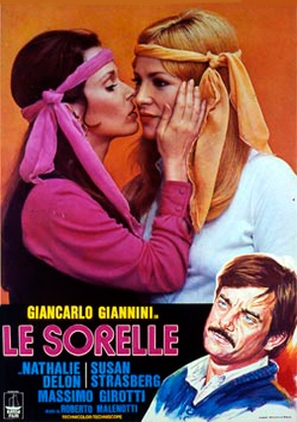
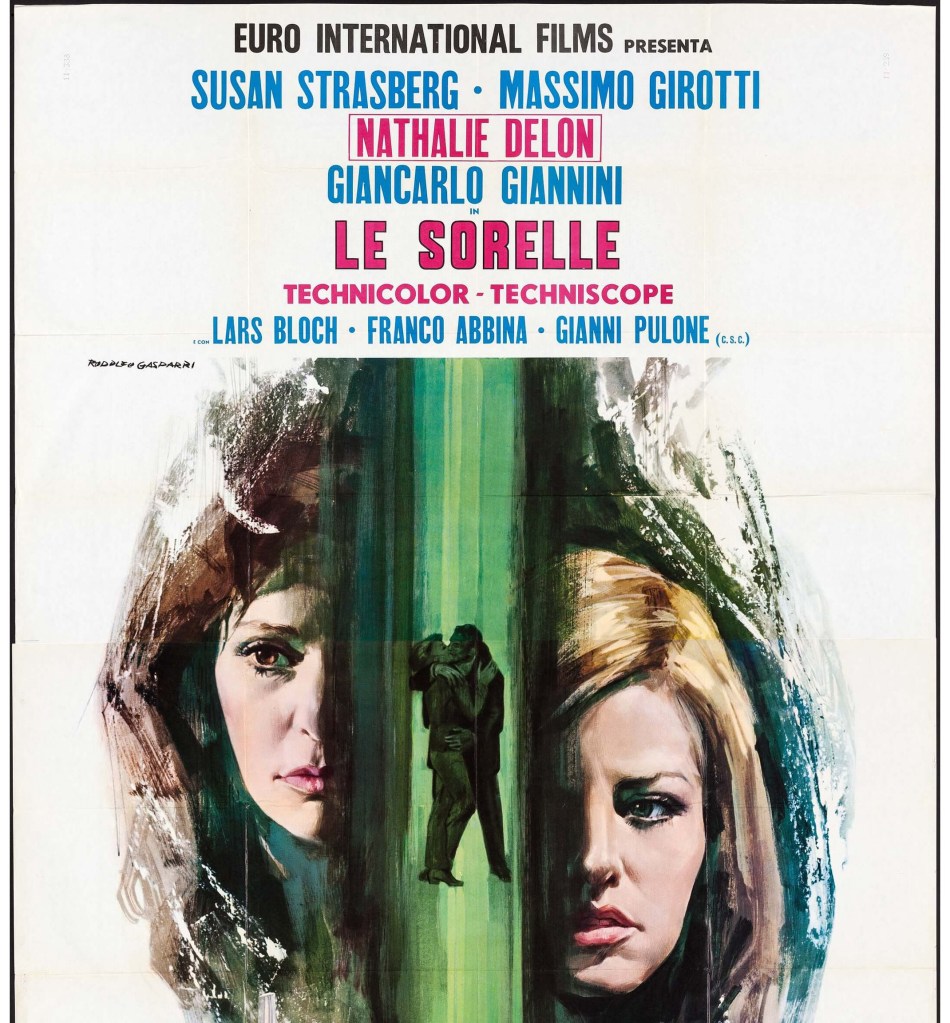
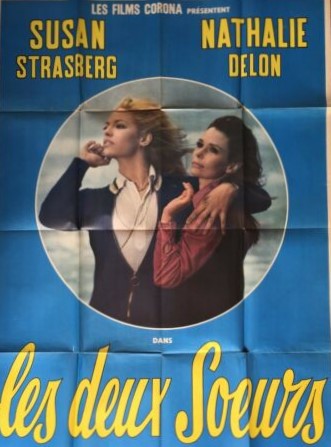
The Sisters / Le Sorelle (1969) ****

Erotically-charged, symbolically-heavy French drama of siblings trying to re-establish the intense relationship they enjoyed as teenagers. After a nervous breakdown and on the point of divorce, blonde translator Diana (Nathalie Delon) seeks respite at the home of younger sister Martha (Susan Strasberg), a brunette happily married to the wealthy and indulgent Alex (Massimo Girotti).

Initially, the more worldly Diana, the more flamboyant dresser, appears the superior but it soon transpires she is the more fragile. The apparently timid Martha allows her husband to control her life to the point of buying all her clothes and confesses to feeling as if she is on “a perpetual cruise.” While on the surface, it seems as if she has given up too much, in reality she disapproves of disorder and seeks perfection. She comes across as needing protection, and believes the woman’s role is to sacrifice, but in fact has managed to arrange her life to her own satisfaction.

Their competitive streaks emerge in different ways, Diana in obvious fashion, seeking to beat her sister while out horse-riding, Martha in more subtle and sensual manner, flaunting her sexual relations with her husband, almost offering her sister to her husband, and having a lover (Lars Bloch) on the side. There is a sense of each attempting to impose their world view on the other. Diana gives her sister a make-over, a new look which Alex adores, Martha hates it. There’s a sense of a chess game, with two or more players, with the males subservient. pawns.

Sensuality is never far away. Diana nuzzles her sister’s neck to smell her perfume. Alex is photographed, encouraged by Martha, in almost intimate mode with Alex. Dario (Giancarlo Giannini) is brought in to tempt Diana. And a scene where the girls experiment with colorful scarves suggests libertarianism. 

But it is clear that both sisters live empty lives devoid of true love and equally obvious as the picture progresses that both have arrived at the conclusion that they were at their happiest when together. There are subtle hints of incest, comforting each other in bed, the sensuality electric and the film begins to examine whether this taboo can be crossed and, if so, will it provide the necessary escape?

Despite Martha’s apparent subjugation, there is more than an inkling of feminism, the girls are involved in a complicated game in which the males are pawns, either rejected or made to look fools. While not fulfilled, Martha has turned as much as possible to her own advantage and Diana seems perfectly capable of taking what she wants.

Alex provides the symbolism. He cultivates rare plants that need to hide from the sun, in a greenhouse, lengthy exposure to whose atmosphere would be fatal to humans. He endlessly photographs them because they won’t last long. And in similar fashion provides a haven for the apparently vulnerable Martha.

Nathalie Delon (When Eight Bells Toll, 1970), married at this point to Alain Delon, shows a subtlety of expression that is rare for someone appearing in just her third film, and effects a gradual character transition throughout. Susan Strasberg, daughter of famed acting coach, Lee Strasberg, inventor of the Method Style of Acting, was one of the boldest actors of her generation, appearing in drug pictures The Trip (1967) and Psych Out (1968). She delivers an excellent portrait of a woman who manages to keep her true personality hidden, and for whom sexuality has few barriers.

This is the puppy-fat version of Giancarlo Giannini (Swept Away, 1974), barely recognizable as the future arthouse superstar whose physical appearance relied on gaunt, angst-riddles features.  Massimo Girotti (Theorem, 1968) is good as the man who thinks he has everything, not realizing how little he has. 

Although this was an accomplished directorial debut from Roberto Malenotti, he only made one more movie. Perhaps he made enough from directing the famous Coke commercial I’d Like To Teach The World To Sing (1971).

Always intriguing, revelations continually undercutting what we think we know of the characters, but delivered in subtle European tones rather than employing Hollywood shock, each of the four main people involved changing considerably due to their interaction with the others. While certainly skirting close to the borders of what was permissible at the end of the 1960s, it does so without exploiting the actresses.

Intriguing.

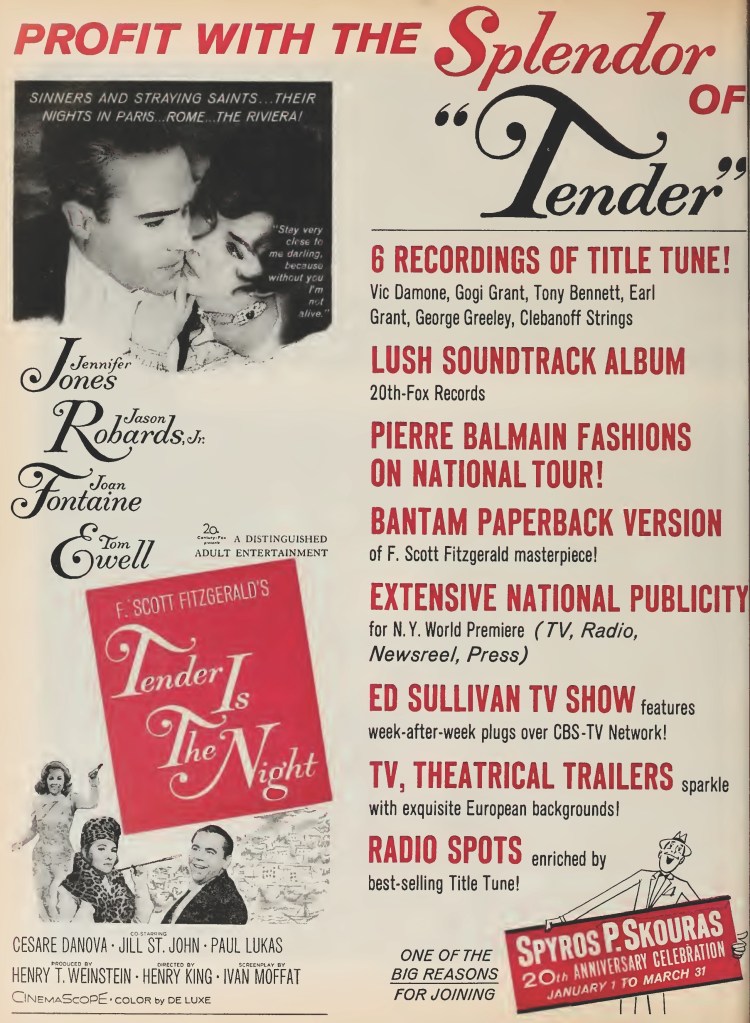
Tender Is the Night (1962) ***

Hollywood hadn’t had much luck with F. Scott Fitzgerald, now considered one of the three American literary geniuses of the 20th century along with Nobel prize-winners Ernest Hemingway and William Faulkner. His novel The Great Gatsby has easily proven the century’s best-read literary novel. He was an alcoholic wastrel when in the employ of studios, in the latter stages of his life. Although The Great Gatsby had been filmed twice, in 1926 with Warner Baxter and 1949 with Alan Ladd, both versions had flopped.

His biggest seller, debut novel The Beautiful and the Damned (1922) didn’t hit the box office mark either. The Last Time I Saw Paris (1954), based on one of his short stories and starring Elizabeth Taylor, and a modest success, didn’t inspire Hollywood and it took Beloved Infidel, the memoir of his lover, gossip columnist Sheilah Graham, to kickstart further interest. But the film of that book, even with top marquee name Gregory peck, died at the box office in 1959.

So, whatever way you cut it, Twentieth Century Fox was taking a serious gamble – the budget was $3.9 million – trying to mount Tender Is the Night especially with such questionable stars. It was a comeback for Jennifer Jones, at one time a solid performer at the box office and an Oscar-winner besides. But she had been out of the business for five years, a lifetime in Hollywood terms. Male lead Jason Robards was virtually a movie unknown. This was his sophomore outing and his debut By Love Possessed (1961) had flopped. How much his Broadway prowess would attract audiences outside the Big Apple was anyone’s guess.

But Oscar-nominated director Henry King (Beloved Infidel) who had helmed Jones’s breakthrough picture Song of Bernadette (1944) clearly thought he was on to a winner because this had the slow and stately feel – running time close on two-and-a-half-hours – of a movie that’s never going to run out of breath never mind pick up a head of steam.

Truth is, it’s slow to the point of being ponderous. Takes an age to set up the story. Psychiatrist Dr Dick Diver (Jason Robards) living with ex-patient wife Nicole (Jennifer Jones) – an arrangement that would be professionally frowned upon these days – in the French Riviera in the 1920s host a party where the husband takes a shine to Rosemary (Jill St John) and the wife shows she has not shaken off her mental malady. Despite there not being a great deal of actual period detail, we spend a long time at the party as various permutations take shape.

Then we dip into a long flashback to find out how we got here, mostly consisting of Dick falling in love with his patient, abandoning his career  to enjoy a hedonistic lifestyle funded by Nicole’s wealthy sister Baby Warren (Joan Fontaine). There’s a stack of gloss. We swap the South of France for Paris and Switzerland and we’re hopping in and out of posh restaurants and hotels and the kind of railway trains that for the rich never meant a draughty carriage and hard seats.

Basically, it’s the tale of a disintegrating marriage – one that would have been better avoided in the first place as most of the audience would have pointed out – and falls into one of those cases of repetitive emotional injury. Clearly, living on his wife’s sister’s money renders Dick impotent, compounded by the loss of peer regard.

Jennifer Jones (The Idol, 1966) is pretty good, essaying a wide variety of moods, flighty, whimsical, and stubborn, exhibiting the kind of nervous energy that was implicit in her illness and which he managed to tamp down but not fully control. Jason Robards is basically on the receiving end of a character he knows only too well, and he is simply worn down by the force of her personality. So, he can’t come across as anything but pathetic, especially when he wishes to succumb to the temptations of the likes of Rosemary.

For all the strength of his usual screen persona, Robards is miscast. He doesn’t command as he needs to in order for the film to work and for the audience to sympathize with his downfall. At this stage of her career, Jennifer Jones was so far more accomplished it doesn’t take much, even when she’s not letting fly, for her to hog the screen at the expense of a balanced drama. There’s a twist in the tale but by the time that comes we couldn’t care less.

In a less showy role than was her norm, Jill St John (Banning, 1967) is effective.

Ivan Moffat (The Heroes of Telemark, 1965) wrote the screenplay. A box office disaster, it only hauled in $1.25 million in U.S. rentals. Henry King didn’t direct another picture.

Trimmed by 30 minutes, this would have been more effective.

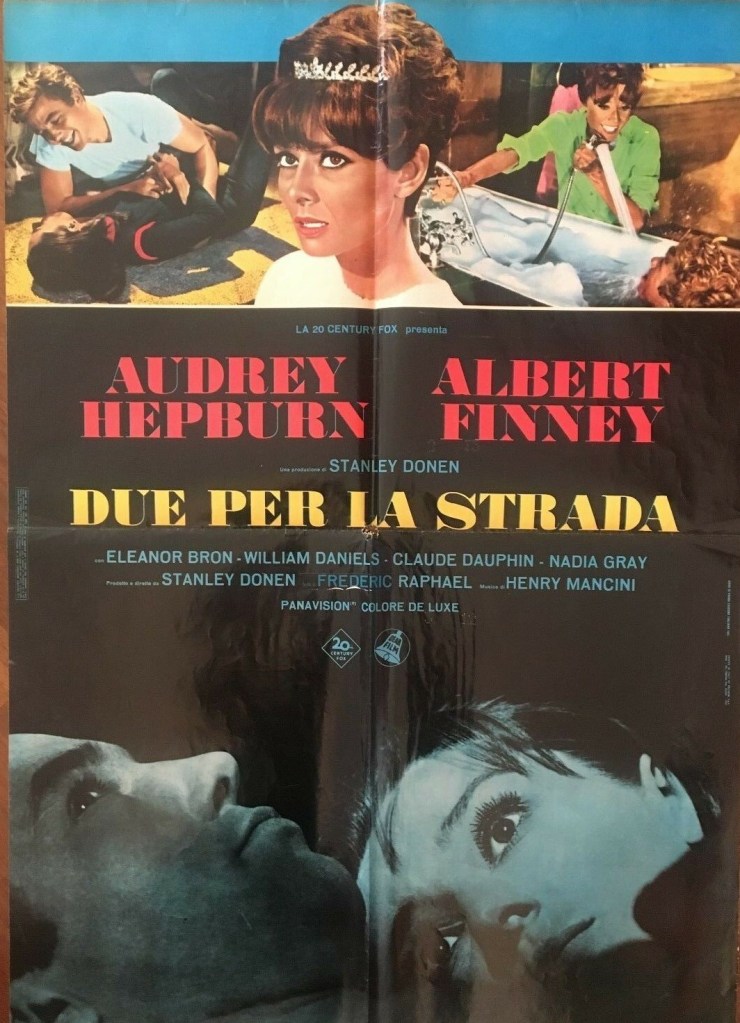
Two for the Road (1967) ***

This film had everything. The cast was pure A-list: Oscar winner Audrey Hepburn (Breakfast at Tiffany’s, 1961) and Oscar nominee Albert Finney (Tom Jones, 1963). The direction was in the capable hands of Stanley Donen (Arabesque, 1966), working with Hepburn again after the huge success of thriller Charade (1963). The witty sophisticated script about the marriage between ambitious architect Mark Wallace (Albert Finney) and teacher wife Joanna (Audrey Hepburn) unravelling over a period of a dozen years had been written by Frederic Raphael, who had won the Oscar for his previous picture, Darling (1965). Composer Henry Mancini was not only responsible for Breakfast at Tiffany’s – for which he collected a brace of Oscars – but also Charade and Arabesque. And the setting was France at its most fabulous.

So what went wrong? You could start with the flashbacks. The movie zips in and out of about half a dozen different time periods and it’s hard to keep up. We go from the meet-cute to a road trip on their own and another with some irritating American friends to Finney being unfaithful on his own and then Hepburn caught out in a clandestine relationship and finally the couple making a stab at resolving their relationship. I may have got mixed up with what happened when, it was that kind of picture.

A linear narrative might have helped, but not much, because their relationship jars from the start. Mark is such a boor you wonder what the attraction is. His idea of turning on the charm is a Humphrey Bogart imitation. There are some decent lines and some awful ones, but the dialog too often comes across as epigrammatic instead of the words just flowing. It might have worked as a drama delineating the breakdown of a marriage and it might have worked as a comedy treating marriage as an absurdity but the comedy-drama mix fails to gel.

It’s certainly odd to see a sophisticated writer relying for laughs on runaway cars that catch fire and burn out a building or the annoying whiny daughter of American couple Howard (William Daniels) and Cathy (Eleanor Bron) and a running joke about Mark always losing his passport.

And that’s shame because it starts out on the right foot. The meet-cute is well-done and for a while it looks as though Joanna’s friend Jackie (Jacqueline Bisset) will hook Mark until chicken pox intervenes. But the non-linear flashbacks ensure that beyond Mark overworking we are never sure what causes the marriage breakdown. The result is almost a highlights or lowlights reel. And the section involving Howard and Cathy is overlong. I kept on waiting for the film to settle down but it never did, just whizzed backwards or forwards as if another glimpse of their life would do the trick, and somehow make the whole coalesce. And compared to the full-throttle marital collapse of Who’s Afraid of Virginia Woolf (1966) this was lightweight stuff, skirting round too many fundamental issues.

It’s worth remembering that in movie terms Finney was inexperienced, just three starring roles and two cameos to his name, so the emotional burden falls to Hepburn. Finney is dour throughout while Hepburn captures far more of the changes their life involves. Where he seems at times only too happy to be shot of his wife, she feels more deeply the loss of what they once had as the lightness she displays early on gives way to brooding.

Hepburn as fashion icon gets in the way of the picture and while some of the outfits she wears, not to mention the sunglasses, would not have been carried off by anyone else they are almost a sideshow and add little to the thrust of the film.

If you pay attention you can catch a glimpse, not just of Jacqueline Bissett (The Sweet Ride, 1968) but Romanian star Nadia Gray (The Naked Runner, 1967), Judy Cornwell (The Wild Racers, 1968) in her debut and Olga Georges-Picot (Farewell, Friend, 1968). In more substantial parts are William Daniels (The Graduate, 1968), English comedienne Eleanor Bron (Help!, 1965) woefully miscast as an American, and Claude Dauphin (Grand Prix, 1966).

Hepburn’s million-dollar fee helped put the picture’s budget over $5 million, but it only brought in $3 million in U.S. rentals, although the Hepburn name may have nudged it towards the break-even point worldwide.

An oddity that doesn’t add up.

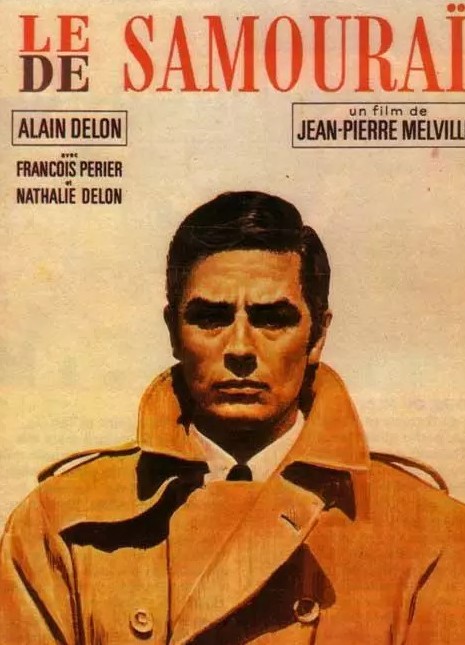
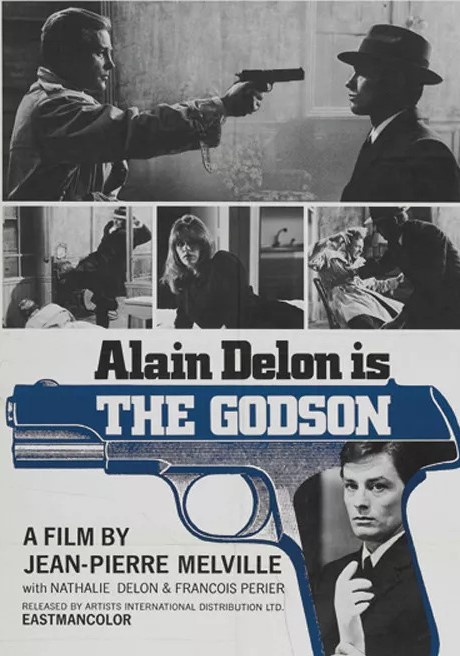
Le Samourai / The Godson (1967) ****

The current trope for giving assassins nicknames – viz Day of the Jackal (2024) – doesn’t stem from Jean-Pierre Melville’s spare picture, the title here more suggestive of the idea of killing as an honorable profession. One of the most influential crime movies of all time, it resonates through Michael Winner’s The Mechanic (1972) – though few critics would give that the time of day -Walter Hill’s The Driver (1978), John Woo’s The Killer (1989), Anton Corbijn’s The American (2010), Nicolas Winding Refn’s Drive (2011) and David Fincher’s The Killer (2023). Even so, few acolytes can match the opening scene of a room empty except for a whiff of smoke in a corner that indicates the presence of recumbent killer Jef (Alain Delon).

There’s none of the false identity malarkey of Day of the Jackal and no high-echelon ultra-secret secret service figures involved in tracking him down. In fact, one of the delights of the movie is the police procedural aspect, with the top cop, here known only as the Commissaire (Francois Perier), insisting on dragging in at least 20 “usual suspects” from each district. Though living a Spartan existence, Jef at least has the sense to acquire an alibi from the lover Jane (Nathalie) he shares with a wealthier man. Nor is he killing public figures. Instead, more like someone from Murder Inc., rubbing out other gangsters.

Shameless attempt to cash in on “The Godfather” after U.S. distributors held off for five years from releasing it.

The witnesses provide conflicting information on the man they saw, but the Commissaire does not entirely trust Jef’s alibi, putting pressure on Jane to recant. Her paying lover Weiner (Michel Boisrond) provides a pretty accurate description of Jef. While the cops bug his apartment and  start to shadow him, Jef falls foul of his anonymous employer who is alarmed at the attention the assassin has attracted and to avoid the possibility of being implicated sets an assassin onto the assassin.

Wounded, refusing to accede to Jane’s demand that he acknowledge he “needs” her, he tracks down the assassin’s boss, Oliver Rey (Jean-Pierre Posier), who happens to be the lover of Valerie, a nighgclub singer Jef takes a shine to. It’s worth noting that there’s an innocence – or perhaps an honor matching that of the samurai – in the police behavior. The Commissaire exists in a world where rules are not bent or broken, where suspects are not beaten up, and where often the cops are hamstrung by procedure and must take special care in arriving at a conclusion. To convince himself that Jef is indeed the correct suspect, the Commissaire makes him swap hat and coat with others in a line-up, only for the witness to identify the coat, hat and face that he believes he saw. It’s only Jane’s unbreakable alibi that keeps Jef safe.

Most of the picture is pure bleak style. You never enter the assassin’s head. There’s no background or backstory to shed any light on action. Even the most appealing characters, Jane and Valerie, occupy moral twilight. I’m not sure Melville’s in a mood for homage, though Robert Aldrich was in the Cahiers du Cinema hall of fame, but the ending comes close to replicating that of Aldrich’s The Last Sunset (1961), not just for the climactic action but for the inherent self-realization of unavoidable consequence.

Despite sparseness of the style, there’s enough going on emotionally and action-wise to keep an audience enthralled. While his outfit echoes the Humphrey Bogart private eye of the 1940s, and while walking the same mean streets, Jef is the antithesis of that untarnished hero.

Melville belonged to the hard-boiled school of cinematic crime, summoning up the gods of noir, and providing a new breed of French star with tough guys to kill for.  He died young, just 55, and left behind 14 pictures, at least three or four considered masterpieces including Army of Shadows (1969) and The Red Circle (1970). You might have thought his minimalist style would appeal more to critics than moviegoers but in his native France, in part because stars queued up to be in his movies,  he was highly popular.

When you compare the Delon of this to Once a Thief (1965) or Texas Across the River (1966) you can see how much acting goes into the restraint of the character here, producing one of Delon’s best performances. His wife of the time, Nathalie Delon (The Sisters, 1969) shines but briefly.

Recommended.

Day of the Jackal (1973) *****

The original – and unlikely ever to be topped no matter the best intentions of Sky’s current remake. Possibly the greatest thriller of all time, certainly in the top two or three, and broke every rule going. No music, excepting the first few minutes, for a start. Could easily have been packed with the easily-recognizable all-star-cast found in roadshows, a few British acting knights thrown in for good measure, but instead has a no-name cast.

You would have had to be particularly vigilant as a moviegoer to have even heard of Edward Fox, too old (aged 36) at this point to be considered a rising star, and without the portfolio (outside of a Bafta supporting actor nomination for The Go-Between, 1971) to suggest he had ever particularly shone.   

Didn’t realize there was a 70mm version.

Apart from their job, every character, especially the chameleon-like Jackal (Edward Fox), is anonymous, virtually nothing of home life intrudes in the sharply-drawn story. The brilliant script by Kenneth Ross (The Odessa File, 1974) jettisons every unnecessary detail, and the even better editing pares every scene down to the bone.

That there is even an iota of tension given we know the outcome is quite extraordinary, but, as with the book, it is wound up taut. Not will he-won’t he, but how, when, where? Every time the police get a lead, they discover he is one step ahead.

What director Fred Zinnemann (A Man for All Seasons, 1966) has the good sense to retain is much of the fascinating detail that author Frederick Forsyth packed into his runaway bestseller. How to create a false identity, how a nibble of cordite can make you look old, where to conceal a rifle in the chassis of your car, and my favourite, how to wind a rope round a tree to ensure your shooting arm is steady.

And, except for the gunman and the rebels he represents, not a maverick in sight. None of this Dirty Harry, Madigan, nonsense, nobody railing against authority, but still the dead weight of bureaucracy, the high-ups only too happy when the moment comes they can dismiss an underling who might steal a sniff of glory.

This shouldn’t work at all, there’s far too much of the dogged detective, cops on both sides of the Channel tearing through reams of paperwork, hundreds of hotel registration cards, lost passport forms, birth certificates, death certificates. Cops stopping every blonde male of a certain height. Most of the minions you never see again, regardless of the vital tasks they fulfil. Virtually the only way characters are permitted emotion is to take a longer drag on their cigarette.

The only feeling permitted is the reaction of the would-be femme fatale Denise (Olga Georges-Picot) when her superior burns the love letters and photographs of her French soldier boyfriend killed in action. The late twist to that element of the story, when one of the politicians is discovered to have fallen into her honey-trap, comes when the cabal of politicians realises that French detective Lebel (Michael Lonsdale) has tapped all their phones.

There’s a constant sense of peak and trough, every breakthrough a dead end, yet endless accumulation of tiny detail allows for maneuver at the end, when we discover that the Jackal is not, as we have been led to believe, an Englishman going by the name of Charles Calthorp.

Given the intensity, there’s still space for nuance. The other murders the Jackal commits are visually discreet. None of the extended hand-to-hand combat of Jason Bourne and John Wick. A karate chop for one victim, another ushered out of view, the hand of a compromised lover grows limp. The torture scene is visually classic. The tortured man, seen from behind, tries to duck away from the glaring light and when he succeeds that light glares in the face of the audience leaving backroom staff to glean his tape-recorded words in between his screams

The money Zinnemann saved on star turns probably went on achieving French cooperation which minimized outlay on building on a set to show the parades and all the military razzamatazz that went with a realistic depiction of Liberation Day, a major French event. The assassin’s target, French President De Gaulle, was dead by the time the movie was made, so could not object, and since the assassination failed in part due to the brilliance of the French police perhaps it was felt this was one movie worthy of such collaboration.

Edward Fox is superb at the chilling bisexual assassin but the support cast is excellent – Cyril Cusack (Fahrenheit 451, 1966) as a gunsmith, Michael Lonsdale (Caravan to Vaccares,1974), a young Derek Jacobi (Gladiator, 1999), Barrie Ingham (A Challenge for Robin Hood, 1967), Alan Badel (Arabesque, 1966) as a snooty minister, Olga-Georges Picot (Farewell, Friend / Adieu L’Ami, 1968) and Delphine Seyrig (Accident, 1967).

Based on his Oscar-heavy record – two wins, four nominations – you wouldn’t have picked Fred Zinnemann for such populist fare. Unless you recalled that he followed From Here to Eternity (1953) with musical Oklahoma! (1956). He had never made a thriller before, but he instinctively knows how to make the material sing.

Hollywood went down the remake route once before with indifferent results despite a top-class cast of Bruce Willis, Richard Gere and Sidney Poitier in The Jackal (1997). The current television series is getting a good vibe but it will have to go some, even with around eight hours to play with, to match this.

Masterpiece.

Paris Blues (1961) ****

Sometimes the stars just do align. Issue-driven drama played out against scenic Paris and host of jazz greats in support. The Walter Newman script gets quickly to the nub of a drama that focuses squarely on racism and creativity.

Jazz trombonist Ram (Paul Newman) lives for his music and fancies himself a composer as well as a player and expects women to fall in with his creative lifestyle until he comes across single mother tourist Lillian (Joanne Woodward) who ups the romantic ante by hopping into bed right away. Ram’s buddy, saxophonist Eddie (Sidney Poitier), falls for Lillian’s pal Connie (Diahann Carroll) but not only is she less promiscuous but a civil rights activist who rails against him for abandoning the cause and hiving off to Paris.

There’s a good twist on the will-she-won’t-she trope as this time around it’s the men (no surprises there) who have trouble committing. While the guys are both smitten, and at various times ready to throw up their Parisian lives and head for home, it doesn’t work out that way, so mostly what we get is argument, making up, repeat. But that’s not to suggest this falls into any kind of trap.

While Lillian uses seduction to try and winkle Ram out of his refuge, Connie, on the other hand, depends on guilt. Although Eddie’s able to verbalize the benefits for a black musician playing in Paris, he hardly needs to point it out, it’s plain to see that the innate racism he suffers at home is entirely absent in his adopted city.

If you’re a jazz enthusiast you’ll probably be more aware of the central musical conflict, the older-fashioned New Orleans style versus the modern be-pop. There’s no shortage of jazz. Duke Ellington was Oscar-nominated for the score, Louis Armstrong turns up, mobbed at the train station by fans, and every time the movie’s not cutting away to a Parisian backdrop it’s indulging in some great jazz tunes in the traditional smoky night club.

What’s really attractive here is the assured acting. Paul Newman was in the middle of a hot spurt, both at the box office and from the critics, successive Oscar noms on the way for The Hustler (1961) and Hud (1962) and endorsing his marquee credentials with From the Terrace (1960) and Exodus (1960). This is a lively performance, one in which he doesn’t have to carry the weight of the world on his shoulders or the deadweight of expectation. He’s not a snarling rebel, he doesn’t need to be, not with nightly improvisation, recognition from his peers, and a toehold on the next stage of creativity, composition. If he’s tussling with anybody it’s himself and his spats with Lillian are little more than arguments with himself about the road to take and the sacrifices that might be essential along the way.

Sidney Poitier (The Long Ships, 1964) snags a great career break, like Newman deprived of heavy duty, able to display his great charisma and charm with such a light touch. Joanne Woodward (Big Hand for a Little Lady, 1966) as ever brings a wide range to her role, sassy at times, pragmatic, not inclined to the lovelorn. Diahann Carroll has the hardest part, since she’s the evangelist for modern America, one where equality is going to be a given, so her scenes with Poitier end up mostly being argument rather than pure romance.

This would have been a lot edgier had it gone down the originally planned route of Ram falling for Connie, and that’s hinted at when they first meet, but I guess Hollywood wasn’t ready for that.

This was the second (of five) of director Martin Ritt’s collaborations with Paul Newman – they had formed a production company – and shows the pair’s preference for movies bearing social comment. Ritt (The Spy Who Came in from the Cold, 1965) marries all the various elements to produce an entertaining picture on a serious subject.

Walter Bernstein (The Money Trap, 1965), Jack Sher (Move Over, Darling, 1963) and Irene Kemp (The Lion, 1962) collaborated on the screenplay from the novel by Harold Flender.

Thought-provoking.

Lafayette (1966) ***- Seen at the Cinema in 70mm – Bradford Widescreen Weekend

We are so accustomed to Hollywood rewriting every other country’s history it comes as a something of a surprise when they get a taste of their own medicine. And in such elaborate style. At the time this was by some distance France’s most expensive movie, a roadshow production made in Super Technirama 70, the widescreen technology favored by productions as diverse as Walt Disney’s animated The Sleeping Beauty (1959), Biblical epic Solomon and Sheba (1960), British drama The Trials of Oscar Wilde (1960), Samuel Bronston’s  El Cid (1961) and Zulu (1964).

I wouldn’t have known from this picture how important a figure Lafayette was in French history. On a couple of forays to Paris I had placed no significance on shopping at the retail metropolis known as Galeries Lafayette. However, it turns out he was a major player in the French Revolution and helped to write the Declaration of the Rights of Man. But I wouldn’t have learned anything about his later career as this picture concentrates on his early life.

This long-lost restored picture was the official highlight of this year’s Bradford Widescreen Festival, mostly I assume because until the restoration it hadn’t been seen anywhere for half a century and because Bradford of all places is a sucker for restoration and its audience often includes more than a smattering of ex-industry professionals who can comment on its technical proficiency.

Although released in France in 1962 it didn’t cross the Atlantic or the English Channel until a few years later, but only for short selective engagements, during a period when there were was no shortage of roadshow material what with Its a Mad, Mad, Mad, Mad World still hogging Cinerama screens and My Fair Lady (1964) and The Sound of Music (1965) embarking on extensive runs.

This turned up in London in 1965 at the Casino Cinerama where How the West Was Won had played for over two years and it was also shown in Liverpool and enjoyed a couple of weeks in my home town of Glasgow at the Coliseum.

While the American alliance with France during the final stages of the War of Independence was critical to turning the tide against the British I suspect the exploits of the titular character (Michel Le Royen), an aristocratic stripling of 19 years of age, have become somewhat embellished in Hollywood  Errol Flynn style.

The movie also ignores the irony that the principles of freedom and independence from regal rule spouted by many of the main characters came back to bite them several years later when the French Revolution sought to separate the brains of the aristocrats from their bodies. The French Emperor helped fund the American Revolution, assuming notions of independence were fine for foreign countries rising up against the British, a particular thorn in the French side at that point.

There’s also a considerable tinge of entitlement and for all its democratic principles the nascent new nation bowing down to the aristocratic breeding of the Frenchman and giving this inexperienced soldier the title of Major-General and putting him in charge of their least-disciplined troops, the irregular starving militia.

Never mind his age, he can hardly speak English and his aristocracy is hardly going to endear himself to his raw troops. And you can hardly ignore the ironic entitlement that when all other wounded men are left to look after themselves, our hero is carted off to George Washington’s (Howard St John) palatial servant-heavy mansion.

Still, according to this story and presumably the legend the young commander did indeed snatch defeat from the jaws of victory, in one engagement when his men were racing away in ignominious retreat he seized the torn American flag and inspired his men to return to battle and victory.

For a near three-hour picture it’s short on military action, though presumably that’s in the interests of historical accuracy so that means wading through countless scenes of politics both in France and America. In his home country he’s treated as something of a traitor for embarking on his own private war against the British. In America Congress is always on the back of George Washington, refusing him the funds and help he needs, insisting such would be in ample supply should he win a battle, the future President retorting back that victory would be guaranteed should he be given funds.

The absence of military set pieces is in part in recognition of the strategy endorsed by Washington, of avoiding a pitched battle with a superior enemy in favor of a guerilla  war of attrition. There are more scenes of thousands of extras marching than of them engaging in any meaningful activity, though I’m assuming that could have been a budgetary restriction.

Whether’s it’s true or not there’s some clever stuff on the French political scene, the Emperor Louis XVI (Albert Remy) prone to taking advice from his wife Marie Antoinette (Liselotte Pulver) whose ear is being bent by La Fayette’s wife (Pascale Audret)  but the self-serving attitudes on both sides will be recognizable to everyone.

There’s a stab at an all-star cast, Jack Hawkins (Lawrence of Arabia, 1962) as the British commander Cornwallis though the director – or perhaps the star himself given his idiosyncratic ways – has rendered Orson Welles as American ambassador Benjamin Franklin virtually unrecognizable, even his noted diction smothered. 

The torch of freedom never had a more handsome advocate than in the hands of Michel Le Royer but it’s virtually a one-note performance though admittedly nobody expected much more from Errol Flynn. 

Directed by Jean Dreville (Queen Margot, 1954).

The Substance (2024) **** – Seen at the Cinema

Like Tar (2022) suffers from stylistic overkill and outstays its welcome by a good 30 minutes, but otherwise a perfect antidote to Barbie (2023). While not entirely original, owing much to the likes of The Picture of Dorian Gray and The Stepford Wives and the doppelganger and split personality nrrative nonetheless a refreshing take on the ageing beauty syndrome. Shower fetish might be a homage to Brian DePalma and except that the movie is directed by Frenchwoman Coralie Fergeat (Revenge, 2017) we might be lambasting its rampant nudity for misogynistic reasons.

On the plus side, everything else about it feels new. The whole story plays out like a demonic fable, the participants only caught out because, in their greed, they refuse to play by the rules. But like all the best horror films this occupies its own world. Whoever offers this free drug and the chance to relive your life through the best possible you is a monosyllabic voice at the end of a telephone. Not only is there gruesome rebirth but a stitching-up process. The black market drug at the center of the tale can only be accessed in a deadbeat part of Los Angeles by crawling under a door, but then, suddenly we’re in a pristine room and the various constituent parts of the substance are laid out on the Ikea model with easy-to-follow instructions.

After surviving a horrific automobile accident, onetime movie star Elizabeth (Demi Moore), reduced to breakfast television exercise guru, is passed a mysterious note by an incredibly good-looking young man that takes her down this particular rabbit hole. Like Eve’s forbidden fruit or Cinderella’s toxic midnight, there’s a catch to reliving her beautiful youth. She must switch back “without exception” to her original persona every seven days.

Of course, that’s too much to ask, and as the double named Sue (Margaret Qualley) steals minutes then hours and days the effect is seen on Elizabeth, a monstrous aged finger appearing in her otherwise acceptable hands first sign that these rules cannot be broken. Warning that there are two sides to this singular personality goes ignored. Instead of acting in concert each prt of the split personality conspires againt each other until entitlement spills over into abhorrent violence.

Apart from the initial rebirth squence, and the toothless section, the best scenes are more toned down, in one Elizabeth is faced with an alternative future, the other when she re-does her make-up four times for a date, unable to decide on which face she wishes to present.

Demi Moore (Disclosure, 1994) is being touted as a shoo-in for an Oscar nomination, but that’s mostly on account of her willingness to appear without makeup and for long sections without clothing. I’m not convinced that there’s enough heartfelt acting beyond the bitterness that was often her trademark. Margaret Qualley (Poor Things, 2023) isn’t given much personality to deal with except for exuding shining beauty and horror when it starts to go wrong.

All the males are muppets, it has to be said, wheeler-dealer Harvey (Dennis Quaid) the worst kind of obnoxious male. But this doesn’t feel much like a feminist rant but a more considered examination of refusal to accept oncoming age. Everyone has the kind of vacuous personality that’s endemic in presenting the best face (and body) to the viewing (television, big screen) public.

The movie plays at such a high pitch that most of the time you can ignore the deficiencies, but the 140-minute running time is at odds with hooking a contemporary horror audience and the gore at odds with hooking the substantial arthouse crowd required to generate the returns needed to pay back acquisition rights. None of the characters has any depth, little backstory, virtually nothing in the way of the usual confrontation with others in their lives, but then Elizabeth already lives a life of isolation, clearly lamenting her longlost fame and the attention it brings.

This won at Cannes for the script and  not the direction and that feels about right. Great idea in ultimately the wrong hands, too much of the repetition that was so annoying in Tar and the determination to make every single shot different, a movie beaten into style every inch of its running time.

Coralie Fergeat has a triumph of some kind on her hands, but one that might struggle, due to excessive length, to find an audience. Not sure, either, why tis is being sold as comedy-horror, a peculiar sub-genre in the first place to make work, but I don’t remember laughing once.

However, like Saltburn (2023) this has a good chance of attracting the young crowd via word-of-mouth, the kind who are just waiting to find their own cult material.

Both facinating and repellant.

Discover WordPress

A daily selection of the best content published on WordPress, collected for you by humans who love to read.

The Atavist Magazine

by Brian Hannan

WordPress.com News

The latest news on WordPress.com and the WordPress community.