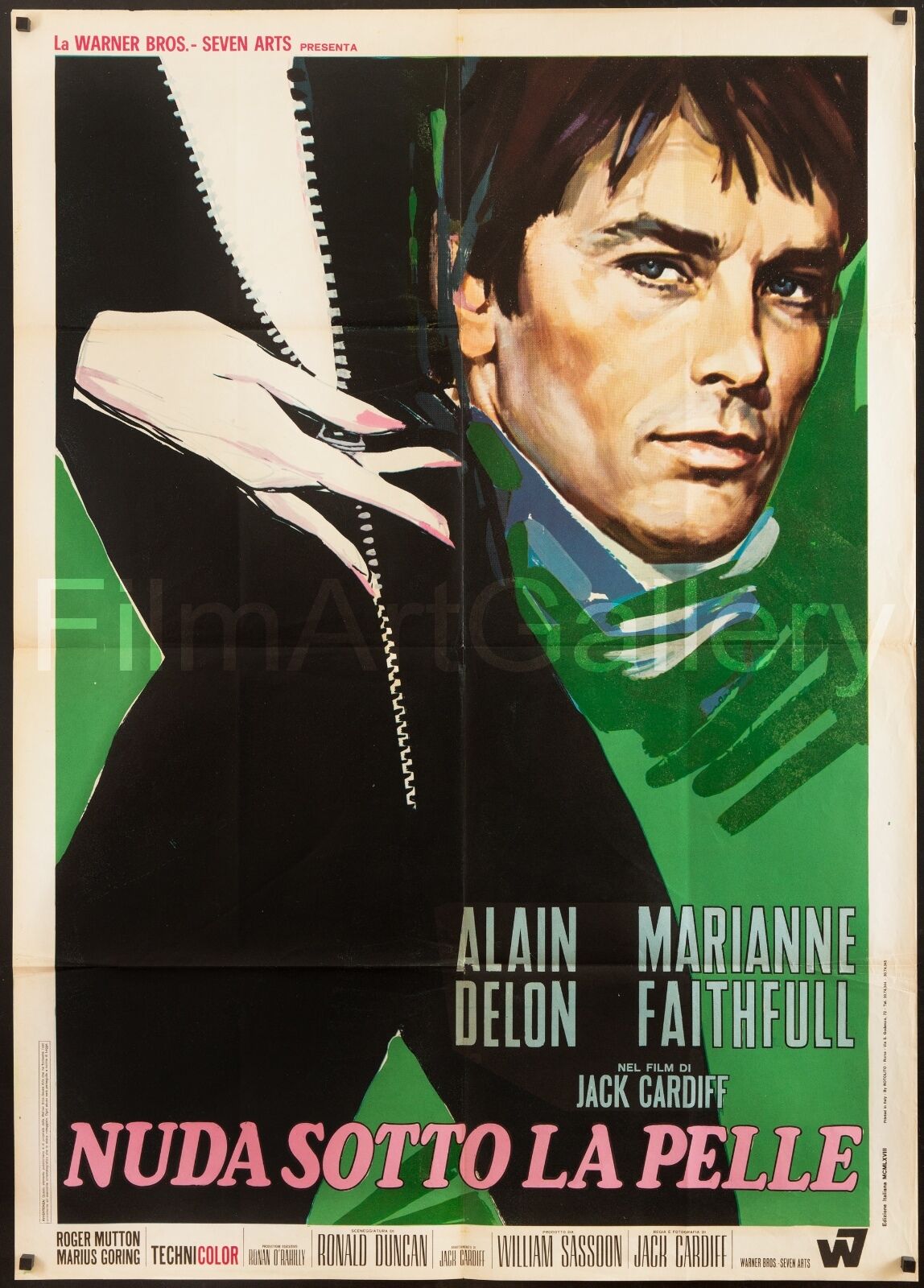
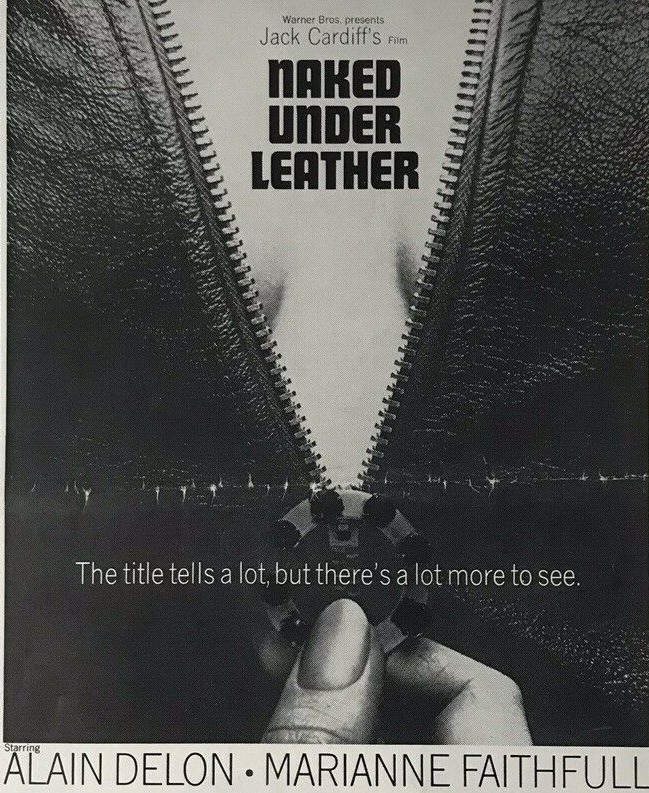
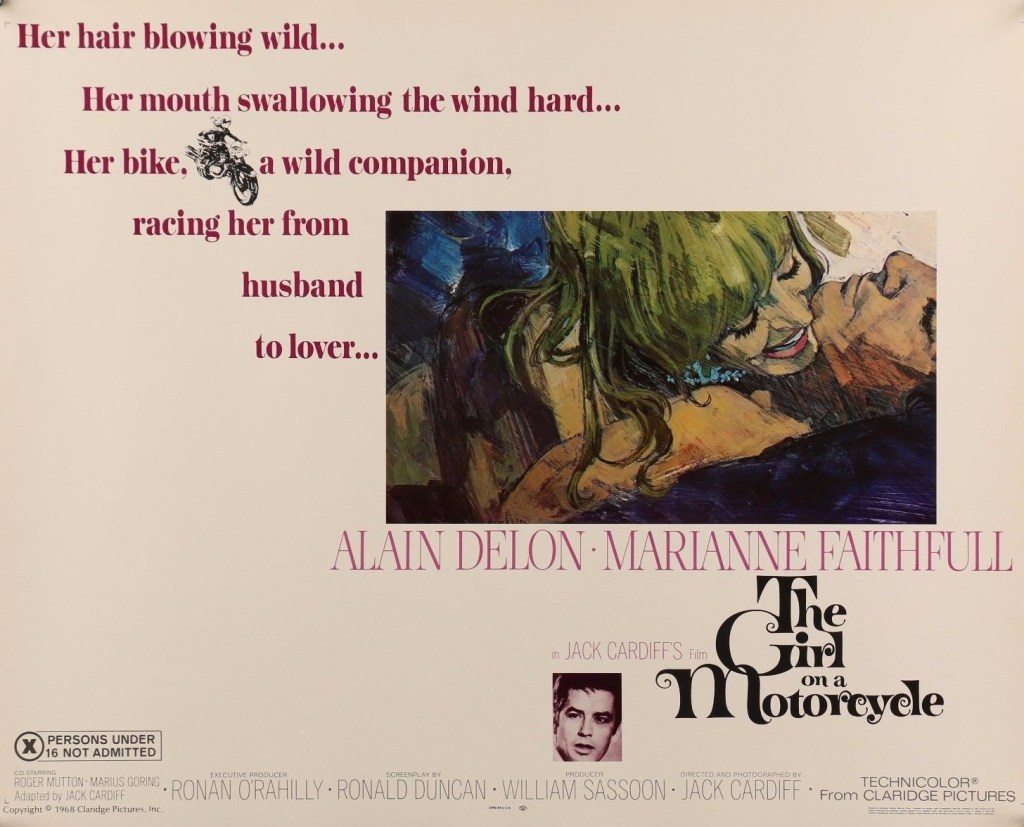
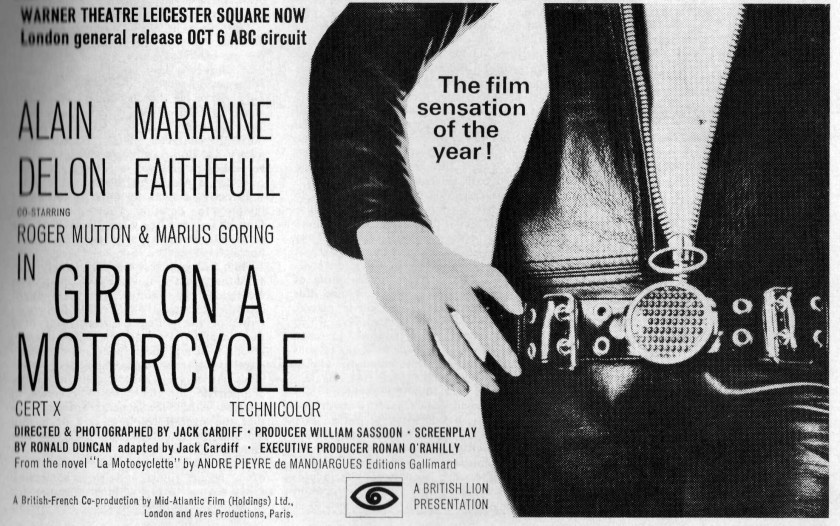
Behind the Scenes: “The Girl on a Motorcycle” / “Naked under Leather” (1968)

Although multi-country co-productions were very common in the 1960s, British-French co-productions were particularly thin on the ground, as if the cultural identities were so far apart there was nowhere they could ever meet. This was only the third such co-production in three years. British Lion, a long-established operation, had recently been overhauled with a new boss in John Boulting, a renowned filmmaker of Boulting Brothers (The Family Way, 1966) fame.

The film was based on a prestigious prize-winning French novel by Andre Pieyre de Manidargues. The budget was set at a modest $1.5 million with location shoots in Geneva, Heidelberg and Strasbourg with interiors shot at Shepperton. Director Jack Cardiff (Dark of the Sun, 1967) had originally hired a German actress, a Playboy centerfold,  for the leading role of the young girl who marries a timid young man while obsessed with a less conventional ex-lover. But the actress suffered a drug overdose and dropped out. Ironically, Marianne Faithful, her replacement, was also a drug addict and famed as a singer and as girlfriend of Mick Jagger.

Although her acting  experience was limited to television film Anna (1967) and a small part in Michael Winner’s I’ll Never Forget Whatsisname (1967), Cardiff was captivated by her sensuality which was ideal for her character. Bear in mind that Cardiff knew what a camera captured. He had made his name as a cinematographer and worked with great beauties like Ava Gardner (The Barefoot Contessa, 1954), Sophia Loren (Legend of the Lost, 1957) and Marilyn Monroe (The Prince and the Showgirl, 1957) so if he thought Faithfull fitted that category then there was no reason to doubt his assessment. He commented: “Never since I saw Marilyn Monroe through the camera lens have I seen such irresistible beauty. To focus on her is to focus the camera on your innermost heart.”  

Cardiff took advantage of a new trend to film movies in both English and French to open up distribution channels. Claude Chabrol’s The Road to Corinth (1967) was shot in this manner as was Farewell Friend / Adieu L’Ami (1968) with Charles Bronson and Alain Delon.   

Faithfull could not ride a motorbike so a stunt double was utilised for long shots. But instead of resorting to back projection, for medium shots and close-ups the actress was towed on a trailer behind a camera car. Not having to worry about the controls also meant that Faithfull could look dreamlike while driving and with Cardiff not having to think about the actress he could turn the camera in a 360-degree pan while she rode along.

Since Faithfull was going to be seen on a motorbike for long sections of the movie, Cardiff came up with a method of creating variety. One of the techniques employed was “solarization.” This was, in effect, a half-positive half-negative exposure, but it had only been used in the past in very small doses, nothing like what Cardiff had in mind. BBC boffin Laurie Atkin had invented a computer system that allowed solarization to be used more extensively. Footage shot during the day was taken immediately to the BBC lab at night where Cardiff could tinker about with creating his effects.   

One of the biggest beneficiaries of this technique were the sex scenes. Without the solarization which hid naked bodies under a psychedelic whirl the sex scenes would never have got past the censor.  There was an unfortunate downside, however. The Girl on a Motorcycle had been invited to the Cannes Film Festival. Critical approval there would have given the picture artistic momentum. Unfortunately, delays caused by the laboratory work meant the film missed its scheduled screening slot. Even so, French critics gave it the thumbs-up. British critics, on the other hand, gave it the thumbs-down. Lack of critical estimation did not appear to matter to British audiences who came out in their droves.

But it was a different story in the United States.

No wonder that to some extent this is one of the great lost pictures because Warner Brothers could not find a way to sell it in the U.S. Having paid a record $1.5 million advance, the studio (known at that time as Warner-Seven Arts) was hit by a double whammy. The picture was the first to receive an X-rating from the newly-established MPAA censorship system which replaced the previous Production Code. The new system was supposed to allow filmmakers greater latitude in terms of sex, violence and language.

Theoretically, that should have been a marketing bonus and the film should have ridden the “sex-art” wave and turned into an arthouse hit with the mainstream, captivated by solid grosses, to follow.  In reality, many exhibitors refused to touch it, regarding the X-rating as a separate category catering for the worst of the adults-only smut market. Newspapers refused to carry advertising for films so rated. Critics hated it, all the New York critics giving negative reviews.

Warners slotted it into a handful of arthouse houses before pulling all prints out of circulation in May 1970 and sending to back for re-editing with the intention of re-submitting it, shorn of some of the nudity, to the MPAA in a bid to win a more acceptable R-rating. In other words, to “re-gear the picture for the general market rather than the adult sex-art trade originally in mind.”  

To ensure that its reputation was not “soiled” the picture was re-titled Naked under Leather – if the content was tamer, the title was certainly not. Initially, that appeared to do the trick when it was re-released a full year later. It pulled in a “boff” $125,000 (worth around $864,000 now – a whopping $36,000 per-screen average) in 24 houses in wide release in Los Angeles, was “hot” in Denver and “tidy” in Chicago and found a few bookings elsewhere. But then it stalled and could not find the extra gear. In reality it did not do much better than on initial release. In the 1969 annual box office chart it featured at No 231 and for the corresponding 1970 chart it placed at number 253.

Sources: Jack Cardiff, Magic Hour, Faber and Faber, 1996, p242-243; “New British Lion Mgt. Gets Motorcyle Rights in UK,” Variety, October 18, 1967, 23; “Stylistic Dash Marks Cannes Films,” Variety, May 22, 1968, 26“British Lion Wraps Up Distribution Deal with W-7 for U.S., Towa for Japan,” Variety, August 28, 1968, 29, “Features Passing Through MPAA,” Variety, December 4, 1968, 20; “All Imports; N.Y. Critics All Bad,” Variety, December 4, 1968, 7; “Recall and Re-Edits W-7’s Motorcycle; X-Rating Now R,” Variety, January 29, 1969, 7; “Computer Tally of 729, 1968,” Variety,  May 7, 1969, 36; “Naked under Leather,” Variety, April 22, 1970, 4; “L.A. First Run Healthy,” Variety, May 13, 1970, 9; “Top 330 Pix in U.S. for 1970,” Variety, May 12, 1971, 37.

The Girl on a Motorcycle / Naked under Leather (1968) ***

An erotic charge deftly switched this picture from the Hell’s Angels default of violent biker pictures spun out cheaply by American International.  Where Easy Rider (1969) was powered by drugs, this gets its highs from sex. Rebecca (Marianne Faithful), gifted a Harley Davidson Electra Glide motorbike by lover Daniel (Alain Delon) two months before marriage to staid teacher Raymond (Roger Mutton), takes to the highways to find herself.

This ode to speed (of the mechanical kind) allows her to shake off her preconceptions and fully express her personality, beginning with the one-piece black leather outfit, whose zip, in one famous scene, Daniel pulls down with his teeth. The bike is masculine. “There he is,” she intones and there is a none-too-subtle succession of images where she clearly treats it as a male appendage.

She is both self-aware and lost. In some respects Raymond is an ideal partner since he respects her wild nature and gives her space, and she views marriage to him as a method of avoiding “becoming a tart.” In other words he represents respectability, just like her father (Marius Goring) who owns the bookshop where she works. But he is just too reasonable for her and, in reality, as she would inevitably discover that is just a cover for his weakness. The only scene in which she does not appear is given over to Raymond being tormented by young pupils who have him chasing round the class hunting for a transistor radio.

But Daniel is not quite up to scratch either. He believes in “free love”, i.e. sex without commitment and he is not inclined to romantic gestures and she knows she could just become another in a long line of discarded conquests should they continue. Raymond is a “protection against” Daniel and her ending up as an adulteress teenage bride and potential nymphomaniac. She seeks abandon not reality.

As well as sexy interludes with Daniel, her head is filled with sexual images, not to mention dabbling with masochism, in a dream her leather outfit being stripped off piece by piece by a whip-wielding Daniel, in a bar imagining taking off her clothes in front of the aged drinkers.

Jack Cardiff’s film is certainly an interesting meditation on freedom and sexual liberation at a time when such notions were beginning to take hold, but it suffers from over-reliance on internal monologue and Marianne Faithful’s lack of acting experience. Cardiff went straight into this from violent actioner Dark of the Sun (1968) and audiences remembering him from The Liquidator (1965) and The Long Ships (1964) would need reminded that he braced romance before in the touching and Oscar-nominated Sons and Lovers (1960). In that film he elicited an Oscar-nominated performance from Mary Ure, something that was unlikely here.

Pipe-smoking was generally the preserve of the old, or detectives, unless you were a young intellectual as Delon is here, but it does seem an odd conceit to force the actor into such a contrivance. Delon is accustomed to playing amoral characters, so this part is no great stretch, but, minus the pipe, he is, of course, one of the great male stars of the era and his charisma sees him through.

It was also interesting to compare Cardiff’s soundtrack to that of Easy Rider. Here, the music by Les Reed – making his movie debut but better known as a songwriter of classic singles like “Delilah” sung by Tom Jones – is strictly in the romantic vein rather than an energetic paeon to freedom such as “Born to Be Wild.” 

Cardiff’s skill as an acclaimed cinematographer (Oscar-winner for Black Narcissus, 1947) helps the picture along and clever use of the psychedelic helped some of the sexual scenes escape the British censor’s wrath, though not so in the U.S. where it was deemed an “X”. 

The Sicilian Clan (1969) *****

Absolutely cracking, brilliantly structured, gangster thriller featuring two fabulous heists and three legendary French stars in Jean Gabin, Alain Delon and Lino Ventura. Roger Sartet (Delon) is a trigger-happy robber whose prison escape is organized for a hefty fee by French-based Mafia chieftain Vittorio Manalese (Gabin). Le Goff (Ventura) is the rugged cop hunting down the escapee which brings him into the orbit of Manalese, about whose existence he is completely unaware, the gangster having kept an extremely low profile, never engaging in violence, hiding behind the legitimate front of a pinball machine business.  Veteran French director Henri Verneuil (Guns for San Sebastian, 1968) dukes between the twin storylines with ease.

Jean Gabin was easily the most famous French actor of the time with a career spanning four decades from Pepe Le Moko (1937) and La Grande Illusion (1937) to Holy Year (1976) . To many he was the best Inspector Maigret (1958). Generally ignored by the French New Wave directors, this picture showed what they were missing.

Sartet brings Manalese the opportunity to pull off the most audacious jewel robbery in history, even though the older man despises Sartet’s penchant for violence and sex. We often see Manalese at family gatherings, head of the dinner table, the family watching television together, frowning at one son’s liking for alcohol, playing with his grandson. He is not just a calm and clever businessman, but very quick-thinking, his sharp mind in a couple of instances preventing disaster. Sartet, on the other hand, will happily endanger his life and freedom by consorting with prostitutes and breaking an unspoken code of honor in an affair with Manalese’s daughter-in-law (Irina Demick).

The result combines dogged detective work by Le Goff and the inspired planning and execution of the jewel robbery until the two worlds collide. The investigation alone would have made this an outstanding picture. Le Goff, always seen with an unlit cigarette in his mouth although he is trying to give up smoking, concentrating initially on Sartet, sets up surveillance on the thief’s innocent sister and begins an involved – and engrossing – process of tracking down every potential lead and when at last he has Sartet in his sights it brings him up close to Manalese.

Le Goff’s professionalism is matched by that of Manalese and the picture develops into an absorbing battle of wits and the latter’s family values and moral compass puts him at odds with loner Sartet. There is some brilliant invention, the sacrificial watch, for example, and the unexpected appearance of a faithful British wife, although you do guess just how long Le Goff will go before lighting his ever-tempting cigarette.  

The ultra-cool Delon excels in this kind of amoral part, but Gabin and Ventura as old-style gangster and cop, respectively, steal the show. Demick thrives as the bored wife of a dull gangster who is attracted by the violent Delon, at one point deliberately putting herself in the line of his potential fire for the thrill. Actually, it’s the jewel heist that steals the show. Unlike other heist pictures where you have fair idea in advance of the details of the theft, here the audience is kept completely in the dark. Just as important in any heist is that the thieves get away with their plunder and the plan in this instance is breath-taking.

Catch it on Amazon Prime.

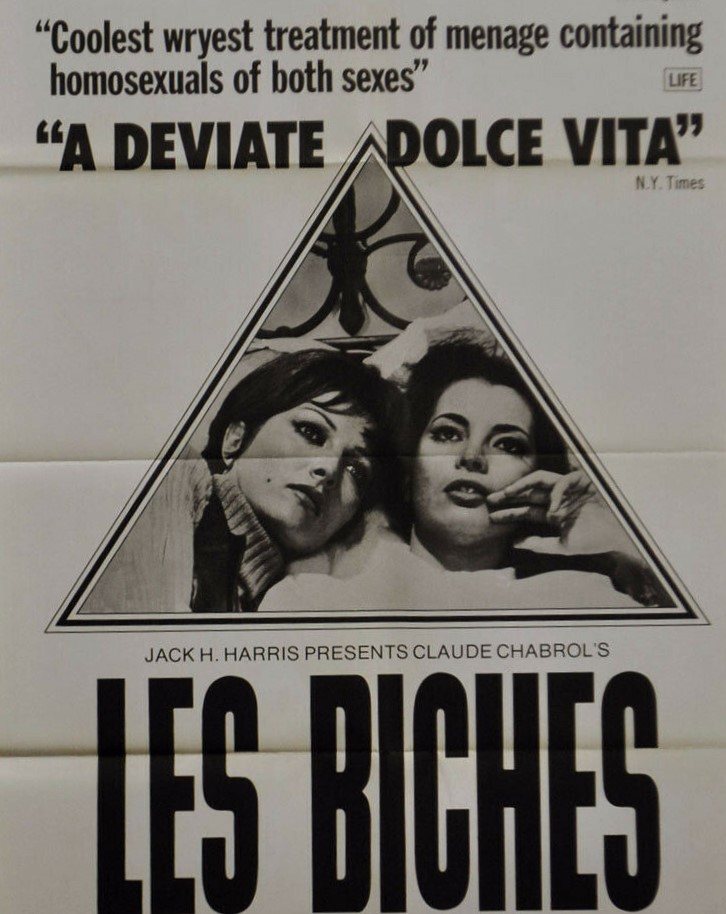
Les Biches (1968) *****

Innocence and experience alike are corrupted by the destructive power of love in this elegant and compelling early masterpiece from French director Claude Chabrol. Although he owed much of his later fame to slow-burning thrillers, this is more of a three-hander drama with a twist and it says much for his skill that we sympathize in turn with each of these amoral characters.

Wealthy stylish Frederique (Stephane Audran), in an iconic hat, picks up younger pavement artist, the artistically named Why (Jacqueline Sassard) in Paris. They decamp to St Tropez where Audran keeps a rather discordant house, indulging the antics of two avant-garde house-guests. Sassard loses her virginity to architect Paul Thomas (Jean-Louis Trintignant) who soon abandons her in favor of Frederique. Each is guilty of betrayal and although a menage a trois might have been one solution instead the lovers dance from one to another with Frederique apparently in control, in one scene stroking Why’s hair with her hand and caressing Paul’s face with her foot. In an attempt to win the man back, Why dresses like her rival down to hairstyle, make-up and even the older woman’s beauty spot.    

At no point is there angry confrontation, nor does Frederique simply dismiss Why from the household, but the story works out in more subtle insinuation, Frderique clearly expecting either that Why makes herself scarce or, alternatively, make herself available for whenever the bisexual Frederique tires of male companionship. The movie’s focus is the baffled Why. When the older pair disappear to Paris, the camera follows Why through off-season St Tropez, chilly weather replacing glorious sunshine. Frederique and Paul are the sophisticates who expect Why to know how to play the game. The younger woman has wiles enough to see off the avant-garde irritants.

It looks for a while as if it might be a coming-of-age tale or of young love thwarted but every time Frederique enters the picture her dominance is such that proceedings, no matter how deftly controlled, have an edge and so it becomes a study of something else entirely. At one point, each has power over the other. What appears on the surface, how each character is initially represented, disguises their interior lives. If Why has learned anything it is restraint, so the movie never descends to tempestuous passion. She also learns, in a sense, to submit, since the impoverished can never compete with the rich. In the end her revolt takes the only other option available, against which even the wealthy have no defense.

Not that it makes much difference unless you were going to analyse the picture to the extreme but clearly the names have significance. Frederique is a feminization of a male name, Paul Thomas is two male names (perhaps indicating alpha male) while Why is obviously not a real name, and either meant to represent anonymity or intrigue. Luckily, the acting is of such a high standard we are not left only in thrall to the intricacies of naming characters.

Jean-Louise Trintignant was the best known of the stars following the international success of A Man and a Woman (1966). Stephane Audran, wife of the director, had been in movies for a decade, this her best part to date. Jacqueline Sassard had broken through with Joseph Losey’s Accident (1967). Claude Chabrol, a driving force behind the French New Wave, had enjoyed conspicuously less success than compatriots Jean-Luc Godard and Francois Truffaut until finding his metier in crime thrillers The Champagne Murders (1967) and The Road to Corinth (1967) but it was Les Biches that marked him out as a sensational talent.

Is Paris Burning? (1966) ****

Paris endured a four-year “lockdown” during the Second World War, under a brutal Nazi regime, and this is the story of the battle to lift it.

Politics didn’t usually play a part in war films in the 1960s but it’s an essential ingredient of Rene Clement’s underrated documentary-style picture. Paris had no strategic importance and after the Normandy landings the Allies intended to bypass the French capital and head  straight for Berlin. Meanwhile, Hitler, in particular vengeful mood after the attempt on his life, ordered the city destroyed.

Resistance groups were splintered, outnumbered and lacking the weaponry to achieve an uprising. Followers of General De Gaulle, the French leader in exile, wanted to wait until the Allies sent in the troops, the Communists planned to seize control before British and American soldiers could arrive.  When the Communists begin the fight, seizing public buildings, the Germans plant explosives on the Eiffel Tower, the Louvre, other famous buildings and the bridges across the River Seine. 

The German commandant Von Choltitz (Gert Frobe), no stranger to slaughter having overseen the destruction of Rotterdam, holds off obeying his orders because he believes Hitler is insane and the war already lost. The Gaullists despatch a messenger to persuade General Omar Bradley to change his mind and send troops to relieve the city. Sorry for the plot-spoiler but as everyone knows the Germans did not destroy the city and the liberation of Paris provided famous newsreel and photographic footage.

Line-drawings from the extended poster – the all-star cast included Orson Welles, Glenn Ford, George Chakiris, Yves Montand, Leslie Caron, Kirk Douglas, Robert Stack, Jean-Paul Belmondo and Alain Delon. At $6 million, it was the most expensive French film ever made. It had a six-month shooting schedule and was shot on the streets of the city including famous locations like Etoile, Madeleine and the Louvre. It was a big hit in France but flopped in the United States, its box office so poor that Paramount refused to disclose it.

Director Clement was also aware he could not extract much tension from the question of whether von Clowitz will press the destruct button, so he takes another route and documents in meticulous detail the political in-fighting and the actual street battles that ensued, German tanks and artillery against Molotov cocktails and mostly old-fashioned weaponry. The wide Parisian boulevards provide a fabulous backdrop for the fighting. Shooting much of the action from above allows Clement to capture the action in vivid cinematic strokes.

Like The Longest Day (1962), the film does not follow one individual but is in essence a vast tapestry. Scenes of the utmost brutality – resistance fighters thrown out of a lorry to be machine-gunned, the public strafed when they venture out to welcome the Americans – contrast with moments of such gentleness they could almost be parody: a shepherd taking a herd through the fighting, an old lady covered in falling plaster watching as soldiers drop home-made bombs on tanks.

This is not a film about heroism but the sheer raw energy required to carry out dangerous duty and many times a character we just saw winning one sally against the enemy is shot the next. The French have to fight street-by-street, enemy-emplacement-by-enemy-emplacement, tank-by-tank. And Clement allows as much time for humanity. Francophile Anthony Perkins, as an American grunt, spends all his time in the middle of the battle trying to determine the location of the sights he longs to see – before he is abruptly killed.  Bar owner Simone Signoret helps soldiers phone their loved ones. Gore Vidal and Francis Coppola fashioned the screenplay with a little help from French writers whom the Writers Guild excluded from the credits.

Like The Longest Day and In Harm’s Way (1965), the film was shot in black-and-white, but not, as with those movies for the simple reason of incorporating newsreel footage, but because De Gaulle, now the French president, objected to the sight of a red swastika. Even so, it permitted the inclusion of newsreel footage, which on the small screen (where most people these days will watch it) appears seamless. By Hollywood standards this was not an all-star cast, Glenn Ford (as Bradley), Kirk Douglas (General Patton) and Robert Stack (General Sibert) making fleeting glimpses. But by French standards it was the all-star cast to beat all-star casts – Jean-Paul Belmondo (Breathless, 1960), Alain Delon (Lost Command, 1966), Yves Montand (Grand Prix, 1966), Charles Boyer (Gaslight, 1944), Leslie Caron (Gigi, 1958), Michel Piccoli (Masquerade, 1965) , Simone Signoret (Room at the Top, 1959) and Jean-Louis Trintignant (A Man and a Woman, 1966).  Orson Welles, in subdued form, appears as the Swedish ambassador. Director Rene Clement was best known for Purple Noon (1960), an adaptation of Patricia Highsmith’s The Talented Mr Ripley starring Alain Delon.

The score by Maurice Jarre is one of his best. The overture at the start is dominated by a martial beat, but snuck in there is the glorious traditional theme that is given greater and greater emphasis the closer the Parisians come to victory.

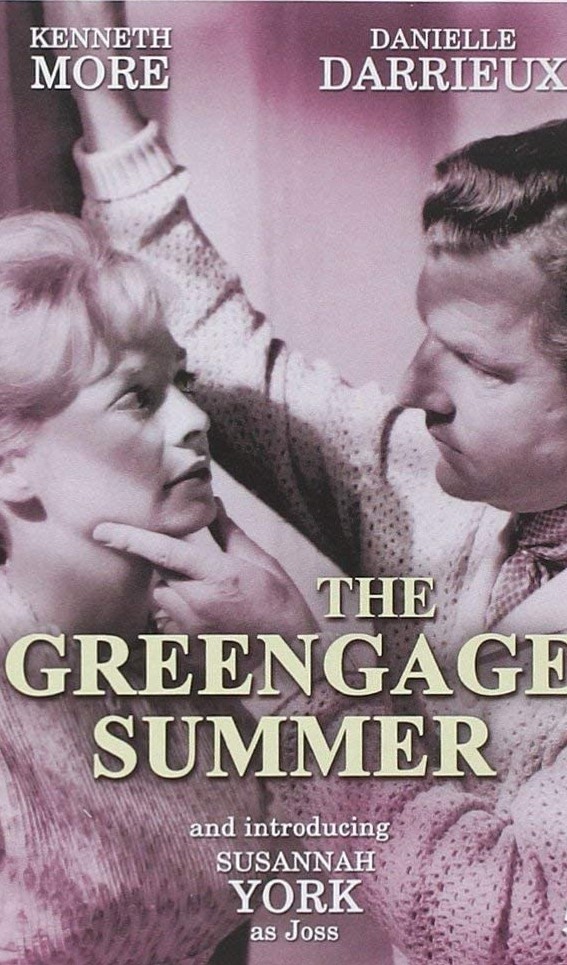
The Greengage Summer (1961) *** aka Loss of Innocence

The alternative title assumed nobody in America knew what a greengage was – it’s a type of plum – but it was actually pretty apposite.

Until then director Lewis Gilbert had been known mostly for Second World War pictures like Reach for the Sky (1954) and Carve Her Name with Pride (1955) so this was a considerable change of pace, and filmed on location.

Susannah York, who had sparkled in a small role in Tunes of Glory (1960), now took center stage as a girl on the brink of womanhood who experiences powerful emotions for the first time – love and its perpetual bedfellow jealousy – as well as rite-of-passage experiences like getting hammered on champagne.

She is the oldest of four siblings stranded in a French chateau when their mother takes ill. Left to her own devices, she promptly falls for the suave and much older Kenneth More who is having an affair with chateau owner Danielle Darrieux (another of Darryl F. Zanuck’s girlfriends).

By modern standards, this is a gentle tale, but not without some harsh moments and York is superb as she undergoes a transformation from uncertain schoolgirl to a woman realizing the power her beauty can exert. She flares from child to adult and back again in seconds. York was headstrong in real life and insisted on being drunk during the drunken scene, which ruined a day’s work.

That was not the only crisis – there were no greengages due to poor weather so they had to be flown in from Britain and sewn onto the trees. Jane Asher plays the more sensible younger sister who is not above violent emotion herself such as fisticuffs with a local lad. Kenneth More is at his charming best in the kind of affable role he had generally moved away from.

The dialogue is surprisingly good and Darrieux is convincing as an aging beauty willing to do anything. The scenery is a bonus as are the snatches of provincial French life. All in, an engaging piece of work, with York delivering a star-is-born kind of turn.      

https://www.amazon.co.uk/Greengage-Summer-DVD-Kenneth-More/dp/B002X7TXDS/ref=sr_1_1?crid=38KFOWT9944AW&dchild=1&keywords=the+greengage+summer+dvd&qid=1593761026&s=dvd&sprefix=the+greengage+summer+%2Cdvd%2C172&sr=1-1

Discover WordPress

A daily selection of the best content published on WordPress, collected for you by humans who love to read.

The Atavist Magazine

by Brian Hannan

WordPress.com News

The latest news on WordPress.com and the WordPress community.