The Light at the Edge of the World (1971) ***

Had me at pirates! Unfortunately, I feel suckered. These scumbags, even with a dandified Yul Brynner (The Double Man, 1967) at the helm, give the traditional swashbuckler a bad name. That said, it’s a decent Rambo-esque adventure, derived from a Jules Verne novel, that sees Kirk Douglas (A Lovely Way To Die, 1968) single-handedly take on the venomous pirate crew, with Samantha Eggar (The Collector, 1963) thrown in as lure.

Ex-gold-miner Denton (Kirk Douglas) runs the southernmost lighthouse off the perilous coast of Argentina leading to the dreaded Cape Horn passage, the only route round South America prior to the opening of the Panama Canal. Helping him out are veteran seaman Capt Mortiz (Fernando Rey), who constantly upbraids Denton for his lack of naval lore, and young lad Virgilio (Jean Claude Drouot) and his pet monkey. When a ship hoves into view and anchors off-shore, Mortiz and Virgilio head up the welcome party only to be ruthlessly – and gleefully – cut down as they climb on board.

Pirate chief Kongre (Yul Brynner) has come up with a neat scam. Switch off the whale-oil-fuelled lights in the lighthouse, wait for unsuspecting ships to be wrecked and pocket the proceeds. After being tormented and humiliated, Denton manages to escape and hide out in the caves, but only for as long as Kongre, bored with idleness, decides to hunt him down astride his white horse armed with a unicorn-like sword, the lighthouse keeper only avoiding capture by diving into the sea, where he is presumed drowned.

But when the first victim of Kongre’s scheme breaks asunder, Denton rescues Montefiore (Renato Salvatore) from the ensuing sadistic massacre. The only other person saved, at Kongre’s behest, is the beautiful Arabella (Samantha Eggar), for whom the captain goes through an almost courtly charade before, espying photographs in the lighthouse cottage, deciding that since his captive bears some resemblance to Denton’s former lover he could inflict further torment to Denton by parading the woman, hoping to use her as lure to bring his enemy out from his hiding place.

While Denton has escaped capture and is carrying out guerrilla warfare against the invaders he’s not particularly successful, given he lacks any decent weaponry, is heavily outnumbered and Kongre is pretty cunning. Denton’s innate decency sees him attempting to rescue the girl only, in a stunning twist, to be knocked back as he has little to offer except hiding out in caves and the captain has been treating her royally. Unfortunately for her, when his ruse fails, Kongre tosses her to the sharks in the shape of the lusty crew who proceed to commit mass rape. Meanwhile, Montefiore has been captured, strung up in the rigging and is being flayed alive, slices of skin torn from his body to the delight of his captors.

As it happens, the pirates, to reinforce defence of the island should they themselves come under attack from the British or Argentinian Navy, have brought their ship’s cannons ashore. As it happens, not only are they trained on the ship, but Denton, despite no experience at all, proves an ace artillery commander. As the ship burns and sinks, he turns his attention to Kongre, conveniently swanning around in the lighthouse rather than the cottage, and in a piece of savage irony sets fire to the building with whale oil.

Could do with shaving 20 minutes off the running time, and certainly have to suspend disbelief at other points, but otherwise it’s a pretty early edition of the Rambo-style revenge, the one-man army that can wipe out a superior force. Despite my desire for a decent swashbuckler, the pirates are probably more realistic than anything served up by Errol Flynn or Johnny Depp, and their cruelty seems consistent with their profession. The scenes with Denton being pursued relentlessly by the mounted Kongre are especially effective as is the rejection of Denton by the snooty girl.

Kevin Billington (Interlude, 1968) directed from a screenplay by wife Rachel and Tom Rowe (The Green Slime, 1968).

Long-lost film that deserves an audience.
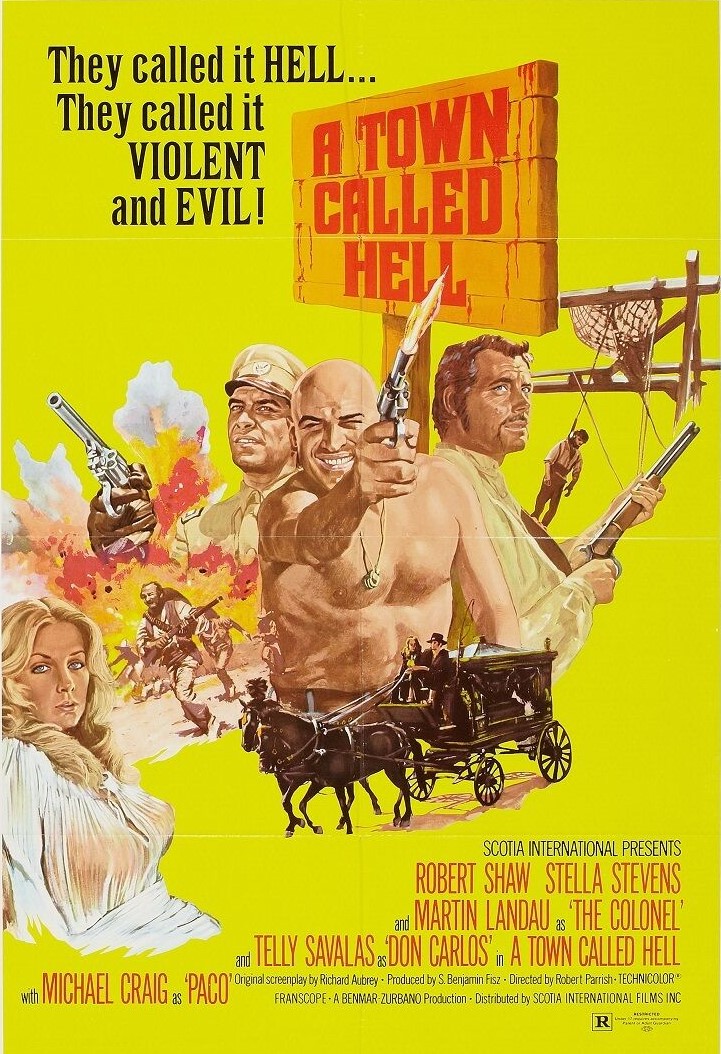
A Town Called Hell / A Town Called Bastard (1970) ***

You think you’re in for something quite stylish when widow Alvira (Stell Stevens) rides into town asleep in a coffin in a hearse. Or when she turns up in a dream as an avenging angel. Or when a rebel, entrusted with funds to buy guns, squanders the cash on women and booze. Or when a Mexican general is so disgusted by informer Paco (Michael Craig) that he refuses to face him. But these are about the only highlights in a bloody, sadistic confusing affair.

And diversity rules. Not only do we have a deaf mute going by the apocalyptic name of The Spectre (Dudley Sutton), there’s also an unnamed blind man (Fernando Rey) who comes in handy because he can recognise people by fingering the contours of their faces.

We begin straightforwardly enough with the massacre in a church of the well-to-do by Mexican rebels led by two unnamed characters (Robert Shaw and Martin Landau). Turns out that’s only the prologue and we cut to a decade later to a town ruled by sadistic sun worshipper Don Carlos (Telly Savalas) who has a tendency to string people up at the drop of a hat. Keeping a low profile is another unnamed character known only as the Priest (Robert Shaw) who may always have been a cleric or who has turned to God after being involved in the massacre. Even so, religion doesn’t prevent him having a mistress.

Alvira is offering a $20,000 reward for the killers of her husband, Montes, a victim of the earlier massacre. To get the money, Don Carlos employs the typical wheeze of framing a couple of villagers, husband and wife, hanging them before their tongues run so loose they can confess it wasn’t them. In a bid to save his own skin, the husband blames his wife.

Don Carlos’s luck turns bad when his sidekick La Bomba (Al Lettieri) decides it might be fun to take over, beginning by shooting off his boss’s fingers before hanging him in the sun. But just when you might think you are getting the hang of what’s going on, the unnamed Colonel (Martin Landau) appears. He’s also looking for information, but not inclined to pay for it. He’s hunting for a rebel leader with, wait for it, an actual name, though this still sounds like a pseudonym, Aguila (Eagle, get it?). For no reason whatsoever, it takes the priest a little while to work out this is his former comrade from the church massacre.

The Yanks were the ones who changed the title from the above. Interesting double bill, though, with Alain Delon as “Le Samourai.” Stella Stevens looks far more provocative
on the poster than she does in the film.

It doesn’t take long for the Colonel to get a grip on the hanging malarkey and with as much relish as Don Carlos, determining to continue hanging the townspeople until they tell him where Aguila is. The two narratives don’t quite mesh, but then what do you expect, this is high on atmosphere, sweating bodies, raw emotions, blazing sun. The Colonel, equally obviously, has given up on being a rebel, presumably because as a government official, he can officially murder people any time he likes without having to round up a gang of rebels to do so.

Every now and then the movie dips into flashback or Paco appears to confuse matters further.

There’s an odd sensibility at work. Maybe this is intended to be one of those down’n’dirty westerns trying to show us how mean the actual West really was (although given it’s set in Mexico, we only need to go as far back as The Wild Bunch, in 1969, to get that point). It doesn’t fit so easily into the spaghetti western canon, either, despite the uniform malevolence.

The oblique tone reminds you more of something that could have been put together by Luis Bunuel, but that would be ranking it far higher than it deserves.

The cast are the biggest plus points, though you might be asking whether Robert Shaw (Battle of the Bulge, 1965) and Stella Stevens (The Mad Room, 1969) were sold a different film entirely. Stevens doesn’t have much to do, except look beautiful and soulful. But Shaw is about the only leading man you’ll come across who so puts his heart into a part that he doesn’t mind being seen actually drooling at the prospect of massacre. In fairness, Telly Savalas (The Assassination Bureau, 1969) and Martin Landau (Nevada Smith, 1966), while not exactly dripping spit, drool in different ways.

There’s enough brooding going on stylistically that you are almost willing it to turn into something not just better but more definable. Alas, no such luck.

Robert Parrish (In the French Style, 1963) does his best with a screenplay  by Robert Aubrey (The One-Eyed Soldiers, 1967) and Benjamin Fisz, in his only writing gig, he was better known as a producer. My guess is they were more script doctors than anything else, the original damage having been done by the uncredited Philip Yordan (Battle of the Bulge).

Could a been something.

https://amzn.to/46Jpk2D

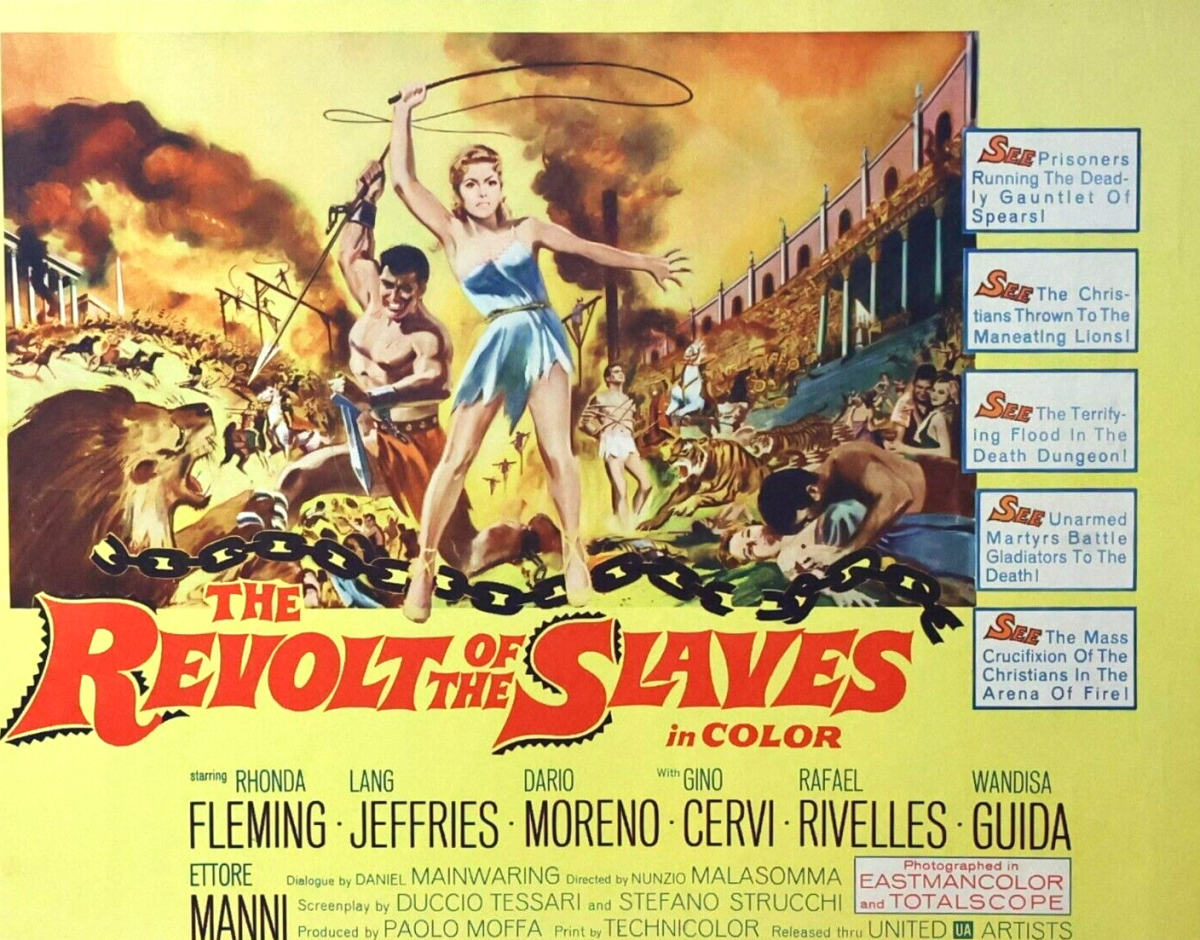
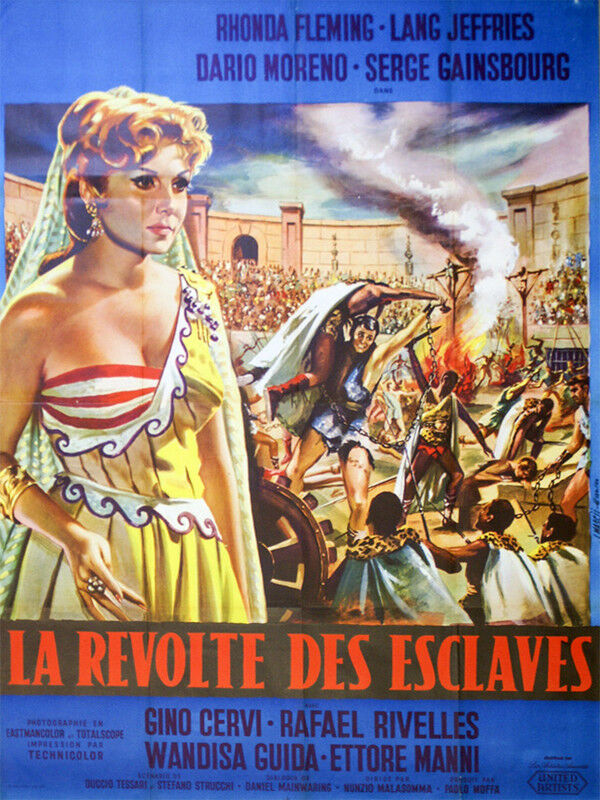
Revolt of the Slaves (1960) ****

Time has been very kind to this underrated handsomely-mounted hugely enjoyable historical romp about victimised Christians in ancient Rome. Virtually a last hurrah for 1950s redhead Rhonda Fleming (Gunfight at the OK Corral, 1957), known as The Queen of Technicolor and here  gifted lines like “the whip will do him good.” Fernando Rey (The French Connection, 1971) is thrown into a pit of ravenous hounds. Singer and serial lothario Serge Gainsbourg, immortalised by late Sixties bedroom anthem “Je t’aime,”  plays a sadistic villain.

Despite the occasional over-the-top religious references – a character called Sebastian (Ettore Mane) is pinioned to a tree by arrows because the overseer (“don’t aim for the heart”) wants to prolong his agony, a prisoner facing death is baptised in a convenient flood – the piety is largely kept under wraps because these Christians refuse to turn the traditional cheek and inflict considerable damage on their masters. A voice that sounds like the Voice of God is revealed as an ordinary mortal. And there are nods to modern politics, the powers behind the throne.

Cool Hand Luke couldn’t have come up with better plans for escape, filling a cell with water from the sewer till inmates, except the aforementioned late convert, float to the hatch in the ceiling. A sojourn along a river is enough to put the pack of chasing hounds off the scent. Pursuers are trapped in the catacombs by the simple device of bringing down the roof.

After wealthy patrician Claudius (Gino Cervi) saves the life of escaped slave Vibio (Lang Jeffries) his arrogant daughter Claudia (Rhonda Fleming), introduced driving a chariot along packed streets with little regard for public safety,  finds every excuse to humiliate him.

The plot is triggered when Claudia’s cousin/niece (the English translation is unclear) Agnese (Wandisa Guida) is followed by spy Corvino (Serge Gainsbourg) to a Christian hideout. Claudia becomes implicated when Agnese seeks refuge and for a good while she’s on the run, eventually committing her first act of unselfishness after falling for Vibio. But, to save her family, Claudia denounces the Christianity she has begun to accept, only to become involved in the finale in the arena where Christians are killed one by one, not by the waiting lions, but by spear.  

It’s mostly heady and bloody action, the driving narrative only pausing now and then to make a religious point. The Emperor, like any leader in Game of Thrones, is afflicted with illness which makes his face burst out in spots. There’s some excellent use of music. In one sequence the hunters with a soundtrack of barking dogs are contrasted with a peaceful scene of the Christians not realising their pursuers are so close until the barking infuses their scene.

Fair bit of poetic license here. No tigers!

Star of the show is undoubtedly Rhonda Fleming. A huge post-war marquee idol, she starred opposite the likes of Bing Crosby (A Connecticut Yankee in the Court of King Arthur, 1949), Glenn Ford (The Redhead and the Cowboy, 1951), Dana Andrews (While the City Sleeps, 1956) and Burt Lancaster (Gunfight at the OK Corral). But she was equally well-known as the top-billed star of adventures like The Golden Hawk (1952), Serpent of the Nile (1953) and Those Redheads from Seattle (1953). It was once said of her by a cinematographer that her beauty was so flawless she was stunning from any angle.

Quite why roles had dried up so much that she headed across the Atlantic to Italy for this is anybody’s guess. It certainly failed to revive her career, possibly because the religious aspects would have been more grating for audiences of the period whereas now they are less dominant.

Oddly enough, it was virtually a last hurrah also for veteran Italian director Nunzio Malasomma (The White Devil, 1947) who didn’t make another picture – his last – for seven years. But he handles the whole venture with aplomb, interspersing humor with action, moving along at a terrific pace, and making the most of a dream cast. In his debut Lang Jefferies (Don’t Knock the Twist, 1962) shows some acting talent among the flash of muscle. But it’s Rhonda Fleming’s picture.

Note: dubbing into English has changed some names. In the Italian version Claudia is named Fabiola – it’s a remake of the earlier Fabiola (1949) starring Michele Morgan – and her father Fabio, so stand by for confusion on imdb.

Certainly a cut above the sword-and-sandals epics flourishing at the time. I’d add that it’s an ideal matinee feature except I watched it late at night and it was just as entertaining. Highly recommended as an easy watch or just to see Rhonda Fleming at her best. The rating might err a little on the high side but every now and then we are allowed our guilty pleasures.

The Ceremony (1963) ***

Actors taking the hyphenated route were quite a fad in the 1960s. Mostly, primarily for tax purposes, they turned themselves into actor-producers. But some went all-out for artistic glory, saddling themselves with the task of directing the movies in which they starred, by this point in the decade John Wayne (The Alamo, 1960) and Marlon Brando (One-Eyed Jacks, 1961) the most celebrated examples. Despite lacking that pair’s box office pulling power, Laurence Harvey (Butterfield 8, 1960) threw his hat into the ring with this often compelling, atmospheric, but occasionally pretentious, offering.

Irishman Sean McKenna (Laurence Harvey) is in prison in Tangiers – “a city of money” – for one crime he did commit (bank robbery) and one he did not (shooting a guard dead during the robbery). Although facing an imminent death penalty for the murder, he refuses to name the killer. Local prosecutor Le Coq (Ross Martin)  is intent on making him an example while the prison warden (John Ireland) pleads for clemency, especially as it is suspected the inmate is innocent.

Astonishing to imagine now but this went out on general release in Britain
as the lead film in a double bill with “Lilies of the Field.”

Meanwhile, McKenna’s girlfriend Catherine (Sarah Miles) and his brother Dominic (Robert Walker Jr) plan an audacious escape. The brother is not altogether altruistic. His price is half the hidden loot and Catherine, that part of the deal sealed when she submits to sex with him.

Dominic gains entry to the prison disguised as a priest, swapping clothes with his brother, so that when sirens sound to announce potential intrusion by Dominic’s sidekick Nicky (Lee Patterson), Sean can simply walk out unharmed. However, when Seans learns of the price to be paid he doesn’t thank Catherine for her noble sacrifice but turns against both. Dominic, now on the run and chased by the police, is virtually burned alive when his car explodes.

My apologies but in order to properly discuss this picture I’m going to have to take you through to the end. So SPOILER ALERT.

Dominic is so badly burnt in fact that he is unrecognizable and the police (decades before DNA would disprove such an assumption) believe he is actually his brother. Dominic is faced with  “the ceremony” – an ironic tittle if ever there was one – in which he is strapped to a wooden throne and shot by firing squad. Despite his brother’s betrayal, and the fact that his death would set Sean free, Sean decides it would better to “prevent the unjust killing of an innocent man” and gives himself up, too late, as it happens, to spare Dominic, but allowing Sean, in a Pieta-style gesture, to carry the corpse into the prison courtyard and announce “my brother died for me.”

Not quite the ending you would expect, not least because religious allegory has been distinctly missing from the proceedings unless you count the somewhat dotty Father O’Brian (Jack MacGowran) who spends most of his time delivering soliloquies unless you count cars, cows and mules as potential conversationalists.

You get the impression the ending was what attracted the director to the tale, and though it is quite a stunning climax, cinematically as well as thematically, Harvey has, like so many debutants, determined to make a big point. “There’s a little bit of God in everyone,” pronounces Fr O’Brian with a saintly air, which would beg the question of when the Good Lord channelled his inner bank-robber.

For all the film’s flaws there are several pluses. The atmosphere “of chilly hell” (to steal a quote about another book) is well done, footsteps echo off stone floors and cobbles, nobody in this black-and-white feature is seen without a dose of noir lighting, resulting in long shadows and aerial shots of tiny figures swarming. While everyone else over-acts for no apparent reason except directorial inexperience, when Sarah Miles (Term of Trial, 1962) overacts, lips constantly a-quiver, words delivered in gasps, she has every right to, since her character has succumbed to the most evil kind of temptation for the best sort of reason.

The only other interesting character, beyond the stock ones populating the prison, is lonely landlord Ramades (Carlos Casaravilla) who has outlived his four lives and whose rooms abut the prison and where Catherine takes refuge while the escape is going on. He senses her tension, but mistakes the cause, assuming she is here to wait for the shots announcing her husband’s death as a means of “sharing his punishment,” quite a piece of psychological insight for an ordinary guy. And there’s also a creepiness about the whole scene, a sense that she might have to give herself to him as well in order to prevent him wandering too far from the bedroom where he might discover Dominic putting into action a crucial part of the escape plan.

Among the flaws: no real tension, especially in terms of the escape, not enough directorial understanding that much more could be gained from greater focus on Catherine’s dilemma, the obvious lack of a body in the burning car, the fact that the Irishman shows no signs of an Irish accent, the priest’s scenes which provoke hilarity more than reverence, and as much as it is a strength the ending appears out of nowhere.

Robert Walker Jr (The Happening, 1967) is too much of a lightweight for this role, but John Ireland (55 Days at Peking, 1963) and Ross Martin (Experiment in Terror, 1962) excel. Look out for Fernando Rey (The French Connection, 1970).

Valiant effort by Harvey who only directed one other time, on his last film Welcome to Arrow Beach / Yellow-Head Summer (1973), plus a stint filling in for Anthony Mann who died during the filming of A Dandy in Aspic (1968). For The Ceremony Harvey was a quadruple hyphenate –  actor-producer-writer-director – for he also contributed enough dialogue to claim a screen credit along with Ben Barzman (The Blue Max, 1966) who adapted the novel by Frederic Grendel.

Discover WordPress

A daily selection of the best content published on WordPress, collected for you by humans who love to read.

The Atavist Magazine

by Brian Hannan

WordPress.com News

The latest news on WordPress.com and the WordPress community.