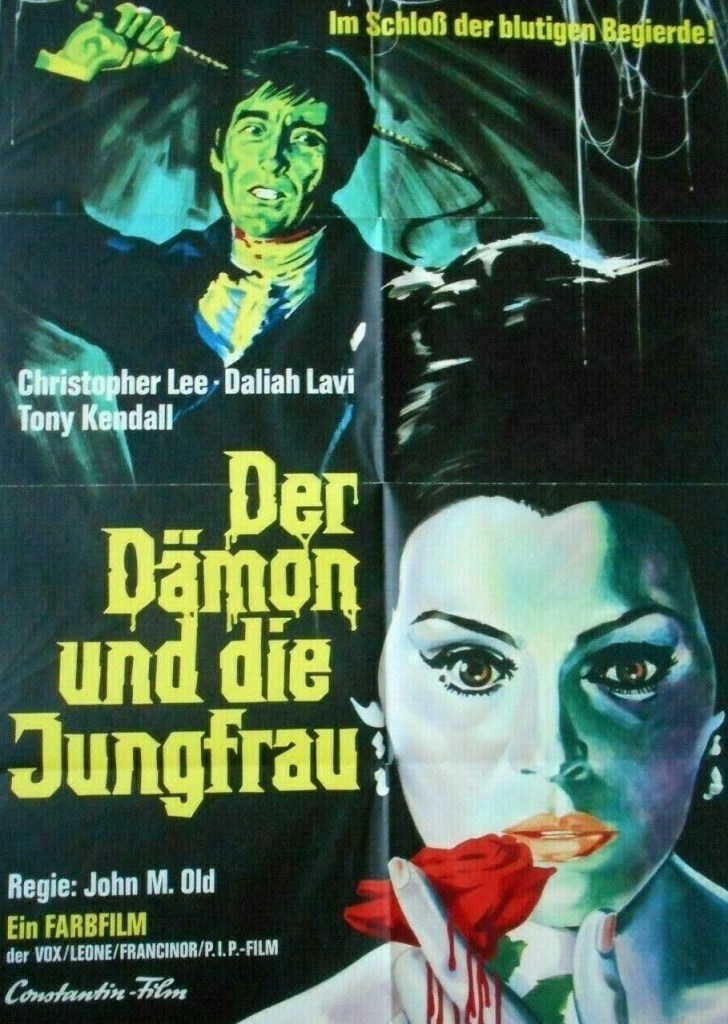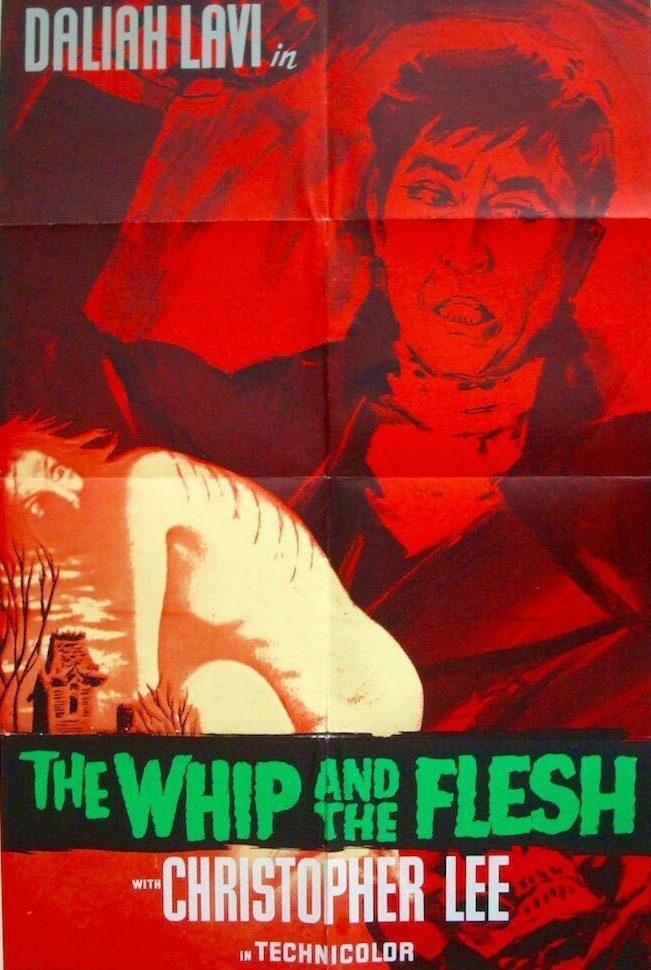
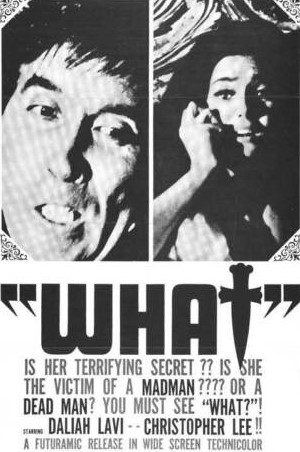
The Whip and the Flesh / The Whip and the Body (1963) ****

Has there ever been actress so skilled at displaying fear as Daliah Lavi? Where the female stars of horror movies too quickly succumbed to the scream and goggle eyes, Lavi could run a whole gamut of terror without uttering a sound and continue doing so for virtually an entire picture. Top-billed ahead of the reigning king of British horror Christopher Lee, this is another acting tour de force, not quite sustaining the intensity of The Demon (1963) but at times not far off it.

Italian director Mario Bava (Black Sabbath, 1963), here masquerading as John M. Old, has stitched together a mixture of horror, and an early form of giallo, the picture taking place in the classic old dark house, in this case a castle perched on a rock above the sea, the deaths grisly, and almost fits into the “locked room” subgenre of the detective story, where the murders appear impossible to carry out.
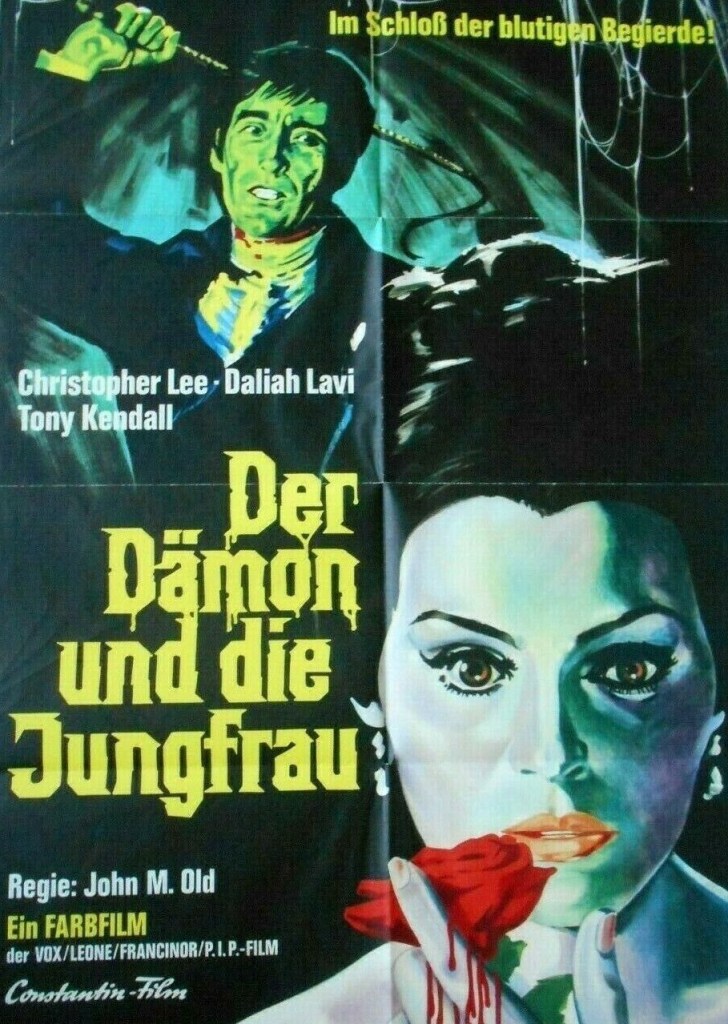
The disgraced Kurt Menliff (Christopher Lee) returns to his ancestral home, begging forgiveness from his father Count Vladimir (Gustavo De Nardo) and hoping to reclaim his inheritance and his betrothed Nevenka (Daliah Lavi). While his father exonerates him, Kurt is denied the rest, Nevenka already committed to marriage to his brother Christian (Tony Kendall). Other tensions are soon evident: the housekeeper Giorgia wants revenge on Kurt for the death of her daughter and Christian is in love with another, Katia (Evelyn Stewart).

Nevenka who outwardly protests how much she hates Kurt quickly reveals masochistic tendencies as she gives in to a whipping. But Kurt’s sudden inexplicable murder instigates an investigation, suspicion falling firstly on the father, then Christian and finally Giorgia.

But Nevenka is convinced Kurt is not dead, although his body has been entombed in the castle crypt. Torment creeps into her face at his funeral and we can almost see her grow gaunt in front of our eyes. In a brilliant scene where she tracks what she imagines to be the sound of a whip it turns out to be a branch lashing a window in a storm. Some of her supposed visions are easily explained, muddy footsteps leading from Kurt’s tomb actually belonging to the limping manservant Losat (Luciano Pigozzi). But how do you account for the hand, in an almost 3D shape, reaching out to her in the darkness? Or her ecstasy in still being whipped, her nightdress stripped from her back?
Although sometimes relying too heavily on atmospherics – windows swinging open at night, storm outside – Bava brilliantly marshals the real and the imagined, until the investigation into murder involves all the characters. Once the film begins, the drawbridge in a sense comes down, and nobody else enters the castle, and so we move from one character to another, each with their own motive for possibly committing dire deed. And with each passing moment we return to the demented Nevenka, who wishes Kurt dead but cannot live without him, and, craving the whip, cannot escape his sadistic power. Her faith in Kurt’s resurrection is so intense that the others are soon seeking signs that the dead man is still alive.

This is a horror superior to Hammer. Using the same leading man, the British studio generally expected Lee to be over-the-top, his innate malevolence generally very obvious from the start. Here, he is at his most handsome and although definitely sadistic, the emphasis is less on his pleasure than that of his victim. And while Bava resorts to a similar kind of set, this castle is remote, has no relationship with villagers, and exudes regal dominance rather than just the normal fear of a Dracula picture. Bava employs a more subtle color palette and the piano theme tune by Carlo Rusticelli has a romantic tone.

But for all Bava’s proven skill, this would not be the same without Lavi. I doubt if there is a single actress in the horror domain throughout the 1960s who could match the actress for portraying fright, as she marches up the scale from mere anxiety to full-blown terror. And although women in Dracula movies succumbed to vampire teeth with more than a frisson of sexuality, there is a different deeper sensuality at work here, in what must rank as one of the greatest-ever portrayals of masochism embedded in love.

As noted previously, Lavi, in stepping onto the bigger Hollywood canvas of Lord Jim (1965) and The Silencers (1966), lost the intensity she displayed here and never came close to matching this performance or that of The Demon. Christopher Lee, although claiming to dislike his experience, continued to rule the horror world until he was afforded a wider audience through James Bond, Star Wars, J.R.R. Tolkien and Tim Burton. 

Tony Kendall, making his debut, soon graduated to the Kommissar X series, spaghetti westerns (he played Django twice), horror (Return of the Evil Dead, 1973), and thrillers such as Machine Gun McCain (1969). Evelyn Stewart went down much the same route, her long career sprinkled with gems like Django Shoots First (1966), The Sweet Body of Deborah (1968) and The Psychic (1977).

Mario Bava continued to exploit the horror vein including Blood and Black Lace (1964), Planet of the Vampires (1965) and Lisa and the Devil (1973) with Telly Savalas and Elke Sommer.
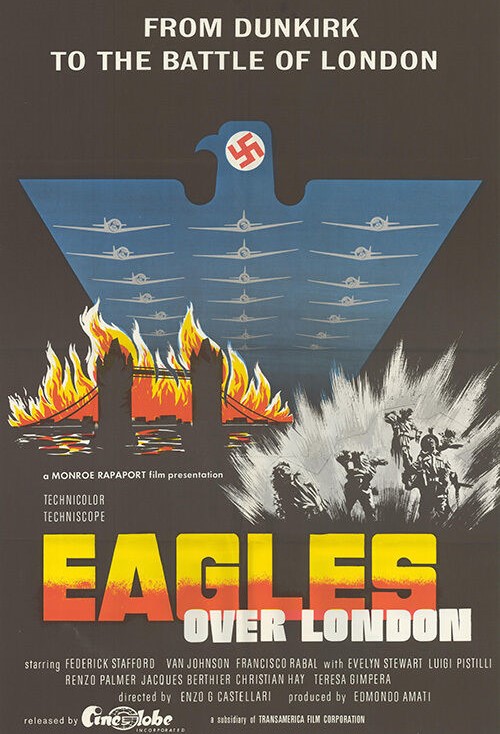
Eagles over London (1969) ***

Presumably intended to capitalize on/rip-off the same year’s big-budget roadshow The Battle of Britain manages to cram in a pack of action beginning with a tank ambush in Normandy, the Dunkirk evacuation, the Battle of Britain, rooftop shoot-outs, ending up with an audacious attack of RAF High Command by a team of German saboteurs. As notable for technical achievement, split screen – sometimes split diagonally or quartered – in the manner of The Boston Strangler (1968) and The Thomas Crown Affair (1968), shots through various tiny holes, scenes filmed overhead, and a dazzling swirling camera sequence that would normally presage intimacy but here means death.

Somehow manages to squeeze a surprising number of dramatic moments focusing on relationships, a brief nod to homosexuality, and emulating Fraulein Doktor (1969) in giving the Germans credit for astute and effective espionage. Obvious use of stock footage for the air fight sequences, but you wonder what else has been cobbled out of the vaults given the preponderance of scenes requiring massive numbers of extras. Throw in Hollywood veteran Van Johnson (Divorce American Style, 1967)  and a particularly good Cockney sergeant (Renzo Palmer) and it hardly lets up.

So, Captain Stevens (Frederick Stafford) heads up a unit delaying the German blitzkrieg in France in 1940. The Germans, led by Donovan (Francisco Rabal), meanwhile, are in disguise, assuming the identities of dead British soldiers with the intention of infiltrating Britain and destroying its radar installations. Inadvertently, Stevens saves Donovan’s life, thus giving the German accepted entry into British high command. Equally inadvertently Stevens allows the German access to his girlfriend Meg (Evelyn Stewart) who needs a shoulder to cry on. Donovan has his own girlfriend, Sheila (Teresa Gimpera) on tap, an undercover agent working as a barmaid, well-trained at collecting loose talk and seduction.

Elements of giallo keep popping up as the Germans need to embark on a murderous rampage to continue to acquire new identities to keep ahead of the pursuing investigation, one strangulation taking place in a gay sauna. Every now and then we pop into RAF High Command where Air Vice Marshal Taylor (Van Johnson) is helping thwart the German aerial attacks and in the end, since more bodies are required, elects to go into battle himself.

The small screen allows laughable moments – model airplanes crashing into the sea, cardboard radar installations toppling – to pass almost unnoticed since most of the rest of the action is well rendered, the rooftop scene especially, and the other various shoot-outs where – shock to the system – the British are constantly outwitted and outgunned.

Mostly, you’ll note how stylish a concoction this is given the low budget. Excellent sex scene against the background of exploding bombs, the duping of our hero by the enemy, and one terrific scene where Sheila is deemed surplus to requirements, calmly accepting her fate on condition that it’s her lover who pulls the trigger.

This would have been solid support material in English-speaking countries but most likely a main feature in its Italian homeland. Might have even done better if distributors waited until Afred Hitchcock’s Topaz (1969) appeared since he recruited Frederick Stafford as his leading man. Stafford was always under-rated but he keeps this afloat, though the Germans have the more interesting roles, especially Francisco Rabal and Teresa Gimpel. Evelyn Stewart (The Whip and the Body, 1964) has a smaller part.

Not content with introducing far more style and, shall we say, flamboyance, than the material might suggest director Enzo G. Castellari (Any Gun Can Play, 1967) has the audacity to end by using Winston Churchill’s “the few” speech to halt the traffic so the British lovers can catch up with each other.

A classic example of what an interesting director can do with what in other hands would be more mundane material. Not quite sure why it took five screenwriters.

Surprisingly fun watch overloaded with style.

REVIEWED PREVIOUSLY IN THE BLOG: Frederick Stafford in Topaz (1969), Evelyn Stewart in The Whip and the Body (1964), Van Johnson in Divorce American Style (1967).

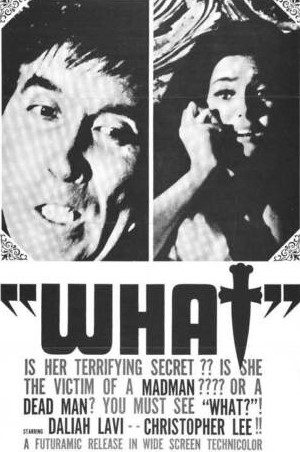
The Whip and the Body / The Whip and the Flesh / What? (1963) ****

Has there ever been actress so skilled at displaying fear as Daliah Lavi? Where the female stars of horror movies too quickly succumbed to the scream and goggle eyes, Lavi could run a whole gamut of terror without uttering a sound and continue doing so for virtually an entire picture. Top-billed ahead of the reigning king of British horror Christopher Lee, this is another acting tour de force, not quite sustaining the intensity of The Demon (1963) but at times not far off it.

Italian director Mario Bava (Black Sabbath, 1963), here masquerading as John M. Old, has stitched together a mixture of horror and an early form of giallo, the picture taking place in the classic old dark house, in this case a castle perched on a rock above the sea, the deaths grisly, and almost fitting into the “locked room” subgenre of the detective story, where the murders appear impossible to carry out.

Originally released as The Whip and the Body, it underwent some title changes, first to The Whip and the Flesh, the German title translated as The Devil and the Young Woman and while in the U.S. it was shown as What?

The disgraced Kurt Menliff (Christopher Lee) returns to his ancestral home, begging forgiveness from his father Count Vladimir (Gustavo De Nardo) and hoping to reclaim his inheritance and his betrothed Nevenka (Daliah Lavi). While his father exonerates him, Kurt is denied the rest, Nevenka already committed to marriage to his brother Christian (Tony Kendall). Other tensions are soon evident: the housekeeper Giorgia wants revenge on Kurt for the death of her daughter and Christian is in love with another, Katia (Evelyn Stewart).

Nevenka who outwardly protests how much she hates Kurt quickly reveals masochistic tendencies as she gives in to a whipping. But Kurt’s sudden inexplicable murder instigates an investigation, suspicion falling firstly on the father, then Christian and finally Giorgia.

But Nevenka is not convinced Kurt is dead, although his body has been entombed in the castle crypt. Torment creeps into her face at his funeral and we can almost see her grow gaunt in front of our eyes. In a brilliant scene where she tracks what she imagines to be the sound of whip it turns out to be a branch lashing a window in a storm. Some of her supposed visions are easily explained, muddy footsteps leading from Kurt’s tomb actually belonging to the limping manservant Losat (Luciano Pigozzi). But how do you account for the hand, in an almost 3D shape, reaching out to her in the darkness or her ecstasy in still being whipped, her nightdress stripped from her back?

Although sometimes relying too heavily on atmospherics – windows swinging open at night, storm outside – Bava brilliantly marshals the real and the imagined, until the investigation into murder involves all the characters. Once the film begins, the drawbridge in a sense comes down, and nobody else enters the castle, and so we move from one character to another, each with their own motive for possibly committing dire deed. And with each passing moment we return to the demented Nevenka, who wishes Kurt dead but cannot live without him, and, craving the whip, cannot escape his sadistic power. Her faith in Kurt’s resurrection is so intense that the others are soon seeking signs that the dead man is still alive.

This is superior horror to Hammer. Using the same leading man, the British studio generally expected Lee to be over-the-top, his innate malevolence very obvious from the start. Here, he is at his most handsome and although definitely sadistic, the emphasis is less on his pleasure than that of his victim. And while Bava resorts to a similar kind of Hammer set, this castle is remote, has no relationship with villagers, and exudes regal dominance rather than just the normal fear of a Dracula picture. Bava employs a more subtle color palette and the piano theme tune by Carlo Rusticelli has a romantic tone.

But for all Bava’s proven skill, this would not be the same without Lavi. I doubt if there is a single actress in the horror domain throughout the 1960s who could match the actress for portraying fright, as she marches up the scale from mere anxiety to full-blown terror. And although women in Dracula movies succumbed to vampire teeth with more than a frisson of sexuality, there is a different deeper sensuality at work here, in what must rank as one of the greatest-ever portrayals of masochism embedded in love.

As noted previously, Lavi, in stepping onto the bigger Hollywood stage of Lord Jim (1965) and The Silencers (1966), lost the intensity she displayed here and never came close to matching this performance or that of The Demon. Christopher Lee, although claiming to dislike his experience, continued to rule the horror world until afforded a wider audience through James Bond, Star Wars, J.R.R. Tolkien and Tim Burton. 

Tony Kendall made his debut and soon graduated to the Kommissar X series, spaghetti westerns (he played Django twice), horror (Return of the Evil Dead, 1973), and thrillers such as Machine Gun McCain (1969). Evelyn Stewart went down much the same route, her long career sprinkled with gems like Django Shoots First (1966), The Sweet Body of Deborah (1968) and The Psychic (1977).

Mario Bava continued to exploit the horror vein including Blood and Black Lace (1964), Planet of the Vampires (1965) and Lisa and the Devil (1973) with Telly Savalas and Elke Sommer.

Discover WordPress

A daily selection of the best content published on WordPress, collected for you by humans who love to read.

The Atavist Magazine

by Brian Hannan

WordPress.com News

The latest news on WordPress.com and the WordPress community.