Beyond the Curtain (1960) ***

Richard Greene had been a childhood idol as that dashing hero Robin Hood in long-running British television series (The Adventures of Robin Hood, 1955-1960) and movie Sword of Sherwood Forest (1960) so I was rather at a loss to discover that his career appeared to stumble thereafter. Only one movie in seven years and then a short stint as the hero in The Blood of Fu Manchu (1968) and The Castle of Fu Manchu (1969).  What I hadn’t realized given his eternal youthful demeanor was that he was already approaching 40 when he first donned the tights for Robin Hood and that he was coming to the end of a reasonable stint as a leading man in both Hollywood and domestically.

So I shouldn’t really have been surprised that he turned up in this Cold War B-picture. Precisely because he was the star the movie didn’t make the inroads it should have done, given the subject matter and the sensitive playing of Hungarian female lead Eva Bartok (Blood and Black Lace, 1964) whose career was equally foundering after a promising start as Burt Lancaster’s squeeze in The Crimson Pirate (1951).
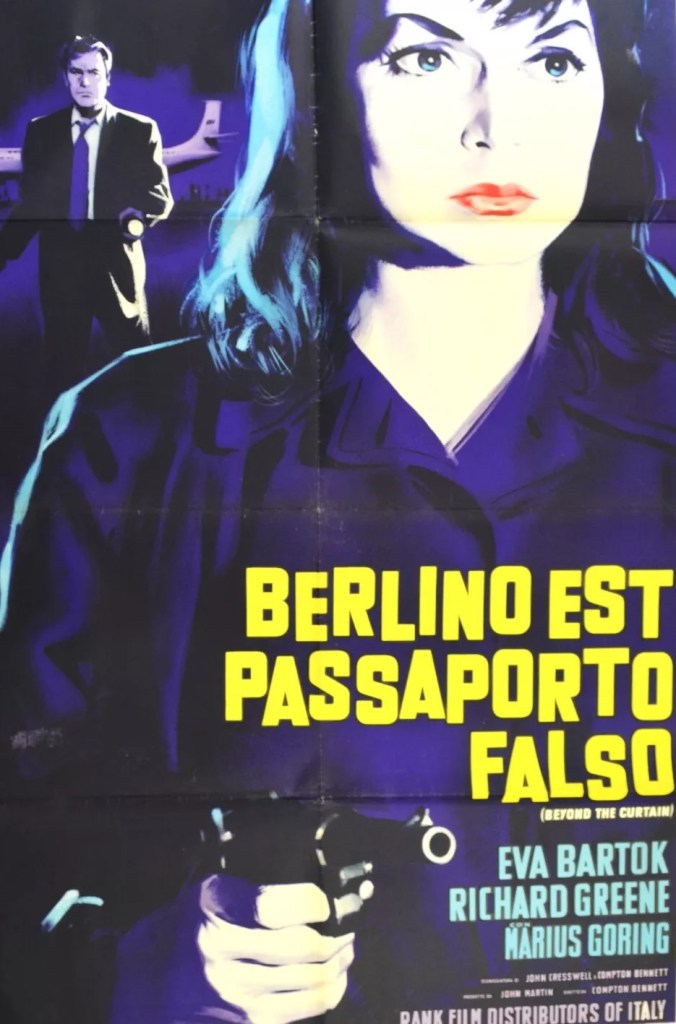
Audiences were probably baffled by the technicality on which the story pivots. As the Cold War begins – the titular Curtain is The Iron Curtain –  air space was as important a national border as land and venturing into foreign air space was construed as deliberate provocation.

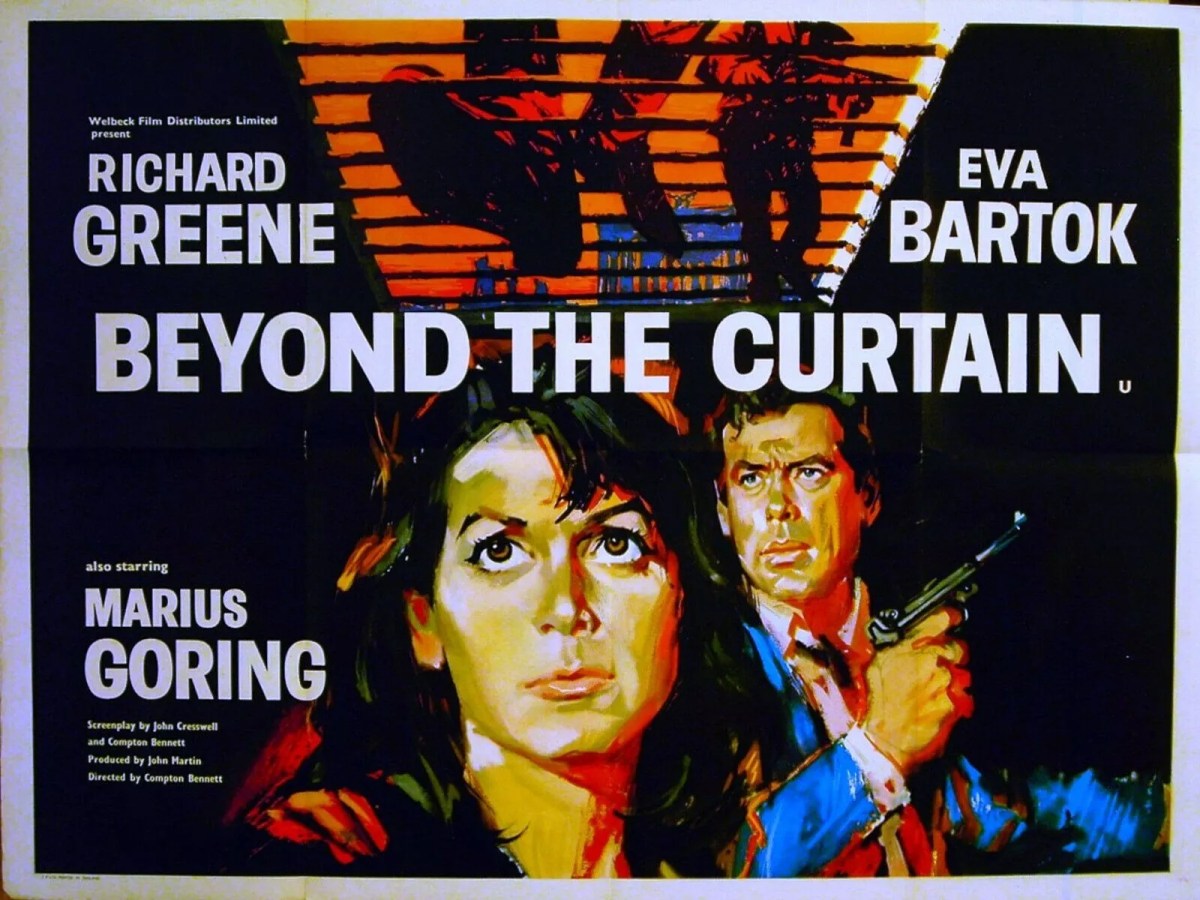
East German stewardess Karin (Eva Bartok), a refugee in Britain from her home country, is arrested when her airplane touches down in East Germany after losing its way in a storm. Pilot fiancé Capt Jim Kyle (Richard Greene), who is let go by the Soviet-influenced authorities, returns to East Germany to try to rescue her.

This resonates more than it did at the time when the Berlin Wall was not yet in existence and the Cold War consisted more of saber-rattling than anything as perilous as the Cuban Missile Crisis. And there’s a definite Kafkaesque tone. Karin is treated as a traitor for attempting to flee her native land and is equally used as bait by her captors to attempt to draw out of hiding her dissident brother Pieter (George Mikell). Outside of Kyle, there’s a sense of romantic revenge, old friend Hans (Marius Goring) now leading the forces hoping to entrap her brother.
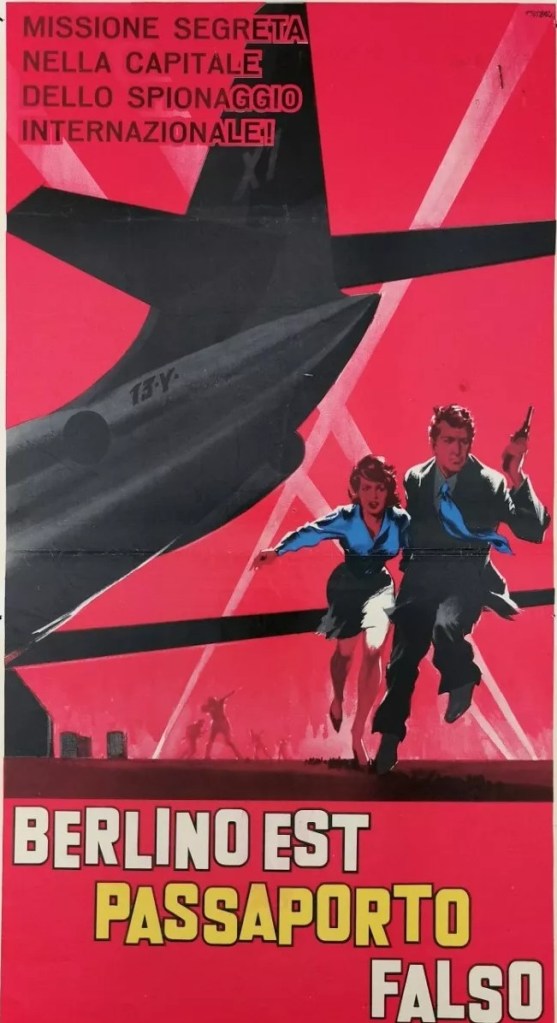
There’s plenty of the usual escape ploys, and the atmosphere has noir-antecedents with lighting that exploits shadow and night. And while the thriller aspects work well enough, especially the exciting climax in a tunnel, they carry less impact than the emotions. Karin is terrified of not just being held against her will and interrogated by the fierce secret police, but the prospect of repatriation – or more likely imprisonment – in a country she now despises and had managed to escape is proof that you can’t go home again.

If you remember the scene in Doctor Zhivago (1965) of Omar Sharif after the war returning to his palatial apartment and finding it filled up with other occupants and his family relegated to a very small space, this is its precedent. Karin’s family home is ruled by a sinister landlady-cum-busybody-cum-informant and her suicidal mother (Lucie Mannheim) lives in the attic and suffers delusions. The despair of living in a totalitarian regime comes across very well.

While reminiscent of elements of The Third Man (1949) and thoroughly overtaken in the espionage genre by the likes of The Spy Who Came in from the Cold (1965) and The Quiller Memorandum (1966), this makes it mark by concentrating on entrapment and lack of freedom.

Richard Greene is in his element as the dashing hero, but he’s outshone by Eva Bartok who has much more to lose.

Final feature of British stalwart Compton Bennett (King Solomon’s Mines, 1950) who injects occasional style into proceedings. Written by the director and John Cresswell (Spare the Rod, 1961) from the bestseller by Charles F Blair and A.J. Wallis.

More thought-provoking than you might expect.

S.O.S. Pacific (1960) ***

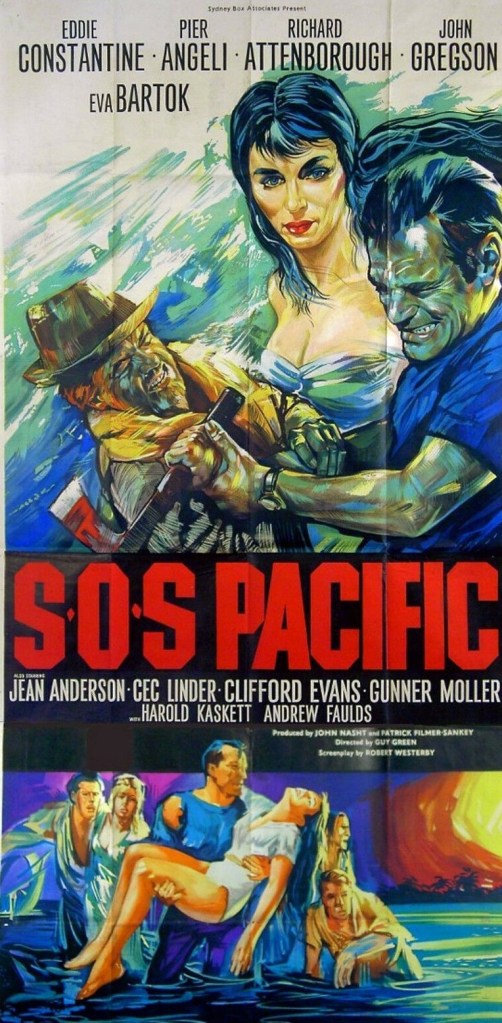
There’s a whole book to be written about poster deception. But this plays with audience expectation in an unusual manner.  Here it’s a case of duping by billing. The top-billed Richard Attenborough (Only When I Larf, 1968) disappears in the last third, John Gregson (The Frightened City, 1961)  spends most of the time out of it and the bulk of the heavy lifting is done by fifth-billed Eddie Constantine (The Great Chase, 1968).

That’s no bad thing because Constantine, self-deprecating tough guy in the Lee Marvin mold, does pretty well in this survival picture, airplane crashing in the Pacific, a motley bunch stranded on an island. And with the bonus of Attenborough and Gregson, typically of the English stiff-upper-lip persuasion,  playing against type.

Alcoholic Jack (John Gregson), piloting  a seaplane on its last legs, is ferrying wanted smuggler Mark (Eddie Constantine), handcuffed to cop Petersen (Clifford Evans), along with shifty witness Whitey (Richard Attenborough), stewardess Teresa (Pier Angela), physicist Krauss (Gunnar Moller), sparky spinster Miss Shaw (Jean Anderson) and the “loaded with sin” Maria (Eva Bartok).

When Mark attempts to put out an electrical fire on board he accidentally kills co-pilot Willy (Cec Linder) and with Jack out cold the plane heads for the drink. Luckily, there’s a deserted island nearby. Unluckily, it’s next door to a nuclear test site.

Meanwhile, Mark, emerging as the hero, is soon fighting off the attentions of Maria and Teresa, Jack’s girlfriend. Whitey, who pointed the finger at Jack and not wanting to be stranded on the same island as him, steals the cop’s gun, puts a hole in one of the two dinghies and sets off to sea on the other. On discovering lead-lined housing, Krauss is able to work out the nuclear issue. With barely five hours to detonation, Mark elects to swim two miles in shark-infested water to the tiny island housing the nuclear device, armed only with a few rudimentary tools.

There’s a surprise waiting for him of course. Should he succeed in his enterprise, there’s reward too because Jack, in best Scott of the Antarctic form, has sacrificed himself to the sharks to give Mark a chance.

There’s some good stuff here, namely seeing Attenborough as a snivelling spiv complete with dangling cigarette, and Gregson as a self-pitying drunk, killing his career one bottle at a time, an airsick cop, the doughty Miss Shaw still fancying herself as a femme fatale, some well-scripted dialog between bad guy Mark and bad girl Maria, and a host of twists.

Contemporary audiences will feel let down by the ending. If only it was as easy to prevent nuclear catastrophe. But on the other hand it is one of the first films to take the issue of the atom bomb seriously, Jack’s self-destruction the result of witnessing at first hand the devastation of Hiroshima.

Yank Eddie Constantine, hightailing it to France to improve his career prospects in the 1950s, and becoming a B-movie star, was still largely an unknown quantity. He had top-billed in French and German pictures and was the male lead to Diana Dors in Room 43 (1958). This should have kick-started a Hollywood career or at least a British one.

A potential inheritor of the Humphrey Bogart mantle, the tough guy with a soft centre, snappy with the one-liners, in this outing willing to go with the flow, confident he will end up back on his feet, if not at least enough appeal to have dames falling at his feet.  But, probably, he would have had to work his way up again, which might be a slow business, whereas in France scripts were being written to suit his screen persona. If you’re interested check out his turn as Lemmy Caution in Your Turn, Darling (1963) and his outings as secret agent Jeff Gordon and private eye Nick Carter.

Eddie Constantine played by far the most interesting character here, and except for Jean Anderson (Solomon and Sheba, 1959) the women were underwritten, Pier Angeli (Battle of the Bulge, 1965) and Eva Bartok (Blood and Black Lace, 1964) there mainly to polish the hero’s ego.

Robert Westerby (Dr Syn, Alias the Scarecrow, 1963), television writer Gilbert Thomas and Bryan Forbes (Station Six Sahara, 1963)  had varying hands in the screenplay.

Director Guy Green (The Magus, 1968) does a good job of marshalling his box of tricks, keeping tensions – whether romantic, criminal or survivalist – high especially as he had to find a way round the unexpected climax, and once you accept that neither Attenborough nor Gregson are going to leap to the rescue quite easy to get on the Eddie Constantine wavelength. Not in the class of The Flight of the Phoenix (1965) or Sands of the Kalahari (1965), and lacking their character complexities, but not far off.

Blood and Black Lace (1964) ****

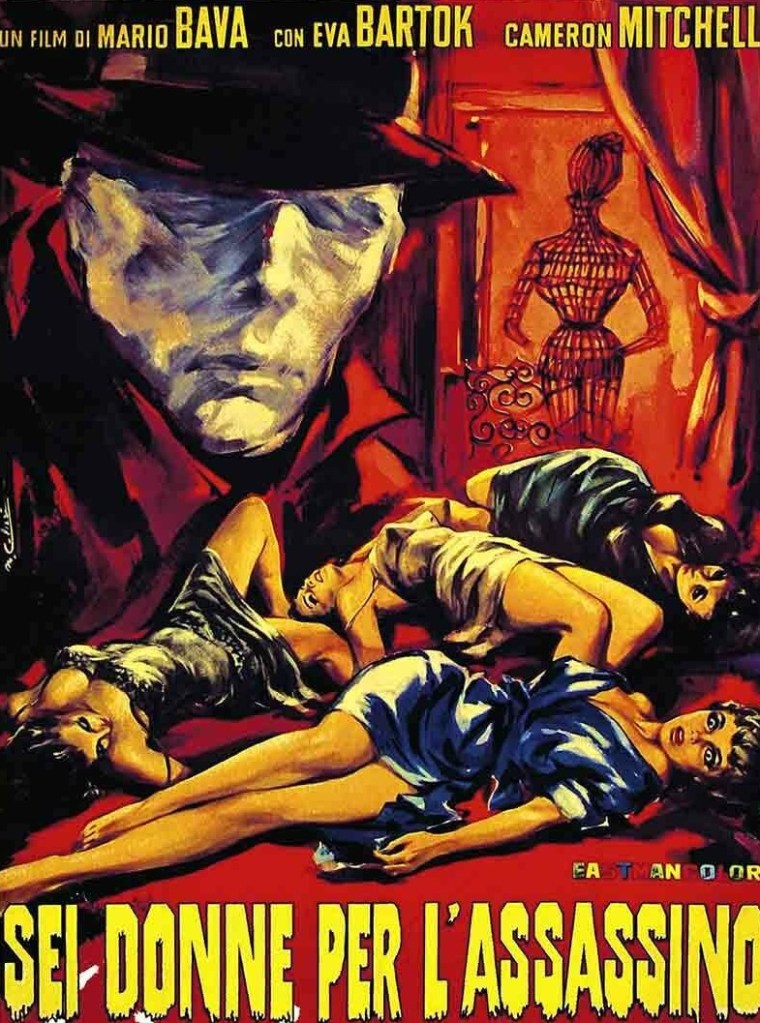
Director Mario Bava channels his inner Douglas Sirk in a rich color palette for this early version of giallo. About as surprisingly rich is the camerawork, which, for a low-budget picture is exceptionally accomplished, tracking, drifting, bobbing between characters. This early in the 1960s, nudity was not so prevalent but setting a movie in a fashion house – ensuring the beauty quotient is remarkably high – provided sufficient opportunity for ladies to be seen (within a work context naturally) in a certain amount of undress and you can be sure the killer leaves them half-naked. And it’s not the usual giallo sex maniac at work either but, despite the volume of murders, a killer driven by a desire to conceal shame.

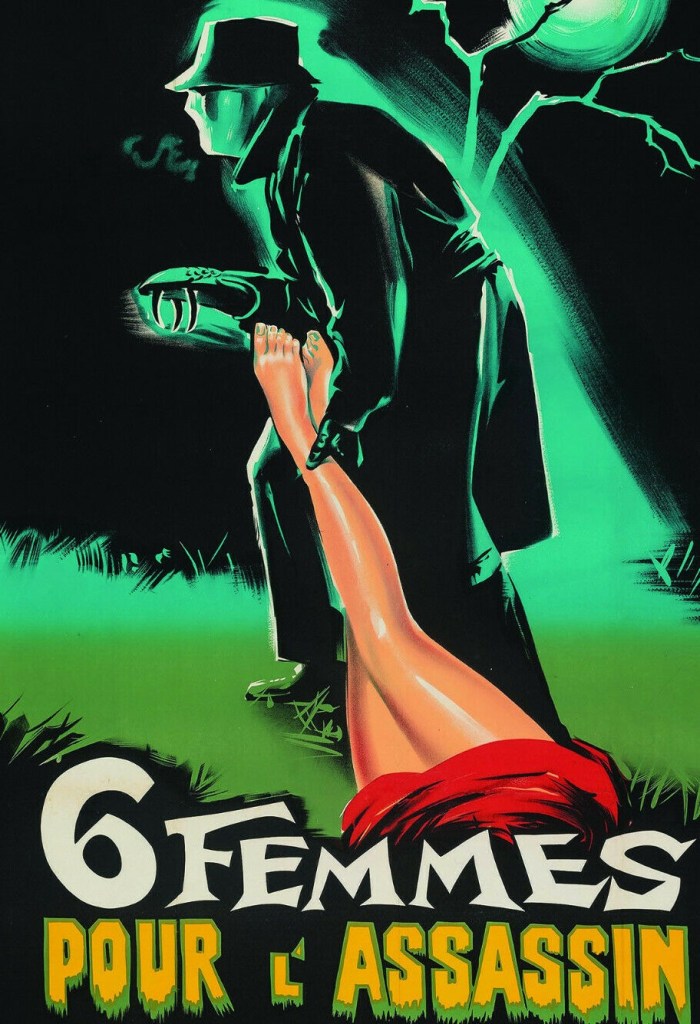
Blackmail, theft, abortion, cocaine addiction, pregnancy, impotence and illicit affairs are among the secrets the protagonists wish to keep hidden, all risking exposure by a diary kept by the first victim Isabella (Francesco Ungaro). So rather than a whodunit, it’s a whydunit. The killer is particularly creepy, face concealed behind white gauze like an Egyptian mummy. As the Italian title explains, six women are intended for the chop, so that kind of rules out a great deal of tension as you spend your time counting. Are we nearly there yet? And as we run out of obvious potential victims, who the heck is there left to kill? Of course, by that time, we are into twist territory and that element is certainly neatly done.

The main candidates for the murderer are: Franco (Dante DiPaolo), Riccardo (Franco Ressel), Cesare (Luciano Piggozi). Massimo (Cameron Mitchell)  and Marco (Massimo Righi). These are the official ones, rounded up by Inspector Silvestri (Thomas Reiner). But that still leaves housekeeper Clarice (Harriet Medin) in her black leather coat. And a fashion house being a festering wound of jealousy, sex, status and privilege you wouldn’t discount any of the models either nor an owner Cristiana (Eva Bartok) who is such a slave-driver she denies her seamstresses time to mourn.

Emotions would be running high in this establishment never mind with a killer on the loose. Relationships are so fraught that even when this is the worst possible time to be alone in a house, certain of the models refuse to offer sanctuary to others and one, Tao-Li (Claude Dantes), just plans to head for the hills (Paris, in other words) and abandon the others. Add to that a high degree of stupidity. When Greta (Lea Lander) discovers the disfigured corpse of Nicole (Arianna Gorini) in the trunk of her car, rather than calling the police, she drags the body into the house and hides it under the stairs while her butler is about to serve tea. Except it’s not out of folly, it’s because Greta, like all the women here, wishes to protect a male, passion reigning supreme to the extent that the thought of losing a lover even if he is a murderer is too much to bear.

The inspector’s task would be made easy if the killer had a distinctive modus operandi. Death occurs through strangulation, suffocation, drowning (though with cut wrists to make it look like suicide), falling from a great height and Nicole’s face thrust into a stove. If victims take a long time to die, it’s not from the killer’s sadism but his/her incompetence. Virtually none are speedily dispatched, murder not as easy as you might imagine, an idea that Hitchcock purloined in Torn Curtain (1966)

For most of the time the way the camera moves you would wouldn’t think you were watching a film about a serial killer (in those days as rare in reality as in fiction) but a dense emotional tale as spun by the likes of Luchino Visconti (The Leopard, 1963) amidst a backdrop of wealth and beauty. Setting aside the murders, there is a feast of intrigue, and a rich seam of characters, though the central theme seems to be (not surprising for the era) that money and beauty are not as fulfilling as love, something that women will commit various crimes (though stopping short of murder) to achieve.   

I would imagine it was just such intricate camerawork that put audiences off the picture on initial release, a big flop in Italy and, if screened anywhere else (as in Britain) the lower part of a double bill. Not quite as intense as Bava’s previous The Whip and the Body (1963) nor so stylistically driven as Danger : Diabolik (1968) and some way short of horror masterpieces like Black Sabbath (1963), this is still an interesting watch, something of a template for future giallo and from a pure directorial perspective glorious to watch.

The number of characters featured and the time spent on the various deaths limit the opportunities for any one star to dominate but Hungarian Eva Bartok (Operation Amsterdam, 1960) leads the line on the female side while American transplant Cameron Mitchell (Minnesota Clay, 1964) and Dante DiPaulo (Sweet Charity, 1969) vie for male acting honors. The screenplay was a joint effort by Marcello Fondato, Giuseppe Barilla and Bava.

YouTube has this for free though be warned it comes with ads and for the sumptuous photography alone you may want in any case to splash out.

Discover WordPress

A daily selection of the best content published on WordPress, collected for you by humans who love to read.

The Atavist Magazine

by Brian Hannan

WordPress.com News

The latest news on WordPress.com and the WordPress community.