Kaleidoscope (1966) ***

Amazing the tension that emanates from the turn of a card. Or, more correctly, waiting for one. Only problem is we’re two-third through the movie before high-stakes poker begins – the pot nudging £250,00 (close on a cool £5 million now). Mostly, the earlier tension derives from not knowing what the hell is going on in this enjoyable thriller made at the height of the Swinging Sixties as playboy gambler Barney (Warren Beatty), a walking Carnaby St model driving an Aston Martin DB5, tilts the odds dramatically in his favor.

Barney is a gambler but the problem with gambling is the odds. They can be against you too much. So Barney decides to turn himself into a burglar, the kind that can clamber over rooftops, abseil between buildings, and break into – a printing business called Kaleidoscope. This just happens to print the playing cards supplied to all the major European casinos. So Barney does a little doctoring of the master printing plates. Bingo, the odds are a bit more even now that he knows what cards are coming out of the shoe – he plays chemin de fer (as it is known in posh casinos, pontoon or 21 to you and me).

While cleaning up he bumps again into fashion designer Angel (Susannah York) – their original meet-cute taking place in a traffic jam – who he dated once in London. Unbeknownst to him, she is on a scouting mission, looking to snare the kind of high-rolling gambler who can take on and completely fleece the drugs kingpin Harry (Eric Porter) being pursued by cop Manny (Clive Revill), her father who, rather than waste so much time collecting the required evidence to put the villain behind bars, decides it would easier done by making him broke. Unable to pay his debts, some other villain would put him out of business in the traditional cemented-boot fashion.

It takes a while for the movie to line up all its ducks in a row, mainly by holding on to the information the audience requires. But the audience is privy to details of the way Manny works that Barney is not. Even for ruthless villains, Manny has a peculiar calling card, one that would make any gambler think twice about entering his lair. Of course, it doesn’t take long for Manny to rumble Barney’s game so the stakes are much higher than the charming gambler imagines.
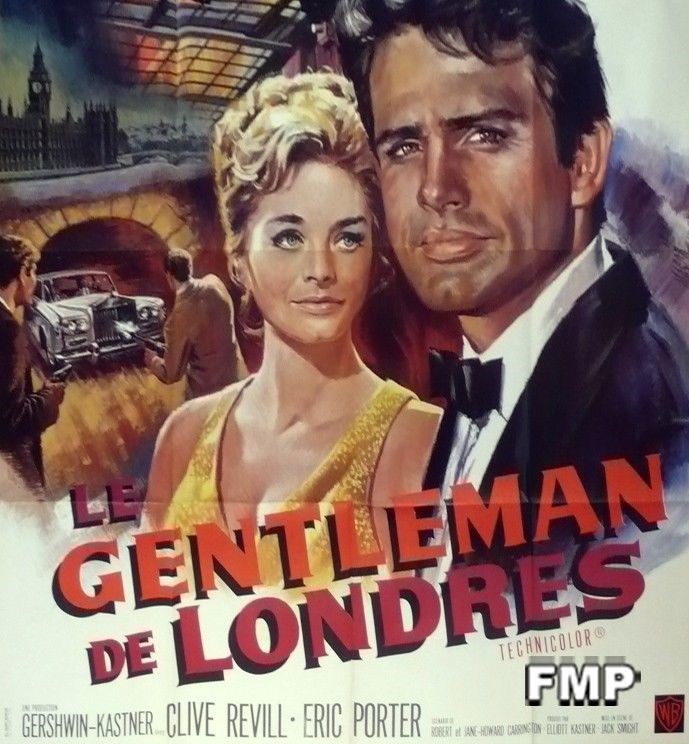
Throw in as much fashion as London was capable of generating at this time, the burgeoning romance, some exotic European locations, a castle with a moat, and the usual tourist guide stuff of red buses, Big Ben, Piccadilly Circus, pubs and Tower Bridge and you have all the ingredients of an easy on the eye thriller.

It’s a movie that relies on star power but Beatty and York deliver. That is, if you don’t need Beatty to do much more than be Beatty, all teeth and charm. At this point in his career Beatty looked as if his career was fast approaching its end. The box office success of Splendor in the Grass (1961) had been followed by a string of flops, romantic dramas and comedies that should have had audiences queuing up plus an occasional wild card like Arthur Penn’s Mickey One (1965), the biggest flop of all. He does make an engaging crook, and he never loses his screen charisma here, but there ain’t quite the right number of twists that moviegoers weaned on the likes of Topkapi (1964) had come to expect.

Hollywood had been doing its best to position Susannah York as a top box office attraction and she had snagged the female lead in The 7th Dawn (1964) opposite William Holden and Stanley Baker in Sands of the Kalahari (1965)  but she was recovering from the colossal flop of Scruggs (1965) by ‘poet of the cinema’ David Hart.  Kaleidoscope offered  the kind of role York could do with her eyes closed. So while the screen pair were not exactly sleep-walking it was not the kind of story that was going to create sparks.

Character actor Clive Revill (Fathom, 1967) and Eric Portman (The Pumpkin Eater, 1964) take more leeway with their roles, the latter almost chewing he scenery, the former content with just chewing his lips. Look out for Jane Birkin (Blow-Up, 1966) and British television stalwarts Yootha Joyce, George Sewell and John Junkin. 

The title would have been more enigmatic, original meaning of images twisted out of shape, had it not also applied, straightforwardly, to the card-making company. Giving Harry the surname of Dominion seems overkill.

Director Jack Smight (No Way to Treat a Lady, 1969) came to this after twisty private eye picture Harper/The Moving Target (1966), a big hit starring Paul Newman. This is too lightweight a feature to command such interest, but he does keep the story rolling along and it’s an effortless watch and it has a certain offbeat quality. The screenplay was fashioned by Robert Harrington and Jane-Howard Harrington, making their movie debut, who also co-wrote Wait until Dark (1967). It was also the debut for Winkast Productions, the Jerry Gershwin-Elliott Kastner production team who went on to make Where Eagles Dare (1968).
The Pumpkin Eater (1964) ***

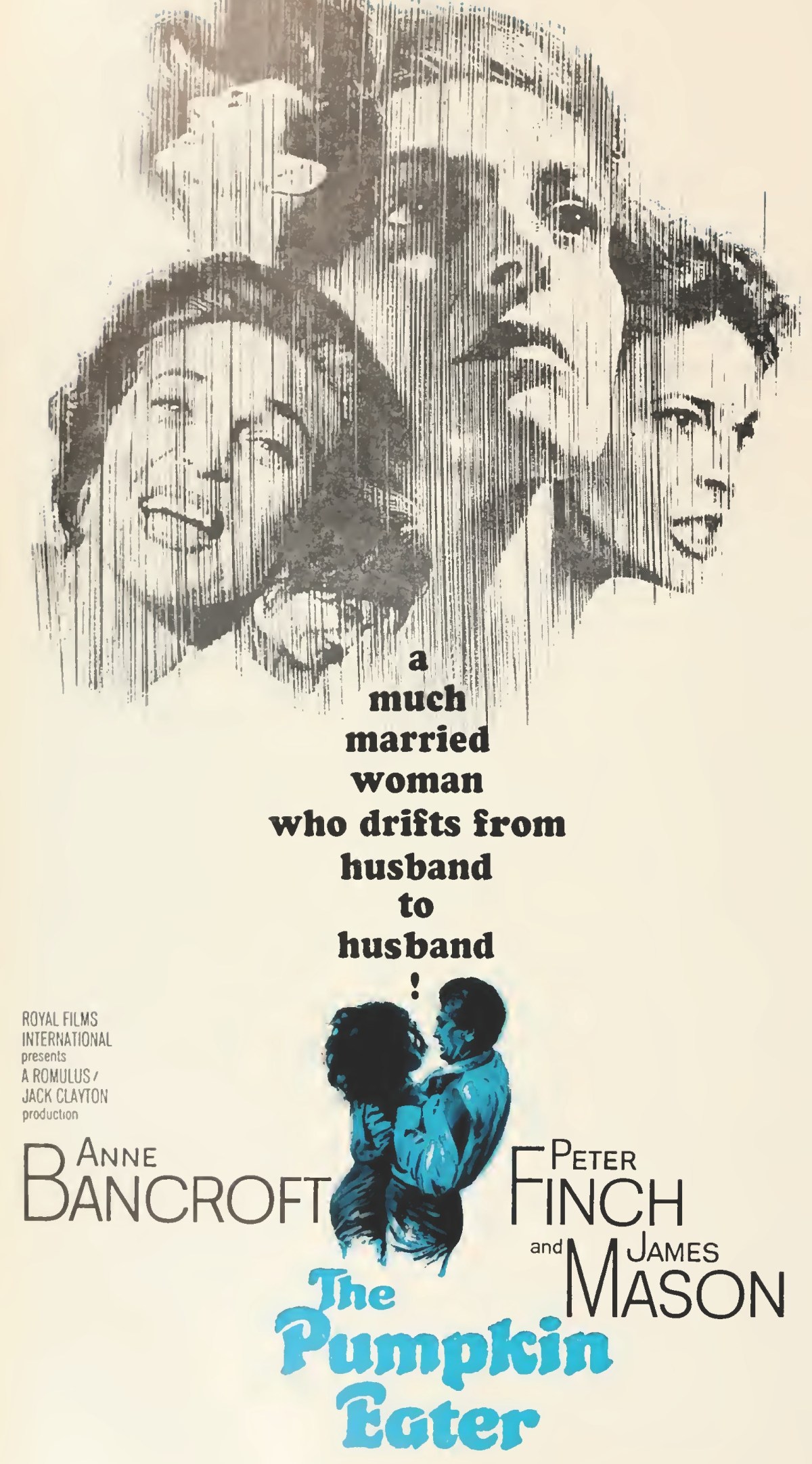
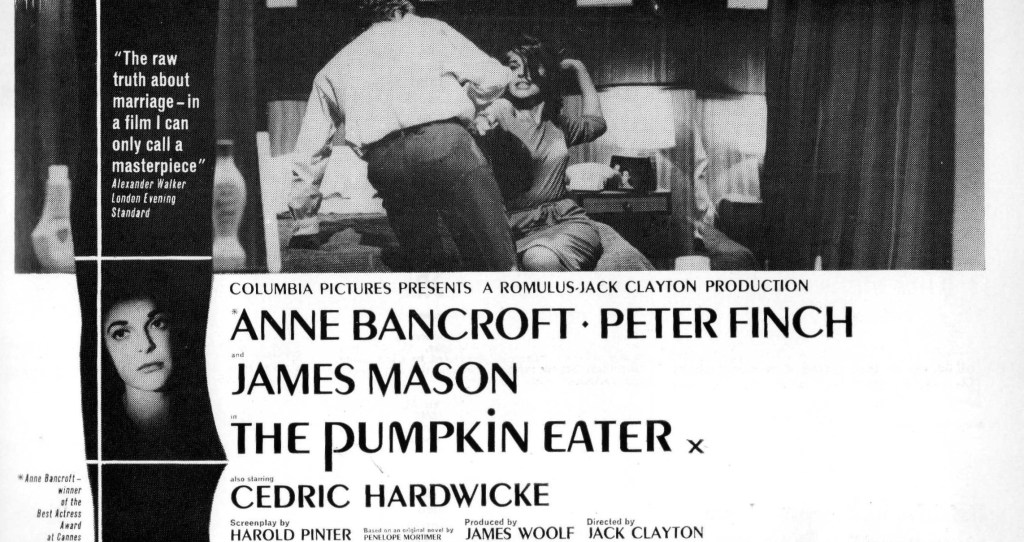
The reference point for Anne Bancroft in the 1960s is usually her cynical Mrs Robinson in The Graduate (1967) but she was Oscar-nominated here for a less ostentatious role as a woman who finds pregnancy – she has five kids by two husbands – almost a state of grace. Denied that role as a birth mother – husband number three (Peter Finch) wants an abortion – sees her tumble into depression.

This is more a character study than anything else and despite a whole bunch of marital confrontation, clever dialog from screenwriter Harold Pinter and some artistic black-and-white cinematography, it would have benefitted greatly from Bancroft actually explaining what ails her rather than everyone around her putting the words in her mouth. Hitchcock used to employ a subsidiary character to spell out the dangers of consequences for the leading actor, but that worked well in a thriller, and less so in a drama where you are desperate to get inside the mind of a woman who shows every signs of being neurotic.

While the unstated worked exceptionally well in director Jack Clayton’s previous picture The Innocents (1961), we really here need much more clarity. It is certainly richly atmospheric in places and the sequence prior to her nervous breakdown in Harrods where without dialog the camera shows her wandering around is very well done. But spending too much time on a self-obsessed person is less appealing.

Story has Finch (The Trials of Oscar Wilde, 1960) destroying her confidence by his philandering (although she dumped her previous husband for Finch) – but it is left to the woman (Yootha Joyce) setting next to her in the hairdresser to express the feeling that a woman needs to be desired by her husband and for a psychiatrist (Eric Porter) to suggest that for her “sex is sanctified by incessant reproduction.” To neither assessment does she respond. She clearly has a happy boisterous family, one to which Finch fits in, children lining up to wave him goodbye and rushing to greet his return.

Finch is on top form as the arrogant, competitive husband with Maggie Smith, delightfully kookie, among the notches on his bedpost. James Mason has a small role as a cuckold and Richard Johnson as a discarded husband. Adapting from a novel by film critic Penelope Mortimer, Pinter provides some distinctive Pinteresque moments, and, beyond the marital disputes, while most of the story is played out at a distance, there are excellent moments of spite, not least Mason choosing to read to Bancroft a love letter from his wife to Finch. In some respects it is a raw look at marriage, but in many ways it ducks out of proper examination of the principals, his character revealed by action, hers rarely explicated.

One particular aspect of the story is glossed over, with no reaction from Bancroft, which seems implausible given her previous attitude. Abortion was still illegal in the 1960s but permission could be granted were pregnancy to jeopardize a patient’s mental health. But to endorse such a sanction also involved sterilization to prevent future occurrence. Since Bancroft offers no insight one way or the other you are left with the impression she welcomes this which would run entirely against the character we have known.

I’ve no idea why the picture did not start at a point where Bancroft initiated action, when she dumped husband number two for Finch. At that point she was responsible for making a decision and clearly some kind of illicit affair had been taking place first. Unlike, for example, The Pawnbroker in which the main character has the same defeated attitude we are given access to his tortured past and he is forced into confrontation with the present. But here passivity is an obstacle to understanding.

Setting aside all my reservations which I guess are primarily structural, it is an absorbing film and Bancroft certainly deserved the Oscar recognition. Finch and Mason are also on top form and it’s worth a look if only to see what Maggie Smith could do with a part before people (perhaps herself) decided her career should go in a different direction.

The Lost Continent (1968) ***

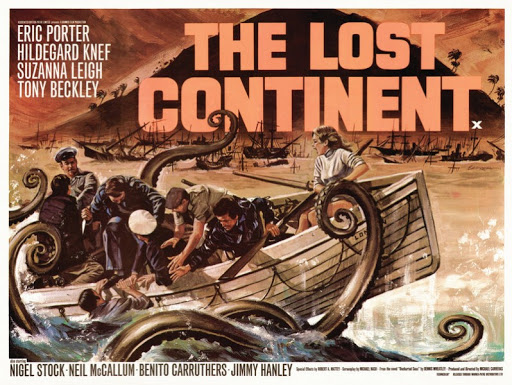
Hammer had struck gold revisiting ancient civilizations in One Million Years B.C. (1966) and with its adaptation of Dennis Wheatley’s The Devil Rides Out (1967). The Lost Continent was another Wheatley number (source novel Uncharted Seas) mixing dangerous voyage, hints of the legendary Atlantis, and monsters. While the first half could have been marketed as The Wages of Fear At Sea the second half would come under the heading  “The Greatest Oddball Film Ever Made.”

It boasts one of the most intriguing setting-the-scene openings not just of a Hammer picture but of any film – a camera pans along a steamship on whose deck are: people dressed in furs, others in modern clothing and – Conquistadors. Attention is focused on a coffin.  How and why they got there is told in flashback. A first half of taut drama, mutiny, sharks, a ferocious octopus, and lost-at-sea a thousand miles from land segues into sci-fi with carnivorous weeds, monsters, and a weird, weird world.

It’s hard to know what’s worse, ship’s captain Eric Porter (straight from television mega-hit The Forsyte Saga) with a cargo of toxic chemicals made combustible when touched by water or the equally combustible passengers all with murky pasts, so determined to escape their previous lives that they refuse to turn back in the face of a hurricane. Heading the Dodgy Half-Dozen is dictator’s mistress Hildegarde Knef  (Catherine of Russia, 1963) with two million dollars in stolen securities and bonds. Nigel Stock (television’s Dr Watson in the 1960s Sherlock Holmes series), a back-street abortionist, is at odds with daughter Suzanna Leigh, who has cornered the market in backless dresses. Tony Beckley (The Penthouse, 1967) plays a conman while Ben Carruthers is trying to recover the pilfered bonds.

But the arrival of cleavage queen Dana Gillespie from the weird world signals a shift to Planet Oddball. The only way to navigate the weeds trapping the ship is with a primitive version of snowshoes with (naturally) balloons attached to the shoulders. Soon they are trapped in the past, not as prehistoric as One Million Years BC, just a few centuries back to the Spanish Conquistador era. The film steals the idea from the Raquel Welch picture of giant creatures locked in battle but without going to the necessity of hiring Ray Harryhausen.

On board ship, director Michael Carreras, fresh from Prehistoric Women (1967), does well, the characters are all solidly presented with decent back stories, the tension mounting as the passengers encounter nautical turbulence, but once he enters weird world budget deficiencies sabotage the picture. Even so, it’s worth a look just to see what you’re missing. If you’re looking for a genuine freak show, this ticks the boxes.

Many of the films made in the 1960s are now available free-to-view on a variety of television channels and on Youtube but if you’ve got no luck there, then here’s the DVD.

Discover WordPress

A daily selection of the best content published on WordPress, collected for you by humans who love to read.

The Atavist Magazine

by Brian Hannan

WordPress.com News

The latest news on WordPress.com and the WordPress community.