Behind the Scenes: “Valdez Is Coming” (1971) – Book Into Film

Elmore Leonard novels were catnip to the movies. From The Tall T (1957) and 3:10 to Yuma (1957) a shelf load of his books have been filmed by Hollywood – some of them (3:10 to Yuma, 52 Pick Up, The Big Bounce, Get Shorty) twice. What he brings to the table is a lean story and an interesting lead character, whether in the western – Hombre (1967), Joe Kidd (1972) – or crime division such as Mr Majestyk (1974) or Get Shorty (1995).

What you probably don’t realize is that pulp fiction (books that made their debut in paperback) were generally short, limited to 50,000-60,000 words rather than the 120,000-150,000 blockbuster “airport” novels, published first in hardcover, that dominated the bestseller lists. The shorter novel led to a leaner narrative, less characters, little in the way of subplot and information drop.
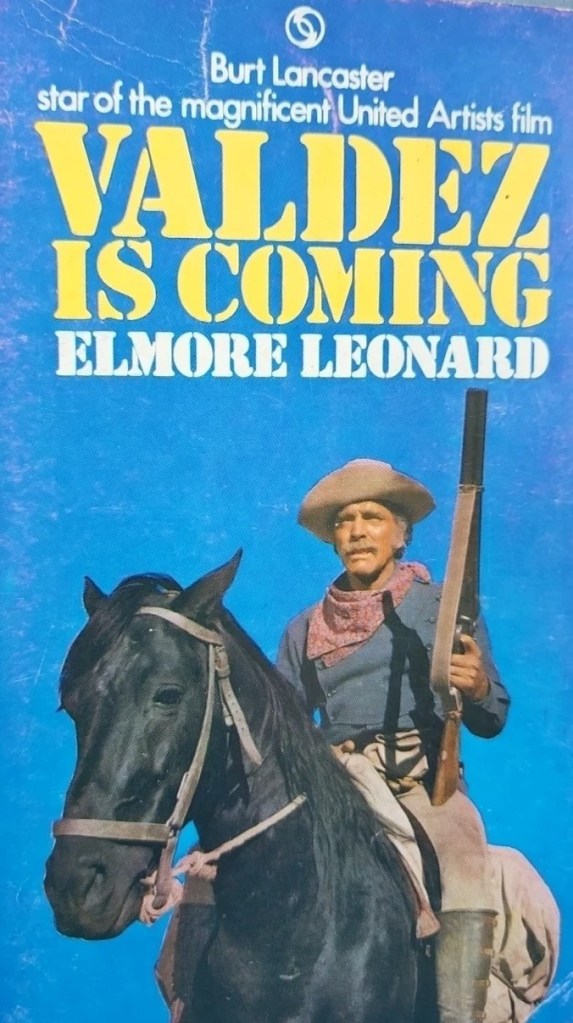
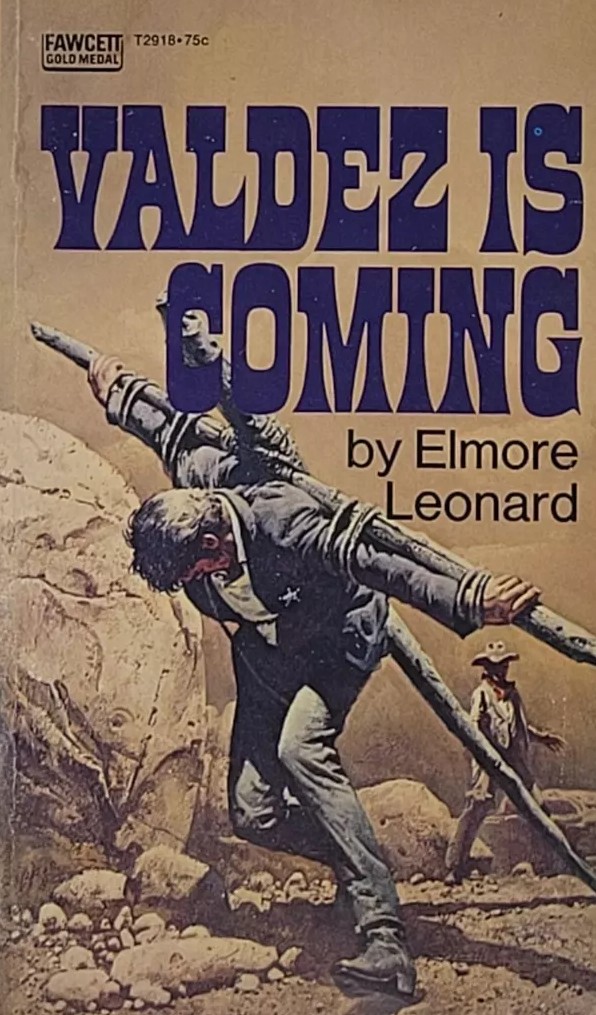
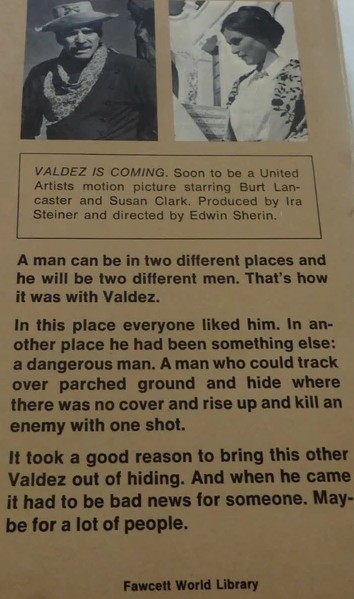
Valdez Is Coming made a speedy transition from paperback (published by Fawcett in the US in 1970, though it did achieve a hardcover edition in the UK) to movie (United Artists release 1971) and it’s interesting to see what changes, if any were made by screenwriters Roland Kibbee (The Appaloosa, 1966) and David Rayfiel (Castle Keep, 1969). You could literally transpose Leonard’s dialog and it would easily stand up in a movie. So the basic, very simple, plot is retained.

Mexican sheriff Valdez (Burt Lancaster in the film) gets it into his head that the mistaken killing of an African American requires monetary compensation and determines that cattle baron Frank Tanner whose mistake led to the killing should be the one to cough up. Tanner sees is differently, sends Valdez packing and when the sheriff returns a second time to plead his case exacts brutal punishment in the form a rudimentary crucifixion.

This triggers a personality change in Valdez. He reverts from being the subservient suit-wearing lawman to the feared sharpshooter who previously hunted down Apaches.

So one of the alterations in the book to film is this transition. In the book we know from the outset he has kept buried his older self in order not to attract attention and to live a peaceful life. That is verbalized via internal monologue and a scene with brothel keeper Inez, who is absent from the film. In the movie his past is visualized, as he pulls out from under his bed a hidden armory and a photo of his previous self.
In the film he is introduced riding shotgun on a stagecoach. He works part-time as a “constable” rather than a sheriff. In the book riding shotgun is the bigger job, keeping the peace requiring little of his time.

All the main incidents – initial rebuff by Tanner, the shooting of bullets around Valdez, the crucifixion, the kidnapping of Tanner’s wife Gay (Susan Clark), the involvement of wannabe gunslinger RL Davies (Richard Jordan), the picking off one-by-one of Tanner’s men and the final stand-off (a Mexican stand-off if ever there was one) – come straight from Elmore Leonard.

But the screenwriters make some critical changes. In the film the kidnapping is accidental, Gay snatched as a hostage as Valdez escapes from a gunfight at Tanner’s house. In the book, there’s no shoot-out at the house, Valdez kidnaps Gay in order to have something to trade with.

In the film it’s – rather surprisingly given his role so far – the weaselly gunman Davies who cuts Valdez free of the bonds of the crucifix. But that’s a considerable simplification from the book. For quite a long time in the book, Valdez believes that Gay cut him loose. And until Davies challenges that assertion, she lets Valdez believe it was her.

For the biggest change is the screenwriters’ decision to eliminate the Valdez-Gay romance. After being captured, in the book she makes overtures to him, whether initially out of survival instinct is unclear, and they make love and he begins to fall for her. We learn why she killed her husband – domestic abuse. Also that Tanner is a convicted felon and that he is a gunrunner supplying arms to Mexican rebels.

So by the time we come to the end there’s more riding on it in the book. Tanner is left isolated not just by his gang boss backing off but by his lover siding with Valdez.

One other point, I noted that in the film the guy called El Segundo (Barton Hayman) was referred to as “the segundo” (in lower case letters) in the book. So I looked it up. Literally, “Segundo” means “number two” which made sense either way.

I’ve been so used to comparing blockbuster novels with their movie adaptation and trying to work what they kept in – and why – that it never occurred to me that one of the reasons so many pulp fiction books were purchased by the movies was because screenwriters had to tussle with less plot and fewer characters.

If you’ve never read any Elmore Leonard this is as good a place as any to start.
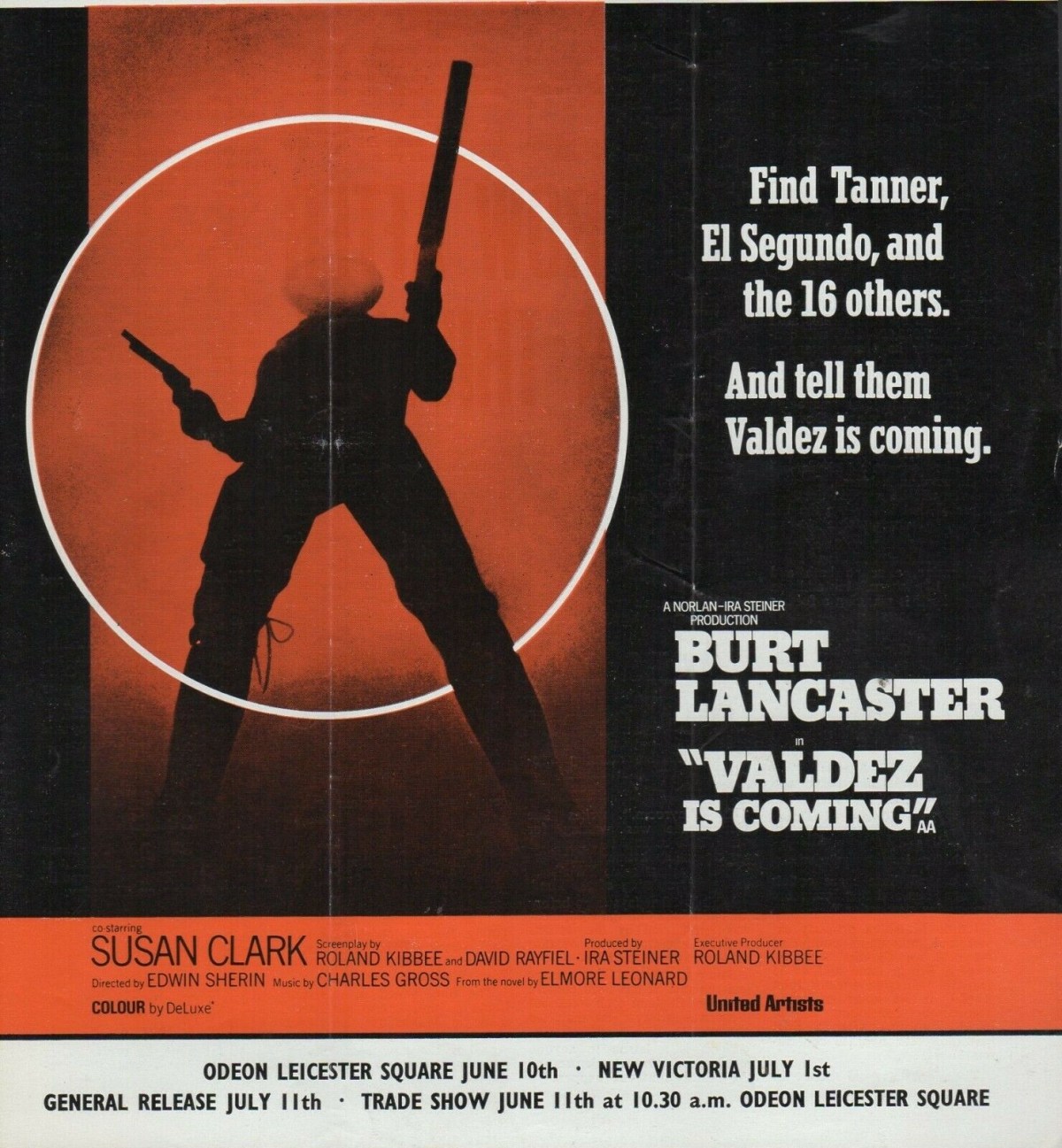
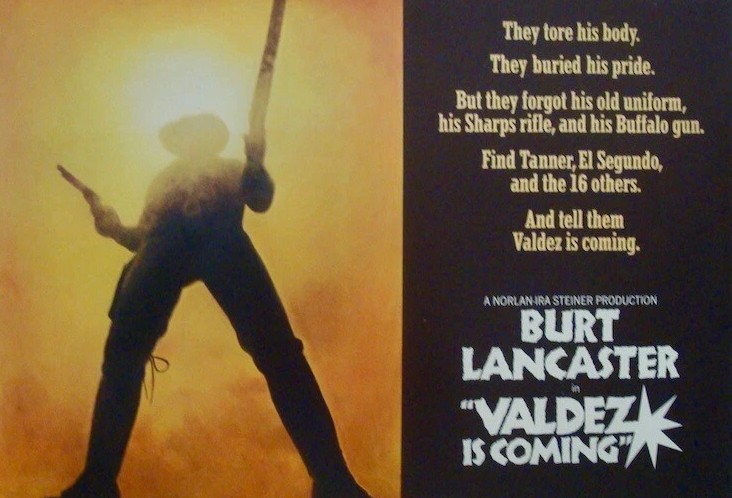
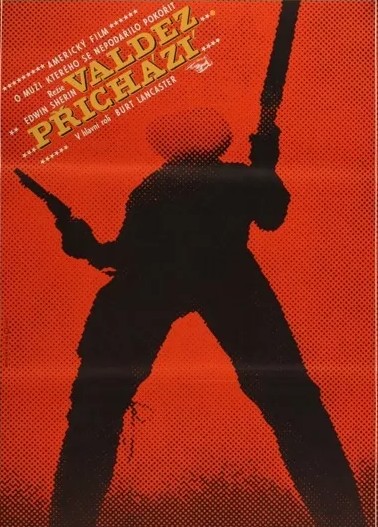
Valdez Is Coming (1971) *****

Five-star review for a long-forgotten much-maligned western? Let me explain. Let me start with one of the most stunning cinematic images I have ever seen that in the hands of a better director would be considered one of the greatest ever devised. The titular Valdez (Burt Lancaster) appears on the top of a hill arms stretched out back contorted under the weight of a crucifix strapped to his back. Another director, more conscious of the image potential, would probably have had him straighten up at that point and positioned the camera for a close-up so the image could be captured against the sky. Even so, it’s an extraordinary image for a director, Edwin Sherin, making his debut.

But that’s not the only one. We’re familiar with the innocent man being forced to dance as the area around his feet is peppered with bullets from a sadistic gunslinger. Here, the victim of gunman Davis (Richard Jordan) is an old Native American woman. As she walks from a hut to collect water, he assails her with a barrage of shots. Does she dance? Does she dickey! She doesn’t even pause. As though she’s used to worse.

The movie opens with another stunning image. Valdez, a local Arizona Territory constable (presumably a less important title than sheriff though he wears the badge), takes time out from riding shotgun to watch a bunch of young bucks blast away at a target. Which appears to be the hut I mentioned. Takes a while for an explanation to be forthcoming. Said hut houses a fugitive from justice.

There’s another startling image when Valdez is used as target practice by the thugs employed by local bigwig Tanner (Jon Cypher). As if he was the equivalent to the target girl in a knife-throwing act, every space around his body is hit by a bullet.

And that’s before we come to the audacious freeze frame ending which, theoretically at least, leaves matters unresolved.

There’s also a post-modern post-whatever feel to this which should very much appeal to the contemporary audience. Very little is explained. Valdez has anglicized his Christian name of Roberto to Bob. He can’t get rid of his Mexican accent but he talks so softly that mostly you don’t notice. From his later demeanor, it’s quite clear that earlier on he is making a huge effort to fit in, not stand out, in a town dominated by white Americans.

But we also never find out why Tanner is hunting a man. He’s responsible for putting the man in the hut under siege. And although that turns out to be  case of mistaken identity, we never find out who Tanner is chasing or why.

Tanner’s  live-in girlfriend Gay (Susan Clark), a widow, has murdered her husband and we never find out why either. But she’s not the only unusual character. The gunslinger Davies is a misfit, finding out the hard way that intemperance and impulsiveness are not the way to make friends, and even Tanner has little time for a gunslinger too handy with a gun, but despite the callous exterior he has a softer side. And while that softer side turns out to be lucky at one point for Valdez, the lawman still doesn’t trust the capricious youngster.

The tale, such as it is, is one of principle. Valdez has been tricked into killing the man in the hut. Given the man proved innocent, Valdez thinks it right his widow, the Native American victim of the target practice, should receive some compensation. A hundred dollars seems a small price to pay. But Tanner is insulted at the very thought. In his eyes, the dead man was a no-account African American.

When Valdez insists, he is trussed up in the makeshift crucifix and left to make a humiliating walk home. That’s when he reverts, shuffles off his disguise as a soft-spoken relatively harmless lawman in a town where the most he will be called upon to do is ride occasional shotgun and jail an occasional drunk.

It’s vague too – you’d have to be well up on western lore to know the significance of the photograph he keeps under his bed – regarding his past. But hidden under the bed is what was known as a buffalo gun, a long-range rifle, manufactured by Sharps (hence the term “sharpshooter”) and suddenly he’s a different, more threatening, person, kitted out in his old cavalry uniform, hat brim upturned.

He interrupts Tanner and Gay making love to demand his hundred dollars. He only takes  Gay hostage to make his escape, minus the cash, and then kidnaps her to provide him with something to trade. Unlike in The Hunting Party (1971), the weapon doesn’t magically ease his path. He doesn’t just take pot-shots from a distance. He spends most of the time rushing up and down hills, using boulders as cover. He can’t afford to use the gun since that would pinpoint his position. So he’s got to knock out Tanner’s advance scouts in other ways.   

Meanwhile, Gay, who initially sympathized with Valdez, is less keen on him once she’s a victim, and spends most of her time trying to escape. In due course, Valdez’s marksmanship reduces the pursuing force by eleven.

He just about escapes but in a spectacular piece of stunt work involving horses colliding and people being thrown from the saddle, he is surrounded. Chief thug El Segundo (Barton Heyman) realizes that he and Valdez have something in common. Valdez wasn’t a buffalo hunter at all, but a stalker of Apaches, the enemy of El Segundo.

So El Segundo pulls back his men leaving Tanner to face up to Valdez alone. Or perhaps pay up the hundred dollars. We never find out because the image is frozen on the screen as the camera pulls back.

Edwin Scherin was rewarded for his boldness by only being allowed to make one more movie (My Old Man’s Place, 1971). This was the first of Burt Lancaster’s western trilogy that encompassed Michael Winner’s Lawman (1971) and Robert Aldrich’s Ulzana’s Raid (1972), completing his move into more of the flawed character he first essayed in The Swimmer (1969). Susan Clark (Coogan’s Bluff, 1968) makes the most of a role that permits her to switch from sympathetic to hard-nosed. Richard Jordan (Chato’s Land, 1972) has a peach of a part as the swithering gunman desperate for attention. Screenplay by Roland Kibbee (The Appaloosa, 1966) and David Rayfiel (Castle Keep, 1969) based on the novel by Elmore Leonard (Mr Majestyk, 1974).

So, sure, justified vengeance but exceptionally well done.

Catch this on Amazon Prime.

Well worth checking it out.

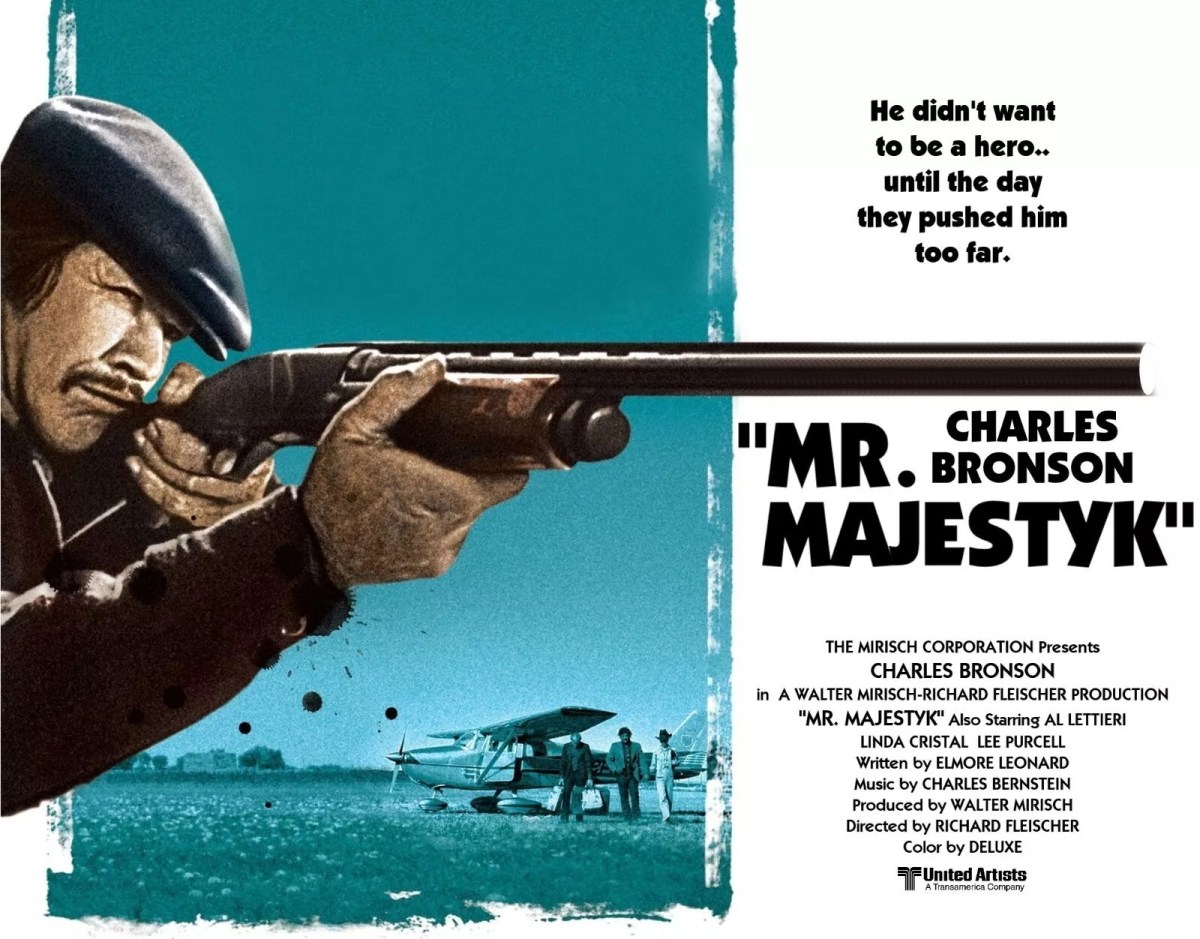
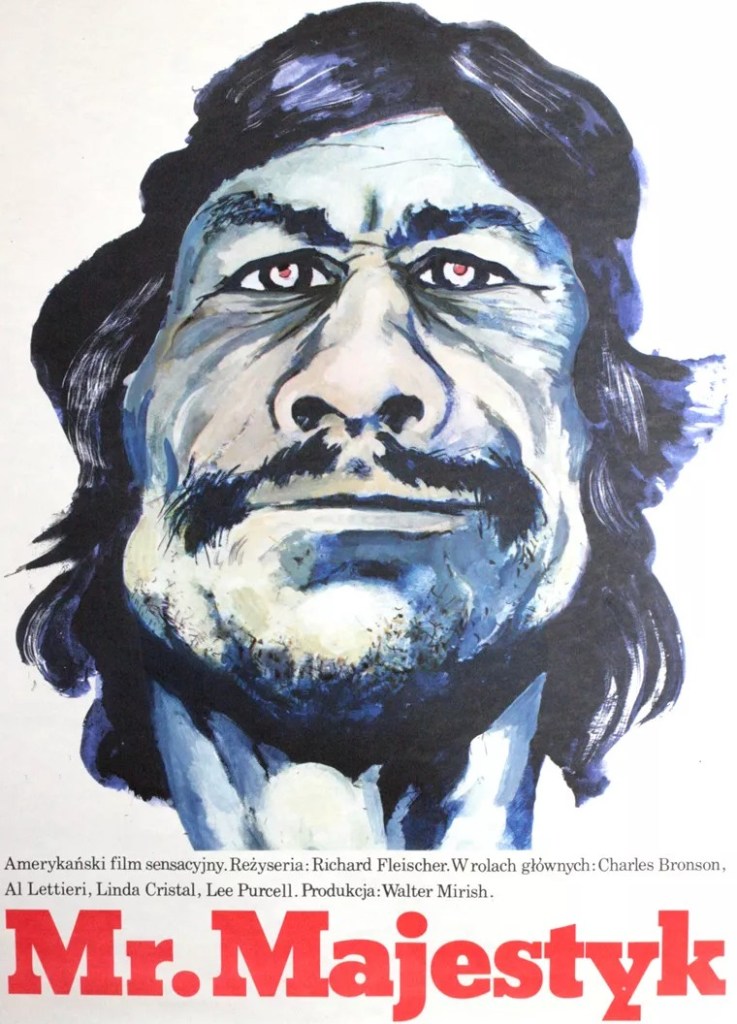
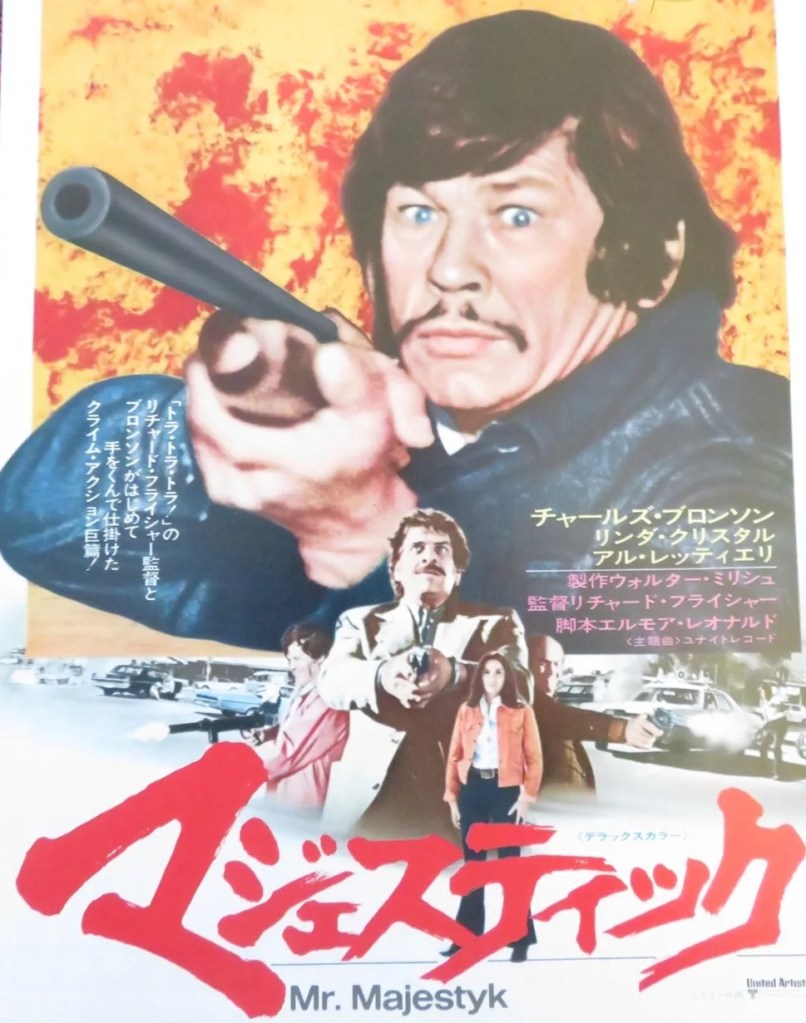
Mr Majestyk (1974) ****

I interrupt the current program to bring you the hugely under-rated Mr Majestyk, now showing on Amazon Prime.

You read any critical assessment of the 1970s and if they talk about male actors at all it’ll be the “new wave” of Al Pacino, Robert DeNiro, Dustin Hoffman, Jack Nicholson, Gene Hackman, Oscar nominees/winners all. There’ll be nary a mention of the actors who kept the box office straight on a consistent basis for most of the decade. Clint Eastwood would come into the equation, but it wouldn’t be for Dirty Harry (1971) or Every Which Way but Loose (1978) but only when he flexed his directorial muscles. Charles Bronson never harbored any ideas of picking up a megaphone so he wouldn’t even have that saving grace.

Yet Eastwood and Bronson saved Hollywood before the big blockbuster like Jaws (1975) or Star Wars (1977) took off and for one specific reason. They attracted a global audience. When foreign receipts started to matter more than ever, these two delivered. And while the critically-adored actors dithered over choices and could scarcely be guaranteed to put out a picture a year, Eastwood and Bronson were dependable, occasionally ramping up output to three a year (1971 and 1973 for Eastwood, 1972, 1974 and 1976 for Bronson). They were old-school reliable performers. .

Mr Majestyk has been somewhat overshadowed because it appeared just before what some ill-informed observers deemed to be Bronson’s breakout picture, Death Wish (1974), and because it was helmed by the under-rated Richard Fleischer (The Boston Strangler, 1968) who never seemed to generate critical traction.

In fact, it’s a cracker – a pair of stunning car chases, full-on blow-away street battle, and the actor is one of his best roles. If anyone could play a farmer convincingly it’s Bronson, who looks as if he knows exactly what it’s like to put in a mucky day’s work (he was a miner). Vince Majestyk (Charles Bronson), in the watermelon line, falls foul of small-time organized crime in the shape of one of the most hapless hoods you’ll come across, Bobby Kopas (Paul Koslo). When Majestyk doesn’t take too kindly to Kopas trying to muscle in on the employment market, the farmer ends up in jail.

During a routine transportation, gangsters try to hijack Mob hitman Frank Renda (Al Lettieri) but despite going in all guns blazing the racketeers haven’t counted on Majestyk, who steals the bus, sees of the pursuing cops and robbers and hides out in a shack in the hills. He trades the mobster for the cancellation of charges against him by Det Lt McAllen (Frank Maxwell). But he’s duped by Renda’s backgammon-playing fashionable moll Wiley (Lee Purcell). On the loose, Renda is determined to get his revenge. The cops are happy to use Majestyk as bait.

Mexican Nancy (Linda Christal), a crop picker and union organizer, also enters the frame, and despite Majestyk, having recognized imminent danger, trying to stifle burgeoning romance, she keeps coming back. She’s a straightforward gal. “You want to go to bed with me, why don’t you just ask?”

But bait becomes bait-and-switch and soon it’s the gangsters who are on a wild goose chase, car passengers driven off the road during a wild chase over dusty mountainous country, others picked off by rifle until it comes down to a showdown at an isolated house.

While Majestyk has the muscle to give Renda an occasional slapping, he’s also got the sucker punch, duping the hoodlum time and again.

One of the elements that distinguishes this is that, apart from Renda, all the characters, good or bad, male or female, are soft spoken. Even Lt McAllen isn’t always chewing someone out.

Although the car chases have been compared to Bullitt (1968) and The French Connection (1971) they have much more in common with Fear Is the Key (1972) where we are miles away from slick city roads. Plenty opportunity for vehicles to sail through the air. Nancy proves something of find behind the wheel, and Vince pretty game in the back of the truck being bounced six ways to Sunday by her driving.

Outside the action, several excellent scenes – the gangsters shooting up the watermelon crop, headlights ominous in the dark, a crop-picker being smashed by a car, Kopas being put in his place by Renda. Not only is the romance in a low register, but Bronson is in a low key, resigned to what he cannot change, but taking charge with blistering speed when he can.

This was a deliberate change of pace in terms of characterization from Bronson following the more action-oriented Chato’s Land (1972), The Mechanic (1972) and The Stone Killer (1973). There’s none of the usual brooding menace. He’s a farmer, not a killer.

Despite a long stretch in The High Chaparral (1967-1971), this was the first movie in six years for Argentinian Linda Cristal who’s effective rather than a scene-stealer which the cool Lee Purcell (Kid Blue, 1973) definitely is in non-showy fashion. By contrast Al Lettieri (The Godfather, 1972) eats the scenery, which is his job, as he turns from cat into mouse.

More than ably directed by Richard Fleischer from an original screenplay by Elmore Leonard (The Big Bounce, 1969).

A must see.

Book Into Film – “The Big Bounce” (1969)

A seminal example of the art of screenwriting, setting aside for the moment that in the future disgruntled novelist Elmore Leonard deemed it “an awful movie.” Which it isn’t, by the way. Not great, but far from awful.

Screenwriter Robert Dozier (The Cardinal, 1963) had his work cut out trying to make something cinematic out of the author’s debut crime novel. At that point Leonard had not been acclaimed as inheriting the mantle of Raymond Chandler and Dashiell Hammett. In fact, as far as critical acceptance went, he was pretty much an unknown. Six novels in nigh on two decades was not guaranteed to attact attention. If he had any reputation at all it rested on providing the source material for the Paul Newman hit Hombre (1967).

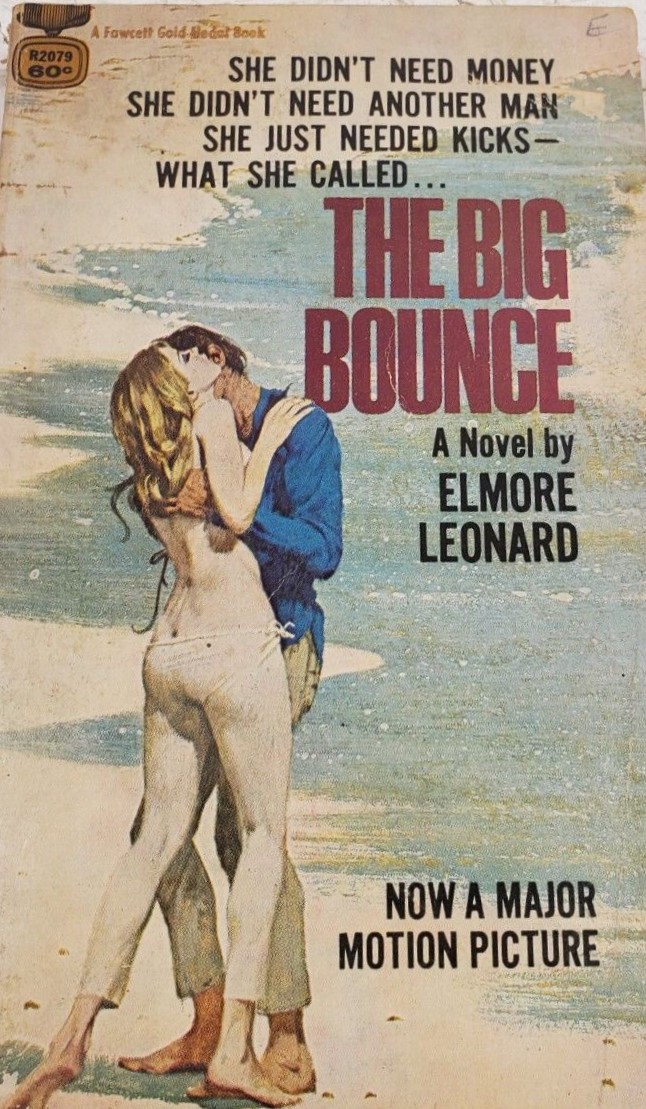
One of the reasons he remained so much under the critical radar was that he hadn’t written a novel in eight years, and all his previous output fell into the western category, a genre staunchly ignored by critics, and heavily reliant, commercially, on the pulp paperback. The Big Bounce wasn’t heralded on arrival, no hard cover printing, just a paperback movie tie-in that didn’t even go to the trouble of using a scene from the film or pictures of the stars.

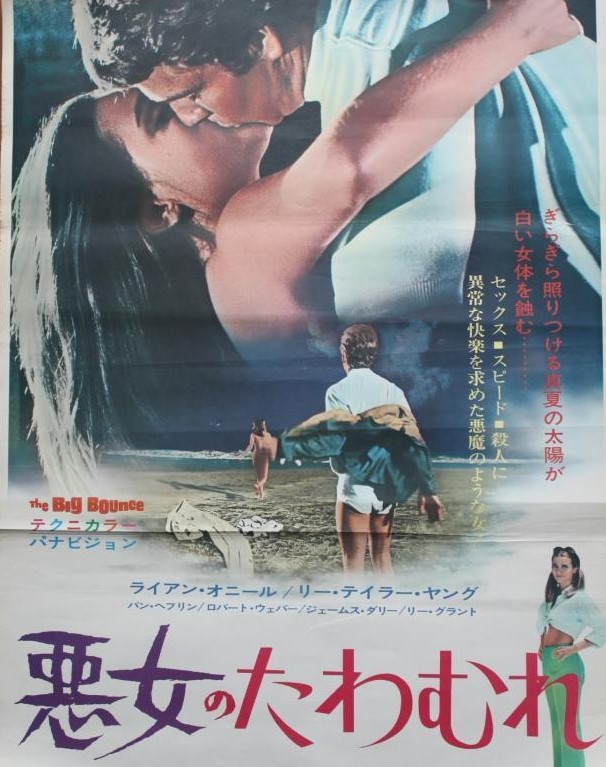
Once again, the foreign distributor produces a better title than the original.

It was up to Robert Dozier to make the source material acceptable to the moviegoer. The book, as written, would never fly. Leonard’s novel lacked a Vietnam veteran, sex in the graveyard, and a nude statue. They were all Dozier’s inventions to bring a character to life who for the most part existed in the novelist’s backstory.

When the novel opens Nancy (Leigh Taylor Young) is due in court to answer the charge of dangerous driving. So rather than leaving that in her backstory, to be dealt with by dialog, Dozier makes that a key element of the film, the episode where Jack (Ryan O’Neal) wonders if he is in over his head as Nancy, annoyed by some pranksters, proceeds to drive a car off the road.

Nor in the book does Jack enjoy a brief dalliance with Joanne (Lee Grant), the single mother renting one of cabanas at the hotel where Jack works as a handyman. In fact, once he knows she has a child in tow, he pointedly avoids making any moves on the mother. His target, as far as the female holidaymakers go, is a single woman Virginia whose look of terror as he seduces her he mistakes for wild passion. The act isn’t consummated as she is struggling too much and it’s only on reflection that Jack, misreading the signals, realizes he had been on the point of raping her.

Jack has been fired from his job as pickle laborer, but he has no Army record. So all the talk about what it’s like to be at war is the screenwriter’s invention. Jack is a failed baseball player (a movie cliché – so that’s left out) and when he loses his job on the pickle farm and prior to hotel handyman turns to a spot of burglary.

He does get a job with hotel owner Sam (Van Heflin) who is also the Justice of the Peace. But Sam’s surname is not Mirakian. It’s – wait for it – Mr Majestyk. Hold on, was there not another movie featuring a guy with that name, starring Charles Bronson? Yep, that appeared in 1974, with Bronson as a melon farmer taking on The Mob. Maybe Robert Dozier thought it was too odd a name for a supporting character, maybe Leonard thought it too good a name to let go. Whatever, Mr Majestyk was left to fight another day.

Where Dozier has been exceptionally clever – rather than just sexing up the movie – is to take sections of the book (as with the car crash scene) and replant them to greater effect. In the book Nancy isn’t pimped out to a Senator by her wealthy lover Ray, but the line that it would take him “oh, a week” to find a replacement mistress comes from the book. In the book Nancy doesn’t swim naked in front of lustful married man Bob (Robert Webber). But she does swim naked in front of a character in the novel who is trying to blackmail her and he envisages holding out a towel to her naked body as she wraps her arms, to pay off her blackmailing debt, around him, rather than that being further teasing of the hapless Bob as in the film.

Dozier has rightly worked out the blackmailing angle would be a sub-plot too many. But it’s the blackmailer she shoots instead of Jack rather than the Comacho (Victor Paul) that Jack has hospitalized at the start of the movie and comes, rather late in the day in the movie, looking for revenge.

Quite a lot of dialog – because Leonard was hot on dialog, and it’s where much of his reputation derives – was taken intact from the book. But there was no way without lots of tedious dialog telling us what we already knew from her teasing Bob and running naked through a graveyard and driving cars off the road that Nancy was a piece of work who took enormous pleasure out of using her sexuality to get the better of men.

The novel explains that as a teenage babysitter she used to come on to the fathers driving her home and if they responded in any way she would blackmail them. One other time when there weren’t enough kicks in letting the neighbors’ kids see her naked, she took fifty bucks apiece from them to have sex with her. And she was always on the look-out for the “big bounce,” the action that would both be exciting and risky and also make her rich.

The Jack in the book is good bit less dumb than in the movie. He is aware that she is using him. He balks at the idea of carrying a gun because that would turn a simple burglary or heist into armed robbery for which, if caught, the sentence was much stiffer.

So, going back to Elmore Leonard’s critique of the movie, I’d be inclined to revise that to an “awful difficult book” to turn into a movie.     

The Big Bounce (1969) ***

Femme fatale Nancy (Leigh Taylor-Young) makes a fair bid for the coveted Bunny Boiler of the Year Award. Had she chanced upon the right wrong guy who could channel her inherent viciousness she could have turned into Bonnie Parker. The only thing that holds her back from being a feminist icon, taking revenge for male betrayal, is her lack of independence.

Mistress to rich farmer Ray (James Daly), she teases the hell out of his head honcho Bob (Robert Webber), makes love in a graveyard, and fuels her amorality by going from breaking windows, attempted burglary and big-time heist to driving cars off the road and murder.

Temptation – Nancy-style.

Dupe is Vietnam vet Jack (Ryan O’Neal) who works as a hotel handyman and happily two-times her with single mother Joanne (Lee Grant).

Although easy with her charms, it’s sex that comes back to bite her when Ray explains that all this heady living comes at a price, pimping her out to a Senator he wants to impress. Whether that turns her against all men, including the dupe who she suspects of making out with Joanne, or whether she is plotting simple revenge against Ray isn’t made clear, but like the best femme fatales she has her eye on the loot that could bring her freedom and doesn’t much care what it costs to get it.

Nobody much cared for this picture, either, but I can’t see why. Sure, too much time is spent on Jack – he gets slung out of a job picking pickles for getting into a fight, and he lands on his feet with a friendly hotel owner Sam (Van Heflin) who buys him beers and even makes his breakfast, and pretty much could have the pick of any girl who walks into a bar. But that’s the usual narrative for film noir, pointing out, usually over and over, what an easy mark he is for a determined woman.

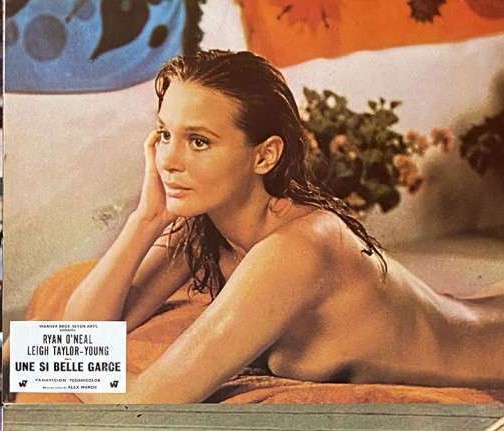
Unusual for the foreign title to be better than the original but this certainly captures the character better.

Nancy could have been less obvious, but she uses her perceived availability as a potent weapon – the scene where she holds her naked body just enough away from the panting Bob while probing him about his wife and children, is a classic – and she doesn’t make it easy for Jack either, although his reward is a drawn-out striptease. She’s the typical bored young woman looking for kicks, and like Pretty Poison (1968) you have to suspect that there’s considerable calculation behind what appear like spur-of-the-moment decisions, trying to work out just how far the dupe will go to retain her favors.

So while she races through the gears, Jack seems stuck on the starting grid, as his apparent good luck turns into confusion. And although he’s got the looks to attract women, he hasn’t the brains to understand them. He’s so dumb you just want Nancy to get away with it. If there’s a weak spot in the movie it’s that he just isn’t interesting enough to spend any screen time with. He boasts of having committed misdemeanours and he’s got a temper when roused but actually he’s your typical lost Sixties character looking for more stability in his life.

Unusually for a movie that’s drawn so much criticism, the supporting characters are quite appealing.  Sam is also a very worldly Justice of the Peace. Ray, far from being an easy conquest, is a hardass, the scene where he deadpans a line that it would take him, oh, a week to replace her if she fails to sleep with the Senator is priceless. There’s also some decent stuff about war, how Jack never even saw the enemy he was killing. And Joanne is a great study, another woman endlessly drawn to the wrong men, who can keep her dangling while never committing.

And beyond the scene where Nancy poses as a naked statue in a graveyard that is obviously unforgettable, there’s a marvellous scene where Jack wakes up in a strange house to the sound of tapping. When, finally, he opens his eyes, he sees a small girl tapping her cup at the breakfast table;  Joanne has a daughter she omitted to mention.

This was the first of Elmore Leonard’s crime novels to be adapted for the movies. But he wasn’t a Hollywood unknown. He supplied the source material for 3.10 to Yuma (1957) and Hombre (1967). And at this point he was keen on setting his stories in poorer areas, as well as pickle farming here,  the Kentucky backwoods are the setting for The Moonshine War (1970) and melon farming for Mr Majestyk (1974). There’s not a million miles between Mr Majestyk reaching for his gun when threatened and Nancy for one when betrayed, but somehow he’s in the right and she’s in the wrong.

And while you’re at it you might as well reflect on the complexities of Hollywood. Leigh Taylor-Young (I Love You, Alice B. Toklas, 1968) carries this picture and despite what the posters show was top-billed. But she didn’t get one more starring role. Two flops in a row – this and The Games (1970) – and Ryan O’Neal gets Love Story (1971) and he’s king of the hill.

Definitely worth a look.

Discover WordPress

A daily selection of the best content published on WordPress, collected for you by humans who love to read.

The Atavist Magazine

by Brian Hannan

WordPress.com News

The latest news on WordPress.com and the WordPress community.