
Gender switch comedies were a rarity in Hollywood at this point though of course Billy Wilder had scored big with Some Like it Hot (1959) and I’m guessing the possibility of Tony Curtis repeating his drag act was an audience lure for this one. Alas, that wasn’t to be. This goes the other way. Or several other ways. A woman playing a man who is a woman. That would be catnip these days were it a transgender thing, but it ain’t.
Confused? So sex predator Charlie (a male) drowns while escaping enraged husband Sir Leopold (Walter Matthau) only to reappear, re-born or reincarnated (as the producers decide after googling it, sorry, after they look it up in a book) as a naked woman walking along the highway, rescued by the wealthy Bruce (Pat Boone) and delivered to the nearest house, Charlie’s own pad, now occupied by old buddy George (Tony Curtis).

There’s some light comedy as George tries to safely manhandle the unknown woman, clad only in Bruce’s coat (necessitating his later return of course) and gradually the surroundings seem over-familiar to the woman and then, shazam, George works out from what she knows about him that actually she must have returned as a man, also called Charlie (Debbie Reynolds).
A cosmic joke, in other words. The man who preyed upon women returning as a woman. See how he likes it to be on the receiving end of misogyny. But, mostly, he/she lolls around with legs spread like a man, gulps down whisky and is a dab hand at cards. But that’s not where the humor lies, apparently, because the movie moves on quickly from the woman acting the man and into the man-woman discovering all the female tricks of the trade, visiting a beauty parlor and the hairdresser. Charlie discovers it’s not the same fun slapping a woman’s backside – what a revelation – if you’re a woman.
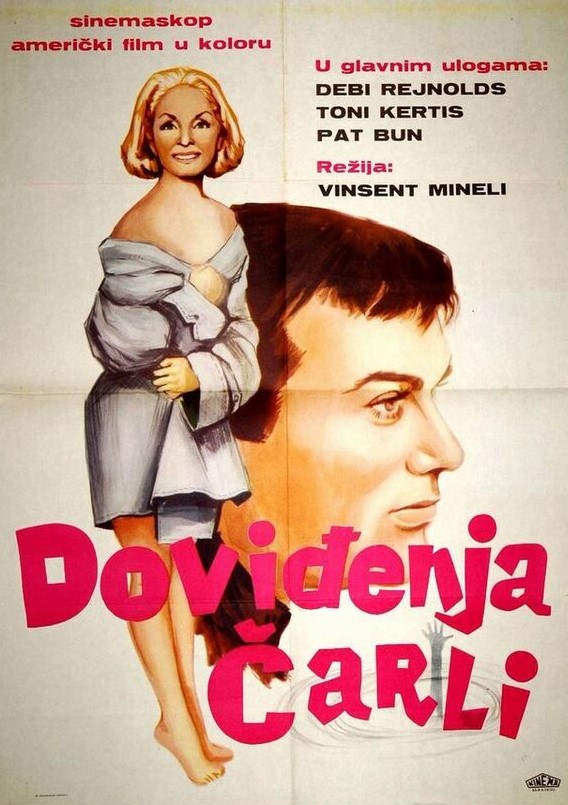
But, basically, the female Charlie decides to become a female version of the male Charlie, the predator, ripping off friends, chasing the big money, trying to seduce Bruce. So, mostly, it’s one odd plot device after another.
But the sizzle is Debbie Reynolds, not so much the man-woman stuff, but turning into a mean Bette Davis character before your eyes, all hard-edge and shifty moves. There’s sexual tension as well, George initially resisting the woman he knows is or was a man, before finding the attraction too much, and the same going for Bruce. There’s a fair whack of sexual confusion, as the newborn Charlie still finds herself ogling women.
In those far more innocent times, it doesn’t know what it wants to say and lacks the narrative to say it. Audiences had terrific fun with Jack Lemmon and Tony Curtis in Some Like it Hot, but that narrative ploy was bang on, and Lemmon enjoying dressing up as a woman and Curtis having to keep his male instincts at bay while ogling Marilyn Monroe was pure catnip.
Here, Curtis is mostly the foil for Debbie Reynolds and by the time it looks as though they might get it together she is way past behaving like a man and is most definitely a desirable woman so it’s kind of difficult to make this work romantically or humorously.
Perhaps the oddest element is that the signs were already there that it wouldn’t work that well. It started as a Broadway play written by George Axelrod (The Seven Year Itch, which was a Broadway smash) but it barely lasted a dozen weeks on stage. By that time, though, Twentieth Century Fox had splashed out $150,000 for the rights. Still, bigger sums have been buried in the annual accounts.
And I guess when Vincente Minelli (Two Weeks in Another Town, 1962) came on board with a pretty decent cast it seemed at least doable. Like many a lightweight comedy from the decade – Dear Brigitte (1965) for example – it’s keep afloat by a terrific performance by the principal star, in this case Debbie Reynolds (Divorce American Style, 1967). You might spot Ellen Burstyn (The Exorcist, 1973) in an early role.
Take away Debbie Reynolds and it would limp along.
 The Magnificent 60s