Complication. The keenest weapon in the screenwriter’s armory. And the most overused and, conversely, not employed to its greatest potential. Generally, it’s the only device for a romance – boy meets girl, (enter complication as…) boy loses girl, boy gets girl. But, just occasionally, it appears with some skill, layer after layer of deft complication until a whole story is tied up in acceptable and believable knots.
Before we get into all that it’s worth pointing out how language changes. These days mention of “action” will carry connotations of a sexual nature, so, just to be clear, here we’re talking about gambling, betting on horses, the mythical sure thing. And if you want to take a more cosmic perspective, we can apply the scientific rule that every action has a re-action, in other words consequence.
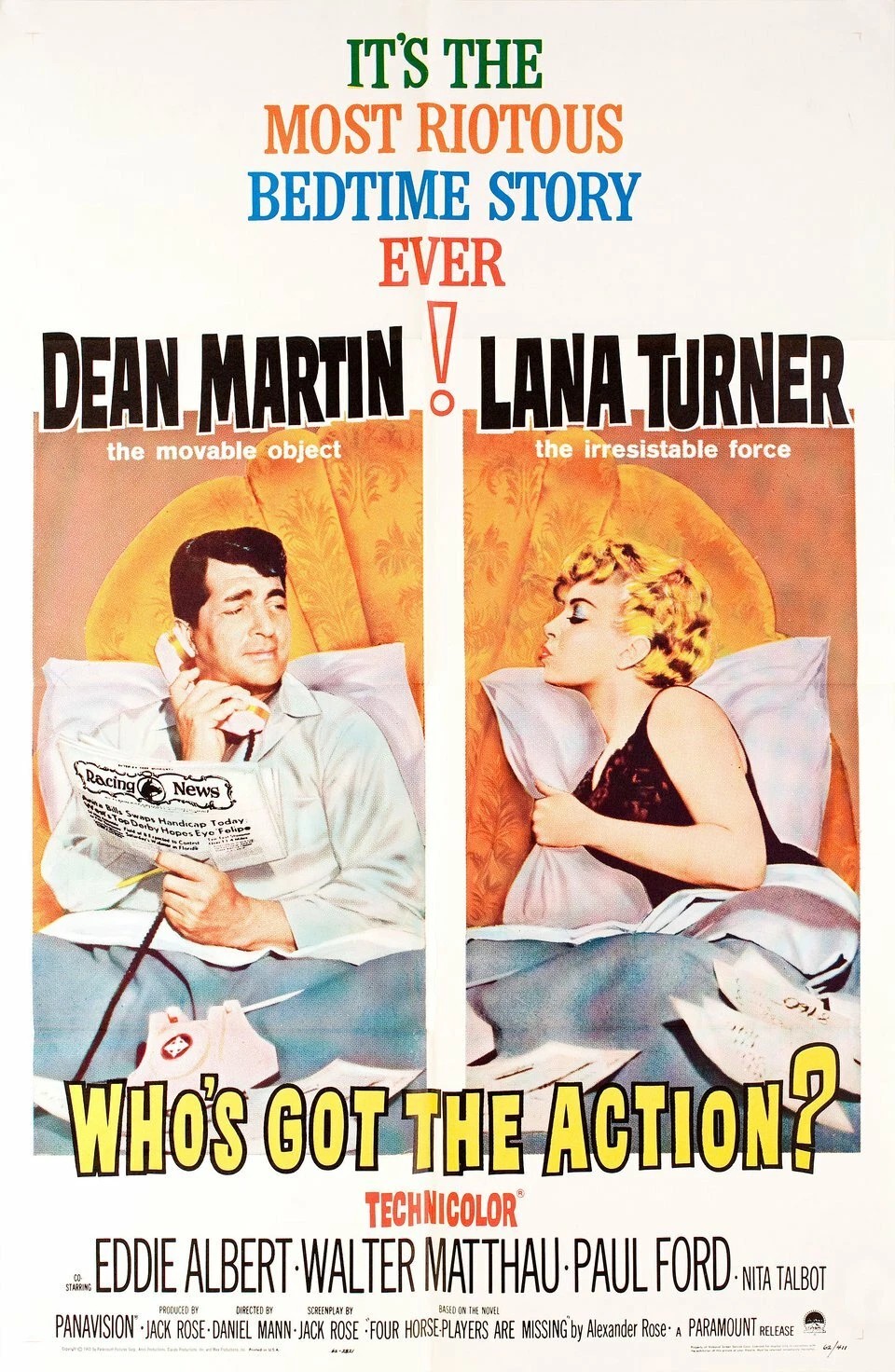
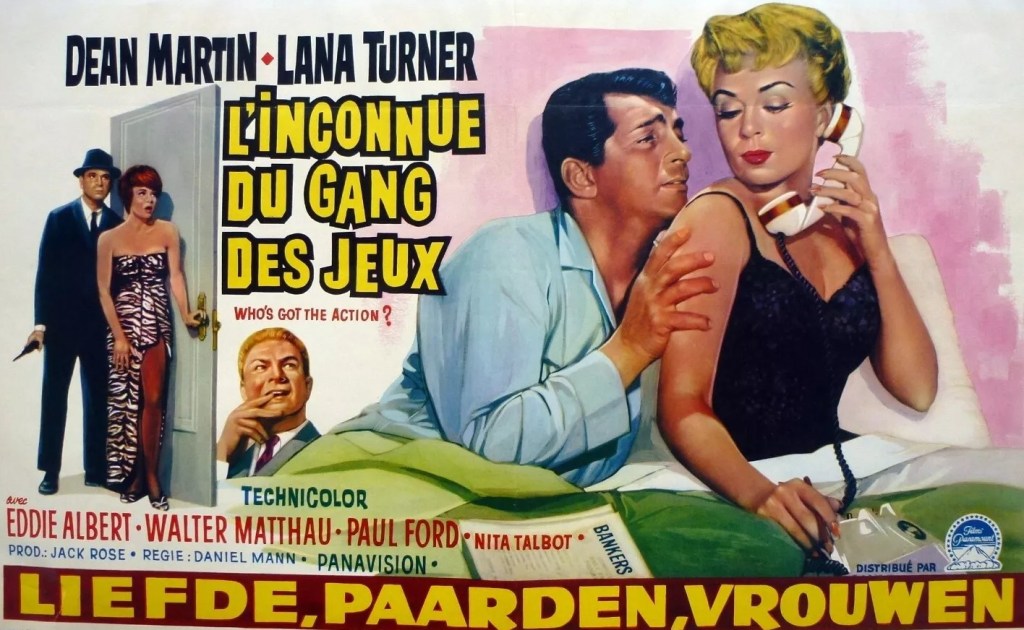
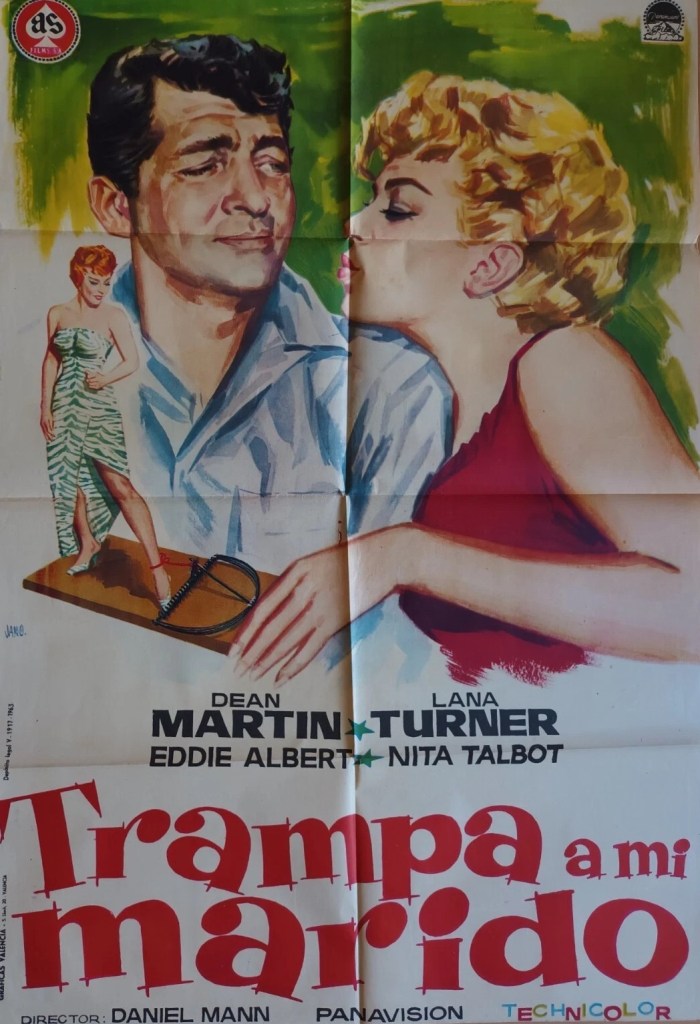
Attorney Steve Flood (Dean Martin) has a gambling addiction. He’s $8,000 in the hole to illegal bookie Clutch (Lewis Charles). Steve’s wife Melanie (Lana Turner) comes up with a clever idea to wean him off his addiction, by creating a fictional bookie, so that her husband’s losses will come to nothing. So she calls in Steve’s partner Clint Morgan (Eddie Albert) triggering Complication No 1. Clint’s always had the hots for Melanie and hopes to take advantage of Steve’s problems, helping her out by agreeing to act as the mythical bookie.
And that would be fine except for Complications No 2 and No 3. Instead of losing, as has been the trend, Steve wins big on his first bet, so now Melanie has to find a large chunk of dough. In dumping Clutch, Steve has come to the attention of mobster Tony Gagouts (Walter Matthau) who’s wondering about the mysterious new bookie queering his pitch and denying him a good customer (such is the definition of a loser).
Steve’s gambling success creates Complication No 4, attracting the interest of a pair of judges who are happy to stake the gambler, whose winning streak shows no sign of stopping.
Complication No 5 – Melanie turns to nightclub singer Saturday Knight (Nita Talbot), her next door neighbor and girlfriend of Tony, for help in raising cash and she obliges by buying some of the couple’s furnishing while Melanie also pawns jewelry.
Complication No 6 is created by Tony, who, trying to trace the rival bookie, installs a wiretap that leads him to the Flood apartment. And that should be the end of the tale, and little chance of a happy ending, except for Complication No 7. Tony has incriminated himself via the wiretaps and with an attorney ready to exploit the situation, it all works out fine, original debt to the gangster wiped out and the mobster blackmailed into marrying Saturday.
Now, with so many complications and sub-plots, this isn’t a Dean Martin picture the way the Matt Helm series is, especially not with a co-star like Lana Turner (By Love Possessed, 1961) who, not weighed down by the kind of heavy romantic tangle that seemed her remit at this point of her career, has the chance to steal a good deal of the limelight.
But the strong supporting case also do their best to chisel scenes away from the big stars. Eddie Albert’s (Captain Newman M.D., 1963) idea of a seductive lunch is a cracker and Nita Talbot (Hogan’s Heroes series, 1965), fashion ideas like Audrey Hepburn on speed, can’t help but play up to the camera. Walter Matthau is trying out a characterization for Charade (1963).
The beauty of this is that the narrative follows a neat logic. You can’t just muscle in on the illegal gambling business.
Director Daniel Mann ( A Dream of Kings, 1969) whips up an entertaining Runyonesque comedy from a screenplay by Jack Rose (It Started in Naples, 1960) based on a novel by namesake Alexander Rose who you might have spotted wearing his acting hat in The Hustler (1961).
They seemed to be a lot better at these effortless concoctions back in the day.
Tricky little number that pivots on a tricky plot point and is almost sunk by the kind of moralizing voice-over that was attached to Riot on Sunset Strip (1967) but actually bears serious reassessment. Quite a brilliant two-minute opening sequence with a tracking camera. I’m a big fan of directorial technical skill so bear with me.
We open with a man dangling from a balcony whose cries for help go unheard at the party inside. We shift inside and with no dialogue the camera begins tracking to the right. A man moves down to kiss a girl and from behind the one being kissed a hand relieves him of his wine glass and the camera slides inches further over to a dark-haired girl in the act of removing a bowler hat from a man and placing it on her head and as she leans back into the sofa that allows a blonde to come to the fore whose cigarette is removed from her mouth to light the cigarillo of an unshaven character who grabs a bottle of wine and in glugging it down moves over to the window and observing the dangling man and pours the rest of the bottle on his head.
“Help him up,” calls out another woman. This request is ignored, but the unshaven character shouts for someone else to help. The man is rescued. With a cynical stare, the unshaven man asks of the woman who has intervened, “Anything else?” She retorts, “Drop dead.” He climbs onto the balcony, falls over, and when the partygoers rush over in horror we cut to the street below where he is swinging from a lamppost.
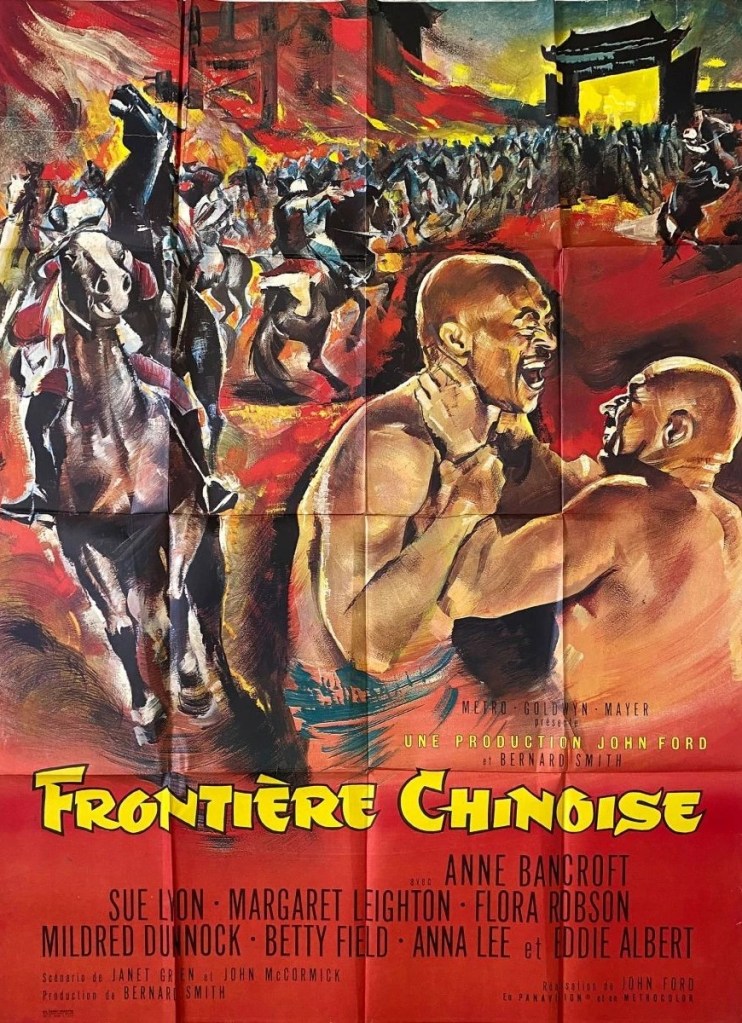
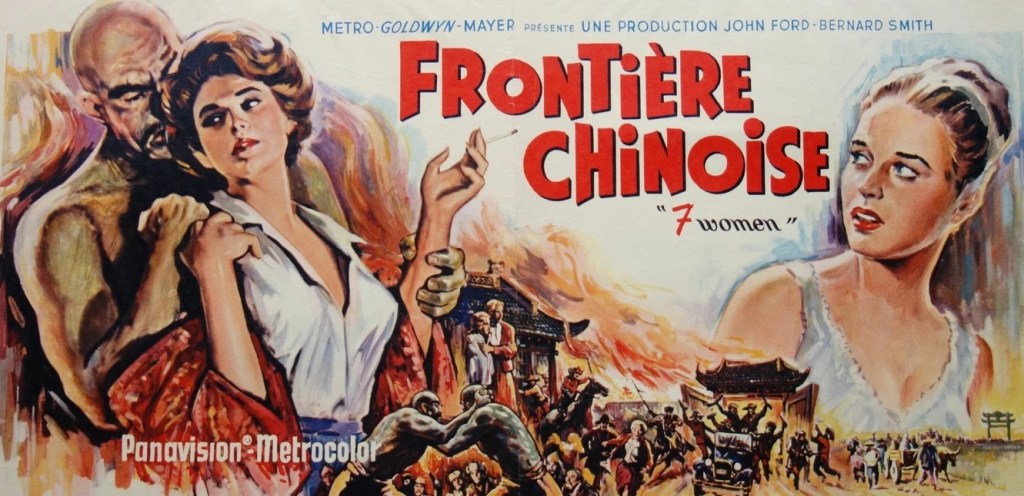
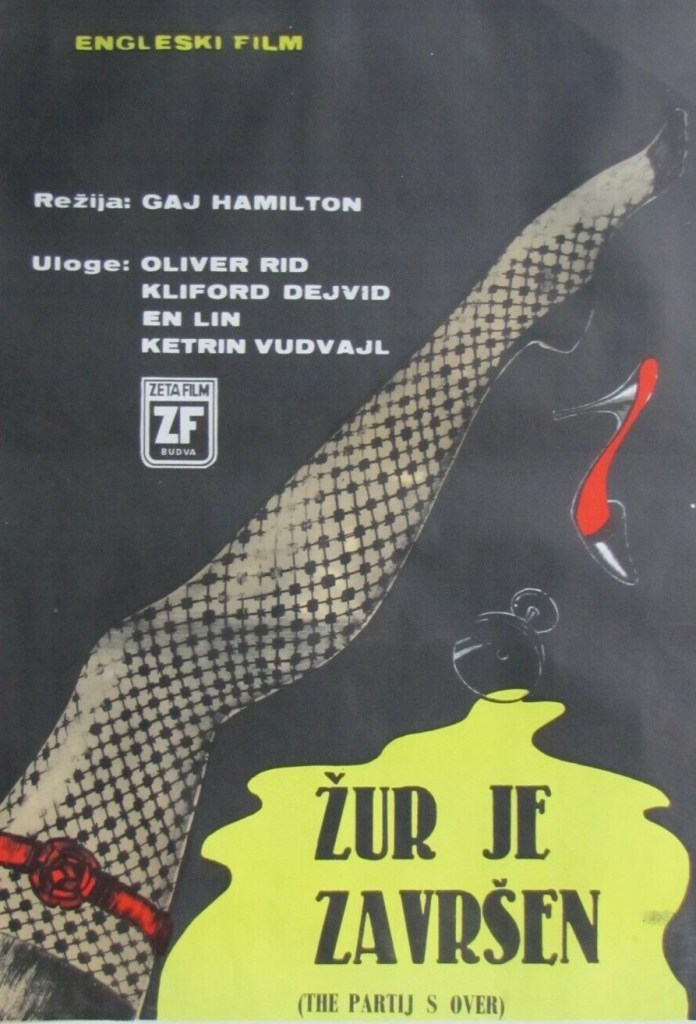
Easy enough to get away on the poster with what otherwise contractual credit billing forbids. Guy Hamilton could take his name off the credits but that wasn’t so easily enforced abroad.
Over the following credits comes the moralizing. “This film is the story of young people who become, for want of a better word, beatniks. It’s not an attack on beatniks…but shows the loneliness and unhappiness and eventually the tragedy that comes from a life lived without love for anyone or anything.” In other words – an attack on beatniks.
Actually, it’s far more about depression, though that’s scarcely acknowledged, not so much people trying to find themselves as not knowing where to look and in consequence spending a lifetime running away. You might only figure that out in retrospect but it gives the picture some punch. And they’re not overtly rebelling against society or authority as in The Damned (1962) or Riot on Sunset Strip (1967) beyond daubing a drunken face with a CND symbol.
These are less beatniks than, from their classy outfits, society debs slumming it. Yes, they don’t seem to do much else but party, although a number have artistic pretensions, sculpting and painting, for example, but mostly they seem able to lounge around without a care in the world, not like the motley secretaries living in bedsitters in The Pleasure Girls (1964).
The party characters quickly evolve into Moise (Oliver Reed), the unshaven character, who lusts in vain after sultry soul-eyed American Melina (Louise Sorel), the girl who gave him a ticking off, even though he has an adoring singer girlfriend, the blonde Libby (Ann Lynn), who he can, as he demonstrates rather misogynistically, summon with with a snap of his fingers. Bowler-hat is mysterious painter wannabe Nina (Katherine Woodville). The rescuer is sculptor and drummer Geronimo (Mike Platt).
Similarly, Guy Hamiltoncouldn’t prevent the marketing team sticking a sly reference to him – director of “Goldfinger” – elsewhere on the marketing material.
Melina has a wimp of a fiance, Phil (Jonathan Burn), and the story kicks into gear with the arrival of her American fiance Carson (Clifford David), a high-flying businessman, though owing rapid promotion to the fact she is the boss’s daughter. Since marriage is immiment, he is perturbed at being unable to contact his fiance.
But when he does try to find her, he is given the run-around. Nina tells him Melina is recovering from a terrible operation, someone else sends an easily-duped Yank to Buck House (Buckingham Palace), he finds her suitases packed in her room, that element backed up by the notion that she has given away clothes and jewellery (Nina wears her bracelet) and she has either skipped off to Paris or might be lying on a building site half-naked after being dumped there, dead drunk, as a prank by the gang.
So far, so black comedy. And you could believe all of it because Melina is “afraid of everything,” dreads having a daughter who might grow up to be “pawed by a thick hand” and otherwise seems to drift like a melancholy ghost. Phil, having failed his medical exams, commits suicide and like An American Dream/See You in Hell, Darling (1966) Carson is cast in the role of the person who could have saved him from diving from a roof.
Eventually, we do learn more about the other characters. Nina, who in the absence of Melina, takes up with Carson, is a provincial girl, who had an ill-advised marriage to please her parents. Libby is desperately in love with the womanizing Moise, who does a nice line in imitation and cutting remarks. When Melina’s father (Eddie Albert) turns up, the pace quickens.
And in a quite brilliant directorial coup, we realize that, ever since Carson’s arrival, the movie has been operating in flashback. There’s a better reason Melina is missing. She’s dead. She wasn’t drunk, she had toppled from a high staircase at a party and snapped her neck. But since everyone else is totally smashed, they assume she’s just out of it. Only Moise knows the truth, since she’d been trying to get away from him too fast. And since he makes no effort to prevent the prank going ahead, there would be some serious trouble should the police get involved.
Of course, the corpse turns up. Carson, reckoning he’s dodged a bullet, isn’t too torn up and he has a nice girl from the country, Nina, to hold his hand. Moise shows some remorse, but not enough.
Yes, a kind of morality tale but hardly enough to warrant the moralizing cautionary voice-over. Instead, it’s more prescient, Melina the forerunner of the kind of heroine who would find life just too tough and either end up in an institution or go on to ruin her own and everyone else’s life. As a study of depression it’s hard to beat. The spoiled brat who has everything only to realize it’s not enough. Guilt, too, if you count in Phil’s horror at kissing his dead girlfriend.
The credit sequence, which has been ripped off countless times, shows the motley post-party crew slinking across an iconic London bridge at dawn. And there are some wonderful scenes with a viciously playful Oliver Reed. In one he gives a Pythonesque take on the misunderstood waif – “my bathwater was never the right temperature, the servants always burned the toast.”
Oliver Reed (The Assassination Bureau, 1969) should have taken all the acting plaudits but in fact the women, with more emotion to openly play with, steal it. Katherine Woodville (The Wild and the Willing, 1962) takes it by a nose from Louise Sorel, in her movie debut, and Ann Lynn (Baby Love, 1969).
Just superbly directed by Guy Hamilton (A Touch of Larceny, 1960), who mixes atmosphere, emotion and mystery, in just the right quantities, a difficult trick at the best of times. And who has the cojones to pull a fast one. It could as easily have been, upfront, a murder mystery. Instead, it’s much more. Screenplay is by Marc Behm (Charade, 1963).
It was made in 1963, when it would have been far more pertinent, but, thanks to the British censor, held back for two years. The censor was exercised by the scene where Phil kisses Melina, thinking she is dead drunk, only to realize some time later that she is actually dead, and the real reason he threw himself off the roof. In those days, nobody had come up with a solution to the knotty problem of a director who wanted their name removed from the credits. Several years later, Hollywood adopted an all-purpose pseudonym to cover that eventuality. But here, if you watch the credits, you’ll see that there is, to all intents and purposes, no director.
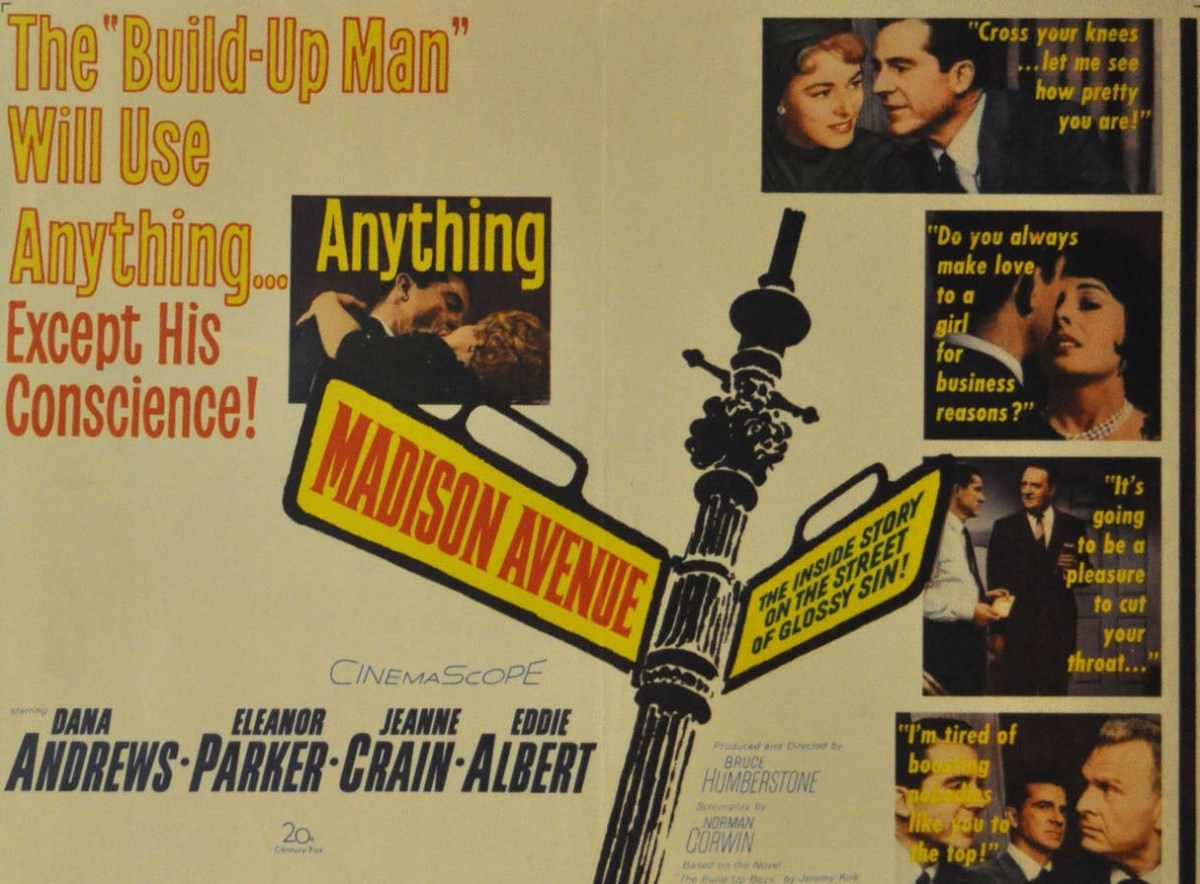
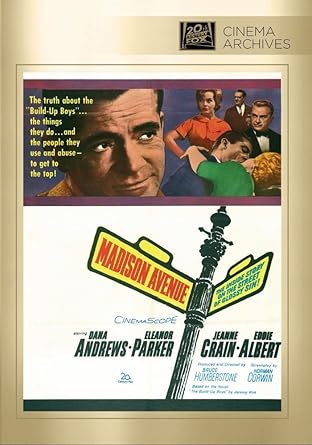
Surprisingly effective feminist angle. Unusual for the suave salesman to get his come-uppance from two vulnerable women, but that’s the case here, in an expose of the “build-up” (what we’d call “hype” these days) techniques of the public relations business, an area of advertising generally considered one step below the Mad Men of popular television. Fancy bars and cocktail dresses put in an appearance but, mostly, this deals with the grittier end.
This was pretty much the end of the mainstream Hollywood career for Dana Andrews. Still best-known for Laura (1944) and The Best Years of Our Lives (1946) and for some key film noir titles, this was his last major top-billed role. He wouldn’t make another movie for four years and anyone coming to him in this decade would associate him with supporting roles in the likes of The Satan Bug (1965) and Battle of the Bulge (1965).
So this is, possibly unexpectedly, a performance to savor, for he is hardly the hero, more the kind of character who might turn up in a contemporary movie, with questionable motives to go along with his decided charm (look no further than Leonardo DiCaprio in Killers of the Flower Moon). Though hardly murderous, he is ruthless and doesn’t care who he brings down in achieving his objectives.
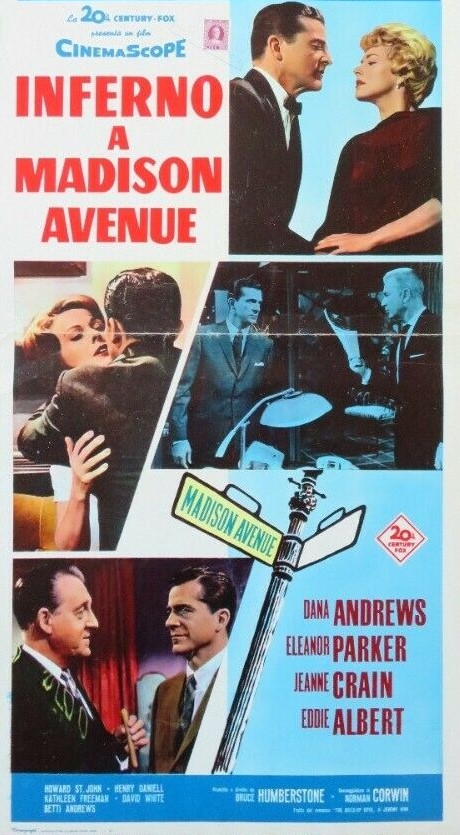
After losing his job for purportedly (an accusation unproven but going with the territory) trying to steal the major client, Associated Dairies, of his boss, J.D. (Howard St John), top executive Clint (Dana Andrews) plans to get his revenge in rather sneaky fashion, by turning round its poorly-performing subsidiary Cloverleaf. He targets the dowdy owner, Anne Tremain (Eleanor Parker), of its failing advertising firm, promising her client a big editorial splash in a big newspaper courtesy of journalist girlfriend Peggy (Jeanne Crain).
Anne’s the first beneficiary of his PR skills, reinventing her as a glamorous, power-dressing, more confident advocate of the persuasion industry. He inveigles himself into her arms, at the expense of Peggy. He aids the idiotic owner of Cloverleaf, Harvey (Eddie Albert), who spends all his time in the office playing with model airplanes. (From today’s perspective, he’s something of a savant, predicting these machines – think drones – could one day form part of the delivery contingent.)
To show just how damn clever he is, Clint “builds up” Harvey into the kind of self-made-man that has politicians purring, and brings Clint back into the winners circle. Unfortunately, the only way to get right in is through deviousness, a bit of back-stabbing here and there, dropping anyone who’s outlived their usefulness. But he’s not as clever as he thinks, lacks the business acumen of Anne, who’s denied him a share of her growing business, and therefore any real power base.
The women take unkindly to being used, Anne now the one doing the tossing-aside. For her revenge, Peggy writes an article that digs the dirt on him. Neither of these women would fall into the femme fatale category, though once all glammed-up Anne could pass for one had she required violence rather than business dexterity to exact her revenge.
Though both, unusually for the times, hold top positions in their businesses – Peggy’s a high-flying journalist working the Washington beat – they are presented initially as easy meat for a man capable of exploiting their vulnerabilities. Clint keeps Peggy on the back foot by failing to turn up for dates or presenting Anne as a rival for his affections.
This is an era where, purportedly, all women wanted was a ring on their finger, and to hang with being landed with an unsuitable man. But both Anne and Peggy upend that stereotype, seeing through the creature who’s come calling. In a western, audiences would have the satisfaction of seeing this kind of despicable character being shot. Here, they get to see him cringe, and be humiliated by women who have come to their senses. Albeit there’s a “happy” ending, that only occurs after some begging by the predator.
It suffers from too many long sequences, and by its determination to go down the satire route in exposing the seamier side of the public relations business. But there are some classic moments, such as when Harvey, tumbling through a prepared speech, has to suddenly wing it and finds his real voice.
But watching Anne get the measure of Clint and seeing him brought to heel by both women suggests the kind of ahead-of-its-time come-uppance that sets this up as an early feminist venture.
Eleanor Parker (The Sound of Music, 1965) and Jeanne Craine (Queen of the Nile, 1961) are both superb as women coming to their senses and this is a quite superb last top-billed hurrah from Dana Andrews. This was also the final outing for director H. Bruce Humberstone (Desert Song, 1953). Former newspaperman Norman Corwin (The Story of Ruth, 1960) and Richard P. Powell (Follow That Dream, 1962) based the screenplay on the best seller by Jeremy Kirk.
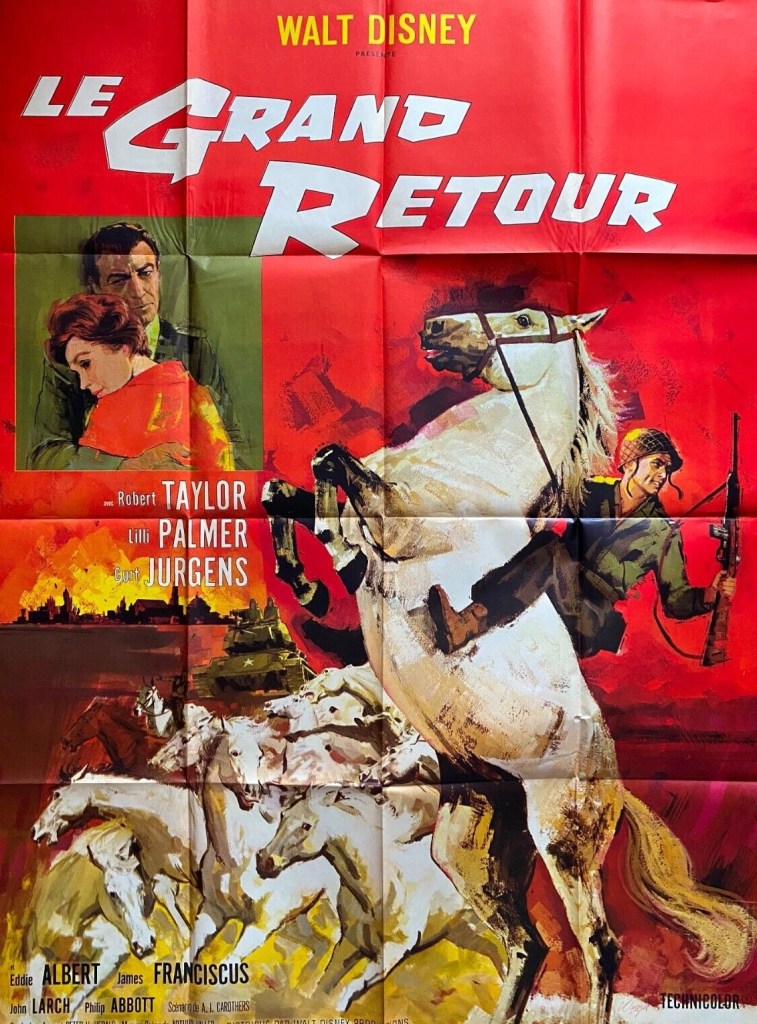
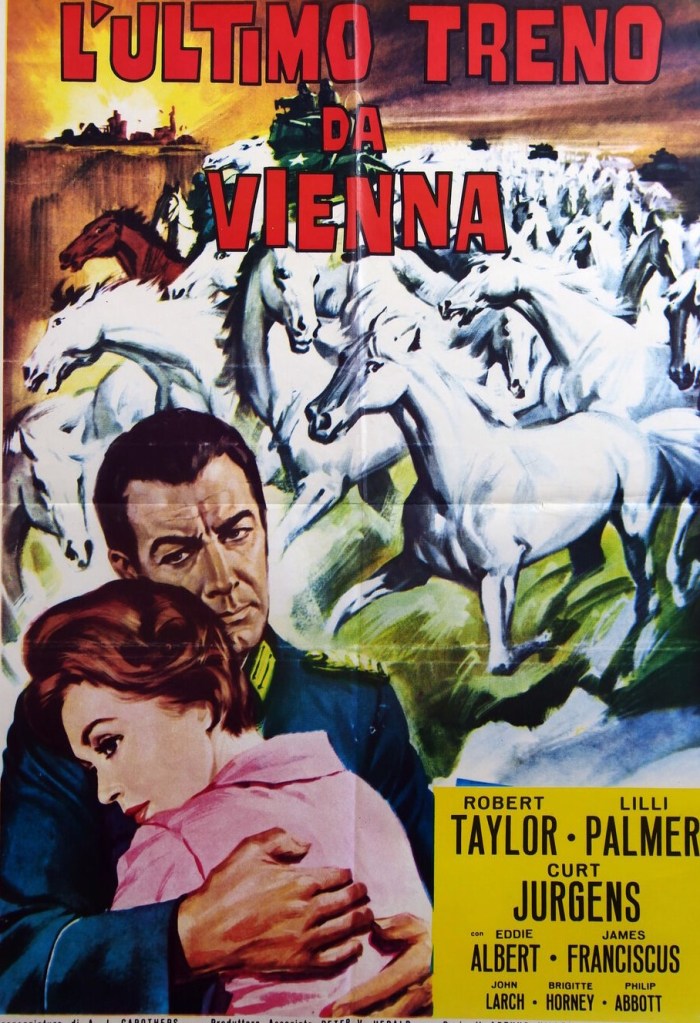
You wouldn’t look to Walt Disney in the 1960s to provide a tyro director with a calling card when so much of that studio’s output was saccharine. But this beautifully-mounted World War Two drama showed there was a new kid in town worth watching, name of Arthur Hiller. And if you always wondered why the later biopic of General Patton showed him in riding gear, that penchant is more clearly explained here.
You might balk, however, at the idea of a bunch of horses being considered in the same category as an art treasure worth protecting from the worst predations of war. And just as with the Von Trapp family, Austrians, despite welcoming the annexation of their country by Hitler in 1938, are given a free pass here.
In case you’re unfamiliar with the subject matter, the Spanish Riding School in Vienna was a celebrated nearly 200-year-old institution in which the famed Lipizzaner white “dancing” horses were put through their paces. With the Second World War coming to a close it was threatened on three fronts: the German Army poached its instructors to man the front line, the invading Russians wanted to appropriate the horses and starving refugees focused on the potential horse meat.
School chief Col Alois Podhajsky (Robert Taylor) and wife Pedena (Lili Palmer) organise an evacuation under the guise of using the horses to draw cartloads of legitimate art treasures. They hole up in the castle of Countess Arco-Valley (Brigitte Horney) but the mares are stolen by the Russians and hidden in Czechoslovakia. (Only the stallions perform, but without the females as breeding stock, the line would become extinct.)
The colonel ditches his German uniform on the arrival of American forces and puts on a performance in a makeshift arena in an attempt to convince Patton (John Larch) to mount a rescue of the captured horses. Patton, we learn here, is a renowned horseman, competed in the equestrian section of the 1912 Olympic Games, and if anyone considers a fabulous horse more valuable than a work of art it’s him. As it happens, there are prisoners to be freed in Czechoslovakia so the horses are included in that mission.
What’s unusual about this animal tale, given Disney’s predilection for anthropomorphising animals, is that it’s not told from the point-of-view of the horses. Nor, as you might have expected, given the studio’s plethora of young talent, turned into the story of a young girl or boy attached to the horses. Instead, the focal point is the impact of the creatures on those around them.
Of course the colonel is bound to be obsessed. But for the ordinary soldiers, who might never appreciate a work of art, they represent a kind of majesty, a grandeur, rising above the horror of war, something well worth the effort of rescue.
What’s even more unusual in saccharine-town is the script’s recognition of the effect of war on humanity. At one point Pedena laments that men are asked to possess “the strength and fury of giants…and then be again the men they were before.” And in some respects acknowledging the beauty of the horses is a step in the right direction. The Yanks are neither celebrated as brave nor foolhardy, in fact mostly they are just working grunts, cleaning out the castle, fixing up the arena, cracking jokes.
Hiller is the big find here. There’s a brilliant scene, all of 40 seconds long (I timed it) that would have been cut out of any other Disney picture. In a chiaroscuro of light, the colonel walks from one end of the deserted Vienna riding hall to the other and his wife, entering the frame, goes to join him. Nothing more is needed to indicate loss. Hiller clearly recognised opportunity and while the film itself is no masterpiece every single frame reveals a talented mind at work, his use of colors and costume, movement within the frame, employing Pedena and the Countess to comment on the action, allowing the inbuilt tension to carry the story without extraneous drama.
You’re mostly likely to remember the performing horses, the balletic choreographed movements, the “airs above the ground,” and indeed Hiller wisely devotes a good 15 minutes to this, but without his input this would either be overly sentimental, saccharine or little more than a documentary. This is a very grown-up picture for Disney.
Robert Taylor (A House Is Not A Home, 1964) was at the tag-end of his career, his first film in four years, but he still has the charisma to carry the film and the gravitas to see it over the line. Lili Palmer (The Counterfeit Traitor, 1962) is well cast as a voice of reason and offering commentary on humanity. Curt Jurgens (Pysche ’59, 1964) has an interesting role, lamenting, as he picks out a classical tune at the piano, how Hitler outlawed famous composers.
There’s a stronger supporting cast than you might expect: Eddie Albert (Captain Newman M.D., 1963) , James Franciscus (Valley of Gwangi, 1969) and German actress Brigitte Horney (The Trygon Factor, 1966).
Somebody certainly took notice of Hiller’s talent because his next films were The Wheeler Dealers (1963) with Lee Remick and James Garner and The Americanization of Emily (1964) with Julie Andrews and Garner. A.J. Carothers (The Happiest Millionaire, 1967) based the screenplay on the book by Alois Podhajsky.