The Kremlin Letter (1970) ****

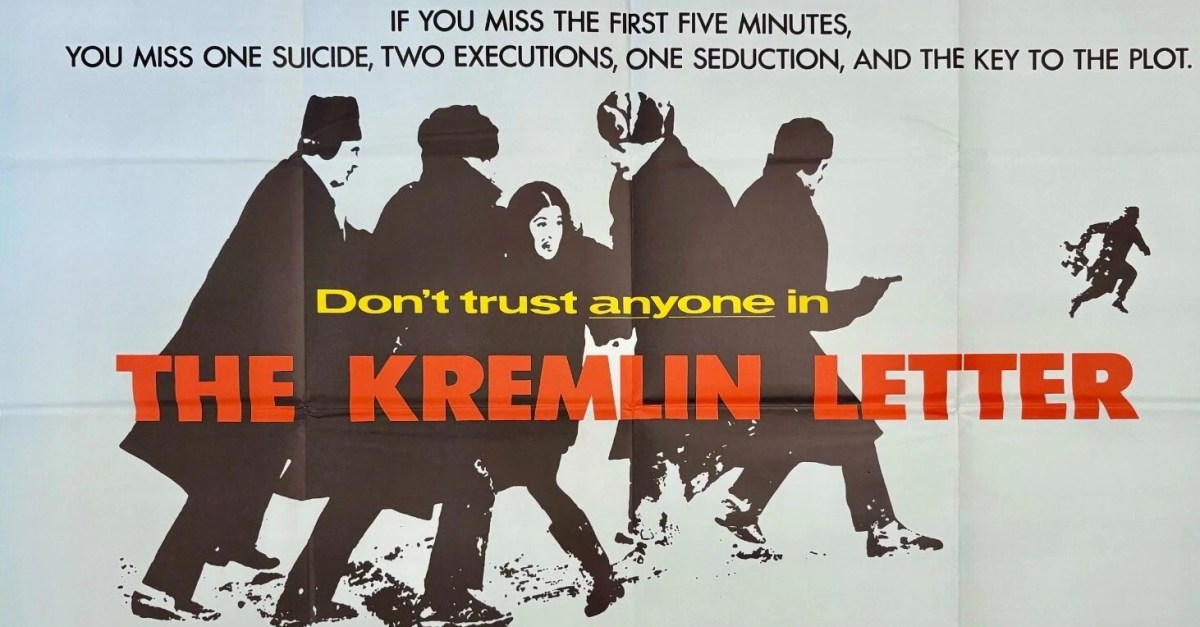
Audiences weaned on glossy spies surrounded by pretty girls and generally their own country taking a straight moral path turned up their noses at this more realistic portrayal of the espionage business where dirty infighting was the stock in trade. The Spy Who Came in from the Cold (1965) was saintly by comparison.  

Complaints about a complicated plot were led by critics who rarely had had to work their way through a tricky narrative, unless it was from the likes of Alfred Hitchcock who was apt to add twists to his stories. The fact that the bulk of the characters went by strange monikers –  The Highwayman, Sweet Alice, The Warlock etc – also seemed to upset critics. (In the book by Noel Behn, the author points out that these spies were constantly adopting new identities, it made it easier for others to keep tabs on them if they were always referred to by nicknames which were constant.)
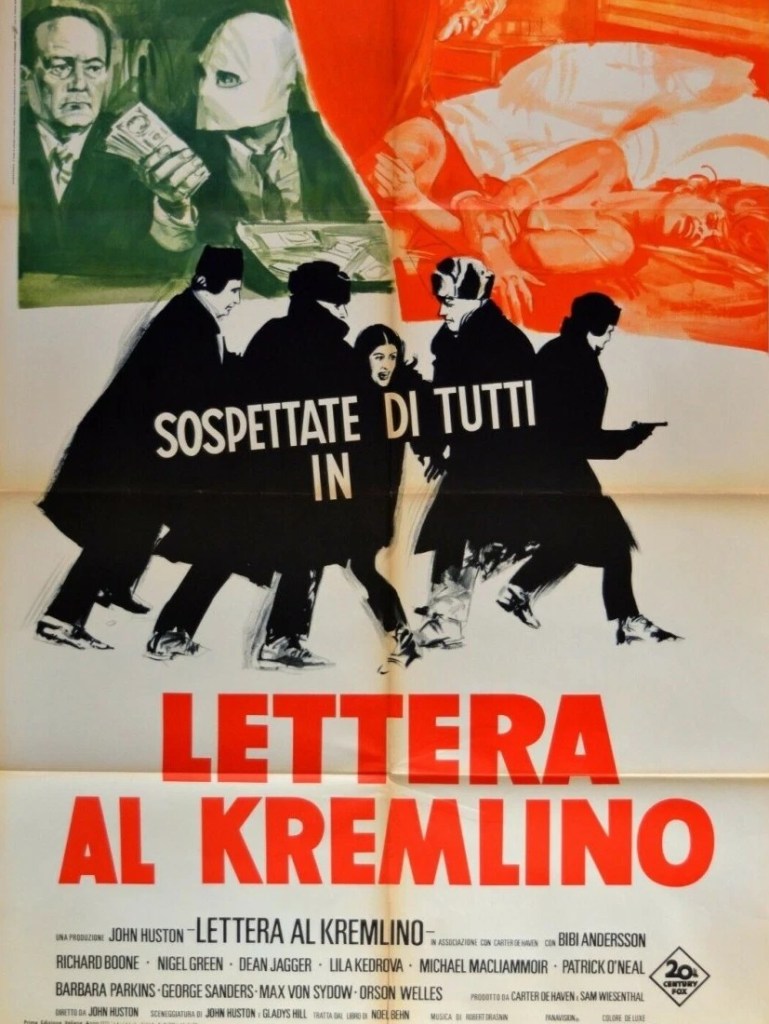
A contemporary audience, accustomed to things never being what they seem and all sorts of double-dealing, would be more at home here.

None of the characters, even the supposed good guys/gals, get off lightly. Personal unsavory sacrifice is unavoidable. Charles Rone (Patrick O’Neal) and B.A. (Barbara Parkins), who have fallen in love with each other, both have to prostitute themselves for the cause. And when the going gets too tough, suicide is the only way out. There’s hefty financial reward for those who survive the mission, but the substantial pot will be split between the survivors and not the dependents of those who don’t come home.

At the crux of the story is recovering a letter which promises that the USA and Russia will conspire against China and destroy its atomic weaponry. Espionage expert The Highwayman (Dean Jagger) recruits a team to infiltrate Moscow consisting of Rone, burglar and safe cracker B.A., drug dealer The Whore (Nigel Green), Ward (Richard Boone) and ageing homosexual The Warlock (George Sanders) who is a dab hand at knitting.

More than a few have a dodgy past, Ward an art dealer of ill repute, The Whore a pimp, even Col Kosnov (Max von Sydow), the target of the US operation, betraying his own countrymen. B.A. has to learn how to use sex to trap the enemy and, to get past the starting gate, loses her virginity to the obliging Rone.
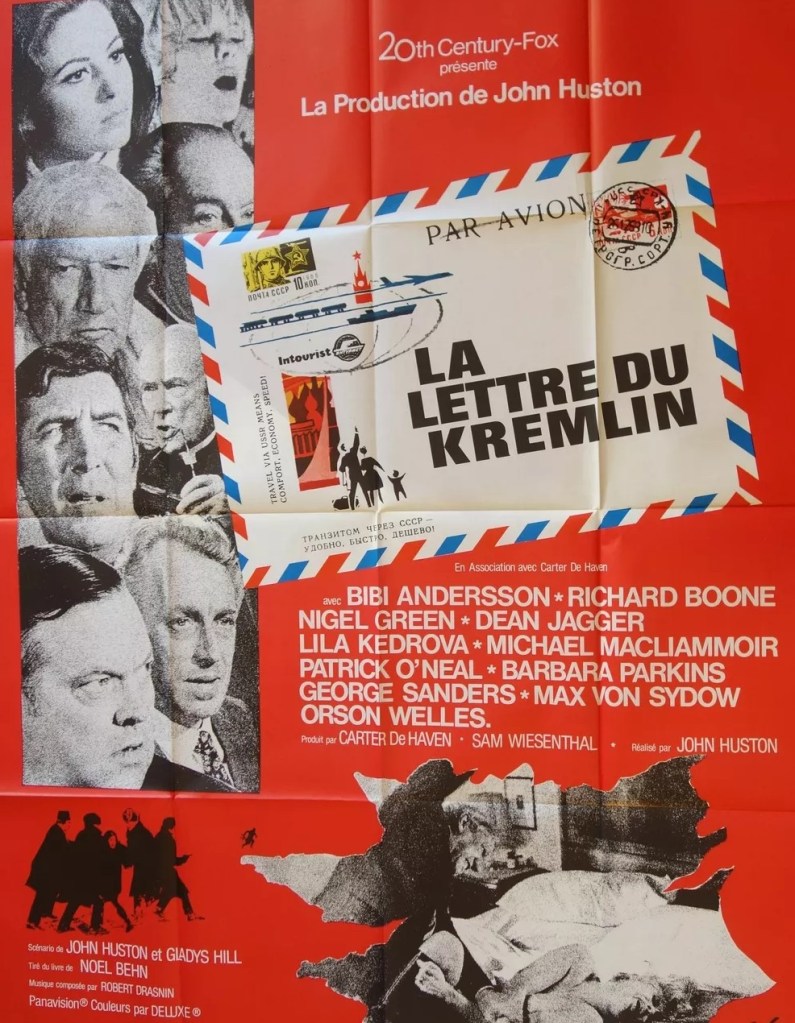
The Whore sets up in the brothel business with Madame Sophie (Lila Kedrova), keeping the sex workers docile by filling them up with heroin, which he imports. As instructed, B.A. shares out her favors with the enemy while Rone seduces the wife, Erika (Bibi Andersson), of Col Kosnov.

You always go into a spy picture expecting double cross and this is no different. B.A., The Whore and The Warlock have their covers blown, the latter committing suicide, the girl failing to do so but paralyzed as a result. Ward kills Kosnov. But his motive seems odd – blaming the Russian for betraying his countrymen – and his action only becomes clear at the climactic double cross when Ward is revealed as a double agent in the pay of the enemy. For which, it has to be said, he doesn’t suffer. If anything, with B.A. in his hands, he has Rone over a barrel.

While this was never going to be a by-the-book espionage number, it’s elevated by exploring the emotional price that has to be paid, both in hiding some feelings and feigning others.

While possibly it made sense to present the stars in alphabetical order, suggesting nobody took precedence in the billing, most have the opportunity to play against type. Barbara Parkins (Valley of the Dolls, 1967) is excellent as the girl embarking on a career for which she has, emotionally, little aptitude. Bibi Andersson (Duel at Diablo, 1966), usually cast in repressed roles, has a ball as woman giving in to impulse. Tough guy Patrick O’Neal (Stiletto, 1969) must knowingly betray his true love. Richard Boone (The Night of the Following Day, 1969) is already playing a secret role and effortlessly dupes his colleagues.

There’s not much of the John Huston (Sinful Davey, 1969) visual magic but he makes up for that by allowing the actors to delve deeper into their characters. But he doesn’t attempt to spin a happy ending and the downbeat climax suggests that the USA lost this battle. The one memorable image is a ball of red wool rolling across the ground, indicating that The Warlock is dead.  Written by Huston and Gladys Hill (The Man Who Would Be King, 1975) from the bestseller by Noel Behn (The Brink’s Job, 1978).

While the themes didn’t appeal then, they resound now.

Has aged very well.  

Tiger by the Tail (1968) ***

Back to those ingénues – or whatever-happened-to-Tippi Hedren. Christopher George’s villainous turn in El Dorado (1967) brought him as much immediate attention as James Caan and though he quickly achieved leading man status he never parlayed it beyond the likes of low-budget numbers such as The Thousand Plane Raid (1969).

But there was a more interesting ingénue on show here. Tippi Hedren had made the instant stardom type splash as Alfred Hitchcock’s go-to leading lady in The Birds (1963) and Marnie (1964). She reckoned she could do better without Hitchcock’s patronage, the director reckoned she was more trouble than she was worth, so there was a relatively amicable parting of the way.

Hedren didn’t find other directors queuing up for her services. Two small screen appearances and a supporting role in A Countess from Hong Kong (1967) were all she had to show for her stand of independence or hubris. Whereas in other circumstances signing up for this picture would have been seen as slumming it, this turned into more of an audition for a steady place in the B-movie division.

In the end she isn’t the stand-out any more than Christopher George is. The movie is too humdrum for that. But it’s the kind of narrative with murder, revenge, robbery, double-dealing and a sadistic villain that in the hands of bigger names with established screen charisma – say George Peppard and Jill St John – might have sparked more substantial interest.

There are three villainous schemes afoot. Vietnam war hero Steve (Christopher George) returns to his home town where his brother runs a race track. No sooner has Steve checked in than the brother is murdered during a million-dollar robbery. The murderers are then bumped off in an airplane explosion by heist mastermind Polk (Dean Jagger), the inside man.

Following on from that, the other four stockholders of the race course plan to ease out Steve, who’s inherited the majority stake from his brother, and buy the racetrack on the cheap, circumstances and the company’s own rules tilting the odds heavily in their favor. Sheriff Jones (John Dehner) also figures Steve for the murder of his brother, so he’s first of all got to prove his own innocence before going after the guilty.

He does a fair bit of running around, aided by barmaid-cum-singer Carlita (Charo) trying to put the jigsaw in place. He’s got some cute ideas how to winkle out the potential bad guys, one of which fingers stockholder Ware (Lloyd Bochner) who gets taken out before he can spill the beans.

Former girlfriend Rita (Tippi Hedren), one of the stockholders, runs hot and cold. Initially discouraging, she eventually warms to her old flame, then turns down the heat when she realizes he considers her a suspect in the robbery. Steve takes a good thrashing every now and then, but proves assiduous and occasionally spot-on in his deductions, though most of his investigation relies on fishing expeditions. Some of the finger-pointing is obvious but the denouement is not.

There was another ingénue here. Commonwealth United intended going down the “mini-major” or “instant major” route as exemplified by United Artists and Avco Embassy, where a new production outfit set up a hefty portfolio of movies, aiming for a release strategy of 6-12 a year, sufficient to be recognized by cinema owners desperate for product as a potential player. Established by real estate supremo Milton T. Raynor, it kicked off in 1968 with Tiger by the Tail and A Black Veil for Lisa starring John Mills and Luciana Paluzzi, followed by a heftier slate of seven pictures the following year.

Big-budget items packed with marquee names such as Battle of Neretva with Yul Brynner and Sylva Koscina, The Magic Christian headlined by Peter Sellers and Raquel Welch, and Oscar-winner Sandy Dennis in Robert Altman’s That Cold Day in the Park were mixed in with low-budget thrillers Paranoia starring Carroll Baker, Tippi Hedren comeback The Girl Who Knew Too Much and It Takes All Kinds with Vera Miles plus a pair of Jess Franco exploitationers, 99 Women and Venus in Furs. The project foundered almost immediately and by 1971 was $80 million in debt.

Whether Tippi Hedren ever acknowledged her debt to Hitchcock, it’s pretty clear here that she owed a ton to the way he presented her, not just the glossy façade, but bringing out the best of her acting. Her trademark fragility is little in evidence here without anything notable taking its place. Away from center stage, she doesn’t light up the movie.

Final picture of  R.G. Springsteen (Operation Eichmann, 1961) from a screenplay by Charles A. Wallace (The Money Jungle, 1965).

Run-of-the-mill crime picture or whatever-happened-to Tippi Hedren.

Cash McCall (1960) ***

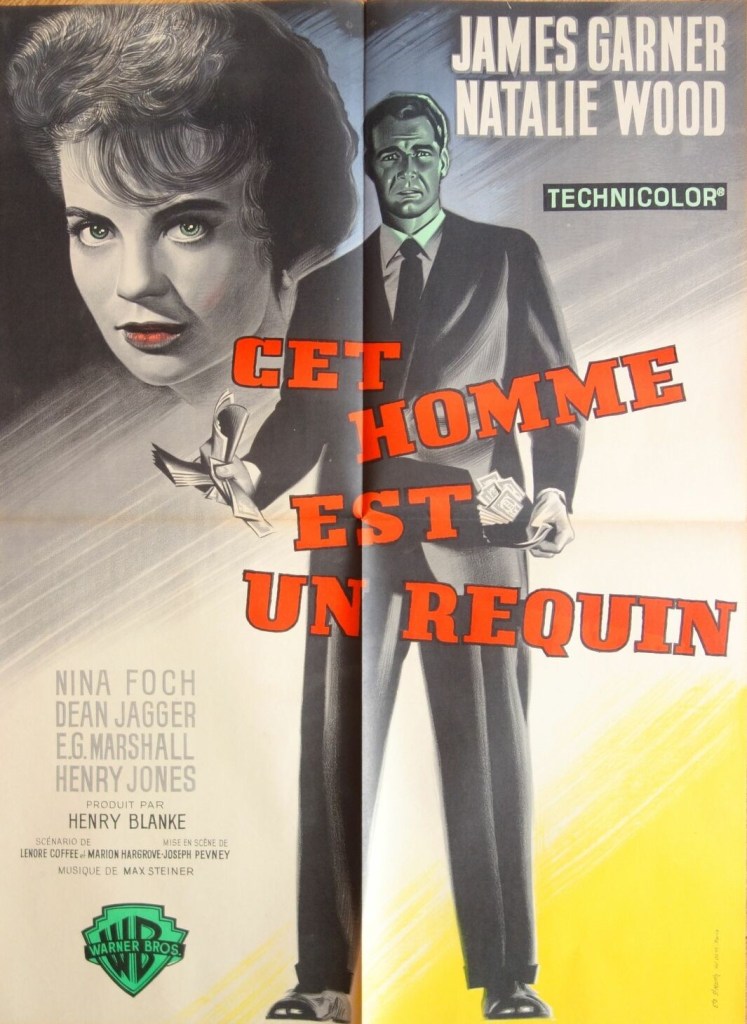
As time wore on and attitudes to corporate skull-duggery hardened – Wall Street (1987), Other People’s Money (1991), The Big Short (2015)  – it was no longer necessary to soften a venal character with romance. And I guess the ruthless Cash McCall (James Garner) falling in love with Lory (Natalie Wood), daughter of takeover target Grant (Dean Jagger), provides the movie with a soft underbelly, intended presumably to show the inhuman businessman’s more human side, but instead diverting the picture away from delivering a massive punch against the asset-stripping proliferating too fast in American business.

Otherwise, it is a good assessment of the double-dealing and pitiless behavior of business sharks preying on weaker businesses. Then complaining when the tables are turned. Anti-Trust investigators would have a field day, but I’m not sure if the U.S. Securities & Exchanges Commission, set up in the wake of the 1929 Wall St Crash, was as powerless as today, usually turning up when the damage is done rather than stepping into prevent it.

Grant decides to sell up when his biggest customer Schofield Industries, run by retired Army General Danvers (Roland Winters), holds him to ransom. Cash McCall swoops in but, after finding a flaw in Schofield Industries, determines through clever maneuver to add that to his mountain of companies and make an immediate $1 million profit on Grant’s company which he purchased for $2 million.

The romance resistance that is standard for such pictures pivots on Lory having been rejected (on a stormy night) by Cash the previous summer. Ironically (though I doubt if the makers noticed the irony), Lory is viewed as a bonus in the deal, Cash’s wealth making him an ideal catch in the eyes of her parents, despite the abhorrence he inspires.

A contemporary audience might expect her to be the fly in the ointment, especially as she owns ten per cent of her father’s company, offering an opportunity to stand up to Cash on  principle. But that’s not envisaged here. And you can’t expect her, in those sexist times, of complaining that her father is depriving her of her inheritance and the chance to run a big company.

It’s at its best in the financial chicanery. Danvers comes unstuck when Cash discovers that Grant holds an unexpected ace and can run his company into the ground. Every time anyone tries to get the drop on Cash it turns out he owns their company or nullifies their intent by knowing what they’re up to. He recruits or increases the salary of anyone who stands in his way. Money not only talks it minimises and even forgives or elevates heinous action.

The only person who bests him is a hotel assistant manager Maude (Nina Foch) who, misreading the signals, believes herself to be his love interest. In revenge, she scuppers his  burgeoning romance with Lory.

In fairness, Cash is as upfront about his intentions as Gordon Gekko in Wall Street. He describes himself as a “thoroughly vulgar character – I enjoy making money” while confessing he doesn’t buy businesses to run them but to sell them or break them up into more viable smaller pieces.

But the James Garner (The Americanization of Emily, 1964) charm gets in the way. He wants to have his cake eat it. Move into serious roles without falling foul of the public. Romance is seen as the tool.

Garner evolved a sneaky screen persona, attempting to be rascal who got away with it thanks to his charm, best personified in The Great Escape (1963) and The Americanization of Emily, in both films his escapades endorsed by the authorities. But it would be hard to find any redeeming qualities in a ruthless business buccaneer who exalted in the chaos he caused, little regard for the wrecked lives left in his wake.

The film attempts to get by this via the romance – a beautiful woman couldn’t possibly end up with a scoundrel, could she – and by setting up virtually every other character excepting Grant as dodgy (and even Grant ends up congratulating him on his clever schemes).

As an insight into corporate malfeasance, it’s interesting enough, and bold for the times, and certainly gets points for not falling back on the old trope of the little guy fighting big business. This features grown-ups knowing exactly what they are letting themselves in for.

A couple of sections jar – the flashback and a labored explanation that “Cash” is not a nickname but a Christian name. On the other hand, it could as easily be perceived as a romance that just happened to take place against the unusual backdrop of the boardroom.

It’s worth noting that Garner himself was not above unscrupulous dealing. Having convinced Warner Brothers to fund his first three movies, he then proceeded to sue the studio over his contract, leaving them with the bill for his flops.

Nina Foch (Spartacus, 1960) and Dean Jagger (Firecreek, 1968) are the pick of the supporting actors. The most interesting aspect of Joseph Pevney (The Plunderers, 1960) was that he directed a quartet of films in this single year and then not another for the rest of the decade.

The final screenplay from celebrated writer Lenore Coffee, whose career spanned forty years, an astonishing feat for a female in Hollywood, and was at one time the highest-paid screenwriter in the industry. It was co-written by Marion Hargrove (40 Pounds of Trouble, 1962) from the bestseller by Cameron Hawley.

Would have been a better picture if it had stuck to the knitting and not wandered into romance, so good in parts rather than a major success.

Discover WordPress

A daily selection of the best content published on WordPress, collected for you by humans who love to read.

The Atavist Magazine

by Brian Hannan

WordPress.com News

The latest news on WordPress.com and the WordPress community.