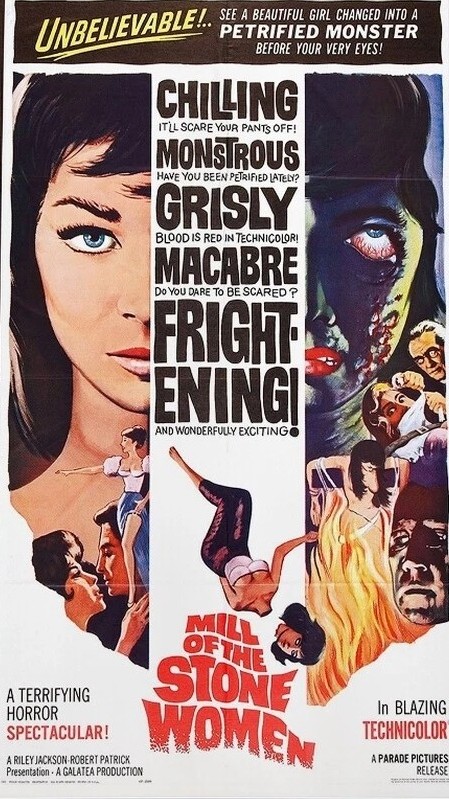
Character has generally been replaced by gore or slaughter in the modern horror film. Ever since Hammer ruled the roost, blood-letting has assumed greater and greater significance, and ever since The Exorcist (1973) the genre has traded on shock values. Current box office sensation Sinners (2025) has gone some of the way to re-aligning the balance with its emphasis on character and thematic symmetry.
So it’s somewhat reassuring to discover that prior to those developments there could be an absolute chiller of a tale where nonetheless character, and not just for the two principals, was all. I should tell you right away that there is a vampiric element in the drawing of blood but that is carried out in the more refined scientific manner of medical blood transfusion. And the undead do rise again, just to get that story point out of the way, but it’s not because an evil count refuses to be put to sleep, but out of a father’s love for his daughter.
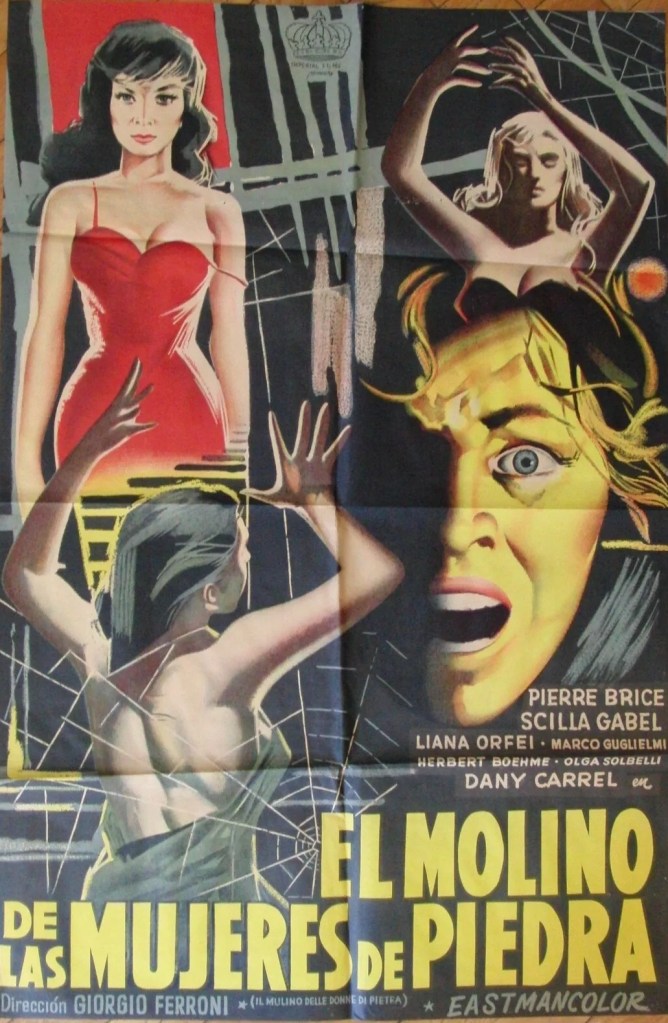
Quite the most fearful element here is the preponderance of unrequited love. The man whose medical skills saves a woman’s life is rejected by her, she in turn is ultimately rejected by an unforeseen suitor while he, in turn, for a time turns his back on his long-term girlfriend. The father also shows he has little loyalty to the man who deserves that most of all.
But let’s start at the beginning. In nineteenth century Holland, land of canals and dykes you will recall, student Hans (Pierre Brice) arrives at the watermill owned by Professor Wahl (Herbert Bohme) to write a report on the macabre carousel he has devised, a feat of engineering running on levers and gears and wheels, that present a “theater of death” populated by very lifelike inanimate statues. While there, he espies a beautiful woman.
Hans’s girlfriend Liselotte (Dany Carrel) is immediately jealous and unsure whether he loves her as much as she, a childhood friend, loves him. Back at the mill, Hans encounters smug Dr Bohlem (Wolfgang Preiss) who is on constant call to look after the professor’s very ill daughter Elfie (Scilla Gabel), the aforementioned beauty.
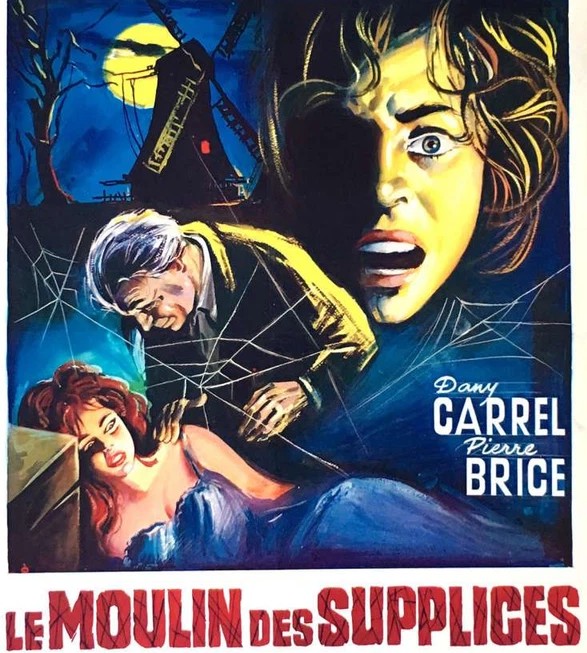
Although for mysterious reasons Elfie’s life depends on the doctor’s ministrations she rejects his overtures with haughty disdain. Meanwhile, she seduces Hans. Although initially smitten, Hans soon realizes the error of his ways. But Elfie, who it turns out has seduced many male visitors, becomes obsessed with him. Before he can break off their relationship, she collapses and dies.
Hans is accused of murdering the girl. Out of his wits, he’s sedated by the doctor and when he wakes up is convinced he has seen Elfie alive and another woman trapped in a room. He is persuaded by the professor and the doctor that he is going mad and he flees the mill, in theory never to return. The professor and doctor have kidnapped local girl Annelore (Liana Orfei), sometime life class model and chanteuse, and revive Elfie via a blood transfusion from the captive. The pair don’t need to get rid of the body, the professor transforming it into one of his very lifelike sculptures by covering it in wax.
Liselotte’s jealousy evaporates when she has Hans all to herself, nursing him back to health, and he asks her to marry him. Though nagged by his visions, he manages to dismiss them until he sees a photo of Annelore, whom he previously never met, and whom he glimpsed tied up in the mill.
Meanwhile, the doctor has discovered a serum by which Elfie can live a proper life, and it only requires one final transfusion. To that end he’s kidnapped Liselotte. But the doctor is determined to extract a price. Knowing that Elfie will no longer be dependent on him, he demands her hand in marriage. Despite what she owes him, she still, as high-and-mighty as before, rejects him. Using the same argument, the doctor appeals to the professor who is even more outraged at the idea, given the doctor was thrown out of his profession for malpractice and is an ex-convict.
The professor is even less grateful than his daughter and kills the doctor. Having witnessed the transfusion so many times, he begins to carry it out himself. But at the critical moment, he can’t find the serum. And it’s gone. When the doctor fell, the bottle of serum in his pocket smashed.
Hans rescues his fiancé while the mill burns to the ground, the wax melting from the sculptures betraying the skeletons underneath.
Most of the horror is left to audience imagination. There’s no gore, no throats slashed, very little blood, not even a scream. It’s the most discreet horror picture you’ll ever see and all the more effective for it. We probably didn’t need the scene of the conspirators gloating and giving away their evil plan but otherwise it works a treat.
All the characters are given clear identities, father and daughter gripped by obsession, doctor by the delusion of marriage as reward, Hans wayward in his affections but sensible enough to recognize stifling love when he sees it, and even Liselotte is best defined as overly jealous.
It’s handsomely mounted too, and the mill interiors have all the eerie trappings of the normal castle. Pierre Brice (Old Shatterhand, 1963) and Scilla Gabel (Sodom and Gomorrah, 1962) are given license to overact, and while Dany Carrel (Delphine, 1969) works through gritted teeth, Wolfgang Preiss (The Train, 1964) and Herbert Bohme (Secret of the Red Orchid, 1962) are the epitome of the cultured villain.
Unable to call upon a vast cauldron of blood to splatter, this is a more intelligent horror picture, directed with measured cadence by Giorgio Ferroni (The Lion of Thebes, 1964) from a script by the director, Ugo Liberatore (The Hellbenders, 1967) and Giorgio Stegani (Death on the Fourposter, 1964).
Rewarding watch.
 The Magnificent 60s