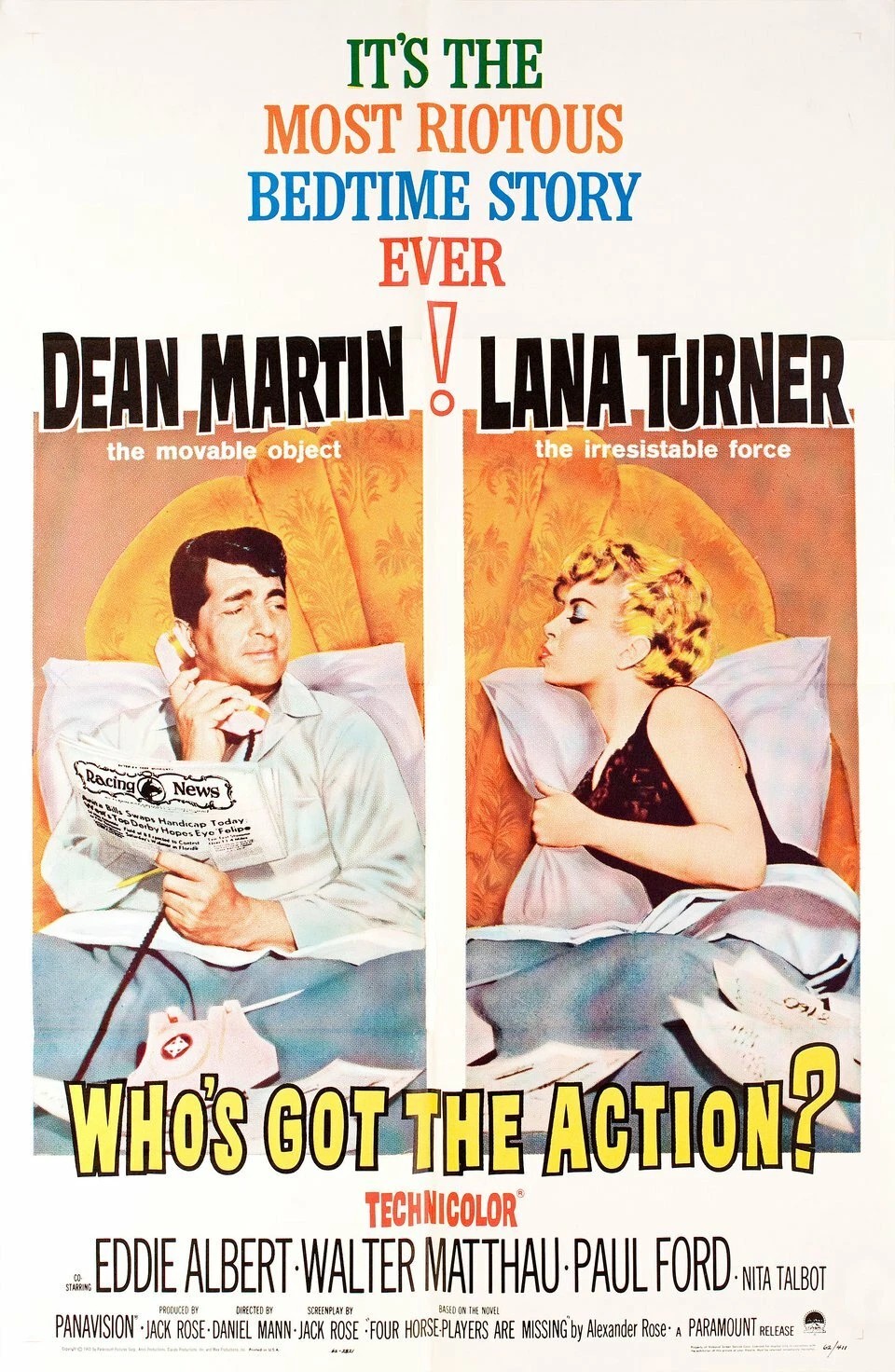
Who’s Got the Action (1962) ***

Complication. The keenest weapon in the screenwriter’s armory. And the most overused and, conversely, not employed to its greatest potential. Generally, it’s the only device for a romance – boy meets girl, (enter complication as…) boy loses girl, boy gets girl. But, just occasionally, it appears with some skill, layer after layer of deft complication until a whole story is tied up in acceptable and believable knots.

Before we get into all that it’s worth pointing out how language changes. These days mention of “action” will carry connotations of a sexual nature, so, just to be clear, here we’re talking about gambling, betting on horses, the mythical sure thing. And if you want to take a more cosmic perspective, we can apply the scientific rule that every action has a re-action, in other words consequence.
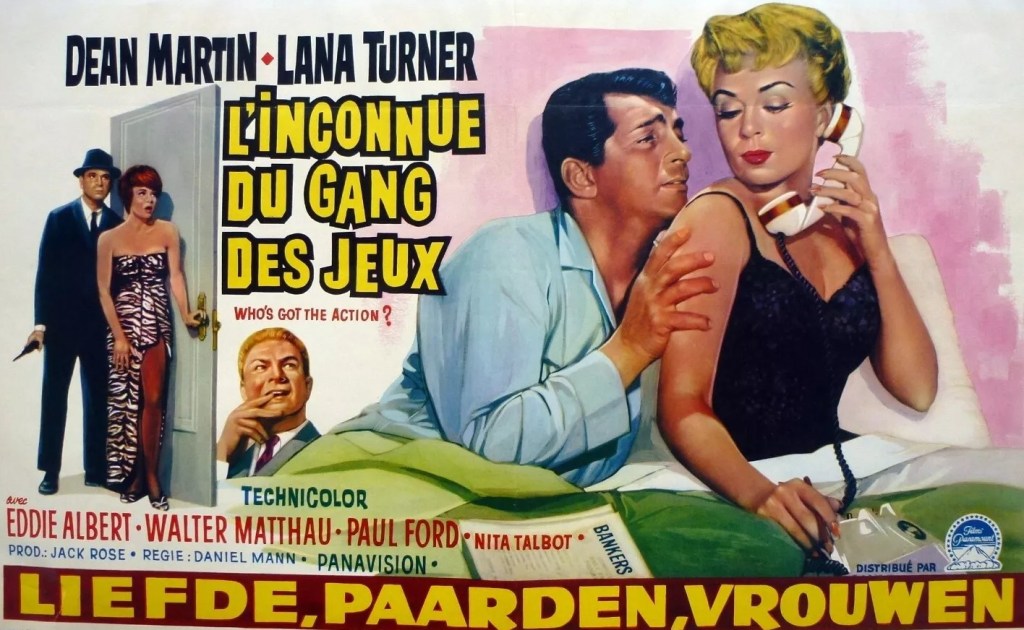
Attorney Steve Flood (Dean Martin) has a gambling addiction. He’s $8,000 in the hole to illegal bookie Clutch (Lewis Charles). Steve’s wife Melanie (Lana Turner) comes up with a clever idea to wean him off his addiction, by creating a fictional bookie, so that her husband’s losses will come to nothing. So she calls in Steve’s partner Clint Morgan (Eddie Albert) triggering Complication No 1. Clint’s always had the hots for Melanie and hopes to take advantage of Steve’s problems, helping her out by agreeing to act as the mythical bookie.

And that would be fine except for Complications No 2 and No 3. Instead of losing, as has been the trend, Steve wins big on his first bet, so now Melanie has to find a large chunk of dough. In dumping Clutch, Steve has come to the attention of mobster Tony Gagouts (Walter Matthau) who’s wondering about the mysterious new bookie queering his pitch and denying him a good customer (such is the definition of a loser).

Steve’s gambling success creates Complication No 4, attracting the interest of a pair of judges who are happy to stake the gambler, whose winning streak shows no sign of stopping.

Complication No 5 – Melanie turns to nightclub singer Saturday Knight (Nita Talbot), her next door neighbor and girlfriend of Tony, for help in raising cash and she obliges by buying some of the couple’s furnishing while Melanie also pawns jewelry.
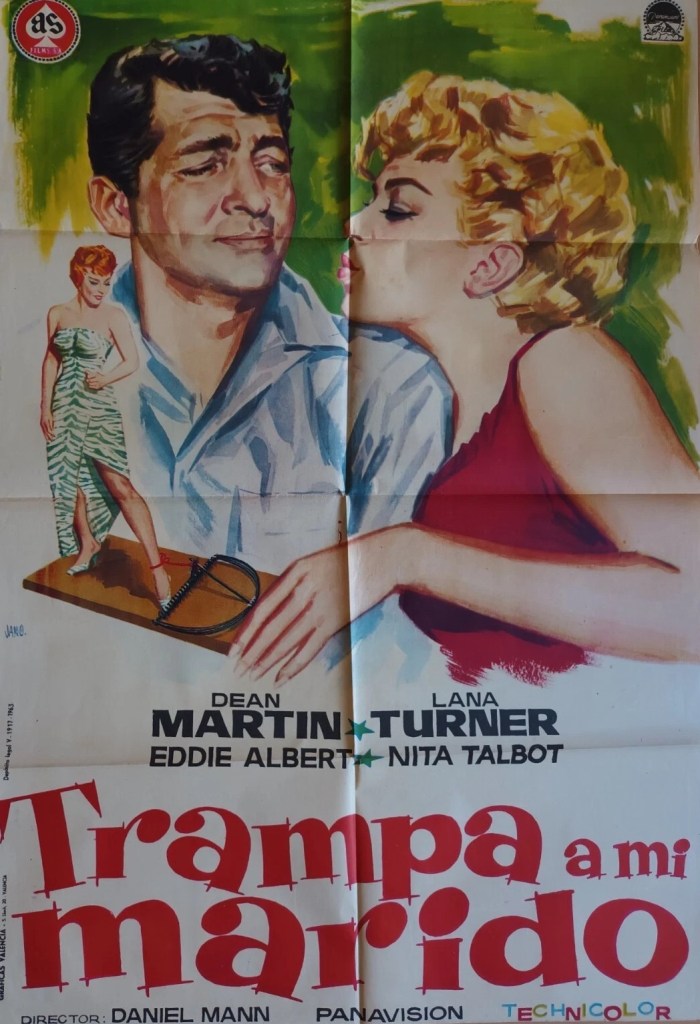
Complication No 6 is created by Tony, who, trying to trace the rival bookie, installs a wiretap that leads him to the Flood apartment. And that should be the end of the tale, and little chance of a happy ending, except for Complication No 7. Tony has incriminated himself via the wiretaps and with an attorney ready to exploit the situation, it all works out fine, original debt to the gangster wiped out and the mobster blackmailed into marrying Saturday.

Now, with so many complications and sub-plots, this isn’t a Dean Martin picture the way the Matt Helm series is, especially not with a co-star like Lana Turner (By Love Possessed, 1961) who, not weighed down by the kind of heavy romantic tangle that seemed her remit at this point of her career, has the chance to steal a good deal of the limelight.

But the strong supporting case also do their best to chisel scenes away from the big stars. Eddie Albert’s (Captain Newman M.D., 1963) idea of a seductive lunch is a cracker and Nita Talbot (Hogan’s Heroes series, 1965), fashion ideas like Audrey Hepburn on speed, can’t help but play up to the camera. Walter Matthau is trying out a characterization for Charade (1963).

The beauty of this is that the narrative follows a neat logic. You can’t just muscle in on the illegal gambling business.

Director Daniel Mann ( A Dream of Kings, 1969) whips up an entertaining Runyonesque comedy from a screenplay by Jack Rose (It Started in Naples, 1960) based on a novel by namesake Alexander Rose   who you might have spotted wearing his acting hat in The Hustler (1961).

They seemed to be a lot better at these effortless concoctions back in the day.
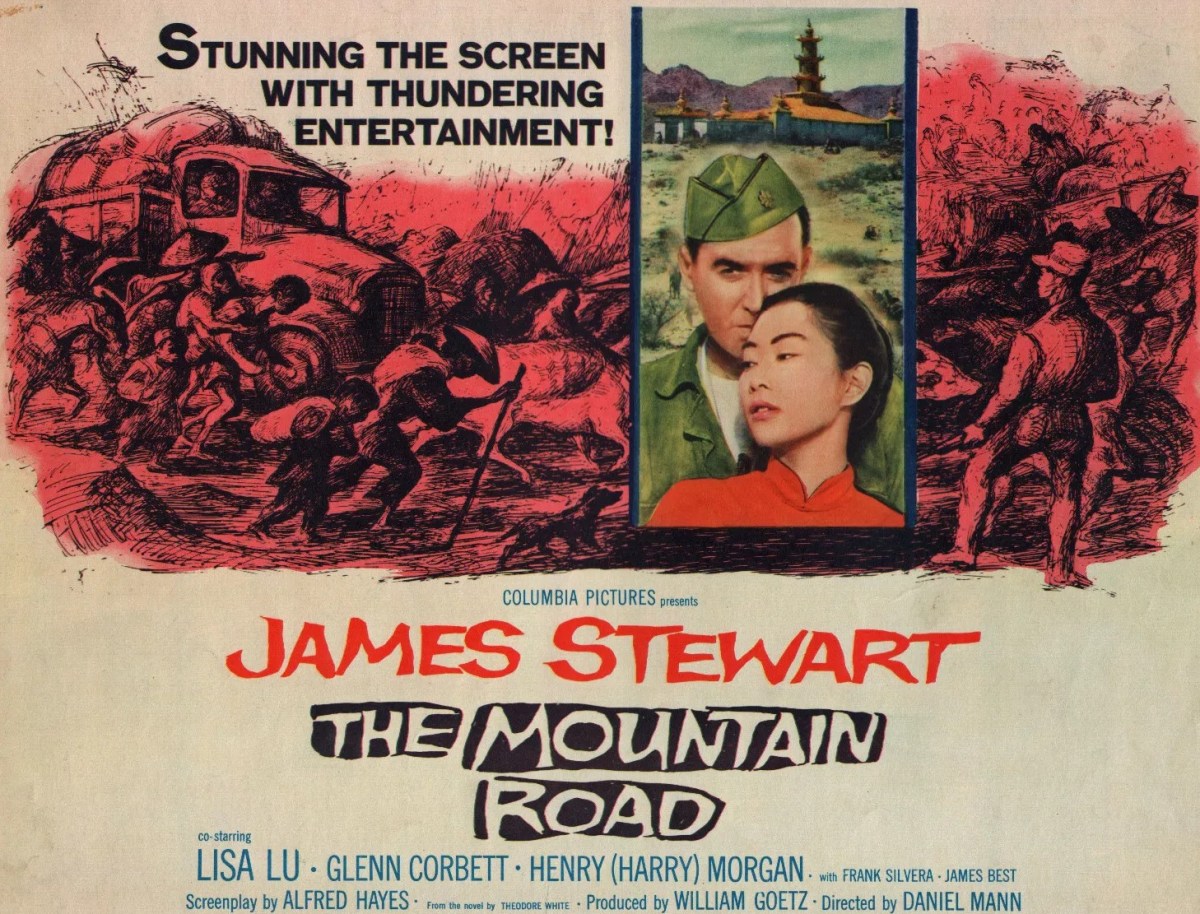
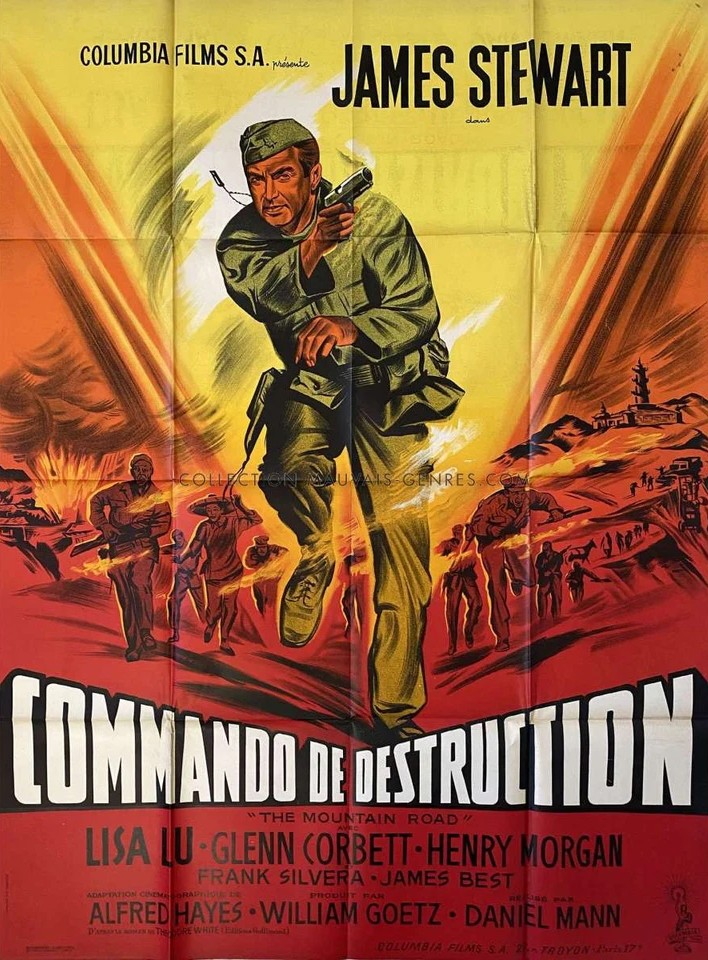
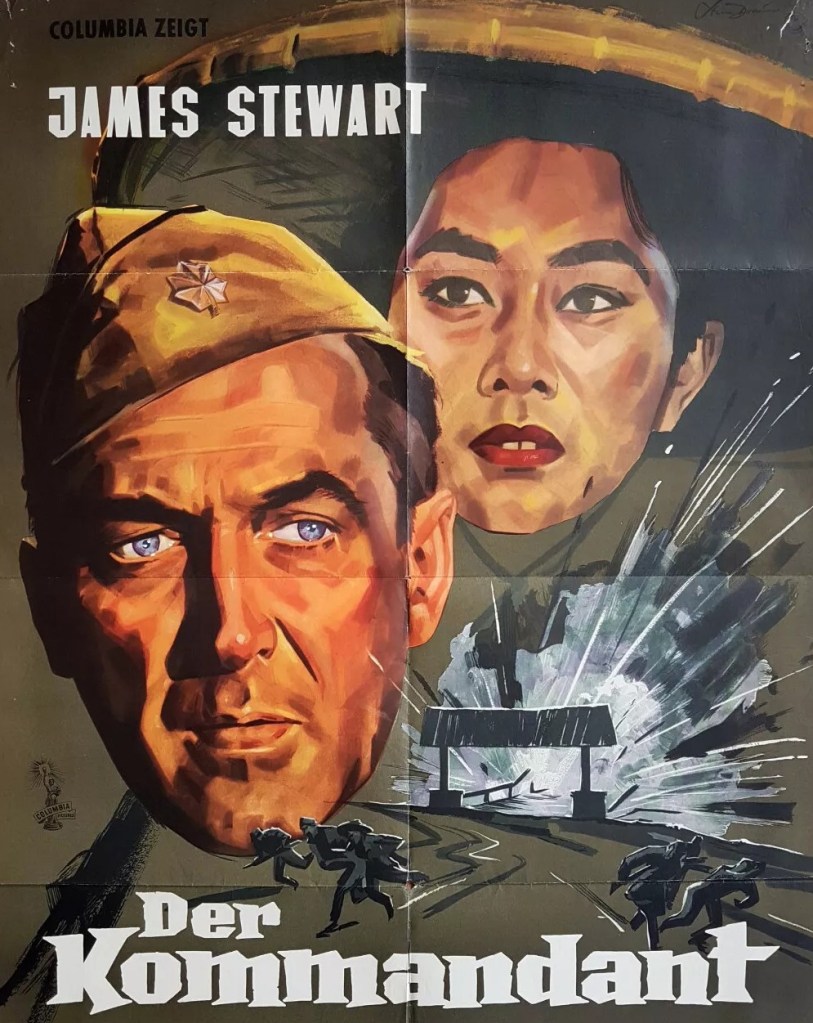
The Mountain Road (1960) ****

First film to deal with U.S. Army war crimes. Though here’s it’s tabbed as abuse of power but amounts to the same thing when it relates to the wanton killing of innocents. Not the first film to examine a commander totally unsuited to command – The Caine Mutiny (1953) would be your first port of call for that, although that was a career officer rather than a conscript. But the blistering under-rated Oscar-ignored performance by James Stewart (The Rare Breed, 1966) is easily comparable to the Oscar-nominated Humphrey Bogart.

And director Daniel Mann (A Dream of Kings, 1969) is helluva sly. He dupes the audience into thinking this is a mission picture, blowing up a massive ammunition dump to prevent it falling into enemy hands. And if you’re one for the easy action of explosions, this is for you, the kind of fireworks not seen till MCU entered the equation.

And here’s a line that’s going to knock you for six. “China and America are friends.” Say again? You what? As far as I can remember in all my decades of moviegoing, China has always been the enemy, either providing a succession of nefarious villains, or on the brink of starting a nuclear war, or just totally ungrateful for all the efforts the West has made bringing to the country Christianity and the western idea of civilization.

But it’s true. Before Communist China reared its ugly head, the U.S. and China were allies against the Japanese in the Second World War. But towards the end of that conflict, the Japanese had invaded and the Yanks were pulling out. Not wanting to leave anything behind for the enemy – like a huge arsenal or thousands of gallons of diesel – is the trigger for the story.

Except it’s not. Major Baldwin (James Baldwin) doesn’t have to go on any mission. His job is just to blow up a much smaller ammunition dump that’s easily accessible without the need to go on a long trek through the mountains. It’s his choice to take on the bigger job. There’s not even any pressure to do so. It’s entirely at his “discretion.” And you can see in the tone of his superior’s voice that it’s not such a good idea. He can just complete the small job and high-tail it out of there.

But Major Baldwin wants to experience command in action. He’s not a glory hunter in the normal sense but there’s definitely something off in a backroom soldier who’s got that on his wish list. It never occurs to him that there’s more to command than ordering about grunts, many of whom he considers “slobs,” and that the position comes with the task of making difficult decisions.

He’s got a very small team, chief among whom is Sgt Michaelson (Harry Morgan) and translator Collins (Glenn Corbett). Chinese officer Col Kwan (Frank Silvera) is meant to smooth his path and the widow of a Chinese general, Sue Mei (Lisa Lu), is thrown his way, initially you would guess to sweeten the load by becoming a love interest, but actually to become his conscience.

Just to fill you in on the background. China and Japan had been at war since 1937. After Pearl Harbor China became critical to US operations in the Pacific by tying down Japanese forces and after the fall of Burma the US airlifted supplies over the Himalayas.

Baldwin soon discovers that leadership equates to callousness. He has little sympathy for the refugees swarming over the mountain roads seeking sanctuary from the invading Japanese. He blows up a bridge and creates an impasse on the road to delay the Japanese without giving any thought to how that will endanger the natives.

He’s pretty inhuman in his treatment of one of his men, suffering, it later transpires, from pneumonia and might be taking all his cues from General Patton who hated all wounded soldiers. While he’s trying to convince the soldier to get back on his feet all the grunt can do is whimper, “Milk! Milk” like a child. Baldwin even sees little problem in stacking the ill man beside a corpse on the back of a lorry.

It would help if Baldwin had been trained in command, in making decisions, rather than picking faults everywhere and letting the pedantic side of his nature run wild. Sei Lei to some extent tries to rein him in, accusing him of blatant racism, treating the Chinese as if they were a lower form of humanity.

When he does relent and orders surplus food to be handed out one of his men is killed in the stampede. The last straw is Chinese bandits who kill and strip three of his men. So he leads a raid on a Chinese village, rolling a barrel of fuel stacked with dynamite down a hill to destroy the village and innocent villagers.

Up till then things were going along nicely on the romantic front, Sei Lei clinging to him when the massive ammunition dump goes up, and kissing on the cards. She’s westernized after all, spent a lot of time in America, well educated, and so easily a contender for marriage. But she tries to stop the barrel-rolling, telling him this action is unjustified, pure revenge.

He thinks she’ll accept an apology, that some madness came over him, he was consumed by power. But she’s having none of it.

Mission accomplished but human flaws exposed.

This isn’t the James Stewart you’ve come to expect, far from it. There’s certainly times in his career when he’s been mean or ornery and in his Hitchcock excursions a bit creepy, but he’s never been so awful as here, the guy desperate for power without knowing how to use it or draw the line. Purely in a technical capacity, working out where to plant explosives and plan a demolition, he’s in his element, but let him loose on human beings and he’s a loose cannon trying to rein himself in, stuck in a mess of his own making, unable to understand consequence. But sometimes even guilt isn’t enough.

This was an unlikely role for Stewart because, after his own experience in World War Two, a pilot in Bomber Command flying missions over Europe, he had turned down every war picture. Perhaps this movie reflected the guilt he felt of dropping bombs and knowing there would be civilian collateral damage, that sense of power over the powerless might equate to the feelings Baldwin has over the Chinese.

This is by far the most human character Stewart ever played, doing away with both the aw shucks everyman and the commanding often truculent cowboy, and instead portraying someone who’s way out of his comfort zone.

Ace scene-stealer Harry Morgan (Support Your Local Sheriff, 1969) is the pick of the support though Lucy Lu (One Eyed Jacks, 1961), being the conscience of the piece, has all the best lines.

Just as with A Dream of Kings, Daniel Mann takes a flawed individual and doesn’t hang him out to dry. But in retrospect, the war crime, of blowing up the innocent civilians, would not have received such a free pass, which puts a different slant on Baldwin. Alfred Hayes (Joy in the Morning,1965) wrote the script from the Theodore H. White bestseller.

Much to ponder.

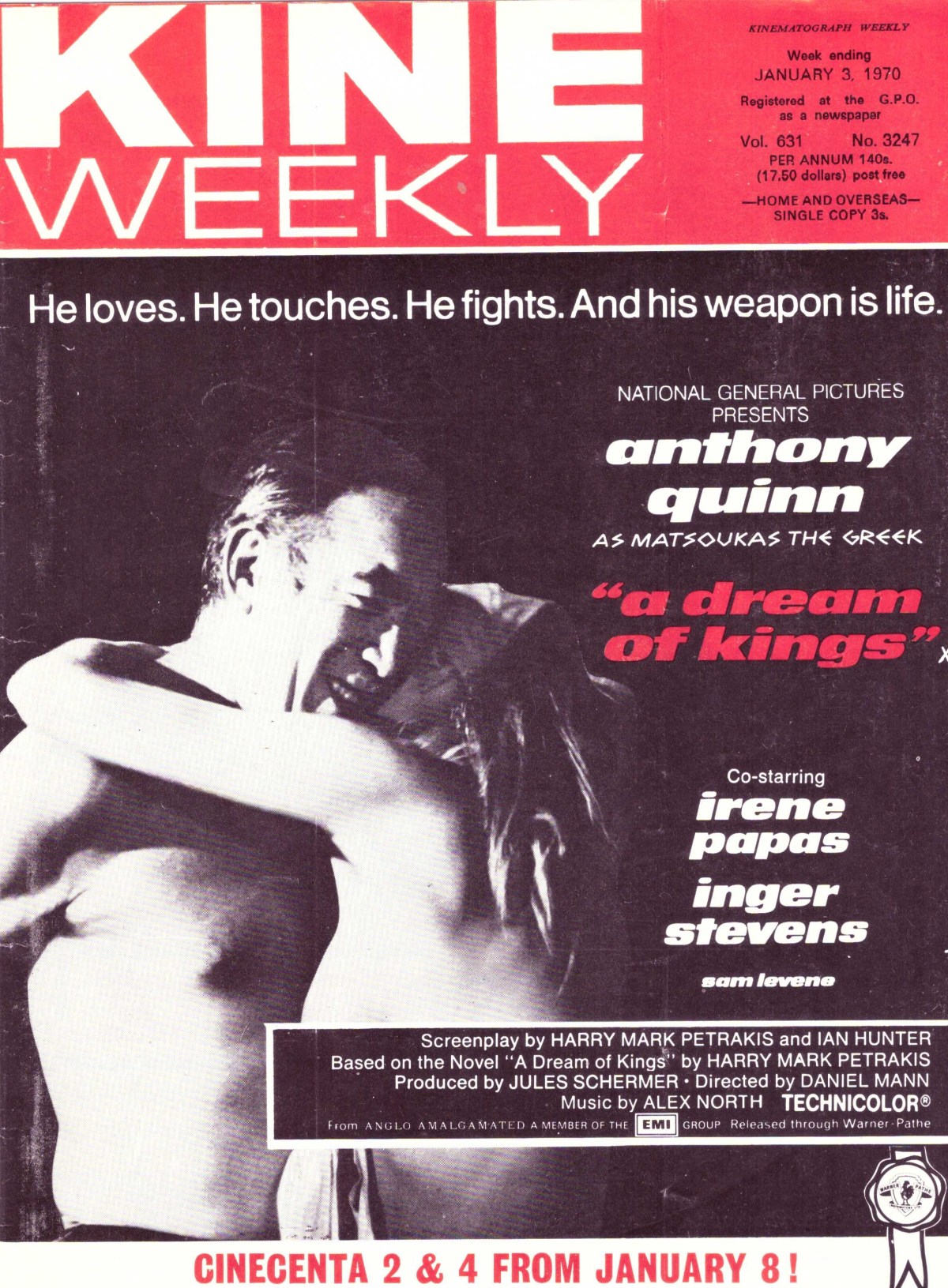
A Dream of Kings (1969) *****

Sometimes great movies just disappear. Even if they pick up some critical traction on initial release, as here, they flop at the box office. And they are not revived because the production company goes bust or the rights are complicated. Or, more likely, they don’t fit into audience expectation. All three stars here completely play against type, outliers in career portfolios. We have become so accustomed to the attraction of stars according to their screen personas that unless they are known to completely change their screen characters with every outing anything that’s different to the norm becomes unacceptable.

Director Daniel Mann (Ada, 1961) was best known for producing Oscar-winning or Oscar-nominated performances from female stars. He was immensely skilled at making audiences sympathize with the most flawed women. Here, he does the same for Anthony Quinn, in a performance that should have had Oscar voters lining up but was dismissed for all the wrong reasons. Theoretically, one of the film’s problems is the dialog. We are so used to a script full of cut-and-thrust or witty putdowns that we fail to recognize a screenplay, that in much the same way as a stage play – but without that form’s inherent artificiality – lets characters live and breathe, explore depths that are just not possible except in fleeting moments in the normal construction of a movie.

Most scenes here begin one way and then move in all sorts of directions, sometimes ending up back where they started, but most often going somewhere unexpected, not in the sense of a sudden twist, but in digging deeper into relationships and understanding that marriages are built on shifting sands, and not all of them perilous. There’s a lot of dialog and when you get a lot of long speeches it can make the actors look as though they’re hamming it up when in fact what they’re doing is opening up the character.

We shouldn’t like Matsoukas (Anthony Quinn) at all. He’s a gambler, a womanizer, drinks, comes home at sunrise, has nothing you’d call a real job.

And yet.

In his company you enter a world of possibility. By sheer force of personality he lifts gloom, even when it’s his actions that have caused it. He can convince the most downtrodden weaklings that they have something of worth.

When nobody has anything good to say about old drunk Cicero (Sam Levene), Matsoukas tells him he has a poker dealer’s graceful hands and provides solace just by befriending him. He convinces a 72-year-old man that the loss of his libido is not down to the old guy’s age but because in four years of marriage he has lost interest in his 31-year-old wife because she’s the one who has aged, physically less appealing, and then he teaches the desperate soul the gentle art of seduction, how to win a woman’s heart by putting her on a pedestal, treating her like a goddess, kissing her softly on eyes and ears rather than pawing her in frantic passion.

Just what Matsoukas’s job is – on the door it says “counsellor” which would suggest something  legal  – but in fact he’s a male version of an old wife and provides solutions to odd problems, a mother worried that her teenage son masturbates, for example.

He is the sort of guy who can wring triumph from disaster. He has just lost a bundle of dough at poker but the way he tells it you’d think he’d won. Instead, he appreciates the drama of it all, the way it makes a great tale even if he’s the loser. Naturally, wife Caliope (Irene Papas) doesn’t see it his way. She’s on her knees with trying to feed her three children from the scraps that fall from his gambling. Though when he wins big, they live like kings.

Although he still has a lusty sex life with Calope, and can mostly coax her round, he has fallen for widowed baker Anna (Inger Stevens), attracted to her in part to alleviate her grief, pull her out of the darkness.

And he cannot face up to the potential loss of his young son who has three months to live and has it fixed in his own mind that the boy will be cured if Matsoukas can expose him to the sunshine and the ancient gods of his Greek homeland, though he lacks the $700 required for the air fare.

Each sequence is long, carefully calibrated, giving time for the exploration of a wealth of emotions. Outside of the three main narratives are two other stand-out scenes. In his sermon a priest rails against the evils of life insurance that makes people welcome death yet argues, ironically, that death is a great joy and should not be feared. And there’s a party where Matsoukas on the dance floor is a magnet for every woman in the room.

This is an Anthony Quinn (The Shoes of the Fisherman, 1968) devoid of all trademark abrasiveness, the loud voice gone, trying to gouge every ounce of joy from a forbidding world. He has a very tender relationship with his dying son, inventing a game with fake telephones to deal with the boy’s fears, and is very playful with his two daughters. He is constantly wooing his wife, in part to ease the pain he causes her, but mostly because he wants them to get the most out of life.

This is a different Irene Papas (The Brotherhood, 1968) too, not the fiery woman or dutiful wife of her screen persona. Whatever anger she feels is subsumed by sorrow and she is always willing to let her husband fire up her heart as in the old days. Actresses don’t get such complex roles these days.

And all the pent-up fragility of Inger Stevens (Five Card Stud, 1968) is suddenly let loose as she twists her entire screen persona of tough woman in a man’s world – usually a western – on its head. Her scenes with Quinn are breathtaking. Unfortunately, this was her final film – she committed suicide shortly after. But she could not have found a better swansong, one that extended her range.

As he always does, Daniel Mann doesn’t take his main character’s side, but while extracting sympathy for character predicament and perspective, still lets the audience make up his mind. This could easily have gone all maudlin, the child miraculously recovering, the flight to Greece to find a rare cure, all Matsoukas’s delusion revealed as nothing more than true faith, but it’s more hard-edged than that. At the end Matsoukas has his exterior carapace ripped apart, beaten up, ostracized for committing the worst crime of a gambler – cheating – in dire straits.

And yet.

Written by Ian McLellan Hunter (Roman Holiday, 1953) from the bestseller by Harry Mark Petrakis.

I just adored this.

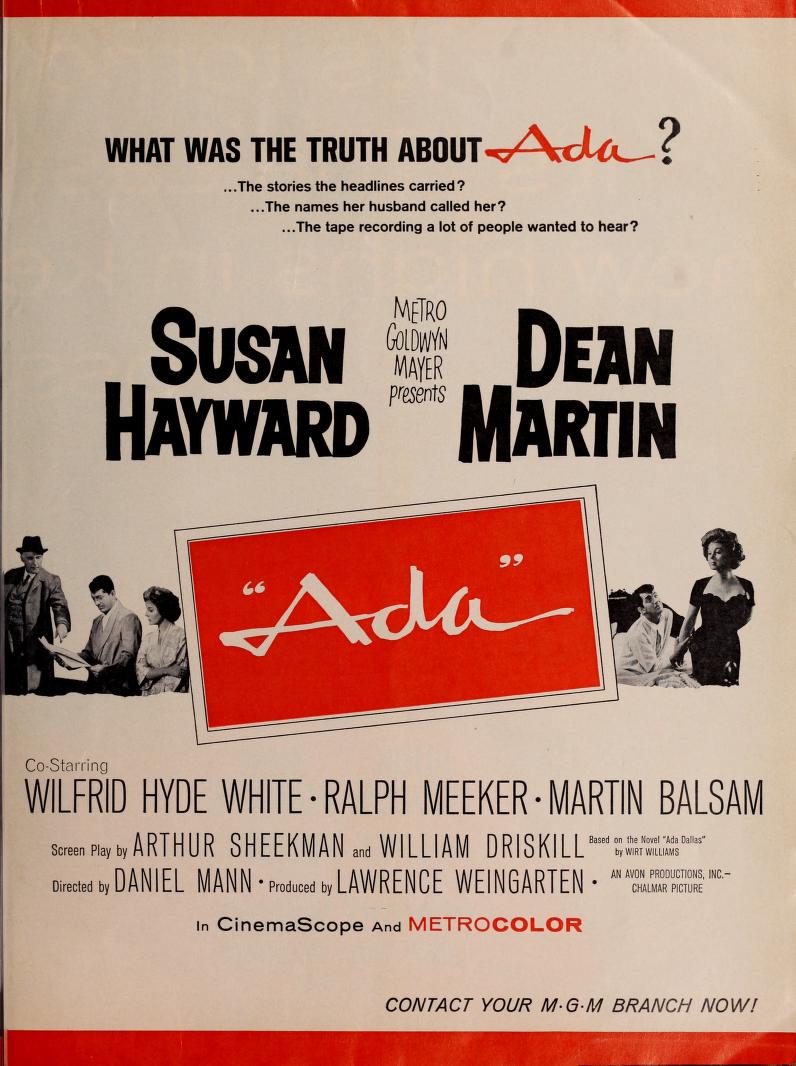
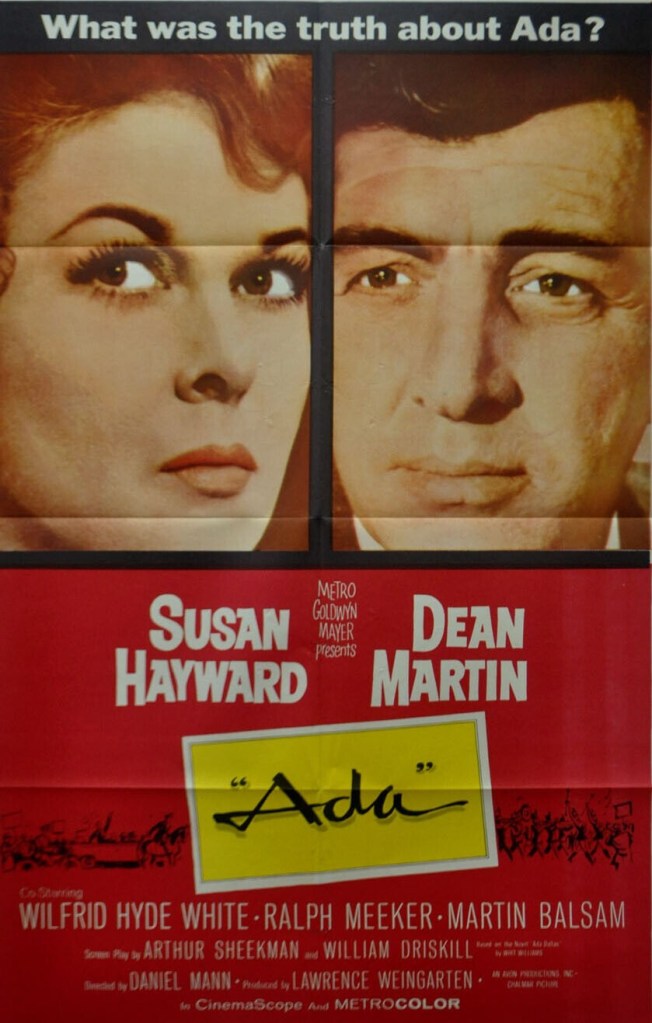
Ada (1961) ****

Oddly enough, this shares some elements with Killers of the Flower Moon. For a start Sylvester (Wilfrid Hyde-White), the political fixer, comes over as Robert DeNiro’s benign uncle, both so low-key, charming and persuasive you’d never believe them capable of  wicked manipulation. In the second place Bo (Dean Martin) is every bit as charming and baffled as Leonardo DiCaprio.

And just as the latter’s role is to worm his way into wealth and power via marriage, so too that’s the route taken by Ada (Susan Hayward), who would be euphemistically known in those days as a “good-time girl.”  

You’d figure this for a mild political satire except for the fact that stooges/buffoons have consistently made their way to the highest political office. As Ada pointedly points out, public appeal is the greatest qualification of any candidate, opportunism a close second.  Bizarre as it seems, Bo is a popular local guitar-playing-singer of the Hank Williams variety, a well-meaning dumb-as-they-come sort, whom Sylvester persuades to run for Governor. In the course of the campaign, as “a present in a back-room saloon,” he is served up Ada with whom he unexpectedly falls in love and marries.

His campaign path is smoothed when one of Sylvester’s hacks leaks news that his rival’s wife is an addict, the woman conveniently shooting her brains out. Naturally, Bo soon realizes he’s the sap, his only job to sign hundreds of legal documents every day, pieces of legislation that as it happens fill the pockets of Sylvester and his buddies.

When Bo’s long-time chum Ronnie (Frank Maxwell) threatens to expose the river of sleaze he is quickly eased out. That leaves an interesting vacancy for Ronnie was Lieutenant-Governor, Bo’s deputy. So, Ada, with a good bit more between the ears than her husband, throws her hat into the ring.

She’s to politics born, a particularly wily creature, able to bring into line the society dames who look down their nose on her, and keep tabs on Sylvester. What she doesn’t realise of course is that once you’ve got a very amenable deputy, that person becomes Acting Governor, and in effect Governor, should anything happen to the incumbent. And should she then decide she’s had enough of the sleaze, then a little poking around in her background should bring her to heel.

So, all the corruption you ever dreamt of, all the smart back-slappers ponying up thousands in campaign contributions in order to seek future reward, all that tax-payers money heading in the rich man’s pocket. Not a lot that’s new there.

What makes this stand out are the performances and the narrative arc. Wilfrid Hyde-White (The Liquidator, 1965) is a sensational casting coup. The British actor specialized in characters oozing wry charm, sometimes verging on the dotty, sometimes a tad idiotic, but never an outright swine. There are a couple of scenes where those mellifluous tones turn in an instant into a sharp crack, the avuncular replaced by the sinister.

And I’m not saying DeNiro copies his aging trick, you know the bit later on in Killers of the Flower Moon, when body no longer as sharp as the mind, the actor begins to drag his leg, and with no reference to that impairment. Well, here, similarly, the fit-as-a-fiddle Sylvester later on, still at the height of his mental powers, is seen being transported in a wheelchair.

The performance of Dean Martin (Rough Night in Jericho, 1967) was oddly dismissed at the time. And yet it was bold playing. He goes from ebullient star, enjoying being feted by all, lousy speeches lapped up by an adoring crowd, to withdrawing into himself as he realizes he has been duped. That doesn’t just take some acting skill, but considerable self-belief, to play a character who undergoes the wrong kind of transformation, not the general redemptive kind, nor sinking into some Oscar-worthy illness, but coming to terms with your own lack of ability.

Of course, Susan Hayward (Stolen Hours, 1963) delivers, as always, her screen wattage burns brighter than virtually any other female star of the period. You know the character expects her past to be exposed at any time, but she dives straight in, determined to tackle the sleaze. There’s a wonderful scene where, her background challenged by the hoity-toity society dames, she puts them in their place with a clever piece of political maneuvering.

Ada totally turns on its head the idea of the political do-gooder. She has none of the usual innocence, nor the ability to capture the crowd by seizing upon an ideal, but she’s more at home by dealing with the sleaze-merchants straight-on, taking apart their schemes in the comfort of the government’s back rooms where until now such deals have been dreamt up.

Director Daniel Mann (Judith, 1966) was known as a woman’s director. Under his direction in the Oscar stakes, Elizabeth Taylor had won for Butterfield 8 (1960), likewise both Anna Magnani for The Rose Tattoo (1955) and Shirley Booth for Come Back, Little Sheba (1953), while Hayward was nominated for I’ll Cry Tomorrow (1955). He not only chose grittier dramas but had the knack of encouraging actresses to let loose, without going overboard, on a part.  

Considerably overlooked and substantially under-rated, but not only prescient regarding future political candidates and the kind of corruption they got involved in (land deals ring a bell?) but elevated by the role of his career by Wilfrid Hyde-White, an unexpectedly good one from Dean Martin and Susan Hayward in top form.

https://amzn.to/3QGZoQC

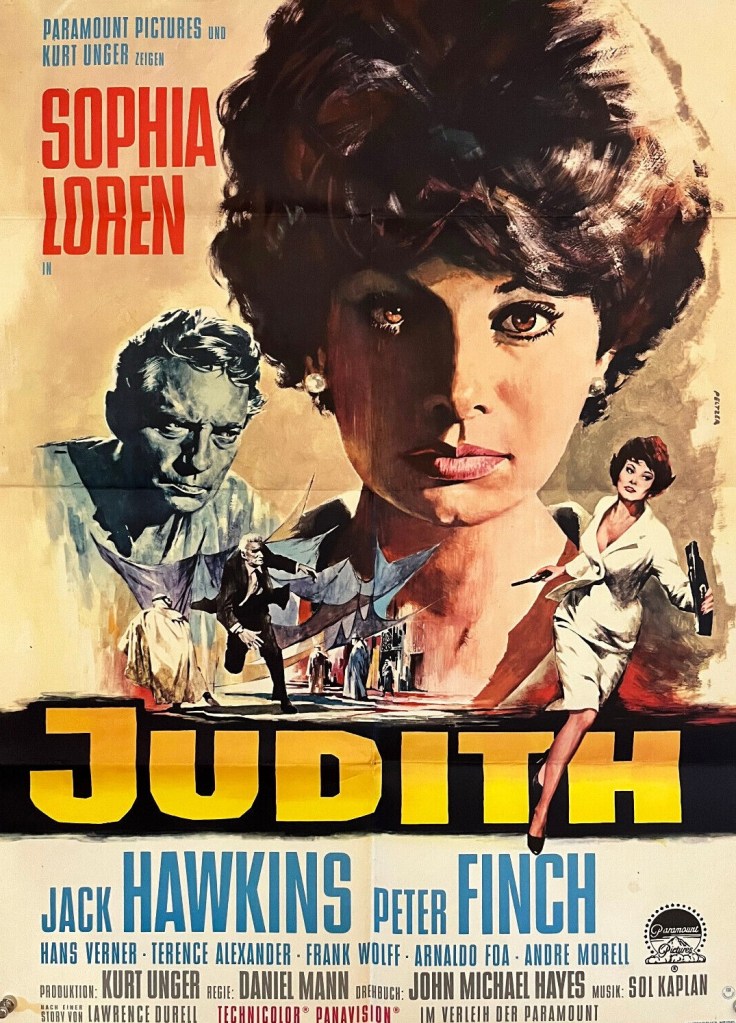
Judith (1966) ***

This is why you hire Sophia Loren. In the middle of a complicated story she provides the  emotional anchor.. And she can do it without words. A few close-ups are all you need to guess at her inner turmoil in a world where, as with Play Dirty (1968), the individual is disposable. The good guys here, Israelis fighting for survival at the rebirth of their country, are every bit as ruthless as the commanding officers in the World War Two picture.

And it’s just as well because the tale is both straightforward and overly complex. Like Cast a Giant Shadow, out the same year, or the earlier Exodus (1961), it’s about the early migrants staving off Arab attempts to destroy the tenuous foothold Jewish immigrants on the land with  the British, stuck in the role of maintaining law and order, cracking down on illegal landings of refugees and arms smuggling.  But where the earlier movies take the war to the enemy, this is all about defence, holding on to hard-won positions.

Israeli leader Aaron (Peter Finch) discovers General Schiller (Hans Verner), a former German WW2 commander wanted for war crimes, currently in charge of the Arab tank regiment, is planning imminent assault. After locating Schiller’s wife Judith (Sophia Loren), he smuggles her into Israel with the intention of using her as bait to kidnap the general.

This would be no romantic reunion. The general had abandoned his wife, a Jew, and she spent the war in Dachau where she survived as a sex worker. She wants nothing more than revenge. But it takes a fair while for the cloak-and-dagger elements to warm up. First of all she has to seduce British Major Lawton (Sophia Loren) into revealing details of her husband’s whereabouts.

Turns out Lawton is the only principled official on show, out of general decency and a British sense of fair play (unlike the soldiers, for example, in Play Dirty)  turning down the offer of her body in return for his aid.  But it also transpires that Judith also lacks any notion of fair play and stabs her husband at the first opportunity, making it virtually impossible for his captors to discover the specifics of the planned attack. You wouldn’t need much of a sense of irony to share the Israeli anger when uner interrogation the captured general tosses back at them the Geneva Convention.

Judith’s involvement in the hunt for the general had the potential to be a very fine film noir on its own, especially had the wife been required to show willing to the husband in order to lure him out into the open.

Unfortunately, that’s not the tack the movie takes. Instead, we follow a series of forgettable characters either espionage agents, or at the kibbutz or effectively just there in passing, on the edge of the action, even when they might be in the heart of the real action either being unloaded into the surf or under attack from Arabs. There’s a sense of trying to cram too much historical incident into what would have worked best as a straightforward thriller. How far would Judith go to extract revenge? And, can Aaron stop her ruining his delicately-balanced plans?

Plenty of room for maneuver too on the sticky point of country vs individual. Where Aaron is happy to sacrifice or exploit Judith to satisfy his agenda, albeit to the greater glory of his country, so, too, is Judith unwilling to surrender her individuality for that more beneficial cause.

So what we get is a riveting mess. When Sophia Loren (Operation Crossbow, 1965) is onscreen you can’t take your eyes off her. When the action switches to the sub-plots, you keep on wondering where she’s got to and when will she next turn up. Judith is a fascinating character, batting away contempt about the way she survived the concentration camp, arriving in an old-fashioned cargo container with the corpse of a companion who failed to last the journey, and before long sashaying through the kibbutz delighted to attract male attention.

Yet, despite the hard inner core, and keeping one step ahead of both Aaron and Schiller, as if she had long ago stopped trusting men, she is emotionally vulnerable and proves easily manipulated when either pierces the carapace.

That director Daniel Mann feels duty bound to attempt to tell the bigger story of the Israeli struggle is  somewhat surprising since he was best known as a woman’s director. Under his watch both Shirley Booth and Terry Moore were Oscar-nominated for  Come Back, Little Sheba (1953), both Susan Hayward and Anna Magnani Oscars winners for I’ll Cry Tomorrow and The Rose Tattoo, respectively.

John Michael Hayes (Nevada Smith, 1966) cooperated with Lawrence Durrell (Justine, 1969) on the screenplay.

Worth it for Sophia Loren’s stunning performance.

Discover WordPress

A daily selection of the best content published on WordPress, collected for you by humans who love to read.

The Atavist Magazine

by Brian Hannan

WordPress.com News

The latest news on WordPress.com and the WordPress community.