Too many hidden secrets turn this into a Peyton Place of a western. When the final unexpected zinger strikes home the movie has nowhere to go and undercuts the climax. Director Robert Aldrich also lets Kirk Duglas off the leash so there’s too much of him festering to put the outcome in any doubt. Strangling a vicious dog with your bare hands is usually a sign of heroism but here it just undermines Douglas’s character.
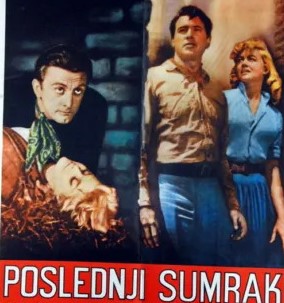
Wanted murderer O’Malley (Kirk Douglas) has skipped to Mexico away from the long arm of the American law. Nonetheless, lawman Stribling (Rock Hudson) is in pursuit, presumably hoping to kidnap him and drag him back over the Rio Grande into U.S. jurisdiction. The story, in a major narrative flaw, finds another way to head O’Malley north.
Anyways, O’Malley is in Mexico not just to escape, but for a more sentimental reason, he wants to hook up again with first love Belle (Dorothy Malone). The fact that she’s married to limping ex-Confederate soldier Breckenridge (Joseph Cotten) appears to make no difference. And when O’Malley strikes up a deal to help Breckenridge drive his herd of cattle to Crazy Horse, a town over the Rio Grande, he tells the husband of his romantic intent.
This would usually spell trouble except the narrative conveniently disposes of the husband. However, by this point the lawman has also thrown his hat into the romantic ring, having signed up to become trail boss. You can see the logic in Stribling’s decision. If O’Malley’s heading in the right direction then it makes it easier for Stribling to get him over the border.
What doesn’t make any real sense is Breckenridge’s hiring of O’Malley in the first place, or the deal the outlaw negotiates. O’Malley would go along in any case for a meal of beans a day just to keep track of Belle who’s the appointed cook for the ride. Instead, and with no cattle herding skills in evidence, he manages to get Breckenridge to agree to give him one-fifth of the herd as a bonus in addition to the normal pay of a dollar a day. Although the audience has already guessed O’Malley’s romantic purpose, he spells it out to the rancher, “I want your wife” the rider to the deal.
O’Malley takes little notice of Belle’s diffidence. The man who was once an enticing prospect to an inexperienced young girl is now presented in a different light. “You carry your own storm wherever you go,” she tells him. She no longer has a hankering to end up just “a survivor,” not convinced by his plan to settle down with the money from the sale of his share of the herd.
As usual, the trail ride has sufficient incident – lightning storm, stampede, a brush with Native Americans, saloon gunfight, a trio of no-goods hitching a ride, a sighting of St Elmo’s Fire and that old trope quicksand – to keep the story moving without the love triangle and what actually turns out to be a revenge tale.
The story takes some unexpected turns. Stribling is a pretty efficient cowboy, seeped in western lore, knows how to keep a herd in shape. He heads off a marauding tribe by trading some of the herd, in compensation for the innocent man O’Malley instinctively shot dead. Belle needs to kill a man to defend herself. And O’Malley, romantic ambitions thwarted by Stribling, starts wooing Belle’s daughter Missy (Carol Lynley) who, no surprises there, reminds him of Belle at a younger age.
As the secrets come spilling out, it becomes apparent that O’Malley has seduced Stribling’s sister whom the outlaw disses as an easy lay – “your sister was a free drink on the house” – and more importantly that his sister has hung herself after O’Malley killed her lover. Double revenge, I guess, to steal Belle and take O’Malley back to face justice.
You might have wondered how Belle ended up with Breckenridge in the first place and it’s not the soldier-wounded-in-battle routine. It’s because he made an honest woman out of her after – or maybe before – Missy was born out of wedlock. And when Belle sees how serious Missy is about O’Malley she reveals that he’s the father. Leaving O’Malley to do the right thing and not load his pistol when he heads for his shoot-out with Stribling once they have crossed the Rio Grande.
The ending smacks of star redemption. Kirk Douglas can play a mean guy better than most and he’s got no problem being tagged an outlaw but to lose a shoot-out would render him the loser whereas noble sacrifice turns him into some kind of winner. That notion doesn’t take into account that Stribling was guaranteed to win the shoot-out anyway since O’Malley’s weapon of choice is the Derringer, ideal for shooting someone standing right next to you, not a lot of good in a shoot-out where your opponent is twenty feet away.
The narrative twists and turns enough to keep you interested but with every secret revealed the flaws are only too apparent. Rock Hudson (Seconds, 1966) wins the duel of the big stars, a wider range of emotions on show but as tough as his rival and with western skills to boot. We’ve seen this brooding Kirk Douglas (The Arrangement, 1969) too many times before. Dorothy Malone (who had partnered Hudson in Douglas Sirk number The Tarnished Angels, 1957) is good as the woman who knows her own mind. Joseph Cotten (The Oscar, 1966) probably signed up not for the chance to show off his limp but for the scene in the saloon where his myth of Civil War heroism is cruelly exposed. Carol Lynley (Bunny Lake Is Missing, 1965) convincingly transforms from dutiful daughter with a Disney-esque affinity with animals to woman.
Robert Aldrich (The Flight of the Phoenix, 1965) looks hamstrung by the Dalton Trumbo (The Fixer, 1968) script based on the novel Sundown at Crazy Horse by Howard Rigsby.
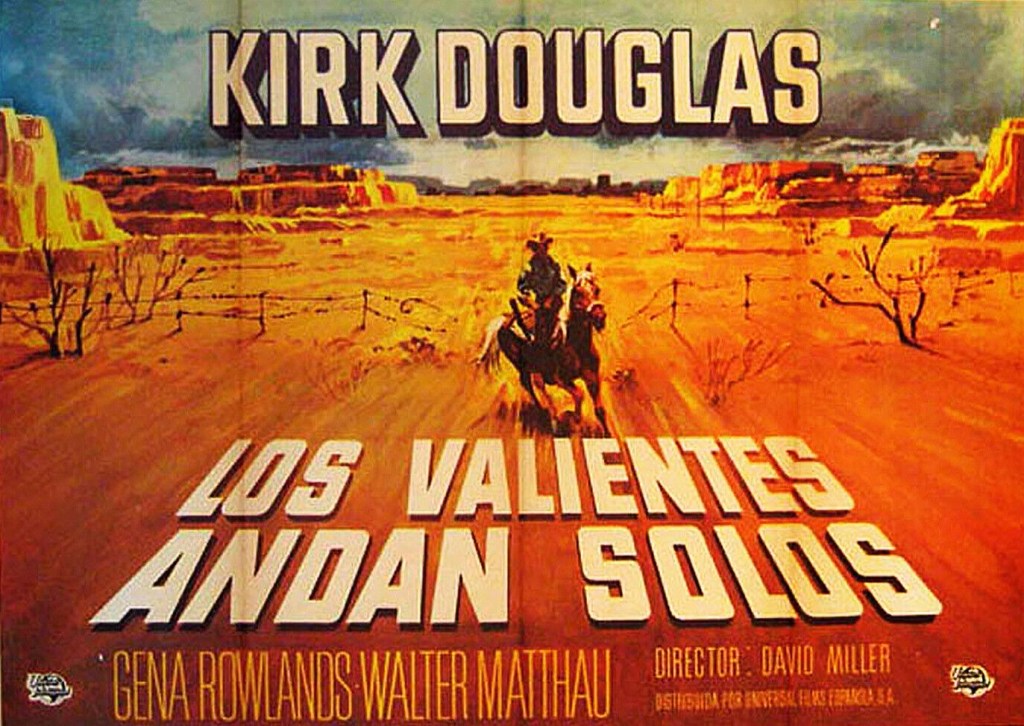
Wannabe blood brother to The Misfits (1961) but more like a distant cousin, cowboy out-of-time yarn too pre-emptive for its own good. Freedom-loving, don’t-fence-me-in Jack Burns (Kirk Douglas) falls foul of the law by escaping prison and is pursued into the hills by competent and sympathetic Sheriff Morey Johnson (Walter Matthau) who is saddled with an incompetent law enforcement team out of their depth up against a true man of the west. You can see the end coming a mile off, a truck that interrupts the narrative for no particular reason.
The only problem for me are certain inconsistencies. A man who refused to be tamed tames a wild horse, his freedom coming at the expense of a captive animal, hobbled overnight to prevent escape. And instead of leading a frightened beast across a busy highway rides him in clear danger.
And I don’t get this voluntary incarceration malarkey, highly principled though it appears, breaking into jail in order to break out a friend Paul (Michael Kane) who just wants to serve out his relatively short sentence instead of being faced with a longer one as an escapee.
Jack won a Purple Heart in Korea but although he was 22 when World War Two broke out there’s no mention of that war record. And it seems a bit of an unlikely cliché that you can still break out of prison in the 1960s with just small hacksaw.
David (Hammerhead, 1968) Miller’s film tries too hard to make a very obvious point, forgetting that it was cowboys like Jack who turned the West into the antithesis of freedom. There are some unexpected touches. Jack, wanting to start a brawl as a means of being arrested, finds himself with a tougher customer than he envisaged, a World War Two veteran who doesn’t take prisoners. There’s a nod towards immigrants swarming into America. Paul, knowing he has crossed a line in the contemporary world, just wants to pay his debt and move on, rather than trying to disappear into a fantasy life. Cops, with all the modern accoutrements, find themselves undone by a man with old world skills.
R.F.D. stands for Rank Film Distributors, patting itself on the head for getting the picture off to a good start in the London West End.
Once the movie heads into the hills, which is what all this lengthy preamble is for, it becomes more interesting, if only because in what is intended to be a game of cat-and-mouse, the cop cats are revealed as the mice.
But Kirk Douglas, having lit a fire for freedom in Spartacus (1961), seems more intent on going down a similar route than creating a proper character. And, as usual, given he is top-billed, reveals acting insecurity, or arrogance, trying to steal every scene, tipping back his hat just one of his many bits of business to ensure the audience eye follows him.
On the plus side is some notable playing by Walter Matthau (Mirage, 1965), encumbered with a bunch of lazy cops who spend more time eating and sleeping than doing their job and easily outgunned in the wilderness by a cowboy for whom it spells home. Gena Rowlands (Machine Gun McCain, 1969) is impressive as Paul’s worn-down wife with a soft spot for Jack though she finds it hard to stand by a dumb man. George Kennedy (Cool Hand Luke, 1967) makes a mean sadistic cop. And there’s an early role for Carroll O’Connor (The Devil’s Brigade, 1968). If you’re talent-spotting Bill Bixby (television’s The Incredible Hulk, 1977-1982) is a helicopter pilot.
Kirk Douglas and business partner Edward Lewis were the producers and hired the former blacklisted Dalton Trumbo (Spartacus) to script Edward Abbey’s novel Brave Cowboy.
I thought the title was a bit of misnomer: Lonely Are the Foolhardy might be more accurate.
Unusually for an Otto Preminger project, this took an unconscionably long time to get off the ground, given he had purchased rights to the bestseller by Evelyn Piper which had been published in 1957. The first problem was that no one could lick the screenplay. Getting first bite was Ira Levin (Rosemary’s Baby, 1967), followed by “wholesale doctoring” by Dalton Trumbo (Exodus, 1960) who delivered a “polished script.” But that failed to satisfy the director either and triggered further attempts by Charles Eastman (Little Fauss and Big Halsy, 1970) and Arthur Kopit (Oh Dad, Poor Dad, Mummy’s Hung You in the Closet and I’m Feeling So Sad, 1967). But nobody seemed able to come up with a satisfactory job. The book had been set in New York as had the various subsequent screenplays. The solution appeared to be to shift the location some 3,000 miles to London. Penelope Mortimer (The Pumpkin Eater, 1964) wrote a draft but ended up having a fight with Preminger and withdrew and the project was completed by her husband John Mortimer (John and Mary, 1969).
The Levin screenplay was dismissed as being too faithful to the book, the kidnapper in this instance turning out to be a former teacher who was childless and afflicted with “menopausal psychosis,” a character Preminger found weak and uninteresting. Trumbo changed the villain into a wealthy woman, not just childless but judged unfit to adopt, an approach the director deemed “very theatrical and wrong.” The Kopit and Eastman versions offered no better solution. “I almost gave up Bunny Lake,” admitted Preminger, “because while working in the script I realized that women would not like the film…because they are afraid of all situations in which a child is in danger.” After considering transplanting the story to Paris, Preminger finally settled on London, and hired the Mortimers whose villain brought the picture a 2new dimension.”
Until now, and in keeping with the original novel, Newhouse, while assisting in the investigation, had been a psychiatrist. In the hands of the Mortimers he now morphed into a police inspector. Wilson who had been Newhouse’s quite respectable friend turned into a drunken reprobate. At this point the heroine’s name remained Blanche as in the book. There was one other significant element that changed between the initial Mortimer script and the final shooting script: at the start of the film the Ann and Steven were shown reacting as if the child was there, whereas when the movie went before camera the question of the child’s existence remained in doubt. Penelope Mortimer dropped out when, summoned with her husband to Honolulu where Preminger was filming In Harm’s Way, she was roundly ignored.
Filming was originally scheduled to slip in between Anatomy of a Murder (1959) and Exodus (1960) with a budget set at $2 million. But something always seemed to get in the way. Occasionally it was a bigger project. After Columbia announced filming was scheduled for 1961, Bunny Lake was pushed back to spring 1962 to permit the filming of Advise and Consent (1961). Then The Cardinal (1962) took precedence but only to the extent of shifting the Bunny project till later that year. Then it was set to be completed by fall 1963. Further cause of delay was the decision to accommodate the pregnancy of that Lee Remick who had signed for the leading female role. But when she was ready to go, Preminger was not and she fell out of the equation.
At one point, fearful of his schedule becoming too crowded – filled with expensive projects like The Cardinal and In Harm’s Way (1965) – Preminger had tried to wriggle out of the directorial commitment, planning to limit his involvement to producing only, but studio Columbia would not accept this. Preminger was in considerable demand, like a major movie star contracted to deals with rival studios, in 1961 for three pictures with United Artists and four for Columbia and by 1965 adding into the mix a seven-picture deal with Paramount, and most of these big pictures, leaving little time for a relatively low-budget – by his standards – picture.
A good example of the British distribution system. The film opened at the Odeon Leicester Square and quickly went into general release, first in cinemas in North London and a week later the prints shifted to South London. In the West End, it ran solo, in the suburbs as a double bill.
Finally, Bunny Lake received the green light with filming beginning in London on April 9, 1965. Unusually, the movie was shot entirely on location, the director expressing a “yen for realistic on the spot” filming in a dozen places including a pub, the Cunard office and Scotland Yard. A school in Hampstead doubled for the nursery, the mews flat was found just behind Trafalgar Square. He was quick to point this was not a matter of economy. “What you save in studio (time) you spend in other ways. But I think it leads to more urgent film-making.” Somewhat surprisingly, he aimed to shoot in black-and-white, colour now being predominant except for low-budget movies and those wishing to take advantage of black-and-white world War Two newsreel footage as was the case with his previous picture In Harm’s Way.
Carolyn Lynley (The Pleasure Seekers, 1964) was given the lead with Keir Dullea (David and Lisa, 1962) in the pivotal role of her brother. Neither could be considered a big star although Lynley had the second female lead in The Cardinal and moved up the credit rankings to female lead in the low-budget Shock Treatment (1964). But she was such a hot prospect Preminger in 1965 signed her to a four-picture deal although this was not exclusive as she also had contracts with Twentieth Century Fox and Columbia. Dullea was potentially a better prospect, picking up some acting kudos for David and Lisa, the designated star of that picture and The Thin Red Line (1964) but only second lead for Mail Order Bride (1963) and the Italian-made The Naked Hours (1963).
Although some decades away from his Hollywood box office prime, the casting of Oscar-winner and five-time nominee Laurence Olivier (Spartacus, 1960) was something of a coup, although he was only hired because another actor proved too expensive. Other parts were filled by actors experienced in the Preminger school of film-making, Martita Hunt from The Fan (1949)- and Bonjour Tristesse (1958), Victor Maddern (Saint Joan, 1958) and David Oxley (Saint Joan and Bonjour Tristesse).
The first day’s shooting was in a television studio to capture the newsreader and pop group The Zombies which the content of the show shown in the pub on television. Contrary to depictions of Preminger as a martinet on set, he was keen in rehearsals to “put everyone at ease” although he emphasised the need for “slow, thoughtful diction.” The famous Preminger wrath came down heavily on personnel failing to carry out their job correctly. But he accepted Olivier’s decision to omit a particular phrase. He was specific about the look he wished to achieve, required high contrast black-and-white cinematography while nothing was to be done “to enhance Carol Lynley’s beauty: instead…to deepen her features, bring out her emotions.”
And he was determined to get what he wanted, 18 takes required to complete a lengthy tracking shot that flows Inspector Newhouse (Laurence Olivier) and Miss Smollett (Anna Massey) as they negotiate a passage through a group of noisy children in a classroom and then across a hall. Accepting Lynley’s difficulty in expressing the pain of losing a child, he instructed her to forget about subtext and play the moment. However, 14 takes of a scene between Lynley and Olivier was too much for the actress but she was comforted when Preminger told her the famous actor was the problem not her. But on another occasion, Preminger ended up giving her an almost line for line reading of how he wanted the scene played. The only way he got what he wanted was to reduce her to “sobbing uncontrollably” and then start the camera rolling.
Without question, Keir Dullea came off first. “He would humiliate you, he would scream at you…his dripping sarcasm was the worst of it,” recalled Dullea. “I was always very prepared in terms of knowing my lines…but the stress, there was some action where I was supposed to put a glass down or pick up a glass” that Dullea kept getting wrong. In face of what he deemed incompetence, Preminger accused him of being “an actor who can’t even remember a line and if heremembers a line he can’t remember an action…what, you can’t do these two things at the same time.” In the end Dullea faked a nervous breakdown and after than “he never screamed at me again.”
Olivier would occasionally coming to rescue, persuading the director to ease off and “stop screaming at the children.” Olivier found Preminger such a bully that it “almost put me off his Carmen Jones, which I found an inspired piece of work…It’s a miracle it came from such a heavy-handed egotist.” On the other hand Noel coward, who played the landlord Wilson, believed Preminger an excellent director.
Preminger spun his marketing on a similar gimmick to that utilised by Alfred Hitchcock for Psycho (1960) in preventing the public from entering once the movie had started. To make this more dramatic, he had clocks installed in the lobbies of theaters that counted down the length of the performance and a sign that stated “nobody admitted while the clock is ticking.” Preminger was credited with coming up with a longer tagline for the advertisements: “Not even Alfred Hitchcock will be admitted after the film has started.”
The only problem was Return from the Ashes, released at the same time, had adopted a similar marketing ruse, nobody admitted “after Fabi enters the bath.” Despite this, Preminger went hell-for-leather for this marketing trick, to the extent of adding a rider to exhibitor standard contracts to that effect, not a problem in more sophisticated cities where by now patrons had become accustomed to turning up for a picture’s announced start time but a problem in smaller towns and cities where the whole point of continuous programme (i.e. no break between one film and another) was that moviegoers could walk in whenever they liked.
The whole tone of the marketing did not meet the approval of two important segments of the greater movie community. The National Association of Theater Owners opined that the marketing campaign was weak and were astonished to learn that there was nothing Columbia could so about it – Preminger had advertising-publicity approval. Allowing that some of the advertising images for Preminger pictures, courtesy of designer Saul Bass – The Man with the Golden Arm (1953), Anatomy of a Murder, Exodus etc – were among the most famous in Hollywood history, it would appear Preminger knew what he was doing. But, in fact, although the Saul Bass credit sequence showing pieces of newspaper being torn away made sense in the framework of the picture, the idea was not so effective taken out of that context.
Not intentionally, perhaps, Preminger also riled the critics, deciding that to “preserve the secrecy of the surprise ending,” the movie would open without the normal advance screenings for reviewers. Such action was more likely to set alarm bells ringing, it being a standard assumption among critics that the only films that went down this route were stinkers. From a practical point-of-view it also ensured that marketing was undercut since the lack of timed reviews denied the picture an essential promotional tool.
Finally, the movie ended up in a war with the censors. Many states in the U.S. had their own censors. Columbia objected to having to wait on the say-so of a local censor – in this case Kansas – before being able to release a movie. And for any release to be delayed if there was any nit-picking by the censor, especially as this movie had an undercurrent of incest. So Columbia refused to conform and failed to submit Bunny Lake Is Missing to the Kansas censors. After being promptly banned for such arrogance, Columbia objected again and the case went to the Kansas State Supreme Court which judged that the censor was unconstitutional. That resulted in the censors losing their jobs when the board was abandoned and the movie entering release a good while after its initial opening dates.
Although it made no impact at the Oscars, Village Voice critic Andrew Sarris picked it as one the year’s ten best and it was nominated for cinematography and art direction at the Baftas. The film was a flop, failing to return even $1 million in rentals at the U.S. box office. In fact it probably made more when it was sold to ABC TV for around $800,000.
SOURCES: Chris Fujiwara, The World and Its Double, The Life and Work of Otto Preminger, p330-342; (Faber and Faber, 2008) “Trends,” Variety, January 14, 1959, p30; “Ira Levin Pacted by Preminger for Bunny,” Variety, September 2, 1959, p2; “Col Primed To Start ½ Dozen Prods,” Variety, April 5, 1961, p3; “Otto Preminger Views Film Festivals As Important Marketplaces,” Box Office, May 1, 1961, p11; “Trumbo May Script for UA,” Variety, May 31, 1961, p5; “Bunny Lake Delayed,” Variety, June 7, 1961, p18; “Preminger Postpones One,” Box Office, June 12, 1961, p13; “Otto Preminger to Film Cardinal for Col,” Box Office, August 7, 1961, -10; “Otto Preminger Is Guest of Soviet Film Makers,” Box Office , May 14, 1962, pE-4; “Two Writers Signed,” Box Office, August 6, 1962, pSW-3; “Preminger,” Variety, September 12, 1962, p15; “Preminger’s New Rap at Costly U.S. Distribution,” Variety, October 10, 1962, p7; “Preminger Gets Rights to Hurry Sundown,” Box Office, November 23, 1964, p9; “Prem’s Next in London,” Variety, January 13, 1965, p18; “Preminger Signs Actress for Four More Pictures,” Box Office, February 8, 1965, pW-3; “Advertisement,” Variety, April 7, 1965, p1; “Preminger-Paramount Pact Calls for 7 Films,” Box Office, April 26, 1965, p7; “100% Location for Bunny,” Variety, May 5, 1965, p29; “Not Even Hitch,” Variety, September 1, 1965, p4; “Preminger’s Nix on Pre-Opening Critics,” Variety, September 22, 1965, p16; “2 Pix Enforce Entrance Time on Ticket Buyers,” Variety, September 29, 1965, p5; “Time Rules Are Set for Bunny Shows,” Box Office, October 4, 1965, p13; “Preminger’s Promotional Prerogative,” Variety, October 27, 1965, p13; “Clock for Bunny Lake,” Box Office, November 8, 1965, p2; “Village Voice Vocal on Bests,” Variety, January 26, 1966, p4; “Col Kayos Kansas Censoring,” Variety, August 3, 1966, p5.
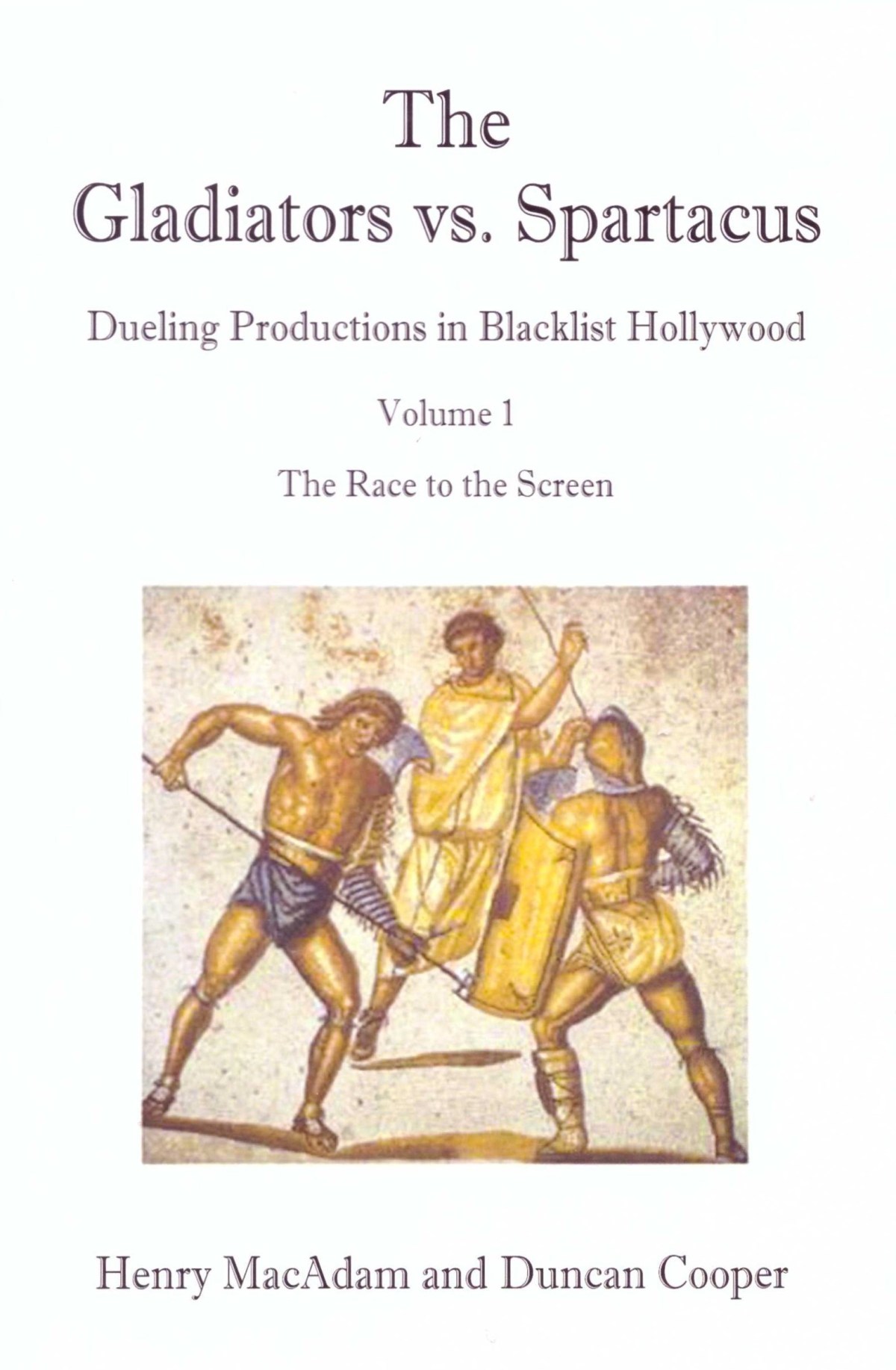
When I wrote my book some years back on the making of The Magnificent Seven (1960) I was aware that Yul Brynner had attempted to set up a project called The Gladiators in direct opposition to rival Kirk Douglas venture Spartacus. What I didn’t know until I came across this fascinating new book, telling the untold story of The Gladiators vs. Spartacus, Dueling Productions in Blacklist Hollywood by Henry MacAdam and Duncan Cooper, was just how close Brynner came to derailing the Douglas production. Indeed, at first it appeared Brynner’s The Gladiators, based on the novel by Arthur Koestler (Darkness at Noon, The Ghost in the Machine), was a cinch to be first past the post. After winning the Best Actor Oscar for The King and I (1956) and starring in box office behemoth The Ten Commandments (1956), Brynner was set to become a movie mogul after being handed a record $25 million – $230 million at today’s prices – from United Artists for 11 pictures. His first project was The Gladiators on a $5.5 million budget, Meanwhile, Douglas, rejected for the title role in the forthcoming Ben-Hur, his picture Paths of Glory (1957) producing dismal returns, struggled to find funding for Spartacus, based on the book by Howard Fast.
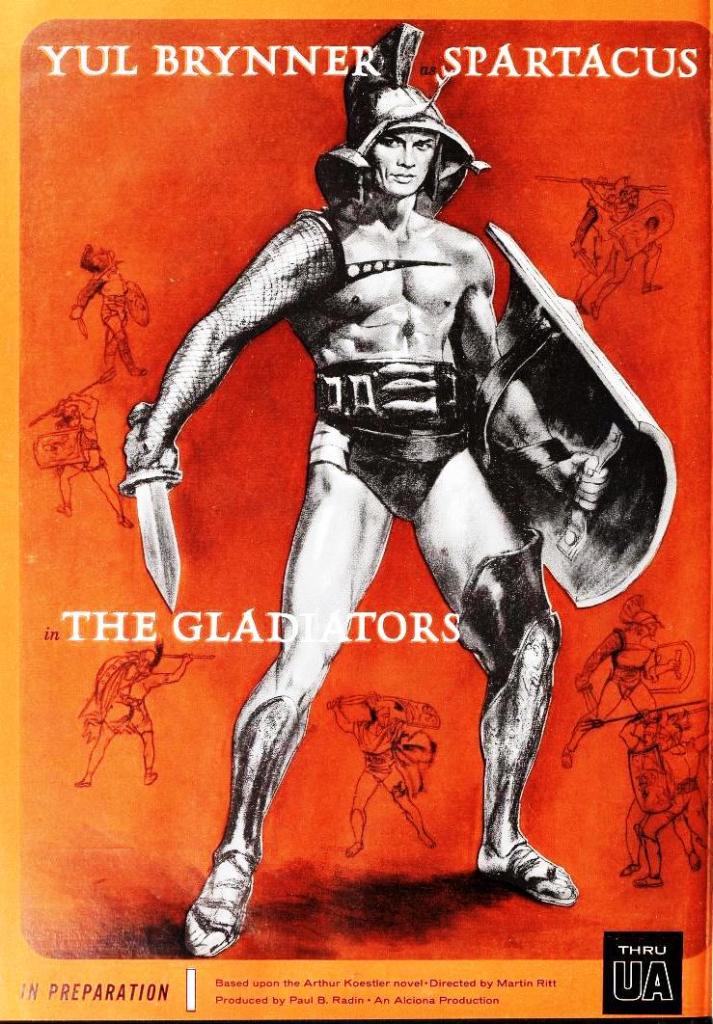
Promotional ad in 1958 for Yul Brynner as Spartacus in ‘The Gladiators.’
There are instances of two studios embarking on similar projects at the same time – sci fi adventures Deep Impact and Armageddon appeared within months of each in 1998 but Warner Bros and Twentieth Century Fox decided to combine competing movies about a skyscraper on fire into The Towering Inferno (1974). Here, as much as efforts were made to combine the projects both actors were determined to continue the battle despite the potential competition. At another point, Brynner sought to recruit Douglas for The Magnificent Seven. The race to the screen went back and forth for a couple of years, Brynner unable to choose between the historical drama and the western, while Douglas had the luck to have as his agent Lew Wassermann, in the process of buying up Universal who determined that Spartacus would be the ideal prestige vehicle to relaunch the studio.
What gives this volume special significance is that the films were being produced against the backdrop of the blacklist, the anti-Communist hysteria stirred by HUAC in the late 1940s/early 1950s. Screenplays for both films were the work of blacklisted writers, Abraham Polonsky on the Brynner side and Dalton Trumbo for Douglas. Polonsky was writer-director of Force of Evil (1948) as well as writer of another quintessential film noir Body and Soul (1947), for which he was Oscar-nominated, before his career was prematurely interrupted. Trumbo was held in even greater esteem, Oscar-nominated for Kitty Foyle (1941), and with A Guy Named Joe (1943) under his belt. While blacklisted, both wrote under “fronts”, Trumbo responsible for the Oscar-winning screenplays for Roman Holiday (1953) and The Brave One (1956), Polonsky successfully switching for a time to television. Both productions proceeded with the need to keep secret the real screenwriters, Ira Wolfert fronting for Polonsky, author Howard Fast unknowingly doing the same for Trumbo.
The parallel tales of two ambitious producers dueling for supremacy and of two blacklisted writers fighting for survival make a thrilling read. At any moment, either production could be killed by revelations about the screenwriters, while the planned films faced a succession of what seemed sometimes insurmountable obstacles. Both movies pursued, for example, the same three stars – Laurence Olivier, Charles Laughton and Peter Ustinov. Martin Ritt, initial director for The Gladiators, dropped out while Anthony Mann, in the same position for Spartacus, was fired. Script problems dogged both pictures. Rivalry was conducted openly in the trade press while the productions clashed over the title. Even when Spartacus nudged ahead in the production process, the spiraling budget almost put paid to the endeavor, while The Gladiators hovered in the background, intent on capitalizing should, as appeared for a long time the most likely outcome, the Douglas film flop at the box office.
The third riveting element of this book is a scoop. The authors have located the original Polonsky screenplay for The Gladiators, believed lost for over 60 years, and so are able to contrast the different approaches to the subject of the Spartacus revolution. (In a separate volume, the entire screenplay has been published with annotations and critical commentary by Fiona Radford and background essays by MacAdam and Cooper). Koestler was a cult figure, far better known than Howard Fast, and has remained in the literary consciousness ever since his suicide in 1983. With The Gladiators failing to reach the screen, Polonsky remained under the Hollywood radar for several years before his career revived with the screenplay for Madigan (1968) and as writer-director of modern western Tell Them Willie Boy Is Here (1969) starring Robert Redford. The revelation that Trumbo had written Otto Preminger’s Exodus (1960) and the involvement of Polonsky in The Gladiators helped break the blacklist. Trumbo went on to enjoy a successful official comeback, biopic Trumbo (2105) depicting the tribulations he suffered as a blacklistee.





 The Magnificent 60s