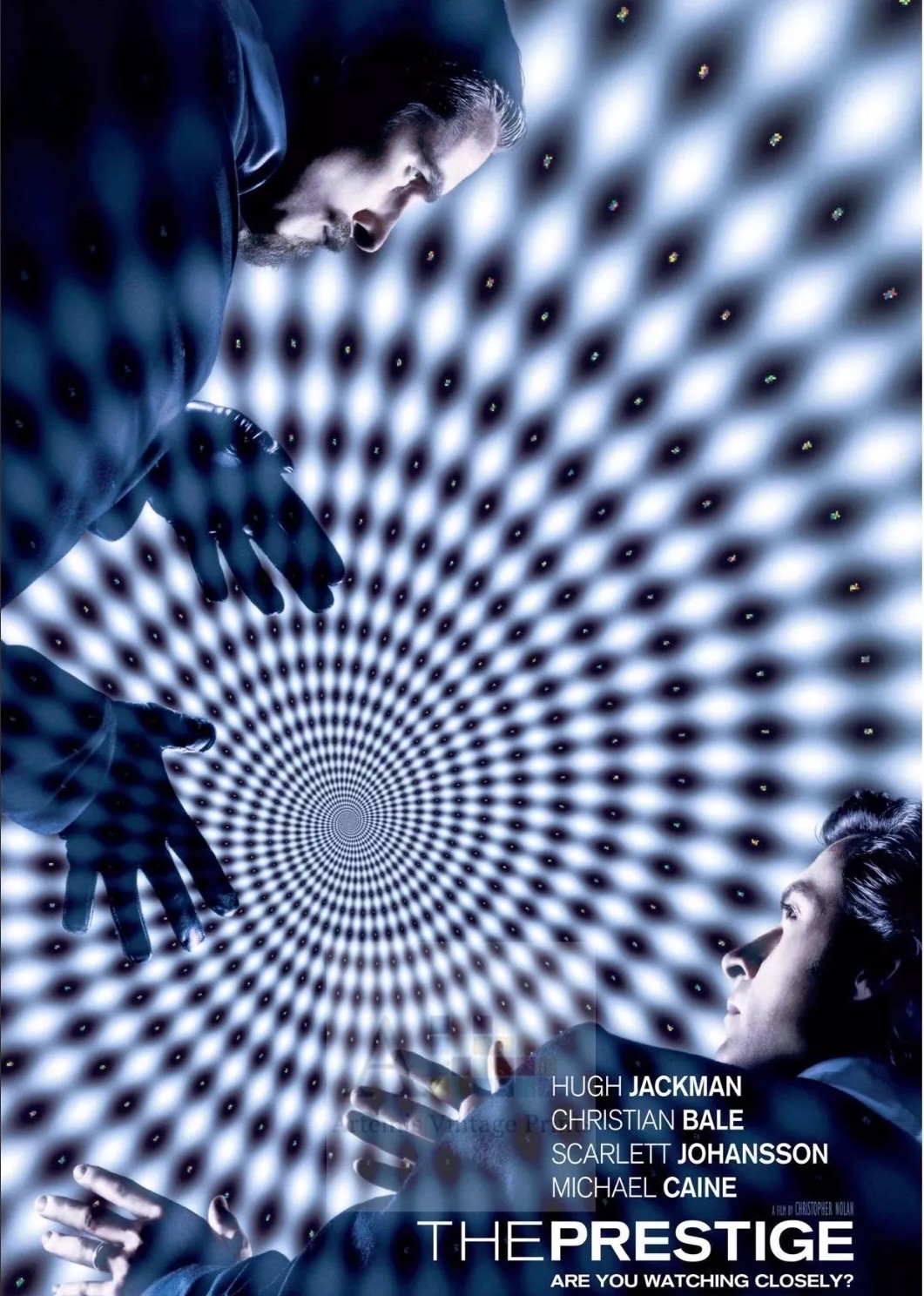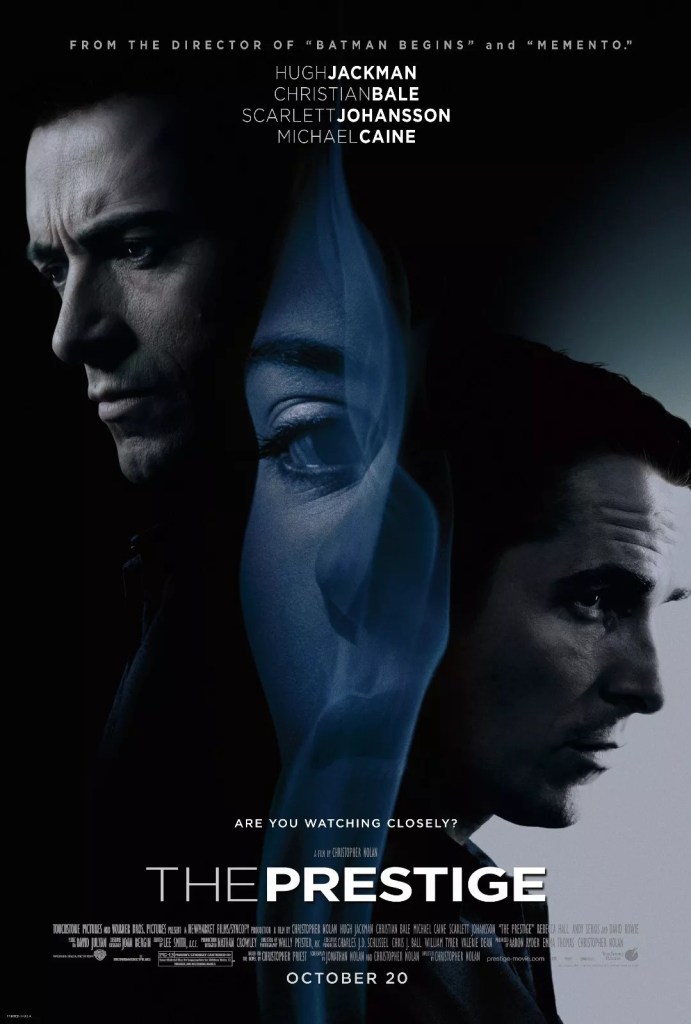
The Prestige (2006) ****

Christopher Nolan (Oppenheimer, 2023) revels in sleight-of-hand, if only by mixing up time frames, but even he isn’t intellectually smart enough to overcome the deficiency that ensured this picture failed to emulate the commercial success of all his other movies. And it revolves not around what you do to dupe an audience. An audience wants to be duped and isn’t so concerned if how the duping is achieved is never revealed, which is, of course, core to the business of the stage magician. Part of the success of this picture is that Nolan gives away stage secrets, even, if you were playing close enough attention, giving away the main reveal of one of the two dueling stage magicians.

But one of these revelations cuts so close to the bone the audience loses its sympathy for both the main characters, Alfred Borden (Christian Bale) and Robert Angier (Hugh Jackman). By the time we understand just how ruthless this pair are to the extent of risking marriage/romantic attachment for the sake of either getting one over on the opponent or maintaining the central deceit of their act, we have already become too squeamish to care overmuch. And the twists which come with increasing regularity which are supposed to take our breath away are defused by the ticking time bomb.

And the miscalculation pivots on who you can kill in a movie. Henry Fonda cold-bloodedly slaughtering an innocent child in Once Upon a Time in the West (1969) set a new high/low for onscreen barbarity, but that was excused because it demonstrated just what a villain this character was. Since then a virtual industry has grown up over inventing more creative ways in which people can be killed.

One of the standard ploys of the stage magician is to make a canary in a cage disappear in front of your very eyes only for said canary, minus cage, to reappear moments later to thunderous applause. Turns out the cage is collapsible and it vanishes into a space hidden in a table. The canary? It is squashed to death in the cage. It’s a different canary that magically reappears.

So all through the picture canaries are squashed, sometimes we see the cages being emptied of dead canaries, and workrooms filled with canaries waiting to be squashed.

What happens after this somehow pales into insignificance. Here we have a business that requires murdering God knows how many canaries every night of the year. It doesn’t take much intelligence among the easily duped moviegoer to work out how many canaries both magicians have ruthlessly despatched.

So when they get around to killing each other’s loved ones, or shooting off each other’s fingers or ruining each other’s acts, your stomach has already been turned and although the darkest of dark narratives has long been a theme of the movies, this, and not fitting into the exploitation B-picture genre where it would more comfortable reside, sucks the sympathy out from under the director’s feet and all his later sleight-of-hand, as ingenious as it is, counts for very little.

There’s certainly tragedy here and of the kind that only Shakespeare could conjure. In order to safeguard the integrity of his act – the secrecy paramount to its success – loving husband Borden is forced to pretend to his loving wife Sarah (Rebecca Hall) that he has a mistress, resulting in distraught wife killing herself. Though discreetly done, scarcely glimpsed in the final sequence, Angier has embarked on the murderous spree essential to concealing the mechanics of his famous trick, The Transported Man.

That it works at all, and splendidly to a large extent, is down to Nolan’s traditional time-shift sleight-of-hand and installing in the middle of this brouhaha the wise Cutter (Michael Caine) whose tempered diction brings the movie unexpected gravitas. When he speaks you tend to believe. The minute the other pair open their mouths you are suspect.

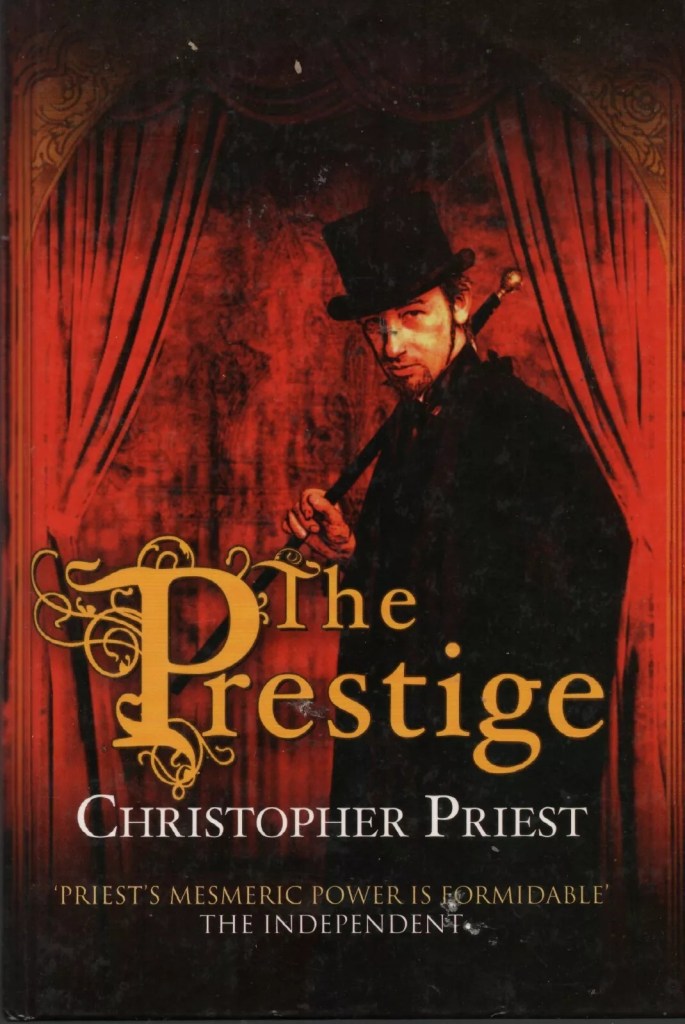
Just for his calmness Michael Caine (Interstellar, 2014) steals the picture from Christian Bale (Ford v Ferrari / Le Mans ’66, 2019) and Hugh Jackman (Deadpool and Wolverine, 2024). Rebecca Hall (Godzilla v Kong: The New Empire, 2024)and Scarlett Johansson (Fly Me to the Moon, 2024) are at opposite ends of the feminine divide, the former unable to cope with deceit, the latter manipulating it to her own ends. The director and brother Jonathan adapted the Christopher Priest award-winning novel.

Setting aside the canaries and the difficulties of presenting all-consuming obsession, this remains an intriguing work, possibly the darkest area into which the director ever ventured.  

Behind the Scenes: Dear Mr Scorsese…or Mr Nolan

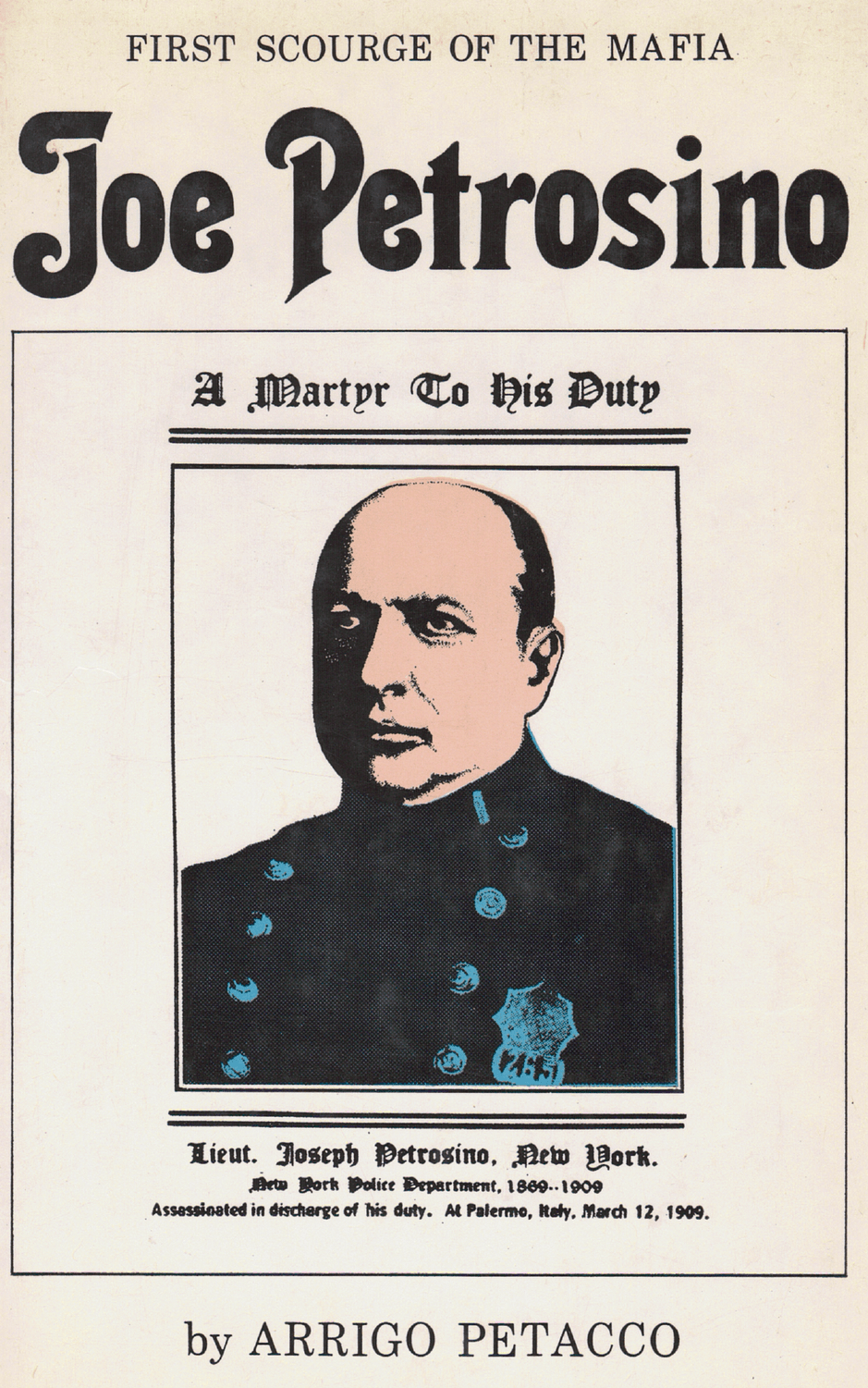
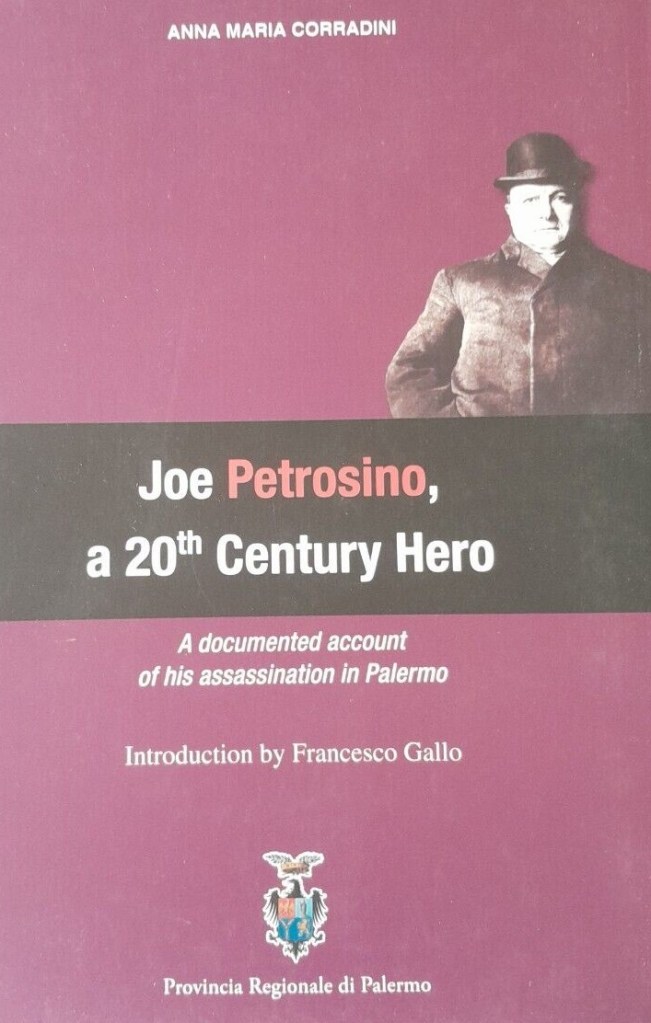
Should you be in the mood for atonement after a lifetime of deifying gangsters, Mr Scorses, you might wish to consider a biopic of the greatest cop, outside of Elliott Ness and Serpico, in American history. I’m sure Leonardo DiCaprio, who was at one time attached to a filmization of the bestseller The Black Hand (2017) by Stephen Talty, has brought the subject matter to your attention. Although Pay or Die (1960) covered similar territory, its budget and restrictions of length denied it the opportunity to properly explore the historical depth and social comment, for which in Killers of the Flower Moon (2023) you now seem more at home.

After the success of Oppenheimer (2023) audiences might be receptive to a true story about a cop who took on the Mafia a.k.a. the Syndicate a.k.a. the Cosa Nostra before it was known by any of those names and there is, to boot, a heart-rending romance that the Ernest Borgnine picture barely touched upon.

I’ve even dreamed up an opening.

A horse pulls a wagon laden with oranges and apples through a congested New York street circa 1883. As the driver pauses to make a delivery, a child, Claudia, watches from the window of her father’s shop – F. Fellini Jeweller. The horse collapses. The fruit scatters. Malnourished kids race to scoop up the merchandise. Claudia races out and strokes the horse’s mane.

We cut to a man in brown overalls striding towards the camera armed with a cleaver. The crowd parts. The child clings to her father in terror. The man raises the cleaver high over his head and slams it into the horse’s haunch. The child screams. The jeweller remonstrates with the man. The man removes his cleaver and says, “Not dead enough.”

As the credits roll, we see Claudia chasing away the flies that gather over the corpse, being pushed away by a man chiselling out the horse’s hoof, another sawing off its tail. Some days later as she is trying to pick off wriggling maggots, the man returns, this time driving a wagon. She hides behind her father.

His cleaver flashes in the sun as he hacks away at the horse. By now decomposition is so bad that the legs easily part from the body and the man is able to drag the horse bit-by-bit onto the back of his cart. Claudia watches as he leaves with the steaming carcass. We follow the wagon through the streets down to the river. A boat is waiting. The man heaves the meat onto the boat. The boat sets sail. Far out in the channels, the man begins chucking the meat overboard.

Back on dry land, the man cleans his cleaver and removes his brown overalls. Underneath he is wearing the uniform of a cop.

This is Joe Petrosino.

In those days cops also ran the Sanitary Dept in New York. Removing dead horses – they were too heavy to lift manually so you had to wait till the meat rotted sufficiently to fall from the bones – was a job for new recruits.

When Petrosino reaches the police precinct you’ll notice two things about him. He is short, well below the standard police requirement, and all the accents except his are Irish. In fact, he’s the only Italian cop on the force and only recruited because he can speak Italian and get information from all those immigrants who still can’t speak a word of English.

But he’s also very unusual especially to a contemporary audience because we’ve all been acclimatized to thinking that all Italians of this and successive generations accepted the Mafia rather than as Petrosino hating them and all they stood for. So this is effectively the tale of a silent majority who came from the same locale as the Mafia, understood their position in society in the home country, but loathed the fact that they had been allowed to infiltrate American society in part at least because they spoke a secret language (Italian) that few Americans understood or made an effort to understand with all the underlying racism that suggested.

But Petrosino’s not like a contemporary cop, forced to work within the tight constraints of the law and he’s not even like the cops of the 1930s-1960s who might have lawyers breathing down their necks and in the later decades accused by the media of breaching civil liberties. Petrosino was a good old-fashioned two-fisted cop, think James Cagney or Lee Marvin or Clint Eastwood but on the side of law and order. He thought nothing of beating up hoods, humiliating them in public as a way of showing that society was not going to stand by and let them terrorize the public.

Eventually, Petrosino was able to set up a specialist Italian-speaking squad to tackle The Black Hand/Mafia.

But he was also a superb detective. The Black Hand’s main line of business was kidnapping – little Claudia would come back into the story as a victim. Don’t pay the ransom and your business or your house would be blown up, the kidnappee killed. You may remember from old kidnapping movies that the kidnappers always cut out words from newspapers to write their demands.

Well, the only reason they ended up doing that was because of Petrosino. Prior to that, they just wrote out their demands in pen and ink. But he started to round up suspects by the hundreds and find an excuse to get samples of their handwriting. And then using the samples on file, whenever a new demand appeared he would scout the files to match the samples and go an arrest an astonished hood. So the gangsters wised up and started using newspapers.

He was also the guy who worked out that immigrants didn’t suddenly take up crime on arriving in America but they may well have criminal records back home and therefore could be extradited.

On top of that was the heart-rending love story. Petrosino had fallen for the daughter, Adelina, of a restaurant owner. Every night he dined in the restaurant. But she had been married before. She was a widow. Her husband had died young and she couldn’t contemplate marrying again to someone who was in such constant peril. So it took years of wooing, nightly meals, before she agreed to marry. The marriage lasted a year, ended by his death. He was assassinated while going into the lion’s den, the Mafia strongholds of Italy.

And all this is before you deal with the social issues of immigrant integration, of racism, of finding the new world as guilty of betrayal of trust as the old, of those complicit in murderous actions of the Mafia by turning a blind eye.

I’m suggesting Martin Scorsese because he’s covered this ground before but on second thoughts this might appeal more to the likes of Christopher Nolan who is comfortable with complexity and constantly seeks a wider perspective and who, whether through the Batman chronicles or Oppenheimer, is happy for his principal character to be in the main an upholder of justice.

Discover WordPress

A daily selection of the best content published on WordPress, collected for you by humans who love to read.

The Atavist Magazine

by Brian Hannan

WordPress.com News

The latest news on WordPress.com and the WordPress community.