Candy (1968) **

Ode to the male gaze. Once a cult vehicle, this will struggle to find favor these days what with its backward attitudes. Virtually impossible to excuse the rampant self-undulgence. The sexually exploited naïve Ewa Aulin in the title role didn’t even have the benefit of being turned into a star. The satire is executed with all the finesse of a blunderbuss. And while, theoretically, picking off a wild range of targets, if this movie has anything to say it’s to point out how easy it is for men to deify themselves at the slightest opportunity.

Not much of a narrative more a series of sketches slung together with the slightest connecting thread. Most its appeal lies in watching huge marquee names make fools of themselves. Or, if you’re that way inclined, seeing how much nudity will be imposed on the star, intimacy  rarely consensual, clothes usually whipped off her.  

Teenager Candy (Ewa Aulin) has father issues, daddy (Jack Austin) being a dumb angst-ridden teacher. Randy poet McPhisto (Richard Burton) drives a class of schoolgirls into a frenzy with his lusty reading, inveigles Candy into his chauffeur-driven car, ends up in her basement drunkenly humping a mannequin while Mexican gardener (Ringo Starr) with an accent as coruscating as that of Manuel from Fawlty Towers assaults her on pool table.  Scandalized father packs her off to his twin brother in New York, that notoriously safe haven for nymphettes, while on the way to the airport they are almost driven off the road by the gardener’s vengeful biker sisters (Florinda Balkan et al).

For no apparent reason she is hitching a lift on a military plane commanded by randy Brigadier Smight (Walter Matthau) who, on the grounds that he hasn’t had sex for six years, commands her to remove her clothes for the good of the nation. In the Big Apple, rock star surgeon Dr Krankheir (James Coburn), entering the operating theater to the same kind of waves of acclaim as McPhisto, finds an excuse to have her undress and submit to him, this just after she’s managed to avoid the attentions of her randy uncle. It should come as no surprise that Krankheit treats women as his personal property to the extent of branding them like cattle.

In due course, she encounters a gang of mobsters, an underground movie director and a hunchback (Charles Aznavour) who, in return for her showing pity for his condition, proceeds to rape her. She is arrested. Guess who wants to frisk her. Naturally, when she escapes she runs into a bunch of drag queens.   

Then she finds sanctuary in a semi-trailer truck, home to guru Grindl (Marlon Brando). He’d be convincing enough as a mystic except he, too, finds an excuse to rip her clothes off. There are more cops to contend with and another guru, facial features obscured by white clay. If they’re going to have sex then naturally it must be in a Hindu temple. Turns out the latest person to take advantage of her is her father but he’s been handed a get-out-of-jail-free card because by now he’s brain damaged.

This might all be a dream/nightmare. Candy might even be an alien. It’s dressed up in enough psychedelia to sink a battleship and its highly likely that any lass as gullible as Candy will find herself at the mercy of any man, so in that context it carries a powerful message. I’m sure many beautiful young girls will attest to the truth that men feel they have the right to paw anyone who comes their way without asking permission. And the other message is just as powerful – how many young actresses have been seduced by thoughts of fame to disport themselves in this fashion only to find that all the industry wants is their nudity not their acting talent.

You might say that the target is so obvious it hardly needs pointing out but the MeToo campaign will beg to differ and you would hope that Hollywood has wised up. It’s just a shame that the satire is so heavy-handed. The military and the medical profession are sorely in need to answering tough questions. Unfortunately, this picture doesn’t ask any. It’s like an endless casting couch.

Directed by Christian Marquand (Of Flesh and Blood, 1963) in, thankfully, his final picture, from a screenplay by Buck Henry (The Graduate, 1967) and Terry Southern (Dr Strangelove, 1962) based on the novel by Southern and Mason Hoffenberg. Nobody comes out of this well and it’s rammed full of cameos from the likes of Elsa Martinelli (The Belle Starr Story, 1968), John Huston (Myra Breckenridge, 1970), Anita Pallenberg (Performance, 1970), Marilu Tolo (Bluebeard, 1972) and boxer Sugar Ray Robinson.

Ewa Aulin (Start the Revolution Without Me, 1971) isn’t given much of chance, her character whimsical, pallid and submissive and she didn’t become a major marquee name.

A mess.
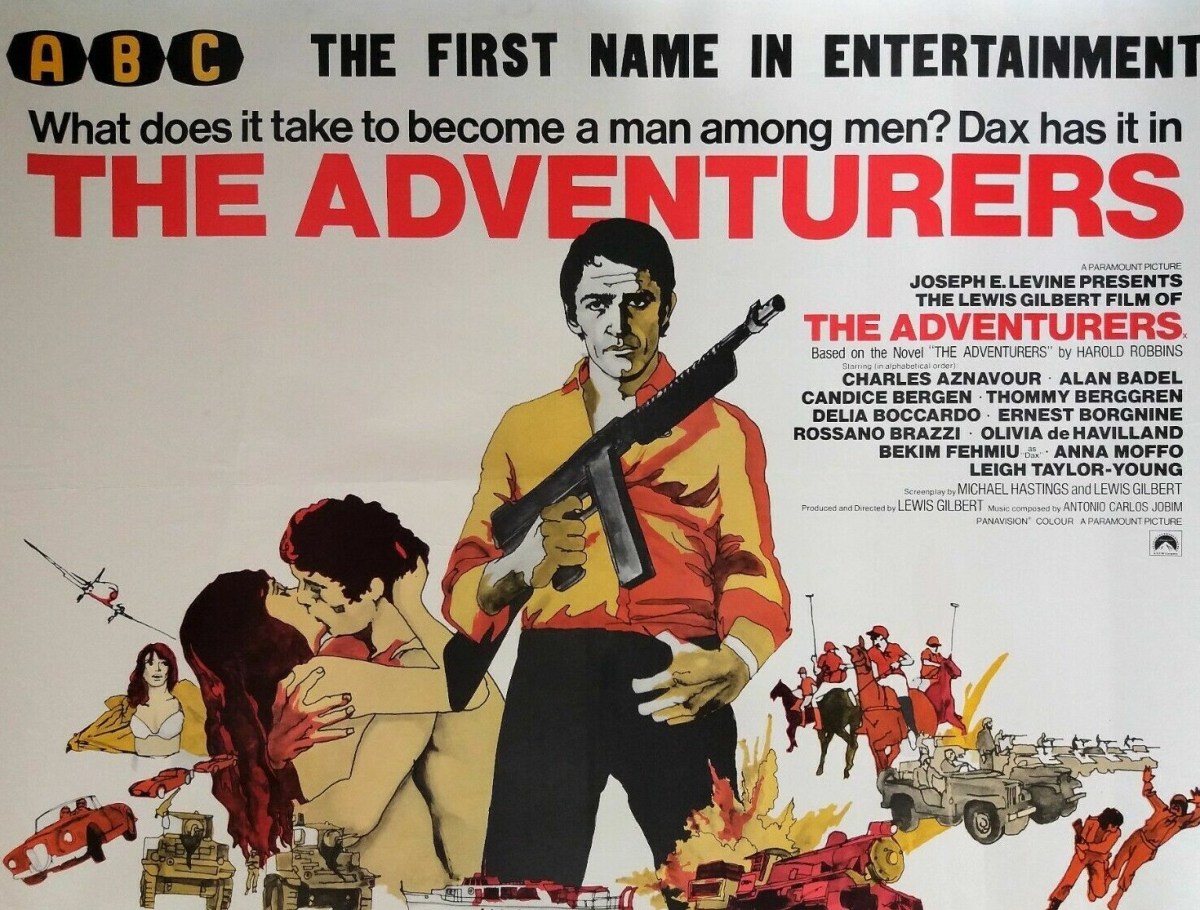
The Adventurers (1970) ***

Class A Trash. Adaptation of Harold Robbins (Nevada Smith, 1966) bestseller goes straight to the top of the heap in the So-Bad- It’s-Good category. Only Alan Badel (Arabesque, 1966) as a double-dealing revolutionary comes out of this with any honors.

The likes of Candice Bergen (Soldier Blue, 1970), Rossano Brazzi (Rome Adventure/Lovers Must Learn, 1962), double Oscar-winner Olivia de Havilland (Hush, Hush, Sweet Charlotte, 1964), Leigh Taylor-Young (The Big Bounce, 1969)  and Ernest Borgnine (The Wild Bunch, 1969) must have wondered how they were talked into this.

And director Lewis Gilbert (Loss of Innocence/The Greengage Summer, 1961) must have wondered how he talked himself into recruiting unknown Yugoslavian Bekim Fehmiu (The Deserter/The Devil’s Backbone, 1970), nobody’s idea of a suave lothario,  for the lead.

One of the taglines was “Nothing has been left out” and that’s to the movie’s detriment because it’s overloaded with sex, violence, more sex, more violence, in among a narrative that races from South American revolution (in the fictional  country of Corteguay) through the European jet set, fashion, polo, fast cars, orgies, and back again with revenge always high on the agenda. At close on three hours, it piles melodrama on top of melodrama with characters who infuriatingly fail to come to life.

Sensitivity is hardly going to be in order for Dax (Bekin Fehmiu) who, as a child after watching his family slaughtered and mother raped, makes his bones as a one-man firing squad, machine-gunning down the murderers. From there it’s a hop-skip-and-jump to life as the son of ambassador Jaime (Fernando Rey) in Rome where he belongs to an indulgent aristocracy who play polo, race cars along hairpin bends, swap girlfriends and, given the opportunity, make love at midnight beside the swimming pool.

His fortunes take a turn for the worse when his father backs the wrong horse, the rebel El Condor (Jorge Martinez de Hoyos)  in Corteguay, and is killed by the dictator Rojo (Alan Badel). In between an affair with childhood sweetheart Amparo (Leigh Taylor Young), life as a gigolo and cynical marriage to millionairess Sue Ann (Candice Bergen), Dax takes up the rebel cause, initially foolish enough to fall for Rojo’s promises which results in the death of El Condor, and then to join the rebels.

But mostly it’s blood, sex, betrayal and revenge. Anyone Dax befriends is liable to face a death sentence. He only has to look at a woman and they are stripping off. It’s a heady mess. It might have worked if the audience could rustle up some sympathy for Dax, especially as he was entitled to feel vulnerable after his childhood experiences. But he just comes across as arrogant and the film-makers as even more arrogant in assuming that because women fall at his feet that must mean he had bucketloads of charm rather than that was what it said in the script. He’s fine as the thug but not convincing as a lover.

Excepting Badel, the best performances  in a male-centric sexist movie come from women, those left in Dax’s wake, particularly Candice Bergen as the lovelorn wife and Olivia De Havilland as the wealthy older woman who funds his lifestyle, aware that at any moment he will leave her for a younger, richer, model. Lewis Gilbert is at his best when he lets female emotion take over, not necessarily wordy intense scenes, because Bergen and De Havilland can accomplish a great deal in a look.

The rest of it looks like someone has thrown millions at a B-picture and positioned every character so that they have nowhere else to go but the cliché.

By this point, Hollywood had played canny with Harold Robbins, toning down the writer’s worst excesses and employing name directors to turn dire material into solid entertainment. Edward Dmytryk (Mirage, 1965) had worked wonders with The Carpetbaggers (1964),  whose inherent salaciousness was held in check by the censor and made believable by characters played by George Peppard (Pendulum, 1969), Alan Ladd (Shane, 1953) and Caroll Baker (Station Six Sahara, 1963). Bette Davis and Susan Hayward contrived to turn Where Love Has Gone (1964) into a decent drama. Even Stiletto (1969), in low-budget fashion, managed to toe the line between action and drama.

But here it feels as if all Harold Robbins hell has been let loose. Rather than reining in the writer, it’s as if exploitation was the only perspective. Blame Lewis Gilbert, director,  and along with Michael Hastings (The Nightcomers, 1971) in his movie debut, also the screenwriter for the end result.

On the other hand, if you can leave your critical faculties at the door, you might well enjoy how utterly bad a glossy picture can be.

Discover WordPress

A daily selection of the best content published on WordPress, collected for you by humans who love to read.

The Atavist Magazine

by Brian Hannan

WordPress.com News

The latest news on WordPress.com and the WordPress community.