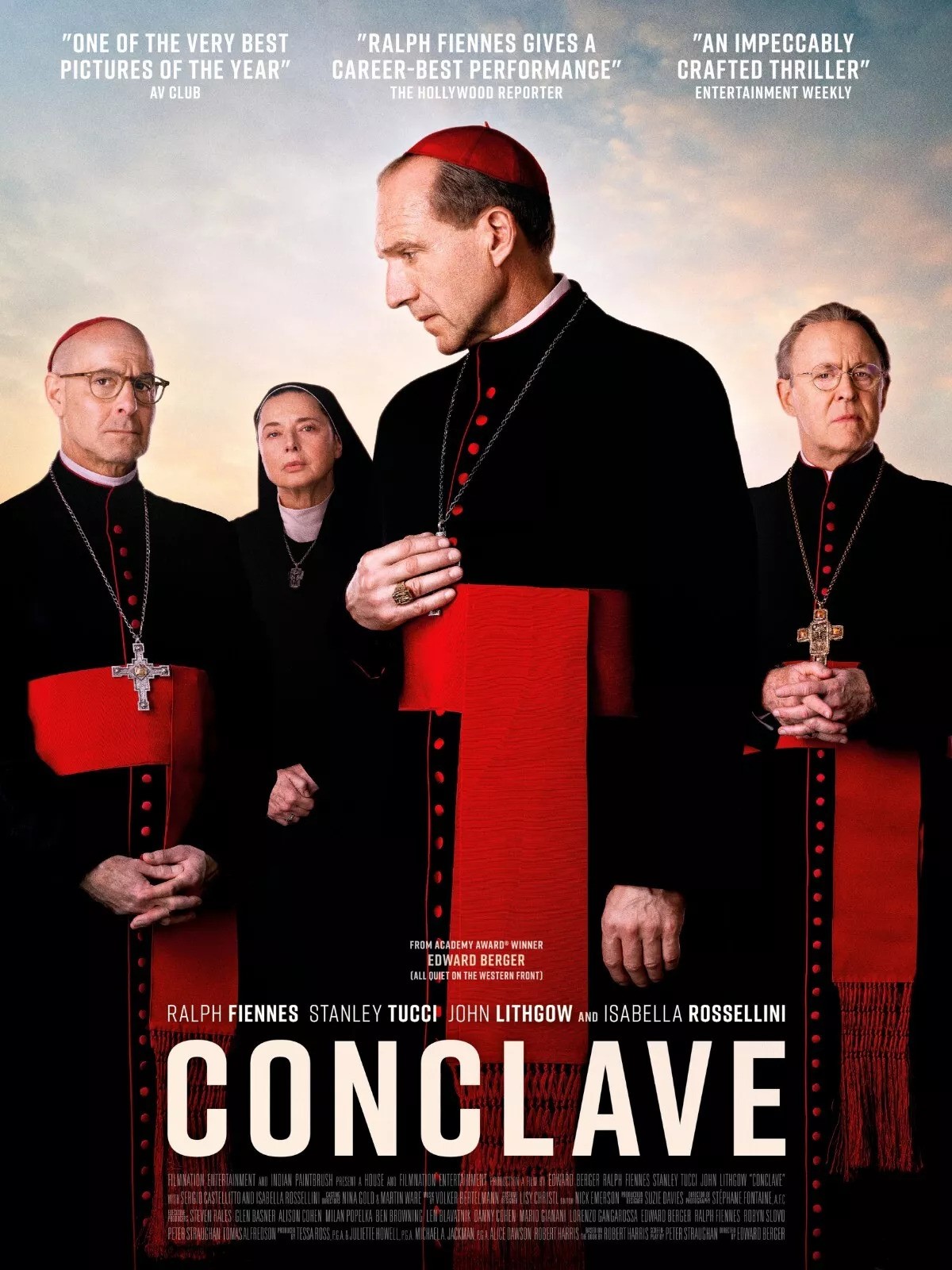
No great surprise that the political thriller has made a return – all subgenres resurface after a while. The surprise here is the context. The Catholic Church hardly seems a fitting setting, given it’s been wracked for decades by accusations of child molestation, Oscar-winning Spotlight (2015) taking it down over historic malfeasance in Boston, though that was more in the line of another subgenre, the fearless journalistic expose.
Nor would you expect the drama of the election by all the Cardinals of a new Pope to turn into a riveting thriller, with a stunner of a twist at the end which carries considerable contemporary heft. The last time the goings-on in the Catholic Church attracted the attention of Hollywood was in Otto Preminger’s The Cardinal (1963) and The Shoes of the Fisherman (1968), which were cut from a more traditional cloth. Except for some interesting procedural background and some argument about the future direction of the Church, the bulk of this picture concerns the horse-trading and corruption that threatens to envelop the election.

Our guide through the shenanigans is Lawrence (Ralph Fiennes), the dead Pope’s righthand man, who, although filled with his own doubts, is in charge of managing the actual election. He’s so self-effacing that it comes as something of a shock to him to discover that he’s one of the candidates. It’s a blind-voting system and continues until one person has secured 72 votes. As you might expect there’s wheeling-and-dealing with the liberal elements set against the more entrenched right-wing groups.
The main contenders are: Bellini (Stanley Tucci), favored by Lawrence, Tremblay (John Lithgow), Adeyemi (Lucian Msamati), a black African who would be a popular winner except for his stringent views on homosexuality, Tedesco (Sergio Castellito) who wants to cancel all the liberal developments of the Church in the last half century, and surprise packet Benitez (Carlos Diehz) from Afghanistan who represents the downtrodden that the rest of the high-living Cardinals appear to have forgotten.
You’re going to remember the twists more than any moral message. But it does allow time for debate of the major moral questions, mostly handled with subtlety. The Cardinals are all sequestered away from the outside world for the duration of the election. Turns out the deceased Pope was trying to rig the election to suit his own ends, conspiring against those Cardinals he felt were too ambitious, self-obsessed or had unsightly, but secret, stains on their characters.

For a holy fellow the dead Pope set some remarkable traps which leave Lawrence reeling. And as the election proceeds, Lawrence is revealed, on the one hand, to be quite a tough egg, like a good journalist determined to uncover the truth, but on the other hand given to bouts of crying as the weight of duty and expectation and, I guess, shock at the findings get to him.
This is quite an adult movie. Not in the sense that we’re dealing with a particularly controversial subject matter, but it’s a kind of courtroom drama in all but name, and except for the sprinkling of revelations, and the inherent tension of an election, apt to be slow moving, allowing characters time to breathe and to put various points across. The structure makes no concessions to the MCU generation. Nor to the traditional Hollywood approach which would have allocated a certain amount of time to tourist Rome. A couple of cheats – hidden documents, access to a computer when access to anything was denied – don’t get in the way.
I’m always worried when trailers concentrate on the number of Oscar winners or nominees involved because generally that suggests to me a weak narrative. But, in fact, two-time nominees Ralph Fiennes (No Time to Die, 2021) and John Lithgow (Interstellar, 2014), and one-time nominee Stanley Tucci (The Hunger Games, 2012) deliver terrific, largely understated performances, while director, also a nominee, Gerard Berger (All Quiet on the Western Front (2022) brings it together with a stately majesty.
He’s allowed himself a certain amount of self-indulgence. The overhead shot of the lines of Cardinals moving through the rain and carrying white umbrellas bears no narrative weight but is visually splendid. As if escaping from a more offbeat movie, turtles appear from time to time. The rigmarole of ritual is compelling.
Some scenes are conducted in Latin, with subtitles of course. Thank goodness, I know now what “in secula seculorum” now means. But you didn;t need to know back in the day. That was the point. It was like joining a secret society. The Catholic Church once had an unique ID that it threw away – the fact that all Masses were spoken in Latin, and therefore universally appreciated, and you could go to a Church in any country and understand what was going on, whereas now you’d need Google translate.
Screenwriter Peter Straughan (Tinker, Tailor, Soldier, Spy, 2011) is on something of a roll at the moment, his teleplay for Wolf Hall: The Mirror and the Light just out. Robert Harris, who’s not had much luck at the box office with the various movie interpretations of his bestsellers Enigma (2001), The Ghost Writer (2010), and An Officer and a Spy (2019) – banned pretty much everywhere because of Roman Polanski’s involvement – gets his just reward here for laying down such a superb template. The music by Volker Bertelmann was particularly striking. Oddly enough his Oscar win for All Quiet on the Western Front didn’t warrant a mention in the trailer.
Thoroughly absorbing.

 The Magnificent 60s