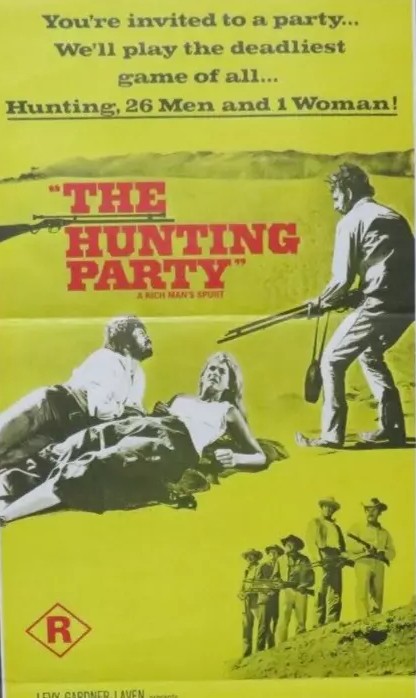
The Hunting Party (1971) **

Colossal flop and deservedly so. One of the most repellant pictures of a down’n’dirty decade.

It’s not just that rape takes center stage – two completed both supposedly by men in love with her and two attempts by more obvious scum – but that cattle baron’s wife Melissa (Candice Bergen) has to choose between murdering rapist husband Brandt (Gene Hackman) and murdering rapist outlaw Frank (Oliver Reed).
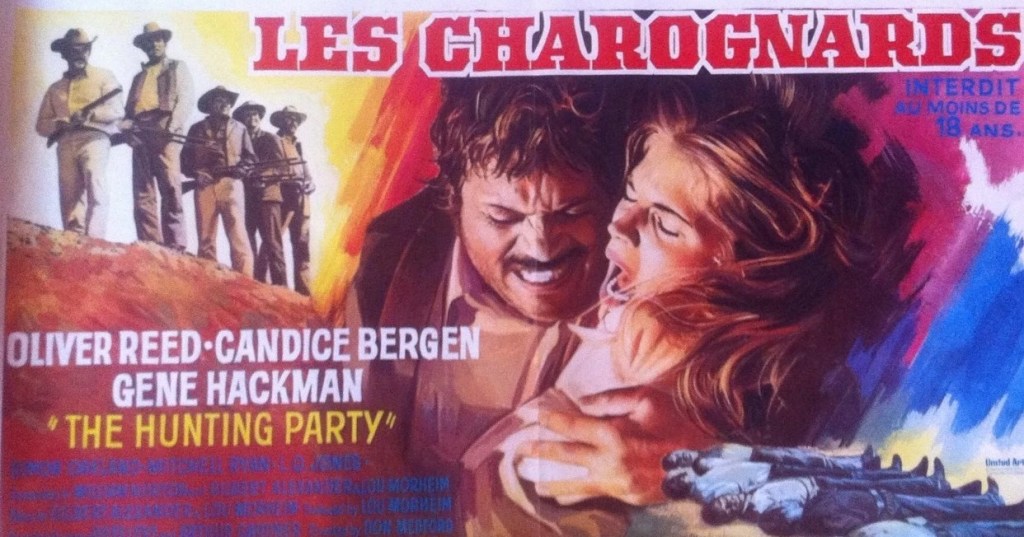
There was an unwelcome trend for consensualizing rape – Straw Dogs (1971) took the  same approach – that a woman in a state of some terror would nevertheless warm to her molester. This is the worst kind of male fantasy fulfilment and that taking a women by force will nonetheless make her fall in love with you.  

Just how keen Melissa is on her rapist is shown by her various attempts to knife him and escape. Which, of course, Frank dismisses in a version of that old trope, “you’re beautiful when you’re angry” in that he likes a spirited woman.

The otherwise cold-blooded Lee Marvin character in Prime Cut (1972) proved likeable because he had an honor code and didn’t take advantage of a vulnerable woman. It’s impossible to feel any sympathy for Frank especially as Melissa, a teacher, has been kidnapped not for ransom but for the sole purpose of teaching Frank to read. Presumably, being an outlaw who robs banks, he can already count. Maybe he needs help writing ransom notes.

Frank should have been taught to read in childhood, we discover in a twist at the end, because his father could read, which suggests he had a different upbringing to the rest of his gang, but, on account of being determined to annoy his old man, he refused to learn. So although he has a yearning to educate himself he’s not educated enough to work out that learning and kidnapping and rape don’t exactly go hand-in-hand.

The only way any attempt at romance is going to work, even theoretically, is if what awaits Melissa when rescued is worse. Husband Brandt is a venal individual. The movie opens with him raping his wife. Compared to his treatment of sex workers, she gets off lightly. And he balks at paying any supposed ransom on the grounds that his wife will most likely have been raped and return with an unwanted bastard son and he’s not going to pay $50,000 for that privilege. Ever since A Fistful of Dollars western heroes have been every amoral shade of grey but Brandt must be the darkest shade ever.
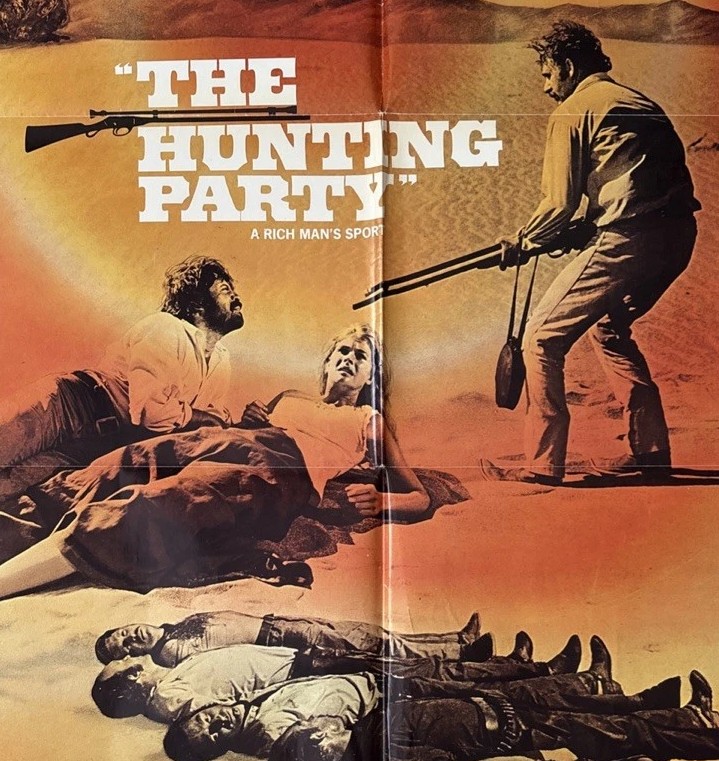
Plus he’s just taken delivery of rifles with telescopic sights that have a firing range of about half a mile so he’s up for a little sport, and with four other rich buddies sets out to hunt humans. The rifle is the equivalent to the Gatling Gun in The Wild Bunch (1969), a weapon of awesome power, and every time it hits home the camera focuses on the gory outcome. The 26 men in the outlaw bunch are soon whittled down.

This might have worked if the narrative had followed a different arc. Had Frank turned out to be Melissa’s protector rather than the most successful of her molesters. If the whole gang had show signs of seeking something maternal rather than just sexual in a woman or were all queuing up for a bit of education. And Frank’s treatment of her from the outset had been protective and she had shared with him her fear of her husband.

The best you can say about Frank is he’s a gentler kind of rapist. But he’s still a rapist and taking advantage when Melissa is at her most terrified, soaking wet from falling into a river while trying to escape. If he had continued just trying to soothe her and comfort her that might have taken the tale in a more acceptable direction, but, no, he decides a bit of rape is in order.

Frank’s too dumb to see that his men are going to turn against him if he doesn’t share out his captive and once he’s aware exactly who she is he should at least, in the eyes of the men, either demand a ransom or hand her back.

Although the long-range rifles tilt the odds heavily in favor of the pursuers, one of them is killed, and two, once they have decimated the outlaws, decide the hunt has gone far enough. Another, later on, takes the same view. But Brandt, determined on revenge, pursues the “lovebirds” into the desert where he kills both.

This was intended to launch British actor Oliver Reed (Hannibal Brooks, 1969) into the Hollywood mainstream but he’s miscast. Candice Bergen (Soldier Blue, 1970) can do little with a role that makes no coherent sense – unlike Michele Carey in The Animals (1971) she shows no sign of accepting an unwelcome protector just to survive. Had it not been for The French Connection (1971) and, taken in conjunction with Prime Cut (1972), Gene Hackman’s career might have spun off into playing a succession of villains.

One other notable turns up on the credits. This is produced by Lou Morheim who originally owned the remake rights to Seven Samurai (1954) and failed to finesse that into a significant credit on The Magnificent Seven (1960).

Discounting To Trap a Spy (1964), a movie combining two episodes of The Man from U.N.C.L.E series, this marked the debut of director Don Medford. Lou Morheim (The Beast from 20,000 Fathoms, 1953), Gilbert Ralston (Willard, 1971) and Bill Norton (The Scalphunters, 1968). contributed to the screenplay.

The bizarre premise set a low bar. Every shade of ugh.
Behind the Scenes: The Box Office Bump Part Two – Foreign Saves the Day

In previous decades, box office outside of the U.S., while a growing part of the ancillary equation, only in very rare circumstances outscored domestic. The general expectation, in part due to tougher competition for screens and extra distribution costs, was on average studios could expect to earn about half of domestic revenues.

There was one obvious exemption to this rule. James Bond overseas blew all the competition out of the water. And so it proved in the early 1970s from an examination of United Artists books for the period. Live and Let Die (1973) was the standout performer, knocking up $27 million in rentals (the studio share of the overall box office gross) from foreign cinemas compared to $16.4 million at home. Diamonds Are Forever (1971) did equally well – $22 million abroad, $20 million domestic.

James Bond was such a cash cow that surprised no one. Last Tango in Paris (1973) was considered an anomaly, controversy stoked by UA four-walling the picture when it couldn’t find enough screens. It came in third in the foreign market league, adding $16 million to domestic $21 million.

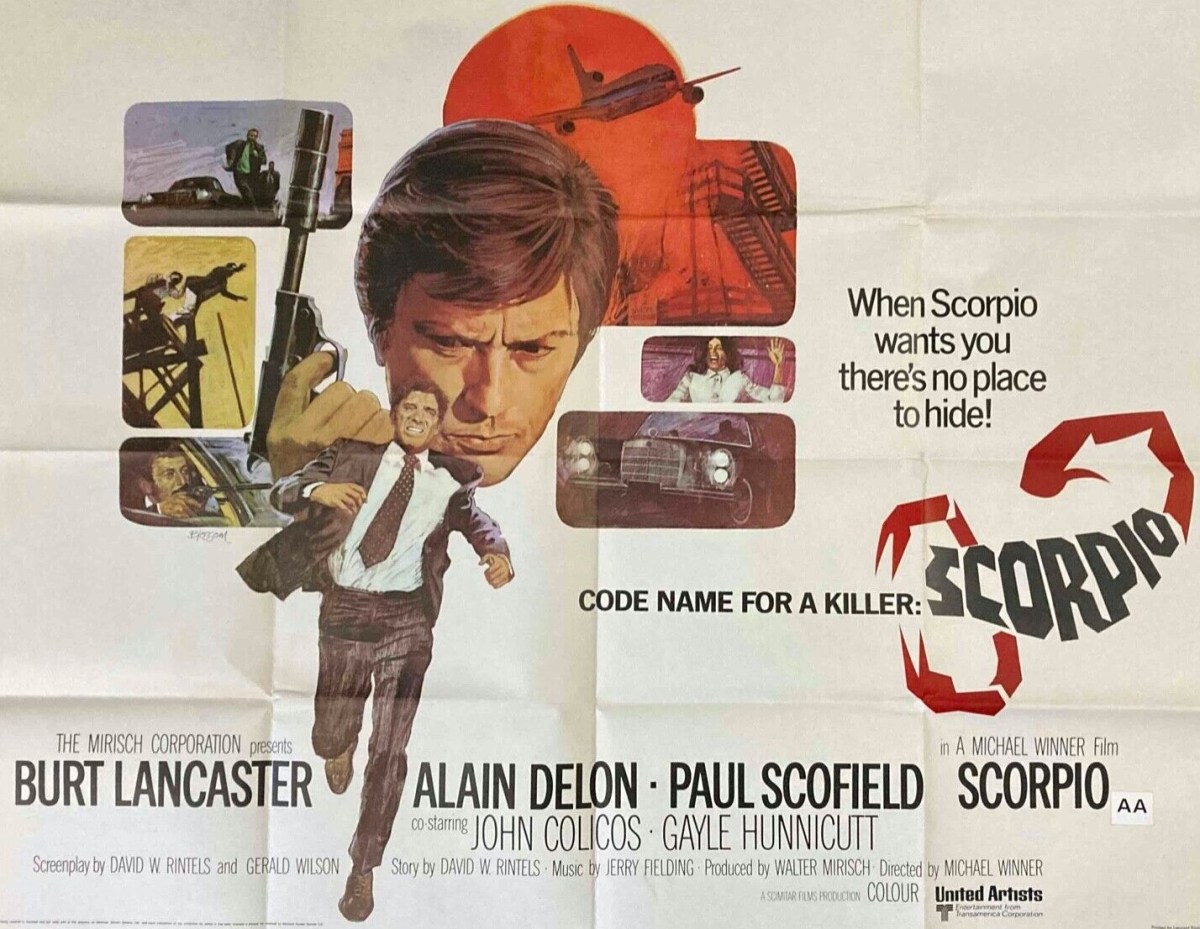
What did take Hollywood’s breath away was how often under-performers – flops even – at the U.S. ticket wickets did gangbusters elsewhere. The biggest winner was the aptly-named Michael Winner, director of westerns Lawman (1971) and Chato’s Land (1972), hitman thriller The Mechanic (1972) and spy drama Scorpio (1973). Total American rentals a shade over $7 million, total foreign rentals three times as much a colossal $21.8 million.

There was hardly a greater example of the disparity between American audience tastes and the rest of the world. And it made Hollywood studios more adventurous when it came to choosing subject matter, and in backing stars, aware that they could make their investment back – and more – from foreign markets.

It was probably astonishing to any studio executive that Burt Lancaster – for over two decades a high-flying marquee name from action-oriented fare like The Crimson Pirate (1952) and controversial drama From Here to Eternity (1953) to his Oscar-winning turn as Elmer Gantry (1960) and hardnosed western The Professionals (1966) – had lost his domestic audience especially after he had fronted up disaster movie smash Airport (1970).

But Lancaster could only scrape up $1.35 million at home for Scorpio, $2.1 million for Lawman and $2.8 million for another western Valdez Is Coming. Scorpio was the biggest hit abroad, with a massive $7 million, over five times domestic, while Lawman shot up $3.2 million (50 per cent above domestic) and Valdez Is Coming $2.65 million.

Charles Bronson was another beneficiary of foreign largesse. The Mechanic, too, targeted $7 million abroad, nearly three times the domestic tally of $2.6 million. Chato’s Land (1972) only delivered $1.27 million in the U.S. but $4.6 million abroad.

Westerns were a mixed bag. Oliver Reed-Candice Bergen-Gene Hackman number The Hunting Party (1971) was an almighty flop at home, just $800,000 in the kitty, but rallied somewhat abroad, not enough to turn profit but at least add a sheen of respectability, with $2.4 million elsewhere, three times domestic. The Magnificent Seven Ride! (1972), proof the sequels had outstayed their welcome, brought in just $750,000 domestically but again did triple the business abroad with $2.15 million and given the paltry budget enough to sit in the black.

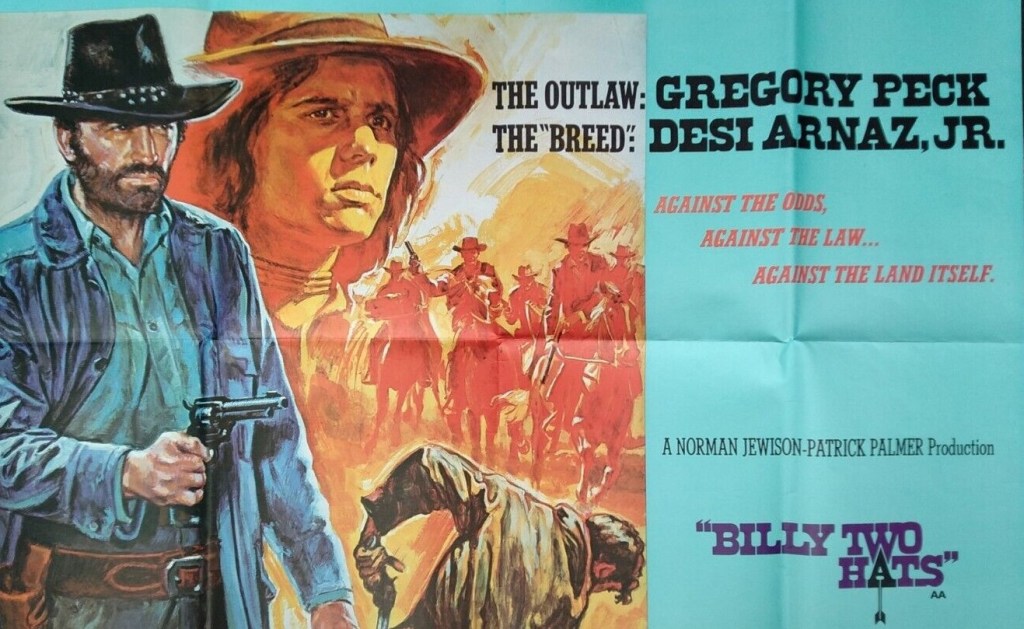
Revisionist effort Billy Two Hats (1974) starring Gregory Peck added $900,000 abroad to a miserable $440,000 at home – foreign revenues not enough to save it from flop. But foreign couldn’t save the second remake of the Gunfight at the OK Corral legend, Doc (1971) with Stacy Keach and Faye Dunaway which moseyed along to $1.35 million abroad to add to $1.8 million domestic. And another western sequel Support Your Local Gunfighter (1971) notched up just $970,000 abroad compared to $2.1 million. Modern western The Honkers (1972) with James Coburn managed just $550,000 abroad and $1 million at home.

It didn’t really matter that Michael Caine comedy thriller Pulp (1972) did better abroad, figures everywhere nothing to write home about, $600,000 in total, five-sixths of that abroad. Fiddler on the Roof (1970), for other reasons, underwhelmed but nobody was going to complain too much when foreign audiences stuck $10 million in till, about a quarter of domestic.

There were some conundrums in the foreign-domestic share-out. Typically, American comedies didn’t travel. But Billy Wilder’s Avanti! (1972) starring Jack Lemmon, perhaps because of the Italian setting, did better abroad – $2.5 million to $1.6 million. Glenda Jackson British-made menage a trois Sunday, Bloody Sunday (1970) not surprisingly did better abroad, but only just, $1.8 million to $1.77 million.

Sidney Poitier in second sequel The Organization (1971) tapped into $2.9 million abroad and $2.45 million at home but generally too-specifically-American features struggled overseas, The Hospital (1971) snaring only $1.9 million compared to $9 million, White Lightning (1973) snagging $1.8 million compared to $6.9 million, Fuzz (1972) holstering $1.7 million against $3.1 million.

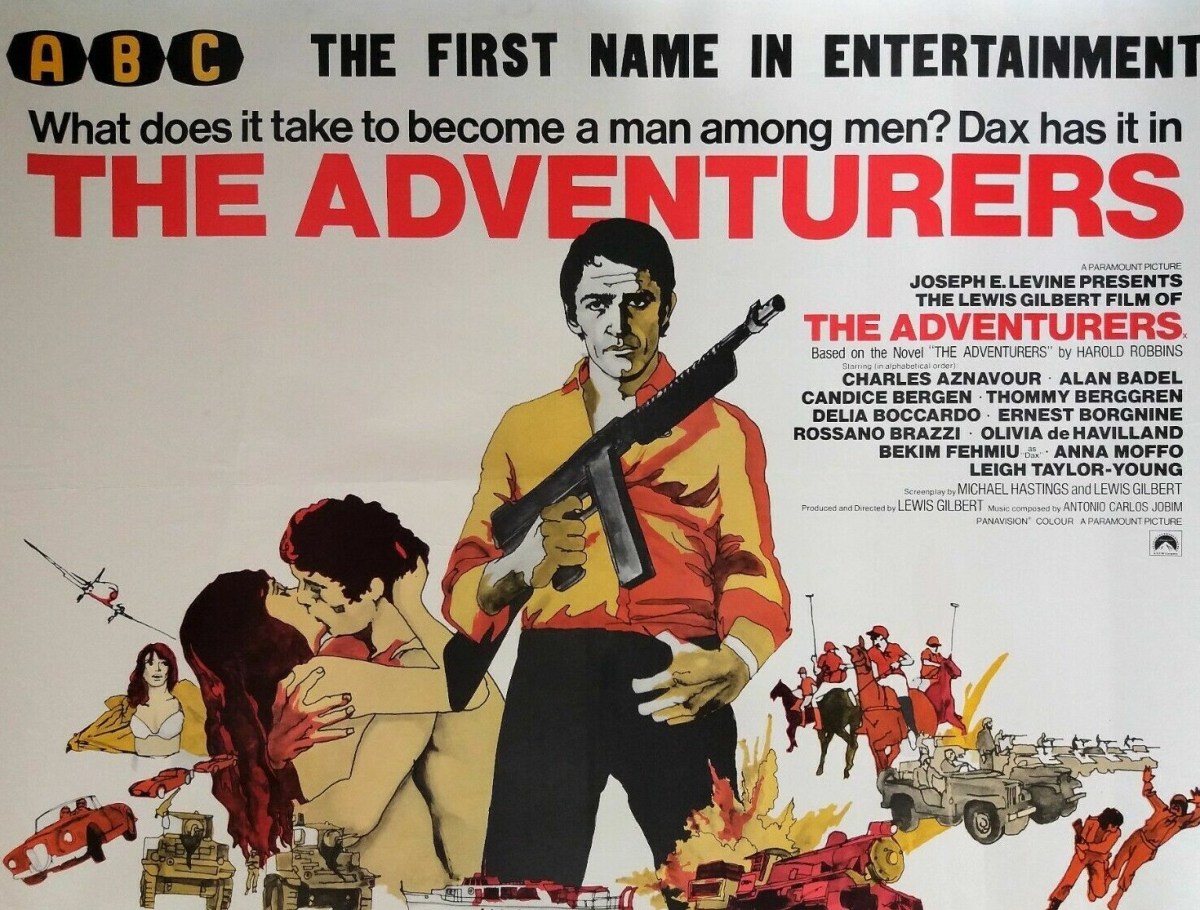
The Adventurers (1970) ***

Class A Trash. Adaptation of Harold Robbins (Nevada Smith, 1966) bestseller goes straight to the top of the heap in the So-Bad- It’s-Good category. Only Alan Badel (Arabesque, 1966) as a double-dealing revolutionary comes out of this with any honors.

The likes of Candice Bergen (Soldier Blue, 1970), Rossano Brazzi (Rome Adventure/Lovers Must Learn, 1962), double Oscar-winner Olivia de Havilland (Hush, Hush, Sweet Charlotte, 1964), Leigh Taylor-Young (The Big Bounce, 1969)  and Ernest Borgnine (The Wild Bunch, 1969) must have wondered how they were talked into this.

And director Lewis Gilbert (Loss of Innocence/The Greengage Summer, 1961) must have wondered how he talked himself into recruiting unknown Yugoslavian Bekim Fehmiu (The Deserter/The Devil’s Backbone, 1970), nobody’s idea of a suave lothario,  for the lead.

One of the taglines was “Nothing has been left out” and that’s to the movie’s detriment because it’s overloaded with sex, violence, more sex, more violence, in among a narrative that races from South American revolution (in the fictional  country of Corteguay) through the European jet set, fashion, polo, fast cars, orgies, and back again with revenge always high on the agenda. At close on three hours, it piles melodrama on top of melodrama with characters who infuriatingly fail to come to life.

Sensitivity is hardly going to be in order for Dax (Bekin Fehmiu) who, as a child after watching his family slaughtered and mother raped, makes his bones as a one-man firing squad, machine-gunning down the murderers. From there it’s a hop-skip-and-jump to life as the son of ambassador Jaime (Fernando Rey) in Rome where he belongs to an indulgent aristocracy who play polo, race cars along hairpin bends, swap girlfriends and, given the opportunity, make love at midnight beside the swimming pool.

His fortunes take a turn for the worse when his father backs the wrong horse, the rebel El Condor (Jorge Martinez de Hoyos)  in Corteguay, and is killed by the dictator Rojo (Alan Badel). In between an affair with childhood sweetheart Amparo (Leigh Taylor Young), life as a gigolo and cynical marriage to millionairess Sue Ann (Candice Bergen), Dax takes up the rebel cause, initially foolish enough to fall for Rojo’s promises which results in the death of El Condor, and then to join the rebels.

But mostly it’s blood, sex, betrayal and revenge. Anyone Dax befriends is liable to face a death sentence. He only has to look at a woman and they are stripping off. It’s a heady mess. It might have worked if the audience could rustle up some sympathy for Dax, especially as he was entitled to feel vulnerable after his childhood experiences. But he just comes across as arrogant and the film-makers as even more arrogant in assuming that because women fall at his feet that must mean he had bucketloads of charm rather than that was what it said in the script. He’s fine as the thug but not convincing as a lover.

Excepting Badel, the best performances  in a male-centric sexist movie come from women, those left in Dax’s wake, particularly Candice Bergen as the lovelorn wife and Olivia De Havilland as the wealthy older woman who funds his lifestyle, aware that at any moment he will leave her for a younger, richer, model. Lewis Gilbert is at his best when he lets female emotion take over, not necessarily wordy intense scenes, because Bergen and De Havilland can accomplish a great deal in a look.

The rest of it looks like someone has thrown millions at a B-picture and positioned every character so that they have nowhere else to go but the cliché.

By this point, Hollywood had played canny with Harold Robbins, toning down the writer’s worst excesses and employing name directors to turn dire material into solid entertainment. Edward Dmytryk (Mirage, 1965) had worked wonders with The Carpetbaggers (1964),  whose inherent salaciousness was held in check by the censor and made believable by characters played by George Peppard (Pendulum, 1969), Alan Ladd (Shane, 1953) and Caroll Baker (Station Six Sahara, 1963). Bette Davis and Susan Hayward contrived to turn Where Love Has Gone (1964) into a decent drama. Even Stiletto (1969), in low-budget fashion, managed to toe the line between action and drama.

But here it feels as if all Harold Robbins hell has been let loose. Rather than reining in the writer, it’s as if exploitation was the only perspective. Blame Lewis Gilbert, director,  and along with Michael Hastings (The Nightcomers, 1971) in his movie debut, also the screenwriter for the end result.

On the other hand, if you can leave your critical faculties at the door, you might well enjoy how utterly bad a glossy picture can be.

The Group (1966) ***

The ensemble picture provided a showcase for new talent. But consider the gender imbalance at work. Only Candice Bergen proved a breakout star of any longevity compared to a flop  like The Magnificent Seven (1960) from which six relative newcomers – Steve McQueen, James Coburn, Charles Bronson, Robert Vaughn, Eli Wallach (only his fourth movie) and Horst Buchholz – became top-billed material.

Part of the problem was Hollywood itself, not enough good roles for actresses who weren’t destined for spy movies or to become a decorative supporting player, and who could not headline a western, war picture or (with the exception of Bonnie and Clyde) a hardnosed crime movie. But part of the problem was the structure of The Group. Yes, there’s a 150-minute running time, but there are eight main characters to contend with.

And the story doesn’t have a central focus like The Magnificent Seven where characters are built in asides to the main action but has to meander in eight different directions. Luckily, it still remains a powerful confection, tackling, as if setting out to shock audiences,  contentious issues like mental illness, leftwing politics, birth control and lesbianism. What could easily have descended into a chick flick or a glorified soap opera instead pushes in the direction of feminism.

A bunch of wealthy privileged university female graduate friends sets out in the 1930s to change the world only discover, to their amazement, that the male-dominated dominion  chews them up and spits them out.

Only Lakey (Candice Bergen), who prefers the company of women, appears to find fulfilment but that’s mostly from running off to the more liberated Paris at the earliest opportunity to study art history though the Second World War puts an end to that.

Kay (Joanna Pettet) seems to have made the best marriage, with a wannabe alcoholic writer (Larry Hagman), but she ends up in a mental asylum. Dottie (Joan Hackett) also views life in the art world, marrying a painter, as the best option only to later prefer a more mundane husband.  Priss (Elizabeth Hartmann), the strongest-minded of the octet, lands a man of a stronger, controlling, character.  

Polly (Shirley Knight) is the most sexually adventurous. Ostensibly, Helena (Kathleen Widdoes), a renowned traveller, and Libby (Jessica Walter), a successful novelist, appear to achieve the greatest independence and success but come up short in that most important of endeavors, romance. The men, you should be warned, are all one-dimensional scumbags.

The movie focuses mainly on Kay, Polly and Libby. Lakey shows up at the beginning and the end.

At its best, it’s an insight into the world of women, on a grander scale than any of the tear-jerkers of previous decades. But it suffers from too many characters and too little time. It might have been better as a mini-series, though that, obviously, was not an option at the time. The Sidney Buchman (Cleopatra, 1963) screenplay fails to match the intensity of the critically-acclaimed source novel by Mary McCarthy, a huge bestseller.

It’s a surprising choice for Sidney Lumet (The Pawnbroker, 1964), more mainstream than his general output, but while he clearly presents the characters in sympathetic fashion, his hallmark tension is missing.

Mostly, it works as a time-capsule of a time-capsule, a movie about the 1960s optimism of 1930s optimism, and the obstacles faced by both.

Only Candice Bergen (Soldier Blue, 1970) approached the level of success achieved by The Magnificent Seven motley crew, achieving top-billed status in a number of films and her screen persona, possibly as a result of this movie, was often independence. Leading lady in Will Penny (1968) and Support Your Local Sheriff (1969) was the height of success for Joan Hackett.

Already twice Oscar-nominated as a Supporting Actress, Shirley Knight was the best-known of The Group, but was only thereafter top-billed once, in the low-budget Dutchman (1966) although she won critical plaudits for The Rain People (1969).

An Oscar nominee for her debut A Patch of Blue (1965), Elizabeth Hartmann was top-billed in You’re A Big Boy Now (1967) and then fell into the supporting player bracket. Never top-billed, Joanna Pettet was a strong co-star for the rest of the decade but that was marked by flops like Blue (1968) and The Best House in London (1968) and she drifted into television.

Best known for Number One (1969) and Play Misty for Me (1971) Jessica Walter failed to achieve top-billing. Though, as a result of this review, it has been pointed out to me (thanks Mr Film-Authority) that I glossed over her brilliant performance in television show Arrested Development (2003-2019); in fact, if your search for her on imdb that TV series is the one that pops up first.

Most of the actresses did have long careers, sustained by leading roles in television or bit parts in movies but when you consider the success visited upon the group known as The Magnificent Seven  you can’t help thinking this was a whole generation of talent going to waste because they could not be accommodated by the Hollywood machine and did not fit the industry prototype.

For another example of gender disparity you could compare the consequent comparative success of the stars of Valley of the Dolls and The Dirty Dozen, both out the following year.

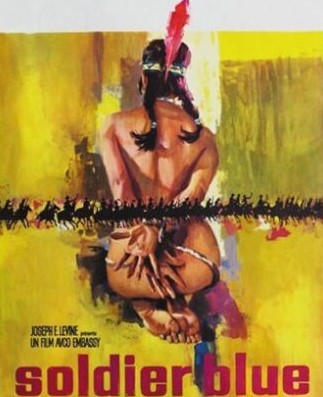
Soldier Blue (1970) ****

Except for the visceral violence and the gender reversal almost plays like a traditional western, mismatched pair, army private Honus (Peter Strauss) and white squaw Cresta (Candice Bergen), trekking through Indian Country until finally ending up where they started, he at the cavalry fort, she back with her Native American husband Spotted Wolf (Jorge Rivero). Initially viewed as an allegory of Vietnam, specifically the My Lai massacre of 1968, no less powerful for that element not resonating so much.

From the outset this U.S. cavalry troop has little in common with the polished units of the John Ford era, the alcoholic commander, sex-obsessed soldiers, while the Cheyenne are considerably smarter, knocking off the unit not to rescue Cresta but to steal the money being ferried to the fort in order to buy rifles. The soldiers are so raw they don’t even post “flankers” to warn of imminent danger, are taken by surprise and decimated within minutes.

Cresta, who has a better grasp of the terrain, is first to find safety, later joined by Honus. Usually, it’s the male who is dominant, the female weak, needing rescued, tended and escorted home across perilous territory. There’s nothing innocent about Cresta who shocks Honus with her cursing and the way she strips off underwear that will hold her back over their long journey. While he makes his bones, defeating a Kiowa chief in a knife fight and demonstrating his marksmanship by shooting a rabbit, largely it’s down to Cresta to plot their course, tutor the young man in the ways of the wild, and get them out of scrapes.

There’s not much to the plot except them growing closer, eventually huddling together for warmth, while she fills him in on the genocidal tendencies of the U.S. government and how life on a reservation will ruin the indigenous people. But the preachy stuff takes second place to their relationship, the virginal Honus surprised by his own feelings, made more difficult by the fact that his more worldly companion has a fiancé back in camp.  

There’s an interlude of sorts when they are captured by the itinerant Cumber (Donald Pleasance), uncovering and destroying his cache of rifles intended for the Native Americans, and pursued as a result.  

Although theoretically, the action takes place after Little Big Horn in 1876, the references are to the Sand Creek Massacre of 1864. We’re given no backstory as to how Cresta came to be welcomed in the Native American camp and was accepted as the wife of Spotted Wolf, and she is regarded almost as a traitor for succumbing. The narrative drives the audience towards Honus as the shocked observer on one side of the battle and Cresta as part of the Native American camp outnumbered by the massed Cavalry and massacred.

The film is more remembered for the violence than the performances which is a shame because Candice Bergen (The Magus, 1968) is particularly good as the far-from-typical Western woman, not just in her defence of the Native Americans, but in her gutsiness and know-how, and in a superb gender reversal becoming the protector of the male rather than the other way round. Peter Strauss (Hail, Hero, 1969) makes the transition from youth to maturity, from staunch  defender of American policy to outraged witness of its barbarity.

While you would need to track back in history to get the Vietnamese references, you will need little reminder of the atrocities armies can visit on the defenceless. The movie appeared at the same time as Dee Brown’s non-fiction book Bury My Heat at Wounded Knee, the first major work to take a different perspective on the Indian Wars. I’ve just finished reading The Earth Is Weeping by John Cozzens, published in 2016, who had greater access to historical data and presented the story in less black-and-white terms and which would have challenged a narrative that placed Cresta as a loved and loving wife in a Native American camp.

Whichever version you read, the outcome is still the same – unforgivable genocide.

The U.S. commander here, Col Iverson (John Anderson) is a pitiless creature. Once the main Native American force has been wiped out, he does nothing to prevent the subsequent raping and killing, some of the scenes filmed too strong for audiences weaned on the violence of the spaghetti westerns and The Wild Bunch (1969).  

Director Ralph Nelson (Duel at Diablo, 1966) almost employs the bait-and-switch approach, lulling us with minimal violence in a tale of the couple’s journey across the wilderness, before revealing the appalling unstoppable climax. John Gay (No Way to Treat a Lady, 1968) wrote the script based on the Theodore V. Olsen novel Arrow in the Sun.

Still retains its power half a century on.

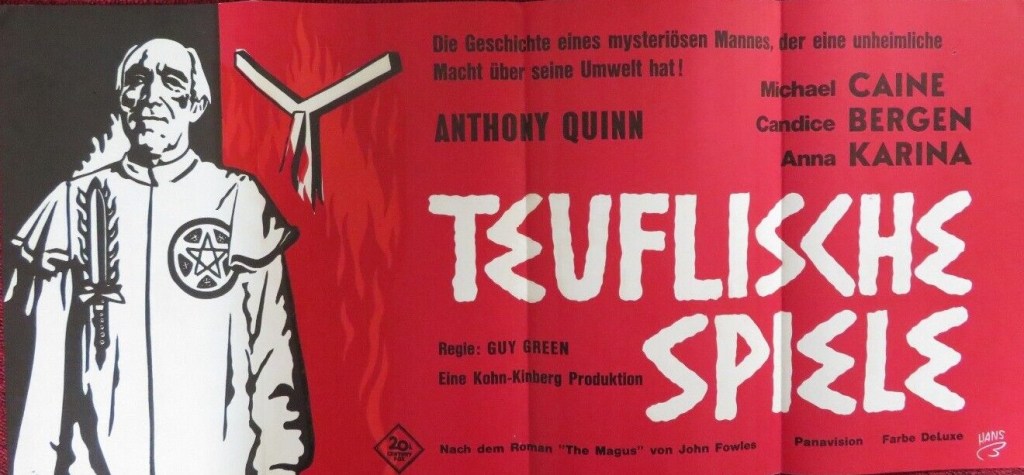
The Magus (1968) ***

Mind-games and unreliable narrators give this considerable contemporary appeal. Throw in Anthony Quinn back in Zorba the Greek (1964) territory and Michael Caine as a lothario in the Alfie (1965) mold plus Candice Bergen (Soldier Blue, 1970) in preppy mode and you have nothing short of ideal casting.

Nicholas (Michael Caine), escaping a failed romance with Anne (Anna Karina) by teaching English at the Lord Byron School on a Greek island, becomes entangled with millionaire Conchis (Anthony Quinn). The action primarily takes place on Conchis’s fabulous villa stuffed full of art treasures.  Conchis initially presents himself as a psychic who can summon up the past, namely in the shape of Lily (Candice Bergen) who talks and dresses like the young girl Conchis previously loved.

But every time Nicholas rumbles a ruse he is presented with a different version of Conchis’s self. These include a psychiatrist, conjurerer-up of the mythic past and Second World War  collaborator. All of these identities carry sufficient personal truth for Nicholas to doubt his doubts.

Is he the victim of some elaborate game, one which caused the mysterious death of his predecessor? Is he smart enough to expose the millionaire as a dangerous fantasist? Is Lily genuinely falling in love with him and will this be yet another romance which makes him feel trapped? Is he actually put on trial in front of the entire village or is that all a dream? Is Conchis intent on stripping him of his core identity? And if so, why?

It should have been a cracking film but somehow misses the target. In theory, this is because Michael Caine is miscast. Caine is usually in charge and here is anything but. But actually, flipping over an actor’s screen persona, especially this cocky one, works. You might keep on wishing the real Michael Caine would stand up, and the fact that he doesn’t gives the film its strength.

Anthony Quinn initially overdoes the flamboyance to the point of being hammy – what magician is not – but you can see the point of that when he turns into the sober mayor forced to deal with invading Germans during World War Two and faced with making life-or-death decisions. The general consensus is Candice Bergen is the weak link, but I’d challenge that too since she is playing a role, that of an easily-duped actress.

The main problem is the picture is loaded down with flashbacks. And all to do with the various reinventions of Conchis’s life. In keeping with the film’s style you are never sure how much of this is true. Caine’s character has little to do except ask questions. (A modern film would have him chasing after physical clues to uncover a riddle.) So it becomes very stagey, with Conchis like a frustrated teacher with an aberrant pupil.

Of all the misleading ads! This lost a fortune for Fox.

John Fowles adapted his 300,000-word cult novel, removing the bulk of the philosophizing, but not realizing that what works in a book, especially in the hands of a gifted narrator, is not so easily translated onto the screen. For the adaptation of his previous bestseller The Collector (1965), director William Wyler brought in screenwriters to make the book work as a film.

Either screenwriters balked at the problems of dealing with a masterpiece or Fowles insisted on writing the screen version or director Guy Green (Pretty Polly/A Matter of Innocence, 1967) believed him the best person to reconstitute his work. Quinn, rather than Caine, has the movie’s pivotal sequence, forced into an action on a par with Sophie’s Choice (1982) and it might have helped if that element had been brought in sooner.

As it is, the movie is no more than interesting when it should have been fascinating.

Hollywood: A Fashion Accessory

The new documentary on Audrey Hepburn – the Queen of Chic – and my reference to the making of the Valley of the Dolls in “My Books of the Year” blog made me wonder just how important fashion had become to movie marketing in the 1960s. So I did some digging. And found that the this particular decade had indeed been a golden age for Hollywood fashion.

Although actresses had set fashion trends before  – Lana Turner’s turtleneck sweater as evening wear, for example, Marlene Dietrich in pants, Carole Lombard’s shirts and Greta Garbo’s pillbox hat while Warner Brother’s star Kay Francis was often in reviews referred to as a clothes-horse – fashion had not previously been given the hard sell. Throughout the 1960s, that was remedied.

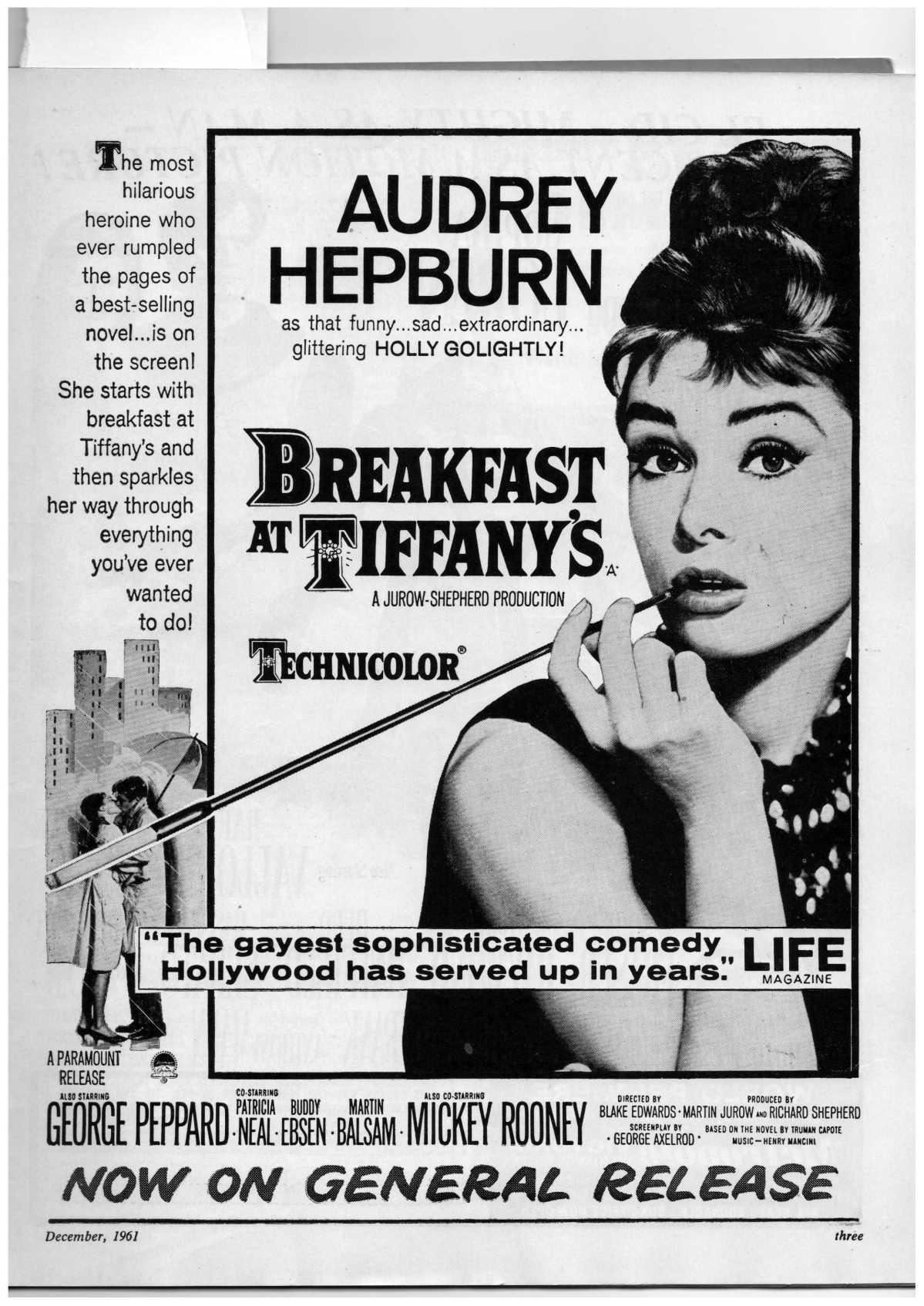
The new attitude to fashion as a marketing tool was instigated after a piece of market research. In 1960 United States market research company Sindlinger carried out consumer investigation on behalf of Universal that came to the conclusion that women made up 58 per cent of the audience going to see seven of the top ten pictures. In consequence, the studio decided to target the female audience with a marketing approach that would specifically appeal to that gender, namely fashion. First picture to benefit from this change of direction was Doris Day vehicle Midnight Lace (1960). Universal was a step ahead of the rest but Paramount was soon leading the field thanks to the impact on female fashion made by Audrey Hepburn in Breakfast at Tiffany’s (1961).

Jean Seberg was a designer’s delight. Yves St Laurent designed the clothes for Moment to Moment (1966).

In 1962 Paramount celebrated the fact that Edith Head was the industry’s only full-time contracted designer by hosting a fashion show on the penthouse set of the studio’s Come Blow Your Horn (1963) starring Frank Sinatra.  The event was called “Edith Head’s Penthouse Party.” Being showcased were costumes from eleven of the designer’s current or forthcoming movies. The cheapest outfit on show cost just $2.89 (worn by Patricia Neal in Hud – known at the time as Hud Bannon)  while the most expensive (for Jill St John in Come Blow Your Horn) set the studio back $3,700. In total the studio spent $420,000 on costumes for the movies.

As well as the two films mentioned above, other pictures in the Edith Head portfolio given a marketing push because of her fashion input included Elvis Presley vehicle Girls! Girls! Girls! (1962) co-starring Stella Stevens, comedy Papa’s Delicate Condition (1963) with Jackie Gleason and Glynis Johns, comedy Who’s Got the Action (1962) headlining Dean Martin and Lana Turner, and France Nuyen as A Girl Called Tamiko (1962). Also involved were Jerry Lewis numbers It’s Only Money (1962) and The Nutty Professor (1963), John Wayne adventure Donovan’s Reef (1963), Paul Newman-Joanne Woodward romantic comedy Samantha (later renamed A New Kind of Love, 1963) and Debbie Reynolds in My Six Loves (1963).

The outfits were modelled by some of the film’s stars including St John, Stevens, Nuyen,  Barbara Rush and Phyllis Maguire (also from Come Blow Your Horn), Myoshi Umieti and Martha Hyer (also from A Girl Called Tamiko) and Elizabeth Allen (Donovan’s Reef). Also on hand were four Japanese models and a quartet of actresses making the transition from modelling –  Patricia Olsen who had a small part in Samantha, Pat Jones, Mary Morlas and Olavee Parsons.  John Wayne, David Janssen (My Six Loves) and Cesar Romero (Donovan’s Reef) also put in an appearance but drew the line at modeling.

However, the big commercial push for Hollywood fashions came from My Fair Lady (1964). The impact of the Hepburn look in Breakfast at Tiffany’s was accidental, rather than deliberate. But from the outset the bulk of the promotional activity for the Lerner and Loewe musical was based around the costumes designed by Cecil Beaton. Whether or not the public could afford such flamboyant outfits was not uppermost in the minds of fashion editors – what Hepburn wore was just so stunning and converted into fabulous editorial spreads, especially for the magazines and newspaper supplements which by this time were mainlining on color, that it created a tsunami of marketing material.

In 1967 costumes hit a commercial peak with a record $12 million budget in total allocated to wardrobes. A total of $8 million was spent on just 15 movies. Easily topping the list was musical Camelot (1967) at $2.25 million while Doctor Dolittle (1967) racked up $1 million, Star! (1968) $750,000 and Funny Girl (1968) $500,000. Three hundred fashion editors attended a fashion show at the Plaza Hotel in New York for a first glimpse of the clothes worn in Funny Girl.

One year earlier Universal had pushed the boat out marketing-wise for the outfits designed by Yves St Laurent for Jean Seberg in Moment to Moment (1966). That same year Warner Bros had focused on fashion for its promotion of the fashion-conscious Kaleidoscope (1966). Stars Warren Beatty and Susannah York might as well have been fashion models given the range of outfits they wore and the movie’s Pressbook claimed the clothes specially created for the picture were on the biggest selling-points for a movie in years especially as most “in” stores “know about the kicky, eye-arresting swingy ‘mod’ fashion clothes which are all the rage.”

Candice Bergen, a former model, caused a sensation in Paris – where she was shooting Vivre pour Vivre (1967) with Yves Montand – when she participated in the Dior show. Her unexpected appearance as well as the clothes she wore received huge publicity. Also in 1967, MGM took out a full-page advertisement in Variety to, among other things, proclaim the impact of Doctor Zhivago on female fashion – “the world is wearing the Zhivago look.”

Expenditure was not an issue. A red velvet cloak worn by Kim Novak in The Legend of Lylah Clare (1968) cost an eye-popping $35,000 while Samantha Eggar’s fourteen costumes in Doctor Dolittle each cost between $7,000 and $14,000. The price of Vanessa Redgrave’s wedding dress in Camelot was $12,000.  Five gowns at a total of $17,000 made for Judy Garland for Valley of the Dolls (1967) were discarded when the actress was sacked and they did not fit replacement Susan Hayward.

Bonnie and Clyde had initially flopped in the U.S. so there was no great demand for Theodora van Runkle’s outfits. The film’s fashion craze started in London where it proved an unexpected hit. There, fashion house Matita launched a Bonnie outfit which caught on. But Stateside when the Bonnie look was widely adopted it was primarily because it was cheap to copy – a mid-calf skirt, thick-seamed stockings and the white beret not hard to replicate.

But it wasn’t just female fashions that benefitted from movie spinoffs. Male fashions seen in Bonnie and Clyde (1967) were adapted for commercial retail use by Geoffrey Beane and Donald Brooks, who were so convinced (mistakenly) that the movie would be a hit straight off the bat that the clothes appeared on racks long before the movie was released and the pair had to wait until the next year before demand for the movie turned into interest in its fashion.

In fact, men had always been a part of fashion marketing for the movies. Even a film as male-oriented and action-filled as The Guns of Navarone (1961) was given a fashion slant as a means of attracting a female audience – as I discovered when writing a book on the making of the film. “Navarone Blue” – was officially adapted by the British Colour Council while “Navarone Gold” was developed for the Colour Association of the United States. Both dyes were marketed to the manufacturers of automobiles, interior design and fabrics such as bedspreads. Grecian fashion was sold in 50 department stores including Macy’s. And it was written into the contracts of all the female stars that they wear clothes of either colour at premieres.

Lee Marvin had become an unlikely fashion icon and to take advantage of this new status MGM set up “coast-to-coast” promotions for Point Blank (1967). Highlander Clothes developed a fashion line as a marketing tie-up with over 60 stores from all over the country participating. Alcatraz – where part of the movie was filmed – was the location for a fashion shoot that went out in a three-page layout to the 20 million readers of Life magazine under the heading “Well-Dressed Moll Styles in Alcatraz.”

At the end of the decade another male-oriented picture, Downhill Racer (1969), was sold via a fashion marketing campaign. Steve McQueen, the epitome of cool, became a hook for fashion marketing, especially after The Thomas Crown Affair (1968) while Eli Wallach was an unlikely male model in upmarket male magazines. Earlier, for another male-dominated story, Seven Days in May (1964), director John Frankenheimer had been pictured wearing a Cardinal custom-made suit in an ad in Gentleman’s Quarterly. More in keeping with old-fashioned publicity gimmickry, for that film Paramount had also hired designer Mollie Parnis to create a suit for women that could be worn seven different ways on seven different days.

SOURCES: “Women Biggest Picture-Goers, So U Laces Midnight Campaign with Fashions,” Variety, Sep 7, 1960, 16 ; “Fashion Omnibus On 11 Features, By Edith Head,” Variety, Oct 31, 1962, 18; “H’wood Fashions Boom Year,” Oct 4, 1967, 5 ; “Paris Fashions – 1967,” Variety, Feb 15, 1967, 2; advertisement, Doctor Zhivago, Variety, Jan 4, 1967, 37.; Pressbook, Kaleidoscope; Pressbook, Point Blank; Pressbook, Seven Days in May; Brian Hannan, The Making of the Guns of Navarone (Baroliant, 2013) p153-154; Brian Hannan, Coming Back to a Theater near You (McFarland 2016) p186. 

Discover WordPress

A daily selection of the best content published on WordPress, collected for you by humans who love to read.

The Atavist Magazine

by Brian Hannan

WordPress.com News

The latest news on WordPress.com and the WordPress community.