Night after Night after Night (1969) ***

British giallo sets tough London cop Bill Rowan (Gilbert Wynne) hunting a Jack-the-Ripper type serial killer who has slaughtered his wife (Linda Marlowe). Chief suspect is leering cocky jack-the-lad Pete (Donald Sumpter) of the wham-bam-thank-you-ma’am school of seduction. In an era when pornography and “perversion” were beginning to shake off the shackles – and strippers, prostitutes, voyeurs and transvestites condemned as evils to be stamped out – this skirts the boundaries between sexploitation and heavy moralizing.

Chief among those embarking on a moral crusade is hypocritical puritan Judge Lomax (Jack May) who spurns his attractive wife (Justine Lord) while indulging in cross-dressing. Needless to say, his clerk, ostensibly another upholder of the moral fabric, is a porn addict. As the body count grows, Pete manages to needle Rowan sufficiently for the cop to consider any nefarious means to put him behind bars.

Knives flash in the dark, the killer wears black leather, victims writhe on the ground as they are slashed to pieces, and coupled with the unusually high nudity quotient it is surprising that this picture passed the British censor. The movie never drags and there is enough incidental sleaze to keep the viewer interested. As a historical document, it details the point at which the country hovered between reined-in respectability and full-on sexual freedom.

Operating here under the pseudonym Lewis J. Force, Canadian director Lindsay Shonteff (The Million Eyes of Sumuru, 1967) conjures up a darker vision of a London so often presented in glorious tourist tones with nastiness seeping into every corner of society. Veteran Jack May (A Twist of Sand, 1968) captures well the double life of a decent man undone by what is perceived to be indecency and his later scenes are quite moving. Donald Sumpter (The Black Panther, 1977) is excellent as the taunting petty criminal while Gilbert Wynne makes a decent debut as a leading man. In small roles are Justine Lord (Deadlier than the Male, 1967) and Linda Marlowe (Big Zapper,1973 – directed by Shonteff). Written by Dail Ambler (Beat Girl/Wild for Kicks, 1960).

Jack the Ripper was such an ingrained element of British culture that any movie featuring a similar villain gave audiences the creeps. British television cops were beginning to move out of the shadow of Dixon of Dock Green and into the new age of The Sweeney and while giallo did not catch on  among home-grown filmmakers there was considerably more focus on hardened criminals such as Get Carter (1971) and Villain (1971).

The House in Marsh Road (1960) ***

Well-structured thriller – especially given the short running time – that allows time for the story to blossom and, given the supernatural tinge, in a somewhat unusual fashion. Worth noting, too, the gender fallibility in keeping with the time, the wife who will support her husband come what may, through his heavy drinking, philandering and deceit. The only truth is that somehow or other her husband is going to get hold of her money.

Wife Jean (Patricia Dainton) is initially complicit in her husband David’s (Tony Wright) small-time fraudulent activity, willing to scamper from short-term let to short-term let, vanishing without paying the bills, because she believes in his grandiose ambitions of rising above his lowly status as a book reviewer to become a novelist.

The too handsome to be true bad guy.

When she inherits a house from an aunt, he wants to sell it and use the £6,000 to fund his ambition, though once he meets sexy secretary Valerie (Sandra Dorne) his plans change to using the dosh to set up a new life with Valerie. Of course, that would mean eliminating his wife and inheriting the property himself. A first attempt, to push her down a life shaft, fails and he moves on to sleeping pills.

Jean is so in thrall with him that even when she catches him out in lying, theft and an affair, she still is apt to stand by him after giving him a frosty reception and a good ticking-off. It’s only when she suspects worse that she seeks help.

Unbeknownst to her she has an invisible ally, a poltergeist named Patrick, who has the habit of rearranging furniture, sighing, setting off the alarm, and, for people to whom he takes an aversion – such as David and Valerie – smashing mirrors and disrupting their desk. Given the budget and the period, the paranormal aspects are kept to the minimum, noise the most obvious evidence, while other actions occur when the camera is not present.

You sometimes wish these kind of British B-pictures would add another 30-40 minutes to explore consequence in true film noir style. There’s no doubt that Valerie would soon find a way to rook David of his inheritance and dump him, easiest way being to lead the police to him.

While Jean finds an attorney willing to take note of her suspicions, you can’t but help noting that mention of a poltergeist is not helping her case, and in the normal course of events she would be committed, leaving David free to cash in on the house and indulge his mistress.

It doesn’t get to the obvious ending, of her being disbelieved, and forced to return to the house and spend her time going mad wondering how her husband is going to bump her off. Instead, Patrick comes to her aid, starting a fire which engulfs the house in her absence. Husband and lover die in the blaze.

As ever, no great acting. Patricia Dainton (The Third Alibi, 1961) might be accused of not putting enough terror in her characterization but that would be to overlook the fact that in those days handsome husbands were implicitly trusted. Tony Wright (Faces in the Dark, 1960) is smug enough but Sandra Dorne (Devil Doll, 1964) only requires a touch of smouldering to steal the show.

Based on a story by Laurence Meynall, inventively written by Maurice J. Wilson (Fog for a Killer, 1962), especially for the undercurrent of malevolence and manipulation. Ably directed by Montgomery Tully (The Terrornauts, 1967).

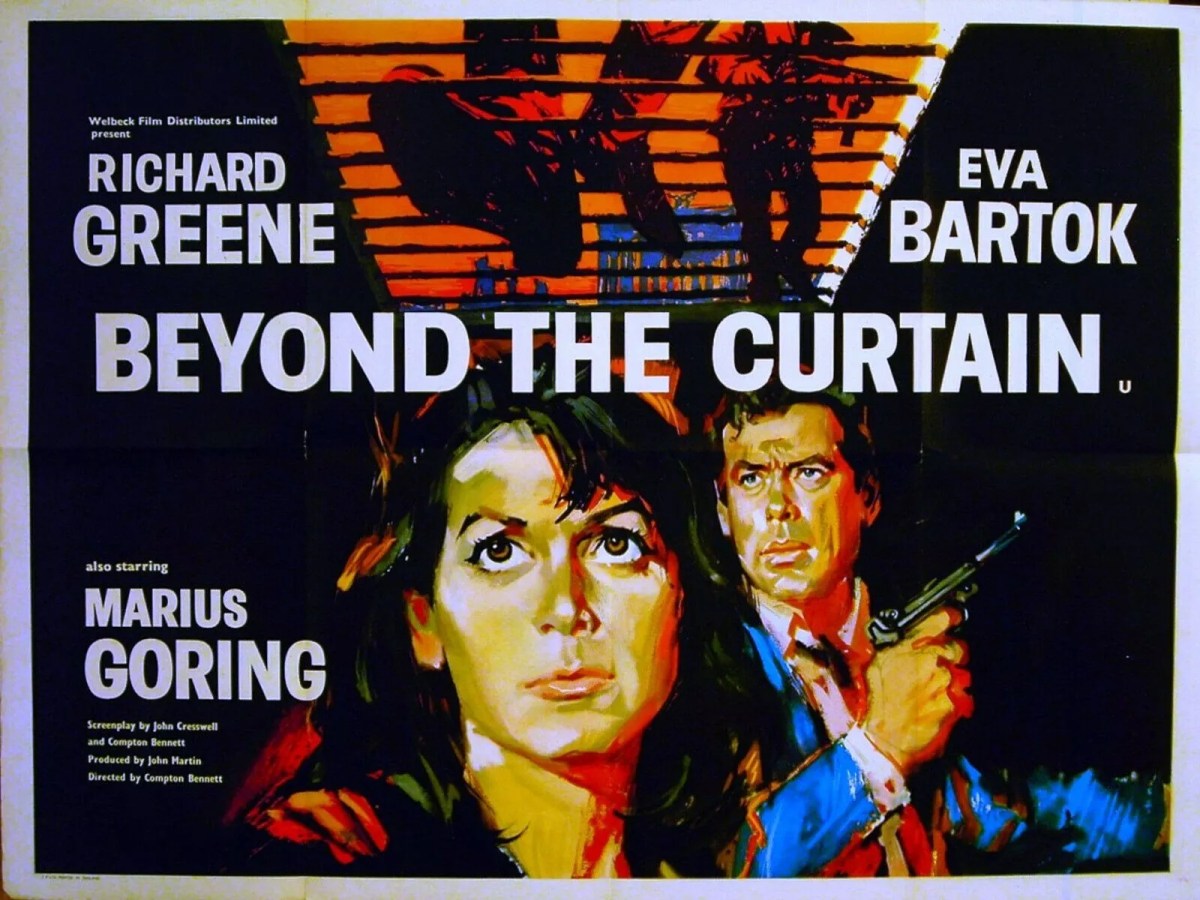
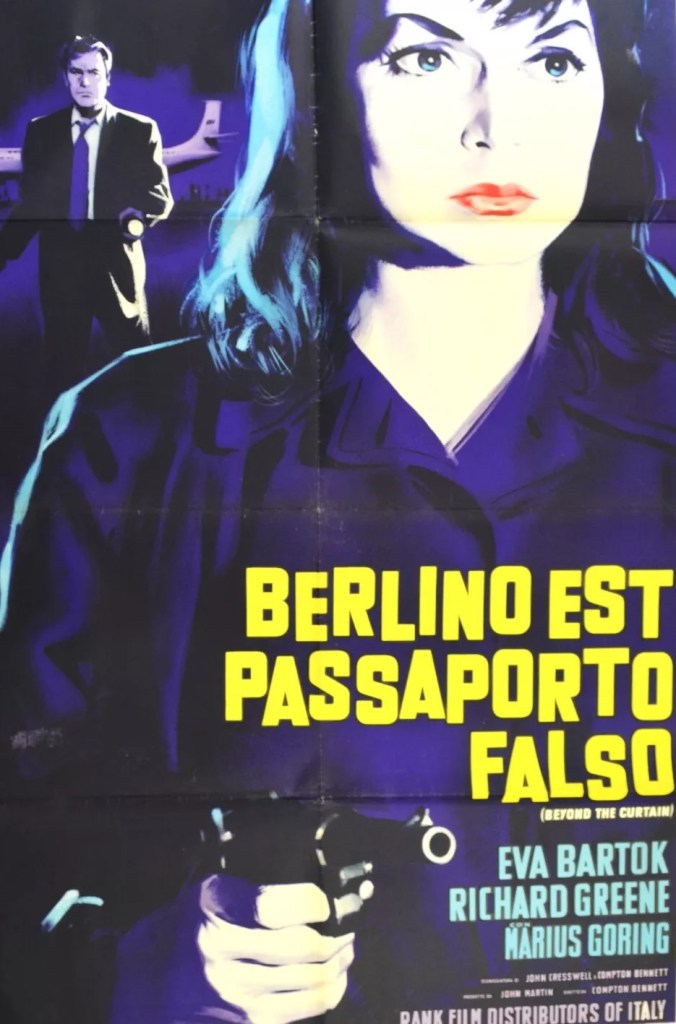
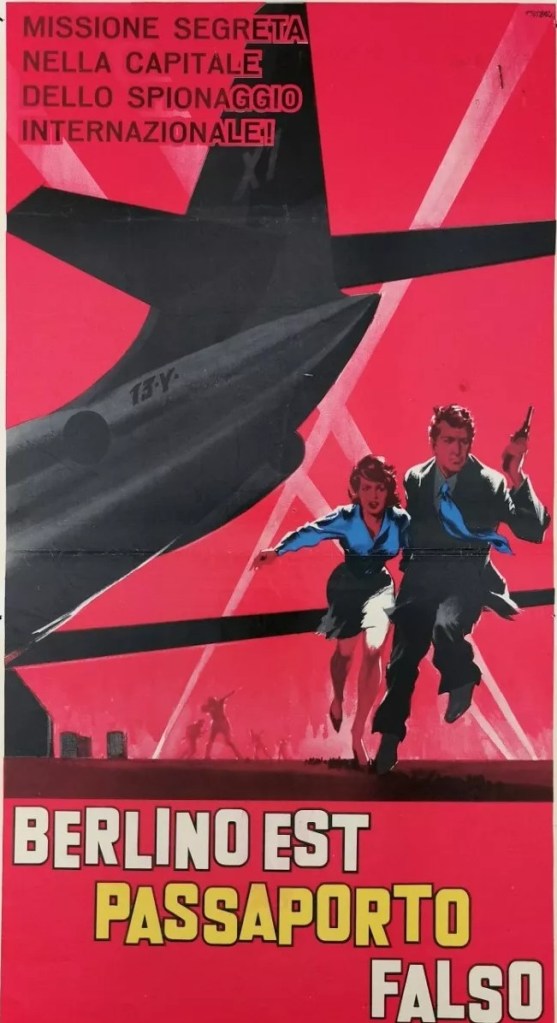
Beyond the Curtain (1960) ***

Richard Greene had been a childhood idol as that dashing hero Robin Hood in long-running British television series (The Adventures of Robin Hood, 1955-1960) and movie Sword of Sherwood Forest (1960) so I was rather at a loss to discover that his career appeared to stumble thereafter. Only one movie in seven years and then a short stint as the hero in The Blood of Fu Manchu (1968) and The Castle of Fu Manchu (1969).  What I hadn’t realized given his eternal youthful demeanor was that he was already approaching 40 when he first donned the tights for Robin Hood and that he was coming to the end of a reasonable stint as a leading man in both Hollywood and domestically.

So I shouldn’t really have been surprised that he turned up in this Cold War B-picture. Precisely because he was the star the movie didn’t make the inroads it should have done, given the subject matter and the sensitive playing of Hungarian female lead Eva Bartok (Blood and Black Lace, 1964) whose career was equally foundering after a promising start as Burt Lancaster’s squeeze in The Crimson Pirate (1951).

Audiences were probably baffled by the technicality on which the story pivots. As the Cold War begins – the titular Curtain is The Iron Curtain –  air space was as important a national border as land and venturing into foreign air space was construed as deliberate provocation.

East German stewardess Karin (Eva Bartok), a refugee in Britain from her home country, is arrested when her airplane touches down in East Germany after losing its way in a storm. Pilot fiancé Capt Jim Kyle (Richard Greene), who is let go by the Soviet-influenced authorities, returns to East Germany to try to rescue her.

This resonates more than it did at the time when the Berlin Wall was not yet in existence and the Cold War consisted more of saber-rattling than anything as perilous as the Cuban Missile Crisis. And there’s a definite Kafkaesque tone. Karin is treated as a traitor for attempting to flee her native land and is equally used as bait by her captors to attempt to draw out of hiding her dissident brother Pieter (George Mikell). Outside of Kyle, there’s a sense of romantic revenge, old friend Hans (Marius Goring) now leading the forces hoping to entrap her brother.

There’s plenty of the usual escape ploys, and the atmosphere has noir-antecedents with lighting that exploits shadow and night. And while the thriller aspects work well enough, especially the exciting climax in a tunnel, they carry less impact than the emotions. Karin is terrified of not just being held against her will and interrogated by the fierce secret police, but the prospect of repatriation – or more likely imprisonment – in a country she now despises and had managed to escape is proof that you can’t go home again.

If you remember the scene in Doctor Zhivago (1965) of Omar Sharif after the war returning to his palatial apartment and finding it filled up with other occupants and his family relegated to a very small space, this is its precedent. Karin’s family home is ruled by a sinister landlady-cum-busybody-cum-informant and her suicidal mother (Lucie Mannheim) lives in the attic and suffers delusions. The despair of living in a totalitarian regime comes across very well.

While reminiscent of elements of The Third Man (1949) and thoroughly overtaken in the espionage genre by the likes of The Spy Who Came in from the Cold (1965) and The Quiller Memorandum (1966), this makes it mark by concentrating on entrapment and lack of freedom.

Richard Greene is in his element as the dashing hero, but he’s outshone by Eva Bartok who has much more to lose.

Final feature of British stalwart Compton Bennett (King Solomon’s Mines, 1950) who injects occasional style into proceedings. Written by the director and John Cresswell (Spare the Rod, 1961) from the bestseller by Charles F Blair and A.J. Wallis.

More thought-provoking than you might expect.

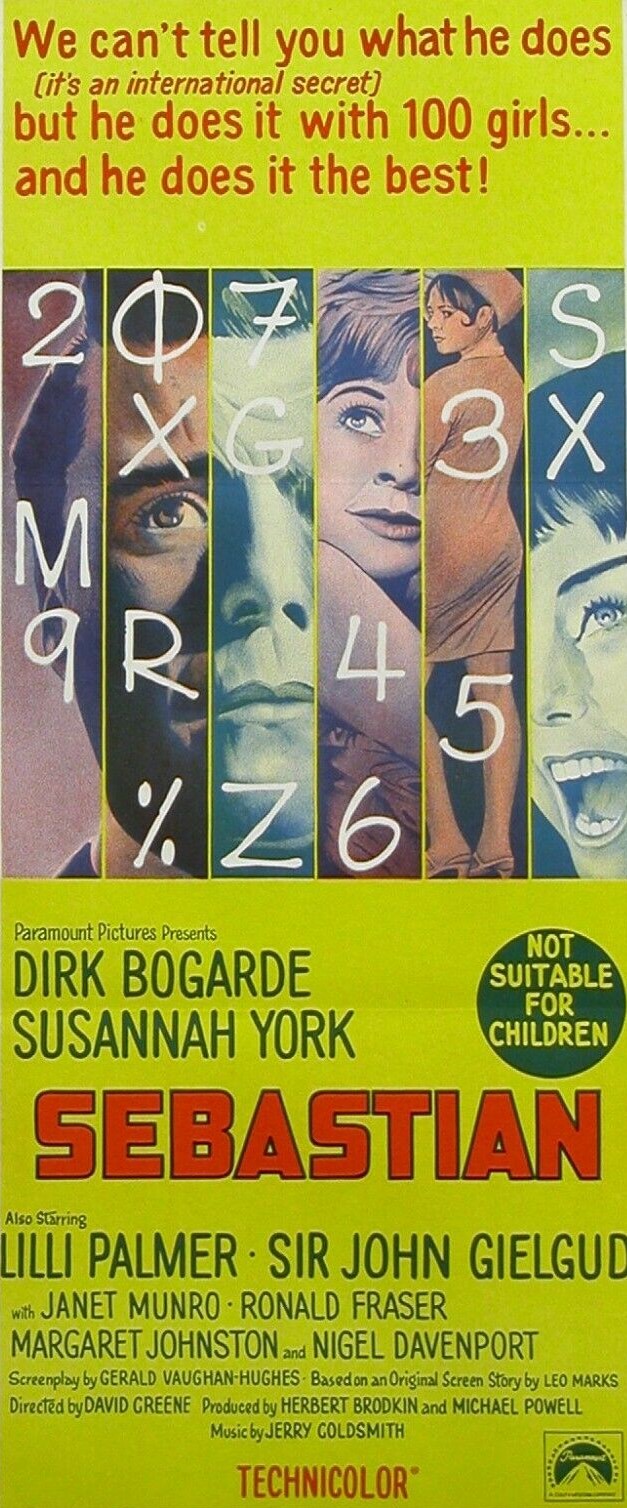
Sebastian (1968) ***

Decoding the emotional life of mathematics professor Sebastian (Dirk Bogarde) lies at the heart of a spy thriller mainlining on loyalty and trust. The presence of a flotilla of potential Bond girls has opened this picture up to charges of being a spoof, but I saw the mini-skirted incredibly-bright lasses as being a reversal of the standard secretarial pool. And a supposed  representation of the “swinging sixties” would hold true if shot in the environs of Carnaby St  rather than the bulk of locations being arid high-rise buildings. 

In roundabout fashion, intrigued after literally bumping into him in Oxford, Rebecca (Susannah York) is recruited into an espionage decoding department staffed entirely by gorgeous (but brainy) women. Among the older employees is chain-smoking left-winger Elsa (Lili Palmer) whom security chief General Phillips (Nigel Davenport) suspects of passing on secrets. When romance ensues with SY, Sebastian dumps dumb pop singer girlfriend Carol (Janet Munro) who is already having an affair and spying on Sebastian.

Although there is no actual beat-the-clock codes to be unraveled, tensions remains surprisingly high as in best Turing manner, breakthroughs are slow. There’s an undercurrent of electronic surveillance, eavesdropping on recruits, bugs planted in the houses of even the apparently most trusted personnel, seeds of distrust easily sowed, codes shifting from numbers to sounds.  The occasional nod to the contemporary, a disco, pop songs, Rebecca doing a fashion shoot in the middle of traffic, is background rather than center stage

Sebastian, though worshipped by is female staff, is “more whimsical than predatory.” Nonetheless, introspective and often morose, unable to deal with emotions, it falls to Rebecca to take on the task of sorting him out which naturally leads to complications.

Most reviewers at the time complained it was a victory of style over substance, but somehow they managed to overlook the essential questions about trust the picture asked. That said, it does follow an odd structure, the third act dependent on directorial sleight-of-hand.

Dirk Bogarde (Hot Enough for June/ Agent 8 ¾, 1964) is always highly watchable and Susannah York (Sands of the Kalahari, 1965) catches the eye with an impulsive, slightly kooky character who turns out to be down-to-earth. Nigel Davenport (Play Dirty, 1969) brings his usual cynical malevolence to the party but with the twist of not knowing whose side he is really on. John Gielgud (Becket, 1964) is a delight. There’s a brief appearance by a pipe-smoking Donald Sutherland (The Dirty Dozen, 1967). Miss World Ann Sidney is one of “Sebastian Girls”

David Greene’s (The Shuttered Room, 1967) direction is mostly competent but the opening aerial tracking shots set the precedence for occasional bursts of style.  Jerry Fielding supplied the score. Written by Leo Marks (Peeping Tom, 1960) and Gerard Vaughan-Hughes (The Duellists, 1977).

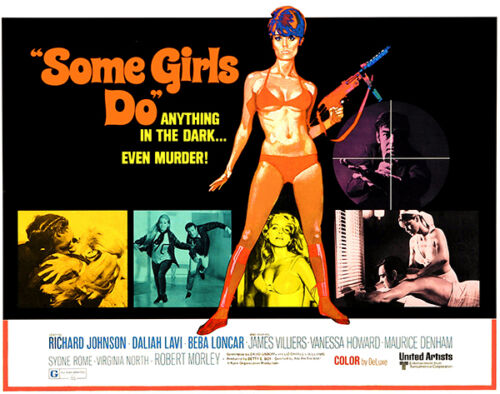
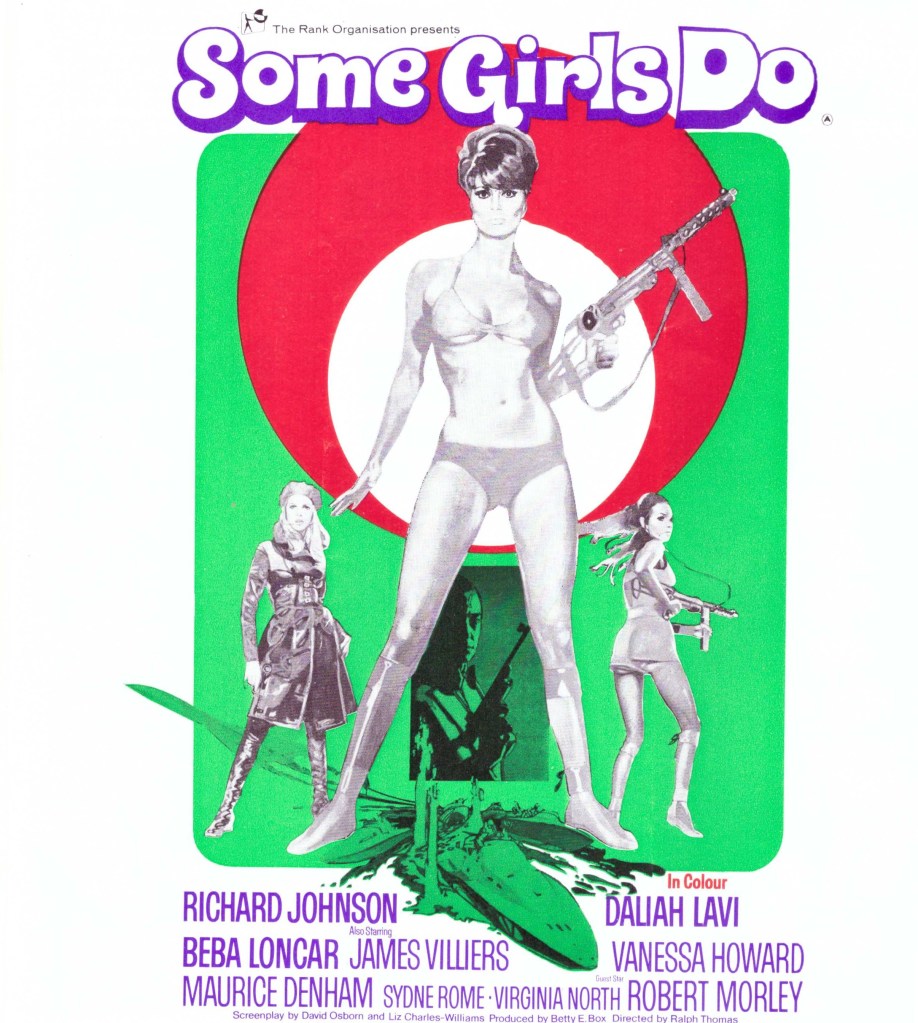
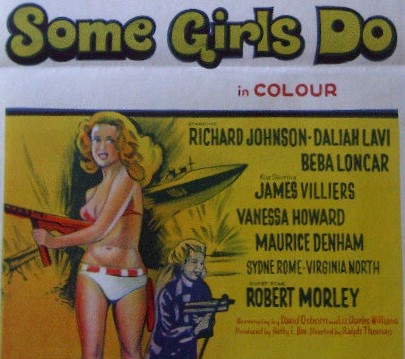
Some Girls Do (1969) ****

Enjoyed this sequel to Deadlier Than the Male (1967) far more than I expected because it sits in its own little world at some point removed from the espionage shenanigans that dominated the decade. Hugh (nee Bulldog) Drummond (Richard Johnson) is neither secret agent nor involved in espionage high jinks, instead employed in the more down-to-earth domain of insurance investigator, albeit where millions are at stake. Although his overall adversary is male, the smooth-talking Carl Petersen (James Villiers), adopting a series of disguises for most of this picture, the real threat comes from a pair of villainesses in the shape of Helga (Daliah Lavi) and Pandora (Beba Loncar). If anything, this pair are a shade more sadistic than Irma and Penelope from the previous outing.

The sequel doubles up – or doubles down – on the female villainy quotient, Petersen having created a race of lethal female robots who spend their time dispatching scientists working on the world’s first supersonic airliner. Global domination is only partly Petersen’s aim since he also stands to gain £8 million ($134 million today) if the plane doesn’t launch on schedule. Livening up proceedings are Flicky (Sydne Rome), a somewhat kooky Drummond fan who has her own agenda, Peregrine “Butch” Carruthers (Ronnie Stevens), a mild-mannered embassy official assigned bodyguard duties, and chef-cum-informant Miss Mary (Robert Morley).

Villiers has found a way of turning an ultrasound device intended originally to aid cheating in a boat race into something far more dangerous. But, of course, for Helga seduction is the main weapon in her armory, and Drummond’s first sighting of her – a superb cinematic moment – is sitting on the branch of a tree wielding a shotgun. Equally inviting are the squadron of gun-toting mini-skirted lasses guarding Petersen’s rocky fortress.

The movie switches between Helga, Pandora and the robots raining down destruction and Drummond trying to prevent it. Dispensing with the boardroom activities that held up the action in Deadlier than the Male, this is a faster-moving adventure, with Drummond occasionally outwitted by Helga and calling on his own repertoire of tricks. Dialog is often sharp with Drummond imparting swift repartee.

The action – on land, sea and air – is a vast improvement on the original. The pick is a motorboat duel, followed closely by Drummond in a glider coming up against a venomous aeroplane and saddled with a defective parachute. And there are the requisite fisticuffs. Various malfunctioning robots supply snippets of humour.

Richard Johnson (A Twist of Sand, 1968) truly found his metier in this character and it was a shame this proved to be the last of the series. Although Daliah Lavi never found a dramatic role to equal her turns in The Demon (1963) and The Whip and the Body (1963) and had graced many an indifferent spy picture as well as The Silencers (1966), she is given better opportunity here to show off her talent. Beba Loncar (Cover Girl, 1968) is her make-up obsessed bitchy buddy. Sydne Rome (What?, 1972) makes an alluring debut. James Villiers (The Touchables, 1968) is the only weak link, lacking the inherent menace of predecessor Nigel Green.

There’s a great supporting cast. Apart from Robert Morley (Genghis Khan, 1965) look out for Maurice Denham  (Danger Route, 1967), Adrienne Posta (To Sir, with Love, 1967) and in her first movie in over a decade Florence Desmond (Three Came Home, 1950). The robotic contingent includes Yutte Stensgaard (Lust for a Vampire, 1971), Virginia North (Deadlier Than the Male), Marga Roche (Man in a Suitcase, 1968), Shakira Caine (wife of Sir Michael), Joanna Lumley (television series Absolutely Fabulous), Maria Aitken also making her debut, twins Dora and Doris Graham and Olga Linden (The Love Factor, 1969).  Peer closely and you might spot Coronation Street veteran Johnny Briggs.

The whole package is put together with some style by British veteran Ralph Thomas (Deadlier than the Male). Screenplay by David Osborn and wife Liz Charles-Williams (Deadlier than the Male) is based on the book by “Sapper”.

Out of the Fog / Fog for a Killer (1962) ***

Unusual and unusually effective entry into the low-budget British B-film crime category. Teeters for a time on the bittersweet before plunking for ending on a  more realistic sour note. Surprising, too, in being issue-driven – the problem of the rehabilitation of criminals, or the way such efforts are blocked by the general populace wanting nothing to do with thieves and villains, especially when it comes to employment or romance.

On release from prison, George (David Sumner) is given the chance of a new life from do-gooder Tom Daniels (James Hayter) who runs a halfway house for ex-cons. George isn’t particularly grateful, since he sees life stacked up against him. But he’s making an effort and turns down the chance to join the other residents in setting up an illegal scheme. Instead, Tom finds him work as a driver for a furnishings manufacturer where he meets Muriel (Mela White). But their nascent romance is scuppered when the cops come calling, investigating a murder on the “Flats”, an area of wildland close to both the factory where he works and the pub he frequents.

When the killer strikes again, and again, the cops Det Supt Chadwick (John Arnatt) and Sgt Tracey (Jack Watson) realize the murderer is striking at the full moon. Luckily, neither of the detectives is apt to go down the werewolf route, especially as the killer tends to strike when a full moon would be of little assistance because the “Flats” are covered in thick fog (for no apparent reason except the script says so).

George becomes the chief suspect and the cops decide to set up Sgt June Lock (Susan Travers) as bait – odd how often this became a trope in these B-pictures. She’s to befriend George and, come the full moon, prevent herself being killed (the cops are keeping tabs on her) long enough to trap George as the killer.  

There’s generally little time to waste in these running-time-conscious thrillers (this only lasts 68 minutes) on any characterization beyond the obvious but here we discover George has been disowned by his mother, a rather well-off character who lives in a good-sized house in middle-class Chiswick. When he asks to be allowed home, she turns him away and when the cops come calling her first words are, “I don’t have a son.” She’s a cold fish for sure, and hardly the entire reason he’s turned to crime, but it would go some way to explain his general bitterness.

George also appears to have an artistic bent and June encourages him, going so far as lining him up for some work. Before we get to the finale, there are other treats in store, the shrewish mother Mrs Foster (Hilda Fenemore) of the sulking Lily (Coral Morphew) who escaped attack by the killer. The other occupants of the house are also well-drawn, with a villainous hierarchy in operation, and clearly much more likely than George to re-offend.

The cops, too, are more ready than usual to admit defeat. Clues are non-existent what with the fog and any attempt at forensics limited to wondering why George cleaned his shoes so assiduously, the obvious deduction being the existence of mud or grass would have put him close to the crime scene.

In truth, there’s not much to the detection, but at least, as I said, nobody falls for the werewolf line and the idea of the date bait seems to come too easily to the cops.

As it stands, it’s mostly a character study, of a young man who can’t get a break, of society’s attitude to criminals, the lack of redemption available and little chance of a second chance once your past is discovered. I’m not sure how much this was an issue at the time but George exhibits a more understandable seam of bitterness than the likes of the surly Arthur Seaton in Saturday Night and Sunday Morning (1960). The movie only scratches the surface of the affect of a child on the lack of a mother’s love, and since we don’t know what triggered George’s first crime it’s hard to go any deeper.

There’s the chance of a happy ending. June is clearly smitten with George and determined to prove him innocent rather than, as her superiors require, guilty. But bitterness wins out in the end.

Directed by Montgomery Tully (The Terrornauts, 1967) who had a hand in the screenplay along with producer Maurice J. Wilson (Master Spy, 1963) based on the novel by Bruce Graeme.

David Sumner (The Long Duel, 1967) gets his teeth into a peach of a part. Career-wise Jack Watson (The Hill, 1965) fared best though Susan Travers (Peeping Tom, 1960) had a running role in TV series Van der Valk (1972-1973)

Interesting twist on the genre.

Shadow of Fear (1963) **

The Eady system at its worst. I’ve been singing the praises of quite a few of these British crime B-movies, made to take advantage of the Eady Levy cashback system and a Governmental dictat that cinemas had to show a certain proportion of British-made features. Generally, they were intended to fill the supporting feature slot, providing cinemas with a double feature. In the course of writing this Blog, I’ve uncovered a few minor gems, brisk, well-directed thrillers, good acting not necessarily essential.

The best this has to show for it is the ruthlessness of British spy chiefs in using an innocent couple as bait for foreign spies. Otherwise, beyond the initial twist, it’s too desultory for words, with too much time – even in a 60-minute feature – spent on too little.

American oilman Bill Martin (Paul Maxwell), flying back to London from Baghdad, agrees to carry a coded message for Jack Carter (Antony Wager), a casual British acquaintance. On landing at Heathrow Bill discovers Jack has been murdered. He’s accosted by a couple of cops, taken to a seedy hotel to wait for a fellow called Oliver, accepting all this oddness because he assumes he’s delivering a message for British Intelligence. After handing over the message he makes the mistake of telling Oliver that not only did he read the message, although failing to decode its content, but, having a photographic memory, had committed it to his brain.

Cue imprisonment. He escapes only because someone attempts to kill him and in turning the tide finds a way out. He flees to girlfriend Barbara (Clare Owen) and she whizzes him in a nifty sports car to her Uncle John (Colin Tapley) who knows somebody who knows somebody and it soon emerges that the fellow called Oliver was actually a fellow called Sharp (John Arnatt), a spy of unknown affiliation.

Assuming the bad guys would still want to eliminate our hero, the real Oliver (Reginald Marsh) reckons this is too good an opportunity to miss – the end justifying the means and all that rather than the more traditional British notion of fair play – and gets Bill and Barbara to agree to act as bait to trap the spies.

This doesn’t go as neatly as the good guys might expect and the baddies make further attempts on the couple’s lives and finally manage to kidnap them and take them out to sea with the intention of dropping them overboard. Luckily, the Brits are able to call in the Coastguard – armed for the occasion – to intercept and it all ends happily.

There’s not enough of anything to keep this moving – scarcely a red herring – and there’s about a dozen characters who flit in and out, various thugs, a top thug called Warner (Alan Tilvern), a femme fatale Ruth (Anita West) who is given no chance to exert her femme fatale wiles, and sundry MI5 and FBI characters and various others along the way. From the amount of time spent focusing on the belly dancer (Mia Karam) in the Baghdad hotel, you might have expected that she would have a role to play because she had more screen time than Ruth.

Nobody went on to greater things. Canadian Paul Maxwell (Man in the Middle / The Winston Affair, 1964) specialized in playing Americans in British films and television, even had a running part in soap opera Coronation Street and if you look closely you’ll see him pop up in A Bridge Too Far (1977).

Director Ernest Morris (Echo of Diana, 1963) can’t do much with the script by Ronald Liles (Night of the Big Heat, 1967) and Jim O’Connolly (Smokescreen, 1964) based on a tale by T.F. Fetherby.

Dull whichever way you cut it.

Echo of Diana (1962) ***

Minor British B-picture gem, though more for the exquisite narrative and tsunami of twists than the acting. And while not being one of those devious arthouse farragoes spins the starting point as the climax. Also, very prescient, heavily reliant of the espionage tradecraft that would later become de rigeur.

On the day she learns of her husband’s death in a plane crash in Turkey, Joan (Betty McDowall) finds an intriguing reference to the dead man in the “Personal Column” of The Times newspaper signed by “Diana.” Suspecting a mistress or skulduggery, her friend Pam (Clare Owen), a former fashion editor, investigates and triggers trouble. Joan’s flat is burgled, they are accosted by dubious police, the dead man’s effects are foreign to Joan, the receptionist at a newspaper makes a mysterious phone call.

Fairly quickly, Joan and Pam fall in the purlieu of British espionage chief Col Justin (Geoffrey Toone) who puts them in touch with suave journalist Bill (Vincent Ball), an old colleague of the husband, whose apartment has also been tossed, and who has taken a shine to Pam. The women are somewhat surprised when a murder is hushed up but that’s the least of the espionage malarkey. Mysterious contacts, equally odd points of contact, disguises (though mostly this runs to a blonde wig), code names, double agents, phone tapping and mail drops leave the women somewhat befuddled but they play along and with that British bluffness, not quite aware they are acting as decoys to draw out a crew of foreign spies headed by a rough fella called Harris (Basil Beale).

Halfway through it seems her husband might not be dead after all, but, according to the Turkish ambassador, Joan might need to head off to Turkey or thereabouts and certainly other interested parties want her out of the country.

And it being British, and nobody wanting to take the whole thing seriously, especially since the James Bond boom had not begun in earnest, the drama is offset by some pointed comedy: the proprietor of an accommodation address business has a side hustle in porn mags, one of the contacts is annoyingly punctilious, one promising lead turns out to be a very grumpy old man, another lead results in a race horse called Diana in a grubby betting shop where they are rooked by another old guy.

But it’s lavished with twists: double-crossers double-crossed, misleading clues, bad guys far cleverer than good guys, the wrong person in the right car, kidnap, unexpected occurrence. Pretty contemporary, too, with much of the action driven by telephone calls. But something of an ironic climax, the notice in the newspaper having legitimate espionage purpose.

The action is so pell-mell, Joan and Pam scarcely have time to draw breath, never mind give vent to heavy emotion, the best we are afforded is a moment when Joan doesn’t know “whether she’s wife or widow.” But that’s just as well. We are in B-movie land with a B-movie class of actors, probably recognizable to audiences then as the kind of actors who never managed a step up.

Vincent Ball did best, a long-running role in BBC TV series Compact (1962-1965), male lead in skin flick Not Tonight, Darling (1971) and decades of bit parts. You might have caught Betty McDowell in First Men in the Moon (1964) or The Omen (1976). Clare Owen was female lead in Shadow of Fear (1963) and had a part in ITV soap Crossroads (1965-1972).

Directed by Ernest Morris (Shadow of Fear) from a script by Reginald Hearne (Serena, 1962). You’d say a better script than a movie, and with better casting might have taken off, but, still, very satisfying supporting feature for the times.

Dr Who and the Daleks (1965) ***

The maiden voyage of the time-travelling Tardis is triggered by some unexpected pratfall comedy. On board are the venerable doctor (Peter Cushing), his intrepid great-granddaughter Susan (Roberta Tovey) and a fearful pair, granddaughter Barbara (Jennie Linden) and accident-prone Ian (Roy Castle). They land on a petrified planet ruled by the robotic Daleks with menacing electronic voices.

The malfunctioning Tardis forces them to investigate an abandoned city but they are quickly imprisoned, the steel robots determined to discover why the earthlings should be immune to the radiation that has consumed this planet after nuclear war. Meanwhile, the planet’s remaining inhabitants, the Thals, are planning an uprising.

Budget restrictions ensure that menace is limited, even as the characters endure a heap of traditional obstacles such as swamp and rocky outcrop. Adults who did not grow up in the 1960s when the BBC television series took Britain by storm and apt to come at this without the benefit of nostalgia will certainly look askance at the sets and costumes. And it doesn’t possess the so-bad-it’s-good quality of some 1950s sci-fi pictures. But since it was primarily made for children, then perhaps it’s better to watch it with a younger person and gauge their response – of course, that may be equally harsh from someone brought up on the modern version of the series or already immersed in superheroes.

On the plus side, it does move along at a clip. Roberta Tovey (A High Wind in Jamaica, 1965) charms rather than annoys as the plucky grand-daughter even if her grandfather has mutated from the sterner figure of the television series into an eccentric inventor. Peter Cushing (The Skull, 1965) is only required to ground the production which he does adequately. The innate comic timing of comedian Roy Castle, in his leading man debut, brings a light touch to proceedings as the bumbling boyfriend and generates some decent laughs. Jennie Linden (Women in Love, 1969) has little to do except look scared.

Oddly enough, it was American Milton Subotsky who, in opportunistic fashion, brought the project to the big screen, although the BBC had a track record of providing product that might make such a leap, The Quatermass Experiment in the 1950s the leading example. He wrote the screenplay and acted as producer and had previously worked with Cushing on Dr Terror’s House of Horrors (1965) and was about to embark on horror masterpiece The Skull the same year. He has approached the material with some reverence and the fact that the budget allowed for hordes of Daleks rather than being seen one or two at a time as on the television probably made some child’s day.

Scottish director Gordon Flemyng (The Split, 1968) would make the leap to Hollywood on the back of this picture and its sequel the following year and you can see what made studios have faith in his ability – he deals with multiple characters, works quickly on a low budget and delivers an attractive picture that was a box office hit.

I suspect that audiences will divide into those who watch the film with nostalgia-colored spectacles, those who think it only as good as a bad episode of Star Trek and those who adore any low-budget sci-fi movie.

Crooks Anonymous (1962) ***

Charm was in short supply in the 1960s. Sure, for a period you still had Cary Grant but David Niven was as often to be found in an action picture (The Guns of Navarone, 1961) or a drama, and others of the ilk, like Tony Curtis, veered more towards outright comedy. Britain had something of what would today be called a “national treasure,” admittedly a term more likely to be accorded females of the standing of Maggie Smith or Judi Dench; maybe a space might be found for the idiosyncratic Ralph Richardson. Dare I put Leslie Phillips into contention for such an honor?

Once into his mellifluous stride and with his trademark appreciation of female beauty, “Ding dong!” a more welcome remark than the more common “Cor!” or “Strewth” or sheer inuendo, Leslie Phillips, not so well known perhaps in the USA and foreign parts, would fit that definition. He had charm in spades.

Unfortunately, you could split his career into those roles where “ding dong” entered the equation and those it did not. This is one of those, and I have to confess I’m both disappointed and delighted. Dissatisfied because the charm appeared part of his screen persona, but pleased whenever I found out he wasn’t tied down to it and could essay other characters just as well.

Here, here’s shifty criminal Dandy, whose only redeeming feature is that somehow he has acquired a beautiful girlfriend, stripper Babette (Julie Christie), who, despite her profession

appears to have steered cleared of seediness and insists he goes straight before she consents to marriage. And that would be fine, except what can Dandy do when faced with such obvious temptation and jewels left idly on a counter in a jewellery?

When she catches him out, he is sent to the criminal version of Alcoholics Anonymous where he is at the mercy of a particularly sadistic “guardian angel” Widdowes (Stanley Baxter – in a variety of disguises). He is locked in a cell full of safes. Food, cigarettes etc are hidden inside the safes, so to eat and satisfy his smoking habit, he must open them. The logic, presumably, is that he will grow sick and tired of opening so many safes for so little reward.

Maybe it’s the hidden punishments – a touch of electrocution and various other booby traps – that do the trick. Or, it could be the glee of Widdowes. When Dandy finds cigarettes, they come without any means of lighting them. He pleads with Widdowes to point him in the direction of a safe containing means of ignition.Replies the “angel”, “I’m glad you asked that because I’m not going to tell you.”

There’s a whole raft of comedy skits revolving around temptation, mostly involving Widdowes in one guise or another. And when the movie stays with Widdowes and a bunch of other reformed criminals, it fairly zips along. But once Dandy is released and plot rears its ugly head it falls back on more cliché elements.

Dandy manages to go straight, employed as a Santa Clause in a department store, while Babette decides to give up her job so both can start afresh. Unfortunately, temptation raises its ugly head to the tune of a quarter of a million pounds and all those goody-two-shoes reformed criminals line up to take a crack at it. The twist, which you’ll already have guessed, is that they have to break into the vault again to return the money they have stolen.

Scottish comedian Stanley Baxter was going through a phase of attempting to become a movie star and was given a fair old crack at it – The Fast Lady (1962) and Father Came Too (1964) followed, the former with both Philips and Christie, the latter with just him.

But what was obvious from Crooks Anonymous was that Baxter was better in disguise – and the more the merrier – than served up straight. He steals the show here where in the other movies his character is more of an irritant.

A well-meaning Leslie Phillips somehow snuffs out the charm and there’s not enough going on between him and Babette when he’s full-on straightlaced. Heretical though it might be, there’s not enough going on with Julie Christie either to suggest she might be Oscar bait. Here’s she’s just another ingenue.

Wilfrid Hyde-White (P.J. / New Face in Hell, 1967), another who generally traded on his charm (in a supporting category of course), is also in the disguise business, so he steals a few scenes, too. James Robertson Justice (Father Came Too) would have stolen the picture from under the noses of Baxter and Phillips had he been given more scenes.

Directed by Ken Annakin (Battle of the Bulge, 1965) from a screenplay by Jack Davies and Henry Blyth (Father Came Too).

I might have preferred Phillips in “ding dong” persona, but this works out okay, especially in the scenes set in the criminal reform school.

Ding dong-ish.

Discover WordPress

A daily selection of the best content published on WordPress, collected for you by humans who love to read.

The Atavist Magazine

by Brian Hannan

WordPress.com News

The latest news on WordPress.com and the WordPress community.