Return of a Stranger (1961) ***

Is going to ring a huge bell with contemporary audiences for its depiction of grooming. Rather a bold approach given those censorious times. But the experience of orphan Pam (Susan Stephen) in welcoming the attentions of the older Homer Trent (Cyril Shaps)  – he drives her around, buys her gifts, treats her as someone special – would chime with the vulnerable young women these days so desperate for attention that they overlook male intent.

Homer has been imprisoned for raping her. Now, several years later, he’s free, and still besotted by her. She’s a middle class mother with a young son. Homer’s reign of terror is of the usual clever kind. There’s a distinct lack of evidence to blame him for calls in the middle of the night and there was no restraining orders in those days so he’s free to bump into her in a supermarket and has legitimate reason for passing her house. The police are apt to dismiss her as a hysterical woman.

A different stranger without question but I’ve run out of other images.

The tension racks up not just through her, but her American husband John (John Ireland) whose chance of a big promotion at work is jeopardized by the ongoing action. Turns out Homer is planning to not just put the screws on John to wind up his wife, but he’s intending to get rid of him altogether to make the coast clear.

And when Homer kills the wrong person, suspicion falls on John because the victim is the one who beat him to the promotion. Luckily, John, being a Yank, has a gun in his possession, which comes into its own at the climax, though not quite how you’d expect.

For the most part we are restricted to the back of Homer’s balding head and although he’s far from a hulking brute he’s still capable of generating fear, especially when Pam has to come to terms with her earlier experiences where, though in innocent fashion, she encouraged his attention, while John is exposed to the tough world of business where employees have none of the rights they enjoy today and employers are not required to treat their staff with any sympathy.

Not all Renown productions are as tight as this one, which primarily concentrates on threat, and the underlying fear that having raped her once Homer intends to do it again. The bigger-budgeted Cape Fear the following year would take the similar route of revenge via sexual threat. While there’s some of the usual stuff such as phone lines being disconnected, the sabotage of a lift falls into the unusual category while the boardroom contretemps add another element.

Hard to say whether American John Ireland was slumming it or whether he hoped a transAtlantic crossing and the hook of top-billing would boost his career back in Hollywood. In some respects this was a considerable step up for a supporting actor and a big jump from third billing in a previous British thriller Faces in the Dark (1960).

Susan Stephen (The Court Martial of Major Keller, 1961) is the pick of the actors, treading carefully between the guilt of her past (naturally she blames herself), her present position as a middle-class housewife, and replaying her fears.  “You belong to me,” grunts Homer, and although Cyril Shaps (The Kremlin Letter, 1970) in person isn’t so threatening, he’s still more than enough for his victims.

Ably directed by Frenchman Max Varnel (Enter Inspector Duval, 1961) from a script by Brian Clemens (The Corrupt Ones / The Peking Medallion, 1967).

Catch it on Talking Pictures TV.

Identity Unknown (1960) ***

The disaster picture in embryo. Well, the disaster picture without the actual disaster, but setting up the disaster narrative formula of who lives and who dies.

But before we go on to that, spot the deliberate mistake – in the poster I mean. At least I’ve realized it comes from an entirely different movie whereas imdb and Rotten Tomatoes clearly do not. But I’m using it as I guess for the same reason they did – due to the lack of a genuine poster for this picture.

Just to confuse you further, this is a lobby card from the wrong picture,
the one from 1945 not the one being reviewed.

Regarding the survival lottery, your card is somewhat marked, this being the innocent start of the 1960s and not a few decades later where screenplays adopted a more cynical – and shock-bait – approach to narrative. The minute you know that the lives of four children depend on the survival of various adults involved in a plane crash in the Swiss Alps then you can guess pretty much who will come out of the disaster scot-free.

But as would later be de rigeur for the disaster movie, the narrative concerns itself with a limited number of characters. There are only ten people on board the plane. We know from the outset only three have survived. So the question is – who?

But instead of following the survivors as they battle the crash and the snowbound mountains and fierce storms and freezing cold and whatnot, instead we focus on the back stories of the passengers and crew through John (Richard Wyler) and Jenny (Pauline Yates), seasoned and novice reporter, respectively, as they go through their door-stepping paces.

So, essentially, it’s an expanded portmanteau, ten stories, ten families’ lives in the balance.

Our cross-section of society includes a few who might benefit from someone not surviving – lawyer Jamieson (John Gabriel) hoping the main witness against his villainous client won’t be able to testify, adulterous wife Mrs Sylvester hoping her husband’s death will leave her free to marry lover Ray (John Carson). To counter those conniving characters, we have the heart-tugging tales of two child refugees from Poland awaiting the arrival of their adoptee mother Mrs Phillips, parent Ken (Vincent Ball) whose child will die if an eminent surgeon doesn’t return, and pilot’s wife Pam (Nyree Dawn Porter) in a maternity ward with a newborn baby.

Movie agent Charlie (Martin Wyldeck) takes advantage of unexpected publicity for his ageing client, praying survival will boost her fading career. But he’s cynical enough to already be imagining headlines: “Farewell Performance” if she dies, “Return Farewell Performance” if she lives.

The journalists are not as hard-bitten as they imagine. Sure, Ken does report fraudster Philbert (Peter Elliott) to the police, but he stops short of revealing the fact that her daughter is on the plane to a blind mother whose family are keeping the news from her. In theory, Jenny, is the more conscience-stricken of the journalists, but that’s only if you excuse the tape recorder hidden in her handbag.

By the time our motley crew head out to Switzerland to meet the rescuers coming down the mountain and find out if their loved ones have made it, some home truths have been spelled out. Mrs Sylvester discovers her lover only seduced her to win a job from her husband. “Think I’ve been hanging around here for the pleasure your company?” snarls Ray. “If your husband’s dead you’re no use to me.” Not one to take a put-down lying down, she chats up a smooth gangster in Switzerland. “I’ll ring you some time,” he says when they part. “You don’t know my number,” she wails.

By the time the journos and those waiting are assembled in the bar at the Swiss airport, you might have expected Hercule Poirot to waltz through the door and start interrogating them – generally the only reason for such an assembly.

By this point, John and Jenny have cosied up, at least she’s cooked him a meal, though that proves not a precursor to seduction. But the movie skips past the joy of the child-related survivors and ends on a couple of telling visuals: the welcome home cake for the daughter who won’t return and the tape unspooling from the recorder as Jenny decides being a hard-nosed journalist isn’t for her. While in some senses Mrs Sylvester gets her come-uppance, husband dead, lover fled, this is no morality tale – the villain gets off with murder.

As usual, with these trim British B-pictures, don’t expect much in the acting department, but the story is well told, sufficient and interesting variety of characters, especially when the narrative goes outside the point-of-view of the reporters and focuses on facial expression of those involved.

Pauline Yates (Darling, 1965) has more spark than Richard Wyler (The Ugly Ones, 1966) while Nyree Dawn Porter (BBC’s The Forsyte Saga, 1967) and Vincent Ball (Echo of Diana, 1963) flesh out minor roles. Valentine Dyall (The City of the Dead/ Horror Hotel, 1960) plays a grumpy newspaper editor.

Directed with occasional nifty touches by Frank Marshall (A Guy Called Caesar, 1962) from a screenplay by Brian Clemens (The Corrupt Ones / The Peking Medallion, 1967).

Another plum on Talking Pictures TV.

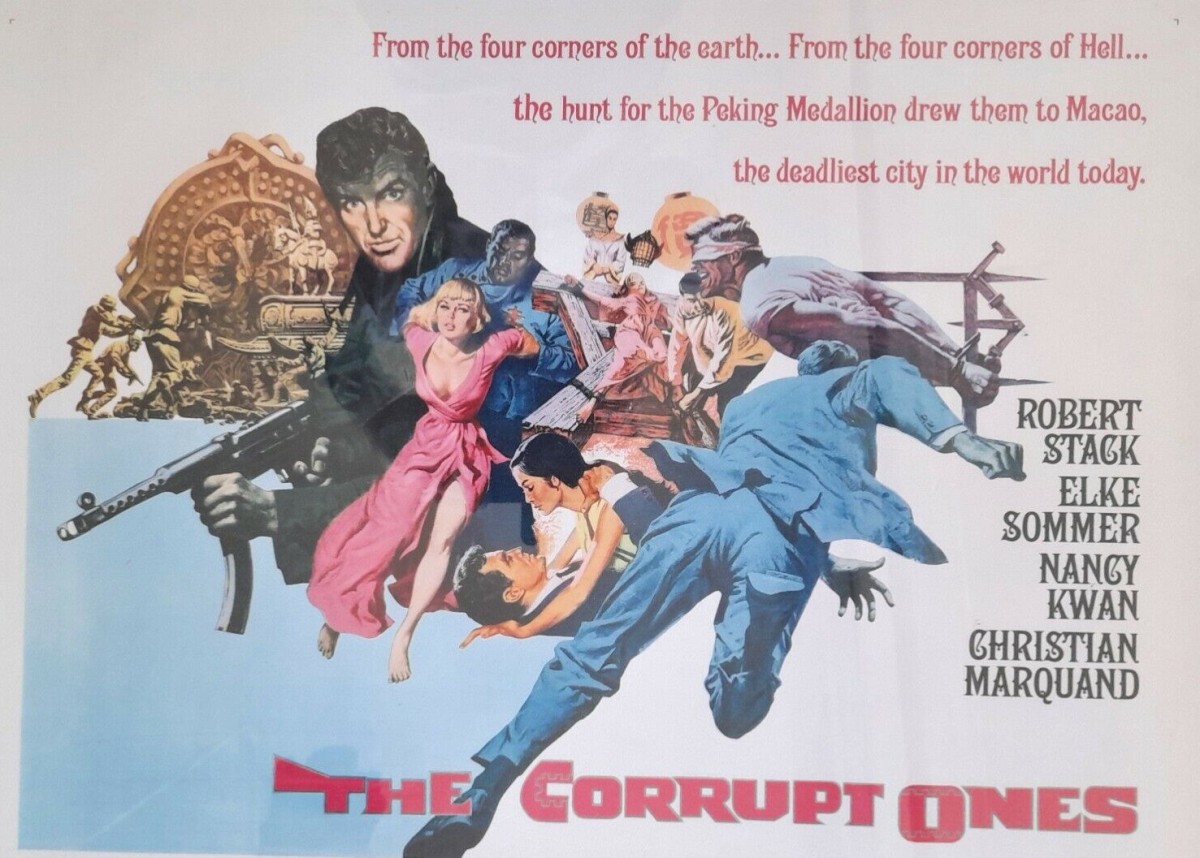
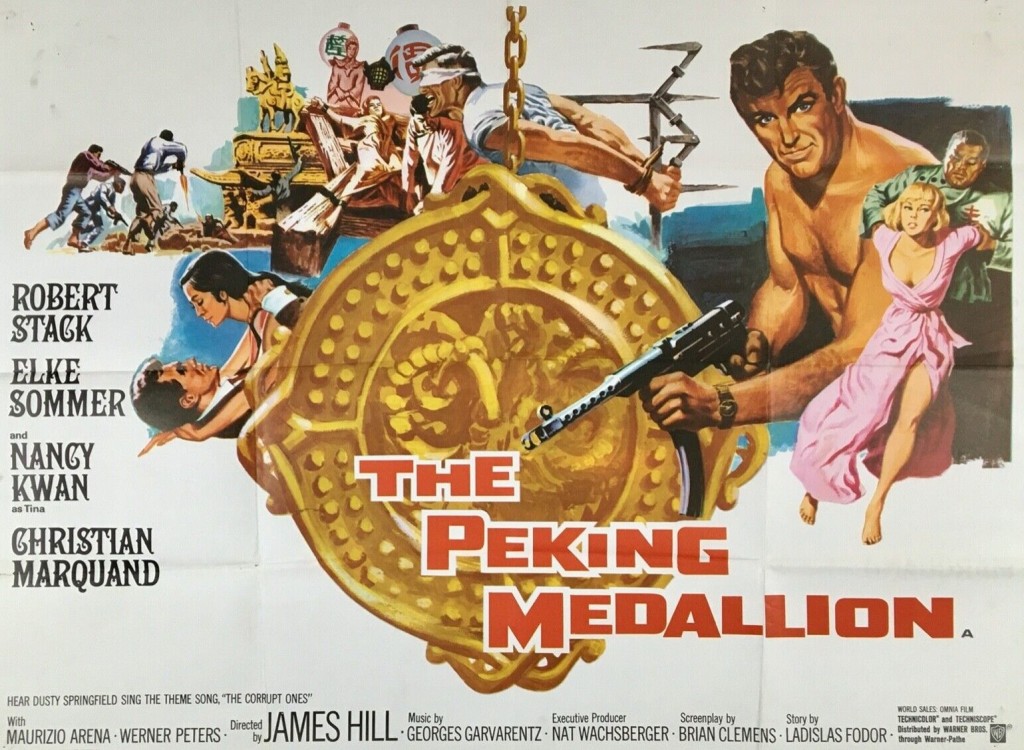
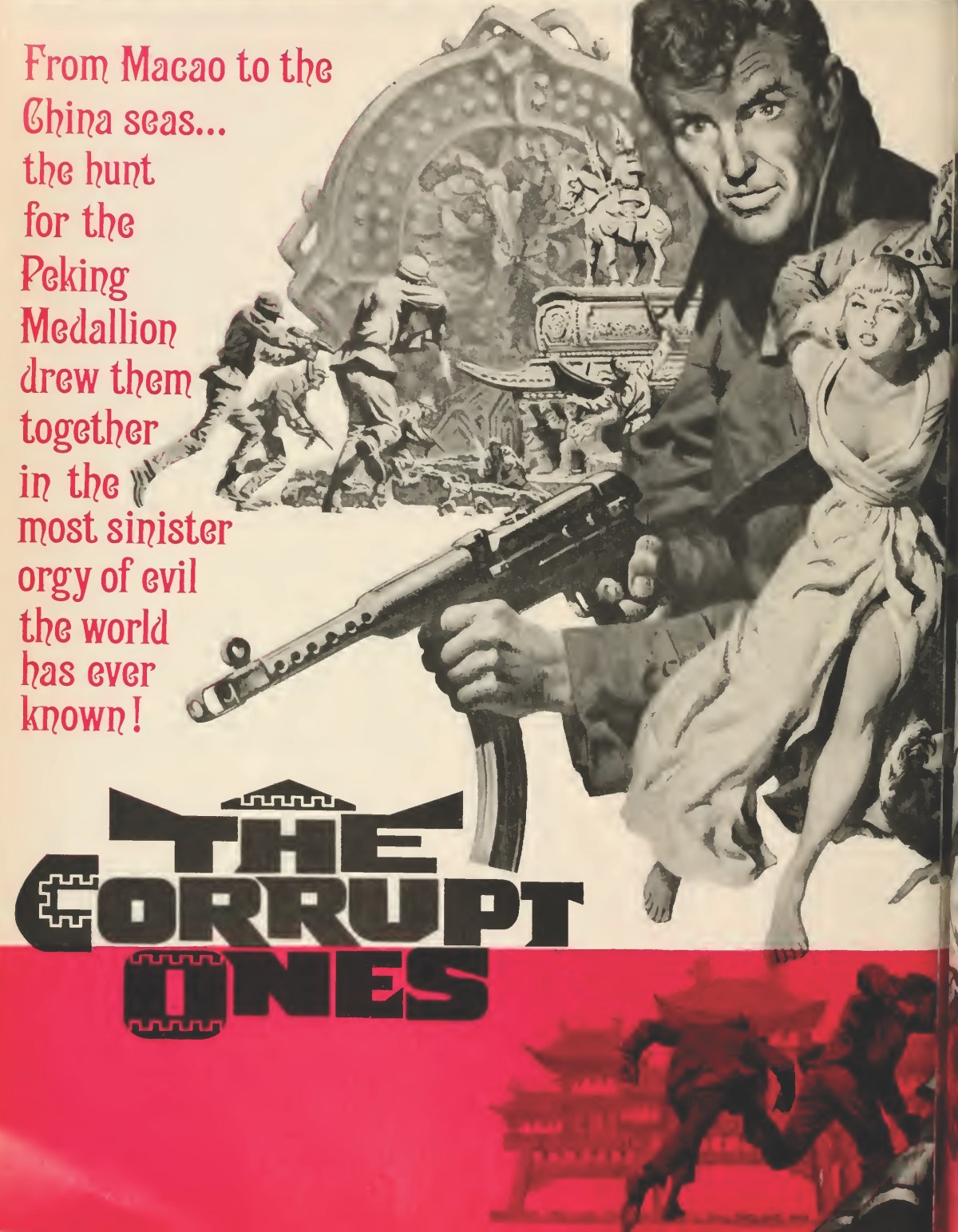
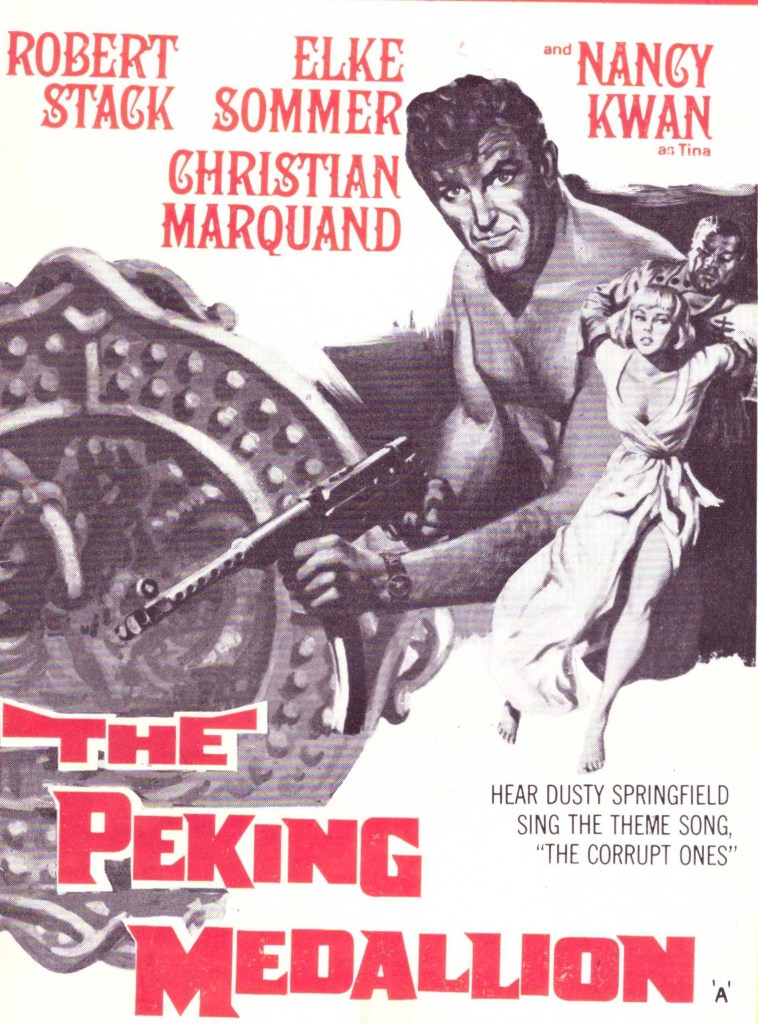
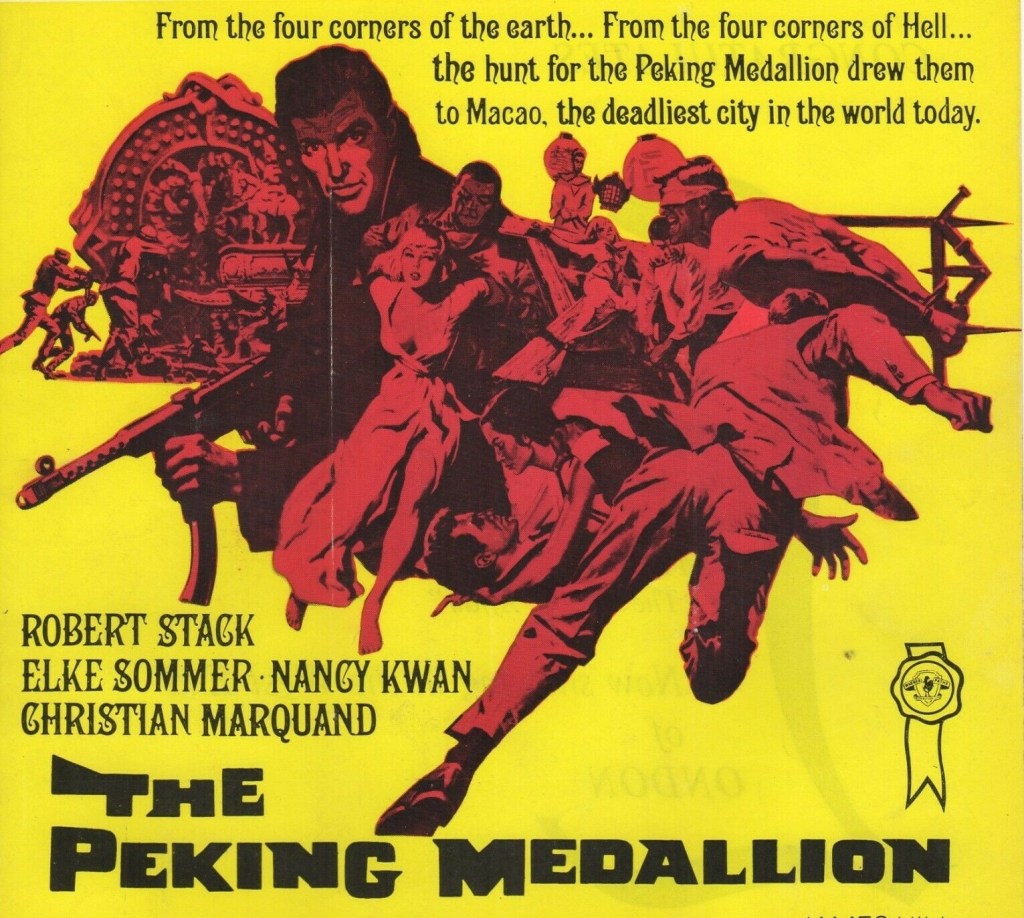
The Corrupt Ones / The Peking Medallion (1967) ****

Non-stop action as spy Cliff Wilder (Robert Stack) battles a variety of crooks in Macao on the Chinese border as they seek to recover the legendary Peking medallion. Wilder hails from the James Bond school of espionage, duty bound to kiss every girl he meets. He might wonder at their compliance until he realizes they are only after his knowledge of the missing medallion.

The violence is criminally brutal – punch-ups, gunfights, samurai swordfights, murder and torture by blowtorch and acid and being dragged behind a motorboat. The string of sexy women is matched by handsome men, Brandon (Christian Marquand) and Danny (Maurizio Arena) in addition to Stack. The thriller pitches helter-skelter through nightclubs, casinos, caves, temples and palatial mansions, the pace only slowing down for, naturally, a scene in a stately rickshaw.

As well as Wilder who briefly – and unknowingly – has the medallion in his hands, others in the hunt include Lilly Mancini (Elke Sommer), wife of Danny who had passed it to Wilder before being killed. Mancini is on the wrong side of the femme fatale equation. Once Wilder  is wise to her seductive charm,s he quips, “Maybe you’re telling the truth but I can’t trust you.”

Also in hot pursuit are gangster Brandon and a Chinese mob headed by Tina (Nancy Kwan) That’s on top of a corrupt cop (“I have never feared death, only poverty” is his mantra) who doesn’t care who wins the prize as long as he gets his share. Double cross is the order of the day, alliances forged then broken. The action never stops long enough for one of those tension-building scenes of which Alfred Hitchcock or imitators like Stanley Donen (Charade, 1963, and Arabesque, 1966) were so fond.

Wilder faces danger with a quip, a kiss or gritted teeth, an old-fashioned tough guy without the James Bond self-awareness. He carries out his manly duties until his brain kicks in and he realizes this isn’t a spy picture after all but a genuine treasure hunt with clues that have to be deciphered. After that, the pictures sidetracks down another route. For a moment, the movie seems to have lost the plot. But then all hell breaks loose and we are back on the safe ground of fistfights, double-crossing and shooting.

Fans of improbable storylines, exotic settings, action, interesting bad guys and twists and turns will love this. How can you fail to love a movie with a samurai vs camera tripod swordfight?

An exemplary cast for this kind of malarkey, a French-Italian-German co-production with English as the mother tongue. Scarcely creditable that Robert Stack, in his biggest picture since The Untouchables tv series (1959-1963), was once Oscar-nominated given subtlety is never required. Nancy Kwan (The World of Suzie Wong, 1960) steals the show as the villainess but she’s run close by Elke Sommer (The Prize, 1963). In supporting roles are Werner Peters (Istanbul Express, 1968) and Christian Marquand (The Flight of the Phoenix, 1965).  

Might seem a considerable change of pace for director James Hill after Born Free (1966) but that’s only if you ignore his work on the equally complicated A Study in Terror (1965).  Screenplay punched out by Englishman Brian Clemens (And Soon the Darkness, 1970), Hungarian Ladislas Fodor (best know for the Dr Mabuse series) and Harald Bloom, his only known credit.

Great fun.

PREVIOUSLY REVIEWED IN THE BLOG: Robert Stack in Is Paris Burning? (1966); Elke Sommer in The Prize (1963), The Art of Love (1965), The Money Trap (1965), The Oscar (1966), The Venetian Affair (1966), Deadlier than the Male (1967), They Came to Rob Las Vegas (1968) and The Swiss Conspiracy (1976); and James Hill’s A Study in Terror (1965); Nancy Kwan in Tamahine (963), Fate Is the Hunter (1964), The Wild Affair (1965).

The Corrupt Ones / The Peking Medallion (1967) ****

Non-stop action as spy Robert Stack (The Untouchables tv series) battles a variety of crooks in Macao on the Chinese border as they seek the legendary Peking medallion. Stack hails from the James Bond school of espionage, duty bound to kiss every girl he meets. He might wonder at their compliance until he realizes they are only after his knowledge of the missing medallion.

The violence is criminally brutal – punch-ups, gunfights, samurai swordfights, murder, torture by blowtorch and acid and being dragged behind a motorboat. The string of sexy women is matched by handsome men (Christian Marquand and Maurizio Arena in addition to Stack). The thriller pitches helter-skelter through nightclubs, casinos, caves, temples and palatial mansions, the pace only slowing down for, naturally, a scene in a stately rickshaw.

As well as Stack who briefly – and unknowingly – has the medallion in his possession, others in the hunt include Elke Sommer, wife of the man (Arena) who passed it to Stack before being killed. Sommer is on the wrong side of the femme fatale equation. Once Stack is wise to her seductive charms he quips, “Maybe you’re telling the truth but I can’t trust you.”

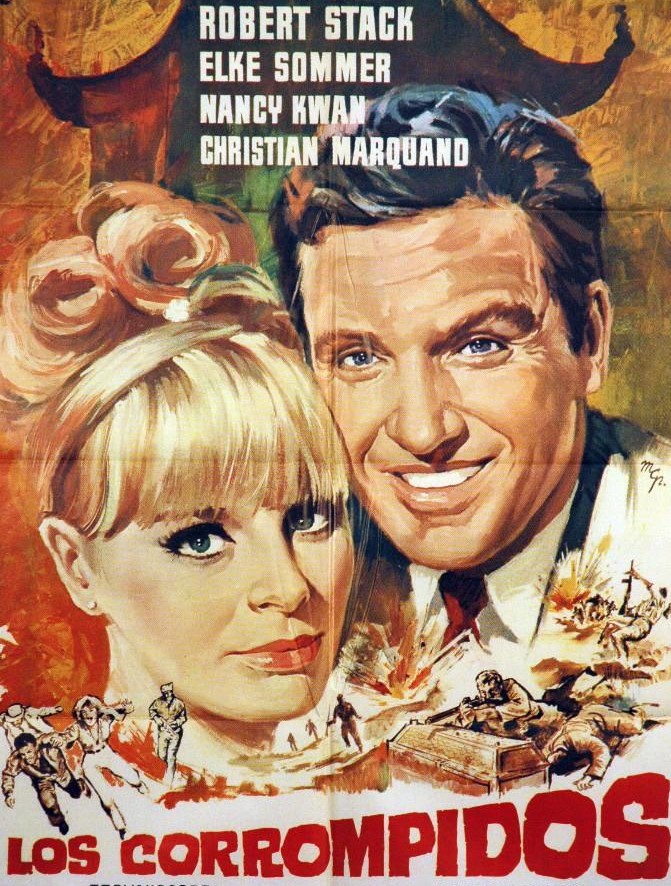
The original title of the picture was “Hell in Macao” and that was used in Germany for example. It was called “The Peking Medallion” in the UK, Italy and Mexico and “The Corrupt Ones” in the US, France and Spain.

Also in hot pursuit are gangster Brandon (Marquand) and a Chinese mob headed by Nancy Kwan (The World of Suzie Wong, 1960). That’s on top of a corrupt cop (“I have never feared death only poverty” is his mantra) who doesn’t care who wins the prize as long as he gets his share. Double cross is the order of the day, alliances forged then broken. The action never stops long enough for one of those tension-building scenes of which Alfred Hitchcock or imitators like Stanley Donen (Charade, 1963, and Arabesque, 1966) were so fond.

Stack faces danger with a quip, a kiss or gritted teeth, an old-fashioned tough guy without the James Bond self-awareness. He carries out his manly duties until his brain kicks in and he realizes this isn’t a spy picture after all but a genuine treasure hunt with clues that have to be deciphered. As this causes the movie to sidetrack down another route, it looks like the picture has lost the plot. But then all hell breaks loose and we are back on the safe ground of fistfights, double-crossing and shooting.

The script by Brian Clemens deftly mixes a variety of genres. What might have been a definite change of pace for British director James Hill given his previous effort was Born Free (1966) was anything but since he was responsible for the most recent Sherlock Holmes thriller A Study in Terror (1965).

Fans of improbable storylines, exotic settings, action, interesting bad guys and twists and turns will love this. How can you fail to love a movie with a fight featuring a samurai sword versus a camera tripod?

Many of the films from the 1960s are to be found free of charge on TCM and Sony Movies and the British Talking Pictures as well as mainstream television channels. But if this film is not available through these routes, then here is the link to the DVD and/or streaming service.

Discover WordPress

A daily selection of the best content published on WordPress, collected for you by humans who love to read.

The Atavist Magazine

by Brian Hannan

WordPress.com News

The latest news on WordPress.com and the WordPress community.