The Visit (1964) *****

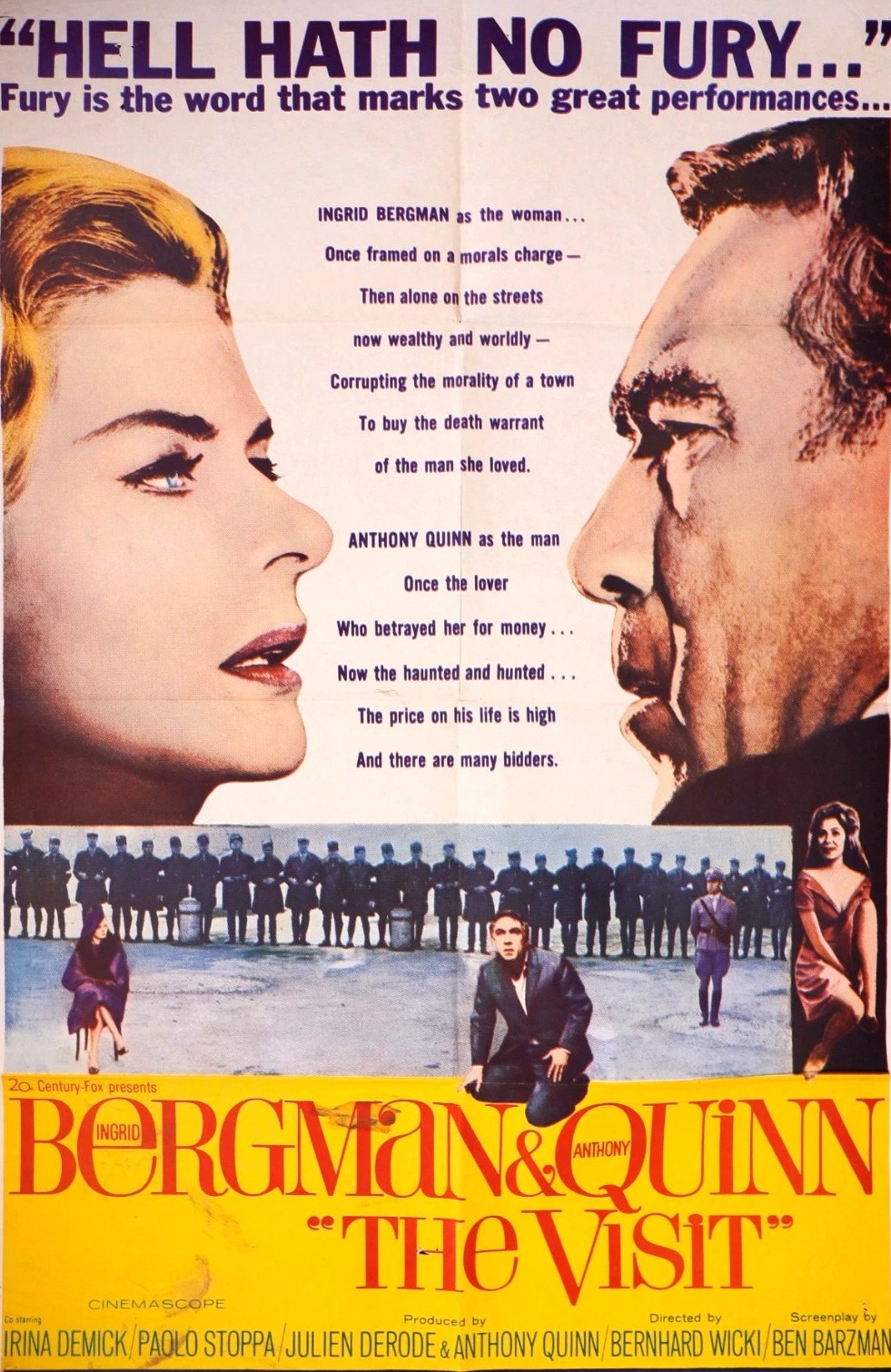
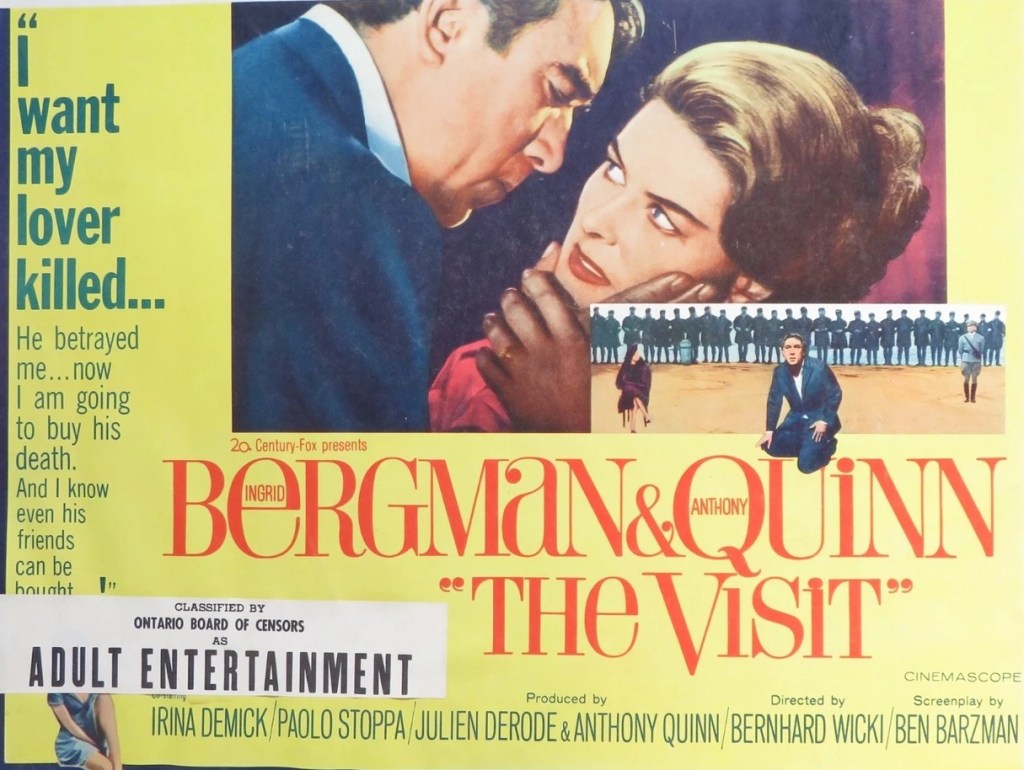
Wow! How has this sailed under the radar? Not only does two-time (at this point) Oscar-winner Ingrid Bergman shred her screen persona as the loved one in a romantic interlude or as the victim, but she turns into one of the most chilling femme fatales you can imagine. Made today, this would be termed “High Concept”. But it’s better than that, it’s concept heaven, such a brilliant idea and superbly executed.

From the moment widowed billionaire Karla Zachanassian (Ingrid Bergman), dressed in white like a Hollywood star, steps off a train and cuts the waiting townspeople dead with a haughty look only to seconds later seduce them with a warm smile, you can guess this is going nowhere near where you’d expect.
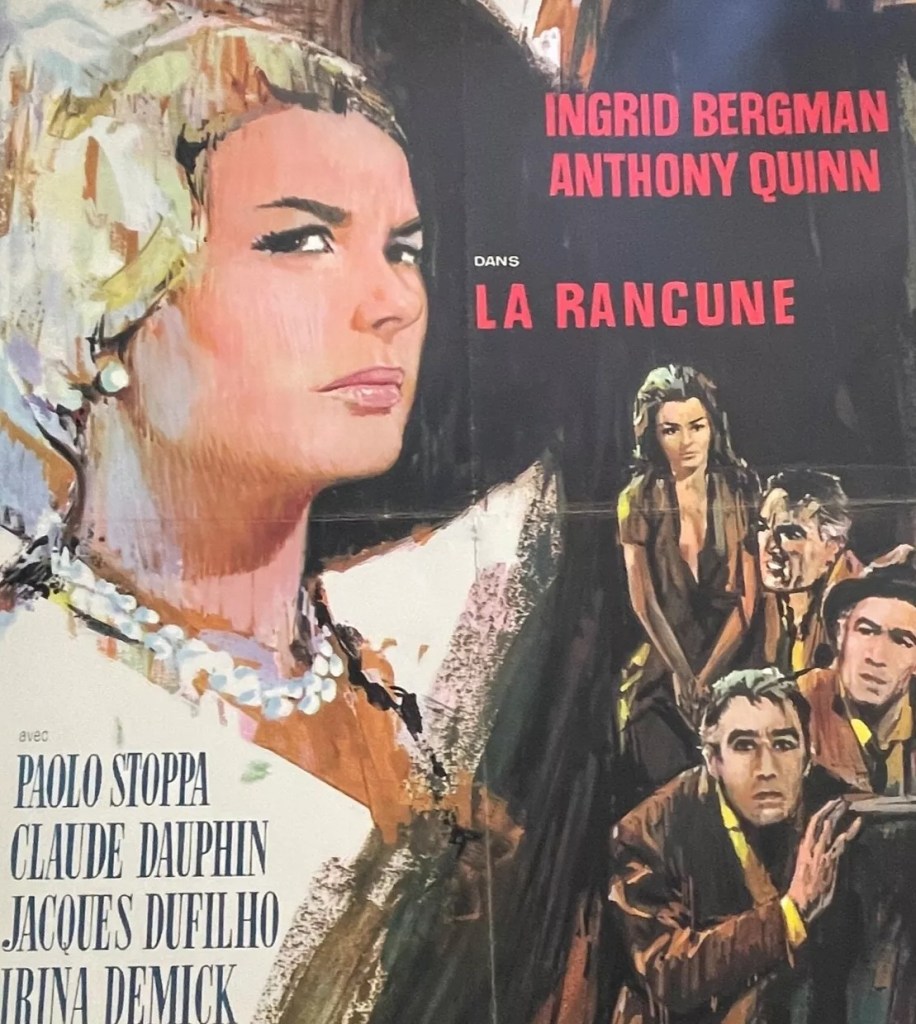
The train wasn’t scheduled to stop. She merely pulled the emergency cord as if her wealth was excuse enough. And she was only on the train because she wanted to make an entrance. For, as it transpires, her chauffeur is in attendance.

The town is bankrupt and in the way of the small-minded the townspeople imagine that the only reason she could be returning to the place where she could grew up twenty years after she left would be to rescue Guellen from its financial misery. So the townspeople are ready with a parade and welcome banners and fine speeches. Former lover Serge (Anthony Quinn), though now married to Mathilda (Valentina Corsese), is happy to play his part and recall their romance, visit the barn where they made love for the first time, as if she has returned only to satisfy memory.

But that’s not the reason. She has a different recollection of events and while she’s willing to play the role of the returning benefactor, offering the town one million and another million to be shared equally among the townspeople, there’s a condition. She wants revenge for being humiliated. Serge – who had thrown Karla over in favour on the daughter of a richer man – denied her child was his and bribed false witnesses so she was sent packing, with prostitution her only option and the child dead within a year.

So now the townspeople can show themselves to be principled, refusing to encourage her barbaric sense of justice, or, more likely, start to nip away at the idea of justice when there’s a bounty of two million at stake. Karla sits on her balcony dressed to the nines twirling her parasol and sipping an iced drink   watching like a hawk chaos unfold below or lounges in her room feeding red meat on a toasting fork to a caged cheetah.
There’s some interesting satire on both bureaucracy and democracy – should people be banned from voting on such a sensitive subject or should democracy insist otherwise. And while ostensibly the powers-that-be back Serge, he gets a shock when he realizes the ordinary people have starting buying new shoes and clothes on credit in anticipation of the bounty and the going rate for an assassin is just two thousand. Soon the town is overwhelmed with retailers selling fancy goods – cars, fridges, televisions, fashion items – on credit. There’s time, too, for other stories to play out in realistic fashion.

There’s a brilliant sequence where Serge is hunted through the streets by men with rifles on the erroneous (or deliberately erroneous) belief that he’s been mistaken for a wild animal and even his wife deserts him. The climax is absolutely stunning.

There would have been many parallels at the time – Communist witch hunt, the persecution of the Jews – but from today’s perceptive it’s more like a capitalist witch hunt or judgement on a “good” society.

Anthony Quinn (Guns for San Sebastian, 1968) bought the rights because he realized Serge was a terrific part but as producer he made the mistake (or touch of genius) in hiring Ingrid Bergman (Goodbye Again, 1961). Without doubt she stole the show. Amazing that she wasn’t even nominated for an Oscar given the chilling portrayal she delivered.

Directed by Bernhard Wicki (Morituri / Code Name Morituri, 1965). Adapted by Ben Barzman (The Heroes of Telemark, 1965) and Maurice Valency (The Madwoman of Chaillott, 1969) from the play by Friedrich Durrenmatt.

When you see how hard today’s “visionaries” strive to come up with meaningful tales of a serious nature or examinations of “the human condition,” you can see how much they fall short compared to this well thought-out drama.

I was blown away.
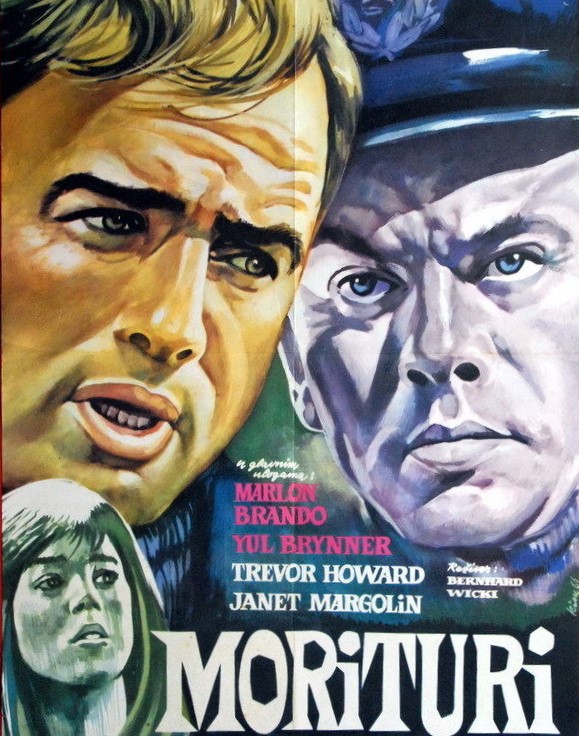
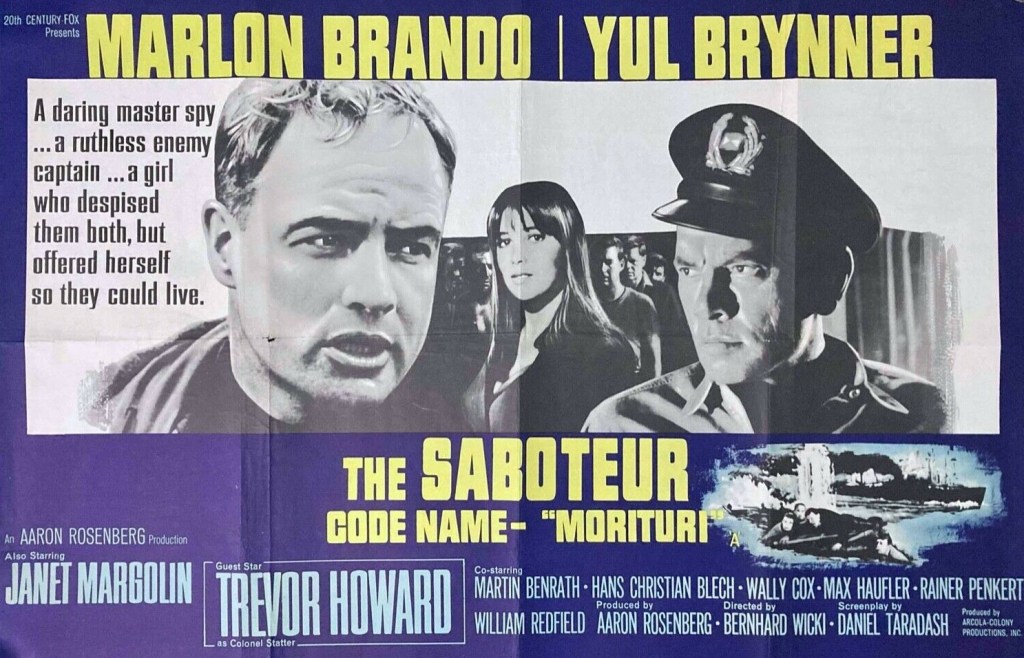
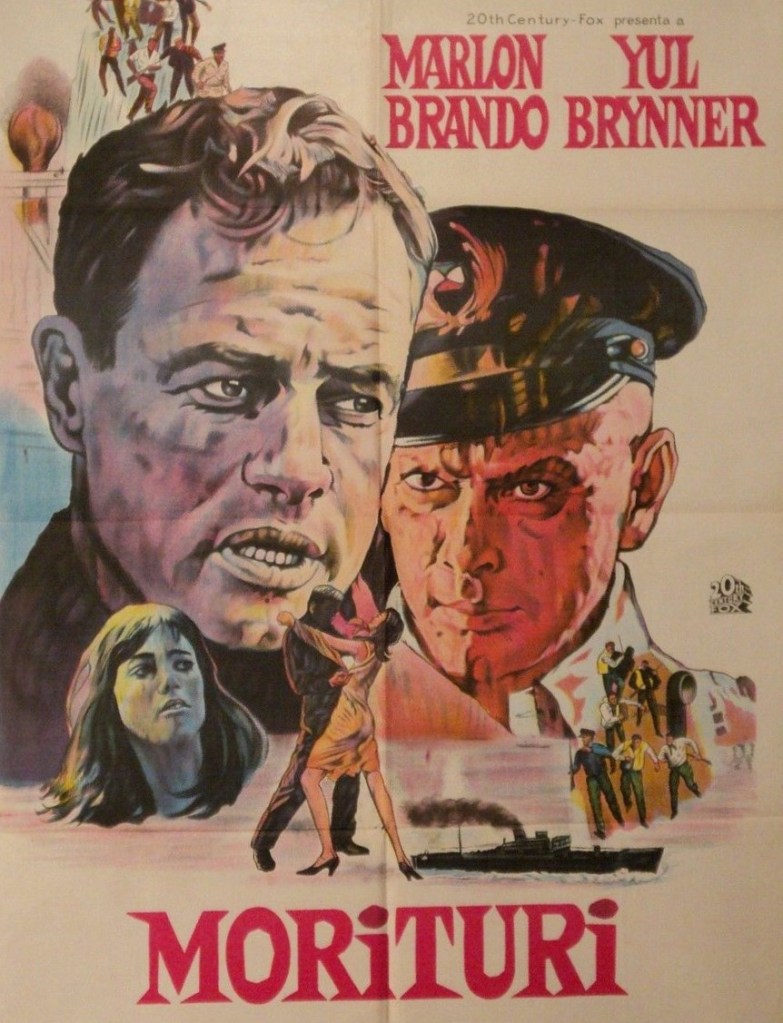
Morituri / Saboteur: Code Name Morituri (1965) ***

For a film that staggered around trying to find a plot to justify its tale of moral ambiguity during World War Two the final third is surprisingly potent. Featuring two good Germans and a bunch of bad Yanks ostensibly it’s a straightforward story of a saboteur trying to prevent a German cargo ship captain from scuttling his ship should it come under attack from the British determined to lay their hands on its vital supplies of rubber.

Supposed German pacifist Robert Crain (Marlon Brando) – actually a coward – hiding out in India is blackmailed by British Col Statter (Trevor Howard) into posing as a high-ranking SS officer on the German ship in order to prevent it being sunk by Captain Mueller (Yul Brynner). After his last command ended in drunken disgrace, Mueller assumes Crain has been sent to keep an eye on him. So Crain spends an almighty time down in the engine room and various below-decks spots defusing the wiring that would cause the ship to blow up at the touch of a button by the captain.

Mueller’s second-in-command Kruse (Martin Benrath) is suspicious of the cosmopolitan art-loving Crain but it’s a renegade band of criminals, led by Donkeyman (Hans Christian Blech) forced into armed service, who rumble Crain. But he talks them into mutiny. The ship avoids detection by disguising itself as a neutral Swedish freighter. Mueller’s attitude to Crain changes when the latter prevents him hitting the self-destruct button as a British destroyer seems poised to attack, changing its mind at the last minute.

Meanwhile, a group of American prisoners, from a ship sunk by a Japanese U-boat, come on board, including Jewess Esther (Janet Margolin). Surprisingly, Mueller steps up to the plate, protecting her from his crew, providing her with a private berth and permitting her to eat in the officer’s mess. On board the submarine are Admiral Wendel (Oscar Beregi), who commissioned Mueller, and a German counter-intelligence officer and, surprised to find Crain on the cargo ship, challenge him. Crain calls their bluff, but when the Admiral leaves he plans to radio Berlin to check Crain’s credentials, information passed on to Crain, who now has a very short deadline to organise mutiny, take over the ship and sail it to safety.

To do that, the mutineers require the support of the prisoners, a task detailed to Esther, who can only achieve that mission by surrendering her body to the prisoners, in much the same way as she has done previously to the Gestapo.

Mueller goes to pieces on hearing that his beloved son, also a ship’s captain, has been given a medal for sinking his fifth enemy vessel – only this time it is a hospital ship. After Mueller drinks himself unconscious, and Kruse assumes command, Crain fails to enlist Mueller to the mutiny which then begins. The surprise ending is both brutal and poetic.

But despite almost capsizing under the weight of an unwieldy cargo of plot and double-plot, the picture finally makes its points, that in war, ambiguity reigns. Mueller, who hates the Nazis but stoutly defends his Fatherland, proves to have the highest moral standards, agreeing to help Esther when they reach their destination, and preventing further molestation of her while aboard. Crain, purportedly the good German, has no compunction about sending Esther to do his dirty work, knowing the risks a sole woman faces in a hold of desperate sex-starved men. The good Yanks turn into rapists at the slightest opportunity, every bit as heinous in their depredations as their enemy.

That the movie stays afloat for so long is largely down to the excellence of Marlon Brando (The Chase, 1966) and Yul Brynner  (The Double Man, 1967). Brynner’s magisterial presence, chest out, legs apart, serves him well, and the ongoing duel with Brando is an acting treat, though Brynner has the best scene, the look of anguish on his face when he realises what his son has done. Brando, reprising the silky German accent of The Young Lions (1958), is very convincing as the dilettante pressed into service, negotiating his way round the recalcitrant Brynner, and living on his wits when faced with the criminals and then the  Admiral. And while Janet Margolin (Nevada Smith, 1966) is little more than a symbol, she invests the role with terrifying humanity, a woman reduced to being a sex object, utter submission her only way to achieve temporary reprieve. Most of her best acting is just with the look on her face.

In his Hollywood debut Martin Benrath appears just a standard German until his mask slips and we realise how much he covets the captain’s uniform. Wally Cox (The Bedford Incident, 1965) is another compromised by immoral behaviour, the doctor who steals the ship’s supply of morphine. Hans Christian Blech (Battle of the Bulge, 1965) excellent as a vengeful mutineer. You might also spot William Redfield (Fantastic Voyage, 1966). Trevor Howard (Von Ryan’s Express) is only there at the outset.

Austrian director Bernhard Wicki (The Visit, 1964) does his best with a plot bursting at the seams, but the scenes of sabotage are well done, and he does recreate the claustrophobic atmosphere of a ship, and the final sequence is worth waiting for. Daniel Taradash (Castle Keep, 1969) wrote the screenplay.  

Discover WordPress

A daily selection of the best content published on WordPress, collected for you by humans who love to read.

The Atavist Magazine

by Brian Hannan

WordPress.com News

The latest news on WordPress.com and the WordPress community.