The Way West (1967) ****

How this crispy-told beautifully-mounted character-driven western ever languished among the also-rans is beyond me. I suspect the specter of John Ford hung heavily over it in the eyes of critics at the time but it more correctly belongs to the cycle of Cecil B. DeMille westerns that told stories with a true historical bent. Often detrimentally compared to How the West Was Won (1963), which told a similar tale of endeavor, this movie deliberately lacks that movie’s inflated drama in which every incident was built up, not least influenced by the need for Cinerama effect, rather than seeking an authentic truth.

Plainly put, the difference is here there are no charges, no races, no fording of rivers in the wrong places. Native Americans are treated with respect. Above all, an epic crossing of the continent with fully-loaded wagons is necessarily going to be slow, risk avoided at all costs, and yet this is not without incident or character arc. In fact, the script is terrific, not just dialog that rings true, but among the elements brought into play are male rivalry, clash with authority, guilt, young love, revenge, vision, justice, America in embryo. That the movie maintains a stately pace, no fistfights descending into brawls, and a shock ending indicate a director in charge of his material.

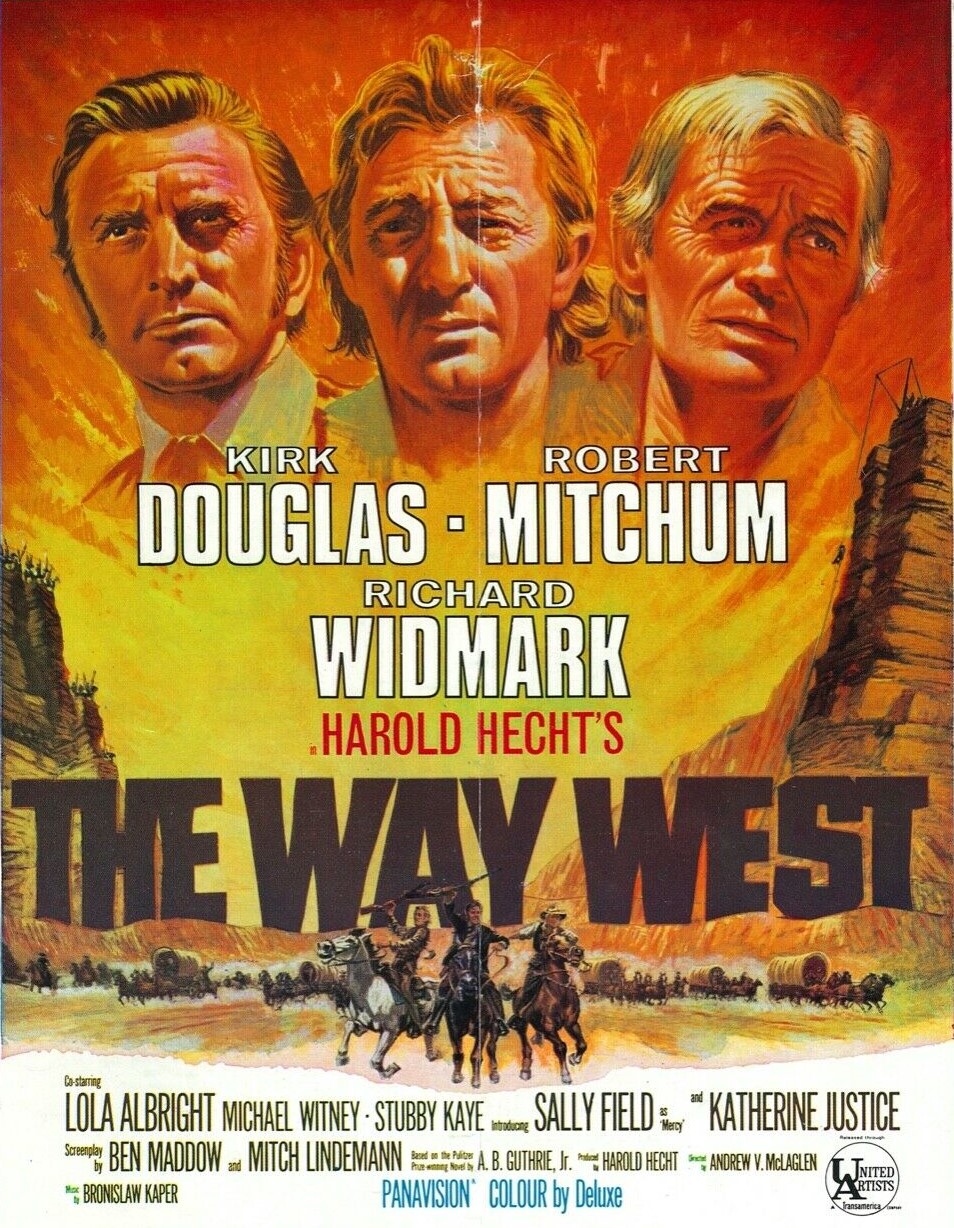
Based on A.B. Guthrie’s Pulitzer Prize-winning novel set in 1843, the first wagon train heads for Oregon under the iron rule of Senator William Tadlock (Kirk Douglas) and guided by a scout with failing eyesight in Dick Summers (Robert Mitchum), both men widowed and in emotional limbo, and in the cantankerous company of Lije Evans (Richard Widmark) and his glamorous wife Rebecca (Lola Albright). There’s a stowaway (Jack Elam), a preacher who can’t afford the price of transportation, an illicit love affair between the vibrant and lusty Mercy (Sally Field) who “hankers after any three-legged boy” but makes eyes at married man Johnnie Mack (Michael Witney), and enough obstacles to keep less determined settlers from reaching their promised land.

Tadlock is the visionary, a politician suffering from an overblown estimation of his self-worth,  who “might have been President except for a woman,” ruthless, valuing only his own ideas. “Point the way,” he tells Summers, “don’t gall me with opinions.” For fear it might interfere with his role as commander, he hides his vulnerability. There’s a plaintive moment when he shares his vision of a city with Rebecca, on the one hand full of his own importance, on the other clearly needing the pat on the back. Later, an occasion of death sees him falling prostate with grief on a grave and on breaking his own laws demands to whipped. The over confident blustering individual is by the end almost suicidal. What is a leader if there is no one to lead?
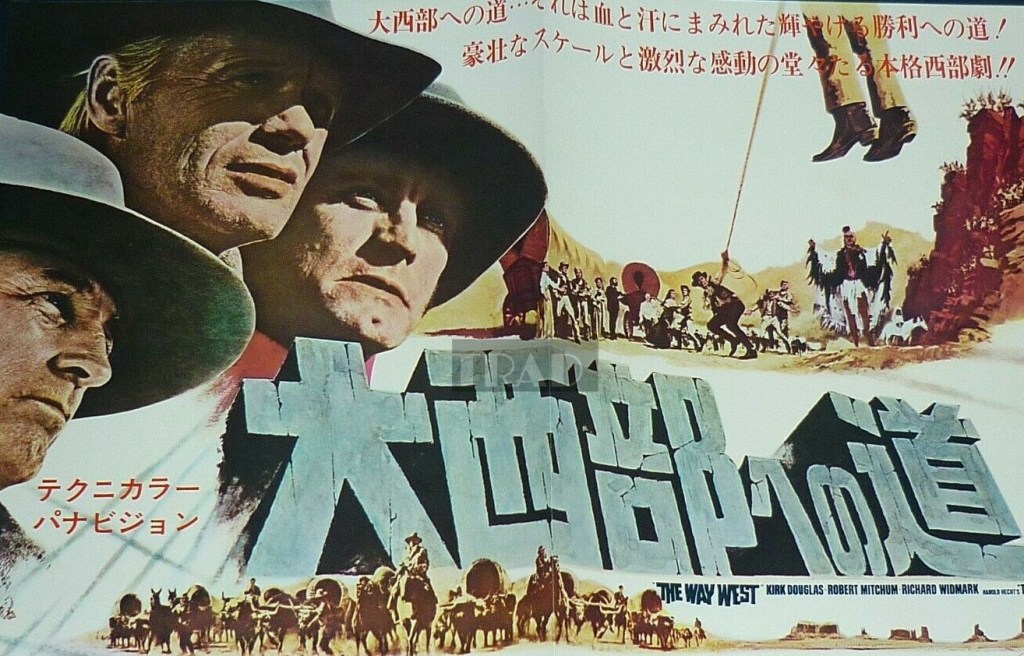
Summers stoically accepts his infirmity, constantly dropping his head so his eyes are hidden from sight under his hat as if his ailment could be easily detected, mourning the loss of his Native American wife, and while full of Western lore as easily passing on gentle wisdom about love, and his “lucky necklace” to an unrequited lover, but still accused of unworldliness, “for a smart man you ain’t got a lick of sense.”  Evans bristles at any authority, believing independence means he goes his own way, especially if that permits the freedom to get drunk at a time of his choosing, and especially once he realizes such lack of inhibition riles the repressed Tadlock. But his fondness for alcohol triggers an incident that almost costs his son his life.

Celebrations he started catch the attention of the nearby Sioux and in the communal drunkenness a Native American child is accidentally killed. In the best scene in the film battle Sioux seeking justice and intent on attack are thwarted only by the “sacrifice” of the killer.

The picture is packed full of incident, many characters coming alive in a single shot or with one line of dialog. A woman tramps on her husband’s foot to prevent him challenging Tadlock’s authority. A woman with a baby retorts that she is afraid when bolder settlers facing potential Native American attack assert the opposite. The bravest man in the camp, the first volunteer to be lowered down a canyon, dies when his rope snaps.  

There are any number of reversals. Buffalo, instead of being a danger and prone to stampede, create a dust cloud to hide behind. Rivers are crossed at sensible points, rapids avoided. An African American whips a white man. A boy becomes a man through honor rather than violence. Stories, large and small, play out in a succinct script.  
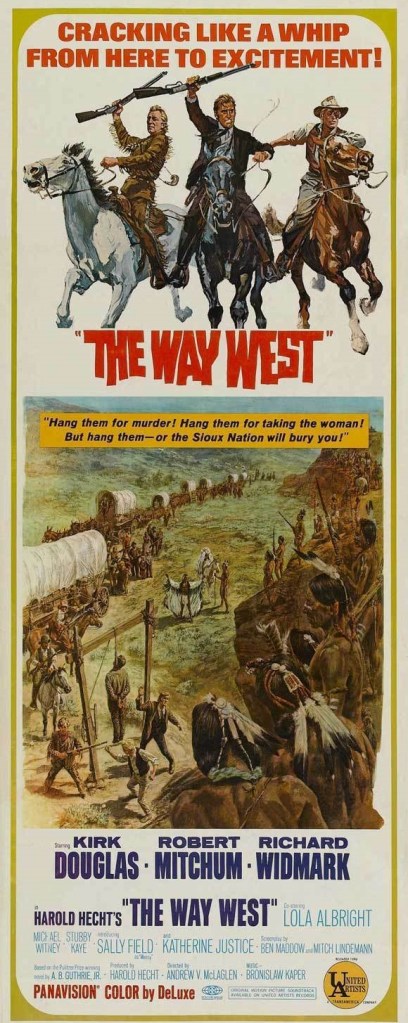
Kirk Douglas (The Arrangement, 1969) is superb as a man whose iron core deserts him. Robert Mitchum (Secret Ceremony, 1969), in almost a supporting role, excellent in full awareness that the sight on which his reputation and job depend will vanish, brings a subtlety to his performance that would be recognized as ideal for Ryan’s Daughter (1970). Richard Widmark (The Bedford Incident, 1965), who is generally simmering, gets to mix in a bit of fun in with the simmering.

Lola Albright (A Cold Wind in August, 1961) swaps seductiveness for sense. In her debut Sally Field (Smokey and the Bandit, 1977), filled with zip and zest, sparkles as the lusty young woman and it’s astonishing to realize she would not make another movie for nearly a decade while another debutante Katherine Justice (Five Card Stud, 1968) finds her inner fire when it’s too late.  There’s supporting talent a plenty – Jack Elam (Once Upon a Time in the West, 1968), Stubby Kaye (Cat Ballou, 1965), Harry Carey Jr. (The Undefeated, 1969) and William Lundigan (The Underwater City, 1962) in only his second film of the decade.

Director Andrew V. McLaglen (The Rare Breed, 1966) captures the correct tone for the film, making up for the essential slow pace with brilliant use of widescreen, coaxing great performances from all concerned. Screenwriters Ben Maddow (The Chairman, 1969) and Mitch Lindemann (The Careless Years, 1957) compress Guthrie’s tome with considerable skill.  

Woefully underrated at the time and since, this deserves reassessment. This is a truer version of how the west was won. And I surely can’t be alone in demanding that McLaglen’s talent be more properly recognized.

You might be interested to know there are two other articles on this film – a “Behind the Scenes” and a “Book into Film.”

Behind the Scenes: “The Chairman / The Most Dangerous Man in the World” (1969)

Had things run according to the original plan, we could have seen Frank Sinatra return to a Communist country for the first time since The Manchurian Candidate (1962). But if you had wanted to write a script about the guy who wrote The Chairman, you couldn’t have invented a more interesting character than Samuel Richard Solomonick. He was one of those guy who held every job under the sun before reinventing himself as an anticommunist going by the name of Jay Richard Kennedy and subsequently entering the fields of real estate, radio and brokerage, then landing a gig managing Harry Belafonte and writing the screenplay for I’ll Cry Tomorrow (1955).

By the time he ended up as an executive at Sinatra Enterprises he had a couple of ideas to sell. Forming Jade Productions in 1966 with director Richard Quine (How To Murder Your Wife, 1965), the pair hooked Sinatra’s interest in two projects, Follow the Runner (which would have co-starred Sammy Davis Jr) and The Chairman plus William Holden eyeing the lead in The Wordlings about the population explosion.

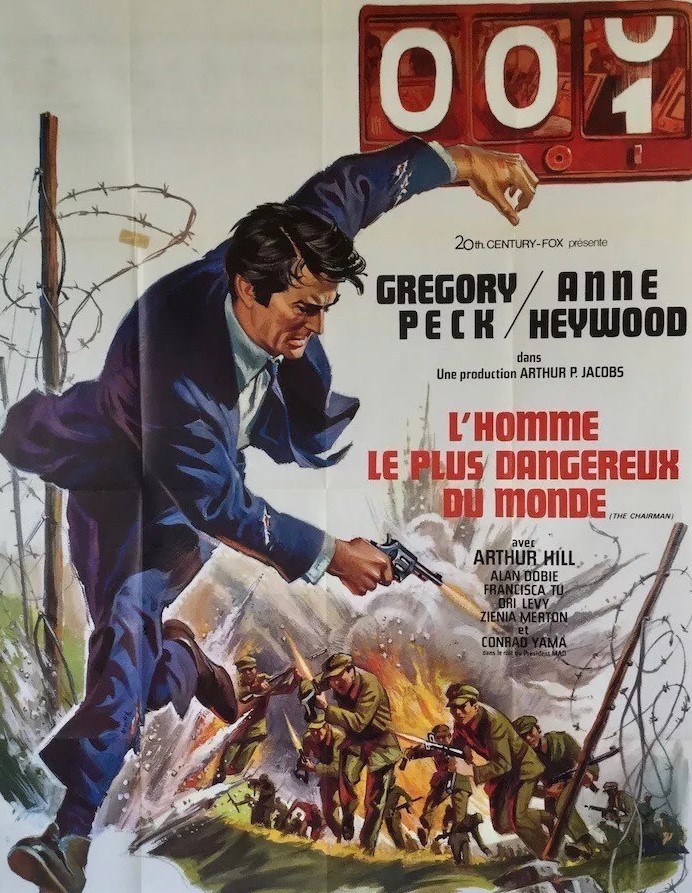
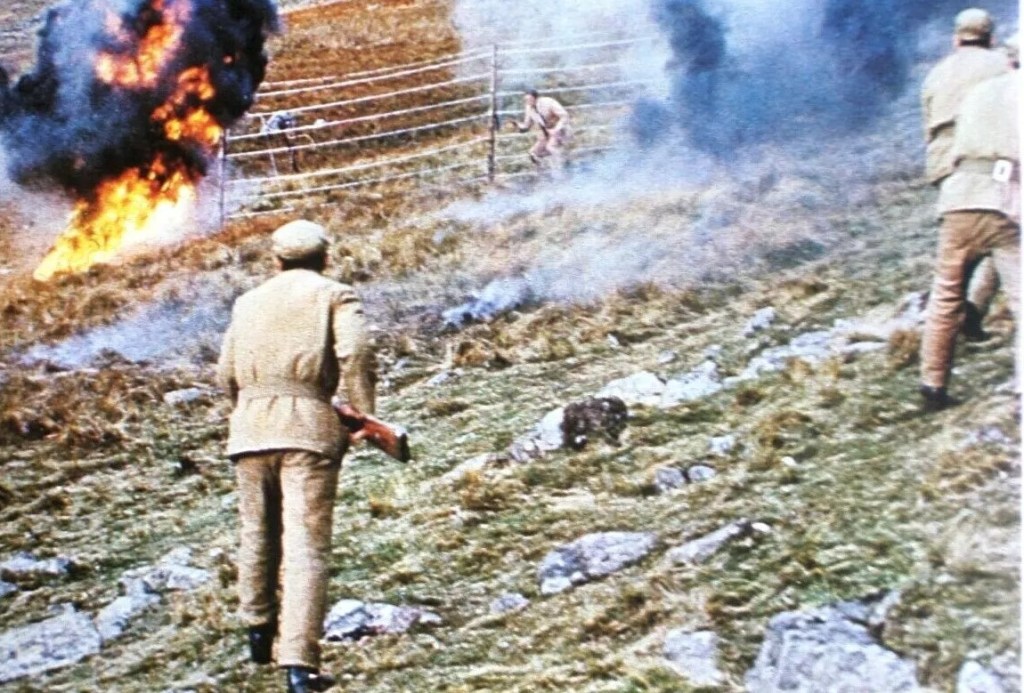
That’s Gregory Peck trapped on the wrong side of the Russian border with Chinese soldiers closing in.

Sinatra was known for falling out with directors, shunting Mark Robson off The Detective (1968), so whether Quine would have lasted the pace is anybody’s guess. After success with Tony Rome (1967), Twentieth Century Fox briefly toyed with the prospect of pairing Sinatra and new wife Mia Farrow in The Chairman. Originally scheduled to begin shooting on January 1967, that later shifted to early 1968. The notion that the movie also had parts for Spencer Tracy and Yul Brynner was one of those puff pieces that some journalists swallowed.

Despite some enticing projects – he was first name down to direct Catch 22, after Columbia had spent $150,000 buying the novel, and to helm the screen translation of Broadway hit The Owl and the Pussycat – Richard Quine’s career teetered after the flop of Hotel (1967). Making no headway with Sinatra he made instead another flop, Oh Dad Poor Dad (1967) and was effectively put on furlough for three years after failing to finance a movie to star Alex Guinness and Lee Radziwill.

Quine exited The Chairman in May 1967 when former PR bigwig Arthur P. Jacobs took over the production and with Sinatra in absentia turned to British director  J. Lee Thompson who had helmed the producer’s debut picture What a Way to Go (1964).  And that proved a lucky break for Thompson who had yet to match the success of The Guns of Navarone (1961).  

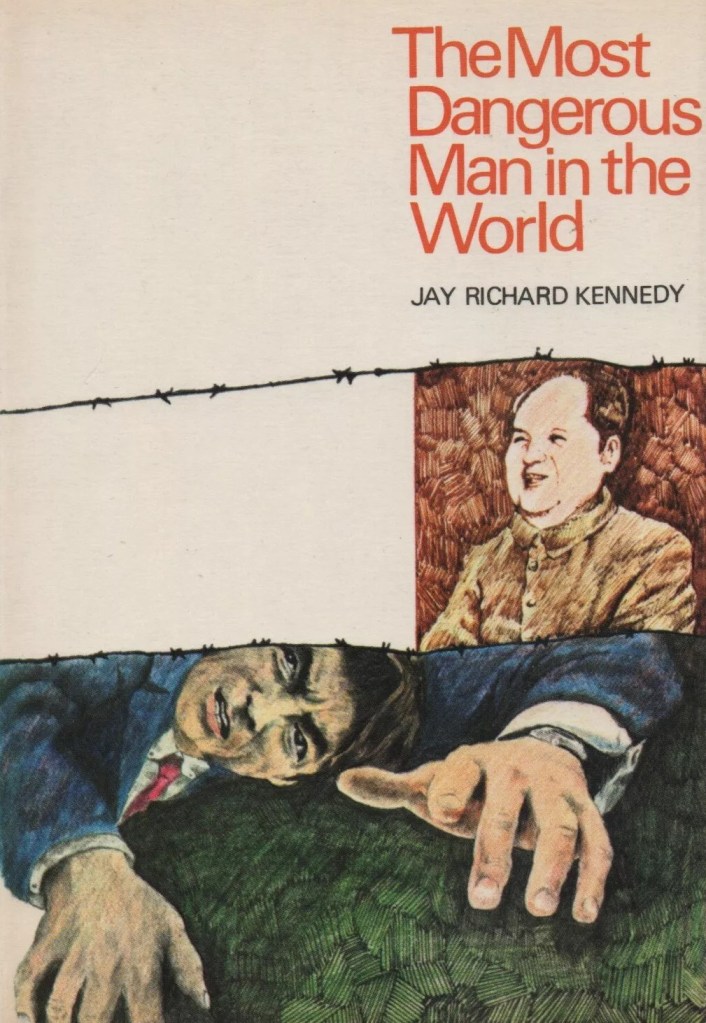
The book cover.

After successive flops – Return from the Ashes (1965) and Eye of the Devil (1966) – Thompson had plenty projects on the boil including a musical remake of Alexander Korda’s The Private Life of Henry VIII (1933) with a score by Richard Rodgers and Peter Ustinov playing the lead. Also on his slate was High Citadel based on the Desmond Bagley bestseller; The Harp That Once for Columbia; an adaptation of James Clavell bestseller Tai Pan; a sequel to The Guns of Navarone called After Navarone that would reunite the director with star Gregory Peck and writer-producer Carl Foreman; and Planet of the Apes (1968) to which he and Jacobs held the rights.

While none of these projects – except Planet of the Apes and minus Thompson – came to fruition, the Navarone connection would lead to Mackenna’s Gold for Foreman. In the meantime he had helmed a modest drama, Before Winter Comes (1968) starring Broadway star Topol. When Arthur P. Jacobs greenlit The Chairman, he hired Thompson who looked no further than Peck, connection re-established via the Navarone sequel.  They were a four-time pairing – Cape Fear (1962) and Mackenna’s Gold and The Guns of Navarone. Peck was a controversial choice from the Twentieth Century Fox perpsective given he had broken a contract with the studio in 1960 to star in Let’s Make Love. But Jacobs smoothed ruffled studio feathers and paid his star $500,000 plus a percentage. With Jacobs on hands-on duty with Planet of the Apes (1968) –  Mort Abrahams oversaw the production of The Chairman  and immediately engaged in a budget dispute with the director. Jacobs had initially stipulated $4 million, Thompson believed he required another million. They didn’t quite split the difference, Fox had the film come in at $4.9 million.

Thompson recognized the problems of the script, pointing out that “the hardest thing for Americans about the film’s concept is accepting that China has some competent scientists.” Rather ingenuously, he averred that the movie would have “no political overtones,” while Abrahams retorted that it might have “some political overtones.” It would been obvious to anyone that a picture featuring Mao was bound to have political repercussions, his Little Red Book a massive bestseller on the campus, an album cut of recitations from the book and Edward Albee in 1968 premiering a play called Quotations from Chairman Mao Tse-Tung.

Denied access to China, the production team spent four months “reading everything we could get our hands on.” At one point they considered dropping the scene featuring Chairman Mao and lengthening the sequence relating to Peck’s arrival in Hong Kong. In any case, different versions of the Hong Kong environs were shot, some with nude shots of girls in a house of pleasure.

The British Colonial Office in Hong Kong blocked filming there after fears of riots due to the production daring to portray Mao Tse-Tung on screen. Taiwan substituted for China although the locals there were also incensed, so much so they burned an effigy of Peck. Wales, funnily enough, was another location as was London University. Filming began on August 28 and finished on December 3.

Although it might appear that Ben Maddow (The Way West, 1967) wrote his script based on Jay Richard Kennedy’s novel, in fact the novel appeared after the screenplay with Kennedy writing the novelizaton, and it’s more likely that what Maddow adapted was the original Kennedy screenplay. Interestingly enough, around this time Maddow had first crack at the Edward Naughton western novel that became McCabe and Mrs Miller (1971).

It wasn’t the first time Variety got a prediction wrong: “powerful box office attaction” fell far short of the actual results. This proved an annus miserabilis for Gregory Peck. In fact, he had four films, not three, released in 1969. By release date The Stalking Moon technically belonged to the previous year, but it only played a handful of cinemas in 1968, its general release taking place in 1969.

Despite pocketing a total of over $2 million, Peck’s marquee value was in clear decline. Of the Peck quartet, Marooned did best, placing 33rd on the annual box office chart, with $4.1 million. Mackenna’s Gold (31st) took $3.1 million in rentals (the amount returned from the gross once a cinema has taken its cut), The Stalking Moon (38th) on $2.6 million, and The Chairman (41st) with $2.5 million.

SOURCES: Gary Fishgall, Gregory Peck (Scribners, 2002) p267; James Caplan, Sinatra: The Chairman, (Doubleday, 2015), p724;  “7 from 7 Arts,” Variety, March 3, 1965, p4; “Richard Quine,” Variety, July 7, 1965, p20; “Return of Advances,” Variety, October 6, 1965, p7; “Form Jade Prods,” Variety, December 15, 1965, p4; “J Lee Thompson Nearly Finished on 13,” Variety, February 2, 1966, p28; “Catch As Catch 22 Can,” Variety, February 23, 1966, p4; “Rodgers and Hammerstein’s Musical Henry VIII,” Variety, Mar 16, 1966, p1; “Inside Stuff – Pictures,” Variety, March 30, 1966, p22; “Lee Thompson Busily Blueprints His Musical Version of Henry VIII,” Variety, April 27, 1966, p17; “Jay Kennedy Script,” Variety, July 6, 1966, p5; “After Navarone,” Variety, April 19, 1967, p14; “Scripting Red Chinese,” Variety, May 21, 1967, p4; “”Personality Chemistry,” Variety, May 24, 1967, p4; New York Soundtrack,” Variety, Sep 20, 1967, p27; “Pat Hall Noel to Col,” Variety, December 27, 1967, p5; “N.Y. Indie Label Grooves Chairman Mao’s Thoughts,” Variety, April 10, 1968, p56; “Man About Town,” Variety, July 17, 1968, p68; “Jas Clavell to Roll Siege,” Variety, August 21, 1968, p7; “Thompson Wraps Up,” Variety, August 28, 1968, p29; “New York Soundtrack,” Variety, October 23, 1968, p18; “British Bar Fox’s Chairman,” Variety, December 4, 1968, p17; Big Rental Films of 1969,” Variety, January 7, 1970, p15; “Big Rental Films of 1970,” Variety, January 6, 1971, p11.

The Chairman / The Most Dangerous Man in the World (1969) ****

The sci-fi elements in this tidy paranoia thriller set in Communist China are not the only issues overlooked at the time and worthy of reconsideration now. Anyone who blasted it for supposedly political jingoism conspicuously failed to read a subtext that chimed with young left-wingers for whom Chairman Mao was not, as now, perceived as a tyrant du jour but as a political god. There’s a distinct whiff of Philip K. Dick in the implanting in a spy’s head of not just a tracking/listening device but one laced with explosive that can be remotely triggered for suicidal or murderous gain. Needless to say, the spy, ignorant of this fact, was a de facto sacrificial lamb. And a key plot thread about genetically modified crops as a means of solving world hunger came about four decades too early.  

Widowed Nobel prize winning scientist Dr Hathaway (Gregory Peck) is despatched into China via Hong Kong to contact a missing scientist with a revolutionary formula for an enzyme. A series of crisp flashbacks set up the scenario of the tracking device and a reverse echo of Marooned (1969) where Army chiefs back at base, led by one-eyed Shelby (Arthur Hill,) can listen in but are helpless to intervene – except in sinister manner. Shelby considers Hathaway “the wrong brilliant man” for the task and that they have sent in “a civilian to do a soldier’s job.”

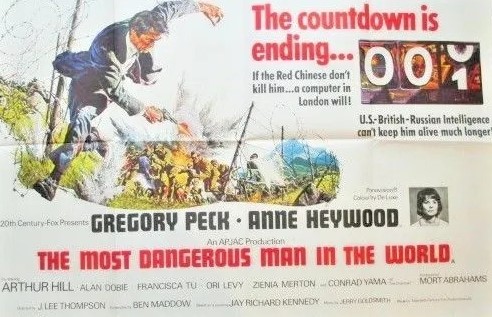
Not able to trust the Brits to know who the title referred to, they came up with a lame alternative. The taglines reveal way too much of the plot.

The hidden transmitter allows Hathaway to keep his superiors posted but the listening device also picks up a creaking bed as Hathaway almost falls into a honey trap in Hong Kong. Amazingly, he doesn’t have to sneak into China but is welcomed with open arms and hustled along to a meeting, and a game of ping-pong (the real thing and the verbal equivalent) with Chairman Mao (Conrad Yama). While spouting some propaganda, Mao is surprisingly open about sharing the secret of the enzyme rather than blackmailing a starving world. Meanwhile, it’s the Americans who are more interested in the double cross, Shelby itching to blow up Hathaway’s head in the assumption the explosion would dispose of the Chinese leader.

Emissions from the transmitter are tangling up the airwaves, making the Chinese secret police highly suspicious of Hathaway as he heads for the secret scientific compound housing Professor Soong Li (Keye Luke), creator of the enzyme, and his daughter Chu (Francesca Tu).

Turns out Hathaway has been summoned by the professor to help find a missing link in molecular chains. Hathaway has to burgle his way to steal the formula, but fails to find it, but when the professor commits suicide and is denounced by his daughter and the Chinese secret police close in, Hathaway has to scarper and head for the Russian border, that country, oddly enough for a spy movie, being on the same side as the Yanks. Meanwhile, Shelby’s trigger finger it itching to blow his man sky high for fear he might give away details of his mission.  

The French, too, had trouble with the original title.

Turns on its head many of the spy film’s truisms: firstly that Hathaway effectively fails in his mission; secondly that patriotism doesn’t blind him to his country’s greed or folly; thirdly that’s he not in constant seduction mode.

Political argument that one point seemed to excessively delay the narrative thrust, now, at half a century’s move, seems more considered and providing an interesting balance between opposing views.

Gregory Peck (Marooned, 1969) is at his quizzical best, deeply-rooted scepticism helping to anchor his character. But if you were attracted by seeing Anne Heywood (The Fox, 1967) second-billed you’re in for a disappointment as she just tops and tails the picture. Arthur Hill (Moment to Moment, 1966) is good value as always.

But it’s testament to J. Lee Thompson (Mackenna’s Gold, 1969, also starring Peck) that his direction brings together diverse political/sci fi/spy/thriller elements in a winning formula, ignoring the obvious. Some interesting detail: someone handing out coffee on a tray to the inmates of the command station; Hathaway’s guilt at his role in the death of his wife barely touched upon, but it explains a lot; Mao’s famous Little Red Book provides a twist.

Occasional flaw: surely the Chinese would have bugged Hathaway’s room and catching him, however soft voiced, filling in his superiors. The idea that the Chinese could be technologically more advanced than the U.S. would have had John Sturges in a fit of fury, but Thompson takes it in his stride. Screenplay by Ben Maddow (The Way West, 1967) and Jay Richard Kennedy (I’ll Cry Tomorrow, 1955).

Reassessment overdue.

The Secret of Santa Vittoria (1969) ***

Sounds like a treasure hunt picture, contemporary buccaneers or thieves in search of missing gold. But there’s nothing in the way of maps waiting to be discovered, no clues, no character unhinged by its pursuit. In fact, the valuable commodity here is wine, over a million bottles of it. Everyone in the hilltop town of Santa Vittoria is in on the secret. Because they hid it from prying Germans who have taken over the place after the death of Italian dictator Mussolini. And that element of the story, once we finally embark on it, doesn’t begin until halfway through.

Meanwhile, we are treated to the browbeaten drunk Bombolini (Anthony Quinn), too dumb to realize that being elected mayor – the previous incumbent kicked out for being a Fascist – is a poisoned chalice. However, taking a few tips from Machiavelli he works out that his survival depends on bringing together a council of more sensible heads. His new position cuts no ice with disgruntled wife Rosa (Anna Magnani) whose weapons of choice, vicious tongue apart, include copper pans and an elongated rolling pin.

But if you were desperate to know how to bury treasure, here’s your chance. A good quarter of an hour is spent on that element. I’m not entirely sure what fascinated director Stanley Kramer (Guess Who’s Coming to Dinner, 1967) about this. Because, clever though the scheme is of vanishing into thin air more than a million bottles, it takes little more than lining up the populace in rows close enough together so they can pass a bottle onto their neighbor, until the total amount – minus 300,000 bottles left behind to fool the Germans – is hidden in tunnels in the caves below the village.

Assuming of course the Germans fail to prod the stones concealing the tunnels and discover the cement is too fresh to be ancient. But Bombolini is in luck because German leader Captain von Prum is a “good German,” inclined to take things easy, coming down hard of any of his soldiers who pester female villagers, allowing the mayor to negotiate to retain some of the supply being handed over to the invaders, half his mind on the local Countess Caterina (Virna Lisi) with whom he fancies his chances, but in gentlemanly fashion of course, aiming to seduce her over dinner rather than resorting to force.

That matter is complicates because the widowed countess already has a lover, a wounded soldier Tufa (Sergio Franchi) whom she nursed. It’s only when the captain realizes that he has been duped by the apparent buffoon of a mayor and by the countess that things start ugly and soon you can hear cries of the torture echoing out over the piazza.

The odd mixture of comedy and reality fails to gel. Anna Magnani (The Fugitive Kind, 1960) doesn’t look as if she’s acting in showing her distaste of Anthony Quinn (Lost Command, 1966) possibly because he is over-acting, cowing and whimpering and using his hands to express every single word he speaks. But it looks authentic enough. Either Kramer has rounded up every aged extra left over from Once Upon a Time in the West (1969) or he has recruited scores of ordinary peasants to play the villagers.

Kramer’s usual earnestness has disappeared, and although his first movie was a comedy, and Guess Who’s Coming to Dinner, his previous picture, played on the comedic elements of the situation, his feeling for comedy is rusty at best, non-existent at worst. It’s hard to feel any particular sympathy, as would be the point, in the villagers outwitting the Germans and in the fact that they have changed from ostensible World War Two conquerors to the conquered once their erstwhile allies turned on them.  

You might consider this a feminist twist on The Taming of the Shrew, Rosa not only being a shrew who would never be tamed, not even by Germans, but actually the family breadwinner. While, until his election, her husband is a nonentity. And it might be viewed as a choice role for Anthony Quinn, a dramatic shift away from the heroic roles with which he was more often associated. Anna Magnani mostly looks as if wondering why she agreed to participate.

The best acting comes from Virna Lisi (How to Murder Your Wife, 1965), a widow realistic about the lack of true love in what sounds like an arranged marriage, and faced with having to keep the amorous captain sweet, and possibly doing whatever that takes in order to protect the townspeople. Hardy Kruger (The Red Tent, 1969) has also abandoned his normal arrogance, is uncomfortable with being a despot, wanting to maintain friendly relations with the villagers, and seeking solace in gentlemanly fashion from the countess. He has the best scenes, the look of superiority as he outwits, he thinks, Bombolini, and the look on horror on his face as he discovers the countess’s lover.

Based on the bestseller by Robert Crichton with a screenplay by William Rose (Guess Who’s Coming to Dinner) and Ben Maddow (The Way West, 1967)  it’s the kind of movie that raises a lot of questions without bothering to answer any of them.  

Book into Film: “The Way West” (1967)

Screenwriters Ben Maddow and Mitch Lindemann earned their keep on this one. The source was a literate historical novel by A.B. Guthrie which, despite winning the Pulitzer Prize, was seen primarily as a western. In considerable detail, it covered what a wagon train heading to Oregon needed to do and know in order to make the 2,000-mile trip. It is a fascinating read, told from many points of view. But very little of the book found its way into the film.

It wouldn’t have been much of a film if the screenwriters had simply followed the book structure, for much of that was internalized, thoughts and feelings of the settlers, dramatic incident not so much. So if this was going to be a big-budget western it needed a lot more.

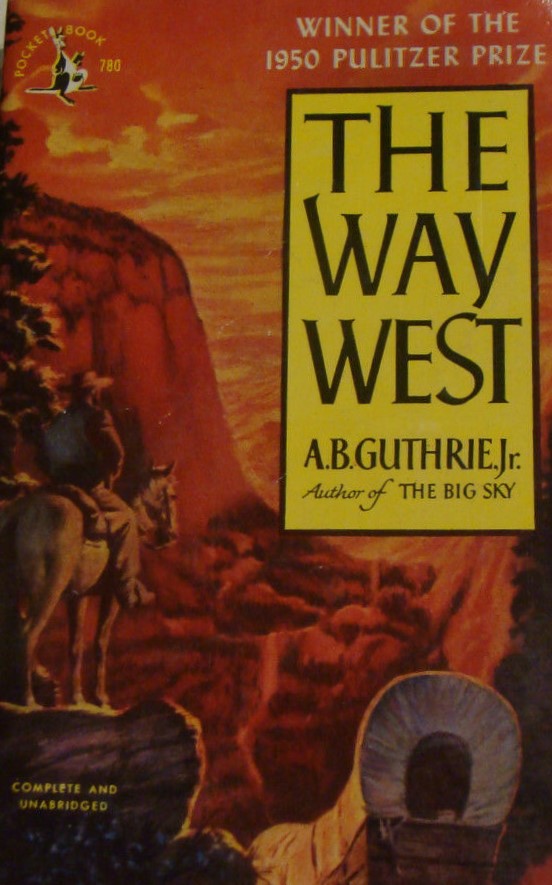
The paperback was sold as a western not as a novel of literary merit so it was inevitable
that the Native Americans who played a minor role in the book took center stage
on the book cover to target the expected audience.

What isn’t in the book: Tadlock (Kirk Douglas) isn’t a Senator for a start, he’s not a widow and doesn’t have a child. He’s not a visionary either with some grandiose map of how he envisages the town he’ll build. He doesn’t hang a man, get a whipping or die falling over a cliff. He’s quit the wagon train long before the cliff section. And he stopped being the leader of the expedition less than halfway through the book.

What isn’t in the book: Evans (Richard Widmark) isn’t overfond of alcohol, doesn’t create an unforced halt in order to celebrate Independence Days several days too soon, doesn’t have a grandfather clock whose loss causes him to lose his rag with Tadlock, in fact it’s he who picks the fight after discovering Tadlock intends to hang a thieving Native American.

What isn’t in the book: Dick Summers (Robert Mitchum) isn’t losing his eyesight, though recently widowed his wife wasn’t a Native American, and he doesn’t have a lucky necklace to pass on to a young man or woman.

So there’s a whole passel of wonder right there. The screenwriters have instantly dramatized all three leading characters by providing them with different attributes, making Tadlock and Summers more sympathetic than in the book, rendering Evans less sympathetic. The problem with the book’s Summers is that what makes him interesting is his lore, his knowledge of everything to do with the West, little of which translates to the screen. So providing the toughest of them all with an impediment allows him an immediate story arc.

What isn’t in the book: a Native American child is not killed by a settler, there’s no settler hanged by Tadlock to placate the warring tribe. There’s no warring tribe. There’s no race with other wagon trains at the outset and no racing across a river to get ahead of a rival. There’s no stowaway preacher either, though there is a preacher (Jack Elam). There is only one stop along the way in the film, at Fort Hall, but two in the book, the other being Laramie.

What isn’t in the book, I’m sorry to say, is the wonderful sequence of lowering wagons down a cliff, and Brownie (Michael McGreevy) marries Mercy (Sally Field) because otherwise she’s going to leave the wagon train at Fort Hall and he doesn’t make a pledge in public that her unborn child is his. And there’s no part for Stubby Kaye.

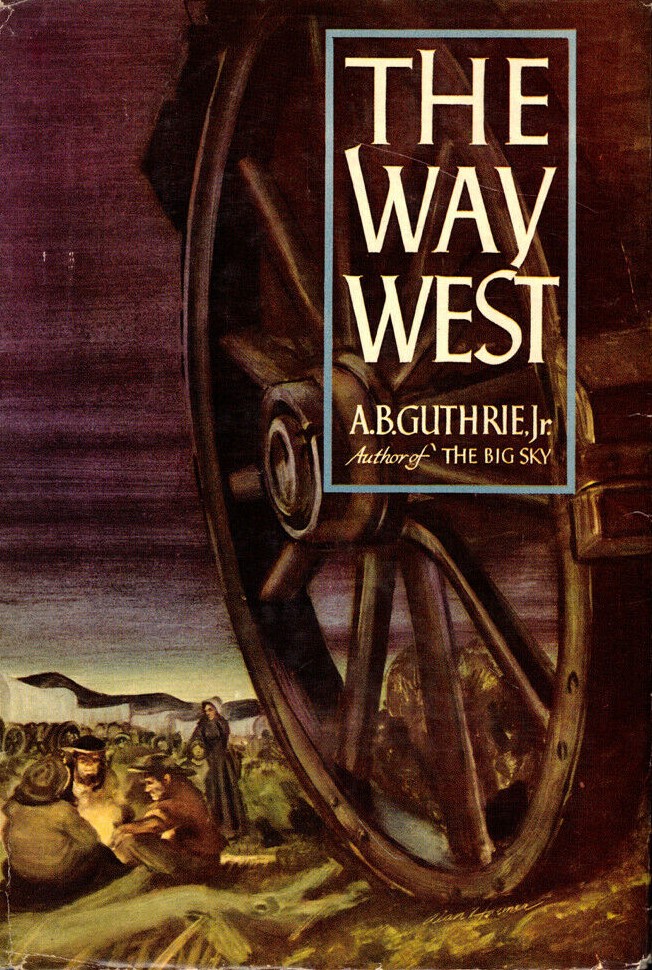
This hardback cover gives far better representation of the novel’s content.

Some of the more solid emotional material is retained. The frigidity of Mrs Mack (Katherine Justice) remains, giving her husband (Michael Witney) the excuse to seduce Mercy, considerably more innocent in the book, where she is described not as sassy but awkward in adult company, “growed up in body and not in knowing.”  While not loving Brownie, she marries him for convenience, though she learns to love him. Brownie gets advice on handling Mercy from Summers and much of that dialog is imported straight from the book.

From the book comes the idea of the settlers chiseling their names on the rock, of Brownie, while doing so, being captured by Native Americans and being traded back to his father.

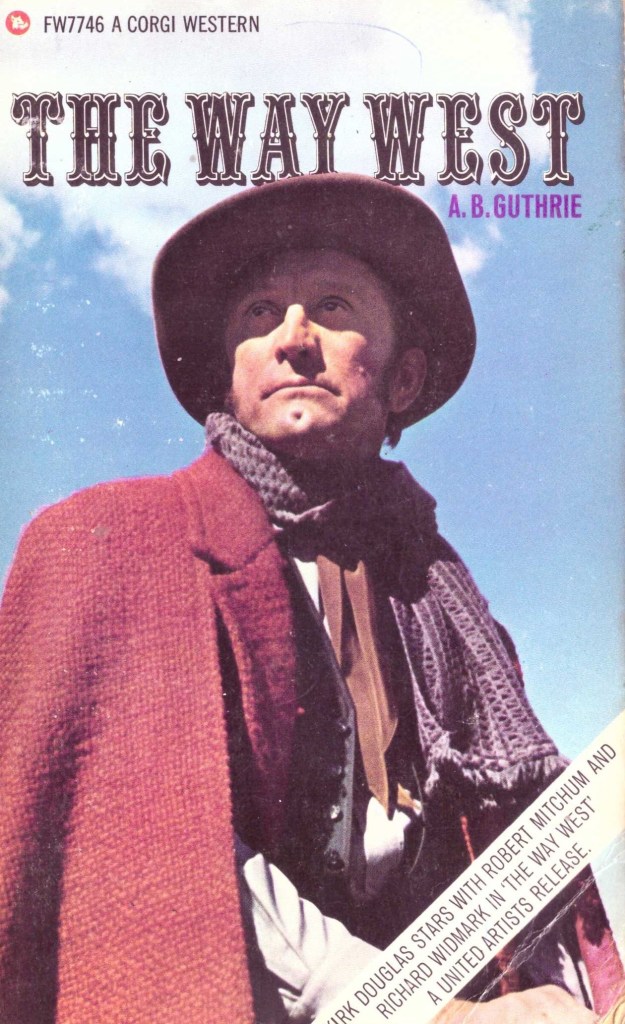
Cover of the British Corgi movie tie-in paperback printed in 1967.

But there are some ideas lifted from the book out of sequence that the screenwriters build up into major dramatic incidents. The river crossing at the start of the film is taken from the river crossing near the end of the book. Close to the start of the novel, Mack kills a Native American, whose tribe seek justice but are sent away empty handed by Tadlock. That becomes a key sequence in the film when Mack is hanged by Tadlock. A child is killed by a rattlesnake and that is transferred to a different father who gives full expression to his grief.

The screenwriters exacerbate the tensions between the characters, create more moments of high drama, invent the visionary element, and are responsible for the vast bulk of crisp dialogue. While the dialogue in the book sounds authentic, it lacks the brittleness and thrust of the words spoken in the film.

A.B. Guthrie was a celebrated American novelist, a journalist who had come to fiction late, over 40 when he produced his first book, a mystery novel set in the West. But after winning a fellowship to Harvard, his writing took a literary turn, and his West did not take the traditional romanticized view. Two of his novels had been filmed – The Big Sky (1952) starring Kirk Douglas and These Thousand Hills (1959) directed by Richard Fleischer – and he had written an Oscar-nominated screenplay for Shane (1953), based on the Jack Schaefer novel, as well as for The Kentuckian, based on the Felix Holt book. The Way West had become such a touchstone for originality and an acclaimed masterpiece that it seemed impossible to turn it into a film.

Whether the film’s negative critical reaction and audience disregard was down to the screenplay veering so far away from what was considered a classic novel is hard to say. This is a very good example of a book that appeared unfilmable being somehow turned into a more than watchable film.     

And I can recommend the book.

Discover WordPress

A daily selection of the best content published on WordPress, collected for you by humans who love to read.

The Atavist Magazine

by Brian Hannan

WordPress.com News

The latest news on WordPress.com and the WordPress community.