
After I had written this original “Behind the Scenes” article I came across an interview with director Henry Hathaway that cast light on his interpretation of “Circus World” as well as an insight into his working methods. Rather than re-write the whole Blog I’ve added his words, which come from the magazine “Focus on Film,” as a stand-alone at the end of the original feature which gives some context to the Hathaway interview. If you’ve already read the “Circus World Behind the Scenes” you can just jump to the bottom of the page.
For John Wayne it was the best of deals and the worst of deals. He had signed a six-picture seven-year contract with Paramount. On the plus side the studio paid the entire amount upfront, wiping out the accumulated debts from the debacle of The Alamo (1960). On the debit side, he received only $500,000 per picture, well below his standard price of $750,000. In fact, Paramount could recoup some of its expense by hiring him out at his previous going rate.
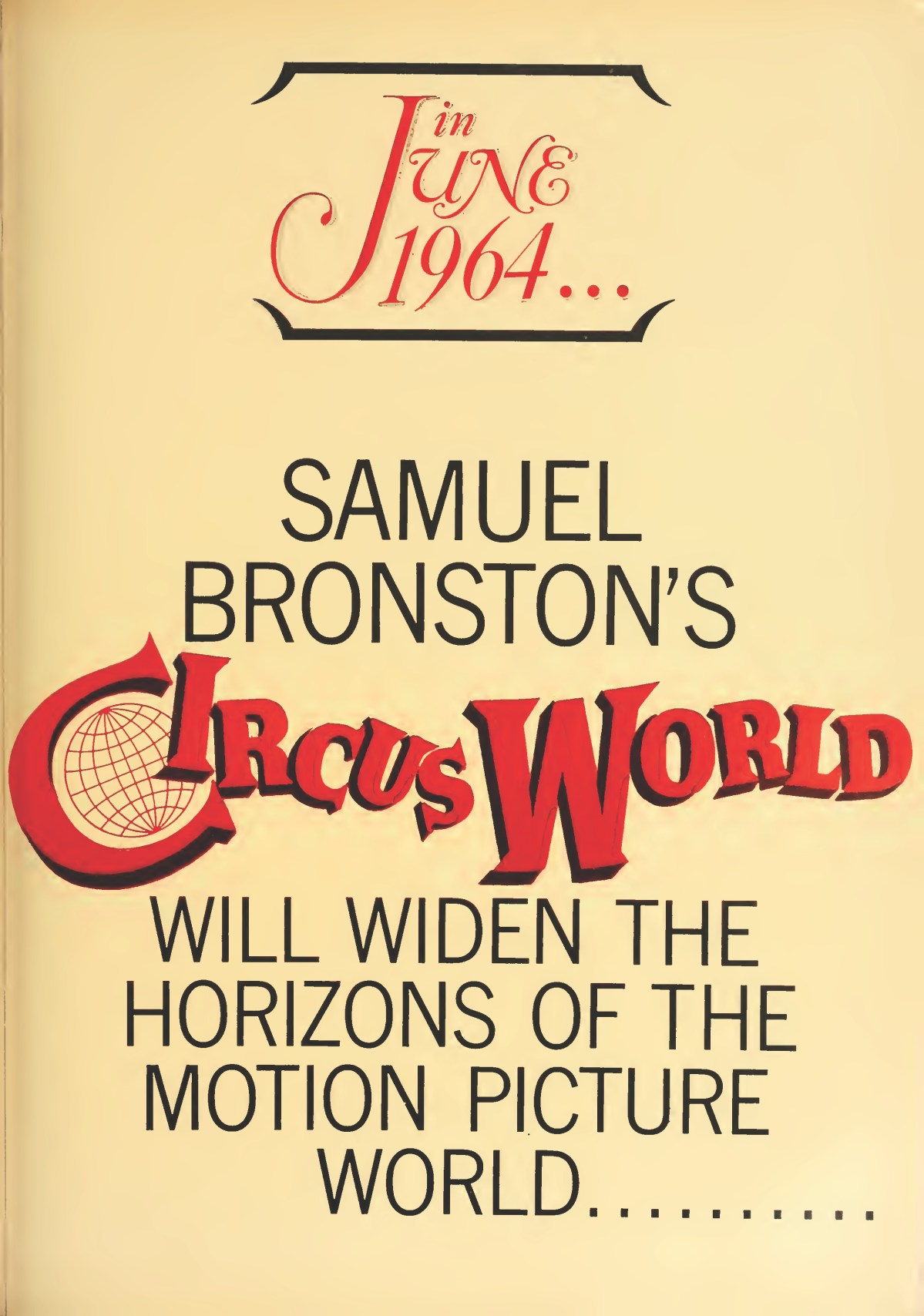
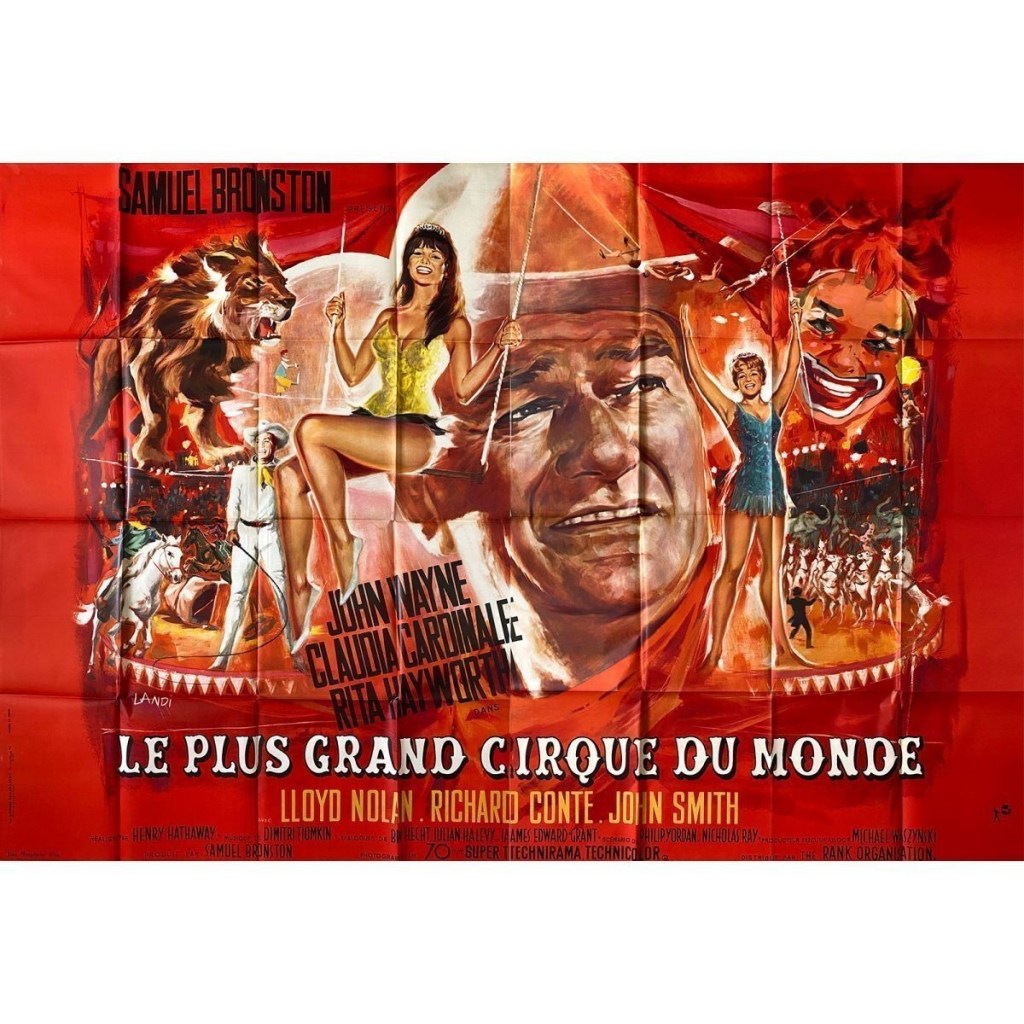
Wayne was coming off hits McLintock (1963), Hatari! (1962) and How the West Was Won (1962) but other movies The Man Who Shot Liberty Valance (1962) and Donovan’s Reef (1963) – the first in the multi-picture deal – had punctured a hole in his supposed box office supremacy. But for maverick producer Samuel Bronston (El Cid, 1961), getting his hands on a star of the magnitude of Wayne was a coup. Originally entitled Those Were the Days, the title switched to the more appealing Circus World.

Bronston was a new-style producer. Apart from a $2.5 million injection by Paramount he financed his pictures by country-by-country advances, and backed by DuPont, hardly the first big company to be seduced by the prospect of becoming a big Hollywood player. Distributors who advanced money in this fashion made hay if the film hit the bull’s eye, but if it flopped they didn’t get their money back. And a flop made it more difficult for an independent producer to raise the dough for his next picture. So Wayne’s involvement was viewed as a guarantee.
Nicholas Ray (King of Kings, 1961) was initially hired to direct followed by Frank Capra (It’s a Wonderful Life, 1946), also made a Bronston partner, who tried to sabotage the script, planning only to shoot the sections he had rewritten. Bernard Gordon (55 Days at Peking, 1963) was credited with the original idea, but when Wayne came on board he brought with him James Edward Grant (The Commancheros, 1961).
Grant was only tempted by the promise of a three-picture deal. The tussle ended with Capra evicted at a cost of $150,000 and Henry Hathaway (North to Alaska, 1960) at the helm.
Hathaway instigated a week of rewrites with Ben Hecht (Spellbound, 1945) before settling down to more serious work with Grant.
Initial casting envisaged Rod Taylor (Dark of the Sun, 1968) in the role of Wayne’s partner and would-be lover of Cardinale, but he took the job without reading the script and on realizing it was little more than male romantic lead he bowed out. David Niven (55 Days at Peking, 1963) was initially signed as Wayne’s old buddy Cap but he, too, quit over the script. (Wayne and Taylor got on very well and should have teamed up for The War Wagon, 1967, until Kirk Douglas muscled his way in, later doing so for The Train Robbers, 1973. )
Their replacements John Smith (who had made his debut in Wayne picture The High and the Mighty, 1954) and the veteran Lloyd Nolan were hardly in the same box office league, but shaved cash off the budget.
A bigger concern than hiring a supporting cast was the circus. Bronston recruited famed European outfit Althoff Circus, whose 400 performers ensured the ringside element was authentic. For further realism Bronston added Bob Dover from Ringling Bros. There was no need for specialist horses, Bronston already having 125 trained from The Fall of the Roman Empire to pull circus wagons and for bareback riders.
The entire circus had to be transported by rail on 51 freight cars through the Brenner Pass to Germany and via Switzerland and France to Spain, halting at the Spanish border to unload the whole shebang onto a different train because the gauges didn’t match.
For the picture’s most spectacular scene, the capsizing of the ship transporting the circus, Bronston bought the 250ft long S.S. Cabo Huertas which was heading for the breaker’s yard. Repainted, decorated with circus posters and renamed S.S. Circus Maximus it was all set for a sinking overseen by special effects expert Alex Weldon (El Cid, 1961).
Three hundred tons of water were pumped into the half of the hold furthest away from the dock. The additional weight of 600 extras was enough to flip the ship on its side. Four 50-ton steam winches with steel cables kept the ship upright until it was time for action.
Female extras who were going to end up in the drink were fitted with corsets made of cork while the men wore cork belts hidden under their costumes. The Spanish Coast Guard cleared the harbor of debris and a local fleet of boats, just out of camera view, stood by for rescue. Seven divers patrolled the harbor bottom in case the cork failed to keep actors and extras afloat. Three sets of costumes were created for each participant so they would be kept dry as long as necessary.
Hathaway completed the scene without a single injury. He called it, “the greatest job of its kind I have ever been involved in.” Bronston, who was as much a detail man as Cecil B. DeMille, ensured the band played instruments from the period
The picture went in front of the camera in September 1963 with Wayne due to end his commitment on December 18. But severe flooding in Spain knocked the movie off schedule and it went way over budget, shooting running on until March 1964, the finishing touches added in London, the budget hitting $9 million.
Rita Hayworth, who hadn’t made a picture in two years, proved a handful, usually late on set, committing the cardinal sin of not learning her lines and, probably as worse, being rude to everyone
At just 135 minutes long, Circus World wasn’t originally envisaged as a roadshow until Cinerama put an estimated $2.5 million into the project, which defrayed the costs. By the time that partnership was announced, it was too late to shoot it in the Cinerama process. The 35mm Super Technirama footage was blown up to 70mm for showing in 60 U.S. theaters boasting the iconic Cinerama curved screens. Everything in Cinerama at that point was roadshow. And they had two more projects lined up with Bronston, Vittorio De Sica’s Paris 1900 and Jack Cardiff’s Brave New World, neither of which were made. Bronston also had another two movies in preparation with Paramount: The Nightrunners of Bengal to be directed by Richard Fleischer and Suez, neither made either.
Roadshow suited Paramount which had not used that method of premium release since The Ten Commandments (1956). In 1963 it had set up a roadshow department to handle the forthcoming Becket (1964) and The Fall of the Roman Empire, which were proper roadshow length of, respectively, nearly 150 minutes and over three hours. But, initially, Circus World did not fall into the roadshow category as far as Paramount was concerned. Only the arrival of Cinerama as an investor made it imperative.
To avoid a title clash with the ultra-successful It’s A Mad, Mad, Mad, Mad World (1963), British distributor Rank changed the title to The Magnificent Showman. That alteration did little to improve its box office, opening at London’s Coliseum for a “NSG” (not-so-good in Variety parlance) $11,200, not much more than The Fall of the Roman Empire in its 17th week, How the West Was Won (90th week) and Cleopatra (51st). Nonetheless it ran there for seven months, followed by a mass general release in the U.K. with a record number of prints. In the U.S., on the eve of general release in April 1965, Paramount considered a title change to Wild Across the World and a switch of marketing emphasis to John Wayne and action.
Audiences didn’t bite, certainly not enough to recoup the budget, and far from enough to prevent Bronston’s operation sliding into liquidation.

NEW STUFF FOLLOWS BELOW
“Circus World was a mistake,” averred director Henry Hathaway.
“Capra was working on it and Paramount had invested a lot of money. Capra was writing a story and Wayne didn’t like the story and the writer (Philip) Yordan didn’t like the story. He and Joseph Sistrom were working on it and they hadn’t quite finished it and Paramount finally got sick because they needed Wayne to get their money out of it and he had given them two months, I think, and he couldn’t give them any longer without charging them more money.
“I’d just finished Nevada Smith (what!!! – some poor editing here, given that film was made a couple of years after Circus World; presumably they meant How the West Was Won) and they said, ‘For Christ’s sake will you go over there because you know Wayne so well, get it straightened out enough so Wayne will say Ok I’ll do it and we’ll get it finished in some way.’
“I couldn’t stand this fellow Jimmy Grant who was the new writer – a phoney man – so I said ‘If you’ll let me work with Ben Hecht…’ So I flew back to New York with what we had and Ben and I had two weeks to try to get some cohesion into the story. We came back and Wayne said he was satisfied. Then we ran into a bad thing with Rita Hayworth on that picture because she was drinking a lot through it.
“I should never have got into it so quickly without more preparation, the fundamental story material was weak.
“I never look at rushes. You see I only work on location and there you can’t project them properly and I get disappointed because it doesn’t look good and maybe the machine’s bad and it looks too dark and then the actors want to put on or change their make-up. I don’t let actors wear make-up (!!!), only girls, so I don’t let the actors look at it – and because they don’t look at it, I don’t.
“I only shoot what can be used so the producer has no choice. According to the law of the Directors Guild the man that puts up the money – the company – owns it. If we want to have complete control we must put up the money ourselves. What right have you to say that because you’re stubborn, and you may not be right, that you have the last say with the man who has spent millions of dollars.
“Literally, you have the right to produce your own version and they pay extra time if necessary. Then you turn it over…The only alternative you have is that if they play with it too much you quit and you won’t work for them anymore.
“I never had that trouble because I’m very conservative and I don’t over-shoot like George Stevens. He shoots a scene all ways, upside down, crossways, backways, everyways. He previewed Shane (1953) just generally telling the story and it didn’t work too well…So he recut the picture telling it through the eyes of the woman Jean Arthur as a love story…and that didn’t work too well. So he took it back and showed it through the eyes of the boy who hero-worships a guy…and that was the successful version. Now it would be impossible for me to recut a picture any other way than the way I shot it. If it’s bad, it’s bad.
“I always cut in the camera. The cutter just has to put the ends together. For instance, I don’t shoot a whole master shot all the way through. I start it and then get into the two-shots and then I get into the close-up and then I get out of it. In other words I don’t make them do the whole scene over again in long shot and then in medium shots and then in close-ups and on and on because the actors get bored with the scene and they’re never as good. You try to direct the picture in a manner that doesn’t waste the energies of the first emotional performances of the actors in long shots that you can’t use.
“The hardest thing is getting people out of goddam scenes. It’s very difficult to get them in and out of scenes gracefully. Another thing that most people never learn is that in each scene there’s a reason for that scene and, as soon as you hit it, get out as fast as you can or there’ll be a repetition of it or it hangs on too long.”
NOTE: I should also point you in the direction of the How the West Was Won “Behind the Scenes” since the Focus on Film interview also covers the shooting of that film and I’ve since added it in.
SOURCES: Scott Eyman, John Wayne, The Life and Legend (Simon & Schuster, 2014) p379-385; Mel Martin, The Magnificent Showman (Bear Manor Media, 2007), p153-168; Rui Nogueira, “Henry Hathaway Interview,” Focus on Film, No 7, 1971, p19-20; Sheldon Hall, Introduction to Circus World, Bradford Widescreen Festival, 2022; “Rank To Distribute New Bronston Pic,” Variety, September 26, 1962, p15; “Althoff Circus Logistics for Bronston’s Film,” Variety, September 25, 1963, p4;“New Roadshow Dept at Paramount,” Variety, November 13, 1963, p3; “Bronston and Paramount in 4-Picture Deal,” Box Office, December 9, 1963, p7; “Circus World Filming in London,” Box Office, February 17, 1964, p14; “Bronston’s Circus Goes Cinerama,” Variety, February 19, 1964, p4; “Bronston-Cinerama Unite on 2 Films,” Box Office, February 24, 1964, p5; “Special Mass Release for Showman,” Kine Weekly, May 28, 1964, p3; “Paramount Retains Circus World Title,” February 24, 1965, p3.

 The Magnificent 60s