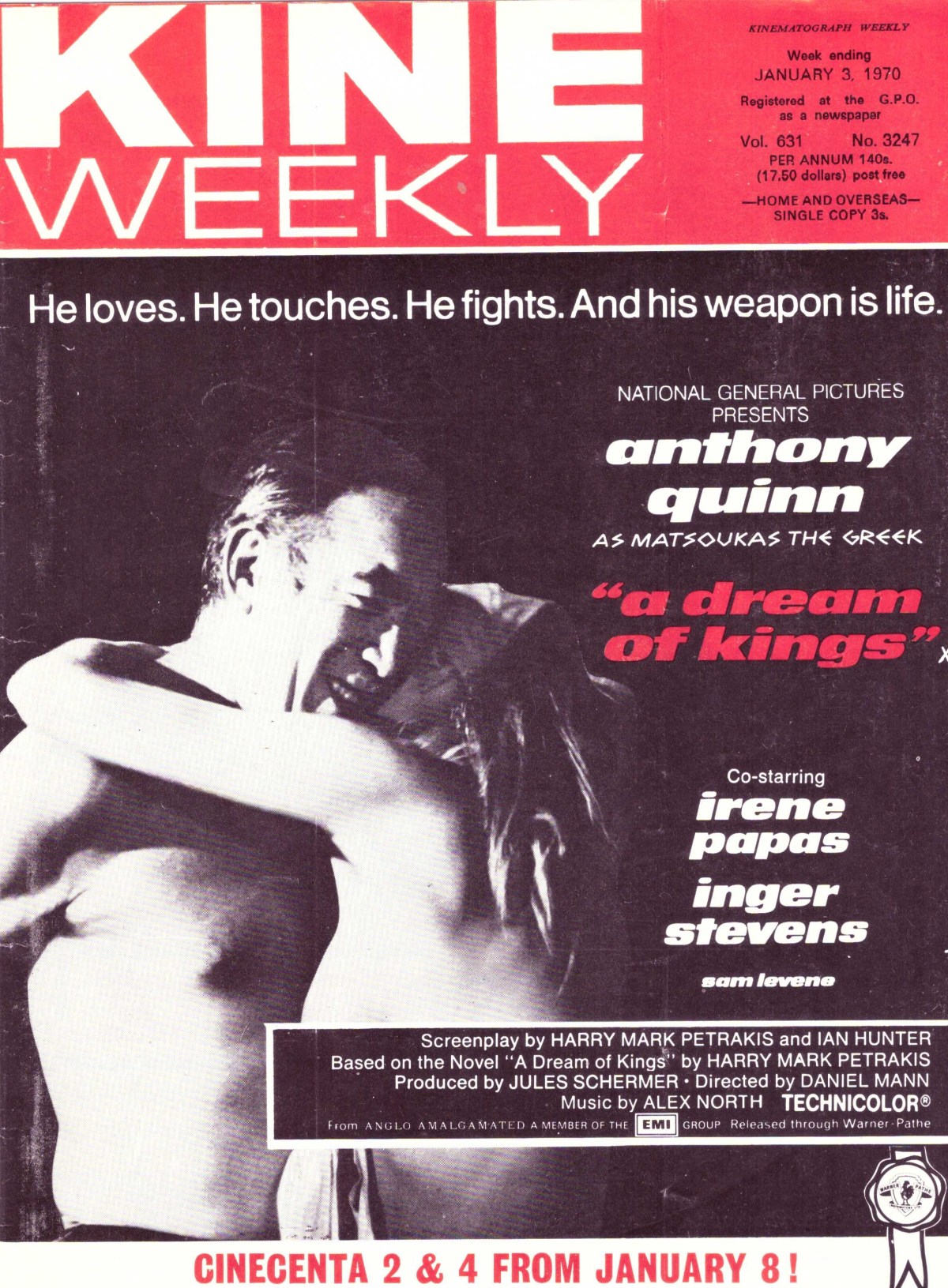
A Dream of Kings (1969) *****

Sometimes great movies just disappear. Even if they pick up some critical traction on initial release, as here, they flop at the box office. And they are not revived because the production company goes bust or the rights are complicated. Or, more likely, they don’t fit into audience expectation. All three stars here completely play against type, outliers in career portfolios. We have become so accustomed to the attraction of stars according to their screen personas that unless they are known to completely change their screen characters with every outing anything that’s different to the norm becomes unacceptable.

Director Daniel Mann (Ada, 1961) was best known for producing Oscar-winning or Oscar-nominated performances from female stars. He was immensely skilled at making audiences sympathize with the most flawed women. Here, he does the same for Anthony Quinn, in a performance that should have had Oscar voters lining up but was dismissed for all the wrong reasons. Theoretically, one of the film’s problems is the dialog. We are so used to a script full of cut-and-thrust or witty putdowns that we fail to recognize a screenplay, that in much the same way as a stage play – but without that form’s inherent artificiality – lets characters live and breathe, explore depths that are just not possible except in fleeting moments in the normal construction of a movie.

Most scenes here begin one way and then move in all sorts of directions, sometimes ending up back where they started, but most often going somewhere unexpected, not in the sense of a sudden twist, but in digging deeper into relationships and understanding that marriages are built on shifting sands, and not all of them perilous. There’s a lot of dialog and when you get a lot of long speeches it can make the actors look as though they’re hamming it up when in fact what they’re doing is opening up the character.

We shouldn’t like Matsoukas (Anthony Quinn) at all. He’s a gambler, a womanizer, drinks, comes home at sunrise, has nothing you’d call a real job.

And yet.

In his company you enter a world of possibility. By sheer force of personality he lifts gloom, even when it’s his actions that have caused it. He can convince the most downtrodden weaklings that they have something of worth.

When nobody has anything good to say about old drunk Cicero (Sam Levene), Matsoukas tells him he has a poker dealer’s graceful hands and provides solace just by befriending him. He convinces a 72-year-old man that the loss of his libido is not down to the old guy’s age but because in four years of marriage he has lost interest in his 31-year-old wife because she’s the one who has aged, physically less appealing, and then he teaches the desperate soul the gentle art of seduction, how to win a woman’s heart by putting her on a pedestal, treating her like a goddess, kissing her softly on eyes and ears rather than pawing her in frantic passion.

Just what Matsoukas’s job is – on the door it says “counsellor” which would suggest something  legal  – but in fact he’s a male version of an old wife and provides solutions to odd problems, a mother worried that her teenage son masturbates, for example.

He is the sort of guy who can wring triumph from disaster. He has just lost a bundle of dough at poker but the way he tells it you’d think he’d won. Instead, he appreciates the drama of it all, the way it makes a great tale even if he’s the loser. Naturally, wife Caliope (Irene Papas) doesn’t see it his way. She’s on her knees with trying to feed her three children from the scraps that fall from his gambling. Though when he wins big, they live like kings.

Although he still has a lusty sex life with Calope, and can mostly coax her round, he has fallen for widowed baker Anna (Inger Stevens), attracted to her in part to alleviate her grief, pull her out of the darkness.

And he cannot face up to the potential loss of his young son who has three months to live and has it fixed in his own mind that the boy will be cured if Matsoukas can expose him to the sunshine and the ancient gods of his Greek homeland, though he lacks the $700 required for the air fare.

Each sequence is long, carefully calibrated, giving time for the exploration of a wealth of emotions. Outside of the three main narratives are two other stand-out scenes. In his sermon a priest rails against the evils of life insurance that makes people welcome death yet argues, ironically, that death is a great joy and should not be feared. And there’s a party where Matsoukas on the dance floor is a magnet for every woman in the room.

This is an Anthony Quinn (The Shoes of the Fisherman, 1968) devoid of all trademark abrasiveness, the loud voice gone, trying to gouge every ounce of joy from a forbidding world. He has a very tender relationship with his dying son, inventing a game with fake telephones to deal with the boy’s fears, and is very playful with his two daughters. He is constantly wooing his wife, in part to ease the pain he causes her, but mostly because he wants them to get the most out of life.

This is a different Irene Papas (The Brotherhood, 1968) too, not the fiery woman or dutiful wife of her screen persona. Whatever anger she feels is subsumed by sorrow and she is always willing to let her husband fire up her heart as in the old days. Actresses don’t get such complex roles these days.

And all the pent-up fragility of Inger Stevens (Five Card Stud, 1968) is suddenly let loose as she twists her entire screen persona of tough woman in a man’s world – usually a western – on its head. Her scenes with Quinn are breathtaking. Unfortunately, this was her final film – she committed suicide shortly after. But she could not have found a better swansong, one that extended her range.

As he always does, Daniel Mann doesn’t take his main character’s side, but while extracting sympathy for character predicament and perspective, still lets the audience make up his mind. This could easily have gone all maudlin, the child miraculously recovering, the flight to Greece to find a rare cure, all Matsoukas’s delusion revealed as nothing more than true faith, but it’s more hard-edged than that. At the end Matsoukas has his exterior carapace ripped apart, beaten up, ostracized for committing the worst crime of a gambler – cheating – in dire straits.

And yet.

Written by Ian McLellan Hunter (Roman Holiday, 1953) from the bestseller by Harry Mark Petrakis.

I just adored this.

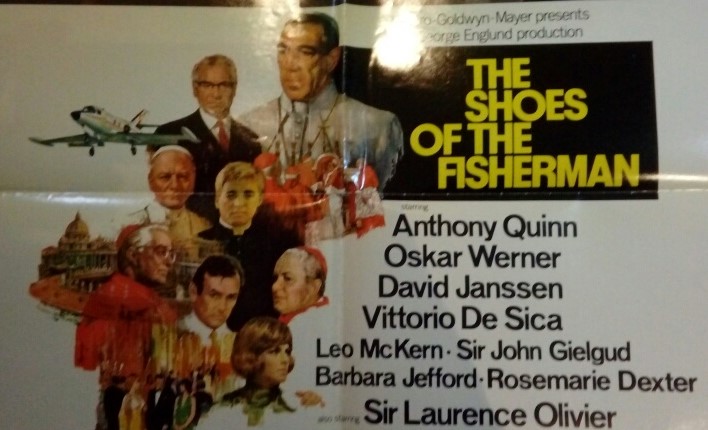
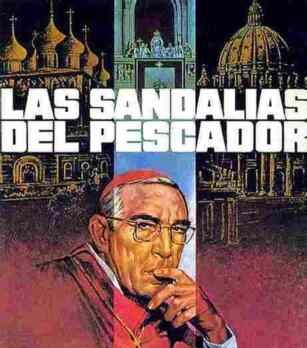
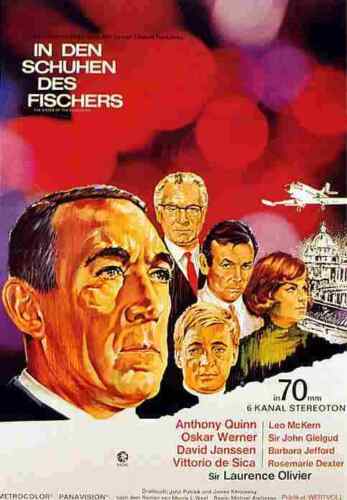
The Shoes of the Fisherman (1968) ****

Another nod to Conclave. Thought-provoking drama with a contemporary slant set against the grandeur of the Vatican amid geo-political turmoil. At a time of global crisis, dissident Russian archbishop Lakotov (Anthony Quinn) is unexpectedly freed from a labor camp by the Russian premier (Laurence Olivier). Arriving at the Vatican, he is promoted to Cardinal by the dying Pope (John Gielgud) before becoming an unexpected contender for Papal Office.

The spectacular wealth of the Catholic Church is contrasted with the spectacular poverty of China, on the brink of starvation due to trade sanctions by the United States, nuclear war a potential outcome. The political ideology of Marxism is compared to the equally strict Christian doctrine, of which Lakotov’s friend Father Telemond (Oskar Werner) has fallen foul. There is a sub-plot so mild it scarcely justifies the term concerning television reporter George Faber (David Janssen) torn between wife Ruth (Barbara Jefford) and young lover Chiara (Rosemary Dexter).

Lakotov is drawn into the Russian-Chinese-American conflict and the battle for the philosophical heart of the Christian faith while bringing personal succor to the lovelorn and performing the only modern miracle easily within his power, which could place the Church in jeopardy, while condemned to the solitariness of his position.

The political and philosophical problems addressed by the picture, which was set 20 years in the future, are just as relevant now. The film’s premise, of course, while intriguing, defies logic and although the climax has a touch of the Hollywood about it nonetheless it follows an argument which has split the church from time immemorial.

You would not have considered this an obvious candidate for the big-budget 70mm widescreen roadshow treatment, but MGM, after the Church not surprisingly refused access to the Vatican, spent millions of dollars on fabulous sets, including the Sistine Chapel. The roadshow version of the picture, complete with introductory musical overture and an entr’acte at the intermission, is leisurely and absorbing, held together by a stunning – and vastly under-rated – performance by Anthony Quinn (The Lost Command, 1966) who has abandoned his usual bombastic screen persona in pursuit of genuine humility and yet faces his moments when he questions his own faith.

Ruth has a pivotal role in bringing Lakotov down to earth but George has the thankless task, setting aside the quandaries of his love life, of talking the audience through the sacred ceremonies unfolding sumptuously on screen as the cardinals bury one Pope and elect another.

You wouldn’t think, either, that Hollywood could find room in such a big-budget picture for philosophical discussion but questions not only of the existence of God but whether he has abandoned Earth are given considerable scope, as are discussions about Marxism and practical solutions to eternal problems. None of these arguments are particularly new but are given a fair hearing. There is a hint of the Inquisition about the “trial” Telemond faces. Oskar Werner (Interlude, 1968) carries off a difficult role.

David Janssen (Warning Shot, 1967) is mere window dressing and Rosemary Dexter (House of Cards, 1968) mostly decorative but Barbara Jefford (Ulysses, 1967) is good as the wounded wife. Laurence Olivier (Khartoum, 1966) is the pick of the sterling supporting cast which included John Gielgud (Becket, 1964), Burt Kwouk (The Brides of Fu Manchu, 1966) Vittorio de Sica (It Happened in Naples, 1960), Leo McKern (Assignment K, 1968), Frank Finlay (A Study in Terror, 1965), Niall McGinnis (The Viking Queen, 1967) and Clive Revill (Fathom, 1967). In a small role was Isa Miranda, the “Italian Marlene Dietrich,” who had made her name in Max Ophuls’ Everybody’s Woman (1934) and enjoyed Hollywood success in films like Hotel Imperial (1939) opposite Ray Milland.

Michael Anderson (Operation Crossbow, 1965) directed with some panache from a script by veteran John Patrick (The World of Suzie Wong, 1960) and Scottish novelist James Kennaway (Tunes of Glory, 1960) based on the Morris West bestseller.

I found the whole enterprise totally engrossing, partly because I did not know what to expect, partly through Anderson’s faultless direction, partly it has to be said by the glorious backdrop of the Vatican and the intricacy of the various rites, but mostly from the revelatory Quinn performance. And even if the plot is hardly taut, not in the James Bond clock-ticking class, it still all holds together very well. From the fact that it was a big flop at the time both with the public and the critics, I had expected a stinker and was very pleasantly surprised.

All hail Anthony Quinn.

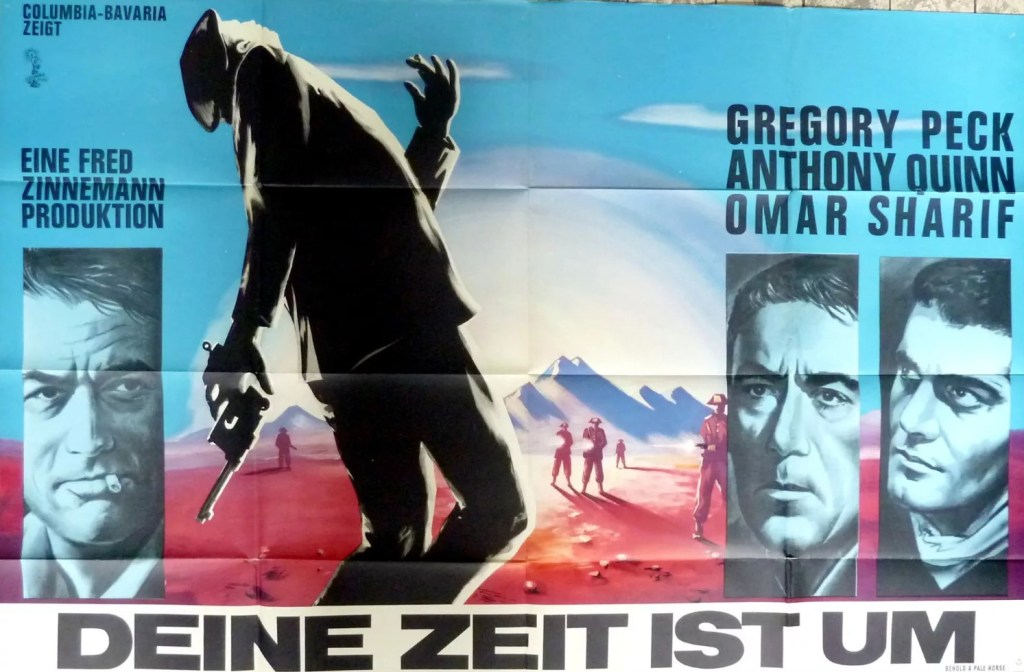
Behold a Pale Horse (1964) ***

Old causes never die but they do go out of fashion and interest from movie audiences in the issues surrounding the Spanish Civil War had fallen from the peak when they attracted artists of the caliber of Ernest Hemingway and Pablo Picasso. But passions surrounding the conflict remained high even 20 years after its conclusion as indicated in this Fred Zinnemann (The Sundowners, 1960) drama.

Manuel Artiquez (Gregory Peck) plays a disillusioned guerilla living in exile in France, who has ceased raiding the Spanish border town under the thrall of corrupt Captain Vinolas (Anthony Quinn). Artiguez has two compelling reasons to return home – a young boy Paco asks him to revenge the death of his father at the hands of Vinolas and his mother is dying. But Artiquez is disinclined to do either. Heroism has lost its luster. He has grown more fearful and prefers to live out his life drinking wine and casting lustful glances at young women.

In France he enjoys a freedom he would be denied in Spain. He is not hidden. Ask anybody in the street where he lives and they will tell you. This is a crusty old soldier, unshaven, long past finding refuge in memories, but not destroyed either by regret. There is a fair bit of plot, some of it stretching incredulity. The action sequence at the end, conducted in complete silence, is very well done, but mostly this is a character piece.

This is not the upstanding Gregory Peck of his Oscar-winning To Kill a Mockingbird. He is a considerably less attractive character, burnt-out, shabby, grizzled, lazy, easily duped, unwilling to risk his life to see his mother. We have seen aspects of the Anthony Quinn character before but he brings a certain humanity to his villain, bombastic to hide his own failings, coarse but occasionally charming, suitably embarrassed when caught by his wife visiting his mistress and praying earnestly to God to deliver Artiquez into his hands. Omar Sharif has the most conflicted character, forced by conscience to help an enemy of the Church.

However, two elements in the picture don’t make much sense. Paco tears up a letter (critical to the plot) to Artiquez which I just cannot see a young boy doing, not in an era when children respected and feared their elders. And I am also wondering what was it about Spain that stopped directors filming it in color. This is the third Spain-set picture I have reviewed in this blog after The Happy Thieves and The Angel Wore Red. For the first two I can see perhaps budget restrictions being the cause, but given the stars involved – Rex Harrison and Rita Hayworth in the first and Ava Gardner and Dirk Bogarde in the second – hardly facing the production dilemmas of a genuine B-picture.

But Behold a Pale Horse was a big-budget effort from Columbia and while black-and-white camerawork may achieve an artistic  darkness of tone it feels artificial. This was never going to be the colorful Spain of fiestas and tourist vistas but it would have perhaps been more inviting to audiences had it taken more advantage of ordinary scenery.

J.P. Miller (Days of Wine and Roses, 1962) adapted the film from the novel Killing a Mouse on Sunday by Emeric Pressburger who in tandem with Michael Powell had made films like Black Narcissus (1947) and The Red Shoes (1948). The film caused calamity for Columbia in Spain, the depiction of Vinolas with a mistress and taking bribes so upset the authorities that all the studio’s movies were banned.   

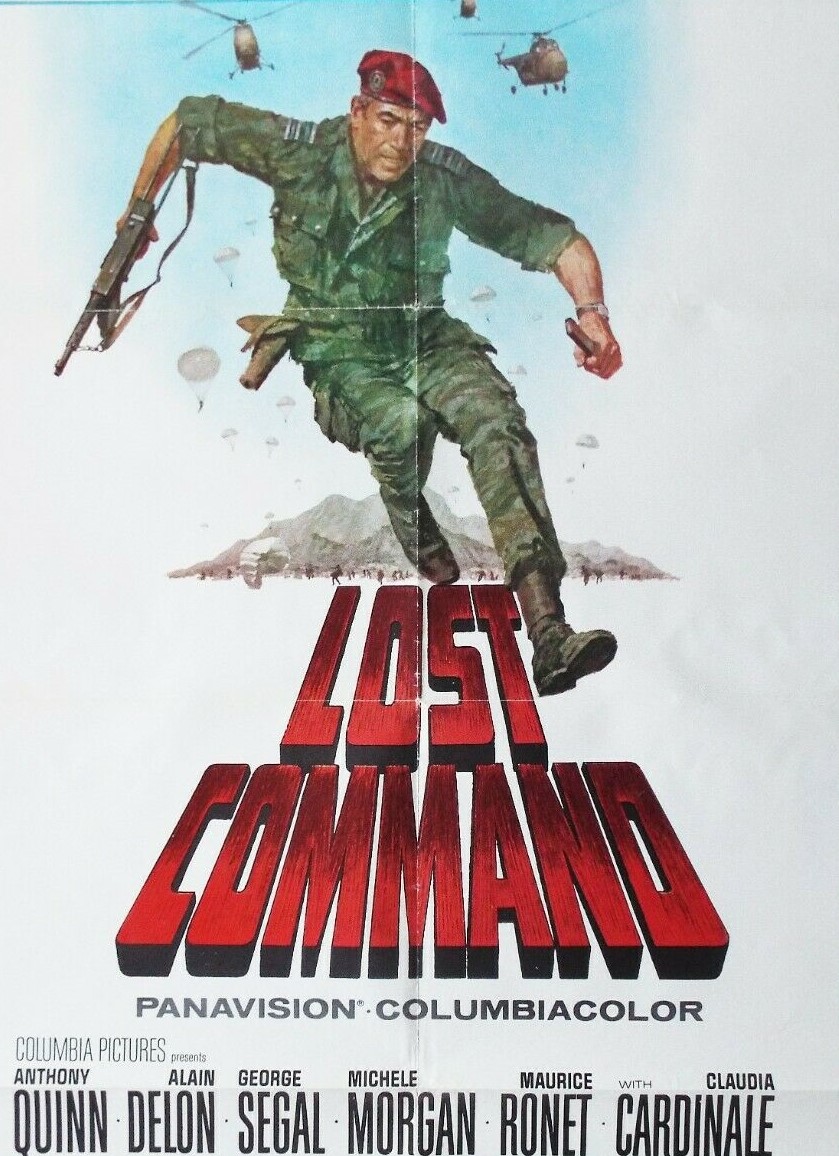
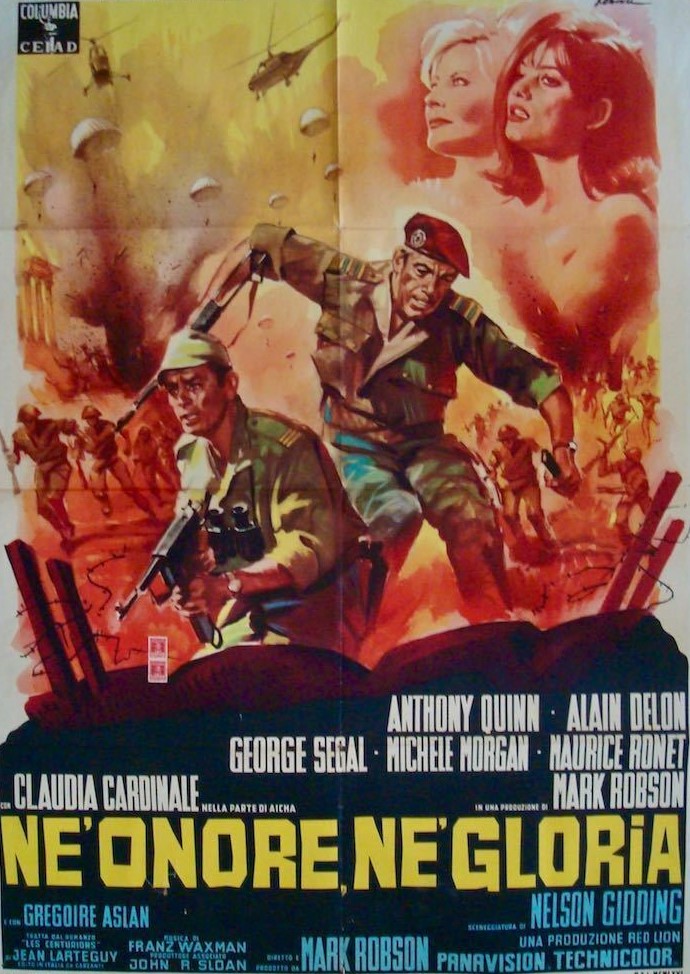
Lost Command (1966) ***

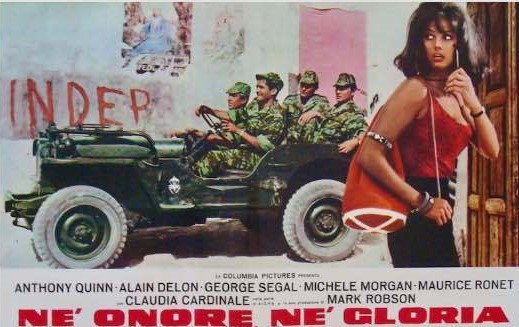
Derring-do and heroism were the 1960s war movie default with enemies clearly signposted in black-and-white. This one doesn’t fall into that category, in fact doesn’t fall into any category, being more concerned with the military and political machinations pervasive on both sides in war. Movies about revolutions generally succeed if they are filmed from the perspective of the insurrectionists. When they take the side of the oppressor, almost automatically they lose the sympathy vote, The Green Berets (1968) in this decade being a typical example, although the sheer directorial skill of Francis Coppola turned that notion on its head with Apocalypse Now (1979) when slaughter was accompanied by majesty. 

In the 1950s-1960s the French had come off worse in two uprisings, Vietnam and Algiers. This movie covers the tail end of the former and the middle of the latter and it’s a curious hybrid, part Dirty Dozen, part John Wayne, part dirty tricks on either side, with a few ounces of romance thrown in.

Col Raspeguy (Anthony Quinn, in unlikely athletic mode – that’s him leaping in the poster) is the officer of a paratroop regiment who sees out the debacle of the final battle of the French war in Vietnam, loses his commission, and then, reprieved, is posted to Algeria, where the fight for independence is in full swing, with a ragbag of rejects plus some faithful comrades from his previous command. In any spare moment, the colonel can be seen keeping fit, doing handstands, swinging his arms, puffing out his chest, and a fair bit of running (presumably to avoid the contention that Quinn was too old for this part). Sidekick Capt Esclavier (Alain Delon) is a bit too moralistic for the dangerous business of war, plays his sidekick. The colonel is an ideal anti-hero for a hero, an officer who ignores, challenges or just plain overrides authority, adored by his men, hated by the enemy, ruthless when it matters.

The brutal realism, which sometimes makes you quail, is nonetheless the best thing about the picture, no holds barred here when it comes to portraying the ugly side of battle. The training in The Dirty Dozen is a doddle compared to here, soldiers who don’t move fast enough are actually shot, rather than just threatened with live ammunition, and there’s no second chance for the incompetent – at the passing out ceremony several are summarily dismissed. The only kind of Dirty Dozen-type humor is a soldier who fills his canteen with wine. Otherwise, this is a full-on war.

Battles are fought guerilla style, the enemy as smart as the Vietnamese, catching out the French in ambushes, using infiltrators sympathetic to the cause and terrorism. Unlike Apocalypse Now where the infantry appeared as dumb as they come, relying on strength in numbers and superior weaponry, Lost Command at least has an officer who understands strategy and most of what ensues involves clever thinking. The battles, played out in the mountains, usually see the French having to escape tricky situations rather than blasting through the enemy like cavalry, although having sneakily pinched a mayor’s helicopter gives Raspeguy’s team the opportunity to strafe the enemy on the rare occasions when they can actually be found, their camouflage professionally done.

Arab rebel chief Lt Mahidi (George Segal, unrecognizable under a slab of make-up apart from his flashing white teeth), matches the French in terms of tactics and brutality, shooting one of his own men for disobeying orders. His sister Aicha (Claudia Cardinale) is the femme fatale making a play for Esclavier, though he’d have to be a lot dumber than the audience to fall for her obvious ploys (guess what, he is dumber). With both sides determined to win at all costs, atrocities are merely viewed as collateral damage, so in that respect it’s an unflinching take on war.

The picture could have done with another 15 minutes or so to allow characters to breathe and develop some of the supporting cast. The movie did well in France but sank in the States where my guess is few of the audience would even know where Algeria was. Gilles Pontecorvo’s The Battle of Algiers, out the same year, gave the revolutionaries the leading role.

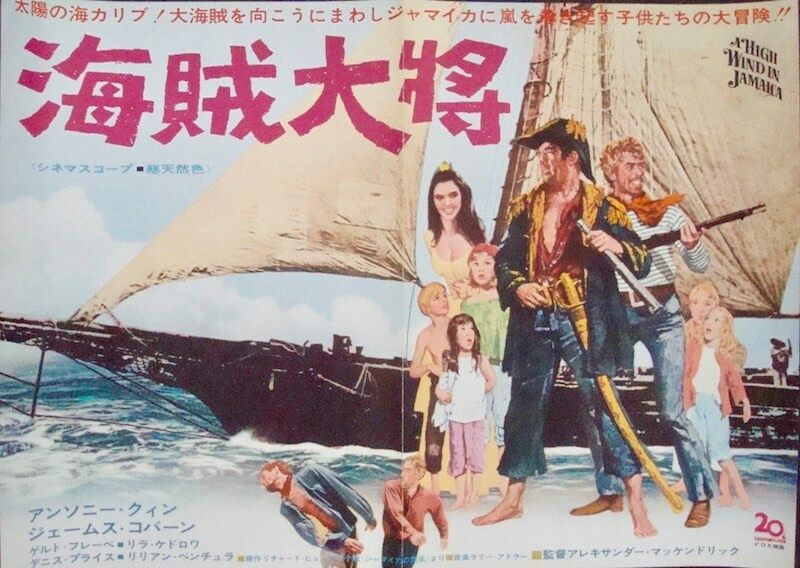
For the most part Anthony Quinn (Guns for San Sebastian, 1968) is in bull-in-a-china-shop form but his character is more rounded in a romantic interlude with a countess (Michele Morgan), his ability to outsmart his superior officers, his camaraderie with his own soldiers and, perhaps more surprisingly, the ongoing exercise routines which reveal, rather than a keep-fit fanatic, an ageing soldier worried about running out of steam. Alain Delon (Texas Across the River, 1967) is entrusted with the morally ambivalent role. George Segal (The Quiller Memorandum, 1966) presumably didn’t realize how culturally inappropriate he would be.

Mark Robson (The Prize, 1963) lets worthy get in the way of action. Screenwriter Nelson Gidding (Nine Hours to Rama, 1963) had the same problem.

Set the politics aside and it becomes much more interesting.

Marco the Magnificent (1965) **

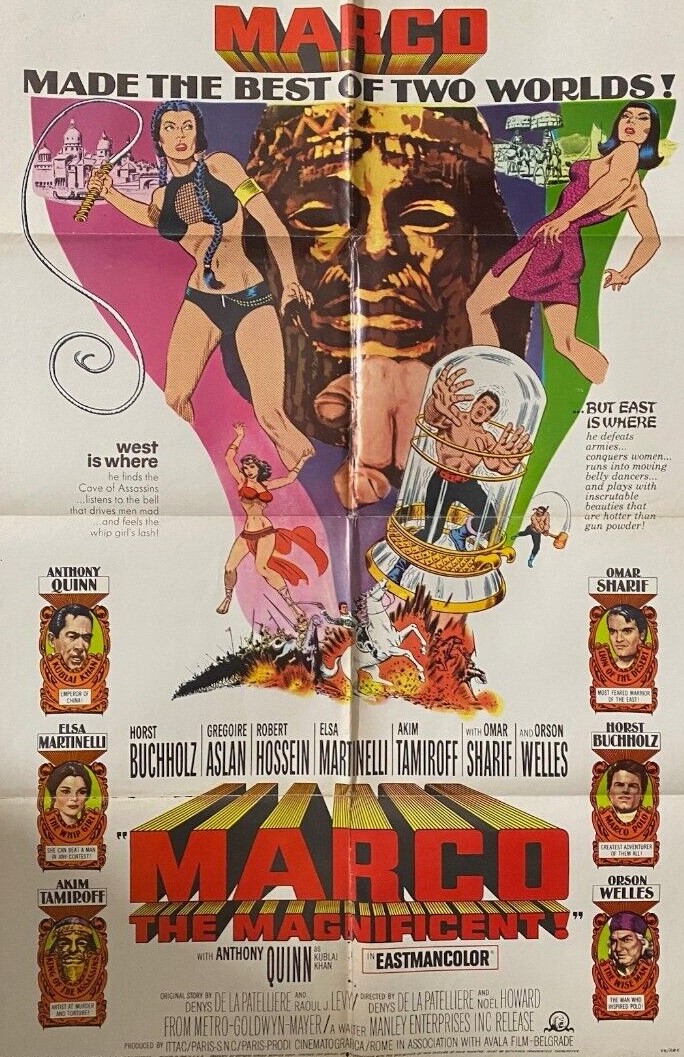
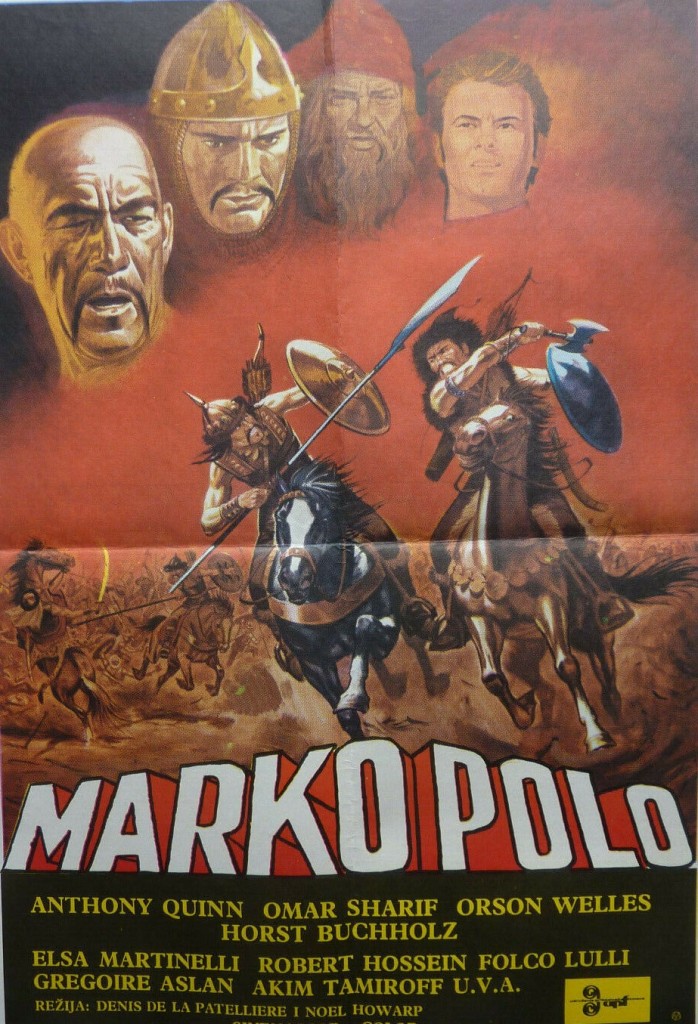
Small wonder this flopped even with the requisite all-star cast of Omar Sharif (Doctor Zhivago, 1965), Anthony Quinn (Zorba the Greek, 1964), Orson Welles (Austerlitz, 1960),  Horst Buchholz (Nine Hours to Rama, 1963) and Elsa Martinelli (Hatari! 1962). Oddly enough, Quinn comes close to saving it. Although initially laughable, presented as a cross between Yul Brynner’s long-lost brother and Ming the Merciless, he tones down the trademark rasp and growl to deliver a powerful performance.

Of course, we also have to take the word of Marco Polos (Horst Buchholz) that he had all these adventures and that he did encounter The Old Man of the Mountains (Akim Tamiroff) and The Lady with the Whip (Elsa Martinelli). The former wore a mask of gold and if you ever saw his face that meant you were in for the chop. And he had a nice line in sonic torture. The latter chooses love above betrayal.

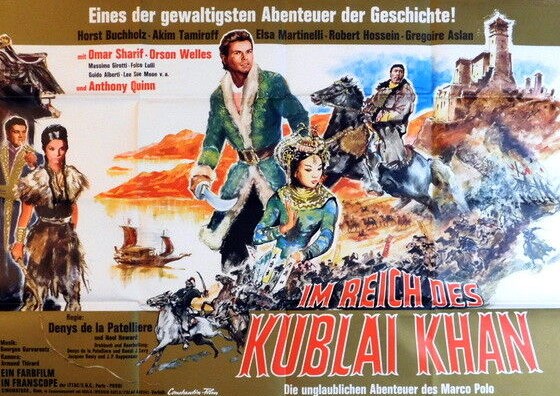
The name of Marco Polo either meant so little to German audiences or the title change was due to the producers hoping to capitalize on the success of “Genghis Khan.”

Love – or sex I guess – is a consistent theme. Marco is chosen for this adventure – whose main aim is to get a message to Mongol overlord Kublai Khan, now the ruler of China, that Italy, the dominant western power at the time, wants peace – in part because he is so handsome. He has no other pedigree that I can see. At the age of 20, he’s best described as an idler. But his father Nicolo (Massimo Girotto) is a renowned trader and has ventured along the Silk road to Samarkand.

But, would you believe it, following that old western genre trope where there’s always someone wanting to sabotage relations between Native Americans and soldiers, the idea of peace doesn’t sit well with everyone. Spies report on Marco’s every move and attempt to stop him completing his mission and when he reaches China discovers that another Mongol warlord Prince Nayam (Robert Hossein) prefers the traditional method of conquest, with the raping and pillaging that goes with it, rather than growing the economy through peaceful means.

Just as well Marco is so good-looking because whenever he is in a tight spot he is rescued by a beautiful woman, including the aforementioned Lady with the Whip, and, would you believe it, Princess Gogatine (Lynne Sue Moon), who has been chosen as a potential wife for Kublai Khan (Anthony Quinn). Multiple romance is the name of the game here – Arab chieftain Emir Alaou (Omar Sharif) has twenty-six wives, one of whom has the temerity to complain at his expanding harem.

Mostly, it’s a travelog – with a bucket of travel cliches thrown in such as Russian dancing – punctuated by occasional peril. But beyond looking handsome and putting his seductive powers to the test, there’s not much else for Marco to do.

The screenplay is so limited and haphazard you get the impression it must have been heavily truncated, that there was a three-hour roadshow covering the ground in a more sensible manner, but that appears not to have been the case. Producer Raoul Levy (who wrote and produced And God Created Woman, 1956, and wrote, produced and directed The Defector, 1966) ) spent so much assembling the cast he scrimped on a workable screenplay and was so intent on ramming it with oddly-named characters (Old Man of the Mountains and Lady with the Whip) that he took his eye off the narrative ball.

The final section with Kublai Khan trying to integrate through his own marriage the conquering Mongols and the conquered Chinese and dispensing with war in favor of peace makes more sense but by then you are so exhausted by the multiplicity of star names contributing nothing and the meandering plot that you have just about given up.

And it wasn’t as if Levy didn’t have time to get a screenplay in place. He’d been working on this since 1962 when an earlier version starring Alain Delon (Once a Thief, 1965) was abandoned when finance ran out. One of the most expensive French movies ever made, and extensively funded by Levy, it proved such a flop, it wiped him out financially and contributed to his suicide.

The inconsistency may have been caused by having three directors – Levy, Denys de la Patellier (Caroline Cherie, 1968)  and Noel Howard (D’Ou Viens-Tu, Johnny, 1963).

All-star cast wasted, promise unfulfilled.

https://m.media-amazon.com/images/I/6161DUBcazL._AC_SY445_.jpg

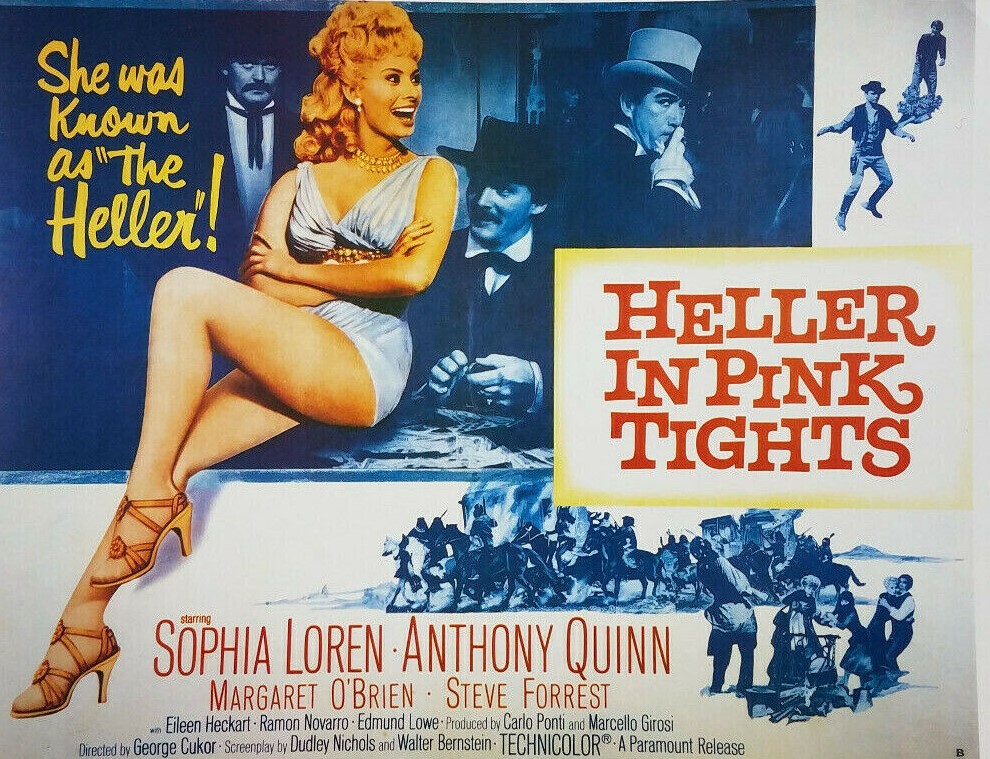
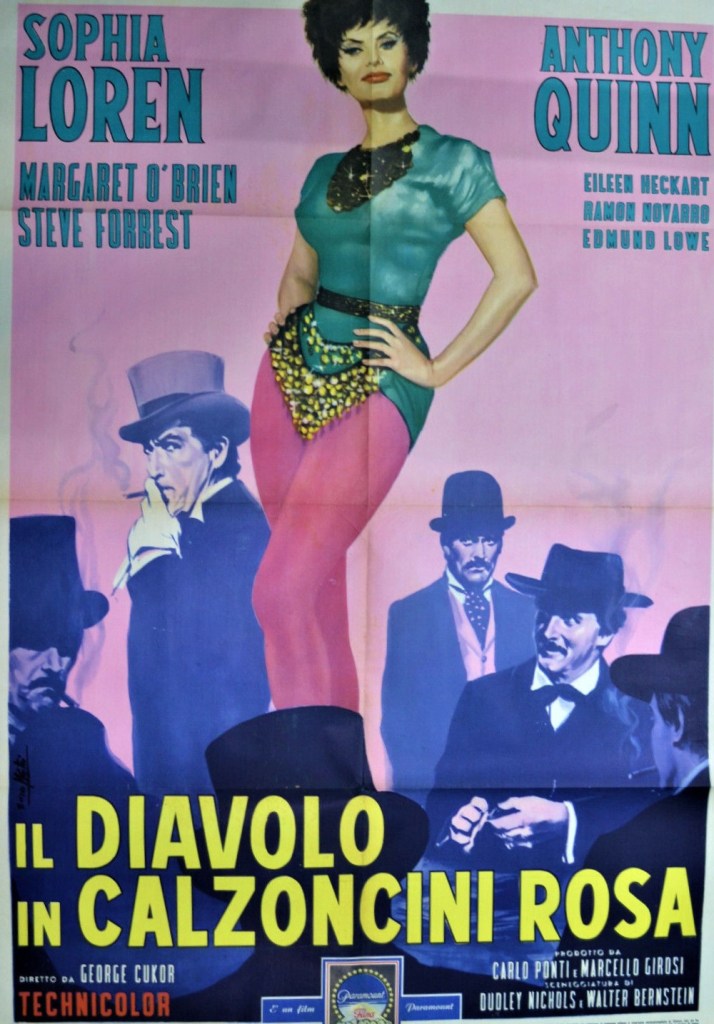
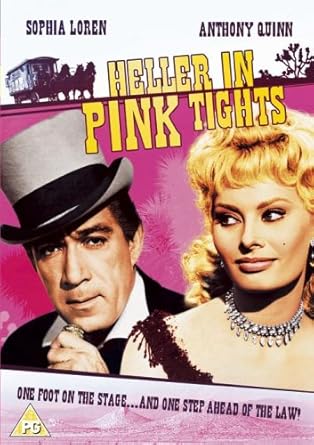
Heller in Pink Tights (1960) ****

Taken on its own merits, George Cukor’s western is a highly enjoyable romp. Hardly your first choice for the genre, Cukor ignores the tenets laid down by John Ford and Howard Hawks and the film is all the better for it. Although there are stagecoach chases, gunfighters and Native Americans, don’t expect upstanding citizens rescuing good folk. Instead of stunning vistas Cukor chooses to spend his budget on lavish costumes and sets.

You can see he knows how to use a colour palette, and there is red or a tinge of it in every scene (to the extent of rather a lot of red-haired folk), and although this might not be your bag – and you may not even notice it – it is what makes a Cukor production so lush. The film might start with comedic overtones but by the end you realise it is serious after all.

Angela (Sophia Loren) is the coquettish leading lady and Tom (Anthony Quinn) the actor-manager of a theatrical company managing to stay one step ahead of its creditors, in the main thanks her propensity for spending money she doesn’t have. Of course, once gunfighter Clint (Steve Forrest) wins Loren in a poker game, things go askew. 

Anthony Quinn (Guns for San Sebastian, 1968) had never convinced me as a romantic lead, but here there is genuine charisma between the two stars. Sophia Loren (Five Miles to Midnight, 1962) is at her most alluring, in dazzling outfits and occasionally in costumes as skin-tight as censors would allow in those days, but with a tendency to use beauty as a means to an end, with the conviction that a smile (or occasionally more) will see her out of any scrape. There is no doubt she is totally beguiling. But that is not enough for Quinn, as she is inclined to include him in her list of dupes.

While primarily a love story and a tale of theatrical woes set against the backdrop of a western, when it comes to dealing with the tropes of the genre Cukor blows it out of the water.  We open with a stagecoach chase but our heroes are only racing away from debt until they reach the safety of a state line. We have a gunfighter, but instead of a shoot-out being built up, minutes ticking by as tension rises, Cukor’s gunman just shoots people in sudden matter-of-fact fashion.

Best of all, George Cukor (Justine, 1969) extracts tremendous comedy from the overbearing actors, each convinced of their own genius, and the petty jealousies and intrigue that are endemic in such a troupe. An everyday story of show-folk contains as much incipient drama as the more angst-ridden A Star Is Born (1954), his previous venture into this arena.

From the guy who gave us The Philadelphia Story (1940) with all its sophisticated comedy, it’s quite astonishing that Cukor extracts so much from a picture where the laughs, mostly from throwaway lines, are derived from less substantial material. Quinn (his third film in a row with Cukor) has never been better, no Oscar-bait this time round, just a genuine guy, pride always to the forefront, king of his domain inside his tiny theatrical kingdom, out of his depth in the big wide world, and unable to contain the “heller.”

I won’t spoil it for you but there are two wonderful character-driven twists that set the world to rights.

There is a tremendous supporting cast with former silent film star Ramon Novarro (Ben-Hur: A Tale of the Christ, 1925) as a duplicitous businessman, former child star Margaret O’Brien, another star from a previous era in Edmund Lowe (Cukor’s Dinner at Eight, 1933), and Eileen Eckhart. Dudley Nichols (Stagecoach, 1939) and Walter Bernstein, who wrote a previous Loren romance That Kind of Women (1959) and had a hand in The Magnificent Seven (1960), do an excellent job of adapting the Louis L’Amour source novel Heller with a Gun, especially considering that contained an entirely different story.

Without a doubt it’s Cukor’s picture but Loren and Quinn combine to make it such a believable delight.

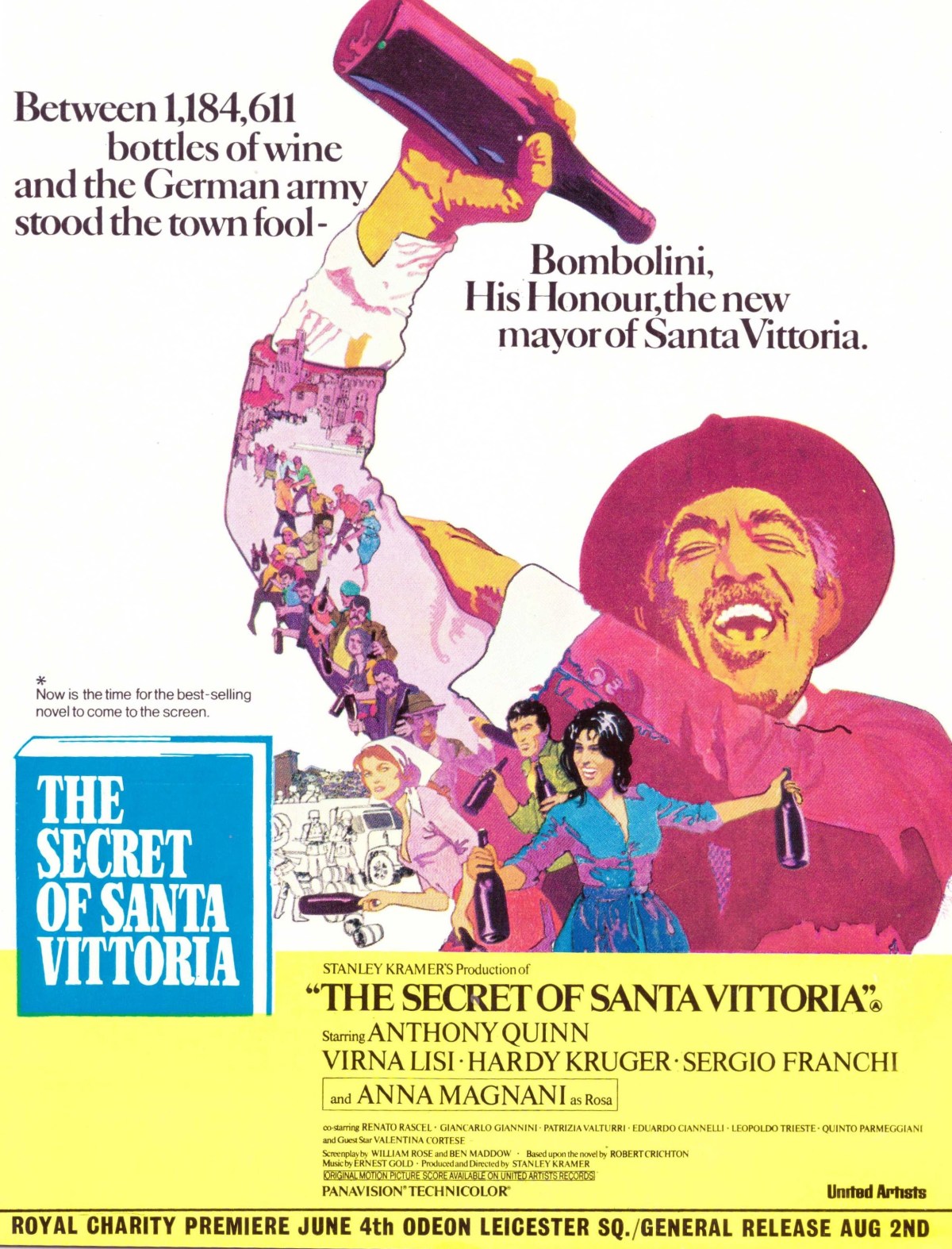
The Secret of Santa Vittoria (1969) ***

Sounds like a treasure hunt picture, contemporary buccaneers or thieves in search of missing gold. But there’s nothing in the way of maps waiting to be discovered, no clues, no character unhinged by its pursuit. In fact, the valuable commodity here is wine, over a million bottles of it. Everyone in the hilltop town of Santa Vittoria is in on the secret. Because they hid it from prying Germans who have taken over the place after the death of Italian dictator Mussolini. And that element of the story, once we finally embark on it, doesn’t begin until halfway through.

Meanwhile, we are treated to the browbeaten drunk Bombolini (Anthony Quinn), too dumb to realize that being elected mayor – the previous incumbent kicked out for being a Fascist – is a poisoned chalice. However, taking a few tips from Machiavelli he works out that his survival depends on bringing together a council of more sensible heads. His new position cuts no ice with disgruntled wife Rosa (Anna Magnani) whose weapons of choice, vicious tongue apart, include copper pans and an elongated rolling pin.

But if you were desperate to know how to bury treasure, here’s your chance. A good quarter of an hour is spent on that element. I’m not entirely sure what fascinated director Stanley Kramer (Guess Who’s Coming to Dinner, 1967) about this. Because, clever though the scheme is of vanishing into thin air more than a million bottles, it takes little more than lining up the populace in rows close enough together so they can pass a bottle onto their neighbor, until the total amount – minus 300,000 bottles left behind to fool the Germans – is hidden in tunnels in the caves below the village.

Assuming of course the Germans fail to prod the stones concealing the tunnels and discover the cement is too fresh to be ancient. But Bombolini is in luck because German leader Captain von Prum is a “good German,” inclined to take things easy, coming down hard of any of his soldiers who pester female villagers, allowing the mayor to negotiate to retain some of the supply being handed over to the invaders, half his mind on the local Countess Caterina (Virna Lisi) with whom he fancies his chances, but in gentlemanly fashion of course, aiming to seduce her over dinner rather than resorting to force.

That matter is complicates because the widowed countess already has a lover, a wounded soldier Tufa (Sergio Franchi) whom she nursed. It’s only when the captain realizes that he has been duped by the apparent buffoon of a mayor and by the countess that things start ugly and soon you can hear cries of the torture echoing out over the piazza.

The odd mixture of comedy and reality fails to gel. Anna Magnani (The Fugitive Kind, 1960) doesn’t look as if she’s acting in showing her distaste of Anthony Quinn (Lost Command, 1966) possibly because he is over-acting, cowing and whimpering and using his hands to express every single word he speaks. But it looks authentic enough. Either Kramer has rounded up every aged extra left over from Once Upon a Time in the West (1969) or he has recruited scores of ordinary peasants to play the villagers.

Kramer’s usual earnestness has disappeared, and although his first movie was a comedy, and Guess Who’s Coming to Dinner, his previous picture, played on the comedic elements of the situation, his feeling for comedy is rusty at best, non-existent at worst. It’s hard to feel any particular sympathy, as would be the point, in the villagers outwitting the Germans and in the fact that they have changed from ostensible World War Two conquerors to the conquered once their erstwhile allies turned on them.  

You might consider this a feminist twist on The Taming of the Shrew, Rosa not only being a shrew who would never be tamed, not even by Germans, but actually the family breadwinner. While, until his election, her husband is a nonentity. And it might be viewed as a choice role for Anthony Quinn, a dramatic shift away from the heroic roles with which he was more often associated. Anna Magnani mostly looks as if wondering why she agreed to participate.

The best acting comes from Virna Lisi (How to Murder Your Wife, 1965), a widow realistic about the lack of true love in what sounds like an arranged marriage, and faced with having to keep the amorous captain sweet, and possibly doing whatever that takes in order to protect the townspeople. Hardy Kruger (The Red Tent, 1969) has also abandoned his normal arrogance, is uncomfortable with being a despot, wanting to maintain friendly relations with the villagers, and seeking solace in gentlemanly fashion from the countess. He has the best scenes, the look of superiority as he outwits, he thinks, Bombolini, and the look on horror on his face as he discovers the countess’s lover.

Based on the bestseller by Robert Crichton with a screenplay by William Rose (Guess Who’s Coming to Dinner) and Ben Maddow (The Way West, 1967)  it’s the kind of movie that raises a lot of questions without bothering to answer any of them.  

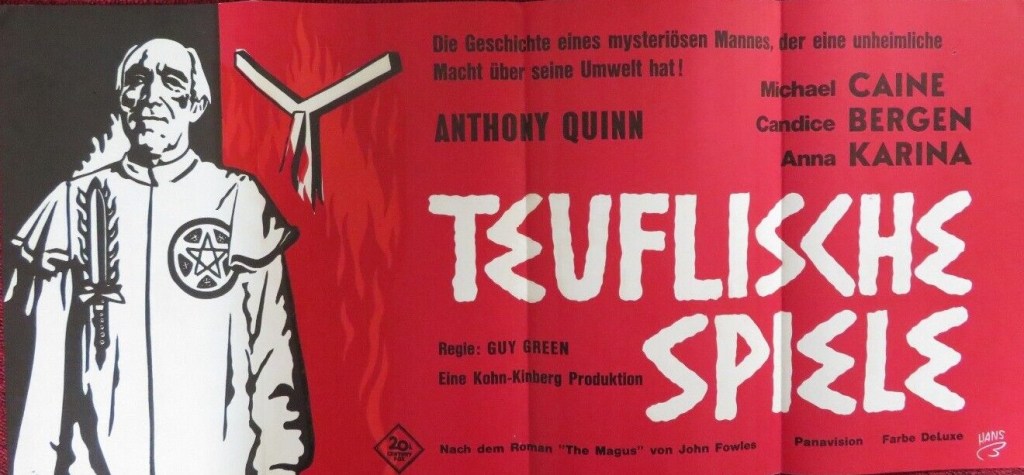
The Magus (1968) ***

Mind-games and unreliable narrators give this considerable contemporary appeal. Throw in Anthony Quinn back in Zorba the Greek (1964) territory and Michael Caine as a lothario in the Alfie (1965) mold plus Candice Bergen (Soldier Blue, 1970) in preppy mode and you have nothing short of ideal casting.

Nicholas (Michael Caine), escaping a failed romance with Anne (Anna Karina) by teaching English at the Lord Byron School on a Greek island, becomes entangled with millionaire Conchis (Anthony Quinn). The action primarily takes place on Conchis’s fabulous villa stuffed full of art treasures.  Conchis initially presents himself as a psychic who can summon up the past, namely in the shape of Lily (Candice Bergen) who talks and dresses like the young girl Conchis previously loved.

But every time Nicholas rumbles a ruse he is presented with a different version of Conchis’s self. These include a psychiatrist, conjurerer-up of the mythic past and Second World War  collaborator. All of these identities carry sufficient personal truth for Nicholas to doubt his doubts.

Is he the victim of some elaborate game, one which caused the mysterious death of his predecessor? Is he smart enough to expose the millionaire as a dangerous fantasist? Is Lily genuinely falling in love with him and will this be yet another romance which makes him feel trapped? Is he actually put on trial in front of the entire village or is that all a dream? Is Conchis intent on stripping him of his core identity? And if so, why?

It should have been a cracking film but somehow misses the target. In theory, this is because Michael Caine is miscast. Caine is usually in charge and here is anything but. But actually, flipping over an actor’s screen persona, especially this cocky one, works. You might keep on wishing the real Michael Caine would stand up, and the fact that he doesn’t gives the film its strength.

Anthony Quinn initially overdoes the flamboyance to the point of being hammy – what magician is not – but you can see the point of that when he turns into the sober mayor forced to deal with invading Germans during World War Two and faced with making life-or-death decisions. The general consensus is Candice Bergen is the weak link, but I’d challenge that too since she is playing a role, that of an easily-duped actress.

The main problem is the picture is loaded down with flashbacks. And all to do with the various reinventions of Conchis’s life. In keeping with the film’s style you are never sure how much of this is true. Caine’s character has little to do except ask questions. (A modern film would have him chasing after physical clues to uncover a riddle.) So it becomes very stagey, with Conchis like a frustrated teacher with an aberrant pupil.

Of all the misleading ads! This lost a fortune for Fox.

John Fowles adapted his 300,000-word cult novel, removing the bulk of the philosophizing, but not realizing that what works in a book, especially in the hands of a gifted narrator, is not so easily translated onto the screen. For the adaptation of his previous bestseller The Collector (1965), director William Wyler brought in screenwriters to make the book work as a film.

Either screenwriters balked at the problems of dealing with a masterpiece or Fowles insisted on writing the screen version or director Guy Green (Pretty Polly/A Matter of Innocence, 1967) believed him the best person to reconstitute his work. Quinn, rather than Caine, has the movie’s pivotal sequence, forced into an action on a par with Sophie’s Choice (1982) and it might have helped if that element had been brought in sooner.

As it is, the movie is no more than interesting when it should have been fascinating.

Behind the Scenes: “Barabbas” (1961)

It could as easily have been Cecil B. DeMille (The Ten Commandments, 1956) in the director’s chair. And Yul Brynner (The Magnificent Seven, 1960) and Jeanne Moreau (Jules and Jim, 1962) as the stars.

The Barabbas tale had already been plundered before Swedish novelist Par Lagerkvist published his relatively short bestseller – only 144 pages – in 1950. An earlier novel of the same name by Emery Bekessy hit American bookstalls at the height of the mid-1940s religious cycle kicked off by Going My Way (1944) and The Bells of St Mary’s (1945). DeMille – whose portfolio included Biblical epics The Ten Commandments (1923), King of Kings (1927) and The Sign of the Cross (1932) – was in competition with British producer Alexander Korda to buy the rights.

While that production never entered production, just to confuse matters a British film, Now Barabbas, based on a successful West End play and with no Biblical element, was released in 1949.

Swedish director Alf Sjoberg (Miss Julie, 1951), twice winner of the Grand Prix at Cannes,  turned the Lagerkvist book into a black-and-white film in 1953, the first Swedish picture to be dubbed into English.

A bigger-budgeted version, piggybacking on the success of Ben-Hur (1959), was the brainchild of Italian producer Dino De Laurentiis who had pacted with Hollywood studio Columbia on a four-picture slate worth $17 million, the bulk of which, $10 million, was to be spent on Barabbas “with a cast of thousands headed by some of the biggest names in motion pictures.”

“Hollywood on the Tiber” was producing movies at a record rate – topping 200 a year – and De Laurentiis, who had shot to fame with Bitter Rice (1949) starring future wife Silvana Mangano and Fellini’s La Strada (1954) was intent on gaining a foothold in America beyond the arthouse market. Producing King Vidor’s War and Peace (1956) for Paramount had not done the trick and the Columbia slate was a last-ditch attempt to break into the Hollywood game.

Hollywood had originally invested in Europe to take advantage of tax breaks or to access monies frozen by countries after the Second World War, but by the 1960s the continent had become more attractive as a cheaper production alternative. While Britain had been a substantial recipient of Hollywood largesse, Italy was fast catching up as the chosen locale for pictures as varied as Cleopatra (1963), The Pigeon That Took Rome (1962) and Jason and the Argonauts (1963).

Director Richard Fleischer’s career was at a curious impasse. The son of world-famous animator Max Flesicher, creator of the Popeye cartoons, Richard had won critical acclaim for low-budget thriller The Narrow Margin (1951), followed up with a pair of stupendous action hits, 20,000 Leagues under the Sea (1954) and The Vikings (1958), both starring Kirk Douglas, and a daring examination of the world’s first “thrill killing” Compulsion (1959) with Orson Welles.

But he was at loggerheads with Twentieth Century Fox, to whom he was contractually tied, having turned down North to Alaska (1960) with John Wayne. As a result, he was relegated to lesser projects, Crack in the Mirror (1960), again with Orson, and The Big Gamble (1961), a picture with virtually no stars unless you count the questionable marquee value of Juliette Greco and Irishman Stephen Boyd trying to capitalize on his success in Ben-Hur (1959).

“Holdover” also meant it was not playing as a roadshow.
In the roadshow exhibition situation, a cinema would be required to play a movie for an agreed number of weeks, generally a minimum of eight or thirteen. Non-roadshow films relied on box office performance for the length of their run, the engagement extended week-by-week.

He had been on Dino De Laurentiis’ radar before, approached to helm War and Peace, circumstances dictating otherwise, and a $10 million project, a 70mm roadshow, presented an ideal opportunity to resuscitate his moribund career. As Fleischer put it, “Even if I had loved Darryl (F. Zanuck, the legendary Fox producer of The Big Gamble), I would gladly have jilted him for this assignment.”

Despite the promise of the budget, the reality was off-putting. The De Laurentiis studio was housed in a “dreary industrial slum” and consisted of a two-storey wooden building housing the offices and “three decaying stages.” However, there was little downbeat about De Laurentiis, “an impeccably tailored bundle of raw energy,” according to Fleischer, “the impact of meeting him for the first time is something akin to sticking your finger into an electric light socket.”

The Italian producer possessed a quality that was appreciated in Hollywood, especially among old-school mavens. He was a showman. He could drum up publicity at the drop of a hat. His first publicity coup was hiring French star Jeanne Moreau, at the time considered one of the few foreign actresses who need not rely on buxom figure, as the female lead. Her arrival in Rome for pre-production prerequisites such as costume and make-up testing induced a flurry of front pages. A mob of about 30 reporters almost prevented any testing. “Even though the tests were purely mechanical, she became the character in the script the moment the camera turned,” observed Fleischer.

Unfortunately, De Laurentiis had no intention of hiring her, not when he had wife Silvana Mangano at home. The press reaction to Moreau might have suggested he was backing the wrong horse, despite Mangano’s own marquee appeal, but he appeared delighted to have achieved a publicity coup, no matter that he had manipulated and duped a great actress and the director.

De Laurentiis pursued Yul Brynner for the titular role, a suggestion with which the director was in accord. This was the real thing, attempted recruitment not just a publicity gag. Until Charlton Heston muscled in with Ben-Hur, Brynner was the go-to actor for historical epics, The Ten Commandments (1956) making him an instant star, a position solidified with an Oscar for The King and I (1956) and commanding a $750,000 payday, on a par with john Wayne and William Holden.

Brynner was initially disinclined to play the role but after a day in discussion with Fleischer they shook hands on a deal only to have it torpedoed by De Laurentiis.

Scriptwriters Christopher Fry, famed English playwright but novice screenwriter, Nigel Balchin (The Man Who Never Was, 1956) and Diego Fabbri (The Corsican Brothers, 1961) were recruited with De Laurentiis reporting that they were “currently at work after having studied the material at length.” Later added to the roster was Italian Nobel prize-winning poet Salvatore Quasimodo. Not trusting the producer to stick to the text, Lagerkvist assigned his son as overseer, a tactic that singularly failed to work.

Still lacking a male lead, De Laurentiis announced the movie would start shooting on January 7, 1961, with French pair Jeanne Moreau and Simone Signoret (Room at the Top, 1958) in the top female roles, neither of whom were ultimately involved.

Despite two Oscars as Best Supporting Actor, Anthony Quinn (Guns for San Sebastian, 1968) had failed to reach the top echelons of Hollywood stardom, stuck in the rut of male lead to top-billed female or starring in lower-budgeted pictures. To rectify the situation, he had embarked on a project intended to provide a prestigious showcase for his acting skills. He had signed up to play opposite Laurence Olivier in the Broadway production of Jean Anouilh’s acclaimed play Becket.

He had to be prised away from the Broadway run by De Laurentiis who forked out $37,500 in compensation and guaranteed the actor time off halfway through the shoot to fulfil a commitment to Lawrence of Arabia (1962). In fact, Becket, while attracting good notices, was a Broadway flop, the production only going into the black as a result of the De Laurentiis pay-off.

The all-star cast never materialized. But there was prestige aplenty, three members of the cast Oscar winners, another trio nominees. Vittorio Gassman (Ghosts of Rome, 1961) was at best a rising star, marquee value restricted to Italy. Jack Palance (Shane, 1953), was better known in Italy than the U.S., having spent the previous five years in Italy and now attempting a Hollywood comeback as a director. He was signed to play the notorious gladiator intent on killing Barabbas in combat. Ernest Borgnine (The Vikings) was still clinging on to vestiges of stardom after unexpectedly winning the Best Actor Oscar for Marty (1955). His wife Katy Jurado (High Noon, 1952) remained a starlet. Despite a bout of Oscar nominations in the supporting actor category Arthur Kennedy (Elmer Gantry) and never-nominated Harry Andrews (Solomon and Sheba, 1959) were no more than character actors.

It would have been impossible to make Barabbas on the tiny studio De Laurentiis owned so, encouraged by tax breaks, he invested in hundreds of acres of cheap land to build a new state-of-the art studio. But when Fleischer first saw it, it was nothing but a barren wasteland. Even so it was in these empty fields that production designer Mario Chiari would construct the ancient world.

Over several hours, simply by pointing his finger in vague directions, the pair came up with over 100 buildings, and the sets for Jerusalem and the Praetorium. The movie already had its arena – the 2,000-year-old structure in Verona – which would double for the Rome Colosseum. The complicated gladiatorial spectacle was the first sequence to be shot, with a world-record 9,115 costumed extras, arriving on a fleet on 75 buses from nearby towns. The only obstacle to rolling the cameras: Anthony Quinn’s specially designed gladiator sandals had been left behind in Rome. A temporary pair were mocked up so the first shot could be completed before lunch.  

On the second day of shooting occurred a Hollywood fairy story. Looking for good characters to focus on in the crowd “one face truly stood out, that of an eighteen-year-old girl of stunning beauty.” The daughter of an officer at a U.S. military base in Vicenza, her name was Sharon Tate. Shortly afterwards, she moved in with Jack Palance, and not too long after that she was on the Hollywood glory trail prior to her premature death.

Another mishap threatened to spoil the scene where Quinn and Gassman, playing prisoners in the sulphur mine, were going to be chained together. The location was the top of Mount Etna in Sicily. On hand were 500 extras dressed as Roman slaves. It was a Sunday since that was the only day the roads would be clear enough to transport so many people and all the equipment up the two-hour drive from Catania up the twisty route.

The weather was terrible, the sky so black, the volcanic cinder ground a perfect match, with barely enough light to get an exposure. The only section of the scene unrehearsed was the riveting of the chains. And that required charcoal. But someone had forgotten the charcoal.  A race down the mountain to bring back the charcoal took till the afternoon. But just as the charcoal arrived there was a break in the clouds and a spot of perfect light. It lasted just long enough for the shot to be taken.

The solar eclipse was no special effect. It was actually taking place on February 15, 1961, and Fleischer had cameras in place to record the phenomenon, the only genuinely ethereal scene in a movie that was more concerned with realism. The burning of Rome was also filmed “in camera,” the sets consumed in one take in one night.

While there were other occasional production errors, Fleischer found the Italian crew as professional as he required. And as accommodating. One day he was informed the crew had to go on strike for one hour. But after consultation with the director, the crew was happy to strike during the lunch break.

Even with a schedule rearranged to include Quinn’s time away filming Lawrence of Arabia (1962), shooting went smoothly with no overages or budget-blowing.

The production faced other threats. The 1953 version, already conveniently dubbed, was being reissued. There was a television production called Give Us, Barabbas, and a new play was launched off-Broadway by Belgian playwright Michel de Ghelderode, all of which could have stolen the limelight.

The movie followed an unusual distribution pattern. Launched in Italy at the tail end of 1961 to big box office it was another six months before it made a mark in London. In June 1962 it was the opening presentation for a new cinema, the Odeon Haymarket in London’s West End, a 600-seat underground emporium set up to take advantage of the demand for hard-ticket roadshow venues. The premises had not operated as a cinema since 1939 when it had been known for a short period as the Gaumont. It was only the second cinema built in London since the Second World War, the other being the Columbia in Shaftesbury Ave which had opened in 1959. In separate-performance advance-booking format, and tickets priced at $1.05-$2.80, Barabbas would remain at the Odeon for over six months.

It didn’t reach the United States – at the DeMille in New York – until October and even then was beaten to the North American punch by the 2,318-seat Odeon Carlton in Toronto, the largest cinema to enter the roadshow arena. And although available as a 70mm roadshow, in most locations it was more likely to be presented in 35mm minus the separate performances that were the hallmark of the prestigious hard-ticket presentation.

Columbia created some enterprising marketing concepts for the U.S. launch, including a touring exhibit by six well-known painters who had all used the film as the basis of artworks. A 41-foot high float including a 10-foot high revolving figure of Barabbas had been seen by 1.2 million people when paraded through Los Angeles. A special 190-page “making of” book was published in hardback. Six months after launch, the film was promoted as a “Special Lenten Presentation” in local cinemas with prices increased by 25 cents.

Although a huge success in native Italy and generally well-received at the international box  office, Barabbas came up short in the U.S., rentals barely hitting $3 million, earning a lowly 35th place in the annual chart.

SOURCES: Richard Fleischer, Just Tell Me When To Cry, A Memoir (Carroll & Graf, 1993) p217-226; “Another Religious Picture May Be Barabbas Novel,” Variety, December 4, 1946, p4; “Now Barabbas Was A Robber,” Variety, June 1, 1949, p1; “First Swedish Picture Dubbed Into English,” Variety, June 23, 1954, p4; “Swedish Barabbas,” Variety, June 1, 1960, p4; “Lagerkvist, Nobel Winner, Assigns Son To Rome As Watchman on Barabbas,” Variety, December 14, 1960, p17; advert, Variety, January 4, 1961, p71; “Barabbas Budget over $10,000,000,” Variety, February 15, 1961, p3; “Dino De Laurentiis No 1 Indie Producer?,” Variety, February 15, 1961, p24;  “Figure $17,500 for Off-Broadway Barabbas,” Variety, February 15, 1961, p71; advert, Variety, April 26, 1961, p71; “Becket Got 37½G On Quinn’s Exit,” Variety, May 3, 1961, p83;  “Becket Folds As 40G Sleeper; Had Seemed Prestige-Only Flop,” Variety, May 31, 1961, p59; “Quinn Back To Work in Barabbas,” Variety, October 11, 1961, p17;  “No Time To Fiddle in Rome,” Variety, November 15, 1961, p1; “To Write Barabbas Dialog,” Box Office, November 27, 1961, pW6; “Canada Coin,” Variety, March 21, 1962, p40; “Barabbas Exhibits Start Key City Tour,” Box Office, March 26, 1962, pE8; “Barabbas London Event: New York Date Oct 10,” Box Office, June 11, 1962, p14; “Barabbas Premiere Set For Oct 4 in Toronto,” Box Office, July 23, 1962, pE8; “Hard Cover Book to Ballyhoo Barabbas,” Box Office, July 30, 1962, p10; “Palance Back, Try Directing,” Variety, October 17, 1963, p3; “Big Barabbas Float,” Box Office, January 4, 1963, pA1; advert, Variety, January 23, 1963, p27; “Barabbas at Eight,” Box Office, February 18, 1963, pK2;  “Lenten Angle for Barabbas Date,” Variety, March 13, 1963, p17; “Top Rental Features of 1963,” Variety, June 8, 1964, p37.

Barabbas (1961) ****

Brutally ironic ending adds a final twist to this religious epic that sheds a murky rather than heavenly light on the early days of Christianity. Barabbas (Anthony Quinn), in case you are unaware, is the criminal who, in a public vote, is spared crucifixion instead of Jesus Christ. Intent on returning to his lusty life, instead he finds himself drawn to the teachings of the Son of God despite his feverish attempts to deny it. Death might have been preferable to two decades spent imprisoned in the sulphur mines followed by a stint as gladiator only, finally refusing to deny his conversion, he ends up on a cross.

The fate of Barabbas in the Bible is undetermined, only meriting a few lines, but in the imagination of Swedish novelist Par Laverkvist he lived quite an extraordinary life, a criminal vagabond coming to believe in what he originally despised.  The religious element is almost an excuse to investigate life at the edge of a pauper’s existence, a world in which faith is possibly the only way to get through the day. It’s an episodic tale with Barabbas as a Job-like peasant on whom constant indignity and humiliation is heaped.

A witness at times to the most exalted elements of Christianity – the eclipse surrounding the crucifixion, the stone rolled away from the tomb – he also sees lover Rachel (Silvana Mangano), a Christian convert, stoned to death. It’s a miracle he survives imprisonment in the mines and that when, thanks to an earthquake, he escapes it’s almost bitter irony that he ends up in gladiator school, facing the demonically sadistic Torvald (Jack Palance). Even when pardoned, he is again arrested for, believing the end of the world is nigh as described in the Christian teachings, helping burn Rome to the ground. Arrest this time sends him back to where he started, heading for crucifixion, though this time willingly.

Anthony Quinn (Guns for San Sebastian, 1968) is excellent as the dumb, mostly mystified peasant, only occasionally rising to the occasion, mostly defeated, or captured, and failing to defend those he should protect. Not entirely cowardly, witness his battle in the arena, but self-serving, and in a sense cursed by events outside his control.

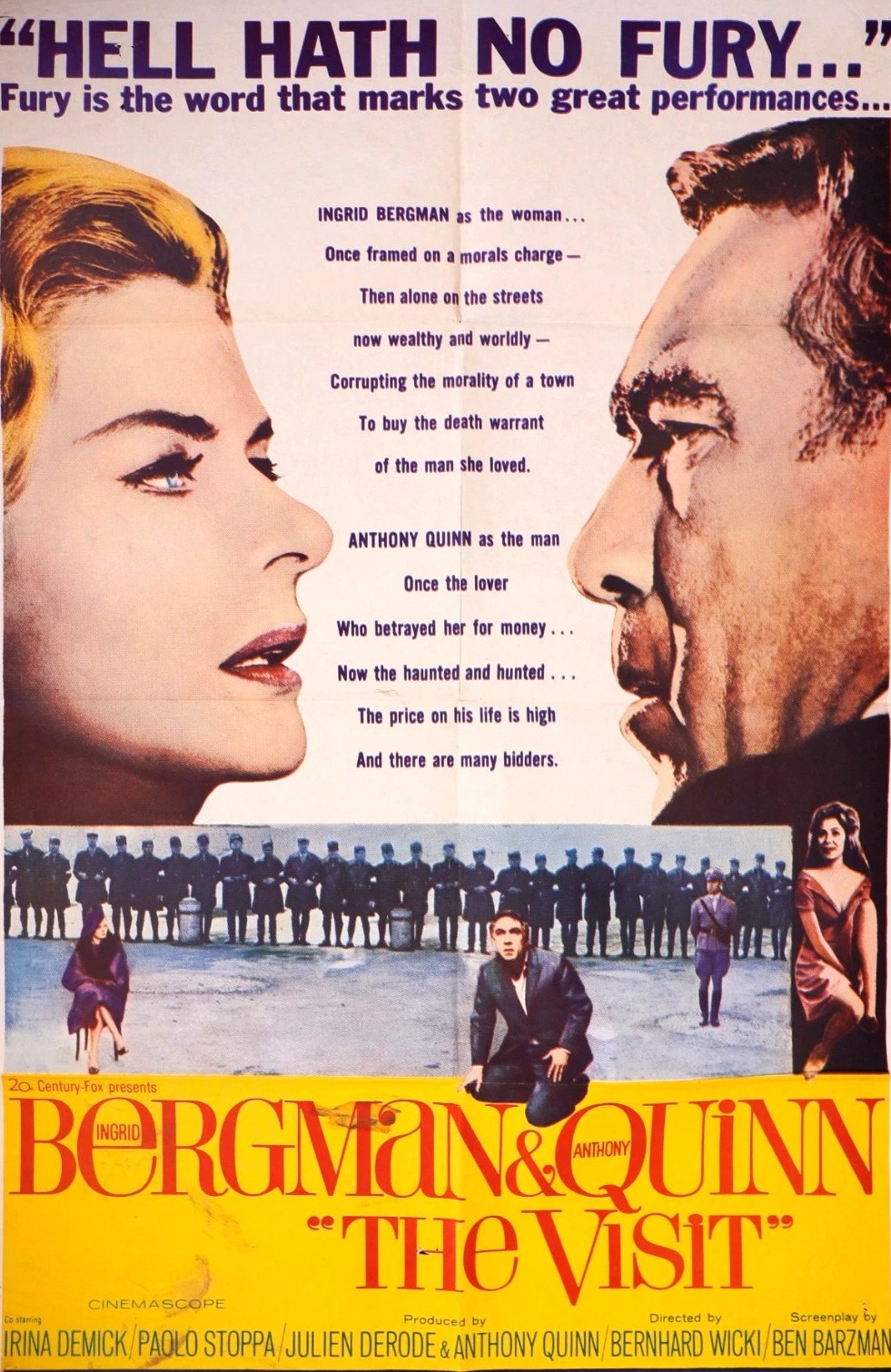
Others are only briefly in the spotlight, Silvana Mangano (Five Branded Women, 1960) good as the converted Christian accepting her fate, ditto Vittorio Gassman (Ghosts of Rome, 1961) as an enemy prisoner in the mines, and Jack Palance (Once a Thief, 1965) over-the-top as the kingpin gladiator. In cameo roles – not exactly the promised all-star cast – you can find Ernest Borgnine (Chuka, 1967), Arthur Kennedy (Claudelle Inglish, 1961), Katy Jurado (A Covenant with Death, 1967), Valentina Cortese (The Visit, 1964) and Harry Andrews  (The Charge of the Light Brigade, 1968).

Director Richard Fleischer (The Big Gamble, 1961) does a brilliant job of keeping reverence at bay, turning the potential awe of the eclipse into a moment of personal terror, ensuring that current persecution rather than potential eternal life remains foremost, focusing on the human not the ethereal. He presents Barabbas as constantly mystified at his escape, guilt-ridden that he has done nothing with his life, thwarted in virtually every attempt at redemption.

The big scenes are well-handled, the sulphur mines a pit of Hell, the arena far more realistic than Spartacus (1960), the burning of Rome that initially represents freedom turning into a trap. Filmed in Technirama 70mm, Fleischer makes the most of the widescreen and the historical detail.

In some respects this makes more sense if viewed alongside the director’s crime triptych of Compulsion (1959), The Boston Strangler (1968) and 10 Rillington Place (1970) which concentrate on outsiders coming to national attention through illicit activity.

Far from the usual stodgy religious offerings of the period, more in keeping with a Pasolini-like vision, with a keener eye on history than creed, it’s been rather overlooked and deserves reappraisal.

Christopher Fry (The Bible…in the Beginning, 1966) was credited with the screenplay from the book by the Nobel prize-winning novelist Par Laverkvist.

Discover WordPress

A daily selection of the best content published on WordPress, collected for you by humans who love to read.

The Atavist Magazine

by Brian Hannan

WordPress.com News

The latest news on WordPress.com and the WordPress community.