Something of a feminist icon with middle-aged single woman choosing her lovers. I should warn you that there’s a May-December trope, which was very common at this period, as older female stars, engaging on romance with younger males, catch up with the unchallenged notion that any ageing male star should be accorded a younger female partner regardless of the age difference.
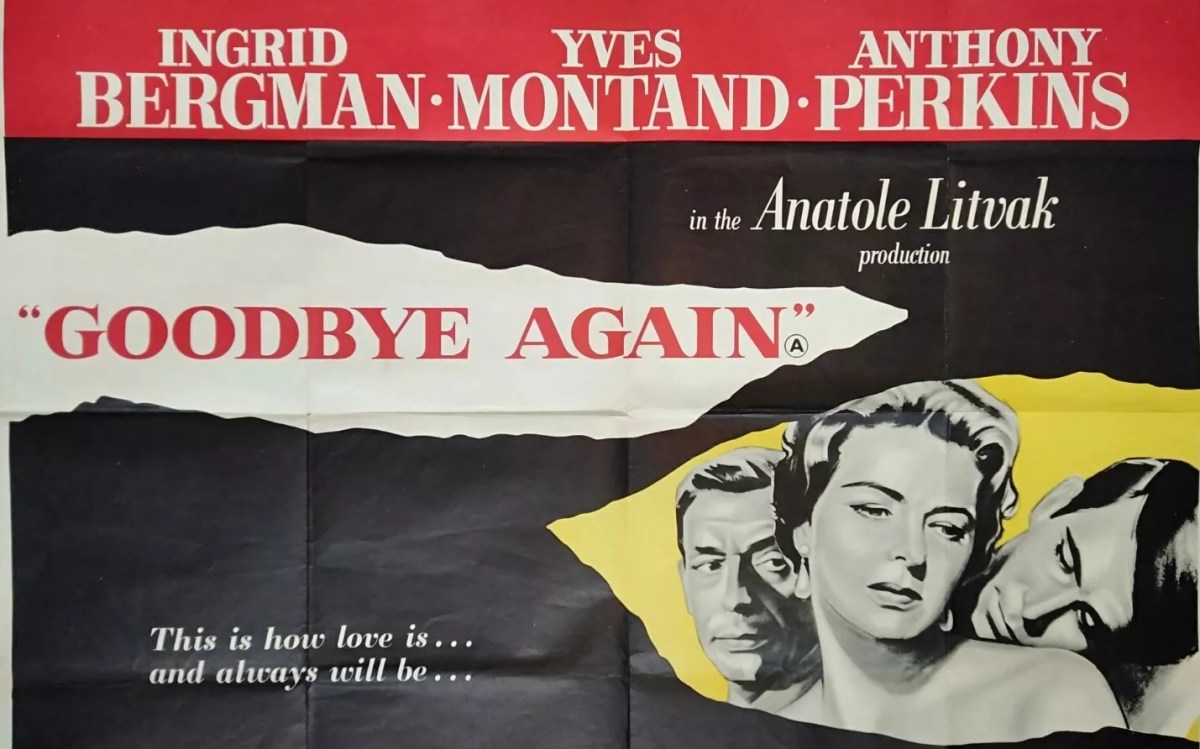
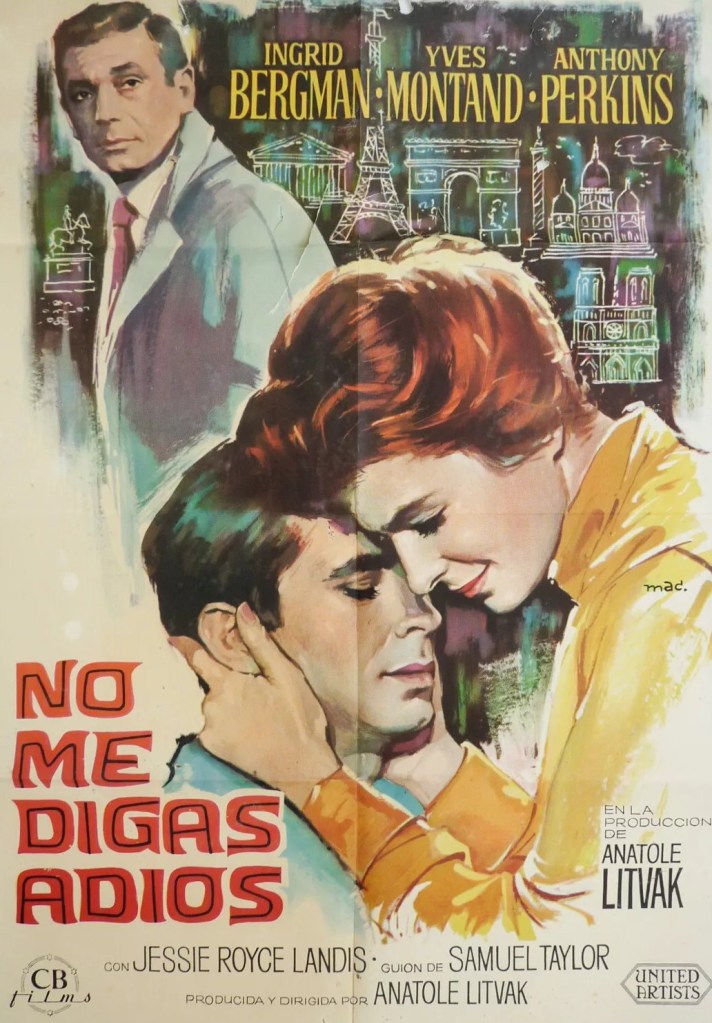
Paula (Ingrid Bergman), a lady of independent means, is tiring of philandering lover Roger (Yves Montand). After five years, he still can’t keep his hands off any young girl – known as “Maisies” – who come within reach. Paula is pursued by a younger man Philip (Anthony Perkins) and eventually succumbs to his ardent wooing. They differ on whether their relationship has much of a future, she the more pragmatic of the two, as, I would guess, are the audience.
While he’s refreshing and energetic, the spoiled rich boy exhibits childish tendencies. There’s a clash between the independent woman and the older macho misogynist male who expects his lover to be at his beck and call, even when his disappearances are the result of assignations with other lovers.
A middle-aged woman was as much on the hook to an unfaithful lover as a married woman. While she doesn’t want to be married, she wants to enjoy the same sense of trust that marriage might bring. However, she’s not destroyed, as a married woman of the period might have been, by her partner’s infidelity. And precisely because they are not bound by legal obligation, she is perfectly within her rights to choose another lover.
Still, there is an intense melancholy that she cannot make Roger settle down with just the one woman – her – and that if their affair is to continue it must be on his unacceptable terms. Yet she is terrified of being alone and except for the appearance of Philip and her independence there is the sense that she might subdue tragic instinct and settle for the crumbs from Roger’s table.
Glorified soap opera, no doubt, but it survives on the playing of Ingrid Bergman (The Visit, 1964) who shares with Deborah Kerr the ability to show conflict and sadness in her eyes. She brings so much depth to her character you are apt to forget you are watching a soap opera. That she remains attracted to Roger beyond the realms of logic compounds her tragedy.
Anthony Perkins (Pretty Poison, 1968) is very charming, ridding himself in the main of the jumpiness that appeared to fit his screen persona. While Perkins and Bergman make an unlikely screen couple, they are a believable one.
Yves Montand (Let’s Make Love, 1961) doesn’t have to drift much outside his screen persona of male fantasy figure, the one who has all the dames at his feet.
This is one of those very well-made Hollywood movies, full of gloss, trimmed with an edginess that soon takes center stage. Made in the 1940s it would be a classic weepie. The ending will take you by surprise.
Directed by Oscar-nominated Anatole Litvak (The Night of the Generals, 1967) in determined old-fashioned style from a screenplay by Samuel A. Taylor (Topaz, 1969) based on the Francoise Sagan bestseller.
Think of this as having been made before Star Wars (1977), Close Encounters of the Third Kind, Alien (1979), heck even Star Trek (1979), changed the sci fi world forever and imagine it’s a huge advance SFX-wise on the 1950s vanguard of sci fi pictures and you’ll probably come away very happy. A lot to admire in the matte work and some groundbreaking effects and actually the story – mad scientist lost in space – has a bit more grit than was normal for the genre.
But it’s laden down with talk and the action when it comes resembles nothing more than a first draft stab at the light sabers of Star Wars and clunky robotic figures that come across like prehistoric Stormtroopers. A bit more light-hearted comedy than in the other three mentioned, various quips at the expense of the robots.
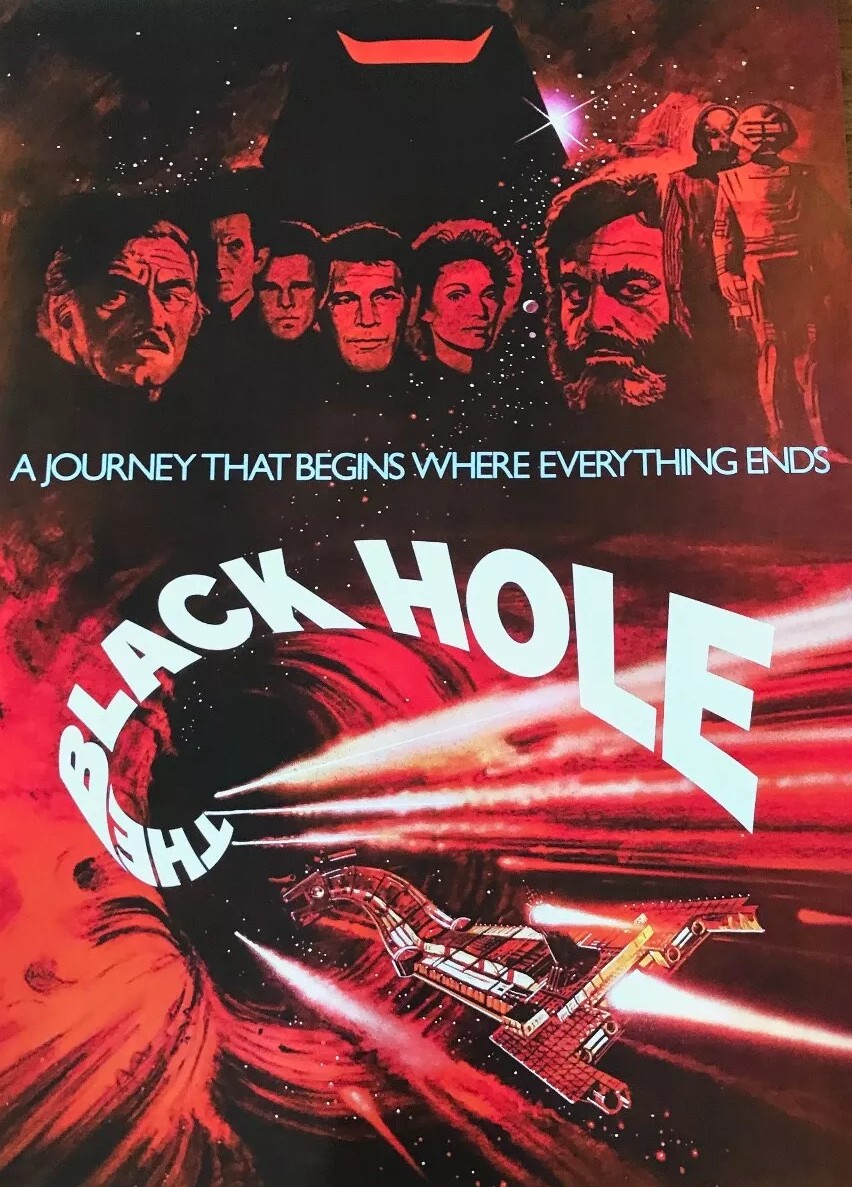
Scientists aboard space ship USS Palomino, a research vessel looking for life in space, is astonished to discover, hovering on the edge of a black hole, a missing spaceship USS Cygnus and are even more astonished to find out it’s not uninhabited, still on board is heavily-bearded Dr Hans Reinhardt (Maximilian Schell) and an army of robots that he has miraculously fashioned during his time lost in space.
This is a bit of an emotional blow to Dr Kate McCrae (Yvette Mimieux) whose father had been part of the crew of the Cygnus. Dr Reinhardt seems kosher enough except for his idea of, in the true spirit of space adventure, blasting off through the black hole. Although Reinhardt has been exceptionally clever in monitoring the invasion from the visitors and nullifying any threat with a blast from invisible laser, once they are on board that monitoring capability appears to vanish, allowing the visitors to search the ship where they find out that Reinhardt’s story doesn’t seem to add up.
Apart from Dr McCrae, the other personnel from the Palomino comprises Capt Dan Holland (Robert Forster), Dr Durant (Anthony Perkins) – the most inclined to follow Reinhardt into the greatest danger in the universe – quip merchant Lt Pizer (Joseph Bottoms) and dogsbody Harry (Ernest Borgnine). Plus there’s a cute robot Vincent (Roddy McDowall) constructed along even more rudimentary lines than R2-D2.
Vincent turns out to be a whiz at a basic version of a computer game, something between Space Invaders and Kong. But his main task is to wind up the crew with a head teacher’s supply of wisdom, spouted at the most inopportune moment. Except for the chest-bursting appearance of Alien, this might have garnered more kudos for the creepy mystery element – Reinhardt has lobotomized his crew members, turning them into these jerky robots, after they mutinied in revolt against his plan to dive into the black hole. Dr McCrae nearly joins the lobotomy brigade. And once she’s rescued it’s a firefight all the way. A stray meteor is on hand to add further jeopardy. And in the end the good guys are forced to plunge into the apparent abyss of the black hole, only to be guided by some angelic light and come out the other end unscathed, no worse for enduring the kind of phantasmagoric light show Stanley Kubrick put on in 2001: A Space Odyssey (1968).
By this point Maximilian Schell (Judgement at Nuremberg, 1961) was an accomplished bad guy, covering up inherent malignancy with charm and scientific gobbledegook. Joseph Bottoms (The Dove, 1974) is the pick of the incoming crew but that’s because he’s been dealt a stack of flippant lines. Anthony Perkins at least gets to waver from the straight-laced. But everyone else is a cipher, even Yvette Mimieux (Light in the Piazza, 1962) who might have been due more heavy-duty emotion.
This was the 1970s version of the all-star cast, all the actors at one point enjoying a spot in the Hollywood sun, but now all supporting players. Schell was variably billed in pictures like St Ives (1976), Cross of Iron (1977) and Julia (1977). Robert Forster (Medium Cool, 1969) hadn’t been in a movie in six years. Anthony Perkins was waiting for a Psycho reboot to reboot his career – only another four years to go. Yvette Mimieux had only made four previous movies during the 1970s including Jackson County Jail (1976). The most dependable of these dependables was Ernest Borgnine (The Adventurers, 1970), for whom this was the 24th movie of the decade, including such fare as Willard (1971), The Poseidon Adventure (1972) and Hustle (1975).
It didn’t prove a breakout picture for director Gary Nelson (Freaky Friday, 1976), Screenplay credits went to Jeb Rosebrook (Junior Bonner, 1972) and female television veteran Gerry Day.
Shouldn’t work at all not with star Roger Moore gussied up like a maiden aunt, fussing over needlepoint and cats, dolled up in tweeds and sporting an unkempt beard and a ginger wig. Our only clue in the early stages that he’s anything approaching a tough guy is that he knocks back whisky like soda pop.
And bear in mind this was a couple of years before the Brits could blithely call in the SAS (Who Dares Wins, 1982) for a ticklish rescue op and more than a decade before it became the norm to rely on a handily-available one-man band of the Die Hard persuasion and even longer before you had to worry about upsetting the pet or elderly neighbor of your local retired assassin.
When the movie flopped in the U.K. it was re-branded as some kind of James Bond number with scantily-clad women.
That it does work is very much down to Moore as the opposite of the standard Hollywood hero, avoiding rather than provoking trouble for strategic reasons, and realizing that, even with the deadliest of deadlines, time could be on his side and be used to un-nerve his opponent. After the film flopped spectacularly, Moore claimed he was miscast, but, in fact, despite the box office failure, the opposite is true. Without him brilliantly treading a very fine line this would have easily teetered into spoof.
A bunch of gangsters – not terrorists, plain cash the motive not some obscure cause – led by Kramer (Anthony Perkins) take over an oil platform supply ship, force Capt Olafson (Jack Watson) and crew, including, unusually for the time a female chef Sanna (Lea Brodie), to park under the oil platform while a couple of the gang plant explosives – to be set off as a warning – under the smaller drilling rig located some distance away, threatening to blow the whole operation sky-high if the British government doesn’t meet a ransom demand of $25 million.
As it happens the mysterious section of government that sometimes even Prime Ministers don’t know exists (as with beekeeping within the C.I.A.) has already recognized such a potential issue and hired ffolkes (Roger Moore) and his self-styled team of “fusiliers” to come up with a solution. Once the female Prime Minister (Faith Brook) – Margaret Thatcher was already in power at this point – is apprised of the cost in loss of revenue and human lives, she gives the go-ahead.
Ffolkes is despatched by helicopter with Admiral Brinsden (James Mason) and a high-ranking lackey. The supply ship crew, meantime, led by Sanna, have attempted to poison the invaders but that’s thwarted by the ruthless Kramer who by now has been chucking any dissenters over the side.
Kramer’s a clever guy. His ploy is smart. Theoretically, the drilling rig is financially worth a lot more than the platform, but that loss would account for a fraction of the lives of those on board the platform, and measured in public relations terms by any government deemed the smaller catastrophe. The platform will only be destroyed if the government is foolish enough not to meet his second deadline – if they fail to hit the first it’s just the rig that ends up in Davy Jones’ Locker.
But ffolkes is as cunning and plans a fake destruction of the rig to remove that ace in Kramer’s pack. The resulting explosion is so convincing, especially since it takes place at night, that the stakes are raised in ffolkes favor. But that’s only until Kramer smells a rat and refuses to allow ffolkes on the supply boat, ensuring the cat-lover has to resort to the more dangerous and potentially deadline-breaching Plan B. Nor, despite early action pointing to ffolkes’ efficiency, is he invulnerable in the tough-guy department, needing rescued twice, once by Sanna, hiding in a lifeboat after her failed poisoning mission.
And it does rely on the occasionally dense Admiral learning a simple trick with a cigarette packet.
This probably flopped because audiences expected some version of James Bond (it appeared within Moore’s stint as 007 in the two-year gap between Moonraker and For Your Eyes Only) or at least the cigar-chomping mercenary in The Wild Geese (1978). If Moore had carried out the required action in tweeds or naval uniform it might have been more easily accepted than dressed in a bright red frogman’s outfit (choice of that color a flaw in an op intended as subterfuge).
The irrepressible sexist character he represented might be more of a challenge to a contemporary audience but it’s delivered without malice and, theoretically at least, his aversion to women (and no overt hint of homosexuality I might add, though you could make your own mind up on that score) is explained. And Sarah (Jennifer (Hilary) , the oil platform skipper’s secretary, is his match, though that’s mostly with dry asides and rolling eyes.
There’s a bit of a sexist joke – although somewhat of a cliché – when our man discovers one of the crew is a woman and not a man. But that’s far better than the out-and-out misogyny of one of the gangsters whose reaction to cornering Sanna is attempted rape.
So, not the all-action yarn you – and audiences back in the day – might have expected, but, still pretty good fun. Director Andrew v. McLaglen melds elements of his The Wild Geese, and Shenandoah (1965), Moore’s performance reminiscent of the slow-burn of the James Stewart character. Screenplay by Jack Davies (Gambit, 1966) based on his bestseller.
Scarcely a lifted eyebrow in sight. Great fun – you couldn’t get more retro – and certainly had me chuckling – and free on YouTube.
Dvorak would be turning in his grave at the audacity of using his New World Symphony (Ridley Scott used it with more subtlety for the Hovis advert a couple of years later) as the score for a Charles Bronson picture. But you could argue this really isn’t a Charles Bronson movie. He’s not the tough guy. He doesn’t come out all guns blazing. He doesn’t slap people around.
This is probably the biggest reversal of screen persona in Bronson’s career (if you exclude The Sandpiper, 1965, where he plays an artist, and you could probably chalk it off anyway because he wasn’t a star at that point). This is so far from the Bronson you guess it must be a cruel hoax.
Here, Bronson is the dupe, the patsy, the stooge.
Come again?
He’s not even dignified with a name, just “The Stranger.” In fact, this could be a remake of Rider on the Rain (1970) with Bronson playing the bad guy not the mysterious cop.
The Stranger, found standing in the road and no idea how he got there, ends up the patient of neurosurgeon and psychoanalyst Laurence (Anthony Perkins). The Stranger is suffering from amnesia so being the good guy he is, and always interested in another scalp for his casebook, Laurence takes him home – in Folkestone on the English south coast, next to Dover – and helps him begin the process of unravelling his identity.
Laurence is a bit cross, it has to be said, because he’s discovered his wife Frances (Jill Ireland) is having an affair with a French journalist Paul Damien. Laurence brings in his brother-in-law to break her alibi of always staying with him.
From a suitcase found on the nearby beach, whose clothes fit The Stranger, it’s conceivable this might be the very same Paul. But he could as easily be an escaped madman. Or he could be the chap who’s raped and murdered a blonde on the beach.
The Stranger, mightily confused, begins to suspect, especially when he finds a photo of a naked Jill in his pocket, he might indeed be Paul. And to even things up, he has reason to be jealous. If he is Frances’s lover, it could very well be Paul Damien to blame.
Naturally, Laurence has arranged for there to be gun handy. And gradually he twists the facts and works inventively to convince The Stranger that he should be very hot and bothered should, as appears likely, at any moment Frances and Paul walk through the door, allowing Laurence to take revenge and get off scot-free.
Whether The Stranger is ill or not, he is clearly easily led and pretty much accepts the situation Laurence presents. Any time he queries anything, Laurence has a ready answer.
So what you have really is two parallel tales of cat-and-mouse. On the one hand you have Laurence snaring The Stranger in a spider’s web of possibility and drawing a tighter noose around his wife and her lover (whoever that may be). But you also have, in his debut, clever-dick Hungarian director Nicolas Gessner (The Little Girl Who Lived Down the Lane, 1976) playing with audience expectation. At any moment, in the first parallel tale, you expect The Stranger will come to his senses, memory recovered, and putting an end to the nasty plan. Equally, at any moment, you expect the real Charles Bronson to stand up, take control and blast everyone to hell.
But neither of these possibilities occurs. The Stranger looks lost for the most part, diminished, outwitted, twisted around like an impotent puppet. Rather than concealing the difference in height between the principals ( that a big star is never smaller than anyone else seems set in the Hollywood Bible of Audience Deception), Bronson always appears to be cowering in front of Perkins.
Not falling back on his screen persona, in fact staying as far away from it as is possible (beyond showing off his torso from time to time to placate his female fans), Bronson delivers a more than believable performance as the little boy lost. This may not be an Oscar-winning elements performance, but in the Bronson portfolio this may well be his finest.
Sure, there a couple of implausible moments, but that’s par for the course in this kind of thriller.
And the coup de grace is that when, finally, Bronson does break loose of his shackles, it’s to act in a way no fan would like to see, when he commits a heinous act.
Bronson was far from the big Hollywood star at this point. While French audiences had certainly taken to him, that wasn’t reciprocated much elsewhere and despite being tossed into films like You Can’t Win ‘Em All (1970) opposite Tony Curtis and an international cast in eastern-western Red Sun (1971) he was still some way short of the top of the Hollywood tree. It would take another year before stardom was validated by the double whammy of The Valachi Papers (1972) and The Mechanic (1972) and another couple of years before Death Wish crowned him a superstar.
So it was an incredibly bold move to make such a shift away from creating a tough-guy screen persona. More so, to pull off such diffidence and weakness.
Interestingly, this isn’t the Anthony Perkins of Psycho (1960) either. He’s not the tic-ridden jumpy quavery-voiced individual that had appeared to be his screen persona.
Very much worth a look. Unless of course you don’t want to disturb your image of Bronson.
Even though critically reviled at the time – “up to his clavicle in whimsicality” (Variety) / “fairground sideshow” (Films and Filming) – Hitchcock blasted wide open the doors to what would be deemed acceptable in modern American cinema. Made on a low budget in black-and-white following the sumptuous color of North by Northwest, it seemed a perverse choice. No studio wanted it. Hitchcock had to fund it himself, Paramount merely the distributor.
On paper, and based on a real-life case, it was certainly an unappealing prospect, leading actress murdered halfway through by a maniac with a predilection for dressing up as his mother. Using the crew from his television series, Hitchcock made it quickly for just over $800,000, a quarter of the cost of North by Northwest. An initial stab at the script from James Cavanaugh was discarded and working with Joseph Stefano (Black Orchid, 1959) the director shifted the focus of the Robert Bloch novel.
Instead of a fat, middle-aged, alcoholic, Norman Bates would become young and attractive like the character from French thriller Les Diaboliques (1959). The story itself changed from “Norman and the role Marion plays in his life…(to) the redemptive but ultimately tragic role Norman plays in her life.” Although Hitchcock openly claimed he detested filming, having already worked out the entire shoot in his head, this was never entirely true. Some ideas just did not work. In Psycho, for example, the director had planned a helicopter shot tracking into Marion and Sam’s hotel room but “high winds kept jiggling the camera” and it was changed to three separate shots.
Also, by using two cameras, he allowed the opportunity to choose a different shot than originally imagined and, in a change from the shooting script, the post-shower focus changed from Sam to Lila, making her the focus of the film’s final section where she confronts the killer.
Nor is Marion Crane (Janet Leigh) a typical Hitchcock villain. She is not cut out for the work. Alone in his repertoire, she regrets her action, tortured by, not so much her conscience, as the thought of getting caught. Having stolen $40,000 she is so jittery she turns a harmless highway cop suspicious.
Once more, Hitchcock has us rooting for the bad guy or, in this case, the bad girl. In Vertigo (1958), the drive is silent, but here the silence is punctuated by imagining what people are saying about her, knowing pursuit is inevitable. By the time she reaches the Bates Motel, she is repentant, planning to return and face the music, “I stepped in a private trap back there and I’d like to go back and pull myself out of it.”
Unfortunately, Norman Bates (Anthony Perkins) has other plans. In Rear Window (1954) the peeping tom is a good guy, here he’s anything but. Although Bates is presented as fighting his demons, he always gives in, while Crane never hears a voice urging her on, telling her she will get away with it. Crane has a working conscience, Bates a defunct one.
Bernard Herrmann’s strings-only score behind the jarring opening credits is only the first in a series of taboos broken. In the opening scene beefcake Loomis (John Gavin) is shirtless, nothing unusual there for a male star, but to show an actress three times in her underwear and more flesh glimpsed in the shower is novel.
Killing her off is, obviously, not the done thing either, that scene a colossal shock at the time. Effectively, she is the bait, the sexiest MacGuffin ever, leading us to the mystery of Bates.
There are many brilliant scenes: Crane’s car sinking in the swamp, the murder of private detective Arbogast (Martin Balsam), the shrieking music as the strings hit their topmost register, the discovery by Crane’s sister Lila (Vera Miles) of the corpse of Bates’ mother, the motel’s neon sign flickering in the dark, the spectral house behind the motel filled with strange voices and, of course, the enigmatic Bates, alternating eager smile with defensive reaction. There are a host of great lines: “The first customer of the day is always trouble,” says the salesman; “We’re quickest to doubt people who have a reputation of being honest,” says Arbogast; and the immortal, “A boy’s best friend is his mother.”
On release, the director engineered a publicity coup by insisting nobody be allowed into the cinema after the start. This was an illogical demand for what did it matter if a patron missed the opening 10 or 20 minutes? But it certainly got the public’s attention – for a different reason entirely. It was an assault on their basic rights as theatergoers.
In those days people went into a film 30 minutes, 50 minutes after the start and left when the film came full circle. When it opened, long queues outside the box office, the best kind of word-of-mouth, attracted interest, thus alerting people who might otherwise have simply passed by. Even drive-ins were forced to comply. Trade advertisements showed Hitchcock pointing to his watch, exhorting, “Surely you do not have your meat course after your dessert at dinner?” Exhibitors were promised a special manual, “The Care and Handling of Psycho.” As well as smashing box office records, it demolished another convention by showing in local New York theaters while still playing at major first run theaters in Manhattan.
The film has enormous visceral power. The shower scene has, rightly, achieved legendary status, every frame dissected by scholars, some images, the curtain wrenched loose, the hand reaching out, the dead eye, the blood draining away, imprinted on the universal brain, and the music unforgettable. The acting from Anthony Perkins (Pretty Poison, 1968) and Janet Leigh (The Manchurian Candidate, 1962) is excellent, Leigh nominated for a Best Supporting Actress Oscar, Perkins not so lucky, ending up typecast. For collectors of trivia, Hitchcock’s daughter, Patricia, plays Crane’s office colleague. And for academics, especially those with auteur on their minds, this was a good place to start.
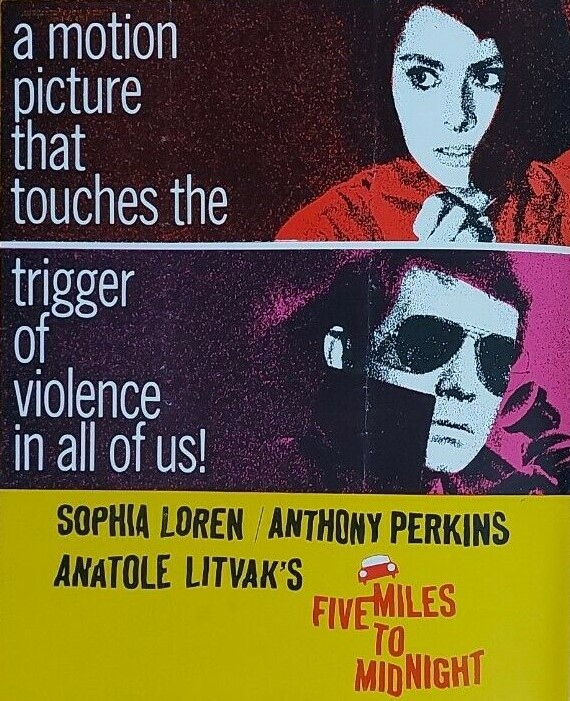
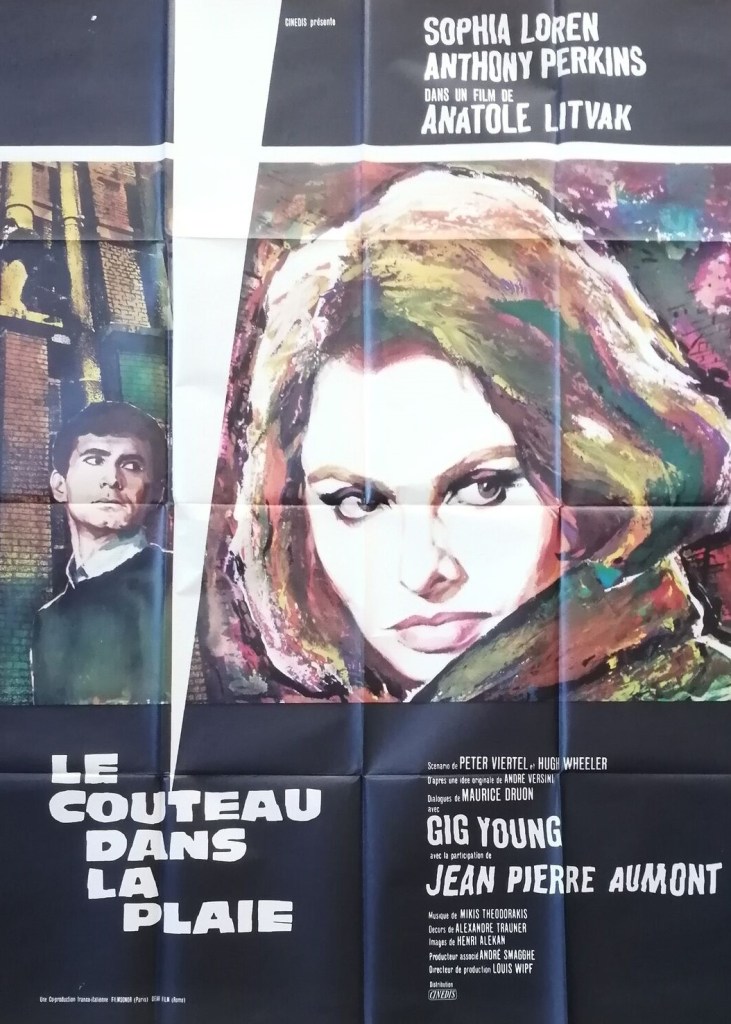
Superb performance by Sophia Loren (Arabesque, 1966) lifts taut Parisian-set thriller into outstanding class. Forced, of narrative necessity, to keep a lid on her emotions, Loren’s eyes betray her feelings. Director Anatole Litvak’s (Lady in the Car with Glasses and a Gun, 1970) camera is relentless, trapping her with almost claustrophobic compulsion, allowing little release, preventing her escaping the eye of truth.
Husband Robert (Anthony Perkins) and wife Lisa (Sophia Loren) embark on major insurance fraud. He’s the instigator, she reluctantly goes along with the plan as she imagines that, with their unlikely marriage already teetering, it will buy her freedom. Robert, sole survivor of a plane crash, rather than announcing he is alive, uses his death to scam the insurance company out of $120,000 (equivalent to $1.2 million today).
Given he is deceased, she has to carry out the formalities of making the claim, dealing with the various authorities, including police and the American consulate. Meanwhile, hiding out, every knock on the door or ring of the telephone creates panic. At various points Robert has to hide in every room in the apartment – remembering to remove any sign of his existence – and on the stairwell and when that proves too dangerous on the roof.
Little things that could give him away. The extra plate or glass could trigger suspicion from the cleaner. Lisa, a non-smoker, has to purchase cigarettes for Robert, the remains of an ashtray a possible reveal. She returns to work much faster than you would expect of a grieving widow.
She attracts an initially unwelcome suitor, David (Gig Young), a doctor, a friend of a friend. Workmates turn up at inopportune moments. A boy in an apartment opposite spots the recluse, at one point, shining a mirror into Robert’s eyes, dazzling him as he hides, precariously, on the roof. A cat, too, threatens to reveal the voluntarily imprisoned man.
You might wonder how why she married the financially dissolute Robert in the first place, more baby than man, a “charming octopus” whose needs would strangle the life out of a wife. He was her meal ticket from post-war Naples. She was so desperate to escape poverty that she would, as Robert acidly (and truthfully) puts it, that she would have gone off with any fellow with “a couple of bucks in his pocket.”
In Britain it was released on the lower part of a double bill to “Taras Bulba.”
He suspects she has a lover. And from random clues in the apartment, David also suspects she has a lover. But mostly it’s nail-biting waiting. And when her nerves are so shredded she is inclined to confess all to the police, and be rid of her husband, she realises she would be jailed as his accomplice. And though going along with the notion that the money will buy both their (separate) freedom, the devious Robert has no intention of letting her go, intending to blackmail her into remaining with him.
As the stakes rise we enter a frankly magnificent endgame, with one twist after another, Lisa barely coherent from overwhelming pressure even as freedom beckons.
It’s splendidly done, chock full of surprises, from the opening credits to the last intense close-up of Lisa. The credit sequence, a long tracking shot following a pair of legs from a bus to a nigh club, jaunty jazz in the background, Lisa exuberantly dancing the Twist, ends in an explosive slap. Where are obstructive insurance agents, the kind that automatically challenge every claim, hoping to whittle down the amount, when you need them? This one couldn’t be more helpful, even easing the path, when she had counted on the opposite in order to scupper the outrageous plan, to getting a death certificate out of the American consulate. It turns out you can easily dupe the police by simply denying that a coat found near the location of the crash does not belong to Robert.
The focus is kept almost evenly on the culprits. Awful husband that he is, Robert’s little-boy-lost persona still extracts audience sympathy – she is a deceiver after all, conning him into marriage, lover on the side – especially as you know that, even though this never occurs to Lisa, that capturing Robert will result in her imprisonment. But Robert already lives on the emotional edge and there’s one terrifying scene where he is clearly tempted to throw the small boy off the roof.
Even when Lisa believes she has found sanctuary in David, his suspicions threaten that. I won’t spoil the endgame for you because it is exceptional, very well worked in terms of action and emotion.
This didn’t get much attention when it appeared despite Loren’s stunning performance, perhaps because insurance fraud suggests little of the inherent tension of a heist. Anthony Perkins, desperately trying to avoid the typecasting triggered by Psycho (1960), successfully develops a more attractive screen persona that would climax in Pretty Poison (1968). Given the set-up, you imagine that the eternally charming Gig Young (They Shoot Horses, Don’t They, 1969) will turn out to be an undercover insurance agent. Even when that is obviously not the case, he is too inquisitive for Lisa’s good.
In contrast to the claustrophobic tension, the movie plays out against the backdrop of fun-filled parties, dancing, nightclubs, cocktails, the high life.
At this point Anatole Litvak was rarely mentioned in dispatches, critics considering his best films (The Snake Pit, 1948, for example) way behind him and that he was more likely to helm lumbering well-meaning vehicles like The Journey (1959). But, opening credits and a couple of scenes making using of perilous shadow apart, he is primarily an actor’s director. And when he gives a star of the skill of Sophia Loren such leeway, the script not permitting her self-justification, he is truly rewarded.
Superb performance by Sophia Loren (Arabesque, 1966) lifts taut Parisian-set thriller into outstanding class. Forced, of narrative necessity, to keep a lid on her emotions, Loren’s eyes betray her feelings. Director Anatole Litvak’s (Lady in the Car with Glasses and a Gun, 1970) camera is relentless, trapping her with almost claustrophobic compulsion, allowing little release, preventing her escaping the eye of truth.
Husband Robert (Anthony Perkins) and wife Lisa (Sophia Loren) embark on major insurance fraud. He’s the instigator, she reluctantly goes along with the plan as she imagines that, with their unlikely marriage already teetering, it will buy her freedom. Robert, sole survivor of a plane crash, rather than announcing he is alive, uses his death to scam the insurance company out of $120,000 (equivalent to $1.2 million today).
Given he is deceased, she has to carry out the formalities of making the claim, dealing with the various authorities, including police and the American consulate. Meanwhile, hiding out, every knock on the door or ring of the telephone creates panic. At various points Robert has to hide in every room in the apartment – remembering to remove any sign of his existence – and on the stairwell and when that proves too dangerous on the roof.
Little things that could give him away. The extra plate or glass could trigger suspicion from the cleaner. Lisa, a non-smoker, has to purchase cigarettes for Robert, the remains of an ashtray a possible reveal. She returns to work much faster than you would expect of a grieving widow.
She attracts an initially unwelcome suitor, David (Gig Young), a doctor, a friend of a friend. Workmates turn up at inopportune moments. A boy in an apartment opposite spots the recluse, at one point, shining a mirror into Robert’s eyes, dazzling him as he hides, precariously, on the roof. A cat, too, threatens to reveal the voluntarily imprisoned man.
You might wonder how why she married the financially dissolute Robert in the first place, more baby than man, a “charming octopus” whose needs would strangle the life out of a wife. He was her meal ticket from post-war Naples. She was so desperate to escape poverty that she would, as Robert acidly (and truthfully) puts it, that she would have gone off with any fellow with “a couple of bucks in his pocket.”
He suspects she has a lover. And from random clues in the apartment, David also suspects she has a lover. But mostly it’s nail-biting waiting. And when her nerves are so shredded she is inclined to confess all to the police, and be rid of her husband, she realises she would be jailed as his accomplice. And though going along with the notion that the money will buy both their (separate) freedom, the devious Robert has no intention of letting her go, intending to blackmail her into remaining with him.
As the stakes rise we enter a frankly magnificent endgame, with one twist after another, Lisa barely coherent from overwhelming pressure even as freedom beckons.
It’s splendidly done, chock full of surprises, from the opening credits to the last intense close-up of Lisa. The credit sequence, a long tracking shot following a pair of legs from a bus to a nigh club, jaunty jazz in the background, Lisa exuberantly dancing the Twist, ends in an explosive slap. Where are obstructive insurance agents, the kind that automatically challenge every claim, hoping to whittle down the amount, when you need them? This one couldn’t be more helpful, even easing the path, when she had counted on the opposite in order to scupper the outrageous plan, to getting a death certificate out of the American consulate. It turns out you can easily dupe the police by simply denying that a coat found near the location of the crash does not belong to Robert.
The focus is kept almost evenly on the culprits. Awful husband that he is, Robert’s little-boy-lost persona still extracts audience sympathy – she is a deceiver after all, conning him into marriage, lover on the side – especially as you know that, even though this never occurs to Lisa, that capturing Robert will result in her imprisonment. But Robert already lives on the emotional edge and there’s one terrifying scene where he is clearly tempted to throw the small boy off the roof.
Even when Lisa believes she has found sanctuary in David, his suspicions threaten that. I won’t spoil the endgame for you because it is exceptional, very well worked in terms of action and emotion.
This didn’t get much attention when it appeared despite Loren’s stunning performance, perhaps because insurance fraud suggests little of the inherent tension of a heist. Anthony Perkins, desperately trying to avoid the typecasting triggered by Psycho (1960), successfully develops a more attractive screen persona that would climax in Pretty Poison (1968). Given the set-up, you imagine that the eternally charming Gig Young (They Shoot Horses, Don’t They, 1969) will turn out to be an undercover insurance agent. Even when that is obviously not the case, he is too inquisitive for Lisa’s good.
In contrast to the claustrophobic tension, the movie plays out against the backdrop of fun-filled parties, dancing, nightclubs, cocktails, the high life.
At this point Anatole Litvak was rarely mentioned in dispatches, critics considering his best films (The Snake Pit, 1948, for example) way behind him and that he was more likely to helm lumbering well-meaning vehicles like The Journey (1959). But, opening credits and a couple of scenes making using of perilous shadow apart, he is primarily an actor’s director. And when he gives a star of the skill of Sophia Loren such leeway, the script not permitting her self-justification, he is truly rewarded.
The screenplay, for once not drawn an another source like a novel or Broadway play, is an original drawn out of the combined minds of Peter Viertel (The Old Man and the Sea, 1958), Hugh Wheeler (Kaleidoscope, 1967) and Andre Versini (Mission to Venice, 1964).
Loren is the true star. In a peach of a performance, her eyes constantly reveal inner turmoil.
Faultessly prophetic. Acquiring significantly greater power than at initial release. You can easily imagine Dennis (Anthony Perkins) these days as a conspiracy theorist on social media. You can picture Sue Ann (Tuesday Weld) as the impressionable acolyte learning at his feet. What she picks up most is the art of manipulation. And it’s done with marvelous flair, disturbing information slipped in at the right moment, and so focused are we on Dennis we scarcely notice Sue Ann’s transformation.
There’s a sense of Big Brother – Dennis evades his probation officer for a year to prevent his activities being overseen – and untrammelled big business, the chemical factory nonchalantly poisoning the local river. And it all takes place in Humdrum U.S.A.: hot dog stands, teenagers practising for parades, evenings at the movies, necking in the woods, mindless jobs in factories, with just a hint of overbearing police wielding a moral big stick.
Classic example of the marketing team getting cold feet. Fox didn’t know how to sell this in the subtle fashion it required so it came over in the bulk of the advertising materials as second cousin to “Bonnie and Clyde.”
The 1960s had taken a new line on the wicked women of the 1930s and the femme fatales of film noir. They might be mentally disturbed like Lilith (1964) or scrapheap fodder like Bonnie Parker (Bonnie and Clyde, 1967), but more likely to be cartoon villains decorating spy movies. This follows a completely different path, exploring latent tendency that might have remained hidden forever except for encountering the right spark.
Dennis is an outright oddball, a fantasist who has created for himself another world of being a secret agent intent on thwarting an alien plot. (Less intense than A Beautiful Mind, 2001) Some people, the next door neighbor, for example, who without question drops in spools of microfilm at the chemist for development under her own name, are easily taken in. Others are not, his employer at the chemical factory itching for an excuse to fire him, Sue Ann’s mother (Beverly Garland) who catches him out too easily.
Dennis snares gullible bouncy blonde Sue Ann in textbook style. He elicits mystery, popping in and out of her life, peppering her with secret codes, tradecraft, warnings, a farrago of information that would appeal to the insecure. She goes from girlfriend to accomplice, an eager participant in Dennis’s admittedly clever plan to cause the plant to shut down. But when he is rumbled by the nightwatchman and rooted to the spot in fear, it’s Sue Ann who comes to the rescue, clubbing the interloper, pushing his body in the river, sitting triumphantly aside her still conscious victim holding his head under the water.
The twist is: reality has paid a visit. Dennis is shocked at the murder. Although his past is now revealed, he is remorseful that it caused unfortunate consequence. Sue Ann’s reaction is the opposite. She wants post-murder sex. Cool to the point of calculating, remorse scarcely entering her vocabulary, taking command, spinning a web Dennis doesn’t see coming.
It plays out brilliantly, even to the point of Dennis taking comfort in the fact that he has spawned a murderess, one who might embark on an endless killing spree, such is the attractive innocent mask she hides behind.
You would put down Anthony Perkins (Psycho, 1960) as warped the minute his lop-sided grin slips into place. But there’s a youthfulness to this nutcase, always sprinting away, and he’s not, like Norman Bates, sitting in a lair awaiting potential victims, and, in a sense, he’s humanized by a beautiful woman falling in love with him. He’s out there like a con man with the practised patter that’s going to snare the pliable. If he was planning to wage war on the chemical polluters we’d be on his side immediately, and although that kind of action wasn’t yet going to turn anyone into an automatic screen hero, it does now, so a contemporary audience would be inclined to view him through an entirely different, and more sympathetic, prism.
Perkins’s playing is perfectly judged. He takes the mickey out of stuffy superiors, smart enough to elude the probation officer for a year, astute enough to find a job that gives credence to his secret identity, ingenious enough to come up with the perfect crime, and certainly his vulnerability evokes audience sympathy, especially when it transpires he may be the subject of unlawful judgement.
But Tuesday Weld (The Cincinnati Kid, 1965) is this movie’s gift. She is stunningly believable, both as the innocent dupe and the calculating killer. Yet she never emerges from her teenage dream. Even when her actions are clearly more grown-up she remains winsome and youthful. If Perkins is revealed as a child who had never grown up, Perkins becomes an adult in teenager’s clothing.
It’s only at the end you think perhaps this movie should be read back-to-front and that Perkins was the victim all along. (Arthouse filmmakers have been more celebrated for less.) Which would make her the mother (or perhaps daughter) of all femme fatales. There is no limit to what she going to get away with. If it was made today, there would be a sequel a year.
Noel Black (Run, Shadow, Run/Cover Me Babe, 1970) was the cult director’s cult director, eventually making a living in television, and only occasionally managing a big screen effort. This would have been a twisty enough number at the time but has rightly grown into a cult.







 The Magnificent 60s