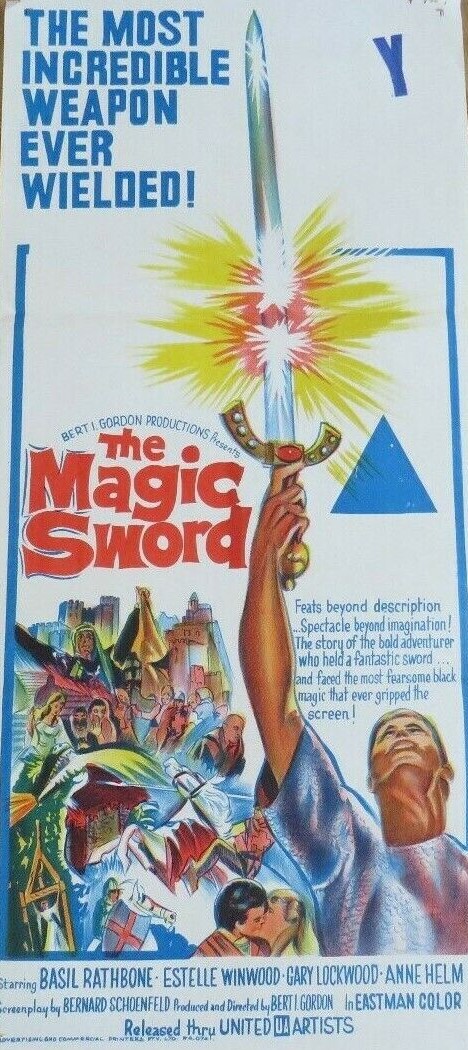
The Magic Sword (1962) ***

Where’s Ray Harryhausen when you need him? Not much wrong in this fun low-budget adventure that a few doses of Dynamation wouldn’t fix. While it means the monsters don’t cut it – man in mask with a dodgy perm playing an ogre, two-headed dragon whose flames appear superimposed – the rest of it is as up to scratch as you might expect from a genre that relies on exploiting old myths.

And we do get a look at Gary Lockwood (The Model Shop, 1969) in embryo and Basil Rathbone (The Comedy of Terrors, 1963) having a whale of a time as a villain who somehow (point plot not explained) has lost his magic ring. That means he’s going to strike a deal with loathsome knight Sir Branton (Liam Sullivan) – who happened across it (plot point unexplained) – to kidnap Princess Helene (Anne Helm). He’s somewhat hindered in explaining his plans because his voice is often drowned out by the thunder he can summon just by lifting his arms.
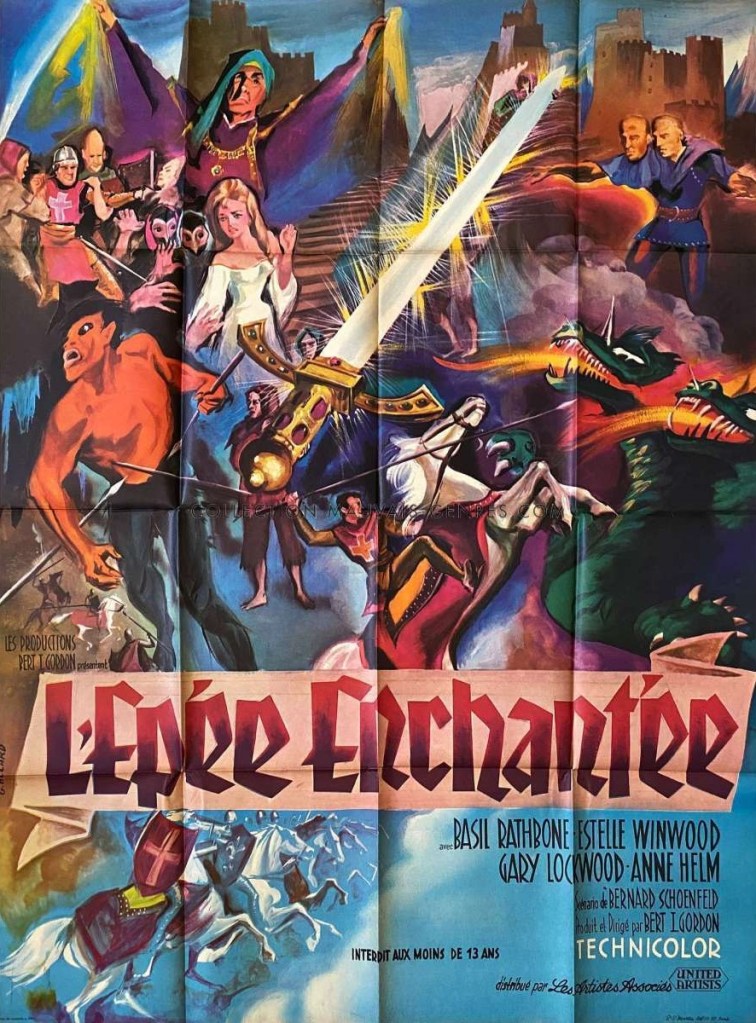
But it’s magic vs. magic as the pair come up against sorceress Sybil’s (Estelle Winwood) adopted son Sir George (Gary Lockwood) who’s stolen a set of enchanted artefacts including the titular sword, armor, a shield and the fastest horse in the world and heads off to rescue fair maiden from the castle of Lodac (Basil Rathbone) where the aforementioned dragon is on a steady diet of consuming a human being (or two, if twins or sisters are to hand) once a week.

Sybil, who seems to exist in some kind of darkroom, constantly lit by red, is a hoot, when not turning herself into a cat, unable to recall spells, not surprising since her memory has to span 300 years. Her coterie includes a chimp who does nothing (what’s the point of that, you might wonder, though perhaps magic is involved in just getting it to sit still) and a two-headed man, both faces speaking the same words at the same time.

There’s a tilt at a magnificent seven scenario as Sir George brings to life six sidekicks, a multi-cultural melange if ever, or a stab at attracting audiences from six different countries if you like. You need to be mob-handed at this game because the bunch, assisted or sabotaged by the accompanying Sir Branton, need to overcome The Seven Curses of Ladoc (the film’s alternative title in various parts), including the ogre and a malodorous swamp, and sure enough those dangers soon cut the motley band down to size.

Meanwhile, the imprisoned princess has watched the dragon eat, and is tormented by dwarves (though the caged elves turn out to be friendlier). There’s going to be two showdowns, not one, since Lodac has no intention of allowing Sir Branton the glory of rescuing said princess and therefore winning her hand in marriage. He is hell-bent on revenge, since the king’s father had burned his sister at the stake as a witch.
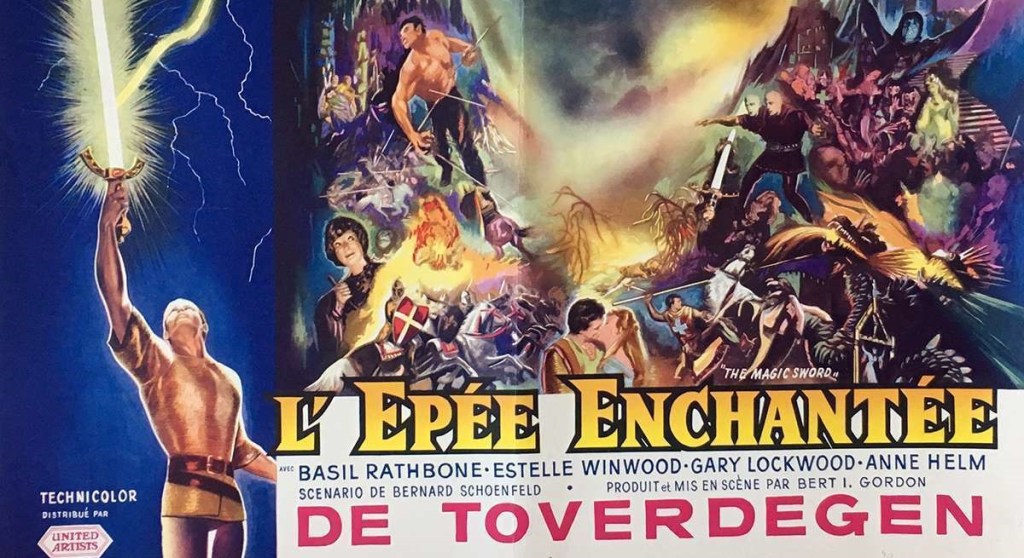
The meet-cute if you like is princess and potential rescuer facing each other across a dungeon while tethered by rope to stakes. Sybil does try to help but damned if she can remember the final words of her spell.

Gary Lockwood, in his first leading role, takes the whole thing seriously, and only made two more films before something in this role and It Happened at the World’s Fair (1963) and Firecreek (1967) tipped off Stanley Kubrick that here was a star in the making for 2001: A Space Odyssey (1968). So it does show that no part, however preposterous, is worth turning down.

Basil Rathbone would steal the show – as he should being top-billed – were it not for the fun-loving Estelle Winwood (Games, 1967) as the dotty aunt kind of sorceress. What Hollywood dictat I wonder determined that leading actresses often made their entrance swimming naked in a pool. Anne Helm (The Interns, 1962) doesn’t have much to do except look scared. You might spot Danielle De Metz (The Scorpio Letters, 1967).

With Sybil to dupe, all the curses to overcome and deal with the duplicitous Sir Branton, the pace never lets up. And it’s short (just 80 minutes) so no time for dawdling.

Director Bert I. Gordon (The Amazing Colossal Man, 1957) has been here before with the special effects that appear dodgy to the contemporary eye but were ground-breaking at the time when SFX did not command multi-million-dollar budgets. Screenplay by Gordon and Oscar-nominated Bernard C. Schoenfeld (13 West Street, 1962).

While Harryhausen tales were always redeemed by the special effects, this is perfectly acceptable late-night entertainment when the critical guard is down.

The Interns (1962) ***

Patients are a nuisance to be tolerated on the route to wealth in this superior soap opera that sees young doctors wrestling with ambition and ethics. Although also concluding that impending lofty status will snare them an attractive bride, they find women less biddable than expected, romance proving the trickiest of all procedures.

The main cast of four men and one women are played by a roster of hotly-tipped newcomers, including future Oscars winners and nominees and the elusive Haya Harareet (The Secret Partner, 1961). Director David Swift, accustomed to handling multiple characters in the likes of Pollyanna (1961), keeps the pot boiling and although some storylines lead to obvious conclusions the screenwriters bring sufficient imagination to the various strands.

The story unfolds over the one year the doctors spend in a general hospital, where the patients are liable to be drunk and obstreperous, before taking up residencies elsewhere. As you might expect, the main characters divide into the good and the arrogant. Heading the latter are Alec Considine (Michael Callan) who cheats on girlfriend Mildred (Anne Helm) with older nurse Vicky (Katharine Baird) in order to gain through her connections a residency at a highly prestigious hospital. Matching him in the cocky stakes is John Paul Otis (Cliff Robertson), charming to old ladies but willing to risk his career to bed movie actress Lisa (Suzy Parker). The good guys are Lew Worship (James MacArthur) who is seduced into the supposed backwaters of obstetrics and Sid Lackland (Nick Adams), an all-round good egg who falls for patient Loara (Ellen Davalos).

The most interesting of the young doctors, however, is single mother Madolyn Bruckner  (Haya Harareet) who takes on surgeon Dominic Riccio (Telly Savalas) at every turn. Riccio spends his time berating his charges and in particular has a downer on female doctors. At every encounter, despite his vicious tongue, she refuses to back down.

But it is the patients, in particular Arnold Auer (Peter Brocco) and Loara, who blow a hole in the myth of hospitals. In the best scene in the film, Auer, suffering from a degenerative illness that will turn him into a vegetable, takes over from the doctor in giving his own awful diagnosis. His pleas for clemency from his ordeal, in essence assisted suicide, create an ethical dilemma for the young doctors who did not realize that modern medicine would prolong rather than curtail patient suffering. Auer’s anguished wife Emma (Angela Clarke) flits in and out of the picture as she buttonholes any doctor willing to listen to a new cure she has discovered. While the more hard-hearted doctors can inure themselves to his agony, a savage turn of events finds them all caught up in a situation that could jeopardize their future careers.

Racy image of Olga (Carroll Harrison) adorns the cover of the soundtrack album with music by triple-Oscar-nominee Leith Stevens (“The Five Pennies,” 1959).

Although Loara has an incurable disease and has more or less given up, Lackland’s effervescent good humor and determination that surgery can resolve all health issues brings her hope. If you were in her condition possibly the last thing you would want would be a cheerleading doctor on your side, but in this instance it brings succor and in the doctor’s case forces him to rethink his priorities.

Probably the last thing the doctors – and the audience – expected was to come up against such stubborn free-thinking women. While Bruckner appears to fly the flag for female independence, she has solid support from Lisa who spends most of the picture rejecting Otis’s advances on the grounds that even when he becomes rich he will be too poor for her liking. Eventually, Vicky forces Considine to choose. Shy nurse Gloria (Stefanie Powers) shocks Worship by putting global travel ahead of marriage. But she’s not as shocking as the bespectacled inhibited Olga (Carroll Harrison) who makes a spectacle of herself by losing her inhibitions in flamboyant style at a wild New Year’s Eve party, her disheveled state a key element of promotional artwork.

Although, theoretically, a film about young doctors having a romp, in reality it is a thoughtful and thought-provoking picture, tackling issues that would have been taboo at the time and removing the submissive tag that daunted most movie female characters in the movies.

Those who succeeded in later winning Oscar favor were Cliff Robertson, Best Actor for Charly (1968), and Nick Adams and Telly Savalas, both nominated for Best Supporting Actor, the former in Twilight of Honor (1963) and the latter in The Birdman of Alcatraz (1962). Robertson was the pick of the bunch, a star in his own right graduating from 633 Squadron (1964) and Masquerade (1965) to J.W. Coop (1971) which he also directed. But largely, the stars did not fulfil initial promise. The peak of Michael Callan’s movie career was reprising his role in The New Interns (1964), star in British director Michael Winner’s You Must Be Joking! (1965) and second male lead in Cat Ballou (1965). James MacArthur had a steady movie career before an epic run in television series Hawaii Five-O (1968-1979). Nick Adams switched between film and television before his premature death in 1968.  Haya Harareet made only one more film, The Last Charge (1962).

Although primarily in television, the less-heralded stars enjoyed greater ongoing success. Mainly a strong supporting actor, Telly Savalas had only one stab at a starring role (Land Raiders, 1970) before achieving worldwide fame as Kojak (1973-1978).  Stefanie Powers was television’s The Girl from U.N.C.L.E. (1966-1967) and later Hart to Hart (1979-1984). Buddy Ebsen (who plays the older Dr Sidney Wohl) went straight into a nine-year run of The Beverley Hillbillies

Discover WordPress

A daily selection of the best content published on WordPress, collected for you by humans who love to read.

The Atavist Magazine

by Brian Hannan

WordPress.com News

The latest news on WordPress.com and the WordPress community.