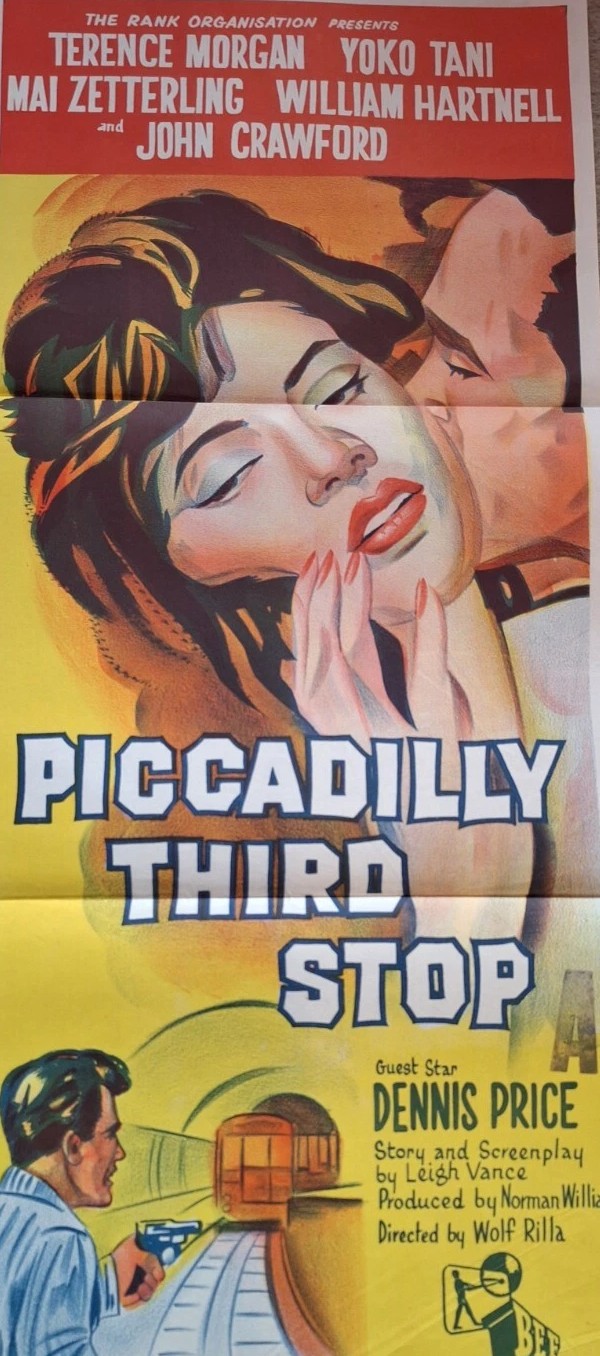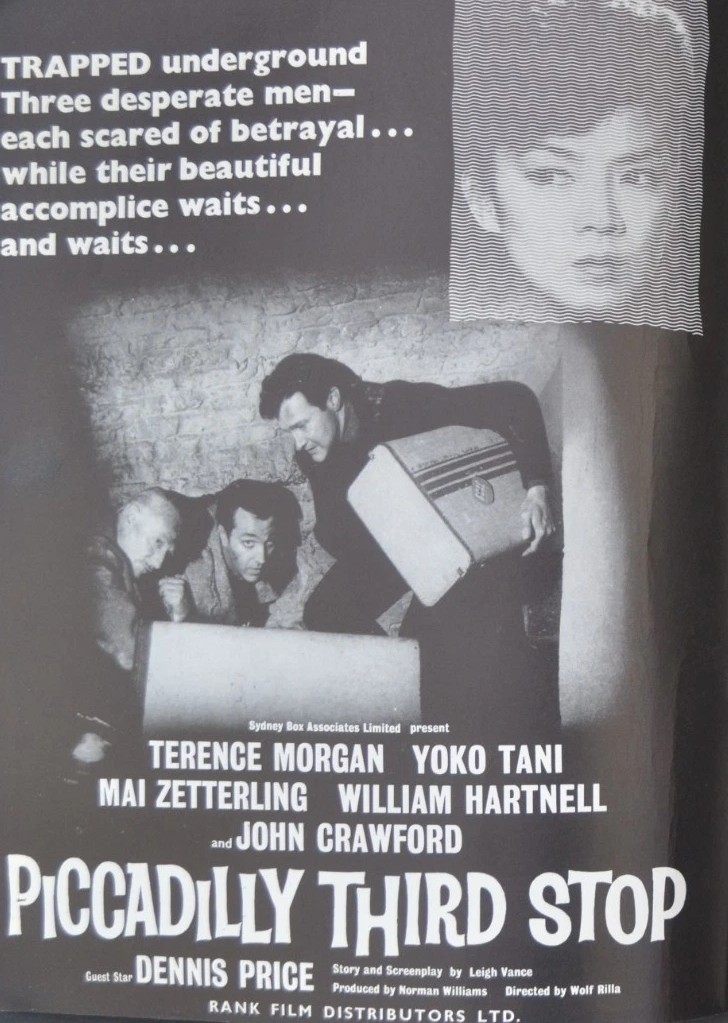
Piccadilly Third Stop (1960) ***

Well-worked full length British thriller that goes against the grain of presenting sympathetic hoods in the vein of Ocean’s Eleven or The League of Gentlemen both out the same year in which audiences largely align with the gangsters in part because they come across as charming and in part because their aims appear thoroughly reasonable.

Unlike the shorter efforts under the Renown umbrella this has time to develop several narrative strands, with deceit the main motivation, and spends a goodly time on the mechanics of robbery, the planning, the percentage split accorded each member, and the heist itself, which is an arduous one, involving digging through a brick wall.

Dominic (Terence Morgan) isn’t exactly a petty thief not when he can dress himself up to the nines, infiltrate a society wedding and make off with an expensive piece of jewellery, which he hides in an unusually clever fashion. But working on his own account is far more lucrative than being an employee in a watch-smuggling ring run by Joe Preedy (John Crawford) who has a classy wife Christine (Mai Zetterling) and life and has so much dough lying around that he’s easy pickings for Dominic who has a side hustle bring dupes to the gambling tables of the pukka Edward (Dennis Price).

Dominic happens to be bedding Christine but that still leaves him time to romance Fina (Yoko Tani), daughter of an ambassador, who casually reveals the embassy safe contains £100,000. She’s so helplessly in love she falls for his tale of them running off together and becomes an accomplice.

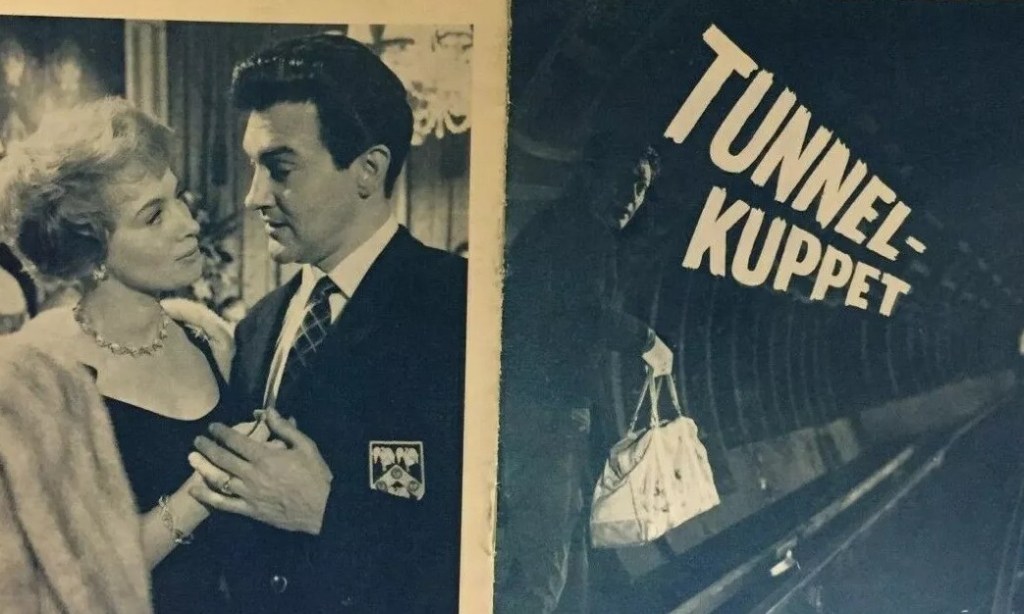
With the assistance of Edward, Dominic snookers Joe into supplying the readies to pay for the robbery set-up costs, the tools, gelignite etc. The plan involves digging a hole through the tunnels of the London Underground into the basement of the embassy.

Joe’s share of the spoils will hardly cover his debts so he’s intent on making off with the full amount. As it happens, Dominic has precisely the same idea. Christine is roped in, unknown to her husband, to act as getaway driver.

There’s a hefty dose of characterization unusual in these movies, more than just information dumps about characters. Dominic could easily fund the caper with the cash he would get from selling the stolen diamond, but he holds out for a larger amount from a fence. Joe should easily be able to afford the money, but he’s in dire financial straits because he lost a packet at the gambling tables and his own astuteness in ferreting away all he owns in his wife’s name. That puts his gains well beyond the long arm of the law but leaves him illiquid (I guess is the technical term) and he has to beg Christine to pawn her mink coats.

She’s a smooth operator, an amateur artist, happily living off Joe’s nefarious activities while running around with Dominic and planning to run away with him at robbery end. Joe’s desperate to be seen as a major player, hence his attendance at the casino, and kicking off when he doesn’t get his way, and raging against all the toffs born with a silver spoon in their mouths.

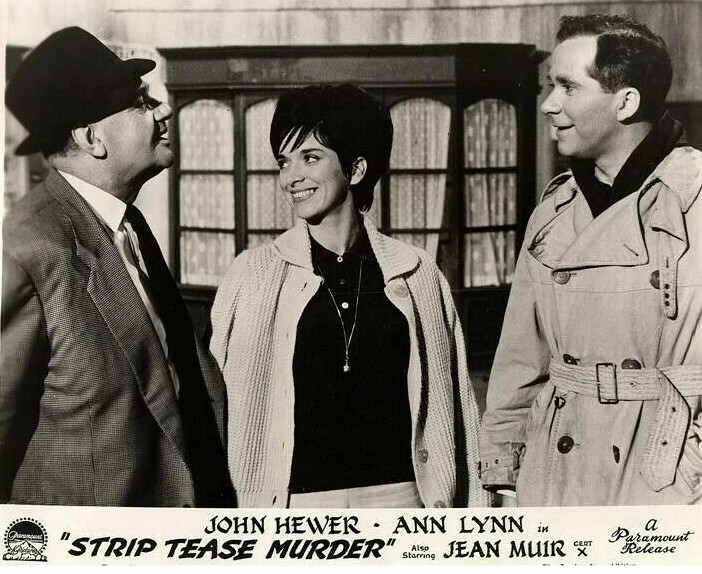
Two of the subsidiary characters are interesting studies. Safecracker the Colonel (William Hartnell) has too much of an eye for the pretty lady and too great a capacity for alcohol, but he’s been careful with his loot, spreading it around in various investments, very secure in his old age, and confident enough in his own abilities that he’s able to negotiate a higher share of the loot. But the prize supporting character is Mouse (Ann Lynn), girlfriend of Dominic’s sidekick Toddy (Charles Kay), who is considered so dumb and harmless that the crooks discuss their plans within her earshot. Except, she’s not concentrating and doesn’t quite get the hang of things and feeds Toddy the wrong information at the wrong time which nearly puts a spoke in the works.

As if the robbery required any more tension. Just how much work is involved in digging a hole through a wall is pretty clear here, should anyone in the audience have ideas of their own. You know double-crossing is also on the cards, not just the Dominic vs Joe and Christine vs Joe but the lovelorn Fina is also due her come-uppance.

And there’s a very nice touch at the end which proves that amateurs are a distinct liability. Any notion Christine has harbored that she would, if only given the chance, prove an ideal getaway driver are misplaced.

Directed by Wolf Rilla (Village of the Damned, 1960) not just with occasional style notes but with a determination to allow his characters room to move from a screenplay by Leigh Vance (Crossplot, 1969). You can catch it on Talking Pictures TV.

All in all a very entertaining little picture strong on tension with a host of interesting characters.

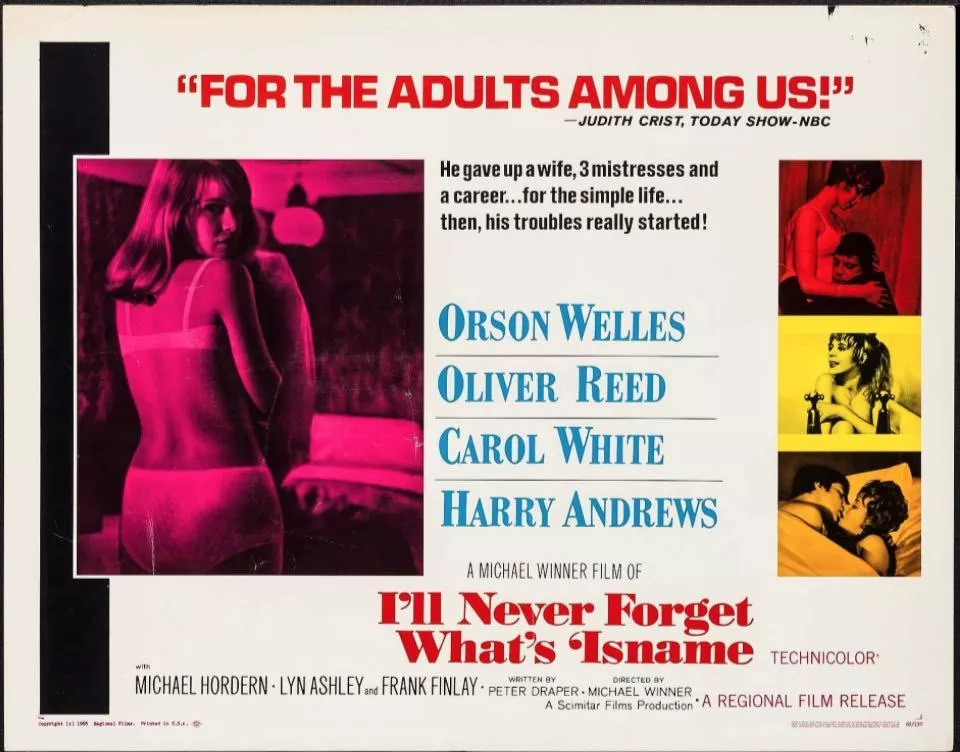
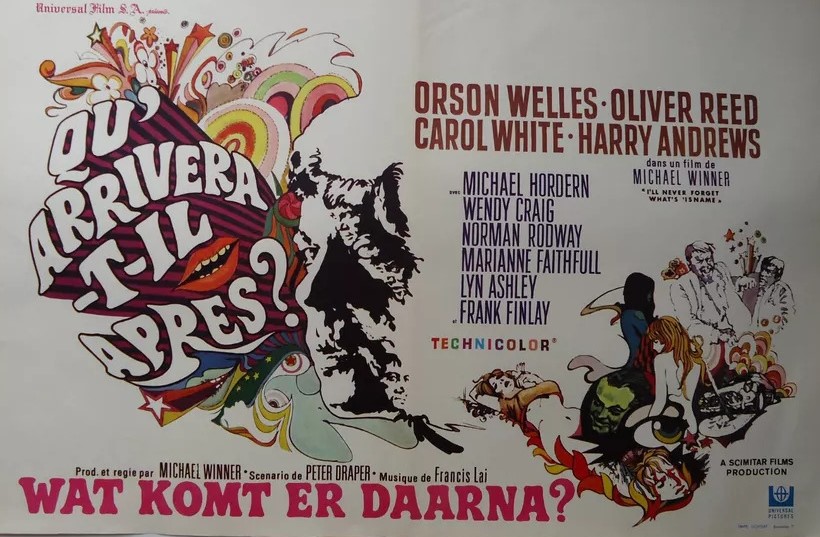
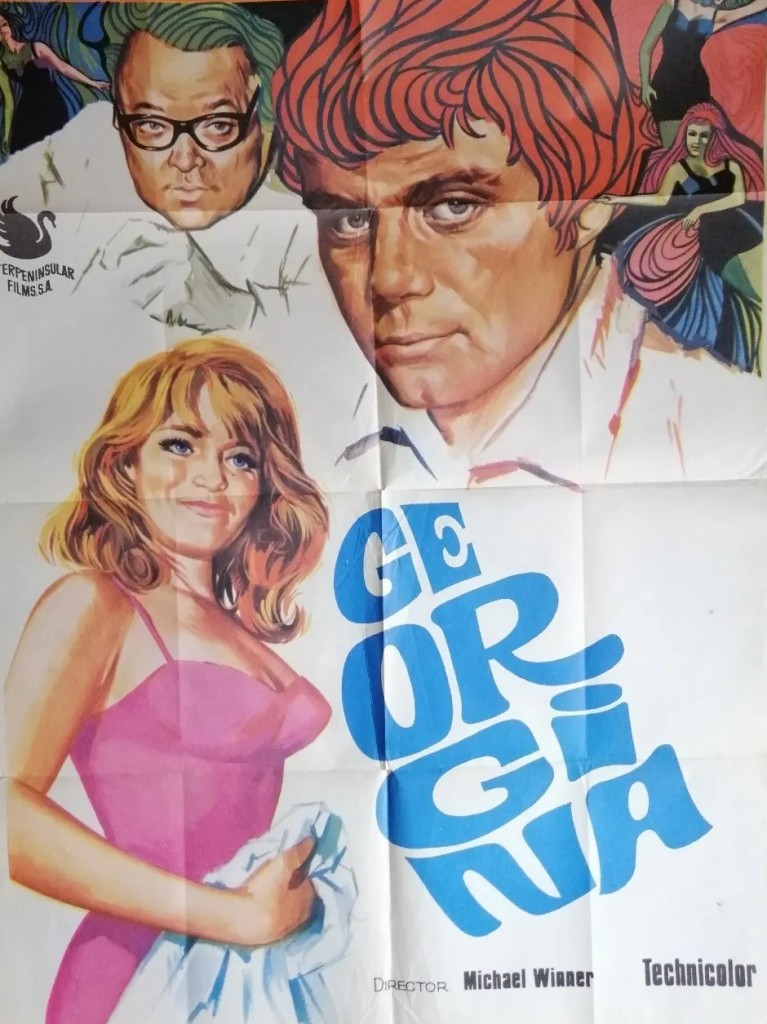
I’ll Never Forget Whatsisname (1967) ****

Director Michael Winner’s proudest moment – from a critical perspective. Rave reviews all round and hailed as a rising star of British cinema. Such adulation didn’t last long, of course, Hannibal Brooks (1968) and The Games (1970) elicited little critical reposnse and whatever kudos he achieved from a couple of westerns was soon blown away once he went down the Death Wish (1974) brutal revenge route. So this fits into the anomaly department in his canon and, although pretentious in spots, it does show a fine intelligence at work and a singular prophetic quality that should have contemporary reverberation.

For a start, he highlights the creativity of the advertising world that became the training ground for such British directorial talents as Ridley Scott (Alien, 1979), his brother Tony (Top Gun, 1986), Alan Parker (Midnight Express, 1978) and Adrian Lyne (Fatal Attraction, 1987) as well as producers in the vein of David Puttnam (Chariots of Fire, 1981). Perhaps more interesting are the ecological aspects, predicting the importance of waste both as an issue and a financial opportunity.

And although If… (1969) was viewed as the pre-eminent depiction of public school immorality, this provided a much shorter introduction to the prevalence of public school attitudes in society. You might also suggest, should you be so bold, that Winner envisioned the boom in reality televison, when the camera is not used to create illusion but to pick at the scabs of society. And we might also fast forward to Jaws (1975) whose meanest character shares the same surname as our hero here, whose personality defects are what drives the picture.

Within all this there’s a fair chunk of satire. And it’s rare for this director to so obviously poke fun at his heroes.

The narrative follows disillusioned advertising ace Quint (Oliver Reed) as he tries to extricate himself from various romantic entanglements in order to concentrate on first playing a more meaningful role via literary creativity and then, when that option is pulled out from under him, exposing the hypocrisy from which he has made his fortune.

The movie opens with a stunning image. Quint wielding an axe. Despite this being in the  middle of London, he scarcely receives a second glance – as if this might be construed as typical English eccentricity – as he marches towards his posh headquarters, proceeds to smash his office and hand in his notice to boss Lute (Orson Welles). He finds work in a literary magazine with old school chum Nicholas (Norman Rodway) where, unfortunately given he already has a wife and several mistresses, he falls for virgin secretary Georgina (Carol White).

But despite his success he is tormented by his schooldays, which instead of toughening him up made him more vulnerable to abuse from a teacher and to bullying from fellow pupils led by entitled thug Maccabee (Harvey Hall). The nightmarish glimpses of school are sharply brought into focus when he encounters Maccabee again and witnesses the savage hounding of another innocent man.

Meanwhile, Lute keeps popping up, either to try and seduce Quint back to his job or to sabotage his existing one. When a fight breaks out at one of Lute’s parties he wants it stopped before another of his precious artworks is broken rather than before a participant ends up in hospital. Lute takes English eccentricity to the extreme, enjoying a massage while playing Scalextrix, the epitome of avuncular decency except that he’s twisting the rules.

Even with his diabolical childhood, it’s hard to sympathize with Quint. He’s little more than a charming lout, but I suspect his is a more universal condition, those who have so much easy wealth inclined to poke at the foundations of success, and seek a more worthwhile profession. The ending is contrived, but, then, the fun has to stop somewhere.

That said, Oliver Reed (The Assassination Bureau, 1969) presents a more rounded character than in many of his later films. From the confidence of his delivery you get the impression that Orson Welles (House of Cards, 1968)  – top-billed ahead of Reed – improvised many of his lines. He’s certainly having some fun with his role, but then that is the seductive part of his character. Carol White (Daddy’s Gone A-Hunting, 1969) is the big surprise, bringing a genuine freshness to her role, before she conformed to the Hollywood dictat. And you won’t forget the malicious Harvey Hall (The Games, 1970).

The quite amazing cast includes Edward Fox (Day of the Jackal, 1973),  Michael Hordern (Where Eagles Dare, 1968) as a demented headmaster, Marianne Faithfull  (The Girl on a Motorcycle, 1968), Harry Andrews (The Long Duel, 1967) as a writer with a creepy hobby, Wendy Craig (TV series Not in Front of the Children, 1967-1973), Ann Lynn (Baby Love, 1969) and Frank Finlay (The Shoes of the Fisherman, 1968).

It’s entirely possible that it was pure coincidence that Winner covered so many topics relevant to today but I’m giving him the beenfit of the doubt. Written by Peter Draper (The System / The Girl-Getters, 1964).

Great – and meaningful – fun.

The Party’s Over (1963/1965) ****

Tricky little number that pivots on a tricky plot point and is almost sunk by the kind of moralizing voice-over that was attached to Riot on Sunset Strip (1967) but actually bears serious reassessment. Quite a brilliant two-minute opening sequence with a tracking camera. I’m a big fan of directorial technical skill so bear with me.

We open with a man dangling from a balcony whose cries for help go unheard at the party inside. We shift inside and with no dialogue the camera begins tracking to the right. A man moves down to kiss a girl and from behind the one being kissed a hand relieves him of his wine glass and the camera slides inches further over to a dark-haired girl in the act of removing a bowler hat from a man and placing it on her head and as she leans back into the sofa that allows a blonde to come to the fore whose cigarette is removed from her mouth to light the cigarillo of an unshaven character who grabs a bottle of wine and in glugging it down moves over to the window and observing the dangling man and pours the rest of the bottle on his head.

“Help him up,” calls out another woman. This request is ignored, but the unshaven character shouts for someone else to help. The man is rescued. With a cynical stare, the unshaven man asks of the woman who has intervened, “Anything else?” She retorts, “Drop dead.” He climbs onto the balcony, falls over, and when the partygoers rush over in horror we cut to the street below where he is swinging from a lamppost.

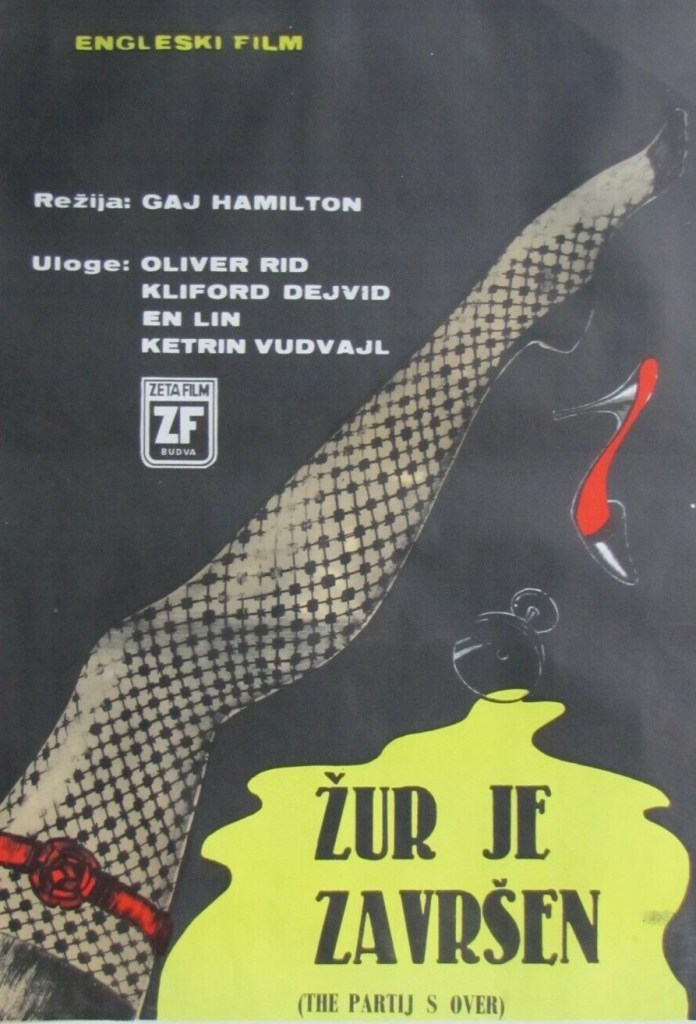
Easy enough to get away on the poster with what otherwise contractual credit billing forbids. Guy Hamilton could take his name off the credits but that wasn’t so easily enforced abroad.

Over the following credits comes the moralizing. “This film is the story of young people who become, for want of a better word, beatniks. It’s not an attack on beatniks…but shows the loneliness and unhappiness and eventually the tragedy that comes from a life lived without love for anyone or anything.” In other words – an attack on beatniks.

Actually, it’s far more about depression, though that’s scarcely acknowledged, not so much people trying to find themselves as not knowing where to look and in consequence spending a lifetime running away. You might only figure that out in retrospect but it gives the picture some punch. And they’re not overtly rebelling against society or authority as in The Damned (1962) or Riot on Sunset Strip (1967) beyond daubing a drunken face with a CND symbol.

These are less beatniks than, from their classy outfits, society debs slumming it. Yes, they don’t seem to do much else but party, although a number have artistic pretensions, sculpting and painting, for example, but mostly they seem able to lounge around without a care in the world, not like the motley secretaries living in bedsitters in The Pleasure Girls (1964).

The party characters quickly evolve into Moise (Oliver Reed), the unshaven character, who lusts in vain after sultry soul-eyed American Melina (Louise Sorel), the girl who gave him a ticking off, even though he has an adoring singer girlfriend, the blonde Libby (Ann Lynn), who he can, as he demonstrates rather misogynistically, summon with with a snap of his fingers. Bowler-hat is mysterious painter wannabe Nina (Katherine Woodville). The rescuer is sculptor and drummer Geronimo (Mike Platt).

Similarly, Guy Hamilton couldn’t prevent the marketing team sticking a sly reference to him – director of “Goldfinger” – elsewhere on the marketing material.

Melina has a wimp of a fiance, Phil (Jonathan Burn), and the story kicks into gear with the arrival of her American fiance Carson (Clifford David), a high-flying businessman, though owing rapid promotion to the fact she is the boss’s daughter. Since marriage is immiment, he is perturbed at being unable to contact his fiance.

But when he does try to find her, he is given the run-around. Nina tells him Melina is recovering from a terrible operation, someone else sends an easily-duped Yank to Buck House (Buckingham Palace), he finds her suitases packed in her room, that element backed up by the notion that she has given away clothes and jewellery (Nina wears her bracelet) and she has either skipped off to Paris or might be lying on a building site half-naked after being dumped there, dead drunk, as a prank by the gang.

So far, so black comedy. And you could believe all of it because Melina is “afraid of everything,” dreads having a daughter who might grow up to be “pawed by a thick hand” and otherwise seems to drift like a melancholy ghost. Phil, having failed his medical exams, commits suicide and like An American Dream/See You in Hell, Darling (1966) Carson is cast in the role of the person who could have saved him from diving from a roof.

Eventually, we do learn more about the other characters. Nina, who in the absence of Melina, takes up with Carson, is a provincial girl, who had an ill-advised marriage to please her parents. Libby is desperately in love with the womanizing Moise, who does a nice line in imitation and cutting remarks. When Melina’s father (Eddie Albert) turns up, the pace quickens.

And in a quite brilliant directorial coup, we realize that, ever since Carson’s arrival, the movie has been operating in flashback. There’s a better reason Melina is missing. She’s dead. She wasn’t drunk, she had toppled from a high staircase at a party and snapped her neck. But since everyone else is totally smashed, they assume she’s just out of it. Only Moise knows the truth, since she’d been trying to get away from him too fast. And since he makes no effort to prevent the prank going ahead, there would be some serious trouble should the police get involved.

Of course, the corpse turns up. Carson, reckoning he’s dodged a bullet, isn’t too torn up and he has a nice girl from the country, Nina, to hold his hand. Moise shows some remorse, but not enough.

Yes, a kind of morality tale but hardly enough to warrant the moralizing cautionary voice-over. Instead, it’s more prescient, Melina the forerunner of the kind of heroine who would find life just too tough and either end up in an institution or go on to ruin her own and everyone else’s life. As a study of depression it’s hard to beat. The spoiled brat who has everything only to realize it’s not enough. Guilt, too, if you count in Phil’s horror at kissing his dead girlfriend.

The credit sequence, which has been ripped off countless times, shows the motley post-party crew slinking across an iconic London bridge at dawn. And there are some wonderful scenes with a viciously playful Oliver Reed. In one he gives a Pythonesque take on the misunderstood waif – “my bathwater was never the right temperature, the servants always burned the toast.”

Oliver Reed (The Assassination Bureau, 1969) should have taken all the acting plaudits but in fact the women, with more emotion to openly play with, steal it. Katherine Woodville (The Wild and the Willing, 1962)  takes it by a nose from Louise Sorel, in her movie debut, and Ann Lynn (Baby Love, 1969).

Just superbly directed by Guy Hamilton (A Touch of Larceny, 1960), who mixes atmosphere, emotion and mystery, in just the right quantities, a difficult trick at the best of times. And who has the cojones to pull a fast one. It could as easily have been, upfront, a murder mystery. Instead, it’s much more. Screenplay is by Marc Behm (Charade, 1963).

It was made in 1963, when it would have been far more pertinent, but, thanks to the British censor, held back for two years. The censor was exercised by the scene where Phil kisses Melina, thinking she is dead drunk, only to realize some time later that she is actually dead, and the real reason he threw himself off the roof. In those days, nobody had come up with a solution to the knotty problem of a director who wanted their name removed from the credits. Several years later, Hollywood adopted an all-purpose pseudonym to cover that eventuality. But here, if you watch the credits, you’ll see that there is, to all intents and purposes, no director.

Best film ever to be made without a director.

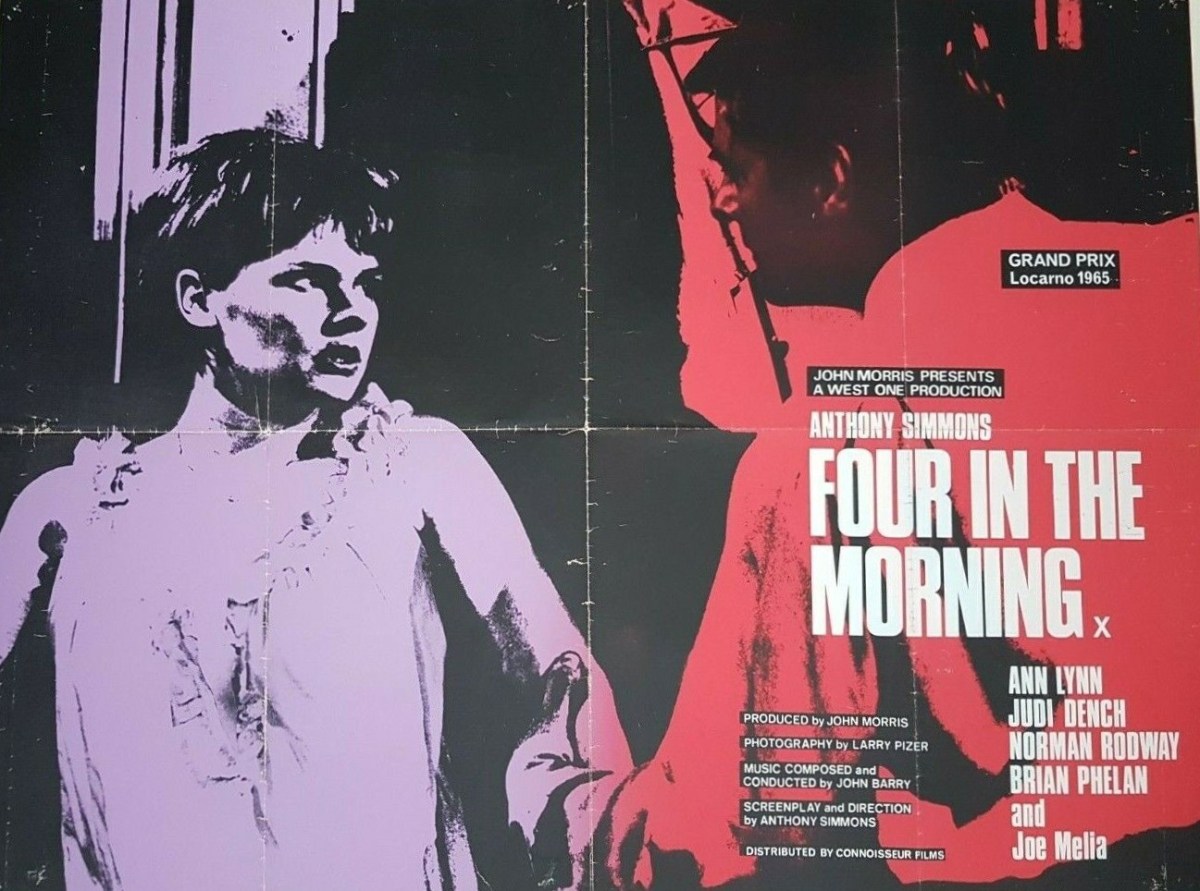
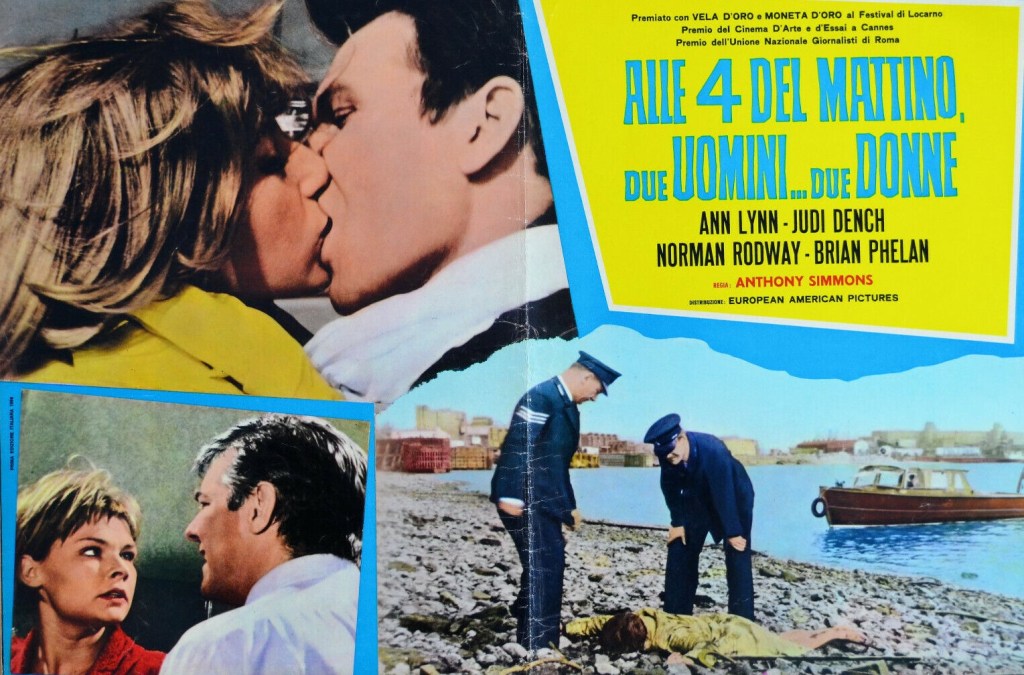
Four in the Morning (1965) ****

Directors learned this early that you only had to point the camera at Judi Dench (Oscar winner for Shakespeare in Love, 1998, but here in her first starring role) and even without the benefit of dialog she will always be compelling. And that’s just as well because this is one of those elliptical movies that were in fashion in the wake of Last Year in Marienbad (1960).

Less twisty and self-conscious for sure two apparently unconnected tales are conjoined by a mysterious drowning in the Thames. And this isn’t tourist London, either, but the working version, a city waking up, famed fruit and flower markets coming to life, ferryboat teaming with passengers, the skyline dominated by tiny dots setting off for the office.

In fact, the picture draws its power from three women, the aforementioned Dench as a young woman smothered by motherhood, marriage disintegrating, Ann Lynn (The System/The Girl-Getters, 1965) who breaks out of the supporting role cage where her character is generally fixed from the start to take advantage of a name-above-the-title role as a reticent lover to explore a gamut of emotions. Last of the trio is the drowned woman, whose callous treatment dominates the action.

If you ever wanted to find out what happens to a drownee here’s your chance. Unceremoniously dragged from the shore, transported to a mortuary in a coffin, head laid on a block of wood, clothes cut off, naked body sluiced with water, fingerprints taken, stored in a refrigerator, indignity run riot, it’s a harrowing sight.

As if to compound the movie’s arthouse sensibilities – and it won big at various film festivals – the characters remain anonymous. The wife (Judi Dench), stuck at home with a mewling teething infant, is disconcerted to find husband (Norman Rodway) has returned from a night on the town with  buddy (Joe Melia) in tow. They want to continue partying, waking up wife and baby, resulting in non-stop argument.

Divorced manager of an upmarket bar (Ann Lynn) tries to put off a boyfriend (Brian Phelan) pestering her for a date. Eventually, she relents and they embark on an initially unsatisfying date before she finally comes alive when he steals a speedboat and they power upriver. Even when passion takes over she remains wary of commitment.

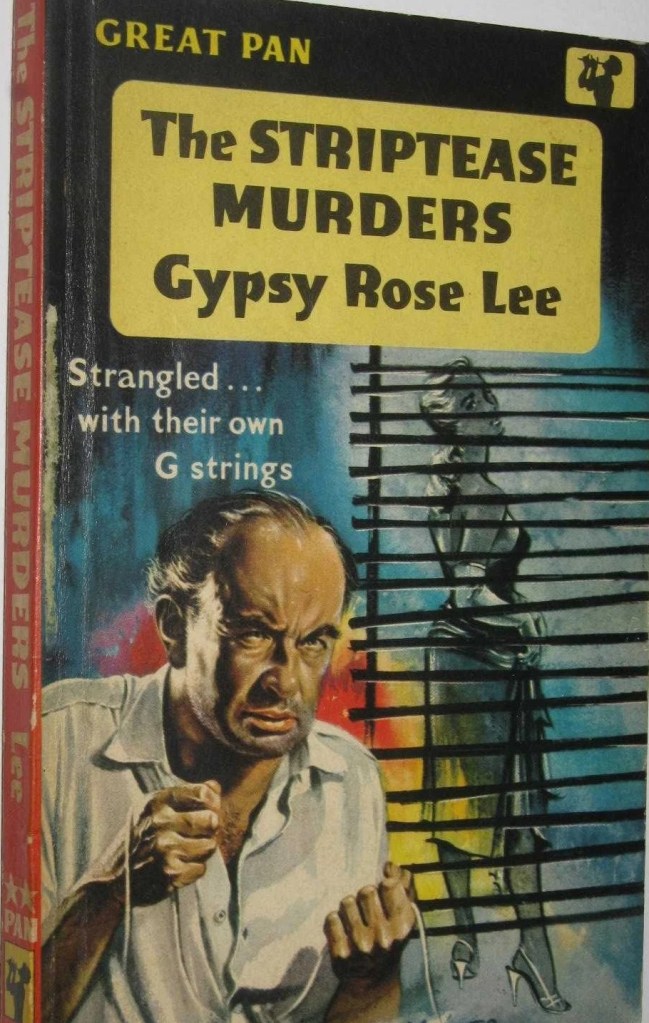
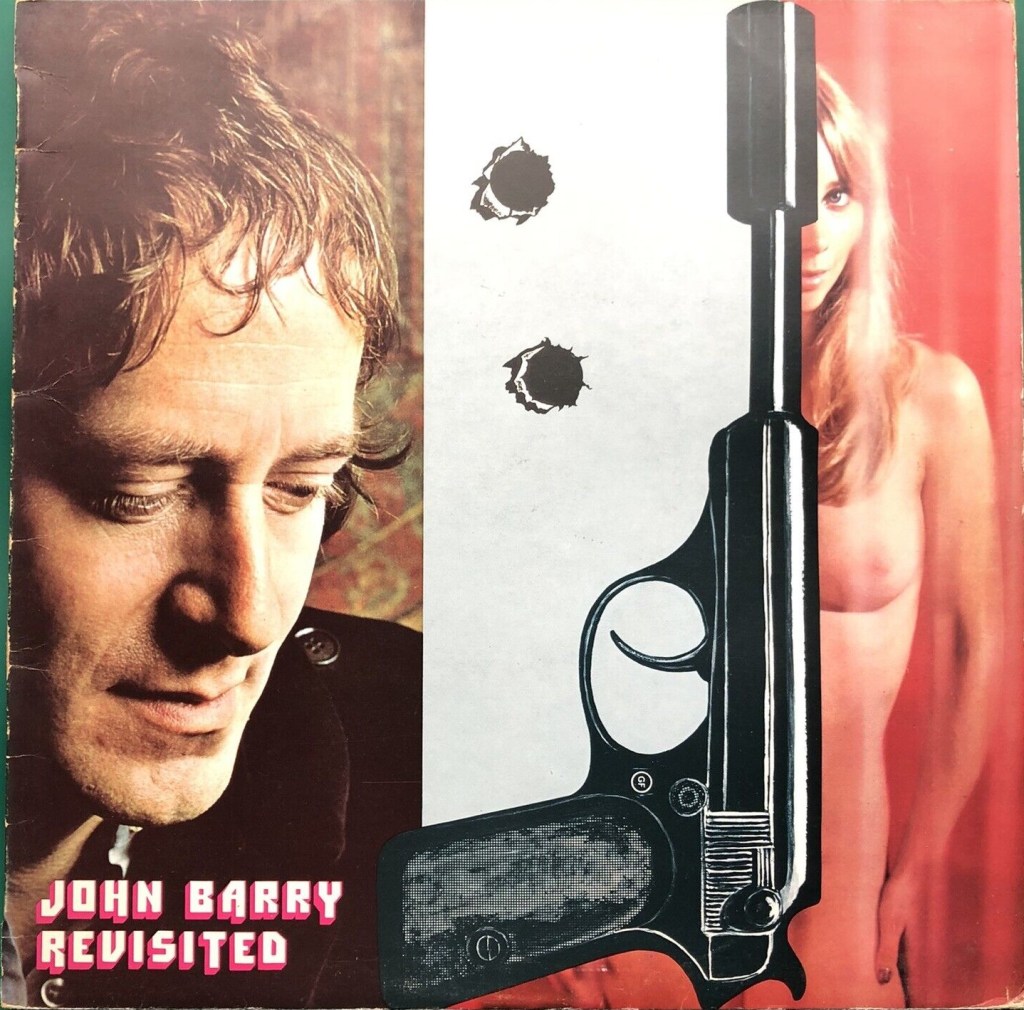
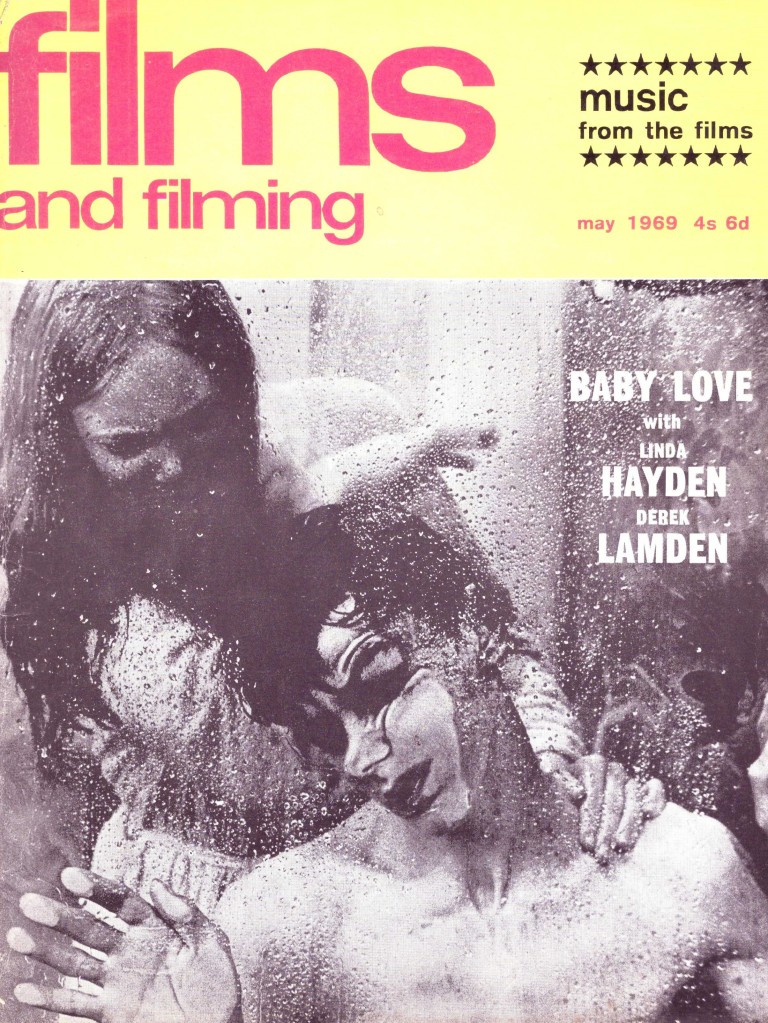
I chose this purely on the strength of the score. I first heard the theme on this album when I was in my teens. Fearing that my parents might veto the purchase because of the nudity on the cover – and since the record player was in the lounge – I showed suprising nous for a teenager, and stuck sticky tape over the offending bits. Of course, I then had to come up with a reason why there would be brown sticky tape on the album cover.

Beyond the to-and-fro of each couple’s situation, there’s little in the way of story, but the dialog is refreshing as it winds back and forth through a variety of emotions, including playfulness, a genuine sense that this is not about scoring points but exploring characters, each development the consequence of action however minimal. The mood is often bleak but always ruminative, a sense that emotions could tip at the touch of a switch, nothing quite defined, except that angst one way or another is going to hold sway.

Most British kitchen sink dramas of the period took place up north, not in the country’s capital, and the wife is too young to expect to be so hemmed in by motherhood, unable to grasp, what with the changing times, that she has still contracted, through marriage, to carry the burden of child-rearing.

The sting in the tale is that since the drowned woman is never identified that she turns out to be one or other of the women, my bet being on the wife, who seems at the end of her tether. This might have been more easily tagged as a couple of one-act plays except for the concentration on the drowning and the focus on girlfriend and suitor exploring various parts of the capital at its least tourist-y. But it’s almost a ghostly city, hardly the location for romance.

Judi Dench is superb – she won the Bafta that year as the Most Promising Newcomer – as she captures a character twisting and turning in a situation she never expected to be so depressing. But Ann Lynn, whose career did not have as much upward mobility, is equally expressive as she changes from morose to excited until heightened romance is sufficient to kill off any expectation of fulfilment. Norman Rodway (The Penthouse, 1967), Joe Melia (Modesty Blaise, 1966) and Brian Phelan (A High Wind in Jamaica, 1965) has less room for  development, tending to be more focused on pleasure than emotion.

This didn’t open too many doors for writer-director Anthony Simmons (Your Money or Your Wife, 1960) and he didn’t get behind a camera for another eight years and only made four films in total. Quite why he was so ignored remains a mystery because this is a haunting piece of work, with an excellent script. John Barry (The Lion in Winter, 1968) wrote evocative score.  

Worth seeing for Dench’s performance alone.

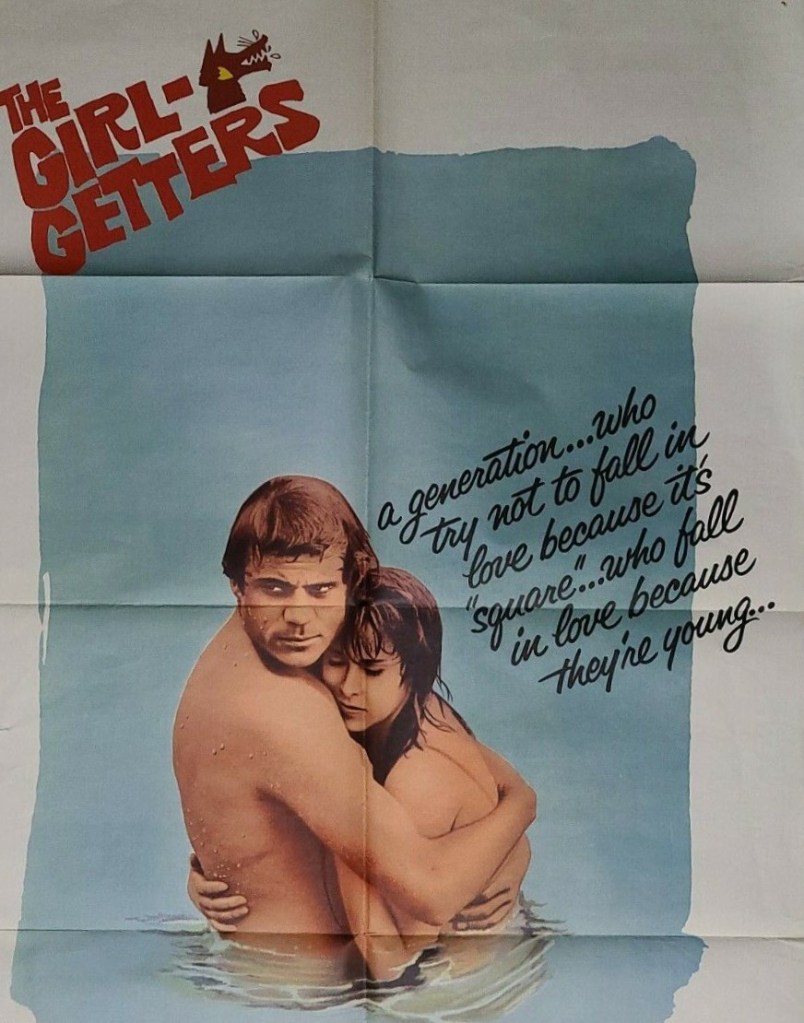
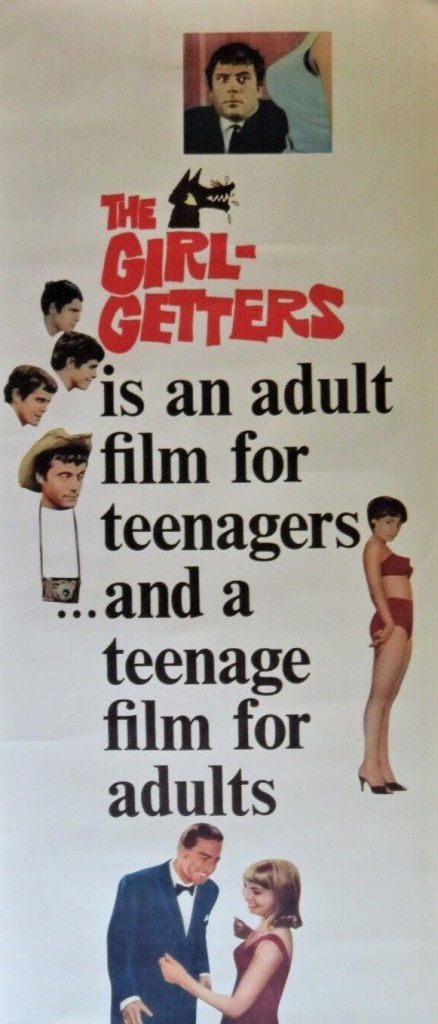
The System / The Girl-Getters (1964) ***

Surprisingly subtle performance from Oliver Reed (Hannibal Brooks, 1968), eschewing the trademark quick inhalation of breath and steely glare, as leader of a gang seducing impressionable young girls during the summer season in an English seaside town.  Surprisingly artistic touches – swipes, montage, a meet-cute involved blowing bubbles – from the more usually heavy-handed director Michael Winner (Hannibal Brooks). Surprising amount of rising talent including cinematographer Nicolas Roeg (Don’t Look Now, 1971).

And unlike the previous The Damned / Those Are the Damned (1963), the impromptu gang headed by Tinker (Oliver Reed) is not hell-bent on violence and destruction, and the various seducers, thankfully, could hardly be described as sexual predators. Young girls away on their own for the first time, disappointed not to find the love of their lives,  are still happy to settle for a holiday affair.

The American title is more appropriate and only an overbearing parent would dream of marketing it – effectively from the male perspective – as girls entering perilous territory rather than with the lightness of tourist romance a la The Pleasure Seekers out the same year. The “system,” a misnomer if ever there was one, involves the guys finding various ways of getting tourists’ addresses – Tinker as a beach photographer has the advantage here – in order to seduce them.

Sometimes the plan goes wrong and a girl gets pregnant leaving Nidge (John Alderton) not only abandoning the frolics but doing the decent thing by proposing. Oddly, there’s no sense of the guys competing with each other for the biggest tally of notches on a bed-post; in fact they’re a democratic bunch, dividing up the potential prospects equally.  Equally oddly, I guess, none of the women come across as virgins, no first-timer angst.

Tinker, who spends most of his time avoiding telling compliant girls what they are desperate to hear, i.e that he is in love with them and that the holiday affair might turn into something more permanent, falls for posh model Nicola (Jane Merrow).

There is some, for the time, risqué material, a view in very long shot of a nude woman, a girl in bra and panties (getting dressed after sex, so perhaps where Roeg got the idea from for the famed montage in Don’t Look Now), a brutal fight between rival photographers, camera smashing on the stairs. But there’s also Tinker’s humiliation by the jet set as he tries to fit in, thumped at tennis, and dumped by the married lover he ignores during the season. There’s surprising inventiveness, a demonic parade where effigies of bride and groom are burned on a pyre, a soulful scene of a bubble salesman blowing bubbles on a deserted beach at night.

The twist is of course that some girls come to the seaside town to find boys from whom they want no commitment, instead just the enjoyment of a casual fling. Should a man like Tinker happy to fall in love, more fool he.

Naturally, with a film aimed at the young crowd, there are snatches of pop performers – the Rockin’ Berries the most prominent – and a rock arrangement of Khachaturyan’s Sabre Dance that would four years later become, for someone else, a hit single.

Oliver Reed proves very engaging, especially when in playful mode, benefitting from lengthy screen time rather than being forced into a supporting actor’s scene-stealing. Jane Merrow (The Lion in Winter, 1968), excellent as the self-aware boy-getter, heads a raft of rising talent that includes David Hemmings (Blow-Up, 1966), almost unrecognisable with a side parting rather than the trademark mop of hair, and really a bystander here. John Alderton (Hannibal Brooks) is also permitted more artistic leeway, and takes it, rather than the comedic gurning of later years.

Look out for Julia Foster (Half a Sixpence, 1967), Barbara Ferris (Interlude, 1968), and Ann Lynn (Baby Love, 1969). Even Harry Andrews (The Hill, 1965) tones down his usual screen persona.

Considerably more thoughtful and visually interesting – and occasionally playful, for goodness sake – than anything else Winner produced during the decade. A good script by Peter Draper on his screen debut makes its points without either being too clever or too forceful.   

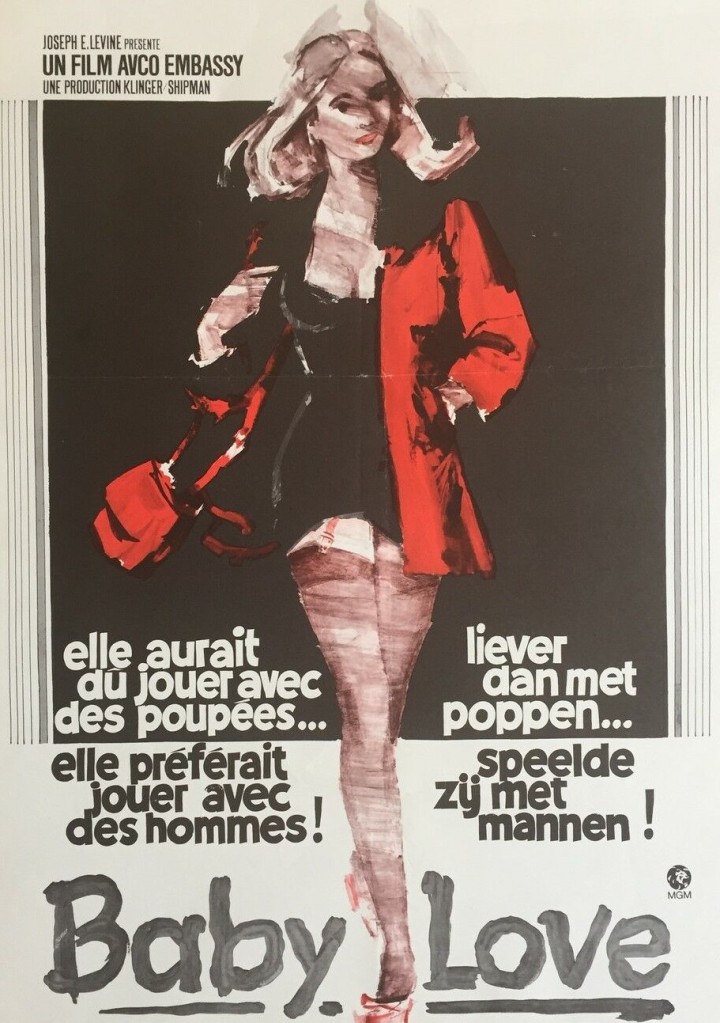
Baby Love (1969) ****

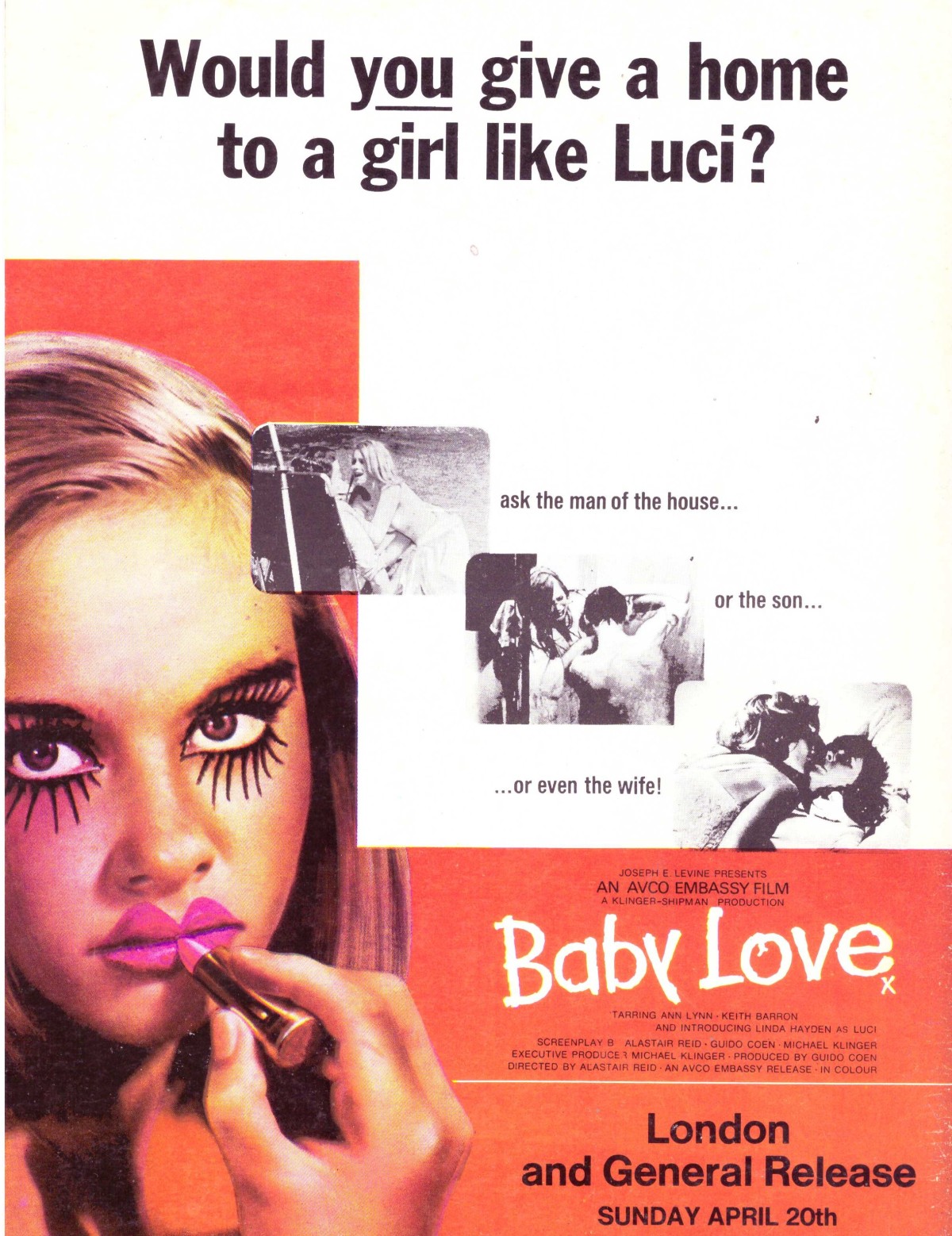
Disturbing tale about grooming marking the debut of Linda Hayden could not more accurately reflect changes in public perception from over half a century ago.  What had originally seemed a movie about a young woman wreaking havoc on a middle-class family is now more easily recognized as a more sympathetic study of a young girl denied familial attention attempting to find a stable and welcoming home.

After the suicide of her mother (Diana Dors) Luci (Linda Hayden) is taken in by Robert (Keith Barron), a highly successful doctor and ex-lover of her mother, and his wife Amy (Ann Lynn). His marriage to sophisticated housewife Amy is distinctly rocky. They live in a fabulous three-storey house on the bank of the Thames with son Nick (Derek Lamden), a typical teenager the same age as Luci but who is sexually naive, confused and hypersensitive. Amy comforts Luci when the young girl has terrible nightmares and ends up sleeping in the same bed until she realizes how inappropriate is such behavior.

Nick chances his arm with Luci but is continually rejected, not surprisingly since his approach is more than a tad creepy, spying on her in the bathroom, entering her bedroom when she is naked, leching after her in the garden. Robert is the only one to try and keep his distance and in the absence of her own father becomes the subject of a father fixation.

Conditioned to accept the advances of older men finds her in potentially unsavory situations in a cinema, a club, and with a friend of the couple (Dick Emery). That she apparently welcomes such attention reveals the depth of her grooming, not just forced to watch her mother make love, but, as suggested in a flashback, the mother complicit in not preventing her lovers making a play for her. If Luci appears sexually confident that only disguises her inner turmoil, a desperate need to be loved, lack of proper parenting and setting of boundaries and having chanced on a proper home determined to do whatever it takes to remain there.

It is actually Ann who is the disturbing element, eventually overcoming her own inhibitions and not only seducing the girl but telling her that if she wants to remain in the house she will need to twist Robert round her little finger. And the only way she knows how to do that is follow her mother’s example and exploit her sexuality. If Luci appears exploitative in the context of the family that is only because they are not privy – as is the audience – to the depth of her nightmares, the constantly reappearing image of her mother dead in the bath, her mother’s leering lovers. Even when she goes over-the-top with make-up or clothing there is an innocence to such behavior, little more than a young woman testing boundaries and trying to find her way. Any intelligent assessment of what is going on would clearly see the child as the victim.

The grandeur of her new potential home bears no comparison to the poky working-class council house she occupied up north. For a child with such an impoverished upbringing, she is fairly grounded. She is not the wild child you might expect from her upbringing. She fits well into family life, happy to listen to classical music, and to Ann’s astonishment can actually cook breakfast and knows how to lay a table, skills her spoiled son patently lacks.

Considerable efforts are made to make each character more rounded. Robert hates his wife’s sophisticated parties and is an insomniac judging from the stack of books on his bedside.  The guilt he feels for abandoning Luci’s mother, apparently his one true love, in favor of ambition, is exacerbated by Luci’s presence that reminds him not only of a path wrongly chosen but of what he has lost, that relationship ripped asunder when abortion entered the frame.

Ann clearly needs to project success, expensive clothes and champagne the least of their lifestyle, and with little outlet for pent-up emotion and a need to mother settles on Luci as the object of, initially at last, her affection. Nick hides his cigarette ends in a matchbox, would accept Luci as just a friend, occasionally rising to the role of protector, delighted to be seen in the company of a beautiful girl. Teenage fantasy in other words but with an edge of entitlement that goes too far.

In her debut Linda Hayden (Taste the Blood of Dracula, 1970) is superb in an extremely difficult role and it was a shame that it was the sexual part of her portrayal that made its biggest impact on future movie producers rather than the sensitivity of her performance, the look in her eyes when she is shown her bedroom for the first time is amazing. Also making a  movie debut Keith Barron (Nothing But the Night, 1973) lacks the mellifluous tones that were later his hallmark and his performance as unloved husband and guilty ex-lover is very well observed.

Ann Lynn (I’ll Never Forget Whatsisname, 1967) has the most challenging role of a woman tortured by desire she has until now kept hidden or under control. Derek Lamden did not make another movie. Diana Dors (Hammerhead, 1968) has a fleeting role.

It wasn’t the fault of director Alasdair Reid that uber-producer and marketing kingpin Joseph E. Levine (The Carpetbaggers, 1964) wanted to sell a different movie from the one that was made, focusing on titillation and turning Luci’s sexual confusion into something predatory. The idea that this movie is a sexualized film noir is a marketing trick. Closer re-examination reveals that Luci is entering a disturbed household, one she lacks the skills to negotiate and is in reality the exploited one.

In fact, Reid (Something to Hide, 1972) did a very commendable job. He made some bold decisions especially relating to sound. The opening credits are accompanied by the sound of a dripping tap that would turn into a cascade of water. That would become a recurring motif, along with steam. Most scenes lacked music. Although most nightmares are image-driven, the initial one is full of clashing sound as well as disturbing sights. As the movie hits its stride, a clever device is adopted, showing disturbing images outside the house that are actually, you quickly discover, another nightmare. Mostly the camera remains fairly static but it occasionally swoops to represents anxiety from one point-of-view. The bulk of the story takes place in the house but when the camera goes outside, to a disturbing scene on the river for example there are original ideas, one character speaking through a megaphone.

Passed by the British censor with an X-certificate then and an 18-certificate DVD today, it still has the power to shock. However as far as I can see it was last classified in 1994 and I have written to the BBFC to see if that classification should still stand.

Well worth a reappraisal.

Network has this on DVD.

Discover WordPress

A daily selection of the best content published on WordPress, collected for you by humans who love to read.

The Atavist Magazine

by Brian Hannan

WordPress.com News

The latest news on WordPress.com and the WordPress community.