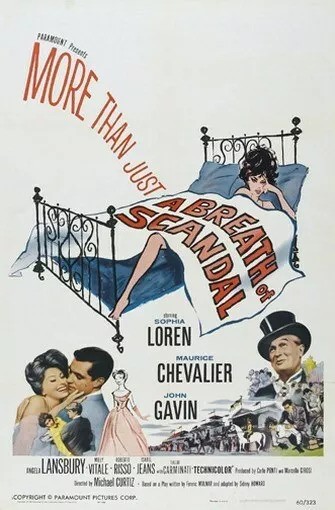
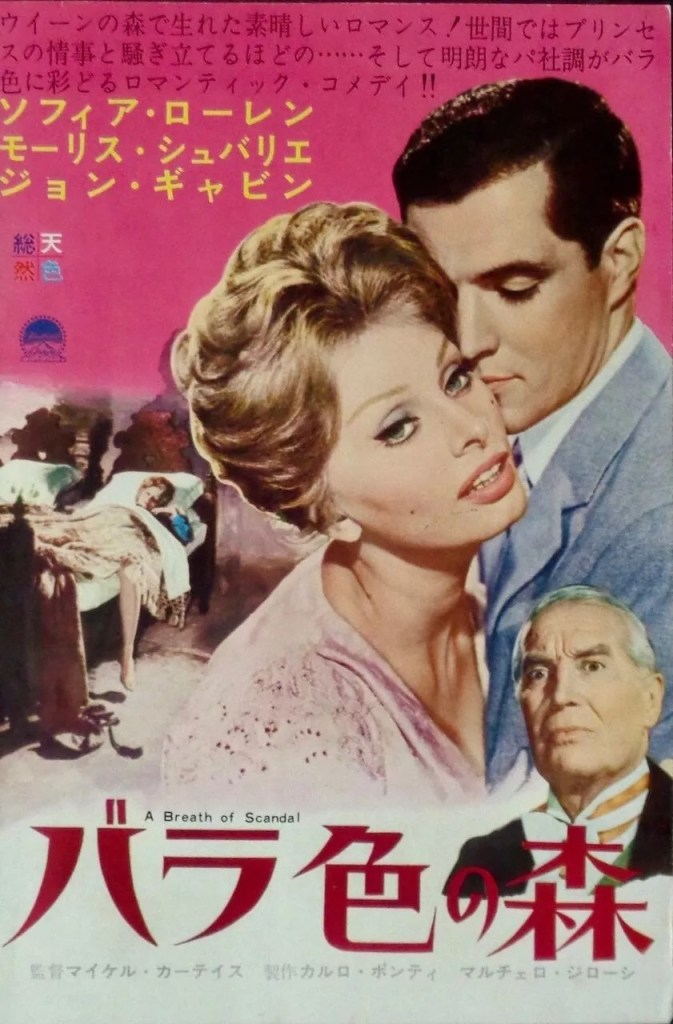
Sophia Loren in playful mood. Not every serious actress could whip up a confection as light as this. She was in the middle of a romance period embracing both comedy and drama that began with Houseboat (1958) and rattled through to The Millionairess (1960) before embarking on a half-decade of more serious stuff starting with her Oscar-winning performance in Two Women (1960).
Easy to dismiss her here as all pout and bosom, but there’s a distinct egalitarianism on show, especially given it’s set in early stuffy 20th century Vienna, where protocol reigns, making life difficult for a lass who wishes an active sex life outside the constrictions of marriage.
There’s not much to the story, in fact it’s as flimsy as heck, but the kind of picture that a top star can swan her way through and charm the audience with her.
When we meet Olympia (Sophia Loren) she’s been exiled to the countryside for one scandal too many and to ease her boredom takes potshots at anyone visiting her quaint castle. Out horse-riding, she tangles with a motor car driven by Yank businessman Charlie Foster (John Gavin) and engineers that they spend the night in a nearby hunting lodge, leading him to believe she’s an ordinary peasant girl and not a princess.
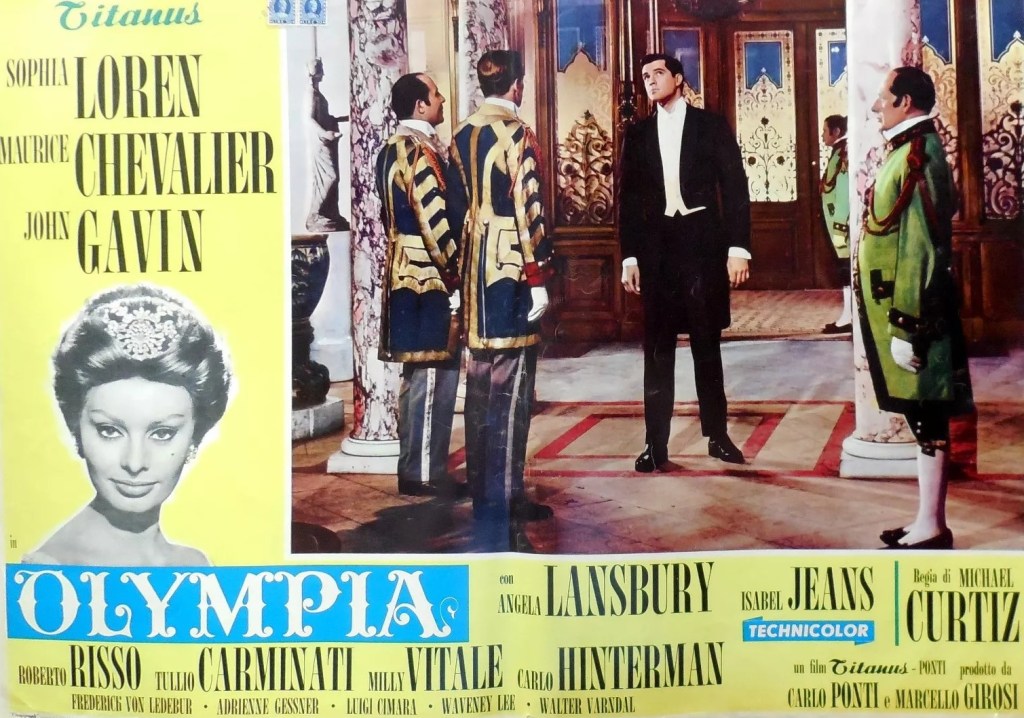
Summoned back to Vienna by her father Prince Philip (Maurice Chevalier) and mother Princess Eugenie (Isabel Jeans) because they’ve found a prospective suitor in Prince Ruprecht (Carlo Hintermann), she encounters Charlie again because he’s trying to sell her father on some business deal.
On the sidelines causing trouble is (Angela Lansbury) who threatens to dish the dirt on Olympia and Charlie and cause a great scandal. And, really, that’s all there is to it except, as had become somewhat de rigeur in his pictures, Maurice Chevalier chips in with a song.
But the settings are glorious and costume design takes the top prize. While everyone else has a whale of a time, John Gavin (Midnight Lace, 1960) looks lost, wooden and out of his depth, unable to respond to the mischievous sparkle of La Loren. This could easily have been devised to show Loren at her marquee best, the belle of the ball, but with a cunning mind, quick repartee, and surprisingly feminist in her approach.
It was one of those Hollywood-Italian co-productions that were starting to take off with little regard for national gridlines. Though set in Austria, the female lead was Italian, male lead American, Maurice Chevalier (Jessica, 1962) as French as they come, Isabel Jeans (The Magic Christian, 1969) is English and director Michael Curtiz (The Commancheros, 1961) Hungarian.
It’s hardly demanding and since Gavin doesn’t step up to the plate lacks the necessary sizzle but all that means is Loren can steal the spotlight. Walter Bernstein (The Magnificent Seven, 1960) and Ring Lardner Jr (The Cincinnati Kid, 1965) turned the Frederic Molnar play into a screenplay.
Easy to criticize if you’re wanting something more demanding, but otherwise effortlessly enjoyable.
Big difference between the manufactured maudlin of a weepie and middle-aged characters so ill-at-ease and discomfited that they are painful to watch, circumstances not redeemed by comedy. Audiences and critics didn’t take too kindly to this because the two stars were way out of their comfort zones. Glenn Ford (Rage, 1966) dropped his take-charge quiet-tough-guy persona, and didn’t even play that for laughs, and Geraldine Page (The Sweet Bird of Youth, 1962) rid herself of the tragic face that sacrificed itself on the altar of Oscar (at this point she was three-eights into her Oscar nominations haul).
The whole unremittingly sad enterprise would have been made for today’s generations, more acceptable of the sour ending and the clunkiness of romance that fails to gell.
Harry (Glenn Ford), a greetings card salesman who falls back on his own profession in his chat-up lines, thinks he has achieved his goal of settling down with widow Phyllis (Angela Lansbury) and becoming father to her young son, enjoying domesticity, extended family round for dinner, playing baseball and larking about with the boy. Evie (Geraldine Page) is too much and not enough, too big in her personality, not enough of whatever it takes to make her a long-term proposition for the opposite sex. They meet at a convention, hers, she’s a postmaster, he’s just staying at the same hotel.
She’s at least the more self-aware, wants more than the one-night stand of convention life, reluctant to take her place among the singletons, can’t work out why if she’s the life and soul of the party that at party’s end she’s still sitting on the shelf. But she also wants recognition – of some kind – makes fictitious calls to hotel reception so that a bellboy will troop round the lobby calling out her name. She brings her own lightbulbs, to replace the low-wattage ones in a bedroom, forever trying to adjust the world o her own vision, teasing bedroom curtains out in a different fashion, mild invention that keeps her sane regardless of how insane some actions are, charging ahead to open every door in the expectation that she shouldn’t count on male gallantry (this is the 1960s after all).
Harry’s the guy who does open doors for women, but cursed with loneliness, caught in embarrassing gaffes, chatting up the dumb kiosk blonde who’s a good bit more savvy. Most of the comedy hurts. He’s late to meet his boss because he stopped off for a martini at the apartment of an occasional lover and when he trips out too many excuses is told, tartly, that while one excuse is acceptable, three or four (train late, weather, can’t get a taxi, taxi stuck in traffic etc) is the sign of a liar. He does the whole unnecessary explanation routine when booking a hotel room for a tryst with the blonde whom he pretends is his wife not noticing the receptionist’s cynical eyebrows, and brought down to earth when said blonde breezes in and calls out a greeting to the receptionist.
Evie works out how to get a table in a packed restaurant, passing onto Harry the clever trick of saying you are waiting for a date and then apologising when they don’t turn up. When he tries this out, the waitress upends him with, “Why not join this lady (Evie), she can’t imagine either what happened to her date.”
There’s nothing cute about either of them so no chance of a meet-cute. She’s continually awkward, independent, and he doesn’t know how to spell out his troubles or work out why he’s walking into an unsuitable marriage. The only room this movie has for comedy is the sudden appearance in Harry’s life of a bearded teenager who usurps his bedroom (girlfriend constantly in the bath). This lad is Phyllis’s grown-up son Patrick (Michael Anderson Jr.) yet Harry’s been led to believe, or thinks he has, that the boy would be much younger, judging by the treasured photo given him by his fiancée. On the one side is a slab of situation comedy, on the other an out-of-his-depth Harry not knowing if he’s been duped and realizing how little he knows of genuine fatherhood. He’s awkwardness grown ten feet tall.
It’s not as if Harry and Evie actually conduct a romance, there’s some kind of attraction that neither can fully recognize, every time it sparks up as likely to wilt, and he’s prone to letting her down, sudden arrangement with son taking precedence over pre-arranged dinner with her, except, she’s mollified because he left her a note at the desk, and she doesn’t get those unless she manufactures them herself and then in her ungainly way lets everyone know someone has tried to contact her, as if that’s a sign of importance, or explanation for her feeling of being so let-down.
Phyllis turns out not to be the smalltown housewife of whom Harry dreams. She’s had enough of being a housewife. She wants what she sees as the high life, living out of hotels, “From now on I just want to pick up the telephone” and order food, cocktails, laundry, newspapers, whatever. Just what different paths they are on is detailed in a killer of a line. When he complains – it would be an accusatory tone if he could muster up the courage – about why she gave him this particular photo of the boy, as a kid not a man, comes the rejoinder, “Because that’s the best picture of me that’s ever been taken.”
You’d be lucky to find romance in this sullen snarky version of New York, filled with uncivil, unhelpful staff, bursting with indifference, nary a touch of sympathy for any customer, whether they are seeking a room in a city jam-packed with conventions or just a cup of coffee.
If you believe in the tagged-on happy ending, you’ll believe in anything. This pair are so discordant, so jarring, that they are probably the most realistic couple to ever grace the screen. Ignored as their performances are, they are probably the best of their careers, in part because neither is central to the bigger story that a high-end drama or western or thriller might entail., in part because they go out on an acting limb, light years away from their established screen persona. They are just so darned realistic your heart bleeds because you just know they are doomed into making relationship mistakes, most likely with each other, and will remain among the jittery unfulfilled, wondering how everyone else manages it.
Director Delbert Mann’s been here before – Oscar-winner for Marty (1955), drawing an Oscar-winning performance from David Niven in Separate Tables (1958) and James Garner’s best performance in Buddwing (1966) – and makes acceptable viewing out of what in the hands of a Harold Pinter would be an impossible watch. But even so, it comes close. Tad Mosel (Up the Down Staircase, 1967) wrote the screenplay.
Had this been an an arthouse picture, it would be drenched in awards.
Surprisingly frank, for the times, exploration of a failing marriage that tackles sexuality, racism, bullying, teenage angst. In those days there was no such concept as midlife crisis, so the general attitude of grin-and-bear-it results in a melancholy that suffuses the picture. Adapted from the Broadway hit by William Inge (Splendor in the Grass, 1961), provides more insight into American family life than the more souped-up soap operas of the Peyton Place variety. Except for crisis escalating action, could well have been misery memoir.
Opens with a surprisingly tender scene that’s again pretty raw for the period. In the morning, salesman husband Rubin (Robert Preston) strokes the arms and face of waking wife Cora (Dorothy McGuire), clearly hoping to initiate sex, when she abruptly rebuffs him. Before he sets off on a week-long business trip he tries to toughen up bullied friendless overly-mothered son Sonny (Robert Eyer), afraid of the dark, and bolster the flagging confidence of inhibited teenage daughter Reenie (Shirley Knight), only succeeding in inadvertedly punching his son in the face and triggering a row with his wife.
But, without warning, he’s fired from his job and not equipped to compete in the employment arena with a flood of younger people with college degrees and greater stamina. Pride prevents him owning up to Cora, rejection sends him to the bottle and a lady friend, hairdresser Mavis Pruitt (Angela Lansbury) who scandalizes the town by (and this dates it) always leaving the top button of her blouse open. Cora plans escape, hoping to go and live, temporarily until she can find a job, with bossy sister Lottie (Eve Arden) in Oklahoma City.
Meanwhile, following an accidental meeting, the hesitant shy Reenie strikes up a rapport with the more outgoing confident Sammy (Lee Kinsolving). Lottie isn’t so keen to help out her beleaguered sister. When Rubin finally returns after a four-day absence it’s to a welter of home truths.
He still can’t bear to admit the loss of his job. The uneasy truce is shattered when Sammy is chucked out of a party he attends as Reenie’s escort at the country club for being a Jew. Subsequently, he attempts suicide and dies, leaving Reenie in shock. Cora determines to find out for herself the rumors concerning Rubin’s affair. But it turns out, although Mavis is deeply in love with Rubin, they’ve never slept together, providing Cora with a second chance to make her marriage work.
What distinguishes the movie is the revelatory dialog you’d expect from an award-winning playwright like Inge. Characters reveal their inner selves, not always with prompting, and not always in argument, and such lines often bring characters to life. Included in that are some of the subsidiary characters.
For example, Ralston (Ken Lynch) whom Rubin openly dislikes because he successfully got away with an insurance scam that turned him into a millionaire, hides away in the back room of a pharmacy, drinking away his guilt. “I know what I am. Who I am,” says Ralston, “the town scandal.” And you think this is maybe just a passing character, but this is the guy, guilt or no guilt, who enforces the country club ban on admitting Jews.
The controlling Lottie suspects her husband’s need for a long walk in the evening is to get away from the sound of her voice. Unusually, the sisters broach the subject of intimacy. Lottie confesses, “I never enjoyed it the way most women say they do.”
What’s keeping Cora and Rubin apart is their lack of intimacy, caused by their battles over money, the husband refusing to get into debt to satisfy his wife’s yearnings not necessarily for the finer things of life, but to avoid the endless scrimping and saving, getting maximum wear from a dress for the growing Reenie by turning it into a skirt.
Rudin laments, “Was a time you liked what I had…If you can’t remember sowing all those wild oats with me, I just plain give up.” Finally, they get to the crux of the matter (again bold language for the times). Rubin asks, plaintively, “How come you don’t enjoy sleeping with me any more?” Retorts Cora, “I can’t fight with you all day and then go to bed with you at night.”
If there is a flaw it’s some attitudes that will jibe with contemporary audiences. “If I had a real wife,” argues Rubin, “I wouldn’t have to go high-tailing it to Mavis Pruit.” And I winced at this particular line: “I wished someone loved me enough to hit me,” says a wistful Lottie hearing that, for the first time in his life, Rubin slapped his wife. Lottie clearly equates manliness and ardor with such violence.
But on the whole, the dialog is a cut above. I’m not sure how much came directly from the play itself and how much was added by screenwriters Harriet Frank Jr and Irving Ravetch (Hud, 1963). The opening certainly, such a situation might be mentioned in the play but a bedroom scene like that would never be staged.
More at home in the theater than on screen Robert Preston (he only appeared in five pictures the whole decade including The Music Man, 1962) exudes such energy as the salesman that you can see how denial of sex would destroy his self-confidence. Dorothy McGuire (Swiss Family Robinson, 1960) is excellent as the wife trying her best not to end up as a put-upon stereotype. Shirley Knight (Petulia, 1968) was Oscar-nominated, Angela Lansbury (The Manchurian Candidate, 1962) came across as too wise to be a loose woman, and Eve Arden (in her only movie of the decade) impresses as the bossy sister.
With such terrific material and an excellent cast, Oscar-winning director Delbert Mann (Buddwing/Mr Buddwing, 1966) doesn’t need to do much to guide this one home.
The most celebrated of the conspiracy thrillers and rightly so. But I’m not going to start with the Korean brainwashing, extraordinary cinematic sequence that that is, but with the scene on the train, the pickup scene as it might be known in those days, meet-cute now. There is little cute about this picture which stretches the bounds of normality. And I guess I was already so unsettled, and perhaps settling into film noir mode when an easily available woman was always to be distrusted, and thought that the sudden appearance of Eugenie (Janet Leigh) was a plant.
But that wasn’t in itself what lodged that scene in the caboose so firmly in my mind. But the superlative acting of Frank Sinatra as the investigative Major Marco. Sure, we’ve seen good, sometimes great acting before from Sinatra, generally under-rated due to the myth that nobody could seriously give a good performance after just one take, as if stage actors do not do this every night of the week. But this is above and beyond.
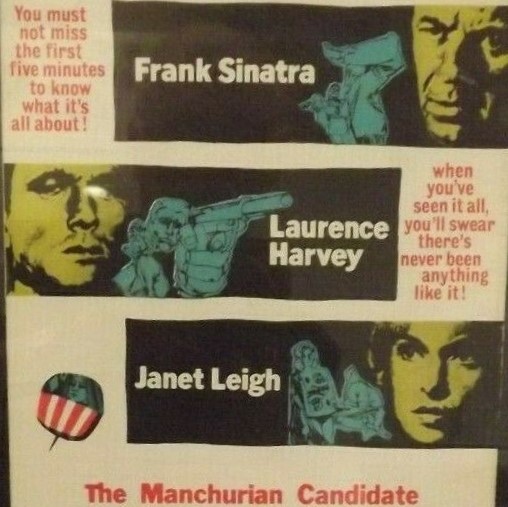
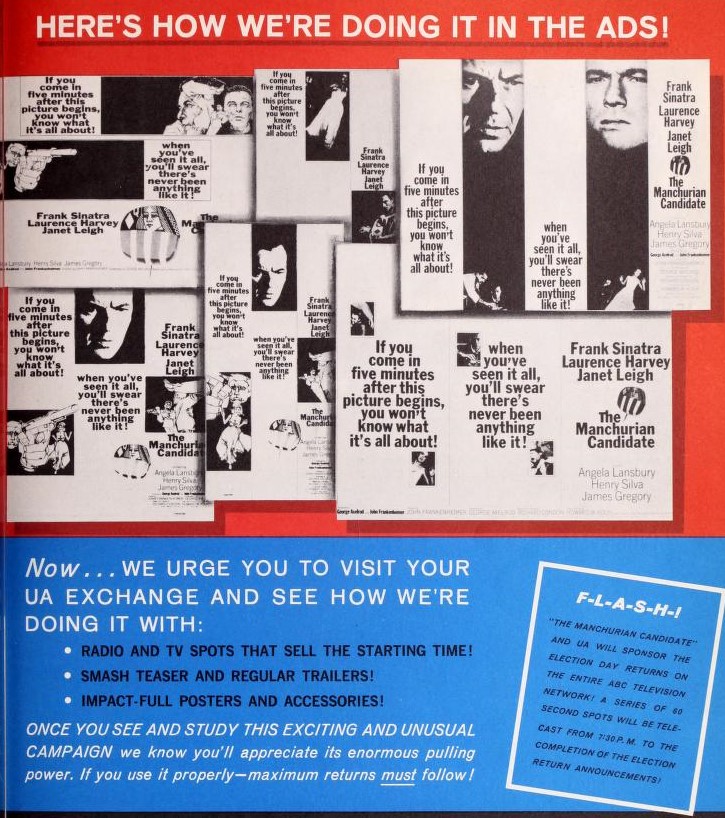
Ads aimed at the cinema manager.
What makes this so outstanding is the depth. Whatever he is saying, that’s not what he’s thinking. He is so dislocated his mind is elsewhere.
Now you give an actor punchy dialog and that’s the way he’s going to treat it, like a punchball, zing zing zing, but that’s not the case here. You can see from his expression that while he is responding well enough to this apparently sympathetic dame that his mind is not completely gone, but that he is barely holding himself together. Another actor would have shown greater signs of mental collapse, signs of a tear perhaps or using an artefact for support, a glass to crush in his hands. But not here. It’s all in the face.
He’s helped of course that the dialog is all about identity. Who is Eugenie? Not as in, who is she really, which would be a good question to ask at this point in the proceedings, but how does someone cope with a name like Eugenie and so the dialog rambles around the various shortenings of her name, while at the same time, recognising he desperately needs a port in a storm, she ensures she knows her address.
The way this movie is going that could be code, too, or a trigger, or that when he turns up at her apartment he’s going to encounter some obstacle, but it doesn’t turn out that way either, even though this is a movie where no one is what he or she seems. Insanely ambitious politician’s wife Eleanor (Angela Lansbury) double crosses her country, the Koreans double cross her by turning her son (rather than any old grunt) into an assassin, and in the end the son, the rather effete Raymond Shaw (Laurence Harvey), turns on the mother in the most murderous way imaginable. Much as she loves her son, she is willing to sacrifice him for the chance of becoming the President’s wife and when she does will exert her revenge on the Koreans.
The “exchange” is an old industry term, literally like a library, meaning where you would take the movie you had just screened and swap it for your next movie. You would pick up all your advertising material and campaign manual at the same time. Certainly saved on the postage. And the exchange manager, meanwhile, would try to sweet talk you into taking another movie you had never heard of.
I’ve gone on before about the beauty of the single-take movie (Grenfell, 2023) but here I’m in raptures at the single scene, how a movie pivots on superb acting. I could have used the brainwashing as an example, but that’s not about acting, but about directing, about perception, about how the audience as much as the participants is being led around by the nose by director John Frankenheimer, who would return to questions of identity and voluntary brainwashing in Seconds (1966).
But back to the brainwashing. This hits the mother lode. A troop of captured U.S. soldiers face an audience with a ringmaster demonstrating just how much they are under his command and can be hypnotised into carrying out any order, even cold-blooded murder. But each of the soldiers sees a different audience. That’s the cinematic coup. I would have loved to have been part of the original audience back in the day, brought up on war movies or thrillers that followed a straightforward narrative arc. Even critics singing the praises of the French New Wave would have never seen anything like this.
Anyway, it soon occurs to Major Marco that his ongoing nightmares are part of a deeper problem especially as his memory of Shaw does not tally with what he finds himself saying about his troop leader.
We follow two parallel stories, Marco trying to get to the truth before he fries his brain, and the audience being let in on much of the truth by tracking Shaw, who, to spite his hated mother, has taken a job with, effectively, the opposition and has fallen in love again with Jocelyn (Leslie Parrish), the daughter of one of her husband’s most implacable foes.
You couldn’t get a more twisty movie, set against the backdrop of the Communist witch hunt, when a politician could garner headlines just by pretending to name Communists in high office. The political element is just as cynical as the same year’s Advise and Consent and savage as the ineffectual Senator Iselin (James Gregory) is, he’s not much worse than the clowns in the Preminger picture. So it all rings true.
There’s scarcely a moment wasted as the movie screams towards a terrifying climax. The built-in control trigger I didn’t see coming, and Shaw’s transformation from strict man-in-charge to bumbling romantic fool is a joy.
Frank Sinatra (The Detective, 1968) gives the performance of his life, Laurence Harvey (Life at the Top, 1965) proof of the power of love, Angela Lansbury (In the Cool of the Day, 1963), the mother from Hell, are all outstanding. The support cast includes Janet Leigh (Psycho, 1960), Henry Silva (The Secret Invasion, 1964) and John McGiver (Breakfast at Tiffanys, 1961).
Frankenheimer directs with elan from the script by George Axelrod (Breakfast at Tiffanys) based on the Richard Condon (The Happy Thieves, 1961) bestseller.
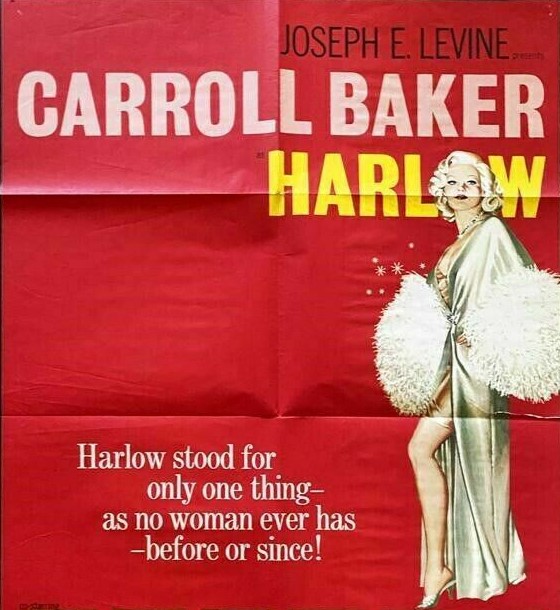
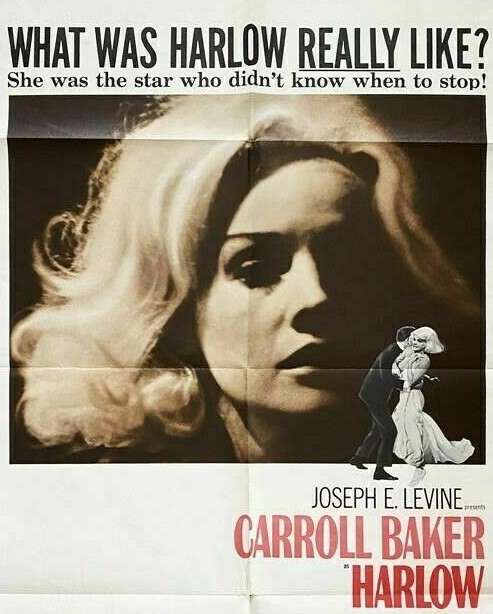
Harlow presents such a convincing picture of Hollywood abuse that I was astonished to discover that it was not entirely truthful where the title character was concerned.
Jean Harlow was a hugely popular star in the 1930s before her untimely death at the age of 36. This film depicts her as a virgin (not true) who turns neurotic (not true) after her impotent husband commits suicide (debatable) on their wedding night (not true) leading to her go off the rails and die from pneumonia (not true). But in terms of the Hollywood system a great deal rings true and if the Me Too movement had existed in the late 1920s the finger would be pointed at a huge number of men.
The film is at its best when dissecting the movie business. A five-minute opening sequence demonstrates its “factory” aspect as extras and bit players clock in, are given parts and shuffle through great barns to be clothed and made up, often to be discarded at the end of the process.
No sooner has this version of Jean Harlow (Carroll Baker) been given a small part than she encounters the casting couch, operated by a lowly assistant director, who bluntly offers five days’ work instead of one if she submits to his advances. When she turns him down, work is hard to come by and she resorts to stealing lunch before rescued by agent Arthur Landau (Red Buttons). After tiny parts that mostly consist of her losing her clothing, receiving pies or eggs in the face and displaying her wares in bathtubs, she geta a big break only for that producer to demand his pound of flesh – “I’ve already bought and paid for you.” Here she has “the body of a woman and the emotions of a child” and ends up choosing the wrong suitor which leads to a calamitous outcome.
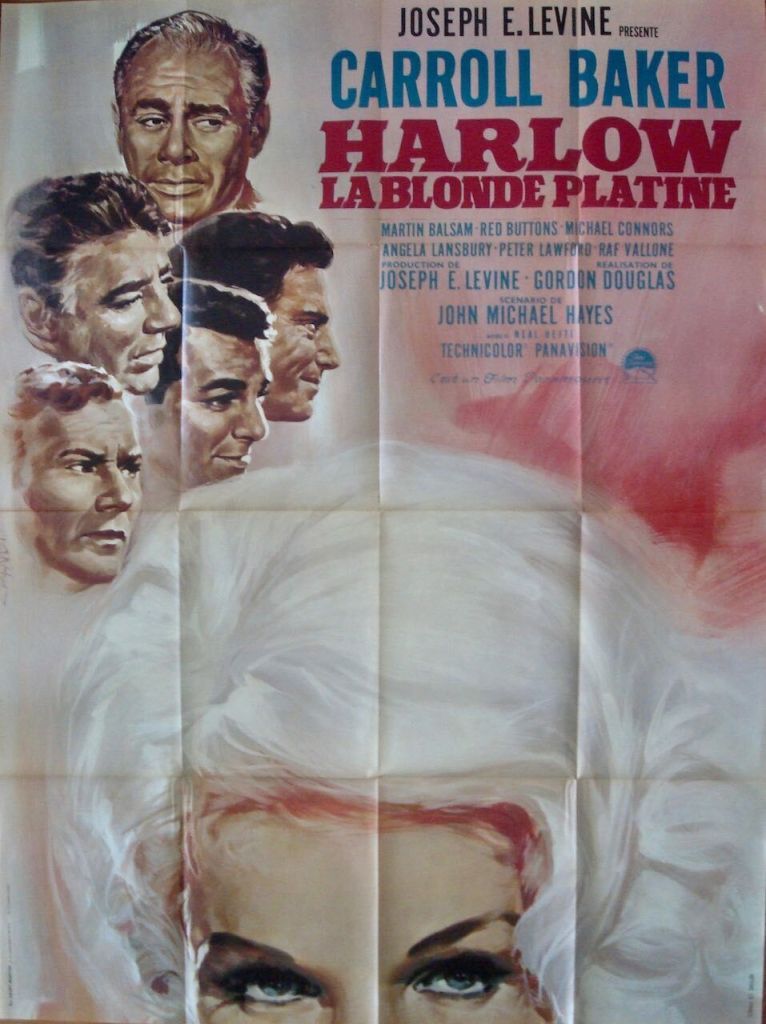
However, the pressures of stardom are well-presented: she is the breadwinner for her unemployed mother Jean (Angela Lansbury) and lazy stepfather Marino (Raf Vallone) and soon box office dynamite for studio chief Everett (Martin Balsam) who sees in her the opportunity to sell good clean sex. The negotiations/bribery/blackmail involved in fixing salaries are also explored.
But the film earns negative points by mixing the real and the fictional. The agent and husband Paul Bern (Peter Lawford) existed but most of the others are invented or amalgamations of different people. MGM is represented as “Majestic” and among her films there is no Red Dust (1932) or China Seas (1935) but lurid inventions like Sin City.
Director Gordon Douglas was a versatile veteran, with over 90 films to his credit, from comedies Saps at Sea (1940) and Call Me Bwana (1963) to westerns The Iron Mistress (1952) and Rio Conchos (1964) and musicals Follow That Dream (1962) and dramas The Sins of Rachel Cade (1961) and Sylvia (1965) which also starred Baker. The opening scene apart, which is a seamless construction, he is adept at this kind of helter-skelter drama. John Michael Hayes (Rear Window, 1954) has produced a punchy script based on the book by Arthur Landau and Irving Shulman.
In the title role Carroll Baker (Sylvia) has probably never been better, comedian Red Buttons (Stagecoach, 1966) excellent in a straight role while the smarmy Raf Vallone (Nevada Smith, 1966) is the stand-out among an excellent supporting cast that also includes Angela Lansbury (In the Cool of the Day, 1963), Peter Lawford (Sylvia), Leslie Nielsen (Beau Geste, 1966), Martin Balsam (Seven Days in May, 1964) and Mike Connors (Stagecoach, 1966).
Except that virtually none of the movie is true, I would have given it four stars for its portrayal of Hollywood but I have come to expect that biopics, while moving facts around for dramatic purposes, are required to be good more faithful to their subjects than this.
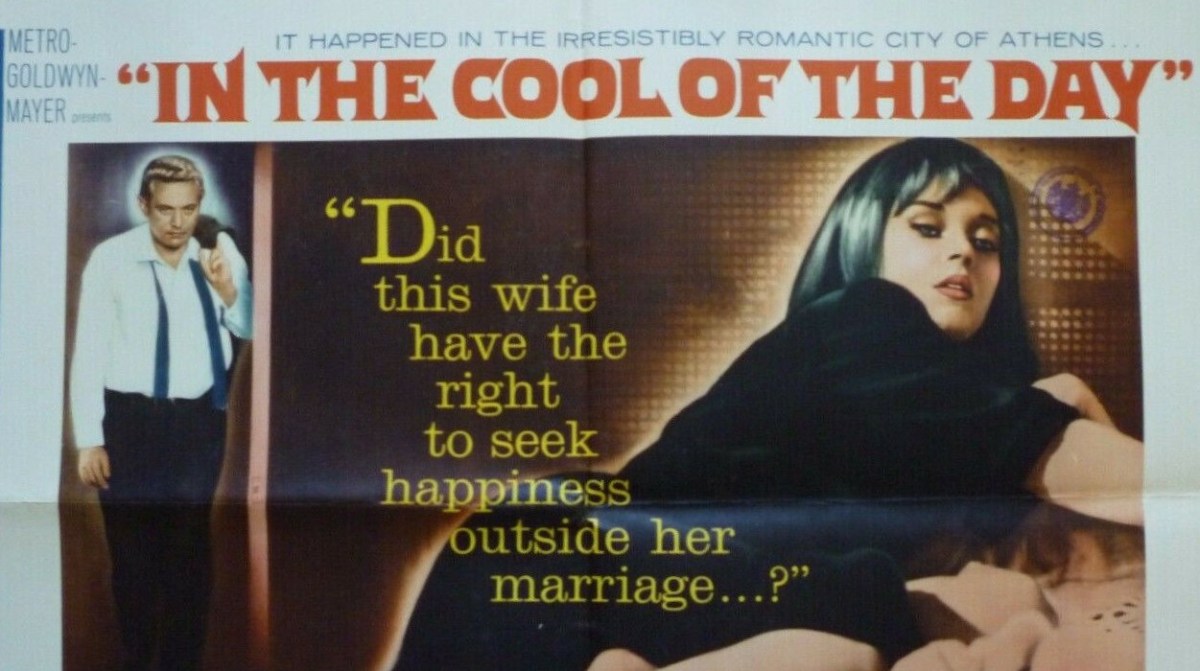
Jane Fonda tagged this the worst film of her career but that’s a bit harsh and I suspect it owed a lot to the actress being dressed up Audrey Hepburn-style in outfits that scarcely suited her. While it’s certainly overheated, melodramatic moments indicated by thundering music, a marvellous supporting cast, including a quite bitchy Angela Lansbury, provides ample compensation.
It’s romance in the Love Story vein, rich young flighty heroine Christine (Jane Fonda) at death’s door half her life, but feeling smothered by understandably over-protective husband Sam (Arthur Hill). When she falls for married publisher Murray (Peter Finch) and sets off on a trip to Greece, chaperoned it turns out by Murray’s bitter wife Sybil (Angela Lansbury), it takes a while for romance to physically bud. That it does at all is only because Sybil has taken off with suave traveling salesman Leonard (Nigel Davenport).
The movie takes a long time to heat up because, as in The Bramble Bush fashion, there’s overmuch character filling-in to do. Part of the interest in this picture is how the bad guys are effectively good guys, more victims of their partner’s behaviour than anything else, though for story purposes, the audience has to be persuaded otherwise.
So besotted Sam, having dealt with umpteen bouts of his wife’s pneumonia and lung operations, a “slave” to her illnesses, is deemed as treating her like a child rather than a wife, preferring her ill rather than well, and denying her the adventure to which she feels entitled. When she meets Murray she has run away. Murray’s wife has a downer on her husband because, wait for it, he killed her child and left her facially scarred (hidden now by hair but she’s still very sensitive about it) in a car accident he caused.
But she’s portrayed as over-sensitive, worried about her appearance, snippy, blaming him for her distraught life, and worse, a philistine, hating being dragged around ancient Greek monuments. Aware of her husband’s proclivities, she mocks, “You’d be an idiot to fall in love with her.” And any time she ventures out, the music rises to a crescendo as if she is a character straight out of film noir.
When she goes off with Leonard, her love affair is viewed as sneaky rather than redemptive, even though he restores her faith in herself. Triumphantly, she tells Christine, “He’s all yours” and her husband “nobody need feel sorry for me any more.”Admittedly, she does take revenge by informing Christine’s husband, who has entrusted his wife to Murray’s care, of their affair. And you would be hard put to argue, although the film wants you to believe otherwise, that Sybil and Sam have been ill-treated by their partners, Sam, in particular, funding her trip to Greece in the hope that allowing her the freedom she needs will save their marriage.
Of course, the characters of both partners, even if their self-pitying is the result of circumstance, do mean that Christine and Murray are presented as people trapped in bad marriages and for whom love, however brief, provides sanctuary from tortured lives, her physical, his more mental, since he is not averse to guilt.
Sybil’s lack of interest in tourist Greece handily gives the prospective lovers plenty time to fall in love, amid gorgeous scenery, and breathing in air rich in culture. With all film made in the 1960s and set in foreign parts – Pretty Polly (1967) another example – sometimes the story takes second place to the scenery, so it’s lucky that the romance is played out against such an interesting background, an ideal combination, killing two birds with one stone if you like. Given this is prior to Zorba the Greek (1964), the filmmakers have even managed to sneak in some traditional Greek dancing, albeit on the deck of a ferryboat.
Dress-wise, the lovers are ill-matched, Murray plodding around in a suit while Christine parades the latest often clingy fashion. When Sybil departs the scene, that leaves one happy character of the happy couple free of marital encumbrance, but still leaves open the question of how Christine will rid herself of Sam and, more importantly, will Murray wish to take on the all-consuming job of nursing Christine. He never gets the chance to find out. When she does fall ill – as the result of Murray recklessly keeping her out in a thunderstorm – her mother Lily (Valerie Kendrick) swoops in to rush her to hospital.
Spoiler Alert – I’m telling you that she dies because it seems to me that the ending the filmmakers hoped for is not how the audience will perceive it. Beautiful young woman dies too young, yep that’s there, but the man, now free and able to shake off his dull life and start afresh as a writer, seems a long shot. Given he has now, thanks to the thunderstorm episode, killed two people, I would surprised if guilt was not uppermost in his mind.
Not so-good-it’s-bad, and despite the complications, and perhaps because of the Sybil-Leonard romance, it’s certainly an interesting picture as much, perhaps, because it fails to send the audience in the desired direction.
In only her fifth movie, Jane Fonda (They Shoot Horses, Don’t They, 1969), exhibiting the nervous friskiness that would become a hallmark, does pretty well with a febrile, spoiled, character. If she falls down at all it’s that she appears uncomfortable wearing Orry Kelly’s fabulous gowns and it would take Hollywood some time to work out she was not a natural successor to Audrey Hepburn. Peter Finch (The Pumpkin Eater, 1964) is perfectly at ease with the illicit.
But Angela Lansbury (Harlow, 1965), a hoot as the wife who turns rejection into triumph, steals the show. Throw in Arthur Hill (Moment to Moment, 1966), Nigel Davenport (Sands of the Kalahari, 1965), for once neither smug nor snippy, Alexander Knox (Khartoum, 1966), veterans Constance Cummings (The Criminal Code, 1930) and Valerie Taylor (Went the Day Well, 1942), John Le Mesurier (The Liquidator, 1965) and Alec McCowan (Frenzy, 1972) and you have a movie where hardly a moment goes by without admiring a performance.
Robert Stevens (I Thank a Fool, 1962) directed from a screenplay by Meade Roberts (Danger Route, 1967) based on the novel by Susan Ertz.





 The Magnificent 60s