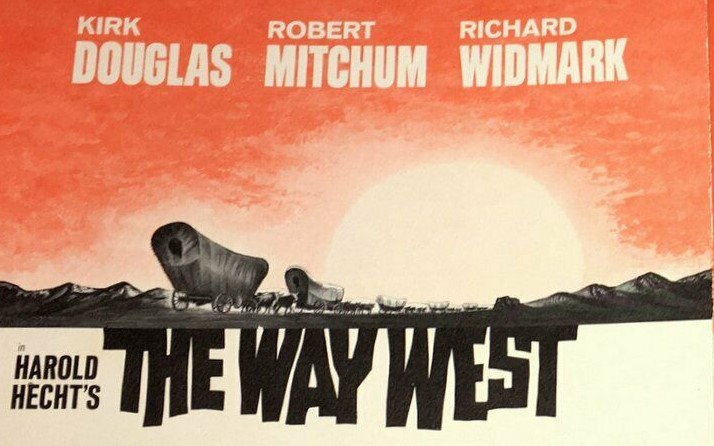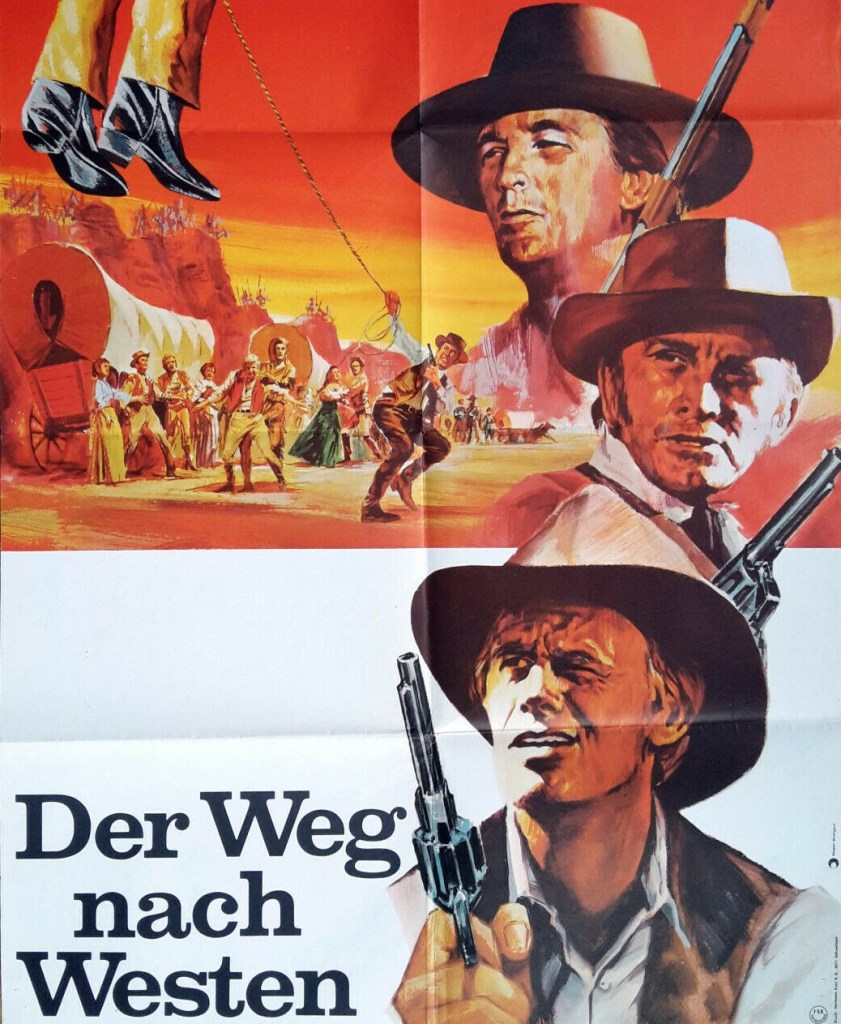
The Way West (1967) ****

How this crispy-told beautifully-mounted character-driven western ever languished among the also-rans is beyond me. I suspect the specter of John Ford hung heavily over it in the eyes of critics at the time but it more correctly belongs to the cycle of Cecil B. DeMille westerns that told stories with a true historical bent. Often detrimentally compared to How the West Was Won (1963), which told a similar tale of endeavor, this movie deliberately lacks that movie’s inflated drama in which every incident was built up, not least influenced by the need for Cinerama effect, rather than seeking an authentic truth.

Plainly put, the difference is here there are no charges, no races, no fording of rivers in the wrong places. Native Americans are treated with respect. Above all, an epic crossing of the continent with fully-loaded wagons is necessarily going to be slow, risk avoided at all costs, and yet this is not without incident or character arc. In fact, the script is terrific, not just dialog that rings true, but among the elements brought into play are male rivalry, clash with authority, guilt, young love, revenge, vision, justice, America in embryo. That the movie maintains a stately pace, no fistfights descending into brawls, and a shock ending indicate a director in charge of his material.

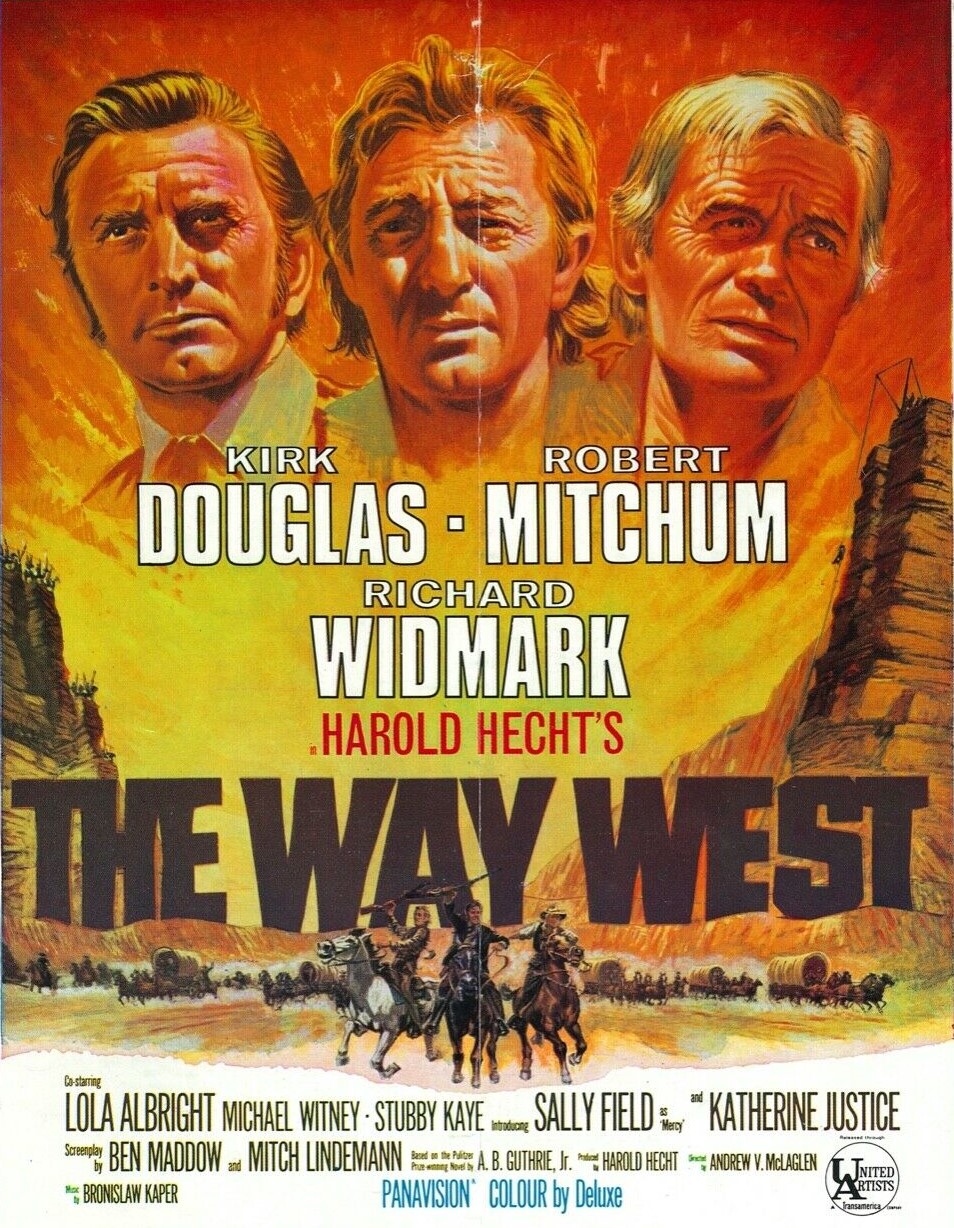
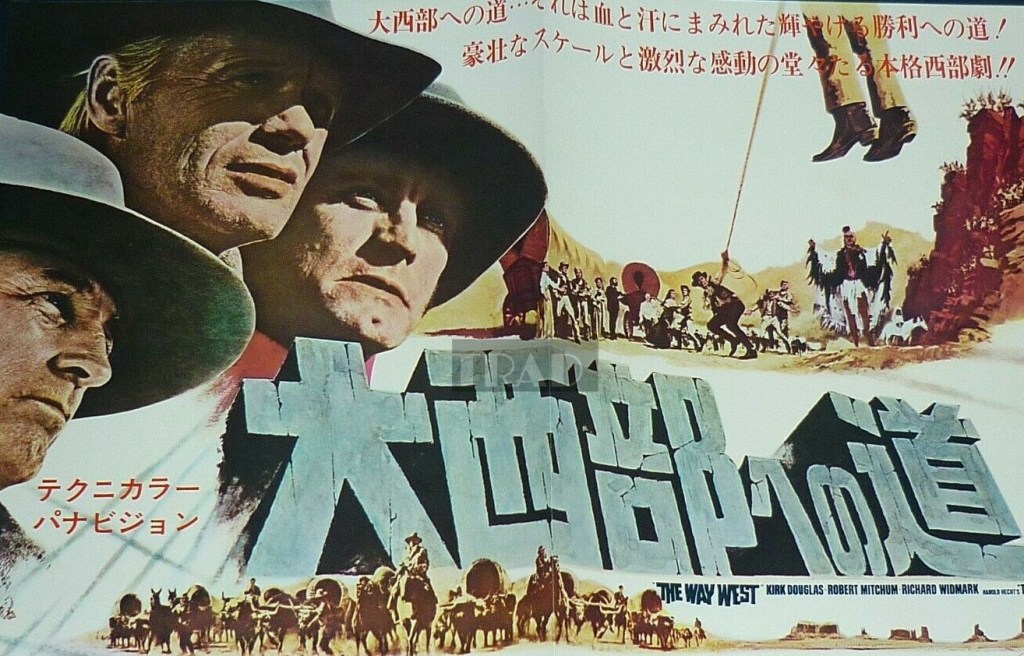
Based on A.B. Guthrie’s Pulitzer Prize-winning novel set in 1843, the first wagon train heads for Oregon under the iron rule of Senator William Tadlock (Kirk Douglas) and guided by a scout with failing eyesight in Dick Summers (Robert Mitchum), both men widowed and in emotional limbo, and in the cantankerous company of Lije Evans (Richard Widmark) and his glamorous wife Rebecca (Lola Albright). There’s a stowaway (Jack Elam), a preacher who can’t afford the price of transportation, an illicit love affair between the vibrant and lusty Mercy (Sally Field) who “hankers after any three-legged boy” but makes eyes at married man Johnnie Mack (Michael Witney), and enough obstacles to keep less determined settlers from reaching their promised land.

Tadlock is the visionary, a politician suffering from an overblown estimation of his self-worth,  who “might have been President except for a woman,” ruthless, valuing only his own ideas. “Point the way,” he tells Summers, “don’t gall me with opinions.” For fear it might interfere with his role as commander, he hides his vulnerability. There’s a plaintive moment when he shares his vision of a city with Rebecca, on the one hand full of his own importance, on the other clearly needing the pat on the back. Later, an occasion of death sees him falling prostate with grief on a grave and on breaking his own laws demands to whipped. The over confident blustering individual is by the end almost suicidal. What is a leader if there is no one to lead?
Summers stoically accepts his infirmity, constantly dropping his head so his eyes are hidden from sight under his hat as if his ailment could be easily detected, mourning the loss of his Native American wife, and while full of Western lore as easily passing on gentle wisdom about love, and his “lucky necklace” to an unrequited lover, but still accused of unworldliness, “for a smart man you ain’t got a lick of sense.”  Evans bristles at any authority, believing independence means he goes his own way, especially if that permits the freedom to get drunk at a time of his choosing, and especially once he realizes such lack of inhibition riles the repressed Tadlock. But his fondness for alcohol triggers an incident that almost costs his son his life.

Celebrations he started catch the attention of the nearby Sioux and in the communal drunkenness a Native American child is accidentally killed. In the best scene in the film battle Sioux seeking justice and intent on attack are thwarted only by the “sacrifice” of the killer.

The picture is packed full of incident, many characters coming alive in a single shot or with one line of dialog. A woman tramps on her husband’s foot to prevent him challenging Tadlock’s authority. A woman with a baby retorts that she is afraid when bolder settlers facing potential Native American attack assert the opposite. The bravest man in the camp, the first volunteer to be lowered down a canyon, dies when his rope snaps.  

There are any number of reversals. Buffalo, instead of being a danger and prone to stampede, create a dust cloud to hide behind. Rivers are crossed at sensible points, rapids avoided. An African American whips a white man. A boy becomes a man through honor rather than violence. Stories, large and small, play out in a succinct script.  
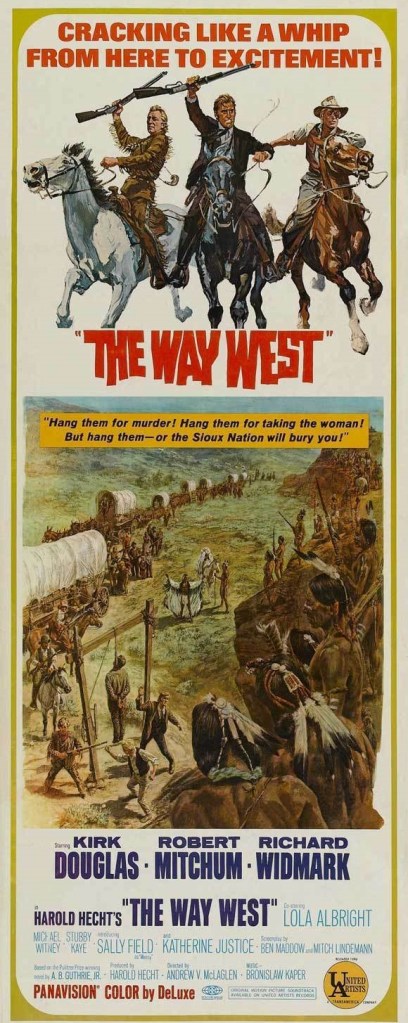
Kirk Douglas (The Arrangement, 1969) is superb as a man whose iron core deserts him. Robert Mitchum (Secret Ceremony, 1969), in almost a supporting role, excellent in full awareness that the sight on which his reputation and job depend will vanish, brings a subtlety to his performance that would be recognized as ideal for Ryan’s Daughter (1970). Richard Widmark (The Bedford Incident, 1965), who is generally simmering, gets to mix in a bit of fun in with the simmering.

Lola Albright (A Cold Wind in August, 1961) swaps seductiveness for sense. In her debut Sally Field (Smokey and the Bandit, 1977), filled with zip and zest, sparkles as the lusty young woman and it’s astonishing to realize she would not make another movie for nearly a decade while another debutante Katherine Justice (Five Card Stud, 1968) finds her inner fire when it’s too late.  There’s supporting talent a plenty – Jack Elam (Once Upon a Time in the West, 1968), Stubby Kaye (Cat Ballou, 1965), Harry Carey Jr. (The Undefeated, 1969) and William Lundigan (The Underwater City, 1962) in only his second film of the decade.

Director Andrew V. McLaglen (The Rare Breed, 1966) captures the correct tone for the film, making up for the essential slow pace with brilliant use of widescreen, coaxing great performances from all concerned. Screenwriters Ben Maddow (The Chairman, 1969) and Mitch Lindemann (The Careless Years, 1957) compress Guthrie’s tome with considerable skill.  

Woefully underrated at the time and since, this deserves reassessment. This is a truer version of how the west was won. And I surely can’t be alone in demanding that McLaglen’s talent be more properly recognized.

You might be interested to know there are two other articles on this film – a “Behind the Scenes” and a “Book into Film.”
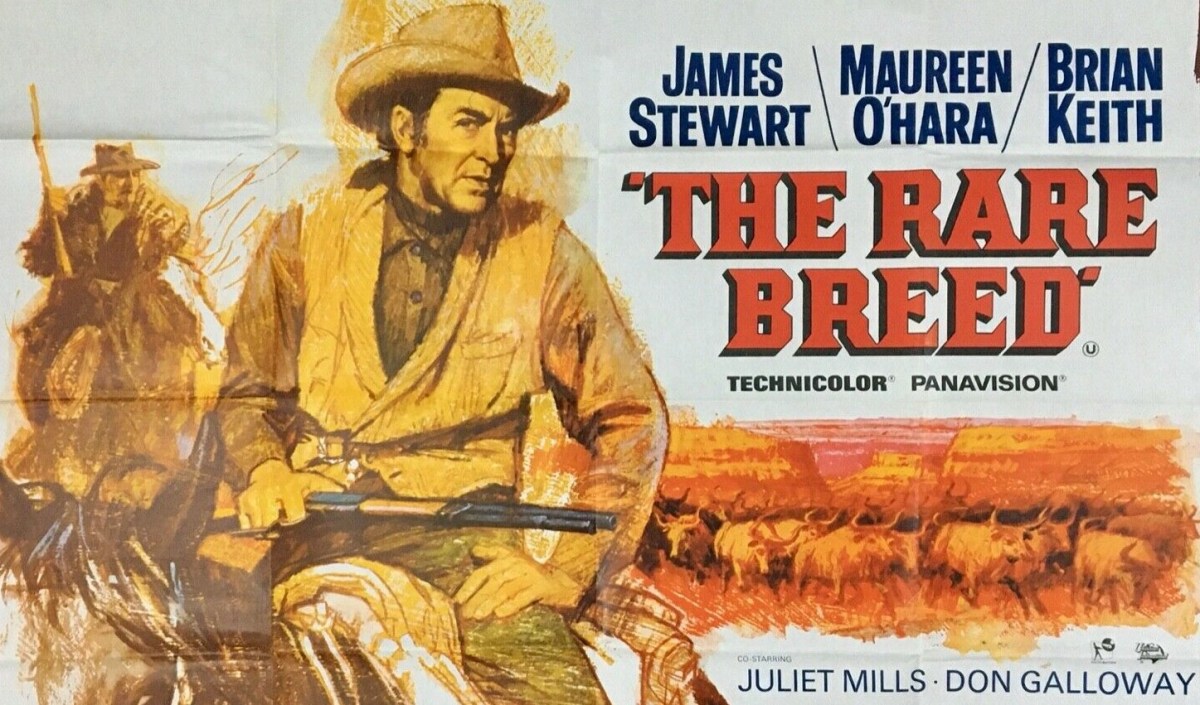
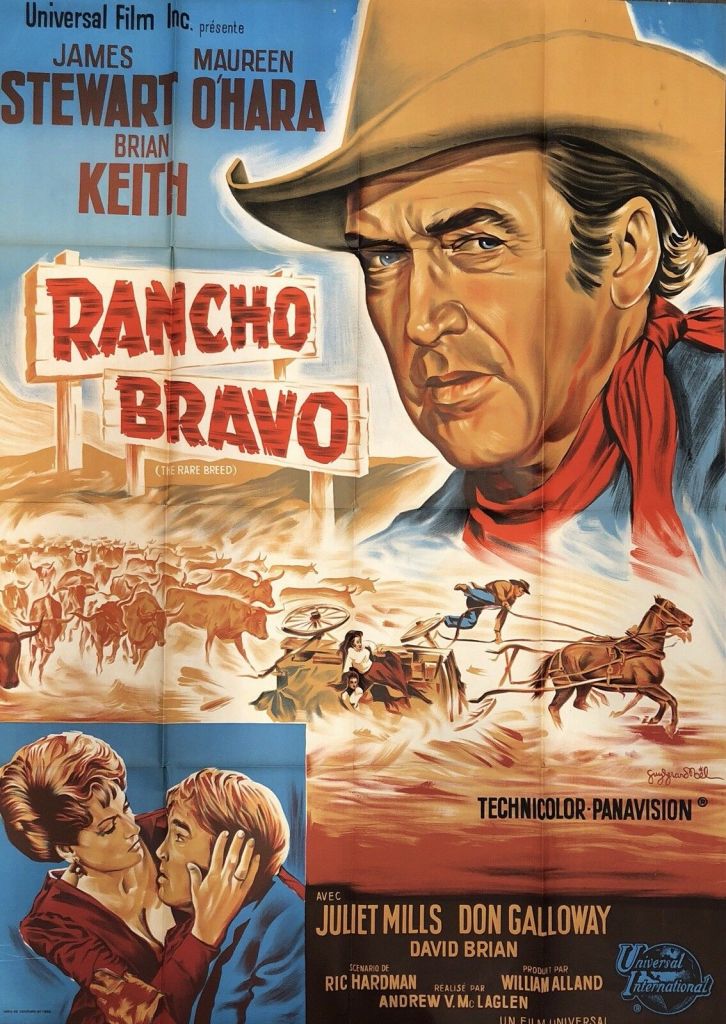
The Rare Breed (1966) ****

Classic themes of hope, resilience and redemption influence director Andrew V. McLaglen’s follow-up to Shenandoah (1965). Add in a battle against widespread misogyny, thieves falling out, a brilliant stampede and a forlorn hunt that has echoes in the decade-old The Searchers. But other more serious issues are explored. At the film’s core is the question of how a nation built on innovation refuses to countenance change, in other words a country where hierarchy (inevitably male) has begun to impose its preference and how those who suggest alternatives must not just buckle to that collective will but admit they are wrong, a problem that in the half century since the film was made has not gone away.

Widow Martha (Maureen O’Hara) and daughter Hilary (Juliet Mills) bring to auction her white-face Hereford bull, a British institution, the first of its kind to be imported (for breeding purposes, you understand) to America where hardy longhorn cattle are the dominant species. Despite being insulted for her temerity in challenging the existing order, Martha is astonished to receive a winning bid of $2,000, only to realize this comes with conditions attached, the buyer assuming his largesse will also win her, a sharp elbow to the ribs dissuading him of this notion.

Determined to see the bull delivered to the Texan ranch, Martha decides to accompany the animal on its journey. Wrangler Sam (James Stewart), hired to transport it instead plans to steal it and to keep the dupe sweet until the time is ripe encourages her to develop romantic ideas towards him. When another cowboy, Simons (Jack Elam), with eyes on the same four-legged prize causes confrontation the game is up, though Sam sees the trip through.

Rancher Bowen (Brian Keith) belittles the Hereford bull although viewing Martha as a better proposition, but the only way to discover whether the beast can survive in the territory is to let it loose on the open range where it was likely to encounter blizzards (not so rare in Texas as you might think). Once the bull is set free, the movie shifts onto a question of endurance, not just of the animal, but of the mindset of Martha and Sam. Her faith in her insane idea is tested to the limit and, almost in compensation, a woman needing security/protection et al, she comes to appreciate the attentions of a less wild Bowen.

Both central characters have much to lose and much to face up to. Martha, in accepting she was wrong and letting Bowen into her life, will almost certainly be surrendering her independence (she can still be feisty but that’s not the same thing). It’s a testament to her acting that you can see that faith wilting. Sam, a conniving thief whichever way you cut it (although the storyline gives him something of a free pass), has to face up to the fact that he was planning to con a woman out of the precious possession on which her precarious future was built.

The scenes between Martha and Sam are superb, especially when he is grooming what he thinks will be an easy dupe. Sam, in a purgatory of his own making, almost certainly an outcast were the truth more widely broadcast, attempts to expiate his guilt.  

James Stewart and Maureen O’Hara had worked together in Mr Hobbs Takes a Vacation (1962) and there is no denying their screen chemistry. But there’s an innocence that O’Hara rarely displays, the woman in love suppressing those emotions not denying them as perhaps in The Quiet Man (1952). She’s both independent and, if the right man comes along, happy to accept his protection (from the male predators of the West), while at the same time keeping him on the right track and sorting out his world of misshapen priorities. There are some brilliant scenes where something else is going on story-wise and O’Hara is internalizing some deeper emotion entirely. It’s an acting coup for an actress like Maureen O’Hara who would never give up to convey so well a character on the verge of surrender.

This is one of James Stewart’s best roles, far removed from the principled hero of Shenandoah (1965) and returning him closer to the shifty character of Vertigo (1958) adept at self-justification. In the scene where he is found out by O’Hara he is outstanding. It’s not a given that the character will find a way to turn things round and his efforts to redeem himself make the latter part of the picture emotionally involving, especially as this is countered by O’Hara’s own internal battle.

It’s worth pointing out that although the narrative mainly concerns the two main characters, the background is filled with ruthlessness. Not only does Sam feel no compunction about stealing a bull worth $2,000, we first encounter Bowen’s son Jamie (Don Galloway) when he is making off with a herd of his father’s longhorns. The cattle barons use their wealth to “buy” a classy woman and cheat cowboys. And there is further murder along the way.

I was going to mark this picture down for the comedy which seems to amount to endless brawls but I wondered if modern audiences, reared on the never-ending fistfights and wanton destruction that usually indicated the finale of a superhero picture, would accept it quite happily, perhaps even welcome it. While Brian Keith (The Deadly Companions, 1961) stands accused not only of one of the worst Scottish accents committed to the screen – and these days of cultural appropriation – that does not take away from a character who, behind the beard, transitions from loathsome father to something more approaching humanity, in other words wild man who realizes the benefits of civilization.  

In fact, the broad comedy serves to obscure a film full of brilliant, cutting, funny lines, generally delivered in scathing tones by the woman.  O’Hara to Stewart: “You may bulldog a steer but you can’t bulldog me.” Stewart to O’Hara: “Can I help you with that” and her response “No, they’re clean and I’d like to keep them that way.” And that’s not forgetting the sight of the cowboys whistling British national anthem “God Save the Queen” in order to bring the bull to heel.

I forgot to mention the romantic subplot involving Hilary – in case you were wondering what role she had in all this – and Bowen’s estranged son, Jamie. Juliet Mills (Avanti!, 1970), older sister of child star Hayley, is excellent as the sassy daughter of a feisty woman, Don Galloway (Rough Night in Jericho, 1967) less of a stand-out in his debut, in part because he has to subsume his rage against his father.

Jack Elam (Once Upon a Time in the West, 1968) is good as always and you will spot in smaller parts Ben Johnson (The Undefeated, 1969), Harry Carey Jr. (The Undefeated), Barbara Werle (Krakatoa, East of Java, 1968) and David Brian (Castle of Evil, 1966). John Williams, masquerading as Johnny Williams, wrote the score.

Setting the comedy aside, this is a more intimate film from director Andrew V. McLaglen compared to the widescreen glory of The Undefeated and the intensity of Shenandoah and for that reason tends to be underrated. There are some wonderful images, not least Sam carrying the injured Jamie in the style of Michelangelo’s La Pieta – an idea stolen by Oliver Stone for Platoon (1986) – but mostly McLaglen concentrates on the actors.

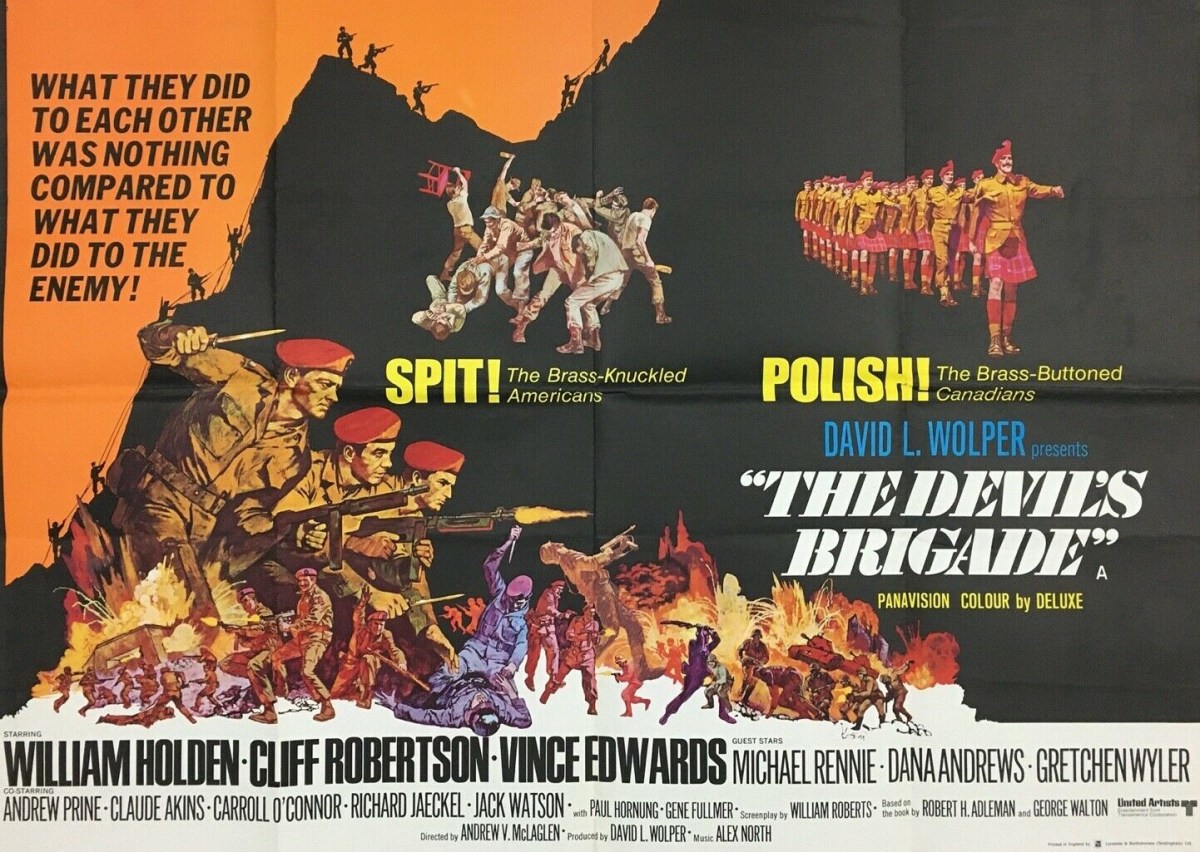
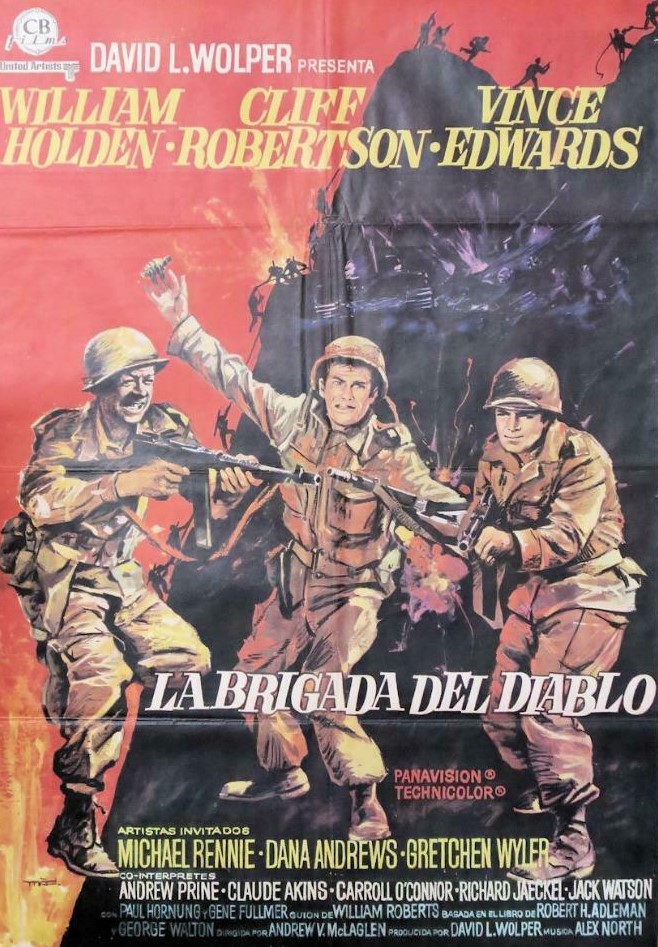
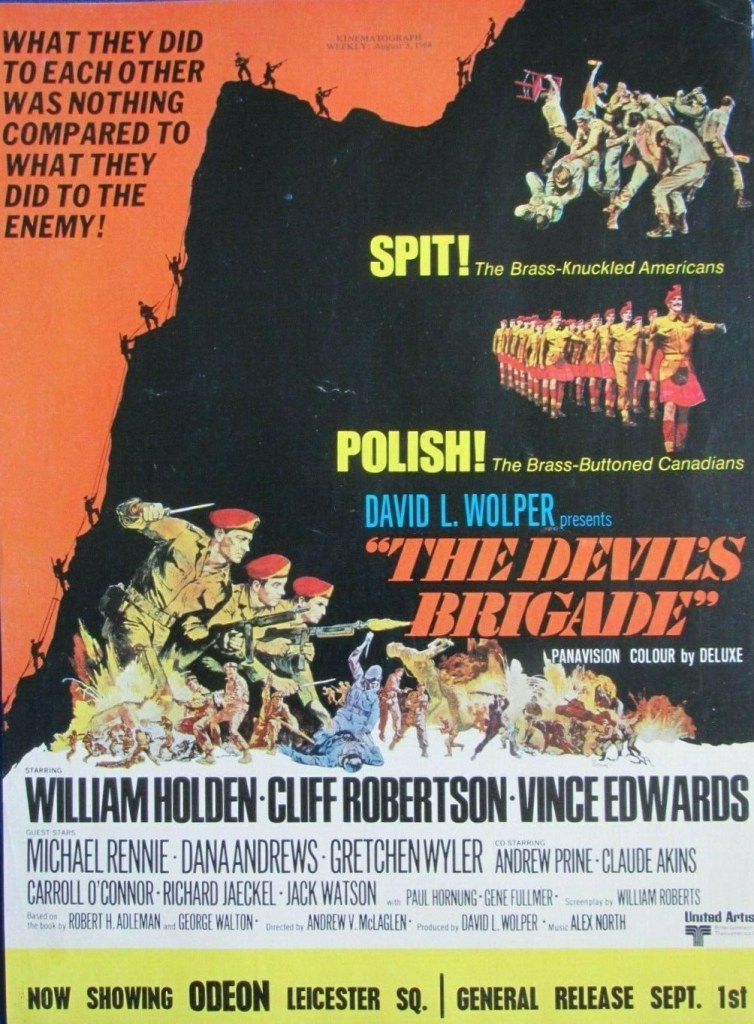
The Devil’s Brigade (1968) ***

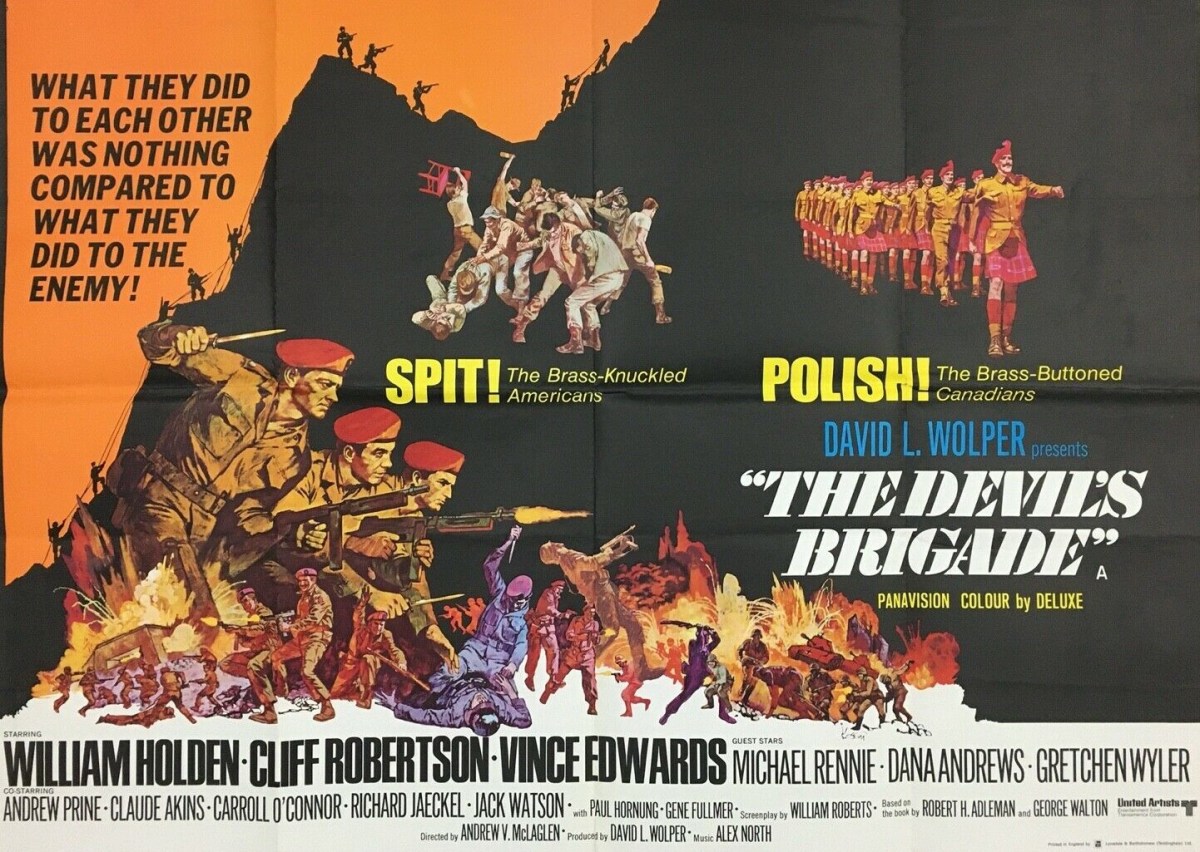
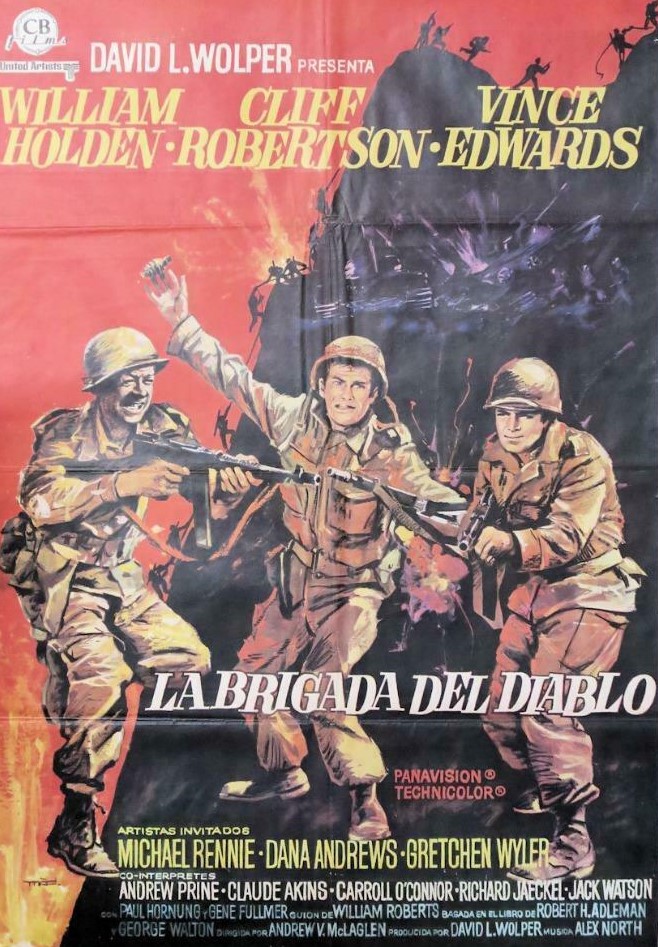
I couldn’t get my head around the idea of the U.S. Army recruiting a bunch of undisciplined misfits, many with jail time, in order to link them up with a crack Canadian outfit. Turns out this part of the film was fictional, the Americans in reality responding to advertisements at Army posts which prioritized men previously employed as forest rangers, game wardens, lumberjacks and the like which made sense since the original mission was mountainous Norway.  I should also point out the red beret the soldiers wear is also fictional and while depicted on the poster sporting a moustache commanding officer Lt. Col. Frederick (William Holden) is minus facial hair in the film.

But, basically, it follows a similar formula to The Dirty Dozen (1967), training and internal conflict followed by a dangerous mission. The conflict comes from a clash of cultures between spit-and-polish Canucks and disorderly/juvenile Yanks though, as with the Robert Aldrich epic, the leader taking some of the brunt of the discontent.  Collapsible bunk beds, snakes under the sheets and a tendency to fisticuffs are the extent of the antipathy between the units, which is all resolved, as with The Dirty Dozen, when they have to take on people they jointly hate, in this case local bar-room brawlers in Utah.

The movie picks up once they are sent to Italy. Initially employed on reconnaissance, Frederick challenges Major-General Hunter (Carroll O’Connor), who prefers to do things by the book, and in a maverick move sets out to take an Italian position by trekking two miles up a riverbed, creeping into town by stealth and capturing the location without firing a shot. 

Next up is the impregnable Monte la Difensa. Taking a leaf out of the Lawrence of Arabia playbook, in a brilliant tactical move, the Americans attack the mountainous stronghold from the rear by way of a mile-high cliff.  But that’s the easy part. The rest is trench-by-trench, pillbox-by-pillbox, brutal hand-to-hand fighting.

The battle scenes are excellent and the training section would be perfectly acceptable except for the example of The Dirty Dozen which set a high bar. That said, there is enough going on with the various shenanigans to keep up the interest, but we don’t get to know the characters as intimately as in The Dirty Dozen and there is certainly nobody to match the likes of Telly Savalas, Charles Bronson, Jim Brown and John Cassavetes. That also said, the men do bond sufficiently for some emotional moments during the final battle

At this point William Holden’s career was in disarray, just one leading role (Alvarez Kelly, 1966) and a cameo (Casino Royale, 1967) in four years, and although his screen persona was more charming maverick than disciplined leader he carries off the role well, especially solid when confronting superiors, exhibiting the world-weariness that would a year later in The Wild Bunch put him back on top. Ironically, Cliff Robertson was coming to a peak and would follow his role as the strict disciplinarian Major Crown, the Canadian chief, with an Oscar-winning turn as Charly (1968). Vince Edwards (Hammerhead, 1968) as cigar-chomping hustler Major Bricker makes an ill-advised attempt to steal scenes.

This was the kind of film where the supporting cast were jockeying for a breakout role that would rocket them up the Hollywood food chain – as it did with The Dirty Dozen. Jack Watson (Tobruk, 1967) is the pick among the supporting cast, but he has plenty of competition from Richard Jaeckel (The Dirty Dozen), Claude Akins (Waterhole 3, 1967), Jeremy Slate (The Born Losers, 1967), Andrew Prine (Texas Across the River, 1966), Tom Stern (Angels from Hell, 1968) and Luke Askew (Cool Hand Luke, 1967). Veterans in tow include Dana Andrews (The Satan Bug, 1965) and Michael Rennie (Hotel, 1966).

William Roberts (The Magnificent Seven, 1960) adapted the bestselling book by Robert H. Ableman and George Walton. Director Andrew V. McLaglen (Shenandoah, 1965) was more at home with the western and although there are some fine sequences and the battle scenes are well done this lacks the instinctive touch of some of his other films.

Dirty Dozen-lite.

The Ballad of Josie (1967) ***

What was viewed as an oddity by the star’s legion of fans has turned out to have considerable contemporary appeal, situating Doris Day as an unlikely feminist icon. It was almost the opposite of her current template. She didn’t sing and the narrative was not driven by romantic mishap. It didn’t endear director Andrew V. McLaglen to his fans either after the tough-guy heroics of Shenandoah (1965). And you might also ask the question – was the feminism watered down by slapstick in order to make it more acceptable to the general audience.

One issue extremely relevant today is pretty much skated over. Josie (Doris Day) kills her drunken husband after setting about him with a pool cue. His death was largely misadventure, he fell down the stairs escaping her intended blow rather than as the result of it. What’s the world coming to, muse the men of the town, if a woman could get away with defending herself against a brute of a husband in such a fashion, given it’s accepted that a wife needs knocked about once in a while.

That she gets off seems less to do with understanding than narrative convenience. It turns her into a widow, and deprived of her son (removed by the threat of legal action by her father-in-law) that means she will come in handy for married men fancying an affair. Unable to find respectable work, she has one catastrophic shift as a waitress. In narrative terms this is intended to act as the ultimate humiliation but in terms of screen treatment it’s convenient excuse for slapstick.

For some reason best known to screenwriter Harold Swanton (Rascal, 1969), she appears best placed to influence the female townspeople on a delicate political point. Whether such influence is due to her getting away with bumping off her husband is never made clear. Turns out that women in Wyoming have the vote and in their battle for statehood the men believe that will count against them and want Josie to get them to agree to drop that right. (History tells us that the good folks didn’t enforce that and allowed women to keep the vote, so three cheers for Josie.)

Those two elements – wife-beating and voting – would make a darn good movie right there but they seem to just dip in and out of proceedings unless in some lame humorous instance. What does take center stage though is Josie’s battle for independence,  not wishing to “be taken care of” by some man. She argues that “you can’t kick under the rug that women are also people” and agin the notion that a woman is “a species of idiot kept in the back closet and spoon-fed three times a day.”

So she decides to become a cattle rancher. That inflames the ire in equal measure of suitor Jason (Peter Graves) and deadly enemy Arch (George Kennedy). And pretty much she is setting herself up for failure until she comes up with the notion of raising sheep rather than cows. The sheep vs. cows argument has been surprisingly well covered in the western – witness The Sheepman (1958), Heaven with a Gun (1969) and, in more recent times, 1923 (2022) – and here they decide the two animals are best kept apart by geographical divide. The sheep are really another narrative device, cue for more slapstick-style sequences, and as you know a sheepdog will tear the britches off anyone foolish enough to get in its way.

It’s somewhat astonishing that within this unwieldy set of confounding narratives that this works at all. And mostly that is down to Doris Day (With Six You Get Eggroll, 1968)  junking her previous persona of feisty female willing to be wooed by ardent or cunning male. While her anger often comes over as more like petulance and you would never mistake her for an Elizabeth Taylor or Maureen O’Hara as a woman not to cross, she does comes out of this with some credit. Peter Graves (Sergeant Ryker, 1968) and George Kennedy (The Pink Jungle, 1968) are merely adequate. Andrew V. McLaglen doesn’t show much gift for comedy apart from the most obvious but presumably he’s to be thanked for even venturing into such difficult territory.

Whether it was, as I said, a deliberate attempt to bring feminist issues to the fore, or to sneak them in under the guise of comedy, is a moot point. The star always claimed she was duped into the role, finding her husband Martin Melcher had signed her up for it without her knowing.

North Sea Hijack / ffolkes (1980) ****

Shouldn’t work at all not with star Roger Moore gussied up like a maiden aunt, fussing over needlepoint and cats, dolled up in tweeds and sporting an unkempt beard and a ginger wig. Our only clue in the early stages that he’s anything approaching a tough guy is that he knocks back whisky like soda pop.

And bear in mind this was a couple of years before the Brits could blithely call in the SAS (Who Dares Wins, 1982) for a ticklish rescue op and more than a decade before it became the norm to rely on a handily-available one-man band of the Die Hard persuasion and even longer before you had to worry about upsetting the pet or elderly neighbor of your local retired assassin.

When the movie flopped in the U.K. it was re-branded as some kind of James Bond number with scantily-clad women.

That it does work is very much down to Moore as the opposite of the standard Hollywood hero, avoiding rather than provoking trouble for strategic reasons, and realizing that, even with the deadliest of deadlines, time could be on his side and be used to un-nerve his opponent. After the film flopped spectacularly, Moore claimed he was miscast, but, in fact, despite the box office failure, the opposite is true. Without him brilliantly treading a very fine line this would have easily teetered into spoof.

A bunch of gangsters – not terrorists, plain cash the motive not some obscure cause – led by Kramer (Anthony Perkins) take over an oil platform supply ship, force Capt Olafson (Jack Watson) and crew, including, unusually for the time a female chef Sanna (Lea Brodie), to park under the oil platform while a couple of the gang plant explosives – to be set off as a warning – under the smaller drilling rig located some distance away, threatening to blow the whole operation sky-high if the British government doesn’t meet a ransom demand of $25 million.

As it happens the mysterious section of government that sometimes even Prime Ministers don’t know exists (as with beekeeping within the C.I.A.) has already recognized such a potential issue and hired ffolkes (Roger Moore) and his self-styled team of “fusiliers” to come up with a solution. Once the female Prime Minister (Faith Brook) – Margaret Thatcher was already in power at this point – is apprised of the cost in loss of revenue and human lives, she gives the go-ahead.

Ffolkes is despatched by helicopter with Admiral Brinsden (James Mason) and a high-ranking lackey. The supply ship crew, meantime, led by Sanna, have attempted to poison the invaders but that’s thwarted by the ruthless Kramer who by now has been chucking any dissenters over the side.

Kramer’s a clever guy. His ploy is smart. Theoretically, the drilling rig is financially worth a lot more than the platform, but that loss would account for a fraction of the lives of those on board the platform, and measured in public relations terms by any government deemed the smaller catastrophe. The platform will only be destroyed if the government is foolish enough not to meet his second deadline – if they fail to hit the first it’s just the rig that ends up in Davy Jones’ Locker.

But ffolkes is as cunning and plans a fake destruction of the rig to remove that ace in Kramer’s pack. The resulting explosion is so convincing, especially since it takes place at night, that the stakes are raised in ffolkes favor. But that’s only until Kramer smells a rat and refuses to allow ffolkes on the supply boat, ensuring the cat-lover has to resort to the more dangerous and potentially deadline-breaching Plan B. Nor, despite early action pointing to ffolkes’ efficiency, is he invulnerable in the tough-guy department, needing rescued twice, once by Sanna, hiding in a lifeboat after her failed poisoning mission.

And it does rely on the occasionally dense Admiral learning a simple trick with a cigarette packet.

This probably flopped because audiences expected some version of James Bond (it appeared within Moore’s stint as 007 in the two-year gap between Moonraker and For Your Eyes Only) or at least the cigar-chomping mercenary in The Wild Geese (1978). If Moore had carried out the required action in tweeds or naval uniform it might have been more easily accepted than dressed in a bright red frogman’s outfit (choice of that color a flaw in an op intended as subterfuge).

The irrepressible sexist character he represented might be more of a challenge to a contemporary audience but it’s delivered without malice and, theoretically at least, his aversion to women (and no overt hint of homosexuality I might add, though you could make your own mind up on that score) is explained. And Sarah (Jennifer (Hilary) , the oil platform skipper’s secretary, is his match, though that’s mostly with dry asides and rolling eyes.

There’s a bit of a sexist joke – although somewhat of a cliché – when our man discovers one of the crew is a woman and not a man. But that’s far better than the out-and-out misogyny of one of the gangsters whose reaction to cornering Sanna is attempted rape.

So, not the all-action yarn you – and audiences back in the day – might have expected, but, still pretty good fun. Director Andrew v. McLaglen melds elements of his The Wild Geese, and Shenandoah (1965), Moore’s performance reminiscent of the slow-burn of the James Stewart character. Screenplay by Jack Davies (Gambit, 1966) based on his bestseller.

Scarcely a lifted eyebrow in sight. Great fun – you couldn’t get more retro – and certainly had me chuckling – and free on YouTube.

Behind the Scenes: “Bandolero” (1968)

A western dream team. Beginning with Winchester ’73 (1950) James Stewart had revived his career post-World War Two with a string of tough westerns and had made seven movies in the genre in the 1960s including The Man Who Shot Liberty Valance (1962) and Shenandoah (1965). Starting with Rio Bravo (1959) Dean Martin had made six including The Sons of Katie Elder (1965). Genre debutante Raquel Welch had hit the box office running with One Million Years B.C. (1966) and Fantastic Voyage (1966). Following McLintock (1963) and Shenandoah, director Andrew V. McLaglen was considered one of the hottest western directors around.

Legendary Twentieth Century Fox producer Darryl F. Zanuck put together the cast and director as a “package” before calling in screenwriter James Lee Barrett (Shenandoah) to shape an idea by producer Stan Hough. McLaglen explained: “It was a Zanuck thing from the beginning.” He was working on another picture when he took a call from Zanuck. “I got a six-page outline for a western,” said Zanuck, “and I figure you ought to direct it. James Lee Barrett out to write it and Jimmy Stewart, Dean Martin and Raquel Welch ought to be in it. Nobody else. That’s the combination I want.” McLaglen took Hough’s six-page outline to Barrett who wrote it based on the actors involved.

Originally entitled Mace after the James Stewart character, the movie quickly became Bandolero!, the exclamation mark possibly to differentiate it from the 1924 Spanish picture of the same name which had been made for Metro-Goldwyn (as the studio was then known).

Despite the success of the Matt Helm spy pictures and a number of decent westerns, Dean Martin ceded top billing to James Stewart (had they shared the billing, Martin would have come first in the traditional alphabetical order).

Marc Eliot, one of Stewart’s biographers, arrived at a more unlikely scenario for the movie being greenlit, concluding that because Martin and Stewart had got on so well when the latter appeared on the former’s television show they decided to make a picture together. Given the show was taped in summer 1967 and the movie went into production a few months later it left an improbable amount of time for the picture to be set up.  

Director Andrew V. McLaglen would be reunited with two of his favorite movie characters – screenwriter James Lee Barrett and James Stewart, both key to Shenandoah. The actor had been the driving force behind McLaglen’s recruitment for that Civil War picture. “I just loved working with him,” said the director, “it got to the point where any time he did a movie he wanted me to direct it.” He viewed Barrett as “one of the best dialog writers I’ve ever known in movies.”

Although theoretically, the movie was set up as a package, with stars and director in place, Dean Martin remained a doubt since he was already committed to a film with Columbia that might clash. And Stewart might easily have dropped out if producer Frank McCarthy’s plans for Patton, with Burt Lancaster in the title role and Stewart as General Omar Bradley, had come to early fruition.

Raquel Welch was on a publicity high, featured on 400 magazine covers, generating such industry buzz that she had been named “International Star of the Year 1967” by U.S. cinema owners, her growing screen popularity ranking her eleventh in Box Office magazine’s female “All-American Favorites of 1968.” Dean Martin, incidentally, came ninth on the corresponding male chart, two places above Clint Eastwood, Paul Newman topping the poll.

George Kennedy (Cool Hand Luke, 1967) had small parts in Shenandoah and The Sons of Katie Elder before graduating to second male lead in McLaglen’s previous western The Ballad of Josie (1967). McLaglen, you might like to know, was highly regarded by the trade as “more concerned with entertaining the public than making intellectual and emotional demands on the audience.” Just after the movie’s launch the director signed a two-picture deal with Fox, The Undefeated (1969) next on his dance card.

One of the few studios to persist with a talent school – Welch claimed as the most recent high-flying graduate – Fox gave current student Clint Ritchie a role in Bandolero!, others in the Class of 1968 including Jacqueline Bisset (The Sweet Ride, 1968) and Linda Harrison (Planet of the Apes, 1968). Relative newcomer Andrew Prine had acted with Martin in Texas Across the River (1966) and enjoyed a supporting role in McLaglen war picture The Devil’s Brigade (1968).

As well as genre newcomers Welch and Ritchie, the cast included western character actors like Will Geer (Winchester ’73), Don “Red” Barry (The Adventures of Red Ryder, 1940) and  Harry Carey Jr. who had appeared in three previous McLaglen westerns. Even current “Tarzan,” Jock Mahoney, who played Maria’s husband, had a string of B-westerns in his portfolio. Possibly as important was the presence of James Stewart’s horse Pie, his onscreen companion for two decades.

Shooting began in Paige, Arizona, on October 2, 1967, before shifting two weeks later to Brackettville and the Shaban ranch where The Alamo (1960) was filmed. Parts of the San Antonio de Bexar set were revamped as the Texan town of Val Verde where the hanging in the film took place, while The Alamo doubled as the Mexican village of Sabinas which provided the action for the climax. Seven buildings were added to the San Antonio set including the jail, while a curio shop was transformed into a bank, a gift shop became a hotel and, conversely, an old hotel was turned into a general store. Thirty-five thousand traditionally-cast adobe bricks were made on site to create the dozen buildings required for Sabinas plus the locale’s arch, fountain, wells and wall.  

Other locations included Arizona, Utah and Texas with interiors filmed at the Fox studios. The shootout between the posse and the outlaws was filmed near Turkey Mountain in Texas. The Rio Grande was forded at Devil’s River but Mace crossed the river at Pinto Creek. Glen Canyon National Recreation Area was utilized for the bandit attack and, naturally enough,  for sequences requiring canyons. Other scenes were shot at Lee’s Ferry in Arizona, Balanced Rocks, and Big Water in Utah. But the first time we view Sabinas is an effects shot.

You do wonder why this film entered the studio books as costing $5 million. None of the principals were in the million-dollar salary range and the cost of 40 days shooting at the Shaban ranch was put at $25,000 a day.

The principals eventually enjoyed on-set camaraderie. Initially, Welch was too serious for the others, bombarding the director and more experienced actors with questions about her character’s motivation and psychology. “I wouldn’t say creativity was the primary concern on that picture,” commented the actress. “Barrett was there mainly because everybody said nobody could write dialog for Jimmy like he could. As far as other things in the script were concerned, they weren’t really supposed to be questioned.

“And with McLaglen it was all by the book. McLaglen created a very constrained atmosphere. It was an inoffensive nine-to-five project with a lot of very senior people, the old John Ford gang. Very cliquish. Except for Jimmy who’d always kind of throw out little things. I felt pretty lonely the whole shoot.”

To “loosen her up,” the two stars invited her out to dinner and “got her good and drunk.” Remembers McLaglen, “Dean and Jimmy and I would take Raquel Welch to dinner and we’d kid around with her.” Quite whether that was sufficient to rid Welch of her feelings of alienation was never established. However, she did register that she was surrounded by talent. Stewart “could cry on cue. No mess, no fuss. Just like that you could see tears in his eyes.

McLaglen equally enjoyed an esprit de corps with the male stars. “When I think of my time with Dean, there’s nothing but joy in my heart…without doubt the most conscientious actor I have ever worked with,” adding, “I think Jimmy had more fun on that location than he ever had.”

Texas was chosen for the June 1968 launch on the grounds that Shenandoah had done so well there. Instead of a city-by-city premiere lasting a week with many stars in attendance, the studio opted for a “new kind of premiere,” opening night at the Majestic in Dallas accompanied by a 30-minute live telecast broadcast to 23 Texas television stations. Also available was a 16mm featurette on Welch promising “an intimate look at a new star.” Welch contributed her vital statistics and preferences to a computer program that would help select the winner in a beauty contest to find the woman closest to the star in looks and personality.

Stewart, of the tub-thumping generation, believed stars should hit the publicity trail, public appearances adding 10 per cent to the gross, rather than insisting it was beneath their dignity or not worthy of their time. He claimed publicity tours were “good for the soul. Unless he has a real bitter selfish attitude (an actor) has to enjoy getting out to different parts of the country and meeting people.” Raquel Welch was one of the stars he chided for adopting the wrong attitude with autograph hunters.

Little of the weaponry seen on screen was from the period, the movie being set in 1867. And even the supposed Remington 1858 New Army revolver used by Martin, Kennedy and Welch, was improvised from another pistol. But Stewart used a genuine Single Action Army “artillery” revolver. There was some cheating going on, Martin firing a Winchester 1892 saddle ring carbine, and others using a Winchester model 1892 rifle and a Winchester Model 1873 carbine.

Despite claims by James Stewart biographer Gary Fishgall that the “film opened to near-instant obscurity” Bandolero! proved a solid box office success in the United States, where it was the top western for the year, finishing 18th in the annual chart, collecting $5.5 million in rentals (not gross) and performing very well overseas. It was a signal year for westerns, though some languished. Hang ‘Em High was 20th with $5 million, The Good, The Bad and the Ugly 24th ($4.5 million), Five Card Stud 34th ($3.5 million) and The Scalphunters 43rd ($2.8 million).  In the flop category were Will Penny in 54th spot ($1.8 million), Villa Rides 75th ($1.2 million), Firecreek 79th ($1.2 million) and Shalako 85th ($1.1m).

SOURCES: Gary Fishgall, Pieces of Time, The Life of James Stewart, (Scribner, 1997) p314; Marc Elliot, James Stewart, A Biography, (Aurum, 2007, paperback) p365; Howard Hughes, “Welch Out West Part 1,” Cinema Retro, Vol 11, Issue 31, 2015, p10-17; internet movie firemarms database; “Raquel Welch To Get Int’l Star Award,” Box Office, February 19, 1967, p4; “Mace Retitled Bandolero!,” Box Office, August 7, 1967, pE6; “Cast Patton and Bradley,” Variety, September 20, 1967, p13; “Bandolero! Moves to Texas Oct 16,” Box Office, October 16, 1967, pC1; “Filming of Bandolero! Ending at Bracketville,” Box Office, December 4, 1967, pSW1; “Fox On Texas Trail for Kickoffs,” Variety, May 15, 1968, p32; “James Stewart: Stars Should Tout Films in Television Age,” Variety, May 29, 1968, p19; “Now There’s A New Kind of Premiere,” advertisement, Variety, June 12, 1968, p17; “Bandolero! Dallas World Premiere Covered Live By 23 TV Stations,” Box Office, June 24, 1968, pSW1; “Fox’s Talent School,” Variety, June 26, 1968, p13; “20th-Fox Signs McLaglen to Two-Picture Pact,” Box Office, August 26, 1968, pW1; “Big Rental Films of 1968,” Variety, January 8, 1969, p15.

Bandolero (1968) ****

Darkest – and possibly the most under-rated – western of the decade featuring a top-class cast playing against type, down-and-dirty in its depiction of the itinerant cowboy, an ending you won’t see coming and if it’s not a heretical notion close cousin to the later The Wild Bunch (1969).

Gang of outlaws led by Dee (Dean Martin), condemned to death for robbing a bank, is rescued by his brother Mace (James Stewart) posing as a hangman.  While a posse led by Sheriff Johnson (George Kennedy) is in hot pursuit and the outlaws kidnap as potential hostage recently widowed Maria (Raquel Welch), Mace, sauntering through the deserted town, indulges in a bit of larceny himself.

All head for Mexico, a pitiless region, where the posse are picked off by bandits, the outlaws directed by the native Maria towards a small town which turns out to offer no safety at all. While there’s plenty action, this is more character-based. Mace and Dee are on the Civil War divide, the former (still sporting his Union uniform) riding with General Sherman, the latter with the Confederate Quantrill’s Raiders, despised by Mace as nothing more than glorified killers.

And while they are both outlaws, Mace blaming his situation on the Civil War, they are divided too by a sense of honor, Mace making it a point of principle never to harm women or children, Dee, far removed from any sense of himself, guilt-ridden, past caring, and lonely, can’t remember the last time he was with a woman he respected.

Sheriff Johnson is in pursuit in part due to unrequited love for Maria. Quick to action  in a professional capacity, he is tongue-tied in her presence. Nor has the newly-wealthy Maria much need of a male protector. A whore since the age of 13 to provide for her extended family, sold into marriage nd acceptance that for security not love, she has been, ironically, set free by violent robbery. Dee’s gang views Maria as plunder, rape imminent should the brothers turn their backs. While Maria has little interest in another male protector she finds herself attracted to Dee.

Mace is mostly peacemaker, prodding his weaker sibling into responsibility, trying to instil into him the kind of code by which the likes of The Wild Bunch swore, but, still on the shifty side himself, concealing from the others the loot from his own robbery. But where The Wild Bunch are essentially sanctified by Peckinpah, especially with their hypocritical codes of honor and their unlikely redemption, the lives of Dee and Mace are unfulfilled, lawful or lawless drifters enjoying little of life.

There’s an ambivalence to Mace, theoretically a law-abiding rancher, but apparently turning outlaw on a whim. We are introduced to an impoverished Mace being ripped off for food and accommodation, spending the night in an overcrowded bunkhouse, his Unionist uniform doing him no favors two years after the end of the Civil War in Confederate Texas. He appears less prone to violence but we are not privy to how he persuaded a hangman to part with his outfit. And he’s a mean hand with a rifle, helping his brother escape his pursuers.

You might wonder just how Mace came to be an outlaw when he witters on so often about his God-fearing mother and his upbringing on a farm and you always have the sense he’s part of that woeful Hollywood creation, the “good” outlaw, as if there was such a thing, certainly no sign of him dispersing ill-gotten gains to the poor. He might just be as deluded as his brother.

Of the three, Maria is the most clear-sighted, no qualms about her behaviour, and,  provided with weaponry, perfectly capable of defending herself. Mexican bandits offer her no clemency either, assuming that, escorted by gringos, she has abandoned the land of her birth, or just because any woman is prey.

So it’s a perfect onion of a western, layers upon layers, the pursued needing to defend themselves not just against the pursuers, but bandits lying in wait, and within their supposed close-knit community the brothers guarding against fellow outlaws and protecting the  woman.  

James Stewart (Shenandoah, 1965) played many a tough guy at the reinvention of his career in the early 1950s in Anthony Mann westerns, and while his characters often displayed venal qualities they were not outlaws. Career-wise this was a dicey role for an established western hero. That he brings the common touch that was the hallmark of his original screen persona to this characterisation of an outlaw with a code of honor does not disguise the fact that he is still an outlaw.

Dean Martin had essayed a really mean bad guy in Rough Night in Jericho (1967) but again this was his debut as an outlaw, and a conflicted one at that, enjoying the boost to his self-esteem that leadership brings, but finding himself enmeshed with the dregs of society, and certainly not on the look-out for any acts of kindness or redemption. This is a beautifully nuanced performance especially when he realizes Maria is responding to him.

Raquel Welch (Fathom, 1967) in what amounts to her first major film opposite two Hollywood legends more than holds her own. Not able to rely upon her overt sex appeal as in her previous outings, she portrays an upstanding women, abused by men in the past, determined not to take that route in the future. Alone of all the characters, having accepted her fate at an early age, she has developed a self-esteem not sacrificed to circumstance. The whore and the outlaw might be the oldest trope in the book but it works very well here as two characters find solace in each other.

George Kennedy (Cool Hand Luke, 1967), more accustomed to playing tough guys, leavens his portrayal by appearing idiotic with women. This, too, is a departure for Andrew V. McLaglen. Anyone aware of Shenandoah or The Undefeated (1969) will be familiar with his dexterity for widescreen composition, but here he tamps down on that stylistic device, concentrating more on group reaction and interaction. James Lee Barrett (Shenandoah) wrote the biting script based on a story by producer Stanley  Hough.  

While there’s plenty action it’s not a rip-roaring western, too much character involvement for that, but certainly ranks as one of the top westerns of the decade.

Apologies again for the premature appearance of the blog “Behind the Scenes: Bandolero!” but that will definitely appear tomorrow.

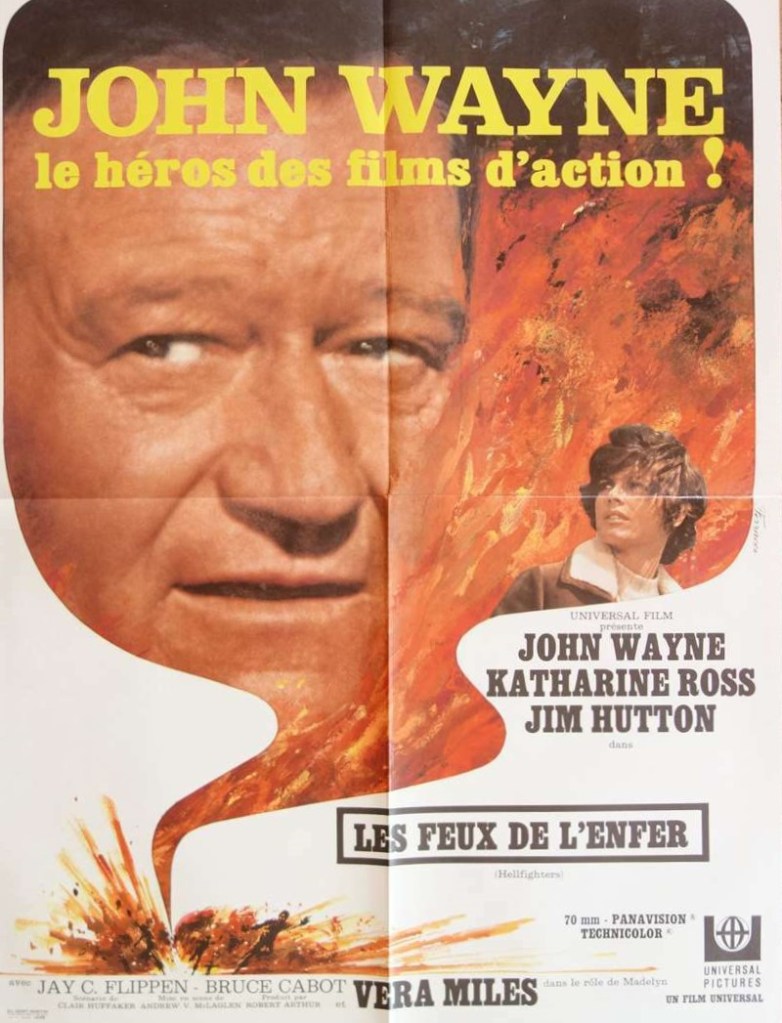
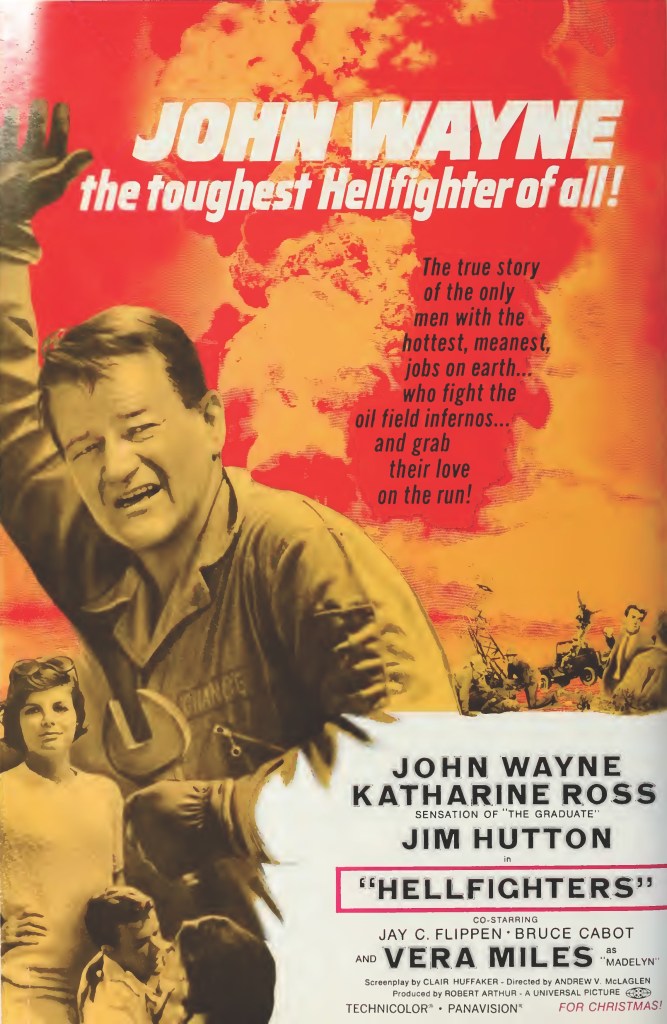
Hellfighters (1969) ****

I’m sticking my neck out on this one – under-rated would be an understatement – and primarily because it’s the Duke’s most intriguing film of the decade and possibly ever. For a start we have John Wayne The Quitter (the hell you say!). Then he ducks out of the picture for a full quarter of an hour (he does what?). Fast forward a couple of years and this would have led the disaster cycle pack – a little tinkering with the structure and you would have all four principals fighting fires in South America in the middle of a revolution (beat that, The Towering Inferno.) But most enthralling of all this is a family drama masquerading as an action picture.

And it led me to thinking if True Grit (1969) had not landed on Wayne’s doorstep whether he would have continued down the dramatic rather than the action road for the tail end of his career. He had just collected his first million-dollar fee so in box office terms he was untouchable. And just for the record, the action scenes, especially given the absence of CGI, are terrific. Sure, the oil’s a little bit too thin to pass for real oil, but it does gets sloshed over all concerned, including the Duke, by the bucketload.

And it might be a shade on the episodic side, Chance Buckman (John Wayne) and compadres racing from one hellish event to another, but it’s wrapped around a tight dramatic core, Chance vs independent daughter Tish (Katharine Ross), Chance vs one-time sidekick and now Tish’s husband Greg (Jim Hutton), Chance vs. Tish’s mother Madelyn (Vera Miles) and Chance vs. all the dimwits on the board of the company he quit his own operation to join.

Chance is based on the real-life Red Adair, an oilman who had invented the extremely scientific but extremely dangerous method of putting out oil-well fires. When a gazillion gallons of oil spurting unchecked out of the ground catch fire you’ve got a helluva problem on your hands. A gazillion gallons of water ain’t going to cut it. The only solution is to cut off the oxygen supply long enough to cap the well. Red Adair’s technique: blast the oxygen out of the way. He’d attach drums filled with massive amounts of nitro-glycerine, roll them into the blaze on the end of cranes, hide behind nothing more resilient than hazard suits and shields made of corrugated iron, and detonate them. The resulting explosion did the trick.

The picture opens with this stunt, although after being accidentally injured, Chance is hospitalized, bringing estranged daughter and ex-wife into the dramatic frame. After a pretty frosty meet-cute,  Tish and Greg hit it off and get married, forcing Tish to confront the fear that drove Chance and Madelyn apart, that, like the wife of a Formula One driver, she never knows if her husband will come back. This bothers the feisty Tish a lot less than the weary Madelyn. And she even ignores all protocol and rushes to her husband’s side, regardless of the danger.

Meanwhile, Chance decides not only has he had enough of dicing with danger but he can leave his company in the safe hands of Greg. His life now on a more mundane keel, Madelyn is attracted back. But of course it wouldn’t do for Chance to live out retirement with nothing more testy than board meetings so he comes back into the fray during a rebellion in Venezula and both women have to confront their true feelings.

The action, considering the lack of CGI, or the kind of budget available to The Towering Inferno, is first-class. This is the ideal movie reversal. Instead of running away from a fire, these characters race towards it. There are some hair-raising moments. At one blowout, gas is leaking from the ground, poisoning everyone in sight, Greg is trapped underwater. And should complacency sneak in, fire, being on the unpredictable side, is prone to sudden explosion.

John Wayne (The Undefeated, 1969) has always excelled at restrained emotion and here he gets both barrels. Having got rid of the over-protective wife he’s now saddled with a daughter he’s desperate to protect from the hell he put his wife through. He’s faultless here, given considerably more acting scope than normal and not, as in McLintock (1963), just able to tan a woman’s backside, presenting a more contemporary male, perhaps as puzzled by female behavior as any of his cowboys, but taking a more modern approach to resolving his feelings.

Katharine Ross (Tell Them Willie Boy Is Here, 1969) has her best role, not a mere appendage as in her other films of this period, but driving forward the action through her independence. Jim Hutton (Walk, Don’t Run, 1966) is growing on me. I’ve reversed my view of him as a lightweight. Vera Miles (The Man Who Shot Liberty Valance, 1962) does a pretty good job of playing older – she was not yet 40 – and essays a complicated character, more rounded than was often the case with the female lead in Wayne pictures. Veterans Jay C. Flippen (Firecreek, 1968) and Bruce Cabot (The Undefeated) head the support.

The perennially underrated Andrew V McLaglen (The Undefeated) does a pretty good job with the action, as you might expect, but is also savvy enough to let the dramatic scenes flow. Clair Huffaker (Rio Conchos, 1964) penned the screenplay.

Guilty pleasure personified, you might say, but I’d retort that this is a damn fine picture erroneously ignored – rating only two paragraphs in Scott Eyman’s  650-page biography of John Wayne for example – possibly because it appeared in between the critically-reviled The Green Berets (1968) and the critically-acclaimed True Grit.

Behind the Scenes: “The Way West” (1967)

As you might expect with a title like this John Wayne was in the frame, at least at the start. But when Burt Lancaster’s production outfit Hecht-Lancaster bought the property that was the end of that casting idea. Hecht-Lancaster was at its peak in 1956, each of its first 11 pictures turning a profit, and just signed up to a $40 million three-year deal with United Artists. Biggest project on the table: $5 million for The Way West with a dream team of Lancaster, James Stewart and Gary Cooper and a script from Clifford Odets (The Sweet Smell of Success, 1957). But by 1959 the dream had soured, with $545,000 already shelled out on the western with no sign of a start date. A year later the project was shelved. When Harold Hecht split from Lancaster, the rights reverted to United Artists.

Hecht’s initial efforts as a solo producer had not paid off, Taras Bulba (1962), Flight from Ashiya (1964), both starring Yul Brynner, and Tony Curtis comedy Wild and Wonderful (1964) all covered in red ink, before suddenly resurfacing with the hit Cat Ballou (1965), making him imminently more bankable than before. However, given the impact music had in Cat Ballou, Hecht hankered after something in the same vein, except bigger, and bought the rights to Finian’s Rainbow, a Broadway hit from 1947. When casting issues caused delay, Hecht signed a one-picture deal with United Artists for The Way West. The studio had such high hopes for the movie that plans were made for its world premiere to be held at the Houston Astrodome, a first, and it was considered a natural for roadshow treatment.

A substantial rejig was required of the source material, the Pulitzer-Prize-winning novel by A.B. Guthrie, by screenwriters Ben Maddow and Mitch Lindemann, not least to ensure that the character played by Kirk Douglas remained with the wagon train until the end of the trail, unlike in the book. Andrew V. McLaglen, with three box office western hits behind him in McLintock (1963) starring John Wayne and Maureen O’Hara, Shenandoah (1965) with James Stewart and The Rare Breed (1966) co-starring Stewart and O’Hara, was first choice to sit in the director’s chair.

Charlton Heston (El Cid, 1961) was approached to play the lead of Senator Tadlock. When he turned it down, Kirk Douglas signed on for his first western in five years – although his next would also be a western, The War Wagon (1967) with John Wayne – Robert Mitchum (Villa Rides, 1968) was offered the choice of either scout Dick Summers or firebrand Life Evans. At the end of a long lunch with Hecht and McLaglen, Mitchum could not make up his mind and the producer and director assigned him the role of the scout.

“I’m awfully glad it worked out the way it did,” recalled McLaglen, “because Widmark was perfect for the other part and Mitchum was perfect for the scout.” It might not have been Widmark because Max von Sydow was also reputedly offered a part. Von Sydow was too big a star to play any of the other supporting parts and the part assigned to Widmark was Scandinavian so in that sense an ideal fit.

While Widmark did not attempt a Scandinavian accent, Mitchum spoke Lakota, apparently with a decent accent, in several scenes where he had to communicate with Native Americans. He didn’t learn the language, as modern actors might do, but simply recited the words spoken to him off-camera.  Mitchum and Douglas had acted together in Out of the Past (1947), where the former had the larger role, and, while not sharing scenes, appeared in The List of Adrian Messenger (1963), where the billing was reversed. Although not in a directorial capacity McLaglen had worked with Mitchum on Blood Alley (1956) before the actor was fired.

It was an arduous shoot, virtually the whole picture shot as exteriors, in Tucson, Arizona, and in various locations in Oregon including Bend, Christmas Valley and the Crooked River Gorge. Around 400 members of cast and crew made the trek. In the absence of CGI, everything seen on the screen was achieved for real without any recourse to blue screen. The desert was real. When the river was forded, it was with real wagons and the cast. The wagons were raised and then lowered from the tops of cliffs using the old-fashioned methods that would have been available at the time, that is by rope-and-tackle.

In order to begin filming or play less arduous scenes on top of the cliffs, cast and crew went up in a ski lift. “You’re up there, hundreds of feet up, nothing but rocks to call on,” Jack Elam remembered. “If you had to go to the bathroom it was a matter of half an hour down and half an hour up.” When the wagons were lowered down the cliff all the actors at some point had to participate and according to Elam “some people landed in the hospital.” The river crossing was no less dangerous, with the potential for drowning a constant hazard.

“Andy McLaglen…was wonderful through the whole thing. Stayed calm through thick and thin,” said Elam. Added assistant director Terry Morse, “Nothing intimidated him…for all the difficulties he kept it right on schedule.”

Given three stars with reputations, it was not surprising there were flashpoints, Kirk Douglas, apparently, at the heart of most, accused of snatching newspapers out of the hands of supporting players and trying to usurp the director. Commented Harry Carey Jr., “He tried to take over the thing at some point. Widmark got furious at it, very agitated. He screamed, ‘You’re not directing this goddam movie.’ Really raised hell with Douglas.”

Said McLaglen, “Somebody like Kirk Douglas and somebody like Mitchum, they were poles apart in personality. Bob was an easygoing guy and Kirk was more volatile. But there was never a feud.” Just how easygoing Mitchum was – a production assistant was assigned to keep an eye on him just in case he got carried away with his predilection for fishing and was wading in the water when it was time for his next scene.

Kirk Douglas thought so little of the picture there’s not a single mention of it in his autobiography The Ragman’s Son.

The movie wrapped on August 29, two days ahead of schedule, which was quite remarkable given how tough the shoot had been. The fact that it took almost a year to reach screens suggested UA had problems with the finished product. Andrew McLaglen asserted that it had been shorn by nearly 30 minutes after the first round of cinema screenings, but that memory seems faulty given that the film Variety reviewed the movie in mid-May 1967 – a month before its world premiere in Eugene, Oregon, on June 13 – ran 122 minutes, the stated running time. Critics were not kind but the director thought it was “a terrific picture” and “one of the things I dream about today.”

SOURCES: Kate Buford, Burt Lancaster, An American Life (Aurum Press, 2000) p171,192, 194; Lee Server, Robert Mitchum, Baby I Don’t Care, (Faber and Faber, 2002), p491-495; Kirk Douglas, The Ragman’s Son (Simon & Schuster, 2012); “Largest Independent Motion Picture Deal,” Variety, April 13, 1956;  “Hollywood Report,” Box Office, November 15, 1965, p20; “Hecht’s Oncer for UA,” Variety, March 30, 1966, p5; “Astrodome May Show Hollywood’s Way West,” Variety, May 4, 1966, p12; “Hecht Finishes Production of UA’s The Way West,” Box Office, September 5, 1966, pW5; “Review,” Variety, May 17, 1967, p6.

The Devil’s Brigade (1968) ***

I couldn’t get my head around the idea of the U.S. Army recruiting a bunch of undisciplined misfits, many with jail time, in order to link them up with a crack Canadian outfit. Turns out this part of the film was fictional, the Americans in reality responding to advertisements at Army posts which prioritized men previously employed as forest rangers, game wardens, lumberjacks and the like which made sense since the original mission was mountainous Norway.  I should also point out the red beret the soldiers wear is also fictional and while depicted on the poster sporting a moustache commanding officer Lt. Col. Frederick (William Holden) is minus facial hair in the film.

But, basically, it follows a similar formula to The Dirty Dozen (1967), training and internal conflict followed by a dangerous mission. The conflict comes from a clash of cultures between spit-and-polish Canucks and disorderly/juvenile Yanks though, as with the Robert Aldrich epic, the leader taking some of the brunt of the discontent.  Collapsible bunk beds, snakes under the sheets and a tendency to fisticuffs are the extent of the antipathy between the units, which is all resolved, as with The Dirty Dozen, when they have to take on people they jointly hate, in this case local bar-room brawlers in Utah.

The movie picks up once they are sent to Italy. Initially employed on reconnaissance, Frederick challenges Major-General Hunter (Carroll O’Connor) who wants to do things by the book and sets out to take an Italian position by trekking two miles up a riverbed, creeping into town by stealth and capturing the location without firing a shot. 

Next up is the impregnable Monte la Difensa. Taking a leaf out of the Lawrence of Arabia playbook, in a brilliant tactical move, the Americans attack the mountainous stronghold from the rear by way of a mile-high cliff.  But that’s the easy part. The rest is trench-by-trench, pillbox-by-pillbox, brutal hand-to-hand fighting.

The battle scenes are excellent and the training section would be perfectly acceptable except for the high bar set by The Dirty Dozen. That said, there is enough going on with the various shenanigans to keep up the interest, but we don’t get to know the characters as intimately as in The Dirty Dozen and there is certainly nobody in the supporting cast to match the likes of Telly Savalas, Charles Bronson, Jim Brown and John Cassavetes. That also said, the men do bond sufficiently for some emotional moments during the final battle.

At this point William Holden’s career was in disarray, just one leading role (Alvarez Kelly, 1966) and a cameo (Casino Royale, 1967) in four years, and although his screen persona was more charming maverick than disciplined leader he carries off the role well, especially solid when confronting superiors, exhibiting the world-weariness that would a year later in The Wild Bunch put him back on top. Ironically, Cliff Robertson was coming to a peak and would follow his role as the strict disciplinarian Major Crown, the Canadian chief, with an Oscar-winning turn as Charly (1968). Vince Edwards (Hammerhead, 1968) as cigar-chomping hustler Major Bricker makes an ill-advised attempt to steal scenes.

This was the kind of film where the supporting cast were jockeying for a breakout role that would rocket them up the Hollywood food chain – as it did with The Dirty Dozen. Jack Watson (Tobruk, 1967) is the pick among the supporting cast, but he has plenty of competition from Richard Jaeckel (The Dirty Dozen), Claude Akins (Waterhole 3, 1967), Jeremy Slate (The Born Losers, 1967), Andrew Prine (Texas Across the River, 1966), Tom Stern (Angels from Hell, 1968) and Luke Askew (Cool Hand Luke, 1967). Veterans in tow include Dana Andrews (The Satan Bug, 1965) and Michael Rennie (Hotel, 1966).

William Roberts (The Magnificent Seven, 1960) adapted the bestselling book by Robert H. Ableman and George Walton. Director Andrew V. McLaglen (Shenandoah, 1965) was more at home with the western and although there are some fine sequences and the battle scenes are well done this lacks the instinctive touch of some of his other films.

Discover WordPress

A daily selection of the best content published on WordPress, collected for you by humans who love to read.

The Atavist Magazine

by Brian Hannan

WordPress.com News

The latest news on WordPress.com and the WordPress community.