Die, My Love (2025) * and Dragonfly (2025) * – Seen at the Cinema and A Stinker of a Double Bill

I can’t be the only one knocked sideways – if we were still awake – by a bizarre climax that pays homage to Daenerys Targaren of Game of Thrones, the dragon queen who could walk naked through fire. Given our heroine here, Grace (Jennifer Lawrence), has plenty other examples of easier ways to die – her uncle committed suicide by sticking a shotgun up his ass, she kills a really annoying dog with a shotgun and her mum or it could be her mother-in-law (it’s one of these pictures where relationships are vague) Pam (Sissy Spacek) is given to carrying a shotgun while out on midnight perambulations, it’s an odd choice. Especially as she’s the one that sets the woods on fire. Quite why she needs to tramp naked into the flames is anybody’s guess unless, as I mentioned, it’s a homage.

Used to be that Oscar buzz was the icing on the cake, the chance, once awards season kicked in, for worthy vehicles to pick some more box office dough. Now it seems to be the entire cake and the promise of seeing a potentially Oscar-winning performance has become the main marketing plank of way too many pictures. Performance used to be linked to narrative with the latter taking precedence. Now narrative is way down the line of considerations.
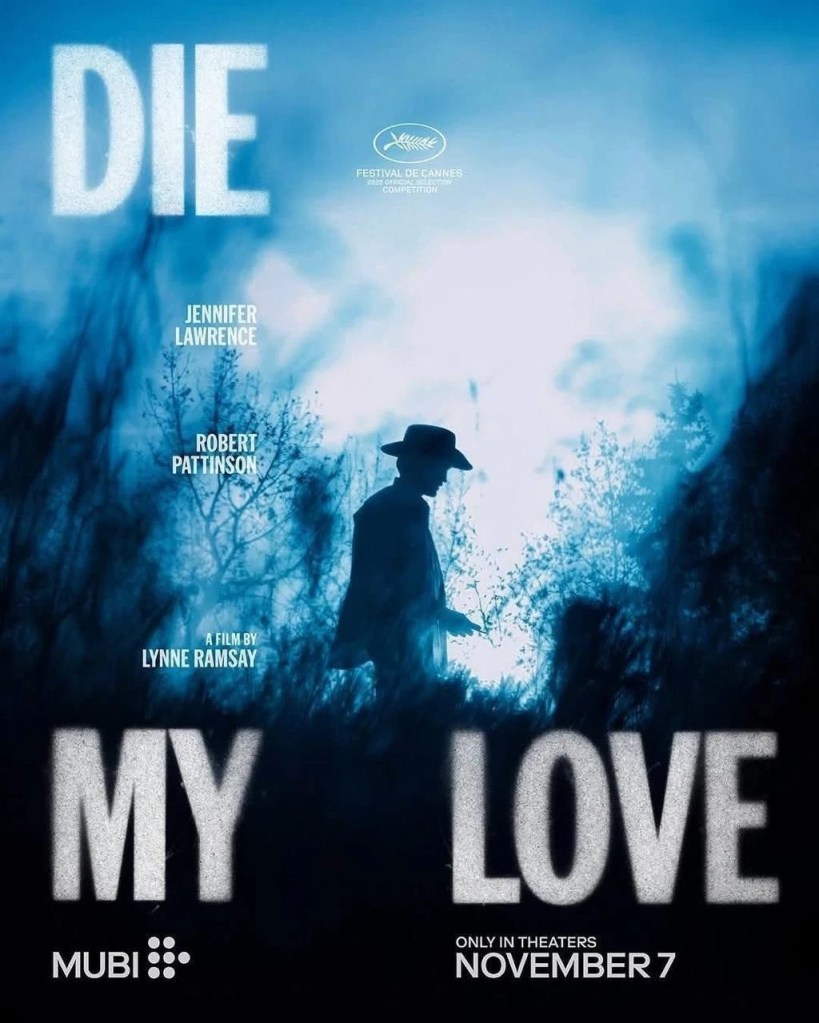
It’s entirely possible that Jennifer Lawrence and Robert Pattinson ended up here because they were short of offers having fallen from the box office heights. Lawrence has been in one flop after another – Passengers (2016), Mother! (2017), Red Sparrow (2018), Don’t Look Up (2012), No Hard Feelings (2023) – since The Hunger Games quartet and Joy (2015). So we’re talking a solid decade of box office turkeys. Apart from The Batman (2022), Robert Pattinson hasn’t done much better. So you’d think both would be aiming to consolidate their fading box office attraction rather than taking time out for this self-indulgent nonsense.

Grace and Jackson (Robert Pattinson) are a hot-for-each-other couple who take up residence in a house you are led to believe is remote but turns out to be a pram’s walk from shops. In a very vague sort of way you are led to believe that they’re here because Grace wants solitude to write the Great American novel. He’s got a job, but that’s vague too, except he’s on the road a lot and it’s hinted that he’s having one-night stands and also hinted that she’s had an affair with a neighbor.

All that’s pretty much by-the-by as the main tale appears to be a study of post-natal depression. But that hardly rings true. There’s clearly been a lot wrong long before the baby arrives and it’s not as if she doesn’t bond with the baby – if anything it’s Jackson who doesn’t bond and clearly feels so left out of the equation that he buys a particularly noisy attention-seeking dog. The house isn’t a mess the way it might be for a manic depressive.

But every now and then Grace goes bananas, smashing up the bathroom, charging though a solid pane of glass and her sharp tongue awaits anyone who attempts a friendly overture. So, we’re just waiting? For what? Some explanation of her madness? Some narrative thread?

Too bad, there’s nothing here except Jennifer Lawrence doing what she thinks might garner an Oscar. Robert Pattinson overacts and director Lynne Ramsay (We Need To Talk About Kevin, 2011) does nothing to stop either.

**

Dragonfly

A glorified television film. Not even that, a blown-up out of all proportion episode of a soap. You can see where this is going from the outset. The director aims to take swipes at all sorts who don’t deserve it in the hope of striking up some sympathy for a murderous Colleen (Andrea Riseborough) who does a kindly turn for elderly widowed neighbor Elsie (Brenda Blethyn). Both are lonely, though Colleen has a brute of a dog for company. They become friends and except for Colleen’s murderous instincts this would have ended badly anyway once the younger woman starts stealing.  

That it goes another way is blamed on middle-class meddling. Elsie’s son John (Jason Watkins), who doesn’t visit nearly often enough, doesn’t trust the friendly neighbor and realizing that the brute of a dog is actually a dangerous outlawed dog informs the cops who destroy it. In revenge, Colleen murders John and then slits her wrists in Elsie’s kitchen.

Whaat? Yes, whaaaat? Who greenlit this? As much about loneliness as Die, My Love is about post-natal depression. Essentially, it’s a gentle two-hander that, if it had only been about a gentle friendship developing between two lonely souls, wouldn’t have been greenlit at all. Writer-director Paul Andrew Williams (Song for Marion, 2012) has a point to make, although for the life of me I can’t work out what that is except give people on benefits a cushy number and they’re liable to slaughter someone. 
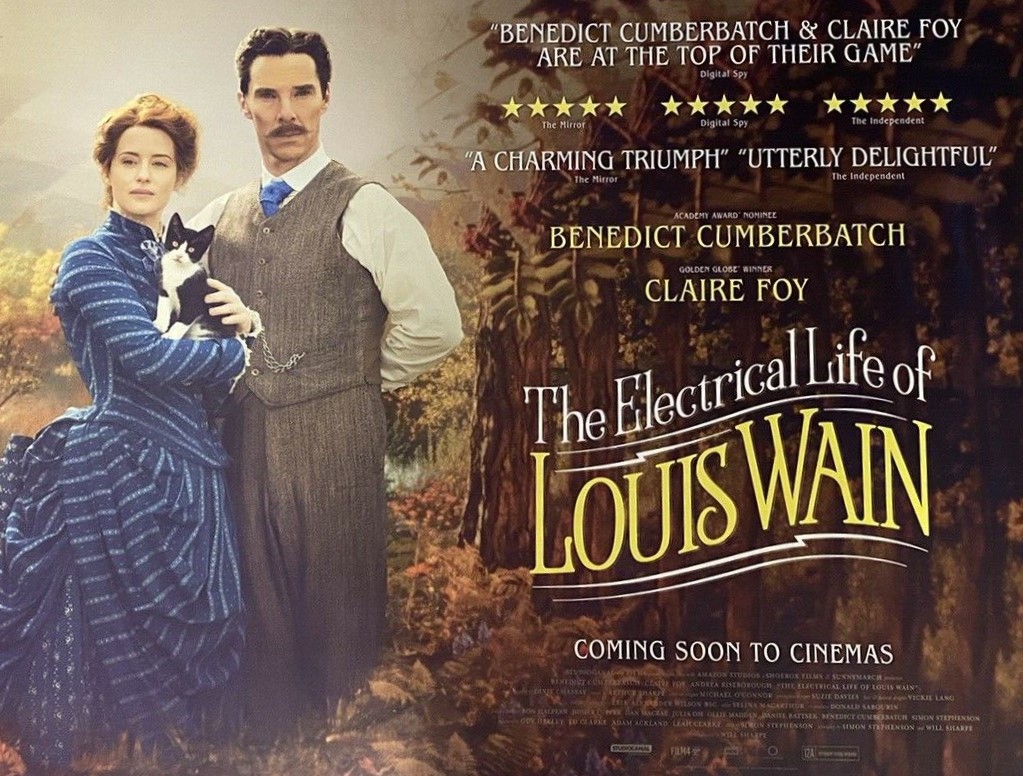
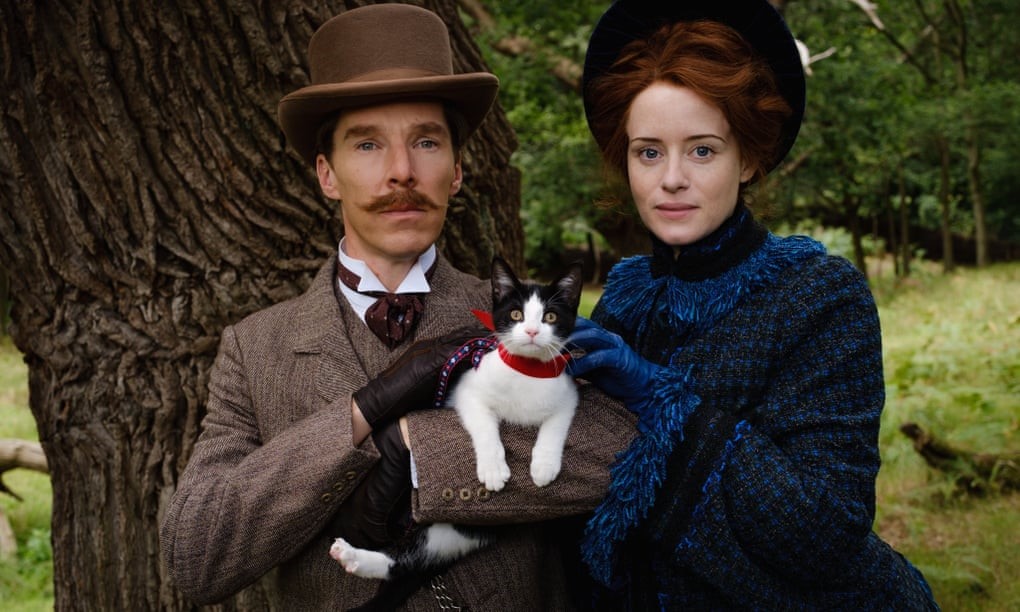
The Electrical Life of Louis Wain (2021) *** – Seen at the Cinema

Contender for worst title of this and any other year, this old-fashioned biopic covers both too much and too little of the life of the eponymous cat illustrator who ended up in a mental asylum. In addition, it’s afflicted by a breezy voice-over that you think belongs to one of the participants until all potential suspects have been killed off and you realise that for no apparent reason the narrative is being delivered by the ubiquitous Olivia Colman. The voice over also serves to cover up what director Will Sharpe fails to properly dramatize.

These deficiencies aside it’s a captivating story with some brilliant acting. Both Benedict Cumberpatch as Wain and Claire Foy as his wife Emily avoid the “strained seriousness” that they fell prey to in potential award-winning projects The Power of the Dog (2021) and a Very British Scandal (2021) in favour of more natural performances that bring both characters to charming life.

As well as inventor, all-round illustrator and amateur boxer Wain became the unlikely poster boy for an emerging generation of cat lovers. The movie also touches on some aspects of Victorian society which provide an interesting contrast to today’s more gender-equal times.  For although the man was the undisputed master of the household, the entire financial burden of bringing up a family fell to him. In Wain’s case, this was inherited, his father having died and left him in charge of a widow and five sisters, with expectations of maintaining a certain standard of middle-class life, and none of the siblings having the decency to get married to alleviate the financial strain.

And all very well from a male perspective if you could take advantage of such a position, with females on hand to meet your every need and never challenge your opinions. Not so easy to maintain if you were of an easy-going disposition with poor business skills and scandalized your siblings by marrying someone below your class, in this case an impoverished governess.

The strain of meeting family obligations, especially with a sister only too willing to remind him of his shortcomings, clearly proves too much for Wain, his earning power diminished by  interest in many other non-remunerative activities. Quite where or when electricity entered the equation is never quite made clear though ongoing nightmares about drowning and imagining he can overhear cats speaking certainly jeopardised his mental health.

By pure accident, at a time when dogs were the prime household pets and cats kept only for the purpose of catching mice, Wain’s cat illustrations became a phenomenon. He would have been wealthy had he retained the copyrights. He fell in love with the thankfully more direct governess and for a time they lived happily together. Ever after was not on the cards once she contracted cancer. The film takes on a different hue once she departs the scene. But eventually his obsession with electricity overcomes him and he ends up in a mental asylum.

The movie covers way too long a period, from his emergence as an artist in 1880 to his commitment in the 1920s. Although Emily features large in the trailer, she is gone too soon and the picture struggles to dramatize his later life. That said, that these shy human creatures emerge from their complicated circumstances to fabricate their own cocoon in the countryside with their beloved cat Peter is a touching tale. The madness that afflicts him may well run in the family, not just in their rampant entitlement, but with one sister carried off to the asylum and the older one a tad neurotic.

Cumberpatch is far better here than in The Power of the Dog where I found his character already too set. Both charming and lacking the guile required to maximize his earning potential, but with a manic nature he can no more soothe than his hair, he dominates the screen so well you are almost taken in by his bizarre theories. As good as he is in love, he is devastating as a man adrift on his own demons. Foy is excellent as the governess doomed to a lifetime of loneliness save for chance encounter with Wain.

Andrea Riseborough (Possessor, 2020) also strikes a chord as the neurotic sister determined to keep family and errant brother together. Toby Jones (Dad’s Army, 2016) plays Wain’s benefactor. The sisters include Sharon Rooney (Dumbo, 2019) and Hayley Squires from television series Adult Material (2020). Putting in a surprise turn as H.G. Wells is musician Nick Cave.

Possessor (2020) *****

This Brandon Cronenberg (son of you-know-who) rumination on identity is heavily disguised as a gory and occasionally sexy dystopian thriller. What appears at first glance a homage to giallo – toplining on shock, flesh and blood – soon reveals deeper layers of something more insistently disturbing. Focusing on an identity thief whose victim turns the tables into a who-owns-who, the films asks questions about the nature of identity and the effect of memory loss or memory accrual on individual personality. An early scene, part-debrief/part-interrogation, sees identity mind-robber Andrea Riseborough interviewed by boss Jennifer Jason Leigh to determine her own memory status, picking her way through a box of items carrying emotional connection, but it later becomes clear that Leigh has more sinister concerns: is the Riseborough returned from her latest adventure the same one as was sent out or has she been infiltrated by another?

Riseborough borrows identities in order to perpetrate a series of assassinations for an unseen corporation. Such murders are gorier than her employers would expect, invariably involving sharp implements, and setting the viewer to wonder whether the source for such brutality comes from a deeper part of the woman’s psyche. How much she is who she says she is is also questionable; before turning up on her ex’s doorstep, she rehearses what she wants to say. So there is mental and emotional dislocation at play, though whether that is the result of the experiments she appears to willingly undertake or whether from an existing characteristic is hard to say. So Cronenberg always has us at a disadvantage, and he keeps us that way, one step removed from what is going on, and may have occurred in the past, and only the determined assurance that nothing is going to turn out as it should.

One of the elements that places this picture in the top-notch category is that Cronenberg’s future does not fully work, components appear constantly out of place, as if a gear is always slipping. When Riseborough impersonates a man it is clear she has not quite grasped his full personality. When she possesses the identity of Christopher Abbott, a lowly drone partnering boss’s daughter Tuppence Middleton, he/she appears to be sleepwalking, parts of his personality eluding her, the disconnect so obvious that Middleton continues to ask what’s wrong and Abbott seems to forget that he is having an affair or has a friend at work. Again, it’s not clear whether this is Riseborough’s skillset drifting, or an extreme example of the dangers of identity theft. Instead of this whole concept being a scientific marvel, he/she is always one step behind. (Nothing to do with the plot but the previous butter-wouldn’t-melt-in-her-mouth English actress Middleton has also gone through a screen persona transformation, searching out her inner raunch for hot action with Abbott).

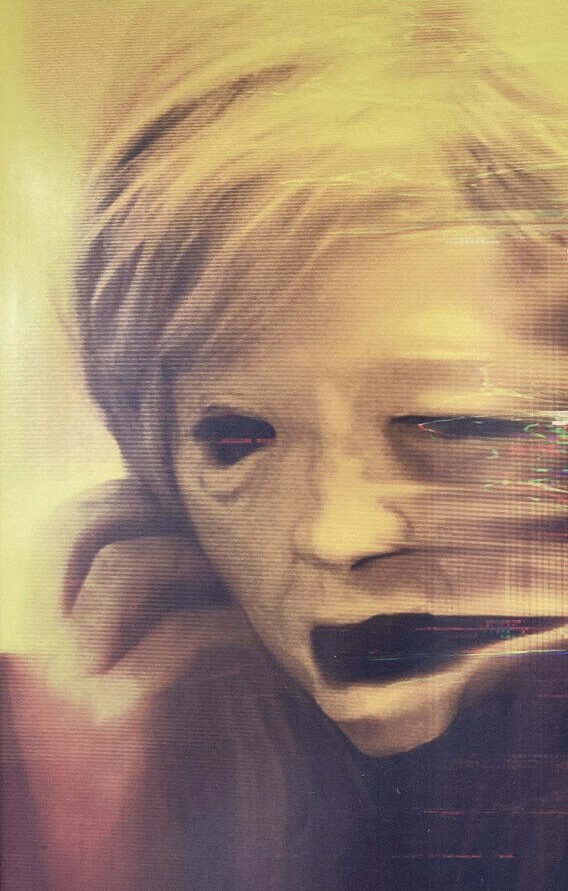
When Abbott begins to imagine inhabiting Riseborough’s face, the ghastly apparition seen on the poster, and in one of the movie’s most compelling scenes, the story takes a different turn, as if a Terminator is now on her tail.

The world depicted is an invasive one. Riseborough can infect the brain and take over the body, while Abbott’s day-job appears voyeuristic, as if the internet eye had become all-encompassing. To complete the dystopian feel, streets are always deserted and although that may be the result of budget restriction it fits the overall tone, this concrete jungle in sharp contract with murder in marble halls (a cameo by Sean Bean).

Riseborough is at her haunted best, Leigh steely as her boss, Abbott a revelation as the disturbed stolen property. Nod to Jim Williams for a brilliant score. While Cronenberg tags Blade Runner, Brazil, Blue Thunder and Terminator, the movie is an original. With enough drive and mystery to keep the thriller aspects at full tilt and while following in father David Cronenberg’s footsteps in his thirst for gore, the thrust of the picture is quite different, the concept so good it could have gone any number of different ways: the burglar trapped between two identities: the identities at war: or the personalities trying to make up what has been removed. You are left wondering what else could be going on in the world of Cronenberg’s imagination and not so much begging for a sequel but another parallel adventure in this particular universe. When a movie is still preying on your mind several days later, that’s when you know you have uncovered something special.

Discover WordPress

A daily selection of the best content published on WordPress, collected for you by humans who love to read.

The Atavist Magazine

by Brian Hannan

WordPress.com News

The latest news on WordPress.com and the WordPress community.