Behind the Scenes: “In the French Style” (1963)

Jean Seberg had wormed her way back into the affections of American critics who had ridiculed  her performances in St Joan (1957) and Bonjour Tristesse (1958) by the cleverest route imaginable – via the arthouse. Critics, hoping to foist what they deemed worthwhile foreign pictures (that they weren’t made in Hollywood was often cause enough), were apt to give overseas performers an easier ride.

Breathless (1960) had been a huge arthouse hit – though not a box office breakout as we would know it today – and, in the absence of any other offers in America and as a result of falling in love with French author Romain Gary, Seberg plied her trade in France. Thanks to her on-going contract with Columbia, she was making a fairly good living, the third highest remunerated female star in France, and working with appreciative rather than derisory directors.

The success of Breathless guaranteed audience interest in her adopted country and arthouse opening in America. In 1961 she had starred in Time Out for LoveLove Play (based on a tale by Francoise Sagan) and Five Day Lover, directed by Phillipe De Broca (King of Hearts, 1966). The following year she skipped over to Italy for Congo Vivo / Eruption.

She hadn’t been producer Irwin Shaw’s first choice. Better known as a novelist (The Young Lions, filmed in 1958) and short story writer, The Girls in Their Summer Dresser and Tip on a Dead Jockey (filmed in 1957), he had set up Susanna Productions with director Robert Parrish with whom he had worked on Fire Down Below (1957). Parrish was down on his luck, not having made a picture in four years. Shaw, who had been blacklisted in Hollywood in 1951 as a Communist sympathiser, had lived in Europe for over a decade and was a dedicated Francophile.

The writer had a troubled relationship with the movie business, as detailed in Two Weeks in Another Town (filmed in 1962), and had “removed his name or tried to from several pix.” But he “recommended that more writers turn producer.” (He didn’t follow his own advice beyond this one picture and in 1968 the documentary Survival 1967.)

Given the producers, doubling as writer and director, respectively, were content to defer their salaries, the movie was not a huge financial risk for Columbia. The budget was a miserly $557,000 – B-movies cost more. And it even came in $26,000 under budget.

Shaw’s script coupled two of his unconnected Parisian short stories – A Year to Learn the Language and In the French Style, the former a love story between wannabe American artist Louise and young Frenchman Guy, the latter focusing on a world-weary journalist Walter who is rejected by occasional model Christine in favour of a safer option. Shaw spun the story so that it turned Christine into the younger artist and took her point-of-view as she rejected Walter.

Shaw was keener on Barbara Harris, the Tony-nominated actress who had yet to make a film, for the lead. But his brother David nudged him in the direction of Seberg and Shaw was swayed after viewing Five Day Lover and that the actress was familiar with Paris, having lived there for  five years.

But Seberg was nine months pregnant when Parrish visited her to discuss the role. The problem was, the father was not her husband. Aware of the calamity that befell Ingrid Bergman after her adultery with Robert Rossellini, Seberg conspired to keep her pregnancy secret, pretending to have a broken foot which necessitated keeping the limb elevated and in a cage which concealed her pregnancy. The son, Diego, was kept a secret until much later.

Parrish tapped the French theater world for Philippe Forquet (Take Her, She’s Mine, 1963). Almost in imitation of one of the short stories, the actor had to learn a language, this time English, which he managed as shooting progressed.

British actor Stanley Baker (Accident, 1966) was already looking beyond home shores to expand his career and had worked on Joseph Losey’s French-Italian co-production Eva (1962) and Robert Aldrich’s Italian-funded Biblical epic Sodom and Gomorrah (1962). In the French Style  seemed an odd choice because although second-billed he was long delayed in making his entrance.

After the success of The Criminal (1961), which had opened on the ABC circuit in Britain to “exceptionally high” business, Baker was also itching to get into production. He owned the rights to two films being prepped by Magna Film Productions – of which he was a director – Marianne and Rape of the Fair Country, the former scheduled for autumn 1962 and the latter for spring 1963, and was already in negotiations with Joseph E. Levine to co-produce and star in Zulu (1964). Possibly cancellation of Marianne freed him up for In the French Style. Baker was in any case a last-minute addition to the cast, not signed until mid-September.

Filming began on August 27, 1962, and lasted eight weeks, shooting in Paris, the Riviera and Studios de Billancourt. It was essentially an American-style movie not made in Hollywood. And, for once, Seberg basked in the admiration of an American director. Instead of enduring the tantrums and temper of Otto Preminger, Seberg found her talent praised. “She’s the most professional, technically proficient actress I think I’ve ever directed,” Parrish pronounced, adding “her knowledge of what the camera kind of wants is staggering.”

There were daily rewrites and at times Shaw questioned his own material, in particular the scene in which Christine (Seberg’s character) is visited by her father. In an example of life imitating art, when her parents came over, Gary took them to a topless restaurant whereas in the film Christine’s father attended an equally dubious avant-garde party.

Shaw, in his capacity as producer, argued with a hairdresser over how Seberg’s “hair was to be combed.” But, generally, the movie  was a happy experience, almost falling into the exhilarating category considering Seberg’s previous experience of Hollywood manners.

At the post-shoot party, Seberg confessed about the broken foot. Parrish doubted that she needed to go to such lengths. But she was so determined to get the part that she had refused to divulge her secret in case Columbia, a big Hollywood studio, rejected her in the way Bergman had been sent into exile.

In the French Style was a hit with U.S. critics – “should make Seberg a popular name” opined Box Office. But The Daily Iowan, published in her home state, put the boot in, calling her “front runner for the world’s worst actress.”

Breathless had been reissued in Britain the previous year, an unusual accolade for an artie. Columbia renewed her contract, one picture a year for five years, proof of its revived faith in her talent. The first movie was Lilith (1964). And she was in line for the leading role in Francois Truffaut’s Fahrenheit 451, at that time titled Phoenix.

“I don’t want to sound pompous,” commented Seberg on her rehabilitation after suffering Hollywood’s cold shoulder for so long, “but I find it gratifying.”

But she was used sparingly by Hollywood – three movies between 1964 and 1968 – until Paramount and then Universal came to her rescue with, respectively, Paint Your Wagon (1969) and Airport (1970).

Fourquet won a contract with Twentieth Century Fox, promoted as the next generation of French stars, and became engaged to another rising star Sharon Tate. When career pressure finished off that romance, he returned to Paris. Two films later Stanley Baker was a huge star, in British terms at least, following the release of Zulu (1964).

The poorly-received box office flop Three (1969) had been adapted without his involvement from another of Shaw’s short stories, but he became more famous via the small screen after his novel Rich Man, Poor Man was turned into a mini-series in 1976 and made a star out of Nick Knolte.

SOURCES:  Garry McGee, Jean Seberg: Her True Story (2018) p93-97; “The Criminal Opens to Big Business,” Kine Weekly, January 19, 1961, p6; “Stanley Baker Signed,” Hollywood Reporter, September 14, 1962, p2; “Irwin Shaw – Writer to Producer,” Variety, October 10, 1962, p13; “New Jean Seberg Deal,” Box Office, February 11, 1963, pME2; “Seberg for Phoenix,” Variety, August 21, 1963, p5; “Review,” Box Office, September 23, 1963, pA9.

https://amzn.to/470agOY

https://amzn.to/49n6Xmv

In the French Style (1963) ***

Short stories can be an excellent starting point for movies because usually they are lean and narrative driven, a screenwriter needing basically to fill out the characters and add a subplot. But short stories have one weakness. They require a pay-off,  a twist, something the reader doesn’t see coming. And short of a twist of the caliber of Jagged Edge (1985) or The Sixth Sense (1999), these don’t usually come off, the audience feeling duped.

This one falls down due to a twist. Two actually, because it comprises a pair of initially unconnected short stories, A Year to Learn the Language and In the French Style. Which is a shame because the movie itself  with its Parisian setting is in general charming and conveys the development of young American Christine (Jean Seberg) as she moves from innocent wannabe artist to promiscuous model while worrying she is throwing her life away on transient pleasures.

Writer Irwin Shaw (Two Weeks in Another Town, 1962), who doubles as producer, has used Christine as the link between two of this best-known short stories. So it’s – to dip into soccer parlance – a film of two halves and I’ll let you know right away co-star Stanley Baker (Sands of the Kalahari, 1965) is consigned to the second part, when he meets an older and perhaps more rueful Christine.

So, young, not exactly starving (an allowance from her father funds her lifestyle), artist meets a young Frenchman Guy (Phillipe Forquet) determined to be the antithesis of the standard Frenchman. He doesn’t drink because alcohol is ruining his country. He won’t kiss her in public because not all Frenchman are insanely romantic. He’s severely lacking it has to be said in the romantic gene. Seduction is abrupt. He’s got the key to a friend’s apartment. Let’s go. Is as much subtlety as he can summon up.

So no sex this time and she decides she’ll be the one doing the asking, which upsets his notion of the biddable girlfriend. Anyway, they end up touring Paris on his scooter looking for a suitable no-questions-asked hotel. Surprisingly, the city, according to Guy, isn’t full of them.

And end up in a freezing hotel room. He can’t open the champagne bottle. He insists she undress last, as apparently that’s the done thing. And then he springs his surprise. He’s not only a virgin, he’s not the 21-year-old he told her he was, but still at school and just 16.

If this had been done The Graduate-style, with his awkwardness to the fore, or if she had just been as clumsy, it would probably have worked. There would have been nothing illegal in their coupling, or cringe-worthy (she’s 19 after all), but it just makes her out to be an idiot, fooled because she effectively fell for the first handsome Frenchman to come her way. It just drops a bomb of the wrong kind halfway through the movie.

Cut to four years later and she’s much more the lady-about-town, independent or of questionable morals depending on your point of view, self-sufficient or relying on male companionship to see her through depending on your point of view. Having been dumped by Bill (Jack Hedley), she hooks up with itinerant flamboyant journalist Walter (Stanley Baker) but while he’s off on some important story she’s made hay with more sober American Dr John Haislip (James Leo Herlihy, yes that one, author of Midnight Cowboy) and chooses security over culture and fun.

The problem with this section is that the short story was originally written from Walter’s point of view, as he comes to realize that long-term commitment is not compatible with globe-trotting.

All told, a pretty odd concoction. That it works at all is largely due to Jean Seberg (Breathless, 1960). I’m not totally convinced by her transition. You get the impression that had she met a more worldly Frenchman in the first half she would have quickly shaken him off for another lover. As it is, her rootlessness is meant to be the result of being disappointed by a schoolboy lover. Hmmm!

Although there’s over-reliance on Paris atmosphere – jazz club, Arc de Triomphe, restaurants where waiters transport flambe dishes halfway across a room, a “happening” where the art crowd lets it all hang out – and we rely on other characters telling us about Christine’s personal situation, it remains an interesting view of the French capital from the point-of-view of an American ex-pat, who, less successfully than Hemingway perhaps, offers a different perspective on the city. Robert Parrish (Duffy, 1968) directed.

Worth it, though, to see Seberg transformed.

https://amzn.to/470agOY

https://amzn.to/49n6Xmv

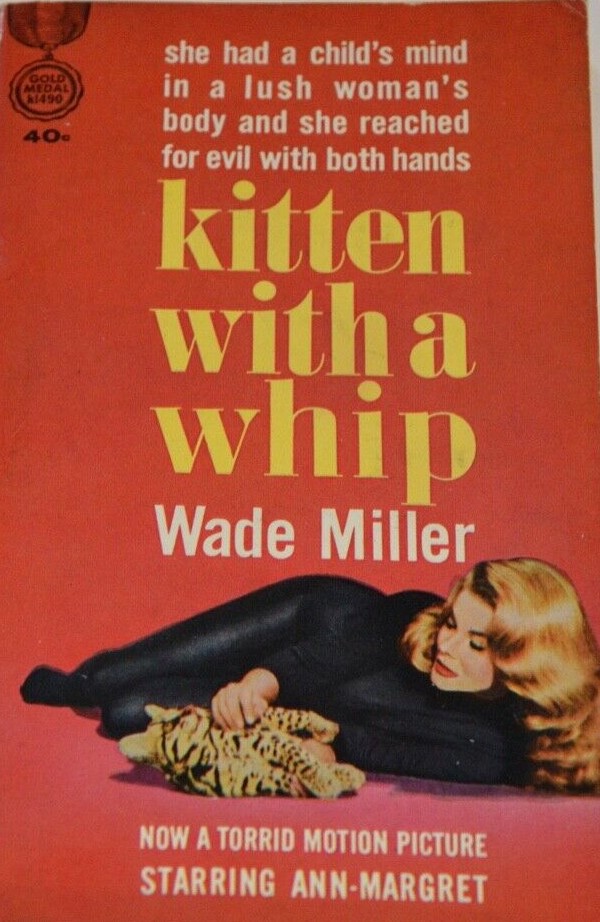
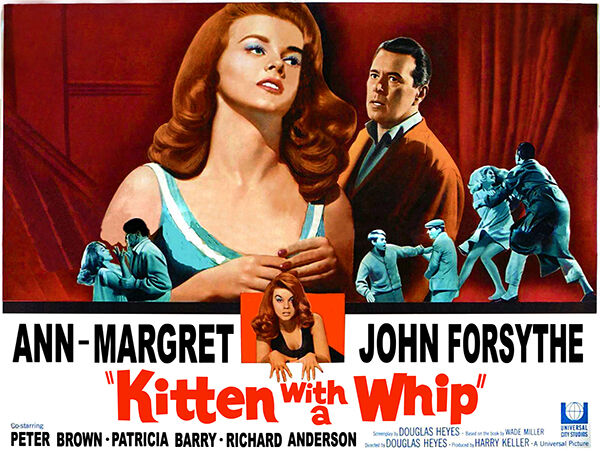
Behind the Scenes: “Kitten with a Whip” (1964)

Ann-Margret was a late arrival on the scene. The voluptuous Mamie van Doren (3 Nuts in Search of a Bolt, 1964) had bought the rights to the novel by Wade Miller in September 1959 before selling them on the Universal a couple of months later, possibly in exchange for the starring role.

Wade Miller was the pseudonym of writing team Robert Wade and H. Bill Miller, who had teamed up at the age of 12, and wrote screenplays under another pseudonym, Whit Masterson. Together they had turned out  30 novels, and hundreds of short stories and their work had been the basis for, most famously, A Touch of Evil (1958). The later Yellow Canary (1963) and Warning Shot (1966) were based on their novels. The moment Hollywood came calling Fawcett publishing, through its Gold Medal paperback division. rushed out a movie tie-in edition, adding another when the film was due for release.

The second movie tie-in edition.

Laszlo Gorog (Too Soon to Love, 1960) was initially allocated the screenplay, but was quickly replaced by Alfred Benner (Key Witness, 1960). Nancy Kwan (Tamahine, 1963) and Steve Forrest (Yellow Canary) entered the frame when Richard Rush (Too Soon To Love) was being tipped to direct. Brigitte Bardot turned it down. And it languished in limbo for a couple of years before being handed to television director Douglas Heyes – a journeyman known for episodes of Laramie, Cheyenne, The Twilight Zone, The  Virginian, et al.

It wasn’t meant to be his debut feature. That was intended to be If One Is To Die from his own original screenplay, announced in 1961. But that was for Twentieth Century Fox. When that failed to materialize, and after a short spell back in television, he did double duty – writer and director, a role he had carried out countless times for television – for Kitten with a Whip

It was the last of the 11 movies scheduled by Universal for production in 1963, shooting beginning on December 27. The studio, at the forefront of developing new talent, put new recruit Patrica Barry (Send Me No Flowers, 1964) in the secondary female role.

That this got into the mix for Ann-Margret must have taken some determined wheeling and dealing for by 1963 the actress was in phenomenal demand, especially for someone with so little experience. She had contracts for over a dozen pictures. In part, she was the most exciting addition to a growing pool of new talent that included Michael Callan (The Interns, 1962), Alex Cord (Stagecoach, 1966), George Segal (The Quiller Mmorandum, 1966) and Peter Fonda (Lilith, 1964), but the fact that she could sing and perform made her doubly attractive since Hollywood had now worked out that hit singles and live performances were “the fastest route to the showbiz area…and the springboard to…film fields.”

Film adaptations of hit musicals, benefitting from the “broader pull of Hollywood productions” and “wider audience exposure,” boosted sales not just of the original soundtrack but also the original Broadway cast recording. Columbia’s Bye, Bye Birdie (1963) sold two million copies of the movie soundtrack and album and 1.5 million of the Broadway version.

There was a three-picture deal with Frank Sinatra’s Essex Productions that should have included Marriage on the Rocks (at that time known as Community Property, its original Broadway title) delayed until 1965 when the original director pulled out. Columbia was owed three movies, Twentieth Century Fox five. Every time she signed a new contract her price went up. She was the object of a bidding war. MGM appeared to be in the lead when it raised her going rate, ponying up $275,000 plus a percentage for two movies – Viva Las Vegas (1964) and Say it with Music (shelved). But Universal trumped that, $250,000 per picture for six movies, the first being Kitten with a Whip.  

Her arrival in showbiz had triggered  whirlwind of promotion. She snaffled her first headline in December 1960, at the age of 19, when Jack Benny added her to his nightclub act in las Vegas. Four months later her face adorned a full-page ad in Hollywood Reporter that announced her television debut on the Jack Benny Show on CBS April 2, 1961. By then Twentieth Century Fox was sniffing around and she landed a $1,000 a week contract.  The studio set her as female lead in State Fair (1962) but she was abruptly dropped and when reinstated it was as second female lead.

At this stage, publicity focusing around her voice. Signed to RCA Victor, she quickly became a top-selling artist. In return for delivering 12-24 singles and a number of albums over three years, the label committed to spending $50,000 a year in promotion. Columbia assigned George Sidney, director of Bye, Bye Birdie, to make an eight-minute promotional film.

After well-received turns in A Pocketful of Miracles (1962), Bye, Bye Birdie and female lead to Elvis Presley in Viva Las Vegas, Kitten with a Whip represented  departure, her first dramatic role. Although some observers later criticized her management team, in retrospect it’s clear that a sensible strategy was in operation, alternating lighter fare where she could sing and dance with more serious works (Once a Thief and The Cincinnati Kid, 1965, and Stagecoach the following year) where she did neither.

Exhibitors were so convinced she was the real deal that she was the youngest-ever winner of their Star of the Year Award, previous holders of the trophy including the more established likes of John Wayne, Gregory Peck, William Holden, Deborah Kerr and Doris Day, but only after they had been in the business for several years with umpteen box office hits to prove their worth.

Male lead John Forsythe, after years on television in Bachelor Father (1957-1962), was making a movie comeback. But he had signed an unusual contract with Universal, suggesting nobody was confident he was as genuine a prospect. The studio offered him a deal for two pictures a year, but one that also included television work for its television arm Revue.

Reviews were better than the actress might have expected. Eugene Archer, the second-string critic on the New York Times said “she demonstrated enough untrained talent to suggest interesting dramatic possibilities in better films.” Box Office opined that Ann-Margret delivered “a realistic and surprisingly effective characterization” but pleaded for studios to “let her return to lighter fare.”  Variety was dismissive: “display of over-acting.”

Exhibitors took a negative view. “Does this popular star a great deal of harm,” was typical of the response. Others were more forthright, describing the movie as a “glaring example of the type of show that shouldn’t be made.” Overall, it was not what anybody – critics, audiences, cinema managers – expected and not in a good way.  The St Paul Evening Dispatch took the MPAA’s Production Code to task for passing a picture of “sheer sadism, depravity without redeeming reason.”  

In some first run situations, it was the solo feature. Other cinemas paired with Lolita (1962), a somewhat obvious choice, or Lilith (1964) or British film Young and Willing (1962), Faces in the Dark (1960) with Mai Zetterling and Audie Murphy western Bullet for a Badman (1964). In some cities, it bypassed first run and went straight into the drive-ins. In smaller locales it went out on the lower half of a double bill.

Only in Pittsburgh did it score at the box office, “lofty” the assessment. It was deemed “sluggish” Washington, “slow” in Chicago and Los Angeles, and “slim” in  Columbus, Ohio. Of 21 movies released in the Winter Quarter, it was ranked lowest where it mattered most, at the ticket wickets, according to Box Office. It didn’t rake in $1 million in rentals, the amount required to earn a place on Variety’s annual box office chart.

Kitten with a Whip didn’t appear to harm the star’s career. Critics praised her work on Once A Thief and The Cincinnati Kid. But as her career first prospered and later crashed and burned it was considered something better not mentioned. John Forsythe fared less well. Outside of television, he only made five movies in five years.

Heyes’ movie career stuttered. He had been due to write and direct The 12th of Never, based on his own novel, to star Sandra Dee, one of Universal’s top marquee names,  in June 1964, but when that was cancelled returned to television until called back to direct Beau Geste (1966).

There might have been reassessment of the value of the original film when Gus Van Sant announced he planned a remake in 2007. On the other hand, that it was Lindsay Lohan’s favorite picture didn’t do it much good.

https://amzn.to/3FP3WxL

https://amzn.to/46Xr0q4

Kitten with a Whip (1964) ****

I’ll let you down gently. Ain’t no whip. What you have instead is one of the most under-rated, unseen and maligned mini-masterpieces you will ever come across marching to the film noir beat. Bewildering femme fatale and the kind of disenchanted anti-authority teenagers who would drive the “youthquake” that almost destroyed the industry half a decade later. And within this, one of the great tragedies of Hollywood, the performance of her career from Ann-Margret, buried because it wasn’t what the public, the critics or the industry expected from the young star.

Edgy score with soulful sax underwrites a picture brimfull of surprises and plays constantly with your expectations, the picture shifting gear so often you’d think you were in a tumble dryer. The doorbell plays like a loaded gun, every interruption racking up tension.

Stylish credits that hint of Hitchcock precede a brilliant opening as in full noir fashion a band of light catches the eyes in the darkness of a blonde (Ann-Margret) dressed in a nightgown cresting a hill.

She tries to jump on a moving goods wagon, eventually makes her way to a deserted house, untouched wrapped newspapers littering the lawn, clambering into a bed, clutching a teddy bear for comfort. You want mystery? This is just the start. In one of the best neat cuts, we jump from the eyes of a teddy bear to headlights. Owner returning home is budding politician David (John Forsythe), wife away due to marital issues.

Come morning, he discovers his guest, Jody. She recites a sad tale of fleeing sex abuse. But soon he realizes she’s got a story to fit every occasion and can turn the emotions on like a tap. Manipulation is in her DNA. But she’s a tough little number. “Hands off, buster,” she snaps at one point as she tries to physically hustle her out.

It’s unspoken that the idea of being caught, regardless of whether he’s entirely innocent, in illicit dalliance would mean  the end of his political ambitions, but she’s happy to spell it out. If the cops work her over, who knows what would spill out.

He buys her clothes, gives her money. Sayonara, baby! Except it’s not. He discovers she’s on the run from juvie, where she torched the home and stabbed the matron. Worse, she’s not left after all, but returned, the house filled with the noise of television cartoons, floor littered with teenager mess.

It’s unclear what exactly she wants. But she knows if she screams rape that’s curtains for him. And if Freud (1962) used a length of rope to show how a psychiatrist can’t escape his client, Jody’s version is a length of telephone cable, dragging her quarry to the floor when he’s talking to his wife.

And before you know it, it turns into home invasion. She’s called up some pals, younger  versions of the creeps in The Penthouse (1967) but with a similar set of philosophic ramblings (“the meanings of the meaningless”) from thug Ron (Peter Brown), not averse to sharing buddy’s docile girlfriend Vera (Patricia Barry). And now it’s blackmail. And violence, a cutthroat razor the weapon of choice, though thug Buck (Skip Ward) is handy with his fists, too.

The kids, drug peddlers, want driven over the border. So now we’re racing off in the dark. David is savvy enough to leave Buck entangled in barbed wire, manages to drop the wounded Ron off at a doctor’s surgery and now desperately tries to escape Jody, though, as you might expect she has other plans.

So the movie spins all the time on the twin axis of discovery that could end David’s career and the demonic damsel. While it steers clear of any sexual attraction by David for the young glamor girl, his interest is initially more paternal, and consequence-aware. Quite what she does want is unclear, beyond some kind of freedom, power even, “I call the shots, not you,” the upper hand over the males, marking him with her nails in the way she has been scarred.

But it races along, it’s impossible not to be dragged into the quandary, half the time you hoping that somehow she will escape her demons, while fully aware that she’s on the fast track to Hell and will take people with her.

This is Ann-Margret (The Swinger, 1966) as you’ve never seen her. It’s not that the sexiness is hidden, it’s a heck more subtle than that, and when she parades in some flimsy item it’s clearly more for approval than arousal. At one point she dances in a jokingly sensuous manner, but otherwise there’s no trademark singing and dancing. She’s a junior version of the more fully-fledged femme fatales of noir who’ve hooked some sap into crime. This gal hasn’t got that kind of criminal brain – or maybe not yet – she’s a victim of circumstance and, let’s face it, the powerful male.

There’s a terrific moment when Vera accepts that she means little more to her boyfriend than that she has a car, exhibiting the kind of impotence that came with the territory for young women of the era lacking confidence or a decent role model. Jody’s the opposite. She’s confident enough, but no idea what to do with it, beyond ensuring no man gets the better of her.

You’ve heard enough of Jody’s sob stories not to believe a word she says but still the power of Ann-Margret’s performance is that you feel the deeper, hidden, pain.

Writer-director Douglas Heyes (Beau Geste, 1966) directs with tremendous verve, keeping his foot down on the tension pedal. That the movie was generally seen as a low-point in the career of Heyes and Ann-Margret is one of those Hollywood anomalies, or ironies if you will, probably dumped on because it was perceived as flying too close to the Lolita (1962)/Baby Doll (1958) template, although in reality the character avoids going down the simpering child route except as a means of extracting sympathy.

John Forsythe (Topaz, 1969) begins on the rack and never gets free.

Nothing like would you expect – and certainly not from the title – and deserves full reassessment and all the critical accolades going especially from those who appreciate the noir canon.

Massive disservice to Ann-Margret, whose performance here should have opened up a career of more serious movies.

B-movie noir masterpiece.

https://amzn.to/3FP3WxL

https://amzn.to/46Xr0q4

The Running Man (1963) ****

Twisty Carol Reed thriller pivoting on emotional entanglement that keeps you guessing right up to the end. In revenge for losing his business after an insurance company failed to cough up for his crashed plane, entrepreneur Rex (Laurence Harvey) fakes his own death and flees to Malaga in Spain.

But when girlfriend Stella (Lee Remick) joins him she discovers he has assumed the identity of an Australian millionaire whose passport he has purloined and completed the transformation by changing his black hair to blond. Rex has a mind to repeat the experiment by killing off himself (under the new identity) and claiming the insurance. Stella, complicit in the original scam, not only balks at this idea but finds disconcerting his change of personality and clear attraction to the opposite sex.

Tensions mount when mild-mannered insurance investigator Stephen (Alan Bates) appears on the scene. Anyone watching the film now has to accept that in the days before social media every face was not instantly tracked and accept that Stephen is unaware of what Rex looks like.

The couple cannot run because they are awaiting a bank draft. Stephen immediately sets the tone for suspicion when he pronounces that their vehicle  “looks like a getaway car.”  Forced to follow “The Godfather” dictum of keeping your enemies closer, the pair befriend Stephen  with the intention of finding out what he knows and what are his intentions. Rex and Stella  have to pretend they have only just met, separate bedrooms et al, leaving the door open for Stephen to gently woo Stella, an action endorsed by Harvey. They are caught out in small lies. Rex’s Australian accent falters. Stephen keeps on making notations in a notebook. Rex  foils his pursuer’s attempts to photograph him.

The ensuing game of cat-and-mouse is complicated by Stephen’s romantic inclinations towards Stella. Is this as genuine as it appears? Or is he trying to get her on her own to admit complicity? Both Rex and Stella are, effectively, forced to adopt the new identities they have forged to dupe Stephen, with unforeseen results. There are red herrings aplenty, a race along mountainous roads, and some marvelous twists as the couple find the tale they have woven is turning too tight for comfort until murder appears the only solution.  

As with his international breakthrough The Third Man (1949), Carol Reed grounds the whole Hitchcockian enterprise in local culture – this being unspoiled Malaga prior to the tourist deluge – Spanish churches, a wedding, fiesta, the running of the bulls, with an occasional ironic twist – “gypsy” musicians watching ballroom dancing on television. Reed resists taking the material down a darker route – Hitchcock would undoubtedly have twisted the scenario in another direction until Stella came under threat from Rex – but instead allows it to play out as a menage a trois underwritten by menace.

The acting is sublime. Laurence Harvey (A Dandy in Aspic, 1968) wallows in his part, Remick (Days of Wine and Roses, 1962) quietly anxious scarcely coming to belief that she had played a part in the original crime, Alan Bates (The Fixer, 1969), his deceptively pleasant inquisitive demeanor the ideal foil to Harvey. Unusually, they all undergo change, Harvey uncovers a more ruthless side to his character, Remick responds to the gentler nature of Bates, while Bates shrugs off his schoolmasterly aspects to become an attractive companion.

A couple of footnotes – special mention to Maurice Binder for the opening credits and this was the final score of British composer William Alwyn (The Fallen Idol, 1948). John Mortimer (Bunny Lake Is Missing, 1965) wrote the screenplay based on the Shelley Smith novel.

Full throttle film noir.

https://amzn.to/45ZFynU

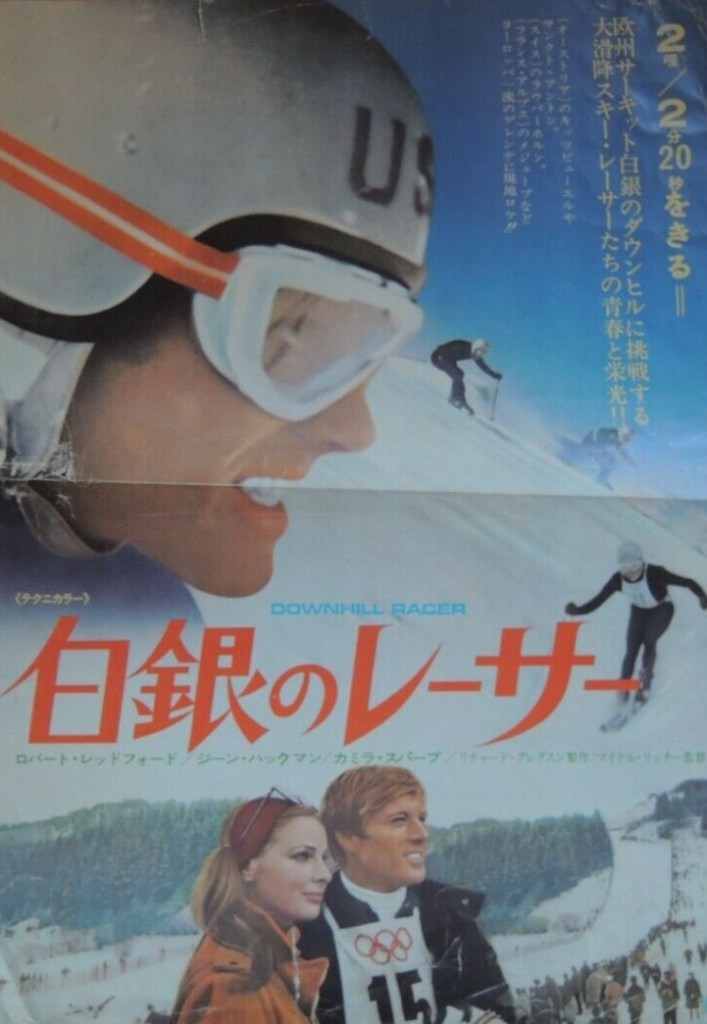
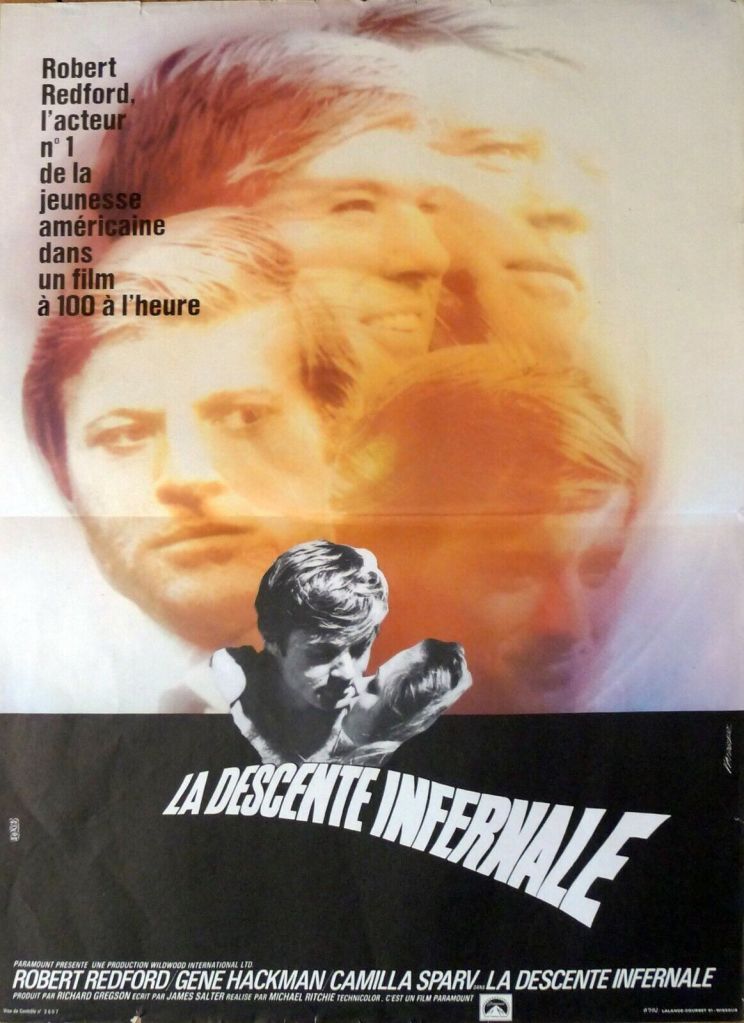
Downhill Racer (1969) ***

Robert Redford rarely took the easy option. Even his big romantic number, The Way We Were (1973), with Barbra Streisand had a serious center, Jeremiah Johnson (1972) focused on ecology and he used his star power to get studio backing for All the President’s Men (1976). Even starting out, and before Butch Cassidy and the Sundance Kid (1969) anointed him a star, when he could, or should according to some observers, have been capitalizing on his good looks he did not shrink from playing unlikeable characters.

Idealizing heroes is endemic. Most films which portray sport stars with feet of clay generally begin with an attractive personality who presses the self-destruct button through alcohol, sex or drugs (or all three) such as Number One (1969) with Charlton Heston. The general consensus is that this approach to the sports movie was not rescinded until the brutal boxer exposed in Scorsese’s Raging Bull (1980).

But it turns out Scorsese was not the first. In this ski drama Chappellet (Robert Redford) is a loner who cares for no-one but himself. Alienated from his father (Walter Stroud), his girlfriend at home little more than a sex object, the obsessed skier proves a constant source of friction for his national team manager Claire (Gene Hackman) and not above the kind of dirty tricks as typified in Slap Shot (1977). He sees nothing wrong with making no bones about the fact that he is in the game for fame.

Totally lacking in self-delusion, he’s a farm boy and few steps up from being illiterate. The world of the professional skier was hardly the obvious subject for a sports drama. There’s certainly an excitement in the action that couldn’t be captured on television, but the essential competitive element, the race against the clock, is not so riveting as the last-minute touchdown or winning home run.

Pretty much Chapellet’s only attractive feature is that he is played by Robert Redford, and the film plays upon the conceit that as handsome a man as this will at some point turn into a good guy.  There’s an interesting debate – and one that would last decades – about whether Redford’s looks got in the way of the characters he portrayed. Imagine Robert Duvall in the part, for instance, and relentless determination would not be called into question.

This leaves the film with only pity as a way to provide the character any sympathy, the sense that if he turns into a loser the audience will warm more to him than if he is a champion, but that arrives outside the competitive circle, and perhaps is even more touching, when his hopes of genuine romance with top-notch blonde Carole (Camilla Sparv) are dashed. 

Michael Ritchie (The Candidate, 1972), making his directing debut, opts for a documentary-style approach, so minimalist it’s almost perfunctory. This is a decent option given there’s very little going on beyond lonely hotel rooms, and an endless round of competitions and an occasional outburst from the manager. The skiing scenes, sensational at the time, are boosted by Blu Ray. Although it gained good reviews, audiences failed to respond although Redford was on a career high after Butch Cassidy and the Sundance Kid (1969).

While it was a brave choice for the actor, the script by James Salter (Three, 1969), based on the Oakley Hall bestseller, doesn’t bring enough insight, though you could argue it was intended to keep the character at arm’s length.  A novel can be engaging enough just by opening up an unusual world, but a movie needs to do more. This is pre-chuckle Gene Hackman (The Gypsy Moths, 1969)   and at this point you would probably have bet on him remaining a supporting player.

Redford, the thinking man’s actor, in embryo.

https://amzn.to/3MonLzM

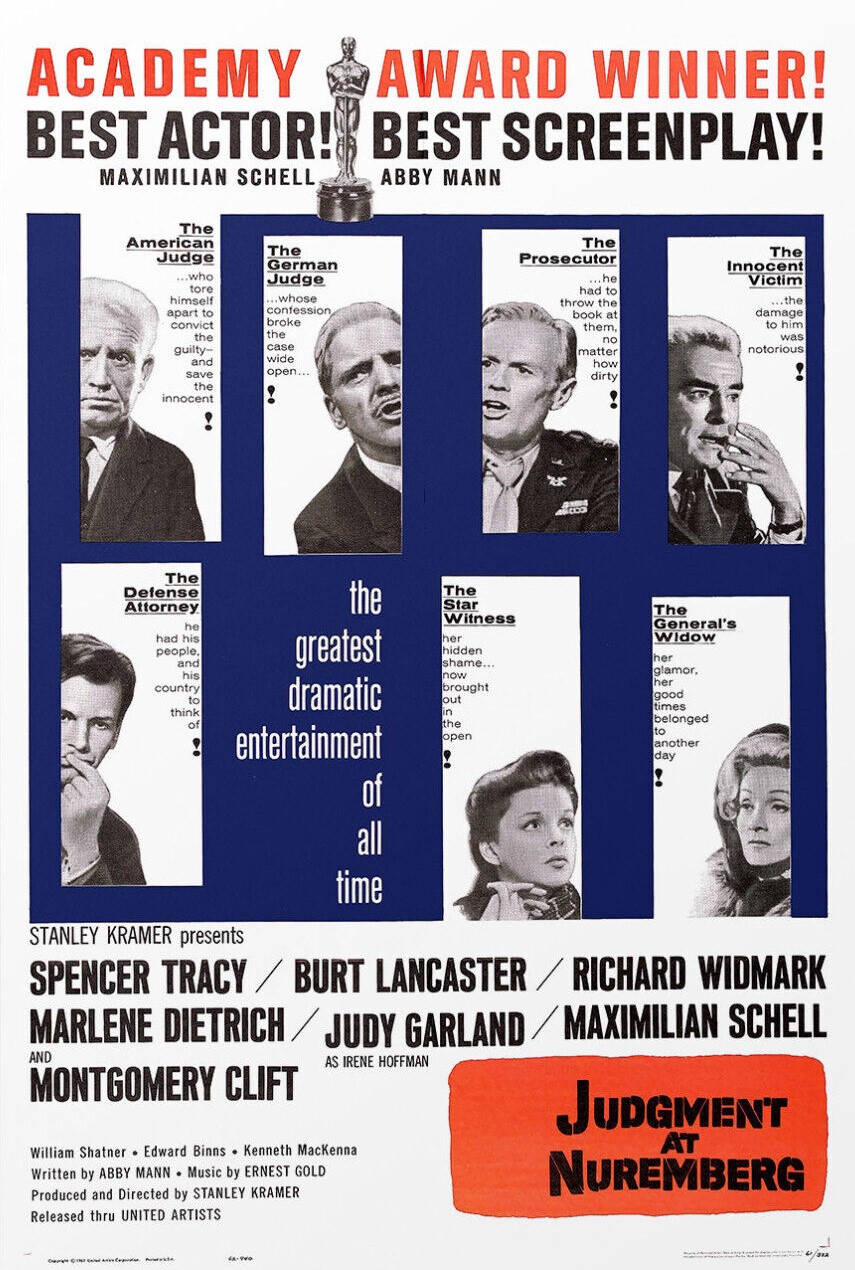
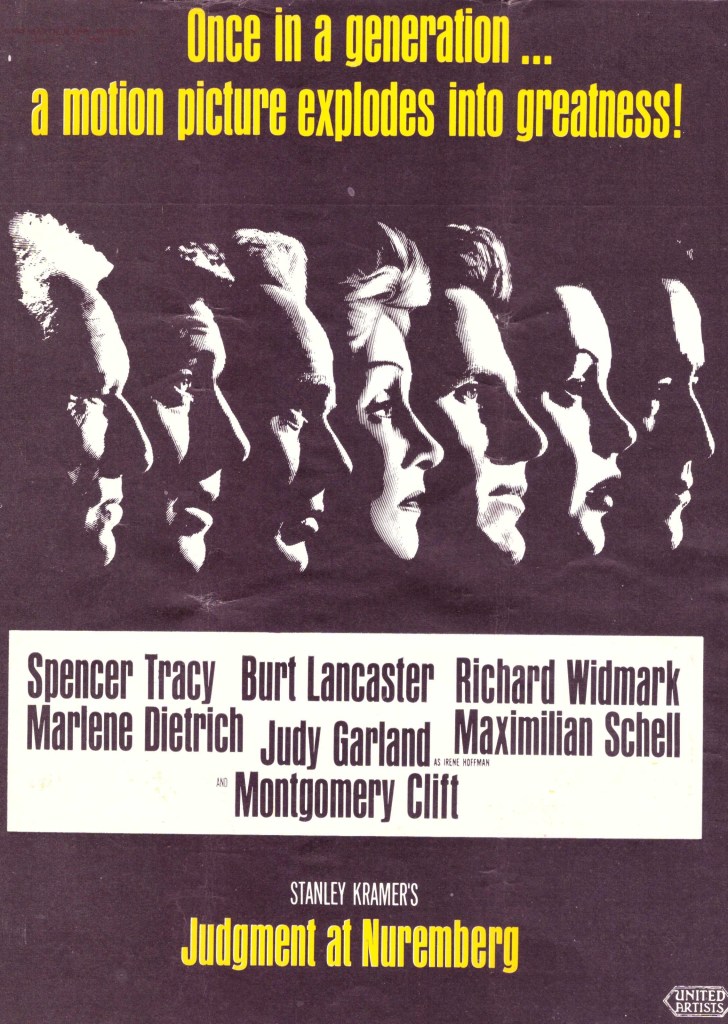
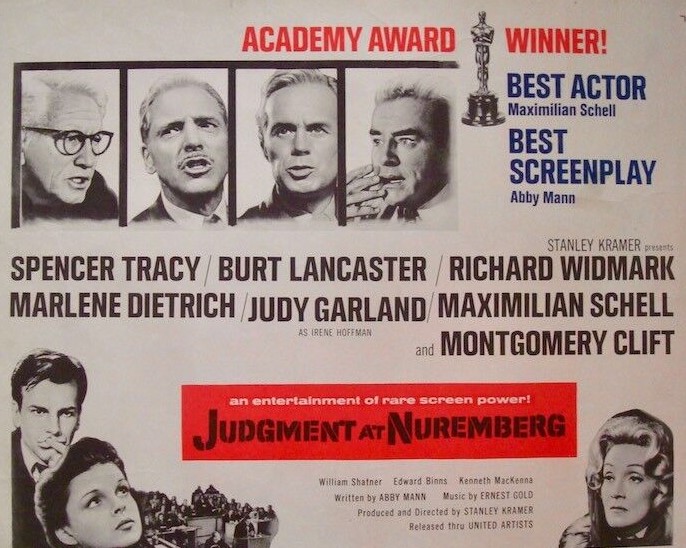
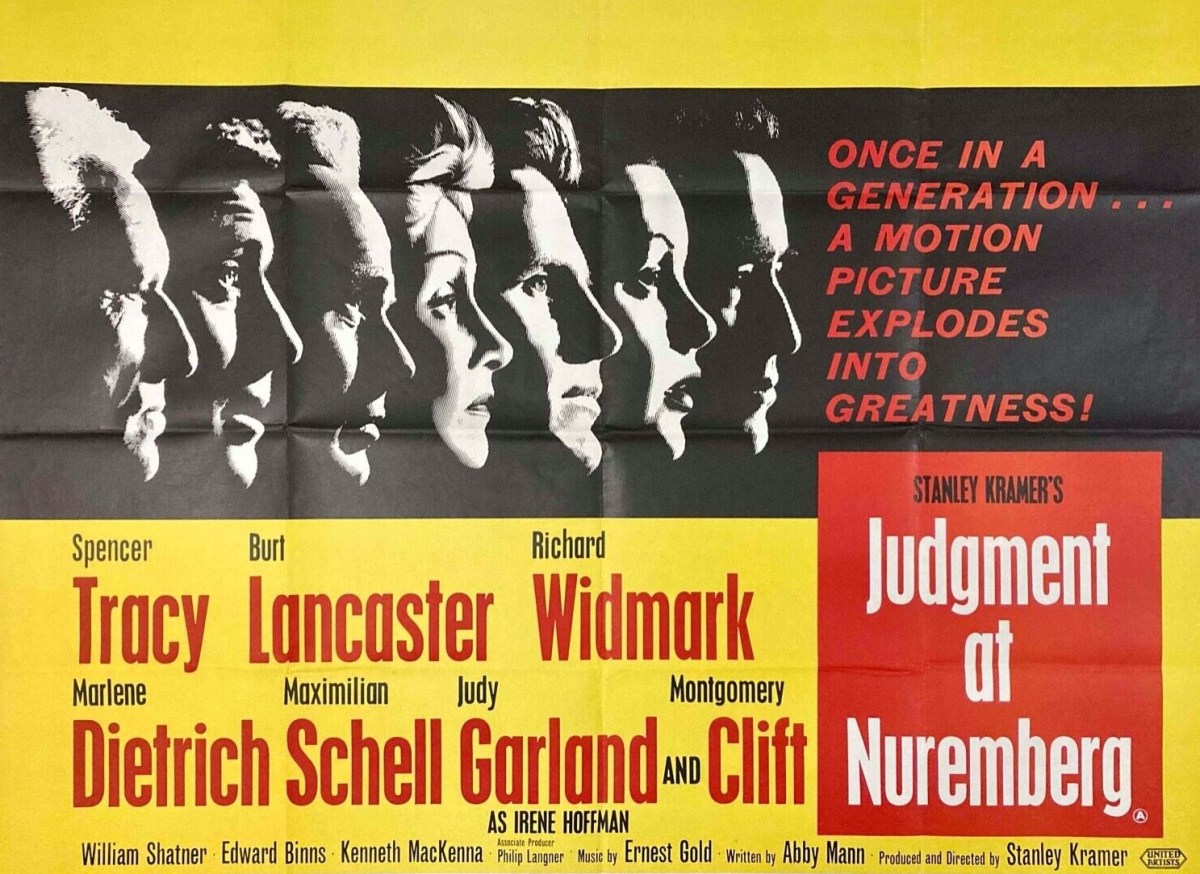
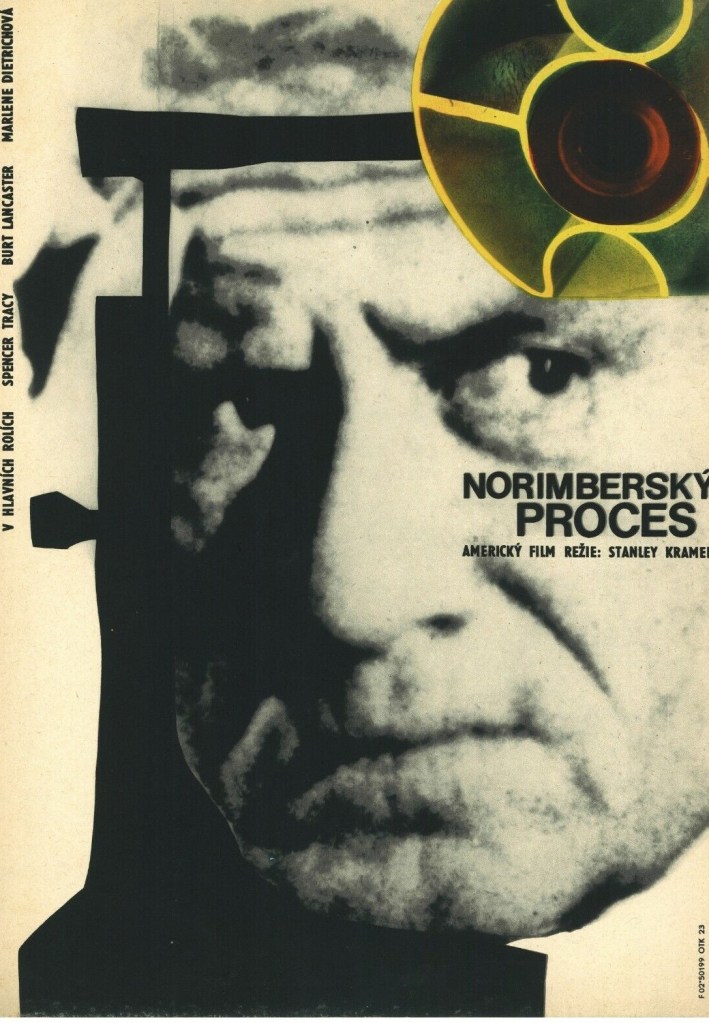
Behind the Scenes: “Judgement at Nuremberg” (1961)

Laurence Olivier could have played a Nazi long before his celebrated villainous turn in Marathon Man (1976). He was producer-director Stanley Kramer’s first choice to play Chief Judge Dr Ernst Janning. He turned the role down in favor of getting married to actress Joan Plowright. Kramer had already decided an all-star cast was required to attract an audience for the grim picture.

The screenplay was an extended version of Abby Mann’s teleplay that had screened on the ABC in 1959. Although Marty (1955) had transitioned with box office and critical success from television to cinemas, that boom was long over.

United Artists, with whom Kramer had a multi-picture deal, were not keen. “I did what looked like a compromise to them, but what I had been planning to do anyway. I promised to fill the cast with stars of such magnitude that their presence would almost guarantee the film wouldn’t lose money.”

There were a couple of other obstacles to overcome. A stage version of the teleplay was being planned for London and Paris and Kramer had to take out an injunction against a documentary with a similar title, Verdict at Nuremberg.

Kramer was known as an issues-driven director, his debut Not As a Stranger (1955) tackling the medical profession, The Defiant Ones (1958) racism and in On the Beach (1959) nuclear war. Along with Otto Preminger, he was viewed as a director of “worthy” pictures, not always a recommendation in the eyes of the critics, but as long as the movies made money and attracted Oscar interest likely to remain attractive to studios. Kramer was just about the only producer (High Noon, 1952, and The Caine Mutiny, 1954, on his calling card) who made a successful career-long transition to direction.

With the exception of Olivier, replaced with Oscar-winner Burt Lancaster (Elmer Gantry, 1960) – not incidentally second choice either, the director preferring to have used a German actor – Kramer hired all his first choices. Spencer Tracy, in fact, was the first recruit. After working with him on Inherit the Wind (1960), Kramer got it into his head when considering a picture to ask himself what part there might be for Tracy.

The actor provided “A depth and candor that would make people notice.” Maximilian Schell (Topkapi, 1964) reprised the role he had essayed on television, a man “living in a complicated gray zone.”

Kramer had a reputation for hiring singers and dancers – Gene Kelly, Fred Astaire, Frank Sinatra –  for dramatic roles and he continued in that vein by hiring Judy Garland. It was a difficult decision. He theorized that “the very disorders that made it difficult to work with her fitted perfectly with the role.”

You could have said the same of Montgomery Clift (Freud, 1962), “reduced almost the level of the unsound person he was portraying.” Given the actor’s problems remembering lines, Kramer allowed Clift to basically ad lib, when attacked on the witness stand permitted to reach “for a word in the script” that appeared the correct emotional response to “convey the confusion in the  character’s mind.”  While Clift did not often adhere to the script, whatever he said worked well enough. Rarely has a director been so sympathetic to a troubled actor. “He needed someone to be terribly kind,” said Kramer, “someone who would consistently bolster his confidence and tell him he was wonderful.

Marlene Dietrich, who had firsthand experience of Nazi Germany at first hand, having fled the country, actually knew the general whose wife she was portraying, which helped to “deepen my understanding of the emotions of Hitler’s victims,” conceded Kramer. Opening up about her experiences and fears allowed Kramer to extend the scope of the character.

While the courtroom where the original trial had taken place was not available for hire – it was in current use – Kramer was permitted to measure and photograph the room to reconstruct it on a soundstage. Only 15 per cent of the movie was shot in Germany.

The experience of filming Inherit the Wind, another courtroom drama, taught Kramer the need to have fluid camerawork since talk and gesture tends to be static. “I learned to move the camera often to achieve a sense of movement for the viewer.”

Abby Mann was required to open up the teleplay, move the action outside the courtroom – scenes in the judge’s accommodation, on the derelict streets, in restaurants – and avoid cinematic claustrophobia and making it a “pious sermon.” “In my opinion,” argued Kramer, “Judgment at Nuremberg conveys a moral not always honoured, then or now, in the world of politics.”

Kramer had a particular method of pre-production. He built all his sets six weeks before filming began. As part of that process, he sat down with his cinematographer and went through the script scene by scene working out the lighting and camera positions. Then he called in the actors and took them through the sets and roughly his shooting thought-process, taking on board any queries and suggestions.  Film like this “sort of demanded it be shot in sequence with a single camera,” explained cinematographer Ernest Laszlo  (Fantastic Voyage, 1966).

The 360-degree turning of the camera was not as revolutionary as you might imagine – although, according to critics, Michelangelo Antonioni invented it for The Passenger (1975). Laszlo had done if before on The Hitler Gang (1944) for director John Farrow. But this was infinitely more complicated set-up with the revolving camera in constant use to allow Kramer the required fluidity.

“I used two key lights,” said Laszlo. “Shooting this I used one and then as we went round I used the other.” It wasn’t as simple as it sounds, the lights needed to be positioned with mathematical precision so the audience wasn’t aware of any change in the lighting.

“The circling camera saved us photographically,” said Kramer, preventing the picture from seeming “slow and cerebral.” As smooth as it appears on screen it was cumbersome. The entire crew involved had to carry cables and equipment round in a circle. But it permitted Kramer to pick up the judges without cutting to them.

Kramer also used the camera to achieve another transition. As the picture began, German actors spoke in German (with translators offscreen) to show the trial was mostly in German. But for the movie to work, the dialog needed to be in English. “We started the transition scene with Schell addressing the court in German. Laszlo’s camera zoomed in on him, then turned elsewhere, then turned again to Schell so that we were able to switch his speech from German to English in perfect cadence as the camera came in on him the second time. His English picked up from his German so naturally you could almost let it pass without noticing.”

Kramer conceded there might, in fact, be “too much camera movement.” But that was in part dictated by a “very authentic situation, a long courtroom, very wide, and the spacing between the original attorney’s box and the witness box was at least forty feet. That’s a long distance if your try to photograph it.” Also, it wasn’t like a normal Hollywood or American trial, where the lawyers can prowl in front of judge and jury. Here, the attorneys could not move from their box.

“Unless you want to play ping-pong in the cutting room, you have to move the camera…I felt trapped by these three positions – the judges, the attorneys and the witnesses in that big spread. So, the forty feet was compressed to twenty-eight feet. We had to put a lot of light on the far figures to hold the forms in focus,” resulting in the actors “perspiring a lot during these shots.”

The movie, rolled out as a roadshow, did better than expected, the all-star cast proving a major draw, global box office netting a healthy profit. Schell won the Oscar as did Abby Mann, Kramer was nominated in his dual capacity as producer and director.

SOURCES: Stanley Kramer, It’s a Mad, Mad, Mad, Mad World: Life in Hollywood (Harcourt Brace & Company, 1997) p179-197; Donald Spoto, Stanley Kramer Film Maker (Samuel French, 1990)p230-233;  “An AFI Seminar with Ernest Laszlo, American Cinematographer, January 1976, p52; “Judgment at Nuremberg Still Slated for Legit,” Box Office, February 3, 1960, p6; “Kramer Gets Injunction,” Box Office, December 11, 1961, p14.

https://amzn.to/3Mkl7v5

Judgment at Nuremberg (1961) ****

Stanley Kramer never caught a decent academic/critical break. Subject matter worthy, execution poor, was the overall consensus. But Judgement at Nuremberg, with its long tracking shots, sometimes turning 360 degrees around a character, should have changed all that. But the kind of critics who would have appreciated such bravura technique weren’t around at the time and even when Antonioni’s The Passenger (1975) appeared nobody thought to reference Kramer, believing this was a new cinematic invention by the esteemed Italian maestro.

So, Judgement at Nuremberg is remembered, if at all, for the subject matter and elevated by the performances rather than the director’s input. Most people misremember what the movie’s about. The main concern here isn’t the war criminal, the men personally involved in running the ghettos. Instead, it’s about those behind the scenes who could, theoretically, have prevented the camps flourishing, or at least challenged their opening.

Those on trial were freedom fighters of a different sort. As judges, the top tier of the legal system, their job was not just to uphold law and order and individual freedoms, but to take government to task for illegal action. It’s a basic tenet of the democratic world that governments cannot act in autocratic fashion but work within public accord.

Should the legal guardians find fault with government activity, their job is to take the ruling body to task – the European Court of Human Rights was set up with exactly that principal in mind, and various British and American law agencies have over time called a halt or questioned government proposals.

Some of the judges were clearly ill-fit for the task, lick-spittle jobsworths, desperate to hold onto rank and privilege, many sharing the same anti-semitic views as Hitler. But the Allied forces, being democratic, have to proceed along proper lines, taking potential criminals to court and allowing them legal defence.

So the main target is Dr Ernst Janning (Burt Lancaster), German’s pre-eminent legal force, a quiet, dignified man, who refuses to fawn or react to the charges. On the attack is prosecutor Col Tad Lawson (Richard Widmark). Acting for the defence is the wily, emotional, Hans Rolfe (Maximilian Schell) who is not above comparing the Holocaust to the Americans dropping the atom bomb on Hiroshima, indiscriminate terror brought on innocent civilians the result of both actions. He also brings to the court’s attention the distasteful theories that once held sway in high American legal circles as promulgated by Oliver Wendell Holmes, a Supreme Court judge, whose views on eugenics aimed at withholding procreation rights from the mentally handicapped.   

As referee we have Dan Heywood (Spencer Tracy), the American chief judge, who didn’t want the job and was way down the pecking order of those best qualified. And he’s a bit of a detective on the side, trying to discover how much ordinary people –  such as the flirtatious Mrs Bertholdt, widow of an executed German general, as well as the housekeeper and butler looking after him in some style – knew about the atrocities as they were taking place.

In the background is an Allied command not wishing to stir up any more controversy, conscious of the rising power of the Communist bloc, seeing West Germany as a bulwark against Stalin, concerned that forcing the country’s inhabitants to wallow in the past will turn their political minds towards the east rather than the west.

In due course, a variety of witnesses are called, testifying to ill-treatment under the German government including the backward Rudolph Pedersen (Montgomery Clift) and Irene Hoffman (Judy Garland).

What makes this so different is that innocence or guilt is not what’s under scrutiny, but reason. Why did such high-minded legal experts like Dr Janning give in to Hitler. And when? And do they recognise their role in providing Hitler with credence to continue with his massacre of the Jews?

Individual conscience and, conversely, collective guilt, might have been the driving force then but they are more than relevant today when actions in war come under even greater scrutiny and politicians are held to account. Perhaps, it’s ironic how little judgement was passed in the end on those convicted in these trials. Nobody was hanged, nobody received even a life sentence. In fact, by the time the movie was released, all were free men.  

Stanely Kramer, the Scorsese or Nolan of his era regarding running time  (it clocks in a just shy of three hours), does a superb job with his even-handed approach. While his technical skills were perhaps under-appreciated, he certainly knows how to command an audience’s attention and draws terrific performances from his actors.

Maximilian Schell, who won the Oscar, is perceived as the standout, but for me the highpoints were Burt Lancaster (The Swimmer, 1968) and Montgomery Clift (Freud, 1962). Abby Mann’s (The Detective, 1968) screenplay was an expanded version of his teleplay of two years before.

Has more than enough humanity to keep you riveted.

https://amzn.to/3Mh4v7c

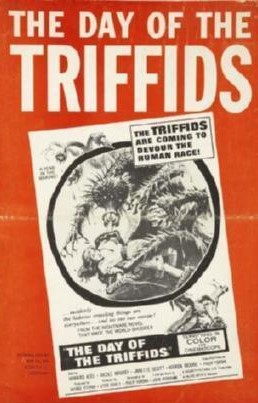
Day of the Triffids (1963) ****

Pandemic means panic and these are by far the best scenes in the adaptation of John Wyndham’s famed sci-fi novel. Virtually everyone in the world is struck blind by the fierce  brightness emitted from a bombardment of meteorites.

When passengers on a plane realize their pilot is blind, the panic is breathtaking. Ditto a train crashing into a station. While those with sight intact such as a busload of convicts can terrorize the blind, forcing them to submit to sexual overtures. On top of that are terrific scenes of deserted cities – very familiar to us all during the current pandemic – and of those unable to see trying to walk hands outstretched or attach themselves to anyone still blessed with sight.

One of the standouts is patient Bill (Howard Keel), saved from seeing the dazzling light display because his eyes were bandaged, walking through a deserted and trashed hospital. And perhaps Jurassic Park found useful the scene where the plants test an electrified fence.

And on top of that, of course, are the unstoppable monstrous man-eating plants whose growth has been triggered by the comets. Steven Spielberg over a decade later showed how to maintain tension by showing a terrifying predator in small doses and indicating its presence through musical cues and especially, when your monster ain’t quite up to scratch, keeping it hidden for as long as possible.

Interestingly, this film uses sound cues, specific noises attributable to the creatures, though the plants are shown too soon and too often but, in terms of special effects, not at all bad for their time and the low budget. And the sheer normality of the locations works very well – a caretaker having his sandwich, hard-boiled egg and flask of coffee the first victim. Some deft humor undercuts the terror. “Once you’ve tasted this coffee of mine,” remarks a character, ”you’ll know nothing worse can happen.”

Leading the fight against the monsters are sailor Bill (Howard Keel), ironically recovering from an eye operation, hotel proprietor Christine (Nicole Maurey) and in an isolated location alcoholic scientist Tom (Kieron Moore) and his wife Karen (Janette Scott).  Bill and Christine are initially intent on mere escape, but in the end have to fight.

A lean 93 minutes (the same as Gravity, 2013), tension is the key. That in itself is astonishing, given cinematographer Freddie Francis was called in at the last minute to puff out what would have been a too-short-to-release feature (under one hour at that point) directed by Steve Sekely (Kenner, 1968). Philip Yordan (El Cid, 1961) and Bernard Gordon (55 Days at Peking, 1963) knocked up the screenplay.

But once again a film like this shows how much more powerful is imagination. We can imagine being blind and walking in a vacuum with the vulnerability and helplessness that fear  entails. As the recent pandemic has shown, the unknown is terrifying and fear of the unknown even worse.

https://amzn.to/3FtsfBt

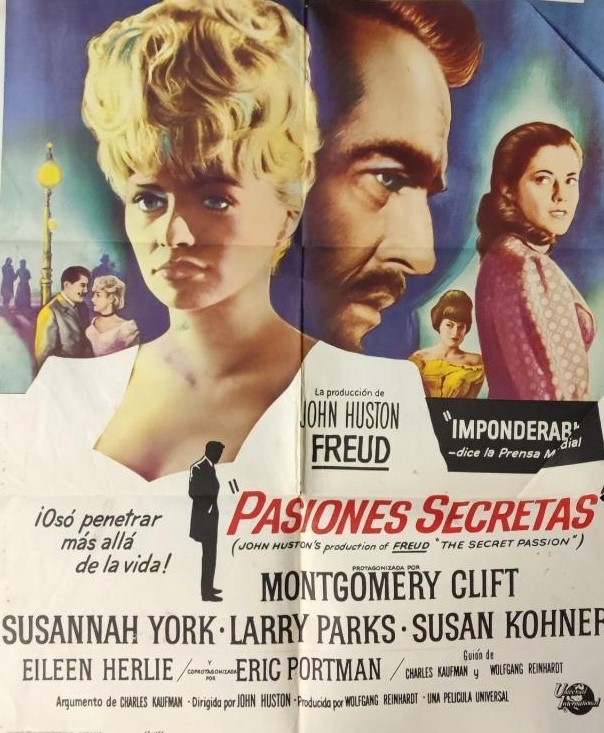
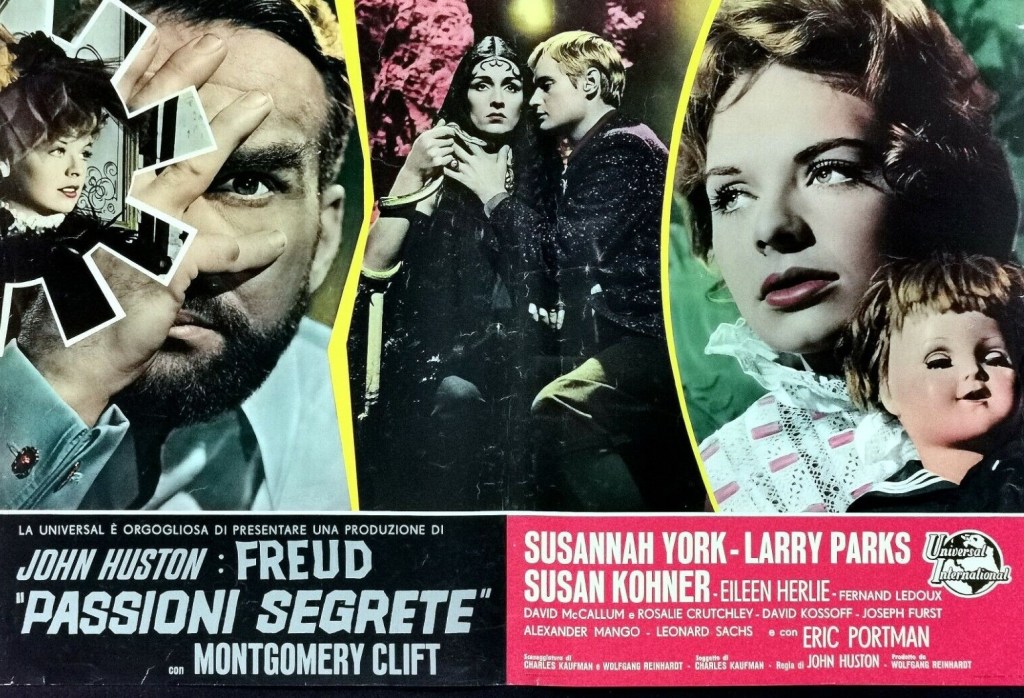
Behind the Scenes: “Freud” / “The Secret Passion” (1962)

Your leading man is an alcoholic drug-addled star with substantially impaired sight. Your leading lady, in her first major role, decides she knows more about acting than the very experienced director. But in the world of victimhood, who gets the blame? Not of course Montgomery Clift (The Defector, 1964) or Susannah York (Sands of the Kalahari, 1965), but  director John Huston (The Night of the Iguana, 1964).

Huston had been trying to put together a movie about the flawed god of psychiatry, Sigmund Freud, for 13 years. In 1949, with a screenplay by Charles Kaufman and backed by Twentieth Century Fox, it was going to be called Dr Freud. That version was still on the stocks a couple of years later. It wasn’t the first attempt to put the Viennese genius’s life on film, in 1940 Warner Brothers announced Edward G. Robinson in The Life of Freud with a script by Gary Endore.

Huston began serious work on the movie in 1956, but it was only greenlit two years later, after he signed a five-picture $20 million deal with new production unit Seven Arts, set up by Ray Stark and Eliot Hyman, future kingpins at Columbia and Warner Bros, respectively. It was to follow The Man Who Would Be King (not finally made until 1975), for which Huston was scouting locations in Afghanistan. At that point Freud was scheduled for 1959. Then it was Unforgiven (1960) and The Misfits (1961) that came first.

Mostly, the delay was caused by the screenplay. Huston had handed the task to celebrated French philosopher and playwright, who with what amounts to contempt for Hollywood, had written a 300-page script. His next attempt was 780-pages. Read that and weep, Christoper Nolan and Martin Scorsese, this was a 10-hour movie. When questioned, Sartre retorted “so make a 10-hour film.” Huston contemplated turning the script into two unrelated movies, perhaps in the vein of Young Tom Edison and Edison, the Man (both 1940).

Sartre spent two weeks at Huston’s home in Ireland, with Reinhardt on hand as well, trying to condense the material. But he spoke so rapidly that Huston confessed “I could barely follow even his basic thought processes….sometimes I’d leave the room in desperation, on the verge of exhaustion from trying to follow what he was saying.” Huston could not fault Sartre’s diligence. The playwright rose at 5am and would have 20-25 pages ready for discussion five hours later.

Sartre was paid $40,000 for his screenplay. Kaufman was brought back on board but his work didn’t gel with Huston’s vision. Wolfgang Reinhardt, whose name also appeared as producer, was more involved on the script. His relationship with Huston went back to Juarez (1939) on which they were co-writers and Dr Ehrlich’s Magic Bullet (1940), for which Huston was credited with one-third of the script and Reinhardt was producer. But Reinhardt hadn’t received a screenplay credit since Juarez and his last Hollywood picture as a producer was Caught (1953). More recently, he had found work in Germany on The Trapp Family (1956). According to Huston, he was “misunderstood, distrusted and ill-used in Hollywood.”

Eliot Hyman questioned Reinhardt’s contribution. In addition to snagging $30,000-$35,000 and a 7.5 per cent profit share for his producer duties, Reinhardt was being paid $300 a week plus expenses for screenwriting, fees Hyman considered “out of line.”

Huston was determined that “Freud’s descent into the unconscious should be as terrifying as Dante’s descent into Hell.” Sartre was viewed as having not just objectivity but as someone who knew Freud’s work intimately. But clearly major work was required to trim the Sartre script. It took six months to reduce the material into a workable script. Naturally, Sartre objected to the reworking and wanted his name removed.

Eventually, with the project at an impasse, Huston turned to leading British psychiatrist Dr David Stafford-Clark to provide clarification. Clift, who as a patient had considerable experience of psychiatrists, insisted on joining their discussions, but “his presence served only to delay and confuse.” When asked to leave, he stood outside the door and cried, then “drank himself  unconscious.”

That should have been warning enough. Having worked with an equally addled Montgomery Clift on The Misfits (1961), Huston might have thought twice about going back into the lion’s den. But, while not covered in box office glory, The Misfits was superlative, with all three principles turning in excellent  performances. And in any case, Clift was the go-to actor for the tortured character.

Eva Marie Saint (The Stalking Moon, 1969) was first choice for the role of troubled teenager Cecily and after she turned it down Huston approached Marilyn Monroe whose psychiatrist advised against it. So, it went to 22-year-old English actress Susannah York, who had attracted Hollywood’s attention after two British films – Tunes of Glory (1960) and Loss of Innocence / The Greengage Summer. Unusually, this was not a romantic part, treatment of this patient critical to Freud’s analytical breakthrough. Karl Malden (Pollyanna, 1960) was offered the second male lead, but due to his unavailability it provided a comeback for Larry Parks (The Jolson Story, 1946) who hadn’t worked in Hollywood since 1954.

Huston recalled, “He had deteriorated to a shocking degree… I should have dropped Monty…but I didn’t. I thought that when we got on the set and he had lines he would be all right.”

Clift continually tried to rewrite the movie. He had got hold of previous copies of the script and produced his own indecipherable version and spoke the lines in an infantile manner. “Finally, I realized this was primarily a stall for time,” said Huston. “Monty was having difficulty memorizing the lines. I was surprized at this because he had done so well during The Misfits.” But those lines were simple compared to the long, complicated speeches of Freud.

“I’m sure Monty had almost no conception of what he said in the picture – yet he had the ability to make you believe what he did.” Eventually, his lines were written on boards, on the labels of bottles, door frames and other places on the set. Added Huston, “There was a mist between him and the rest of the world that you simply couldn’t penetrate.”

Huston also encountered problems with York. “Susannah was the personification of the uninformed arrogance of youth. Shortly, under Monty’s influence, she became convinced she was entitled to scientific opinions regarding a subject of which she was woefully ignorant.”

She and Monty would collaborate to rewrite their scenes. York refused to do a scene as originally written until a call to her agent changed her tune. 

It took all Huston’s experience to hold onto his temper but a confrontation with Clift in his dressing-room resulted in a door slammed so hard it shattered a mirror. That was later conflated into Huston smashing furniture and tearing the couch apart. Huston was also blamed for Clift receiving rope burns during the climbing sequence. In fact, the shots were arranged so that after just holding on to the rope for the short period required, the actor could let go and land a few feet down on a pile of mattresses. Instead, he slid down the rope, holding on with his hands.

“My reputation for cruelty appears to stem directly from this one scene,” complained Huston, convinced the rope burns were Clift “for his own reasons beating himself up.”

Cinematographer Douglas Slocombe developed a technique of three-plane camerawork to help audiences distinguish between reality, dreams and memory. Scenes where characters recalled memories were shot through a small clear-glass plate mounted on the lens matte box. Dreams acquired an extreme black-and-white effect with chalky faces and other details standing out as luminous in tunnels of darkness. This was achieved through a combination of dramatic contrast in photography, stock and lab work.

The production spent five weeks at the Bavaria Studios in Munich before shifting to Vienna, which included 10 days of night shooting.

Universal underwrote the movie, and with To Kill a Mockingbird (1962) also on its roster, intended to celebrate its golden anniversary in fine style with “record rentals” from a raft of movies appealing to the public and the critics.

Freud’s daughter Anna and son Ernest didn’t take kindly to Hollywood’s interpretation of their father’s life and disassociated themselves from the movie and the Viennese hierarchy objected to the film’s louche elements.

Filming began in August 21, 1961, including three weeks on location in Vienna, and was due to wrap on December 5. That it took another two months to complete, (final shooting date was February 10, 1962) inflating the budget, was laid at the foot of Clift. Never mind the drink and drugs he was consuming in mighty proportions, he had cataract problems and could hardly see. 

Universal sued Clift for $686,000 for not acknowledging his cataract problems prior to filming, an issue that prevented him memorizing his lines.  Clift counter-sued for the remaining $150,000 owed from his $200,000 fee, claiming the problems had developed during filming. “I refuse to accede to the defendant’s demand that this condition…was responsible for delays to the picture.” Firemen’s Fund Insurance, whose policy covered the actor for a year from April 1, 1961, with the proviso the movie finished by December 5, 961,  denied liability.

Universal was concerned that the title would mean little to the general public and pre-release toyed with changing the title to Freud: The Dark Passion but agreed, in the end, not to “tamper” with it. However, exhibitors disagreed. And once Minneapolis second-run and neighborhood cinema owners refused to book it under the existing title, it was changed to The Secret Passion, which at least got it through the door with bookers even if the public remained wary. On posters, The Secret Passion part of the title grew bigger and bigger until the Freud element almost disappeared. The film was cut after initial release but the DVD shows the full version.

Despite critical approval and a 12-week run in New York and some decent runs in smaller houses in the country’s bigger cities, it was a flop, not managing the $1 million in rentals required to earn a spot on Variety’s annual box office chart.

SOURCES: John Huston, An Open Book (Columbus books, 1988) p294-305; “Memo from Eliot Hyman,” July 15, 1959, United Artists Archive, University of Wisconsin, Box 7, Folder 7; “Endore for Freud,” Hollywood Reporter, February 24, 1940, p2; “Robinson As Freud,” Box Office, March 2, 1940, p2”; “Dr Freud Bio On Fox Docket,” Box Office, September 17, 1949, p19;  “20th Lead with Five in Biopic Sweepstakes,” Variety, January 24, 1951, p5; “Freud Biopic 1st Hyman 7-Arter,” Variety, July 30, 1958, p3; “John Huston’s Next Spot – Afghanistan,” Variety, October 15, 1958, p19; “Huston Seeks Saint,” Hollywood Reporter, November 10, 1958, p2; “Universal Unchained,” Variety, August 19, 1959, p5; “Huston in on Freud Biography,” Variety, October 28, 1959, p11; “Sartre Script on Freud: 780 Pages,” Variety, June 29, p3; “Freud Rolls August 21,” Variety, July 26, 1961, p5; “Freud Moves Location,” Hollywood Reporter, October 12, 1961, p6; “Freud on Night Shift,” Hollywood Reporter, October 24, 1961, p3; “Freud Film Not To Liking of Kin,” Variety, November 1, 1961, p2; “Three-Plane Photography Developed for Freud,” Hollywood Reporter, December 19, 1961, p11;  “Huston’s Freud Ends Photo Phase,” February 14, 1962, p4; “Universal Sues for $600,000,” Hollywood Reporter, April 30, 1962, p3 “Montgomery Clift’s Eye Trouble,” Variety, June 5, 1963, p5; “U’s Insurance Claim on Monty Clift,” Variety, June 27, 1962, p7;  “It’s Plain Freud, U Won’t Tamper,” Variety, October 3, 1962, p3; “Never Heard of Freud,” Variety, October 9, 1963, p5; ’“Top Rental Films of 1963,” Variety, January 8, 1964, p37.

https://amzn.to/404Z2q1

Discover WordPress

A daily selection of the best content published on WordPress, collected for you by humans who love to read.

The Atavist Magazine

by Brian Hannan

WordPress.com News

The latest news on WordPress.com and the WordPress community.