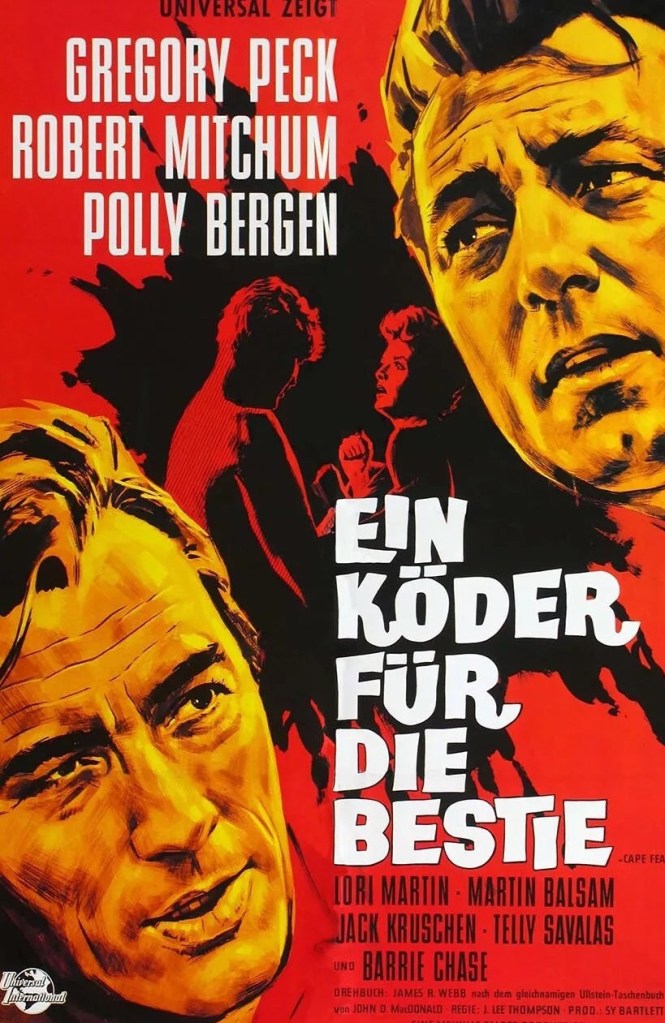
Behind the Scenes: Selling the New-Look Paul Newman – Pressbook for “The Hustler” (1961)

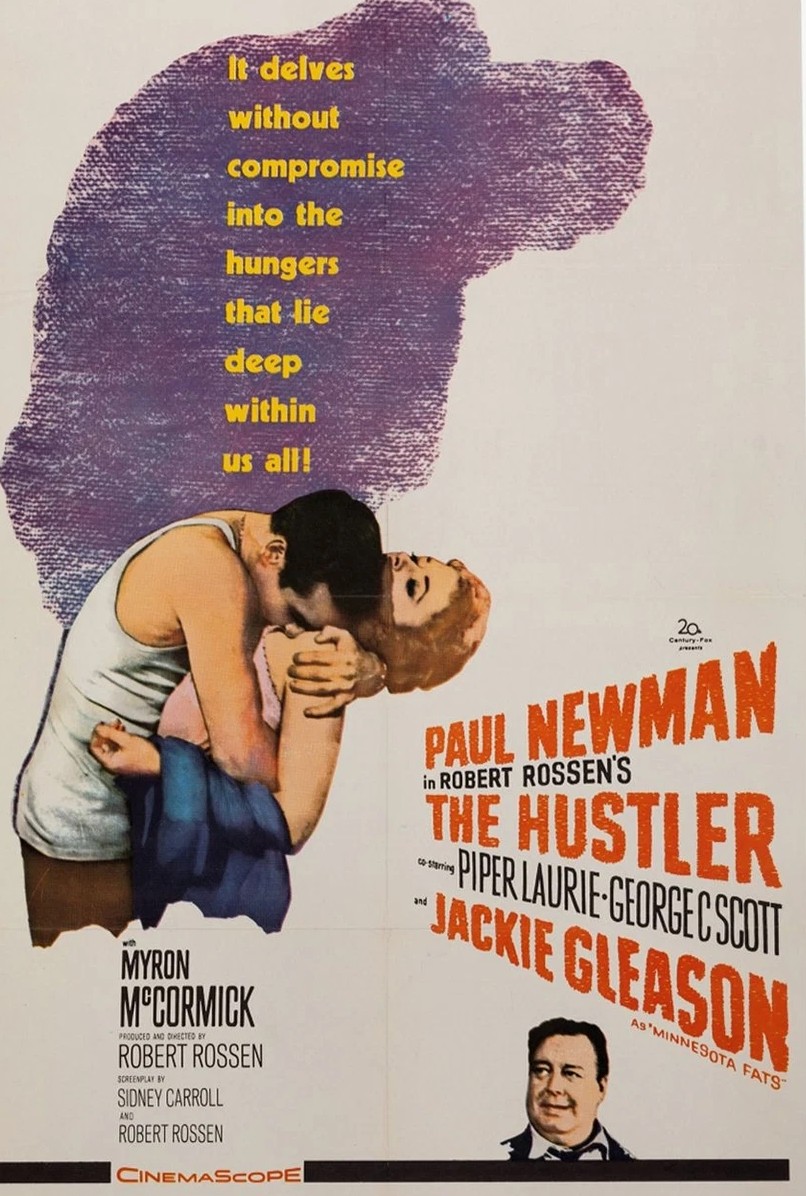
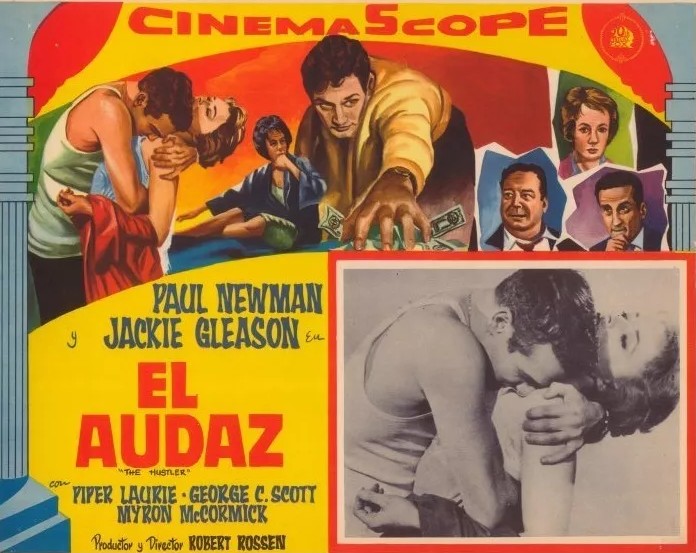
While Twentieth Century Fox head honcho Spyros Skouras initially balked at the title, with its connotations of prostitution, by the time the movie appeared that subject matter was less contentious thanks to critical and commercial big hitters Butterfield 8 (1960) and Never on Sunday (1960). Given that the idea of a movie set in a poolroom was going to be a hard sell to a female audience, despite the marquee lure of Paul Newman, the studio gave marketeers free rein to pitch it as a raw, sex-oriented drama.

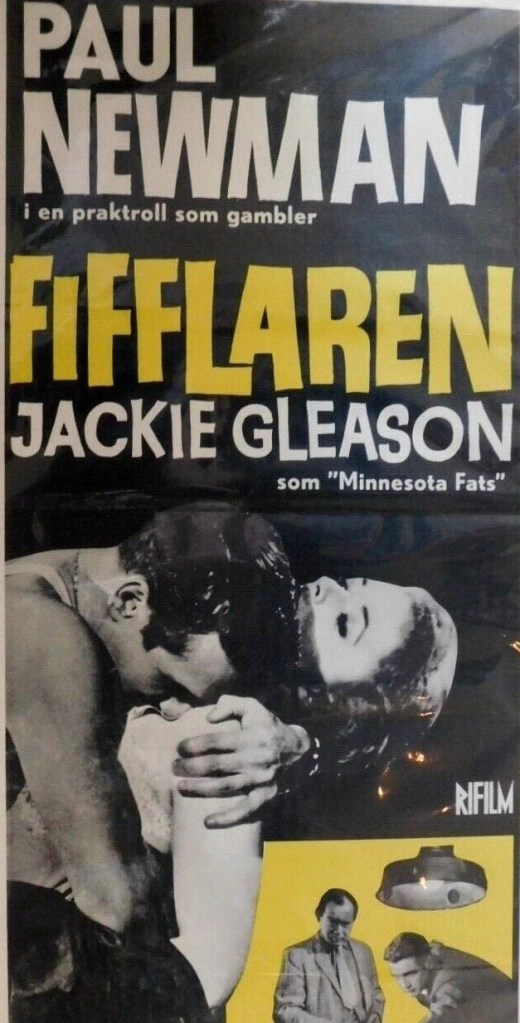
There’s little sign of a pool cue in some of the artwork. Instead, we have Paul Newman lustily nuzzling Piper Laurie’s neck or bosom. The taglines promise something far removed from a sports picture.

“It probes the stranger…the pick up…the  savage realities,” screamed the main tagline. Another tempted with: “It delves without compromise into the inner loneliness and hunger that lie deep within us all!” In other words we’re talking about sex, not love, and casual sex at that, the world of the one-night stand between consenting adults for whom marriage is the last thing on their minds. “The word for Robert Rossen’s The Hustler is prim-i-tive” suggested out of control lust.

Fast Eddie Felson (Newman) has “the animal instinct.” Sarah (Piper Laurie) has a “bottle, two glasses and a man’s razor always in her room.” Bert (George C. Scott) is on the look-out for the “sucker to skin alive.”

Those images which did show a cue and pool balls did not suggest an august sport like football or baseball, not with a tagline like “he was a winner, he was a loser, he was a hustler.”

With such talented actors to hand, the Pressbook wasn’t short of good stories relating to the actual movie rather than the kind of snippets that might appeal to an editor on a slow news day. So we learn that Piper Laurie continually limped, Method-style, around on the set. “When I limp in the picture, I don’t want to act it. It’s something that has to be a part of me, something of which I am no longer conscious, apart from its being a physical defect. I must be able to limp as if I had a bad foot from birth.”

Laurie had made so few pictures that her name wouldn’t be on any director’s wanted list and what she was best known for – ingénue roles when a contract player for Universal (who gave out that she bathed in milk to keep her skin soft) opposite  the likes of Tony Curtis – wouldn’t have inspired confidence. Robert Rossen might well have spotted her in two Emmy-nominated performances in successive years including Days of Wine and Roses (1958), but instead said he remembered her for “a sensitive characterization” from a stage production of Rosemary.

Ames Billiards Academy had once been a Chinese restaurant so boasted a balcony. This was unseen in the picture but allowed director Robert Rossen to shoot from widely varied overhead angles. The crew took over the Manhattan Bus Terminal for a day and a night. A row of lunch booths was constructed in front of the existing lunch counter. “It looked so real,” we are told, “that passers-by sat down and waited for their orders to be taken.” A nice story, and the kind often furnished by Pressbook journos, but rather fanciful, since it would be obvious what with the crew milling around and the lights and cameras and miles of cable that this was a movie set with security posted to prevent trespassing.

Just how good a pool player was Jackie Gleason, who came to the picture with a reputation for handling a cue? Well, at one point, the affable television comedian with a top-rated show, potted 96 consecutive balls.

Paul Newman plays the iconic hero as a “figure cut from the fabric of our time.” He had a firm grasp of the character. “With him it’s a question of commitment. He is so wrapped up in his drive to win and be somebody that he has no time to give of himself that which others need. It is a disease of our time, both the ambition and the isolation. I want him to be understood.”

Needless to say there was no mention of author Walter Tevis. That wasn’t so unusual in the make-up of Pressbooks, but if the marketeers these days were looking for something to write about the eclectic Tevis would be prime. He followed up The Hustler, published in 1959, four years later with sci fi The Man Who Fell to Earth, filmed in 1976 with David Bowie. A sequel to The Hustler, The Color of Money, was directed in 1986 by Martin Scorsese with Newman reprising his role and managing Tom Cruise. Tevis also wrote The Queen’s Gambit, turned into an acclaimed television mini-series in 2020 with Anya Taylor-Joy.

Behind the Scenes: Selling William Holden and Audrey Hepburn – Pressbook for “Paris When It Sizzles” (1964)

One of the main aims of the Pressbook/Marketing Manual ws to provide cinema managers with material for local journalists, which might result in the movie getting a mention outside the entertainment pages. Mostly, these consisted of bizarre snippets that you might imagine editors would instantly reject, notions that an actor had previously had an arcane profession, or something quite random such as that Audrey Hepburn demanding Dressing Room No 55 in a studio. However, marketeers on this picture struck gold.

Having made three pictures in Paris, Audrey Hepburn offered useful tips for prospective travellers. She named five offbeat haunts. “One is a tiny shop near the Madeleine where old and proud workmen are busy all day on all kinds of things from miniature Eiffel Towers to chessmen,” she advised. “Another is a flower stall on the Ile de Cite where an old grandmother whose three sons died in World War I looks after what she has brought from her own garden to sell.

“Another is an ancient Left Bank restaurant, the Procope, which dates from 1686 but few persons except students know about. Robespierre, Danton, Napoleon, Victor Hugo, Balzac, Verlaine and many other famous persons ate there regularly.”

Another favorite is a “small grove” in the Bois du Boulogne near where the Duke and Duchess of Windsor lived. “The combination of the sun filtering through the elms, spruces and chestnut trees against the loveliest beds of blooms with a little waterfall on one side makes an exquisite ‘real life’ painting.” Her final recommendation was the Little Trianon, favored by Marie Antoinette, at Versailles.

On the fashion front we discover that Hubert de Givenchy worked for six months on designing her clothes for the picture. A hundred sketches “were discarded” before the final selection was whittled down to eight dresses.

Having acted the part of a secretary, Hepburn also felt qualified to pass on tips to those occupying such a position. Don’t ask about your boss’s personal life, she emphasised. Also, make sure you wear the kind of make-up he likes, don’t dress better than the rest of the staff and be prepared to give up your coffee break to pound your typewriter.

Not to be outdone, and possibly encouraged by working alongside a fashion icon, William Holden let rip on male fashion. “Who says that a man has to wear a coat in a fashionable restaurant?” he rages. “And this   business of the extra-heavy coat lapel. That’s got to go along with those stupid folded-handkerchief pockets. Also, I can’t understand why men have that extra bottom button on their coat, you know, the one they never button.”

He rails against trouser cuffs and objects to the fashion that “dictates” he has to wear cuff links inside his jacket sleeve.” He and director Richard Quine once fashioned their own suits during the filming of The World of Suzie Wong (1960).

Quine was discounted as having any publicity value in the 10-page A3 Pressbook, but screenwriter George Axelrod was deemed worthy of an article about the “wacky” concept. He argues, “Pictures today must be unconventional. Stories that old-time editors might tell you are the safest may lead to disaster.”

Unasked, he also sprung to the defence of the principals, claiming “They are never late, are spark plugs of enthusiasm and ask to spend extra time rehearsing.” This would have come as something of a surprise to studio executives enduring Holden’s alcoholism – at one point during filming he had to go and dry out.

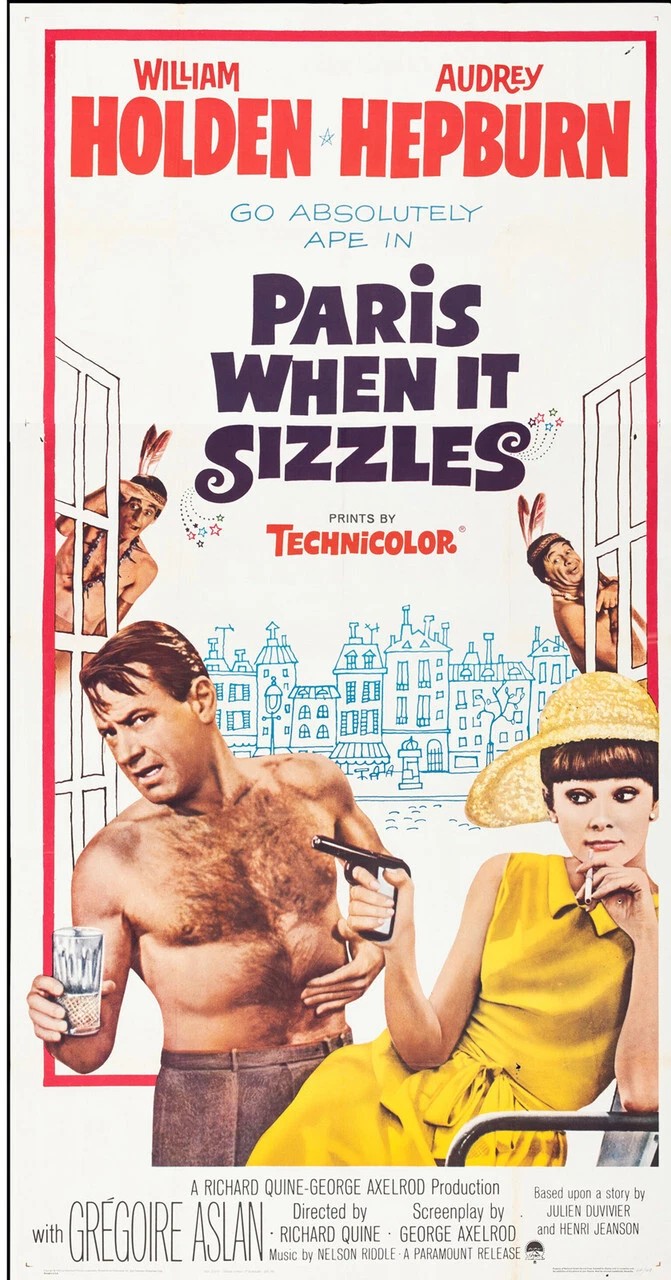
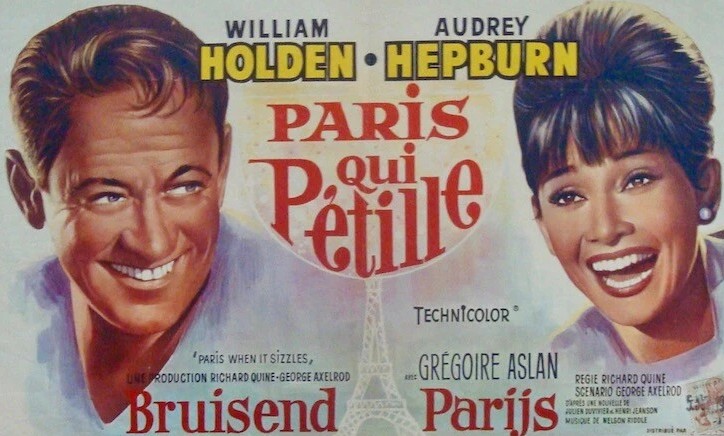
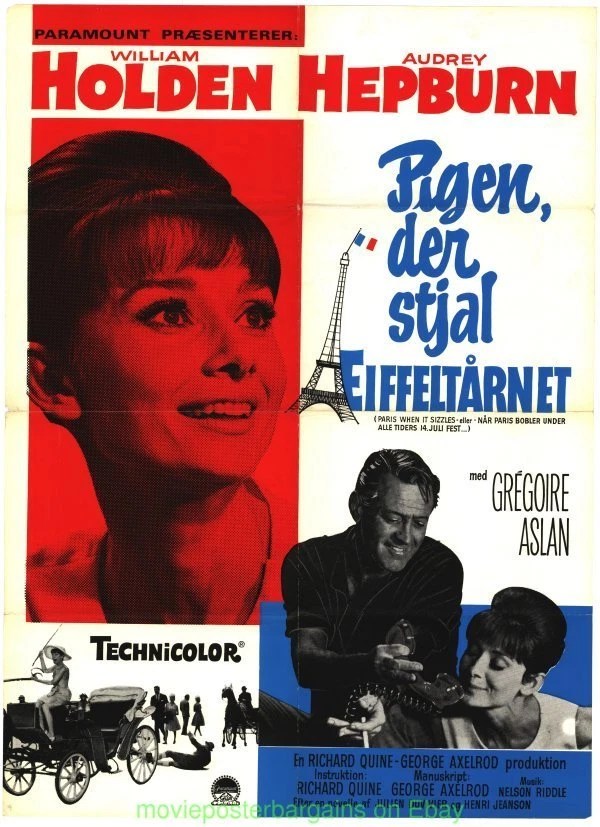
Perhaps believing that the names of the stars would automatically sell the picture, the advertising team stinted on poster variety, relying on two simple designs and taglines.

Otherwise there was a wealth of marketing ideas, the pick of which was a “gigantic national contest” to win an escorted tour of Europe, including a trip to Paris (natch!) run by Gateway Holidays.

As well as record retailers stocking Nelson Riddle’s soundtrack and bookshops selling a novelization of the script – both of which could offer vital window displays, there was also a tie-in with Givenchy. The fashionista’s dresses weren’t being turned into a line, which the vast majority of the audience couldn’t afford in any case. Instead, Givenchy had created a special perfume for Hepburn called “L’Interdit Perfume.” Its launch was accompanied by half-page ads in the likes of Vogue, the New Yorker and Women’s Wear Daily, each carrying mention of the movie.

Behind the Scenes: Selling “Zulu” (1964) – The Pressbook

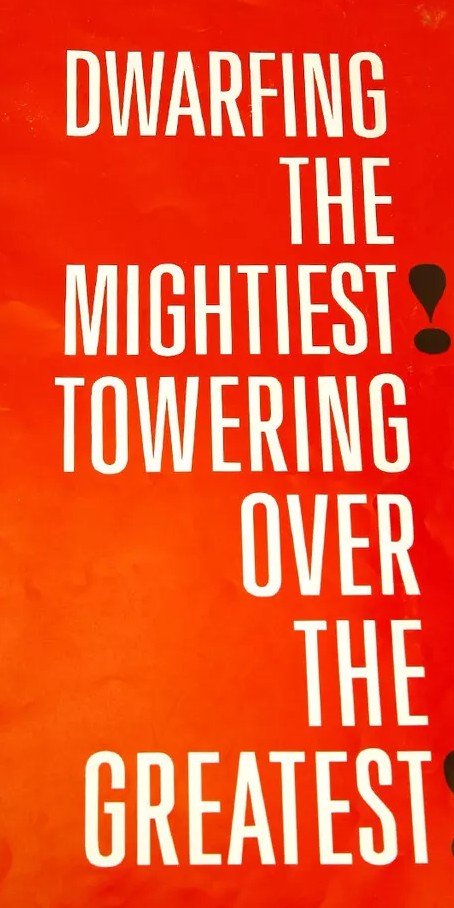
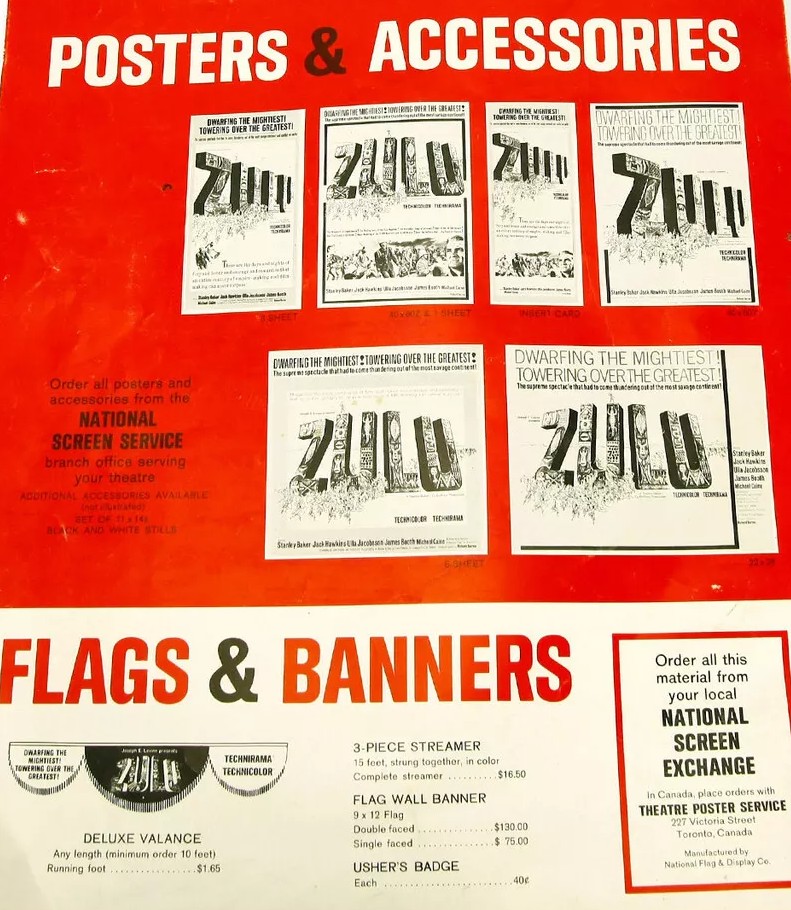
“Dwarfing the Mightiest! Towering over the Greatest!” wasn’t just the movie’s tagline. It could have easily been used to describe the Pressbook. This folded out into a colossal 40 inches wide  by 20 inches high, one of the biggest pressbooks ever produced.

The marketing team produced an impressive list of ideas. Cinema managers were urged to get war correspondents and war heroes involved and to blow up photos of the Victoria Cross. Hanging on the name of the star was a “Baker’s Dozen” competition, inviting people to list the thirteen movies featuring Stanley Baker. Quite how they thought a promotion involving banks would go down is anybody’s guess. Especially as this was the notion: “Zulus are allowed as many wives as they want, provided they can afford to pay for them. The price ranges between six and twenty head of cattle per wife. For an interesting tie-in, get local banks to display money and other barter materials. Give them a montage of still from the picture to display.” Culturally tone-deaf doesn’t cut it.

To attract children there was a coloring-in competition and a school study guide. The movie was available in 70mm Super Technirama so there was a special advertisement linked in to that for cinema going down that route.

Other taglines included: “The supreme spectacle that had to come thundering out of the most thrilling continent!” and “These are the days and nights of fury and honor and courage and cowardice that an entire century of empire-making and film-making can never surpass!”

And in case hyperbole wasn’t enough, one of the ads spelled out the exciting details. “The Massacre of Isandlwana! The Mating Song of the Zulu Maidens! The Incredible Siege of Ishiwane! Night of the 40,000 Spears! Days That Saved a Continent! Mass Wedding of 2,000 Warriors and 2,000 Virgins! Amid the Battle’s Heat…the Flash of Passion!”

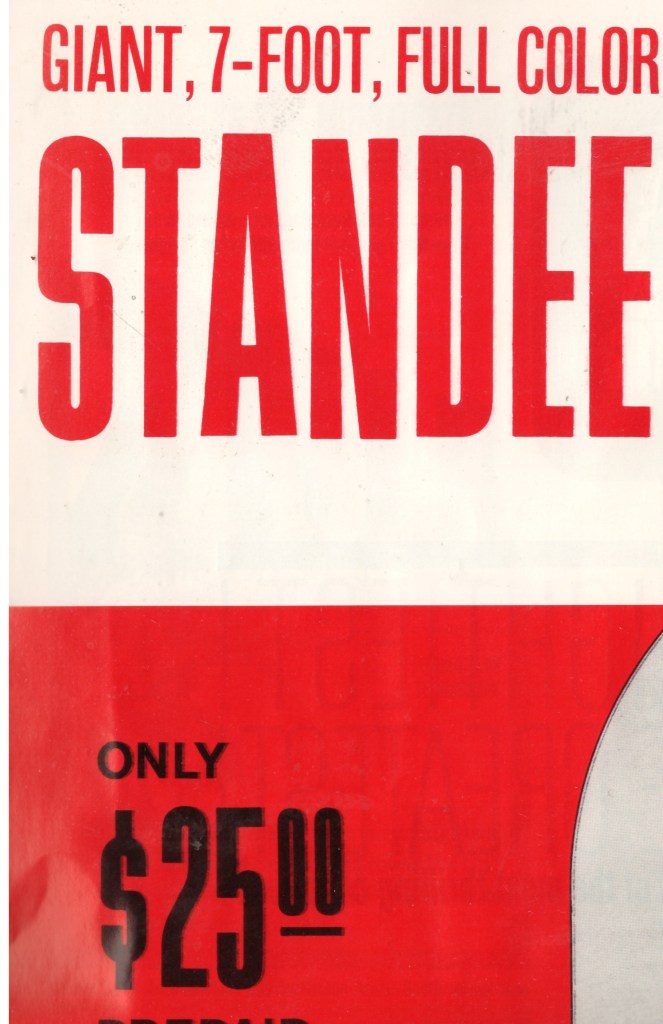
There was a seven-foot high standee and a three-foot 3D illuminated standee.

To help sell the picture to local journalists, little articles were planted that could hook an editor’s interest. For example, when director Cy Endfield glimpsed some soldiers firing their rifles left-handed, he stopped filming, because British soldiers were required to shoot right-handed. The film was shot in the shadows of the Darkensberg Mountains. The river which flowed past Rorke’s Drift was slower than it had been at the time of the battle so the course was altered and dammed to increase the flow. Out of sight of the cameras but essential to filming were the modern villages constructed to house cast and crew, stores, catering and compounds for horses and oxen.

The cast were on set at 6.30am for make-up. The Zulus spent more time in make-up than the British soldiers, as the costume department ensured every aspect of their outfits was historically correct. A total of 100lb of small colored beads was crafted by made by local women for the maidens to wear. A primitive method of making necklaces, strung together with animal sinew and rolled by hand, was employed incorporating a further 100lb of wild syringa seeds which were dyed.

The warrior loincloths of softened animal skins were made the traditional way using stones aqnd animal fat. Shields were also made from animal skin. The teeth of tigers and baboons formed their necklaces. They kept snuff in a small gourd worn round the waist. The purpose of a porcupine quill tucked into their hair was to extract thorns after a long march.

Three cameras were utilized to shoot the blaze that burned down the hospital. “Undress rehearsal” was the name given to the marriage ritual scenes of bare-breasted women.

Though Michael Caine was being touted for stardom, as far as the Pressbook was concerned he was relegated to section below Jack Hawkins, James Booth and Ulla Jacobsen who had smaller parts. The movie was a notable change for Jack Hawkins, who saw action in World War Two. Instead of playing his usual hero, he was a weakling and drunk. It was the second English-language film for Swede Jacobsen after Love Is a Ball / All This and Money Too (1963).

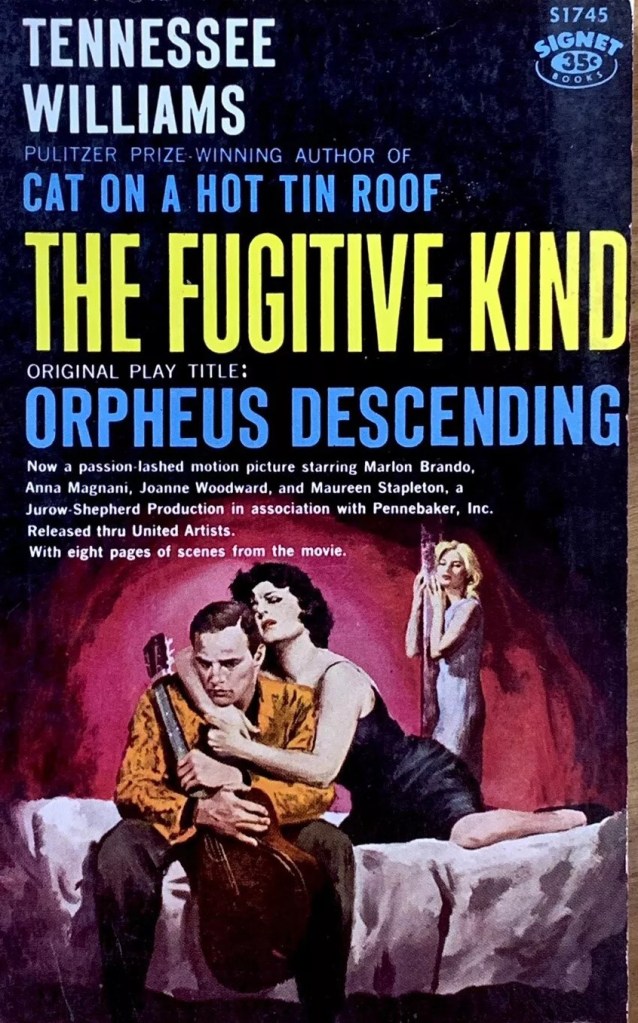
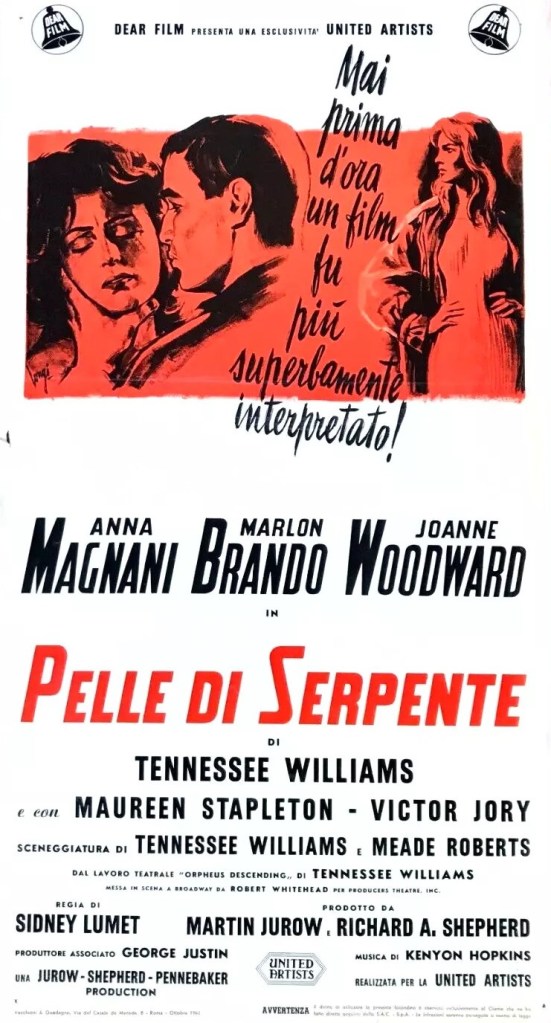
Behind the Scenes: Selling The Million-Dollar Marlon Brando – “The Fugitive Kind” (1960) Pressbook

Should have been a darned-easy sell. After all, Marlon Brando had made global headlines after becoming the first actor to be paid a million bucks for a movie, his fee for The Fugitive Kind outstripping by $250,000 the previous record jointly held by John Wayne and William Holden (see Note below) for The Horse Soldiers (1959). And there was no suggestion – as indeed there is not even now – that audiences held against the stars the wealth their talents accrued.

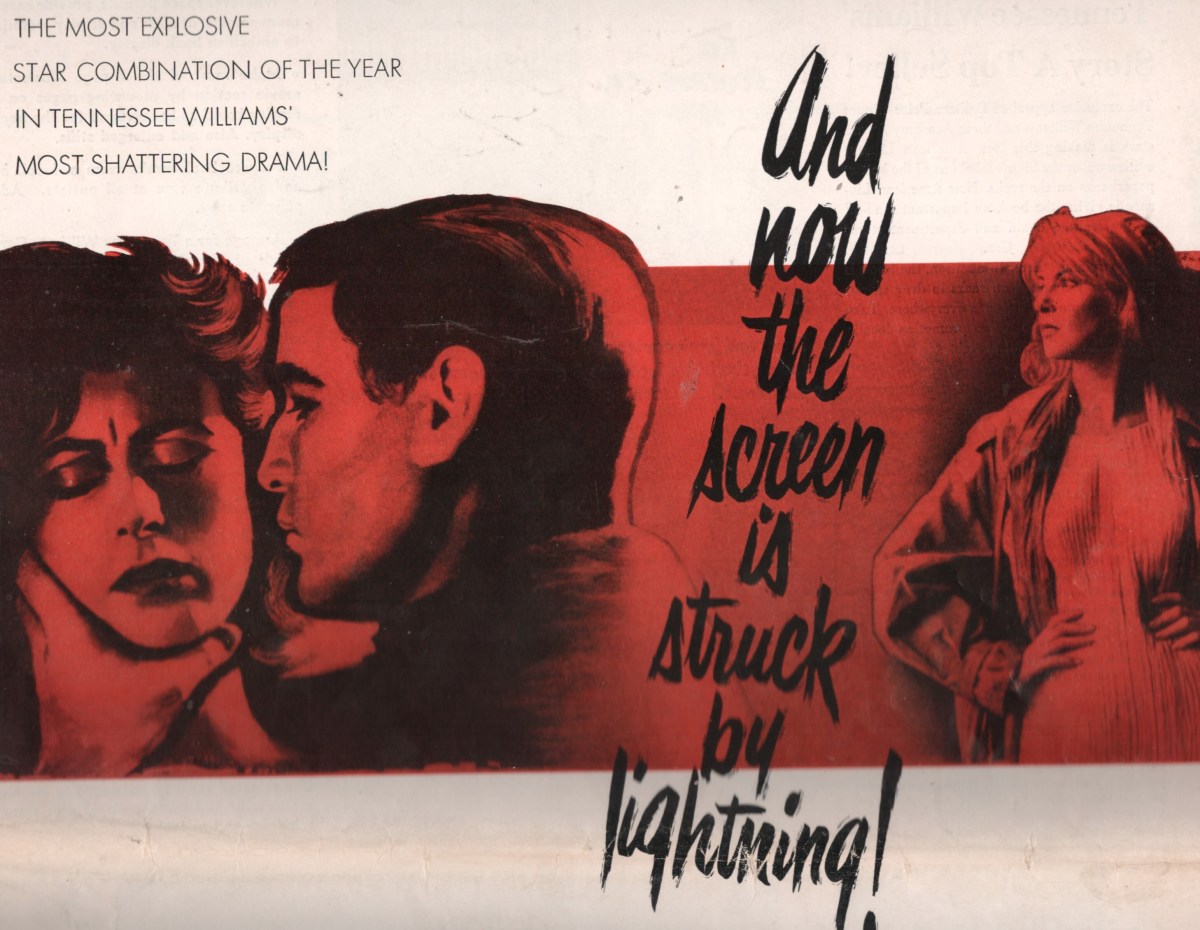
“The Most Explosive Star Combination of the Year” was how this was generally sold, on the back of the Oscars held by each of the principals, Brando, Italian Anna Magnani and Joanne Woodward and the Pulitzer Prize awarded to playwright Tennessee Williams, himself also a two-time Oscar nominee as well as his work providing Oscar wins and nominations by the bucket load for actors and directors.

“Something about the way he looked at a woman, something about the way he handled a guitar” were other notable taglines and marketeers tried to convince the public “the screen is struck by lightning.” And if that was not enough – “their fire…their fever…their desire” was expected to do the trick.

Publicists encouraged exhibitors to make full use of Brando’s accoutrements from the movie, namely his snakeskin jacket, Rolex and Kay Guitar, which in one scene he actually played. Suggestions included auctioning a guitar for charity and running a talent contest. Brando was a reasonably accomplished player, specializing in perennials like “Shenandoah” and “Streets of Laredo.”

How to make a snakeskin jacket was another angle.  The Rolex watch his character wore presented opportunities for marketing tie-ups with jewellery stores. No marketing stone was left unturned to the extent of the Necchi sewing machine, seen in the movie, being offered as a prize in a national competition. Novo Greetings Cards were also seen in passing in Lady Torrance’s store and this company was backing the movie.

Unusually, Signet was using the movie tie-in approach to sell a play, the paperback comprising the source material Orpheus Descending, which included an eight-page spread of stills from the picture. Williams’ position as the most popular playwright of his generation – his only rival Arthur Miller had less success in Hollywood – brought potential access to libraries, book clubs and schools. Military bases around the world were targeted  through marketing material emphasizing Joanne Woodward.

It would certainly have helped if the movie had been able to set a new fashion trend for the wearing of snakeskin jackets. Or revive a trend that had last occurred in the 1930s, “quite a craze” for shoes, bags, hats and belts. “It wouldn’t surprise me,” said United Artists costume designer Frank Thompson, “if Brando wearing this jacket starts the whole thing again.”

Thompson had quite a task making two identical jackets – in case one was damaged during filming. First of all, he had to locate skins that were found in Mississippi. The choice came down to rattler or python. Opting for python, Thompson went through 200 skins before he found three that matched. “Looking for two snakeskins that match identically is like looking for two fingerprints that are exactly the same.”

The film was based on Battle of Angels, written by Williams in 1939, his first full-length work professionally staged (in Boston). He “never quit working on this one…it never went into the trunk, it always stayed on the work bench.” Rewriting about 75% of the play, it was reprised as Orpheus Descending on Broadway in 1957. Although Williams had Brando and Magnani (star of the film version of The Rose Tattoo, 1955) in mind for the stage play, it went ahead instead with Cliff Robertson and Maureen Stapleton. Williams had written The Rose Tattoo for Magnani but again it was Maureen Stapleton who won the role on stage.

Williams had outstanding success in writing roles that were in tune with Oscar sensibilities. A Streetcar Named Desire (1951) won Oscars for Vivien Leigh, Kim Stanley and Karl Malden with Brando nominated. Anna Magnani won for The Rose Tattoo and Marisa Pavan was nominated. Other nominations included Carroll Baker and Mildred Dunnock for Baby Doll (1956), Elizabeth Taylor and Paul Newman for Cat on a Hot Tin Roof (1958), and Katharine Hepburn and Taylor for Suddenly, Last Summer (1959).

Despite its Mississippi location and except for external establishing shots, The Fugitive Kind was shot in the Bronx. Director Sidney Lumet was a notably New York kinda guy, having filmed his first three movies – Twelve Angry Men (1957), Stage Struck (1958) and That Kind of Woman (1959) – in the city.

He argued, “Hollywood’s great attractions have been the technicians and the shooting facilities, With care, men of comparable talent can be found in New York. As for facilities, a sound stage is a sound stage wherever it is. I concede that in California they’re larger and more elaborate, but the same results can be produced elsewhere. And the fabulous back-lots, which counted so heavily in the past, seem to be outmoded today by the sophisticated eye of the audience. You can’t shoot on studio streets and pretend any more. It has to be real.”

NOTE – William Holden pocketed around $3 million in the end as his percentage share of the gross –not the more contentious net – of Bridge on the River Kwai (1957) so he was the decade’s biggest winner until Richard Burton made more on a similar deal from Where Eagles Dare (1968).

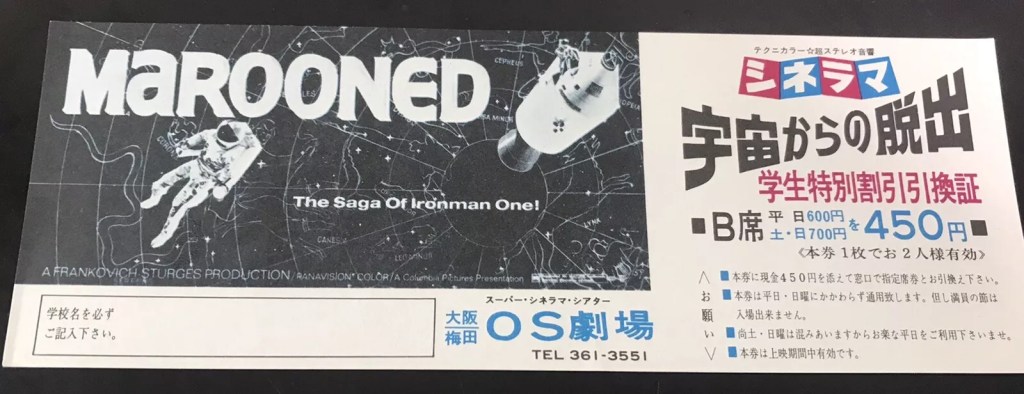
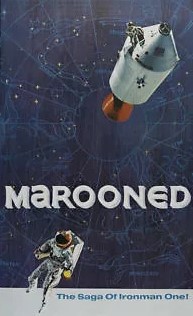
Behind the Scenes: Selling Jeopardy in Space – Pressbook for “Marooned” (1969)

You could come away from the Pressbook/Exhibitors Manual wondering if some of the actors were in the wrong profession, given the number of accomplished pilots on the roster.  James Franciscus held a commercial license for multi-engine planes and had logged three thousand flying hours in three years. Gene Hackman not only had a private flying license but was in the process of building his own biplane.

Producer Mike Frankovich had flown with the US Air Force during World War Two, clocking up 7,000 hours flying time and ending up a colonel. Technical expert George Smith had ejected at 6,000 feet from a plane flying at 800 mph.

Another less well-known fact, Natalie Wood (who was appearing in producer Mike Frankovich’s Bob and Carol and Ted and Alice, 1969) was fluent in Russian and was brought in to translate for a showing of the movie to visiting Russian spacemen. Nancy Kovack, by the way, was equally talented, speaking Persian and other languages.

As much as the main function of the Pressbook was to provide exhibitors with a range of adverts in every conceivable size that they could cut out and take along to their local newspaper, its secondary function was to provide cinema owners with promotional ideas and to provide snippets and articles that could be passed on to a local friendly reporter.  But pickings were slim for jouranlists. Not surprisingly, Gregory Peck didn’t have much say, since whatever he did have to say he’d said already as promotion work for the two other features preceding Marooned this year. And nobody’s spilling the beans on the special effects.

Due to the bulkiness of their space suits, the three actors playing astronauts couldn’t sit down between takes and instead the production employed “the slanted boards usually leaned against by elaborately-gowned female stars to protect their costumes.” (You learn something new about the business every day!). Never mind the bulkiness, the actors spent a chunk of their time in the air and the one day James Franciscus expected to meet acting hero Gregory Peck (they had no scenes together) it proved impossible as when the star visited the capsule set Franciscus was 60 ft in the air.

Richard Crenna got a better response from his young son, who had little concept of what an actor did. But after seeing his dad floating around in space high above him, he reckoned his father was actually a hero

For such a male-oriented picture, Columbia made a big play for the female audience. “The Ladies Love Marooned,” boasted one advert in the 16-page A2 Pressbook/Campaign Manual aimed at exhibitors. Pulling on quotes from critics nobody had really heard of, it managed to present the notion that the picture was as exciting, fascinating, “ingeniously-devised,” and suspenseful for women as much as men, at the same time as focusing on the feminine aspects of the movie – “Lee Grant is a knockout.”

The Pressbook itself allocated editorial space to the three female stars. For Lee Grant the slant was that her talent had been recognized by a host of awards – Emmy, Obie, Best Actress at Cannes plus an Oscar nomination (she would later win an Oscar for Shampoo, 1975). But you have to wonder how an actress would respond to be called, in print, “an egg-head with sex” as was the case with Nancy Kovack. In between turning out such pictures as Tarzan and the Valley of Gold (1966) and this, Kovack had been resident in Iran where she made Diamond 33 (1967) and Night of the Angels (1968). By comparison, Mariette Hartley got off lightly, thanks to her Shakespearian training.

A separate 4-page A2 insert promoted the three Oscar nominations for cinematography, sound and visual effects. “Nominated for 3 Academy Awards,” was the slug accompanying the ads. Never mind the reviews from female critics, much bigger space was devoted here to a rave review form Rex Reed, one of the most famous critics of the day (and star, if that’s the right word, of Myra Breckenridge, 1970), who claimed Marooned was “as exciting, spirited and suspenseful as any spy movie or any cops-and-robbers movie ever made.”

As you might expect, the bulk of the promotional ideas were science-based. Exhibitors were told to target the country’s 2,500 science clubs, the armed forces, the industries that supported the space program and, of course, schools and colleges. Tie-ins had been achieved with 4,500 A&P stores, Jane Parker Donuts, and Philco-Ford dealers.

From a contemporary marketing standpoint, the surprising tie-in was with Omega watches, tagged “the first watch on the moon,” the company’s Speedmaster brand not just worn by the astronauts who did land on the moon in July 1969 but seen in the picture on the wrists of Gregory Peck, Richard Crenna, David Janssen, Gene Hackman and James Franciscus. Over 4,000 dealers were backing the movie.

Model kit manufacturer Revell was offering space suits as prizes in a competition. It distributed more than 42,000 standees and posters and printed five million entry forms. Bantam books was promoting the original novel by Martin Caidin.  That exhibitors would be eager to equip a staff member with an astronaut’s garb and have him/her parade through the streets went without saying. Using lift-off sound effects in a cinema lobby was another idea or turning the entire lobby into a space set.

Rather disconcertingly, the marketing bigwigs thought it would be a clever idea to propose a discussion program on radio or local television on the subject of what would happen if spacemen were marooned, a rather tetchy subject when that became reality.

Unusually, but not surprisingly, the posters stuck with the one tag line: “Three marooned astronauts. And only 55 minutes left to rescue them. While the whole world watches and waits…” and buttressed by some thumbs-up quotes from the likes of reviewers from the New York Times, Redbook, Los Angeles Times and Los Angeles Herald Examiner. In fact, the advertising department took such a shine to Charles Champlin of the LA Times that they cut up his review and stuck snippets of it in three separate ads.

You’ll have seen from the variety of adverts I’ve used to support the review and the Behind the Scenes article earlier in the Blog, that there was a wider range, initially, of adverts, some showing the capsule stuck out in the middle of space. By the time it came to printing this Pressbook, the one for the picture’s general release, all of those were jettisoned in favor of the insipid “thumbs-up” poster with faces to the foreground and the launch in the background, attendant quotes and the “3 Academy award Nominations” slug.

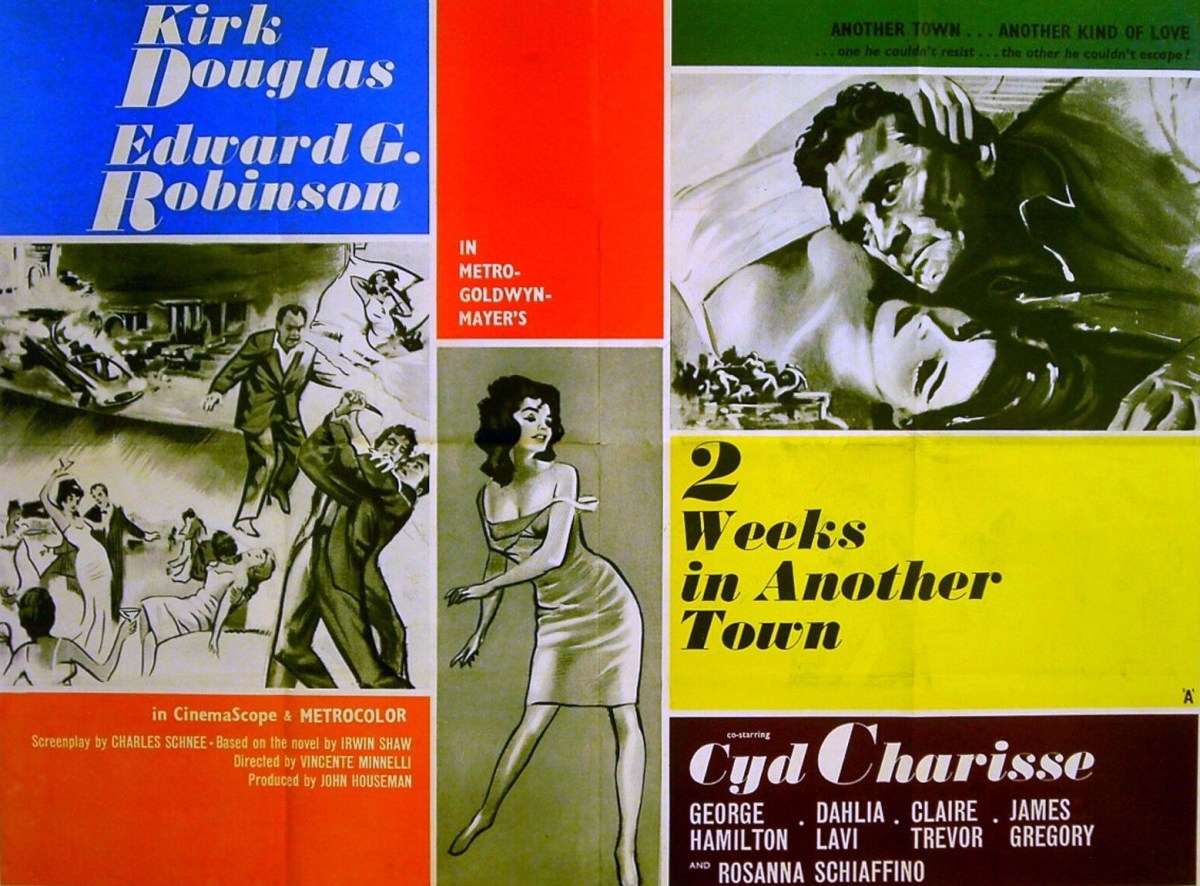
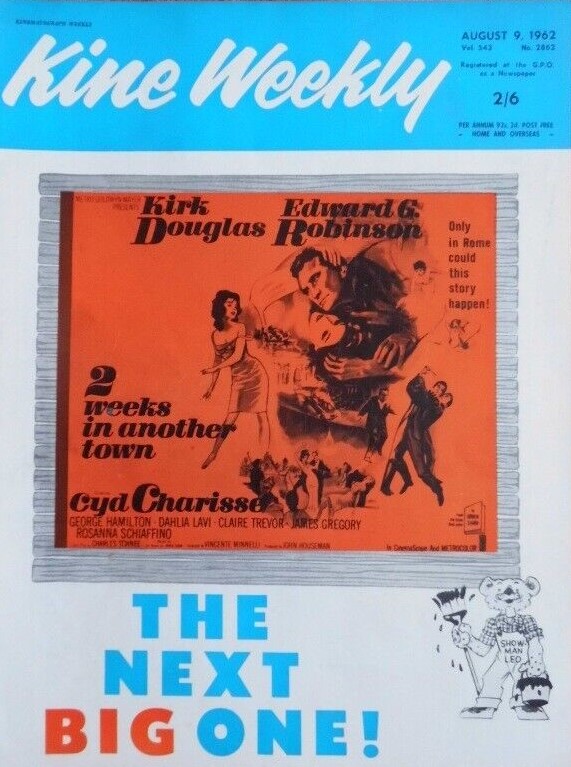
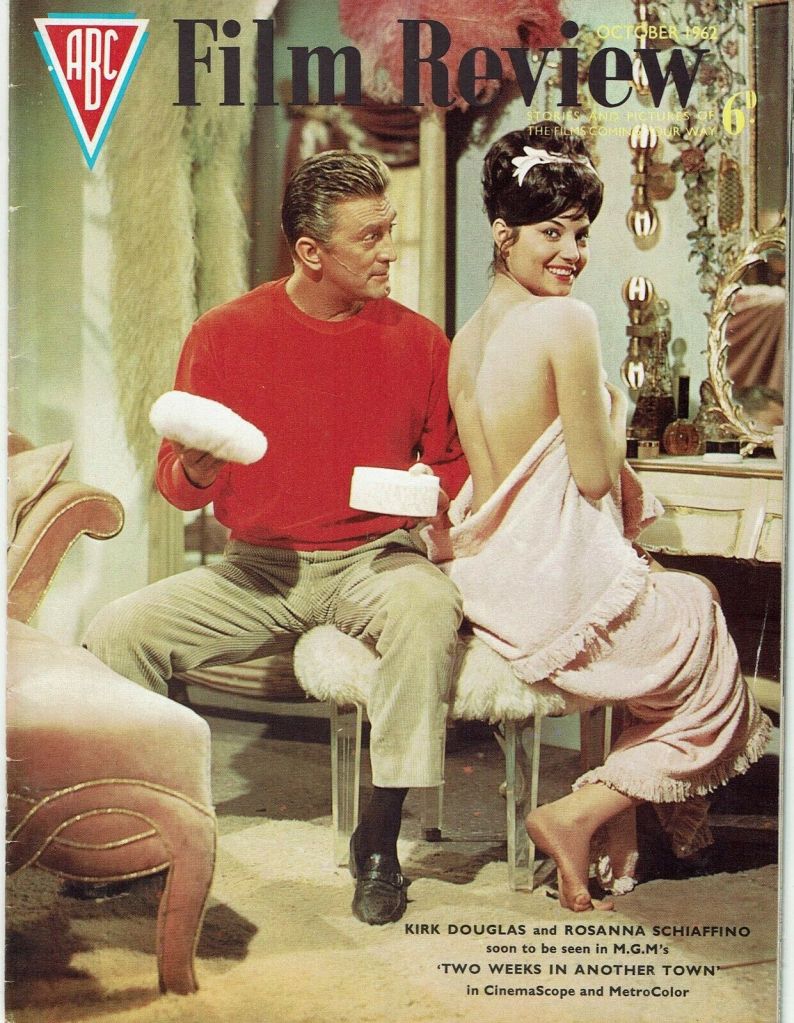
Behind the Scenes: “Two Weeks in Another Town” (1962)

Until a technological invention first used in Once a Thief (1965) it was impossible to shoot “day for night” without it appearing very obvious. So when director Vincente Minnelli aimed for as much verisimilitude as possible for the Rome-set drama it meant half the shoot took place at night. “Minnelli could sleep easily during the day,” recalled star Kirk Douglas (The Arrangement, 1969), “sometimes till six o’clock in the evening, but I couldn’t so there were three unpleasant weeks of night shooting and not much sleep.”

But the movie suffered, Douglas later complained, by studio interference at the editing stage. When the movie fell foul of the Production Code, change of MGM management vetoed the more salacious aspects of the movie – the worst aspects of “La Dolce Vita” including a sequence in a nightclub where guests watched an unseen sexual act. Fifteen minutes were cut including a scene that showed Cyd Charisse’s character in a more sympathetic light. In an ironic reflection of the film’s narrative, Minnelli played no part in the editing, not due to production deadlines as in the movie, but out of choice.

The actual producer John Houseman – producer of Douglas starrers The Bad and the Beautiful (1952) and Lust for Life (1956) though later best known as an actor in Rollerball (1975) etc –  backed out of any tussle with MGM head honcho Joseph Vogel. Douglas implored Vogel and editor Margaret Booth, to no avail. Consequently, in Douglas’s opinion, the film was “emasculated.” He argued MGM had turned an “adult” picture into a “family” film. Quite how this could be squared with marketing that promised a “shocking intimate view of Rome’s international film set” (see below) was not mentioned.

Following the commercial and artistic success of Spartacus (1960), Douglas was at the peak of his career, though his last three pictures had been flops. After nabbing an Oscar for Gigi (1959), Minnelli also enjoyed a career high, and although best known for musicals like Meet Me in St Louis (1944) and An American in Paris (1951) was equally adept at drama like The Bad and the Beautiful,  Lust for Life (1956) and Some Came Running (1958). But he, too, was running empty, his last three serious films – Home from the Hill (1960), All the Fine Young Cannibals (1961) and big-budget roadshow The Four Horsemen of the Apocalypse (1962) coming up short at the box office.

Douglas earned $500,000 and a percentage of the profits (though none were forthcoming – it made a loss of $3 million) and top-billing. Although co-star Edward G. Robinson (Seven Thieves, 1960) appeared above the title, Douglas refused to accord female lead Cyd Charisse (Maroc 7, 1967), on one-tenth of his salary, that concession.

Douglas recalled that he build up his acting skills through wrestling. A college wrestling champ, he barnstormed across the country in a carnival, playing the cocky person reputedly from the audience who challenged the giant resident wrestler. “My job was to make the audience think he was going to murder me,” Douglas told the Pressbook/Campaign Manual. “And the way to do this was by expressions on my face. To yell out in pain would seem cowardly. But I learned a hundred and one ways of showing it through use of my eyes and the muscles in my face.”

The actor escaped serious injury when lightning, preceding one of the worst thunderstorms in a  decade,  struck a 200-year-old clock on the top of the church in Santa Maria Square. Four huge iron numerals were torn off and crashed to the ground, one grazing Douglas’s head.

In fact, the movie’s authenticity owed much to being filmed on the streets of Rome rather than reconstructed on the studio lot. In particular, scenes utilizing the Via Veneto, two long blocks of sidewalk cafes where the movie industry socialized, created a realistic atmosphere, especially when a hundred or so of the extra employed were actually people who would naturally populate the location. So, for example, when the script called for an opera star among the extras, casting director Guidarino Guidi used Bostonian Ann English, an opera singer studying in Rome. Among those sitting in the background at café tables were a promising young painter, a poet and a librettist.

George Hamilton (Act One, 1963), who had worked in Home from the Hill and just finished Light in the Piazza (1962) also shot in Rome, reckoned he couldn’t have been more miscast given his role called for a “funky James-Dean type.” He got the role through the influence of Betty Spiegel, wife of producer Sam, and her friend Denise Gigante, the director’s current girlfriend (later wife). Hamilton drove around in a red Ferrari costing $18,000 (ten times that at today’s prices) and, as he put it, “Italians knew how to worship” Hollywood stars.

Hamilton reckoned part of the problem of the film was that Minnelli was so “besotted with Denise that he had lost his vision.” Jumping to the defence of Cyd Charisse against a tirade from journalist Oriana  Fallaci at the Venice Film Festival won Hamilton, unexpectedly, the cover of Paris-Match.

Daliah Lavi owed her career break to Douglas. As a nine-year-old in Hiffa, Israel, she struck up a friendship with the actor when he was filming The Juggler there in 1952. The actor and other stars attended her birthday party, Douglas presenting her with a ballet dress. Later a dancer and then an actress, this was her Hollywood debut. Erich von Stroheim Jr, making his movie acting debut, had his head shaved to make him appear more like his famed director father. Originally employed as an assistant director on the picture, Minnelli decided he would make a good Ravinski, the “fast-talking press agent.”

Chauvinism reared its ugly head, especially when women had to apologise for being on the receiving end. “What goes on in the minds of beautiful women when they get slapped for the cameras?” mused the editor of the Pressbook/Campaign Manual. Rossano Schiaffino’s response regarding being whacked on the behind by Douglas: “He hits hard so charmingly I didn’t mind standing up for a day of two.”

The actress proved tougher than many of her colleagues. She turned down the offer of a double for a scene in which she jumped into a lake. That might not have been such an undertaking had the sequence been shot in the hot Italian sunshine at the height of summer. But the MGM studio tank on Lot 3 was a different – and much colder – proposition. “She shrugged off her stunt with the remark that heated pools are unknown where she comes from.”

Irwin Shaw, author of the best-selling source novel, wasn’t too upset at the way the movie turned out. “An author who wants complete control of his work on the screen is in something of a cleft stick,” he observed. “He can either go into production himself, which is often neither possible nor desirable, or he can refuse to sell his work to the movies. Minor deviations in screen conception don’t send me reeling back a stricken man. I think I’m sufficiently realistic to know that even in the most enlightened films there must be some compromise if they are to be a success.  What does matter very strongly to me is that the theme of the novel…should come over on the screen.”

Music trivia: Kirk Douglas was the first big Hollywood star to perform “The Twist” on screen and the song “Don’t Blame Me” was reprised from The Bad and the Beautiful, sung here sung by Leslie Uggams and in the older film by Peggy King.

French designer Pierre Balmain created the dresses, allowing a marketing campaign to be built around those stores which supplied his clothes. TWA, which flew directly to Rome, was suggested to cinema owners as an ideal tie-in. Not only did New American Library issue a new movie tie-in paperback/soft cover but cinemas were encouraged to build a campaign around a director, many of whose films would be well-known to audiences. The marketeers also had material to tie in with stores retailing music, women’s sportswear, menswear, men’s sweaters, beauty and hair styling.

The 16-page A3 Pressbook/Campaign Manual offered a selection of advertisements and taglines. The key advert tagline ran “Another town…another kind of love…one he couldn’t resist…the other he couldn’t escape.” But there were alternatives: “Only in Rome could this story be filmed/Every town has women like Carlotta and Veronica and the kind of man they both want!/From Irwin Shaw’s great best seller.”

Or you could opt for: “Irwin Shaw’s shocking intimate view of Rome’s international film set. The world only sees the glamor. This is the drama behind it!.” Or: “Only in Rome could this story happen. Only in Rome could this story be filmed!”

SOURCES: Kirk Douglas, The Ragman’s Son (Simon and Schuster paperback, 2010) p342-344;  George Hamilton, Don’t Mind If I Do (JR Book hardback 2009)pp 155-159; Pressbook/ Campaign Manual, Two Weeks in Another Town (MGM).

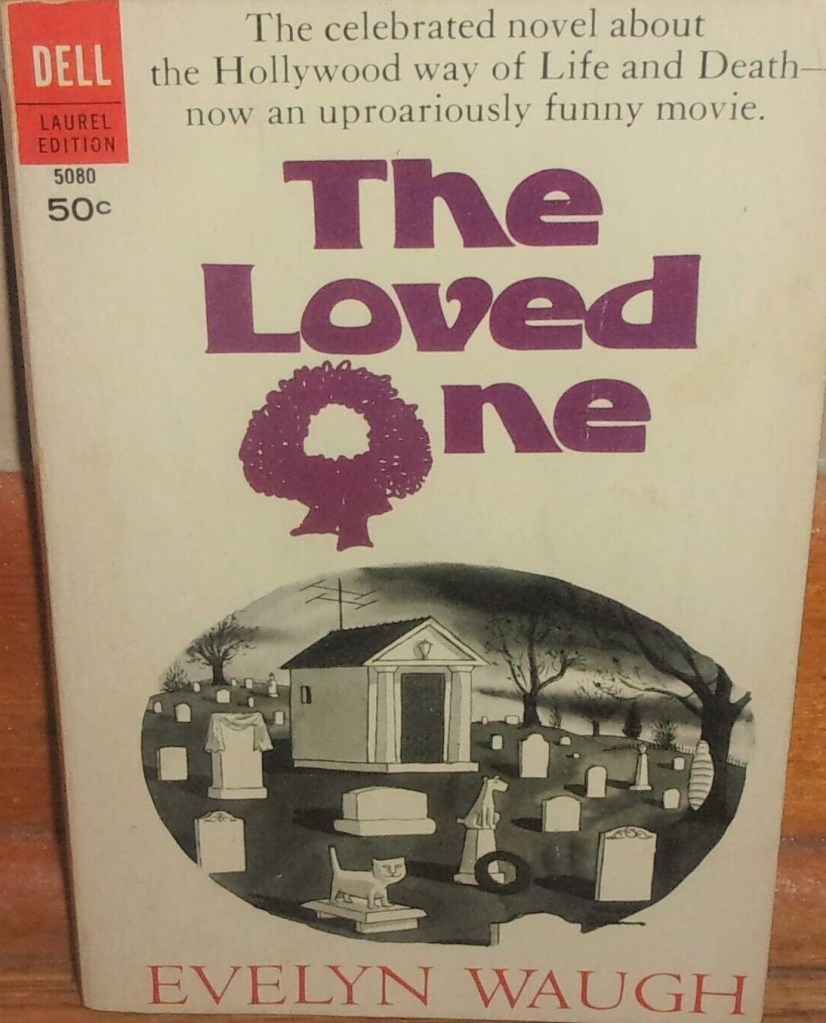
Behind the Scenes: Selling Death – The Pressbook for “The Loved One” (1965)

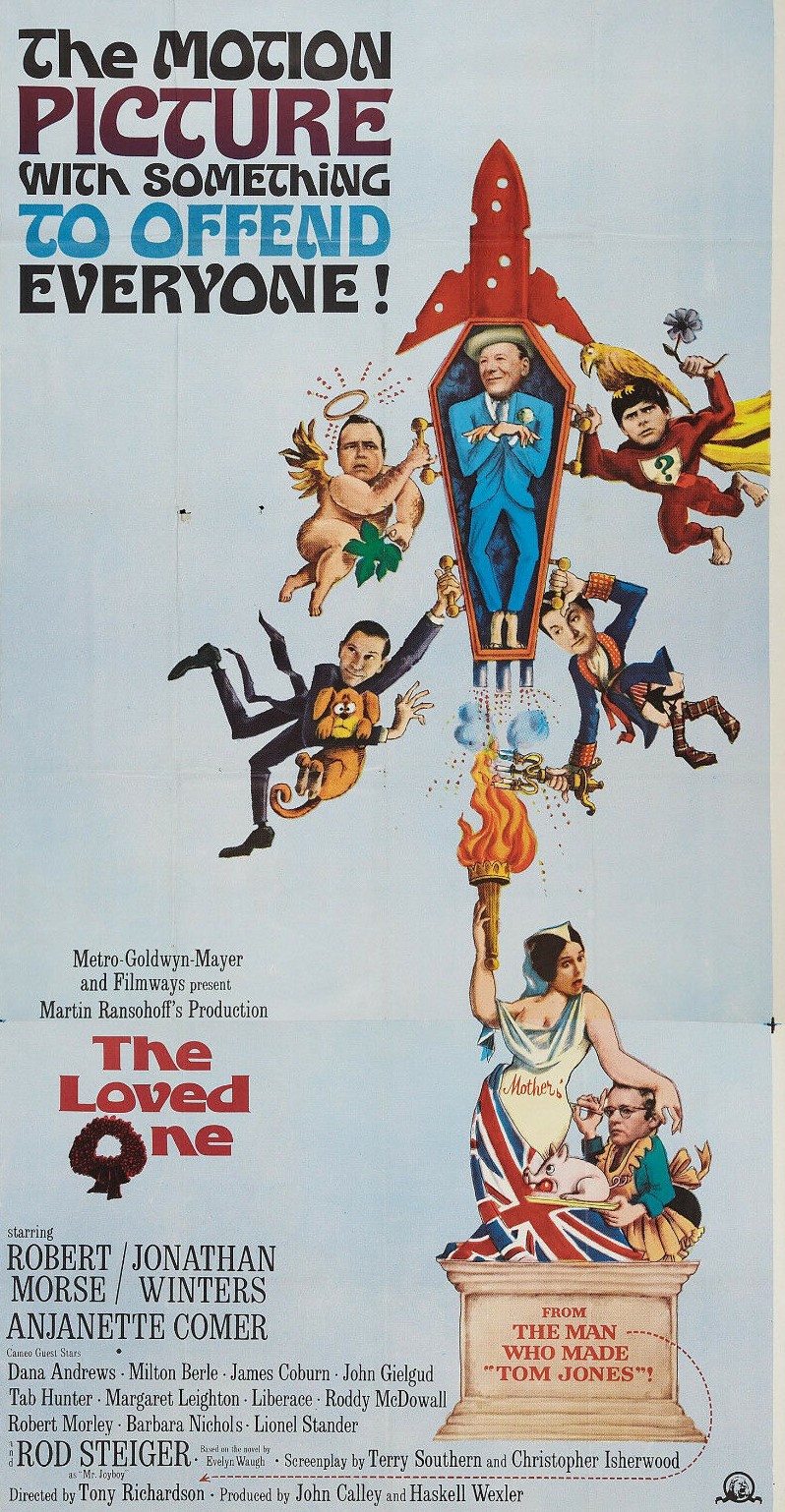
Yep, you hand the promotional department the problem of selling a movie about undertakers and see what they come up with. The tagline “the motion picture with someone to offend everyone” is unlikely to attract the unwary and leaves you only with an audience that enjoys seeing sacred cows slaughtered, which might minimize appeal. Coupled with a montage of outlandish scenes and characters, the main advert had its work cut out to attract anyone.

Just as well, then, the marketing department had some apparent plums up its sleeve. Even more than weddings, funerals are associated with flowers. So, top of “the ticket-selling ideas” was suggesting to cinema owners either to stick a wreath at the front door or get a florist to spell out the title in a lobby display.

If that didn’t work, go for broke and stick a tombstone (easily constructed from plywood or papier mache, apparently) in the lobby. (The Fall of the House of Usher had gone one better, promising a free casket to anyone who dropped ad of fright.) Better still, lay down grass on the pavement outside to achieve a lawn effect.

And if that doesn’t get the media buzzing, why not just hire a hearse. That could sit outside the theater or tour the locality with banners slung along the sides. If the local newspaper was willing, you could arrange to have the print delivered by hearse, photographer on hand to record proceedings.

“Since The Loved One spoofs the undertaking business, most morticians aren’t too happy with the picture. This can be twisted to advantage to get you a newspaper story,” proclaims the Pressbook. Basically, the notion is that undertakers will respond to a reporter nosing around and that somehow that will permit mention in the resulting article of the movie. Another idea is to invite undertakers to the opening night on the assumption that no one will turn up and that somehow that, too, will make a newspaper story.

A simpler alternative was just to hire a model and have her parade around town dressed in white like a mortician and passing out flowers.

Just in case nobody had noted the off-beat nature of the picture, cinema managers were encouraged to browbeat local journalists into spelling this out and putting the movie into the same bracket as Dr Strangelove (1964), What’s New, Pussycat? (1965) and, of course, Tom Jones (1963).

Oddly enough, the movie received a favourable press – or at least a word or two which could be culled from reviews to make it appear so. Thus, one advert was able to rustle up quotes from the New York TimesCue magazine, Herald TribuneHoliday magazine, Life and Saturday Review.

Basically, there was as little meat on the advertising bones as in the genuine narrative to the picture itself. There was only one tagline and all the adverts, covering three-quarters of the 12-page A3 Pressbook, were variations on the one ad.

Outside of the cameo appearances, the male and female leads were relative newcomers, both starring in Quick, Before It Melts (1964). Courtesy of his long-running role on Broadway hit How to Succeed in Business Without Really Trying, Morse was marginally the bigger marquee name.

For a comedy, it was a potentially lethal role for Morse. “There was one scene in which a toy rocket blew up in my face and another in which I was dragged 40 feet by an automobile. I came close to being asphyxiated after doing a 60-minute stint in an air-tight embalming room.”

“Fate has been kind to me so far,” averred Comer. “But it didn’t all happen overnight, you know. Actually, I don’t think the quickie successes mean very much. You can be belle of the ball one day and a has-been the next.

“When I decided to go into this business, I made up my mind about one thing. I wouldn’t go into it unprepared. I got the groundwork in workshop plays at the Pasadena Playhouse and I concentrated on acting to the exclusion of everything else. I never even got to see what Hollywood actually looked like.”

After the success of Tom Jones, director Tony Richardson was given carte blanche. He filmed in 21 locations including the California freeway (as yet unopened), pet cemeteries and Beverly Hills mansions (the ground floor of Dohney marble chateau) and never in the studio.  “I feel constricted working anywhere but in the real locales,” he told the Pressbook. “There are inconveniences in working outside a studio but I don’t mind them.”

His quest for realism extended to make-up. For example, he vetoed applying make-up to Jonathan Winters’ hand so that it matched his tanned face. Other attempts at verisimilitude saw lights taped to ceilings and sound equipment strapped to plumbing. Substitutes were found for equipment deemed too bulky or sensitive for location filming.

Future Warner Bros boss John Calley, here working as co-producer, explained some of the problems encountered. “Normally, when a piece of equipment is to be used or something needs to be constructed in Hollywood, it is only a matter of dialling the proper studio telephone extension. But under the Richardson plan every bit of equipment, every prop, every item of construction had to be individually contracted. There is no question that this is the most difficult way to make a picture, but it is the only way Richardson will work.”

Behind the Scenes: Selling that Old-Time Religion – The Pressbook for “Elmer Gantry” (1960)

The one element that every movie requires – advance publicity – was denied Elmer Gantry. Shooting took place on a closed set with all visitors carefully screened. Only six actors were given access to a complete screenplay while a general synopsis was denied distributors and cinema owners.

Over 30 years after publication of the source novel by Sinclair Lewis, its contents were considered so volatile and contentious that, rather than be pre-judged by the industry on expectations of what the movie may contain, director Richard Brooks took to issuing baffling statements such as describing Elmer Gantry as “The All-American Boy.”

Even the 12-page A3 Pressbook/Campaign Book, the prime source of marketing contact between studio and theater owner, was niggardly in the extreme. Narrative detail was limited to “the story of a spellbinding evangelist” rather anything approaching a synopsis.

Stuck with how to woo an audience in advance, United Artists fell back on a teaser campaign comprising six separate ads. The sequence was as follows: “Elmer Gantry Is Coming!” / “Sinners! Elmer Gantry Is Coming!” / “Sinners! Elmer Gantry Is Coming! starring Burt Lancaster”/ “Sinners! Elmer Gantry Is Coming! Starring Jean Simmons” / “Sinners! Elmer Gantry Is Coming! starring Burt Lancaster and Jean Simmons”. The last advert was coupled with a quote from the New York Times with the final salvo the same ad repeated but with a different quote from the New York Post.

The New York campaign – in those days a movie might take a few months to spread out from initial opening locale to other cities allowing promotional ideas that worked in one area to be publicized – relied on the first two teasers. But they went out in saturation – in railroad stations, subways, buses and race tracks with additional displays on poles, stilts and drums.

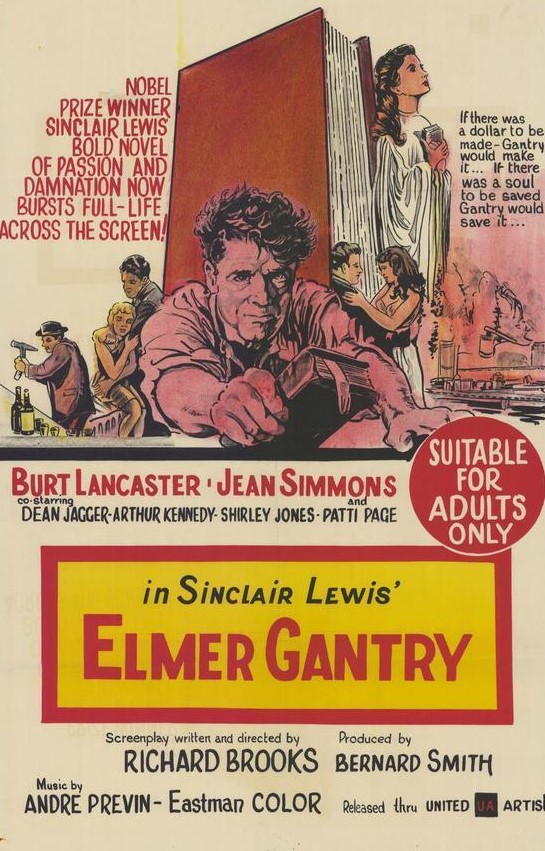
The major print advertising onslaught was led by two bold large-sized adverts intended to run facing each other on the same page. “Bless Him! Tens of thousands of believers shouted his praises!” was accompanied by the iconic illustration, Bible in hand, of Burt Lancaster. “Damn Him! Three women damned his soul” showed Lancaster grappling with Jean Simmons with Shirley Jones and Patti Paige in the background in more revealing clothing. But these two elements could also be fitted into the one ad, as shown above.

There were nearly a dozen full-size advertisements with a range of taglines. In all Lancaster is shown in the same pose with the Bible while Simmons is presented clutching a Bible and gazing heavenward. Shirley Jones appears in even skimpier outfits.

As was standard at the time, taglines could stand on their own or mix and match. Snippets for other ads were edited from this main ad: “Nobel Prize Winner Sinclair Lewis’ Bold Novel Of Passion And Damnation Bursts Full-Life Across The Screen! If there was a dollar to be made – Gantry would make it…If there was a soul to save -Gantry would save it…”

“Sinner! Elmer Gantry Wants You!” ran another ad backed up by “Are you ready, sinner? He wants you to know all about heaven…but not about his whiskey and his women!” Other adverts were fashioned from taglines like: “You’re all sinners…you’ll all burn in Hell! Tell ‘em Gantry…save ‘em from sin…lead ‘em to salvation…tell ‘em about everything…but not about your whiskey and your women!” Or included: “From the book that shook a nation with its sledgehammer theme…from a Nobel Prize-winning author…comes the raging story of a man who used the Holy Bible and broke every rule in it!”

Rarely have so many exclamation marks been employed in so short a space, but equally, rarely has a marketing team encapsulated so vividly a movie with a difficult subject matter, all tease and no substance.

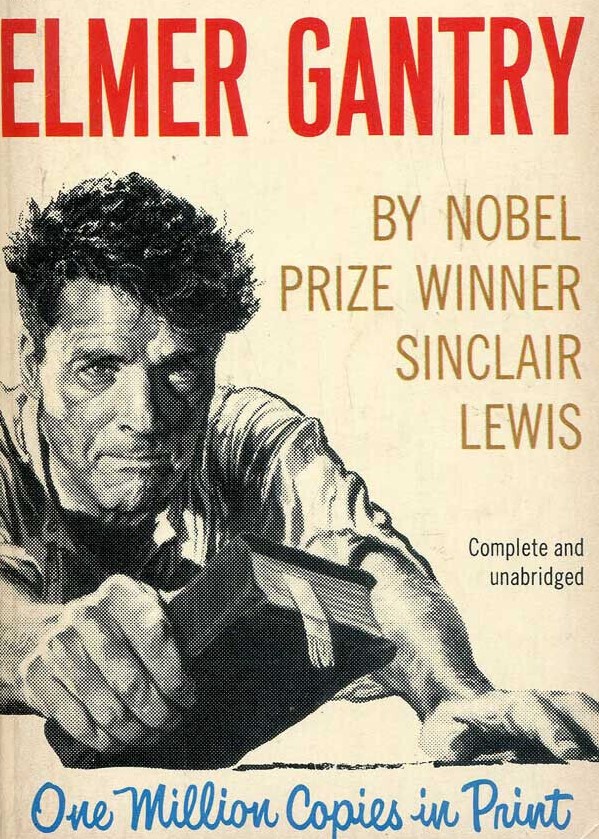
Out-with the usual marketing routes, the marketing team were able to take advantage of various ancillary promotional opportunities. Dell organized a massive paperback book tie-in in thousands of bookstores and newsstands, Burt Lancaster dominating the front cover with Simmons and Jones pictured on the back. Music retailers also played their part, United Artists Records launching the Andre Previn soundtrack album while Mercury released an album of revival tuness sung by Patti Paige, who made her movie debut in the film. With record sales exceeding 35 million, Paige’s host of fan clubs were a natural target for contact and if there was none in the local vicinity cinema managers were encouraged to start one by the simple device of setting up “a giant postcard in the lobby” and inviting fans to attach their signatures.

Department stores were called upon to run 1920s Fashion Shows.

Anniversaries, so important today, helped out. It was 30 years since Sinclair Lewis was awarded the Nobel Prize, the first American author so recognized, and 1960 was the 75th anniversary of his birth. But the promoters also played upon the book’s initial controversy, hoping to re-ignite the debate as a promotional tool.

With the bulk of the Pressbook given over to advertising and promotional ideas, barely little more than a single page was devoted to the stars, but even then there was little of the usual soft-focus puff pieces. The kind of  journalistic nuggets that might help an editor fill a vacant space were limited. All we learned of Burt Lancaster, who had worked with Richard Brooks before on Brute Force (1947), was that – as if this was a mark of respect – he agreed to read the screenplay twice. Of Jean Simmons it was pointed out she had played an evangelist in Guys and Dolls (1955) but the Pressbook erroneously states that she played a nun in Black Narcissus (1947); in fact, she was a beggar girl. Arthur Kennedy is mentioned in relation to his Oscar nominations.

Shirley Jones was the most likely to attract column inches as a result of explaining how she made the transition from more demure roles in Oklahoma (1955) and April Love (1957). “It feels just fine – now,” she told the Pressbook interviewer. “At first, well, I really don’t wear much except what you see. A slip, these shoes with the green frills, and slinky black silk wrap-around that’s transparent.

“Usually, I walk into a movie set wearing my bustle and petticoats and some of the boys turn round as I go by and say, ‘Hiya, Shirl.’ But when I walked in dressed like this the fellows all just turned round and didn’t say anything. They never turned round like that before. Well, not really. It did take some getting used to after provoking the big brother reactions for so long.

“But I guess every girl dreams of being a conversation stopper some day. This is my chance. Of course, I am embarrassed sometimes…or maybe it’s inhibited.”

Brooks rewrote the script eight times before “he felt he had captured the essence” of Gantry. Most of the scenes were filmed on sound stages or adapted from an assortment of 1920s vintage streets from the backlots of other studios. The tabernacle was constructed out of an ice skating rink on a beach pier in Santa Monica.

Art director Edward Carerre spent $6,500 erecting and furnishing a genuine evangelist tent rented from Canvas Specialty. It was slightly trimmed to fit onto two combined sound stages on the Columbia lot. A total of 400 benches each measuring eight- or ten-feet were constructed by studio carpenters to provide seating for 1,000 – the tent accommodated another 2,000 standing. The stage required 500lb of imported sawdust and banners 30ft long were specially made to incorporate Biblical quotations. Where most movies required a maximum of 15-20 sets, Elmer Gantry boasted 62.

The climactic scene, conflagration in a tent, took five days to film. Soaking the set in kerosene would not supply the instant flash of flame the director demanded. So, instead, he turned to old film footage, including some frames from It Happened One Night (1934). “We’re burning film to make film,” quipped Brooks.

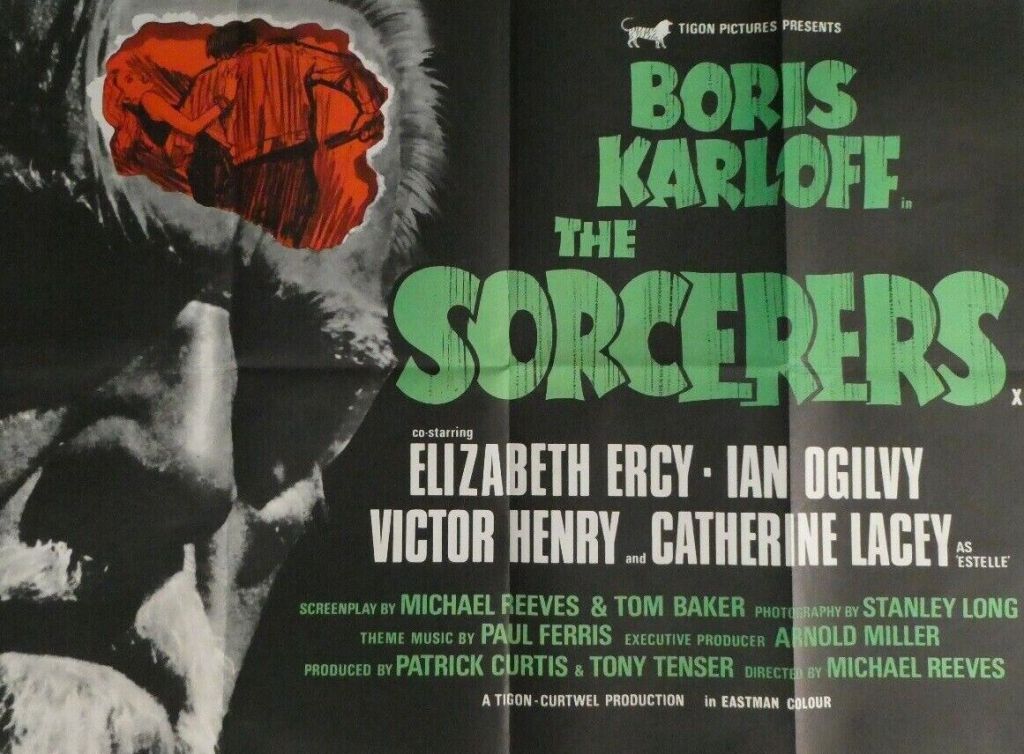
Selling Boris Karloff, Or At Least Trying To: Pressbook for “The Sorcerers” (1967)

Exhibitors measured a movie’s commercial potential in large part by the size and shape of the Pressbook. There was a correlation between a studio’s marketing budget and box office expectation.

This was the era of the 16-page A3 (twice size of a sheet of A4 paper) Pressbook/Campaign Manual that would contain what a cinema manager required to make the most of the picture through newspaper exploitation. This included snippets that would be passed on as nuggets for the editor of the entertainment section – incidents that occurred on set, details of location, hitherto unknown facts about the stars, interesting quotes – and for the newspaper’s non-editorial section that came in the form of a series of  different advertisements, six or seven not unusual.

These adverts were core to what you might see in your local newspaper. The cinema manager simply cut out the preferred size of advert – they were offered a huge range of sizes that often took up to half the Pressbook – and handed that in to the newspaper which duly, with cinema name attached, used it to make up the printed ad.

The point of the A3 Pressbook was to accommodate ads that size (11.7 x 16.5 inches / 297 x 420mm) and encourage the cinema manager to consider paying for such a hefty space in a newspaper. Beginning with the giant size indicated studio confidence, which, it hoped, the cinema manager would match. Of course, should he or she not, then there was a wealth of smaller-sized ads – which might themselves start at roughly A4  (8.3 x 11.7 inches / 210 x 297mm) that the cinema manager might feel more appropriate to the picture house’s marketing budget.

The various ads accommodated a number of different taglines and images, so that a cinema manager could choose the best one for targeting their specific audience – most commonly, for example. an action picture might be sold on the love interest.

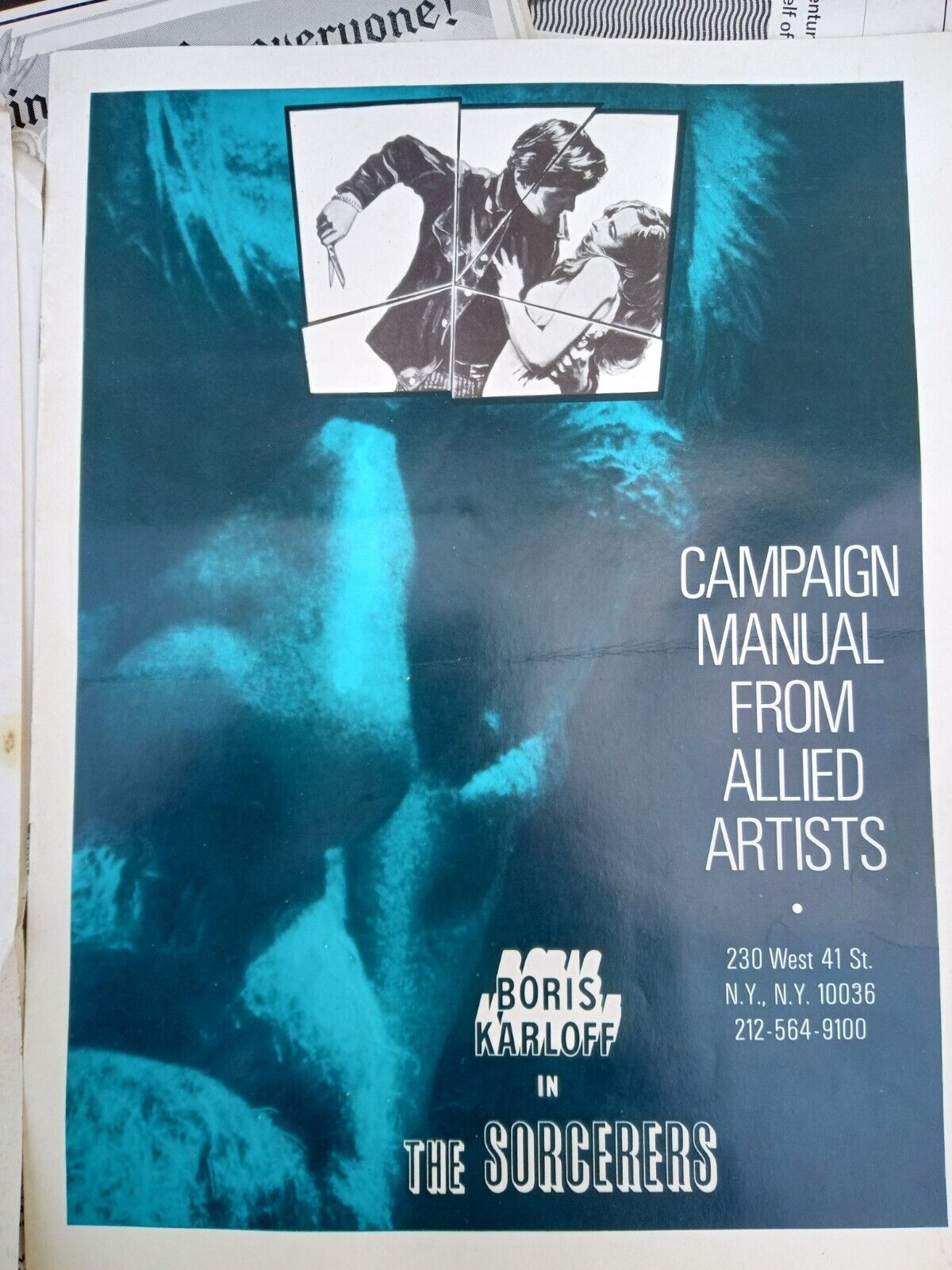
The Sorcerers was released in the U.S. by Allied Artists. Once a big name, producing Friendly Persuasion in 1956, it had now fallen on harder times and largely reverting to its Monogram origins except for a financial boost from the unexpected success of the French-made A Man and a Woman (1966). Whatever imapct that had on Allied’s coffers did not translate into expenditure on the Pressbook for The Sorcerers. Cinema mangers would not have been filled with any great confidence. In size and in the advertisement material it did not shout box office winner.

This is an ad from the British campaign which showed more originality than in the U.S.

The Pressbook was 8-pages A4, of which more than half was advertisements, one full-page A4. But there was only, effectively, one ad, though presented over five pages in twelve different sizes, from the aforementioned A4 down to what would be little more than a slug, one inch running the width of one newspaper column (about two inches).

Boris Karloff’s brooding features, intercut with a man knifing a woman, dominate the advert. There is a tagline: “He turns them on…he turns them off…to live…love…die or KILL!” At the foot of the ad is a montage of young things, dancing, kissing, a girl in backless dress the height of the titillation portrayed. The rest of the near-dozen adverts are all exactly the same, with, as the adverts grow smaller, bits of the main ad dropped out.

The problem with marketing any film starring Boris Karloff was the actor himself. Although a legendary name in movies thanks to Frankenstein, that career-making role had been three decades before and anyone who had seen it in the 1960s had done so on television where it was shorn of a lot of its power. Karloff had only intermittently popped up in horror movies during the 1960s, most recently in Die, Monster, Die (1965).

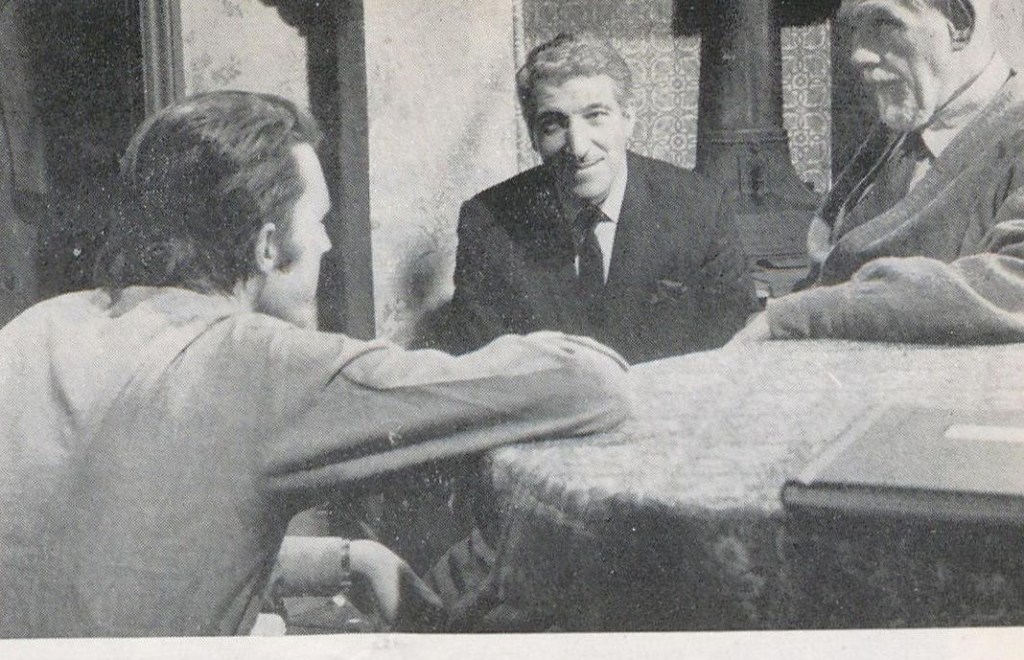
Director Michael reeves (left) with Tony Tenser of Tigon and Karloff.

Karloff was not, to put it mildly, a major marquee attraction. And part of the reason was his determination not to be typecast. So, in the 1940s and 1950s he was more likely to be seen on stage, in Arsenic and Old Lace or The Lark, for example, or on television. He only made eight movies during the 1950s.

There had been some kind of horror comeback in 1963 with The Raven, The Terror, Black Sabbath and The Comedy of Terrors, but since then movie appearances had been sparse. And, of course, for an actor of his age, there was nothing new to say, although perhaps just to remind people that he had been born William Henry Pratt in England.

None of the other performers were remotely well-known. Ian Ogilvy had supporting roles in She Beast (1966) and Stranger in the House / Cop-Out (1967). Elizabeth Ercy had small parts in Doctor in Clover / Carnaby M.D. (1966) and Fathom (1967). Each was given an one-eighth page biography. Despite directing She Beast, Michael Reeves wasn’t mentioned at all.

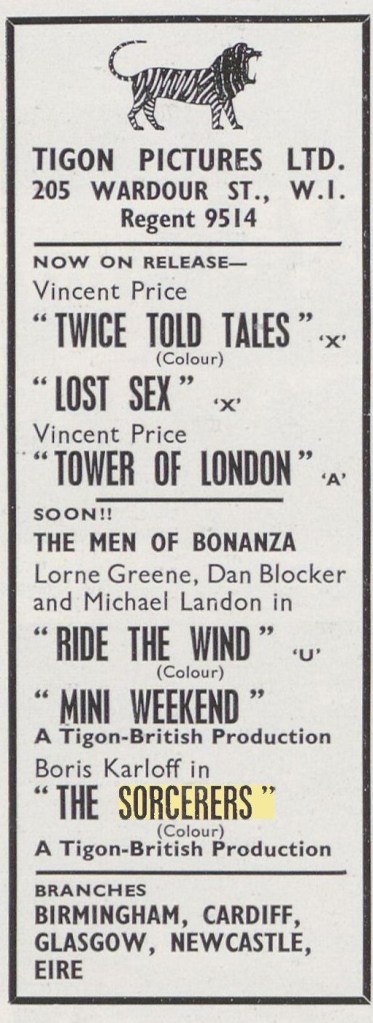
The company you keep. Tigon’s line-up for 1967.

So you get the distinct impression from the Pressbook that it’s Karloff or nothing and since the actor, as noted, was hardly a major player, nobody was going to much trouble to sell the picture.

The Pressbooks I’ve presented in previous features in the Blog have all had considerably more going for them, but this was the downside of the movie business. When there wasn’t much to sell, the distributor wasn’t going to waste his money trying to achieve the impossible.

The Pressbook, printed in 1967, did not appear to achieve any success. The movie did not win a single first run or showcase booking in any of the major cities whose box office was reported by Variety magazine. However, in July 1968, the film was awarded the Grand Prix at the Trieste Sci Fi Festival, with Elizabeth Ercy named Best Actress. That did not appear to brighten the movie’s prospects.

But in 1969, it turned up at the bottom of two horror triple bills. In Boston in first run at the Center it grossed $7,000 (Variety, February 19, 1969, p8) supporting Island of the Doomed (1967) and Castle of Evil (1966). In Los Angeles in a Karloff triple, it was topped in the billing by The Comedy of Terrors and The Raven, earning a decent $110,000 from 12 houses. (Variety, April 30, 1969, p8), it was top-billed in first run in Chicago taking in a “neat” $5,500 at the Monroe (Variety, October 15, 1969, p8).

But it’s possible these few bookings and doubtless others on the drive-in circuits and in smaller towns might still have helped turn a profit on the picture since it only cost $210,000 to make in the first place.

Selling Steve McQueen – Pressbook for “Nevada Smith” (1966)

Truth never stopped producer Joe Levine. Not finding in the film the requisite image to encapsulate the struggle of Nevada Smith he just invented one. The iconic poster of Steve McQueen with rifle over his shoulders did not appear in the movie. Yes, in the early part of the picture Nevada Smith trekked through the wasteland. But that was minus any weapon, unless you count the broken pistol he had found under a wrecked wagon. Naturally enough, if he did have a rifle at that point, presumably Levine surmised, that’s exactly how he would have carried it.

Levine was an unusual character even by Hollywood standards. He was pretty much the first to invent the metaverse, the extended world within which a main character revolved, having sourced Nevada Smith from the Harold Robbins bestseller The Carpetbaggers which he had turned into a blockbusting film in 1964, and by dint of picking up the story of Nevada Smith at an earlier age than in the movie created a “prologue,” better known these days as a prequel or an origin story. Better still, it was two pictures for the price of one book.

Of course, it wasn’t Levine’s idea to make a prequel, or at least that’s how the publicists spun it. “It doesn’t happen very often,” begins the Pressbook, “but it happens, a character in a motion picture intrigues the fancy of fans to such an extent that they write the producer and beg more of him. Instead of wanting to know more about this fascinating character, the public wrote in asking how this intriguing character got that way.” 

Levine took quite a different approach to marketing a movie than other producers. He tended to concentrate on one central image, creating a single core advertisement rather than, as other studios did, churning out a host of different adverts to meet the various perceived needs of exhibitors. And he also liked to fix subsidiary characters in the audience’s mind by providing nuggets of information about their personalities in the poster.

Assuming McQueen was such a big star, exhibitors didn’t need any more juicy nuggets, so the first two editorial pages of the Pressbook concentrate on everything but McQueen. And given that the star’s production company, Solar, was involved in the making, it seems McQueen was exactly of the same opinion. The biggest plug went to Henry Hathaway (The Sons of Katie Elder, 1965), “one of Hollywood’s most celebrated directors,” credited with inventing the action picture three decades before with Lives of the Bengal Lancers. But “action was never permitted to get in the way of the story which, Hathaway always insisted, was of prime interest.”

Five-time Oscar nominee Arthur Kennedy, rather than the second-billed Oscar-winner Karl Malden, came next in the promotion stakes. Kennedy epitomized the importance of a stage training for actors, borne out by the fact that, except for McQueen, all the main players received their training in the theatre. Brian Keith, however, addressed the downside of being in a long-running play. “It means you’re tied down,” he complained, “nothing to do every afternoon, can’t go anywhere or do anything, you have to keep yourself fresh for the evening.”

The Pressbook was surprisingly short on the kind of journalistic snippets that an exhibitor might feed to a local newspaper. That Suzanne Pleshette had a pathological terror of snakes, that Pat Hingle had nearly died after falling down an elevator shaft, and that Hathaway had given Karl Malden his big break were the closest the Pressbook came to anything that might interest a newspaperman.

The iconic image of McQueen shouldering the rifle was mostly used on its own in teaser adverts. For the main advert, that was placed centrally above a montage of scenes from the picture and at the foot came the one-liners about the other characters. Tom Fitch (Karl Malden) was described as “he treated Nevada like a kid – then spent a lifetime regretting it” (not true as it happens). Jonas Cord (Brian Keith) – “he taught Nevada how to kill – then got out of the way.” Bowdre (Arthur Kennedy) – “the bravest man in the world with a gun – and a coward when he faces one” (not true either). Pilar (Suzanne Pleshette) – “she found Nevada in jail and he loved his way out.”

While the main advert, outside of the teasers, was the only advert, there were more taglines. And quite wordy at that. “Some call him savage – and some called him saint…some felt his hate – and one found his love…some had to run – and three had to die…and there never was another like Nevada Smith.” (Incidentally, he had two lovers, not one.) A second tagline ran: “From the California gold fields to the Louisiana bayous, he drank and killed and loved and never forgot, how to hate!”  There was a third, briefer, tagline – “Now a name…soon a legend” and that sometimes prefixed the other taglines.

In terms of tie-ins, there was little. Possibly The Carpetbaggers had already done the work for Levine. The novel had been the biggest-selling fiction since the turn of the decade, around six million copies printed, so it was the ultimate “pre-sell” with a movie tie-in edition, front and back covers bearing testament to Nevada Smith. Pocket Books was one of the biggest publishers in the country and there were over 20,000 outlets for paperbacks including book stores, drug stores, and newsstands. Window banners, rack cards, counter displays and dump displays meant pedestrians would be passing an artillery of promotion every day.

Discover WordPress

A daily selection of the best content published on WordPress, collected for you by humans who love to read.

The Atavist Magazine

by Brian Hannan

WordPress.com News

The latest news on WordPress.com and the WordPress community.