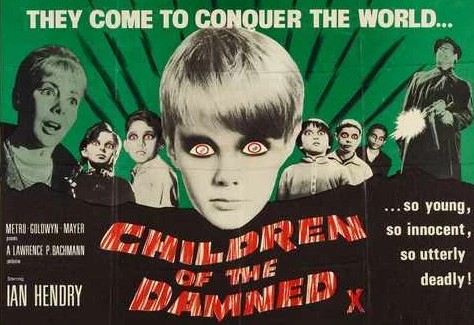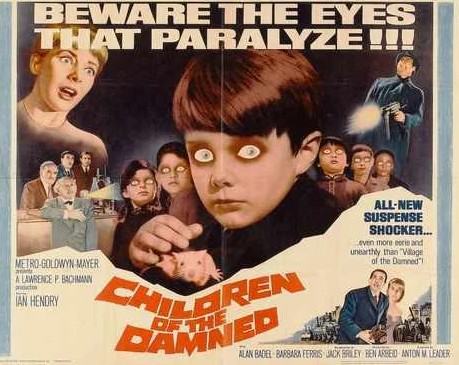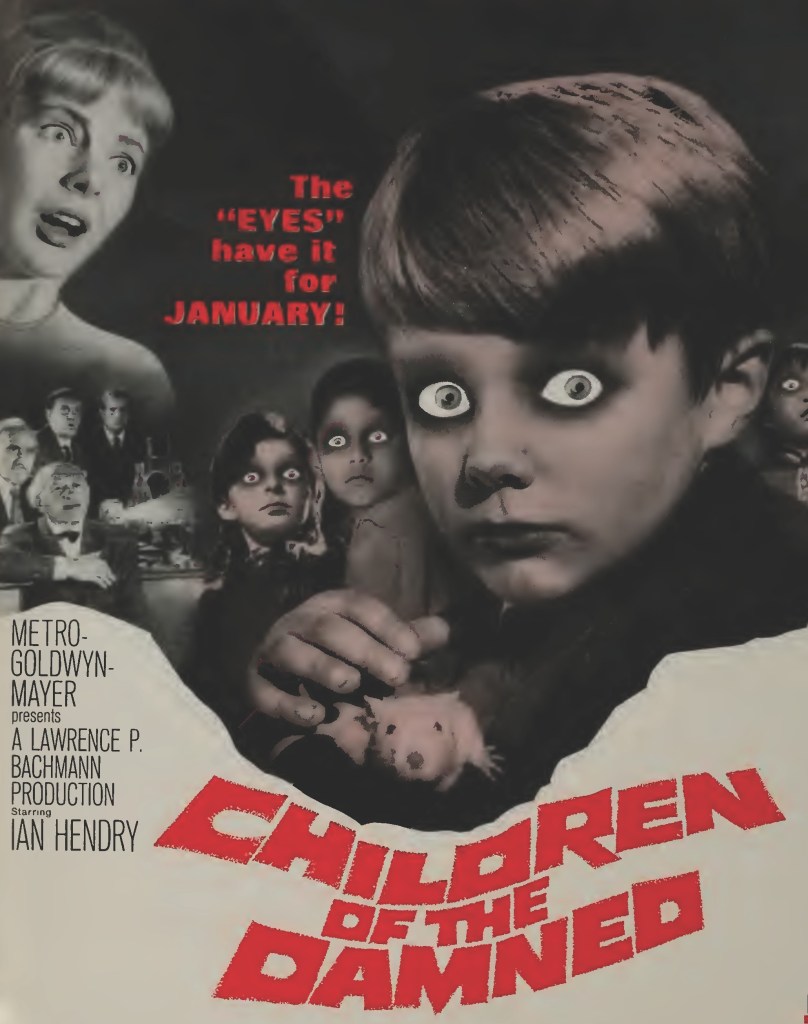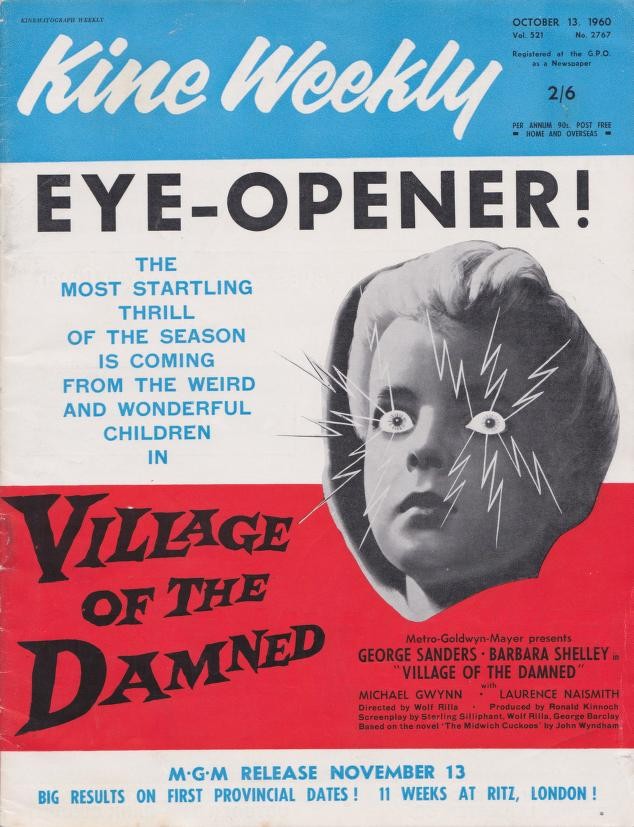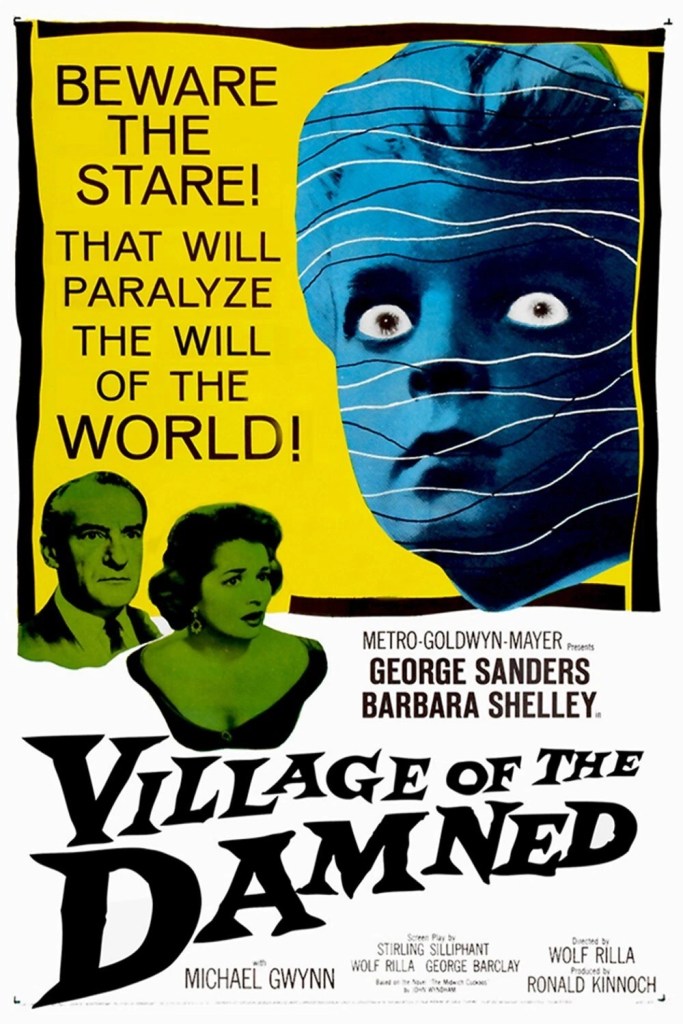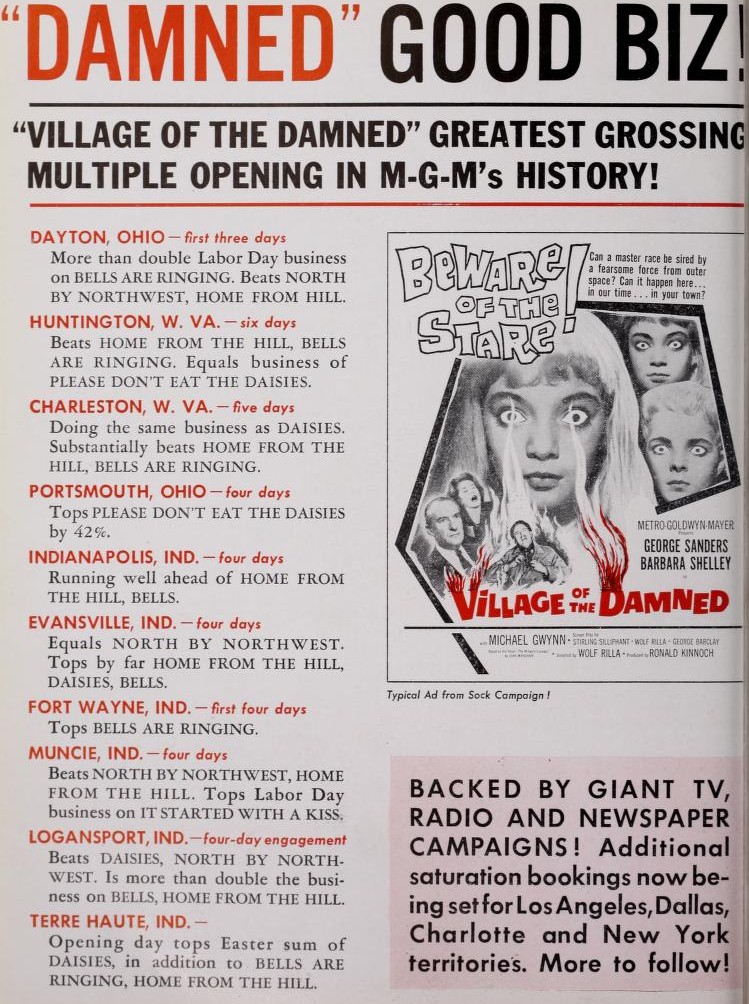
Village of the Damned (1960) ****

Superb chiller that, unusually, takes time to develop several strands over a longer time frame than is normal for a genre where the immediate takes preference. Opens a new dimension of terror, too, with the brain control sub-genre that would spill over into brainwashing. You could also, if you were of a mind, point to the genuine growing social power of the young as emphasized later in the decade with movies about hippies. It might not be too much of a stretch to point to the “Youthquake” at the end of the 1960s when pandering to a youthful audience nearly destroyed Hollywood.  

Terrific opening sequence of everyone in the small village of Midwich dropping to the ground, the immobilized driver of a bus crashing off the road, the driver of a tractor hitting a tree, taps left running, telephone calls cut off, all manner of accidents ensue. You think everyone’s dead, as do the military, called in to investigate. They cordon off the area, employ canaries and then humans to discover how far the danger spreads. But when a soldier who is dragged out unconscious from the forbidden zone wakes up, they soon realize the population is merely unconscious.

Childless couple Professor Gordon Zellaby (George Sanders) and younger wife Anthea (Barbara Shelley) are among those affected, apparently suffering no side effects for having been knocked out for around four hours. A couple of months later Anthea is delighted to report she’s pregnant. She’s not alone. But for many of the villagers what would be a cause for celebration causes untold grief. One husband returns home after a year away to find his wife is pregnant. In the days when pre-marital sex was frowned-upon, virgins, similarly affected, are shamed.

The pregnancies don’t run to the normal period either, and fully-grown children are born within a few months. What’s more, they all look as if they have inherited the same genes. Their blonde hair and striking eyes suggest they share the same father. Soon it transpires they can not only read minds but control them, causing at least two people to commit suicide.

Turns out this is a global problem, several other communities afflicted with the same condition, the Russians so concerned at the prospect that they bomb one village to oblivion, other cultures simply murdering the children.  Here, being English, where fair play still rules regardless of potential threat, the children are taken under the wing of Professor Zellaby, though the military, having sealed off the area, wait in the wings, itching to wipe out the troublemakers.

Quickly, it becomes a duel for power, the children will do anything to protect their species, Professor Zellaby at first wanting just to study the kids and understand them but soon recognizing the threat.

In between bouts of action, most of which is discreetly handled, none of the deliberately shocking scenes that might have emanated from an exploitationer, the authorities have plenty of time to ponder their existence. A leap in genetic mutation, or extraterrestrial origins, are among the options considered.

Eventually the villagers react like terrified Transylvanians confronting Dracula and attempt to set fire to the building where the children are housed but reckon without the brain control that can be exerted. In the end Professor Zellaby comes up with a self-destructive solution.

This is formidable stuff, all the more so, because in the days when most monsters grew fangs or claws or developed huge bodies and were otherwise physically frightening, the worst these kids get up to is to have a striking glow in their eyes, a startling contrast to their blonde hair, calm demeanor and neat uniform clothing.

Tremendously well done and it helps to have cast mainstream actors like George Sanders (Warning Shot, 1967) and Barbara Shelley (only later did she become a Scream Queen) and others who don’t carry the tinge of the horror genre.

Very well paced by German director Wolf Rilla (The World Ten Times Over, 1963) who resists the temptation to overplay his hand, achieving much more by leaving it to your imagination. Stirling Silliphant (The Slender Thread, 1965), George Barclay (Devil Doll, 1964) and the director adapted the groundbreaking novel The Midwich Cuckoos by John Wyndham. Horror maestro John Carpenter remade this in 1995, which only wnent to show how more successful the restraint of the original was.

Top notch.

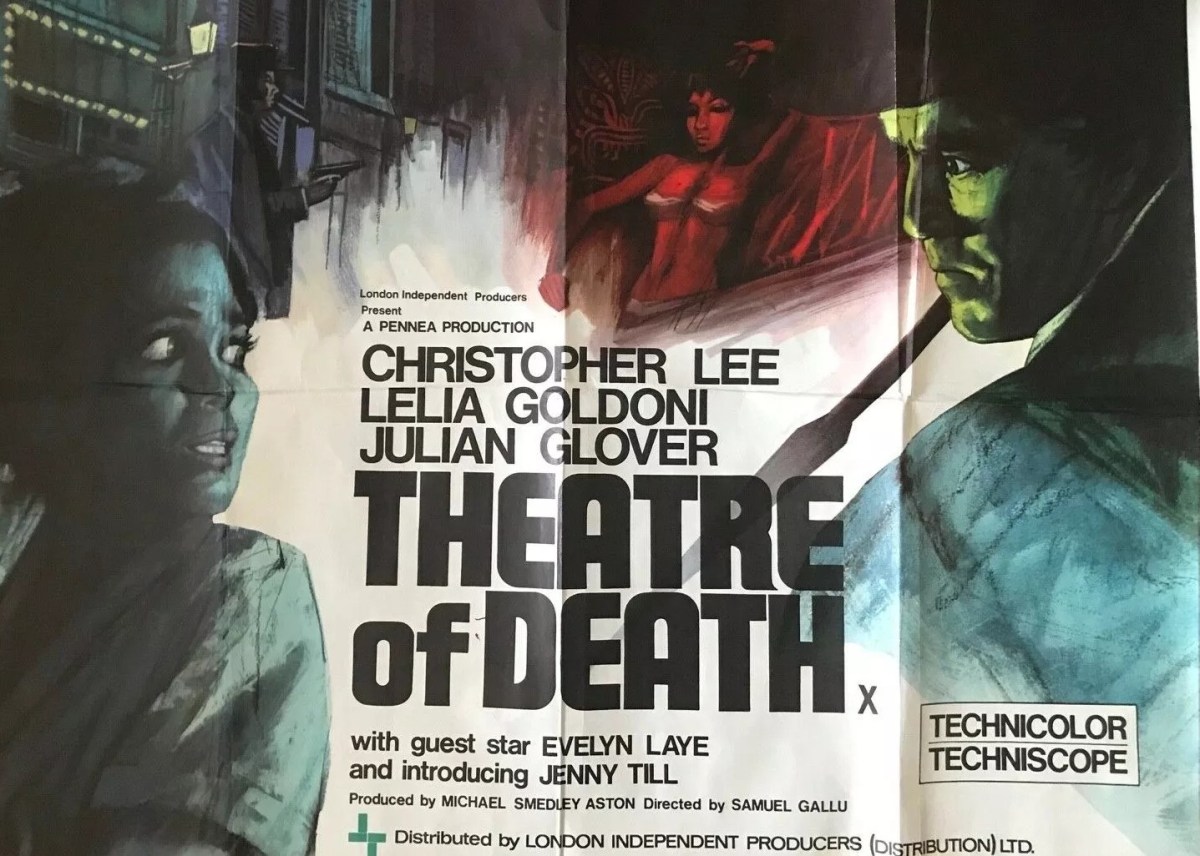
Theatre of Death (1967) ***

Takes considerable brass neck to treat master of the macabre Christopher Lee as nothing more than a red herring. A very slow slow-burn with a pinch of the vampiric, quartet of characters with a mysterious past, Grand Guignol Parisian setting, some decided sleight of hand and a series of murders staged to huge audience delight (in the titular theater, you understand) turns this into a more interesting venture than you might expect. In more literary hands, the incident on which this pivots could well have turned into tragedy.

Impresario Darvas (Christopher Lee) has launched The Theatre of Death, a show comprising a series of highly realistic sketches in which characters appear to be brutally killed. At a first night party he hypnotizes neophyte actress Nicole (Jenny Till) into nearly burning star Dani (Lelia Goldoni) in the face with a branding iron during a sketch about witches, disaster prevented by the intervention of Dani’s boyfriend Charles (Julian Glover). He’s a police surgeon called in to help investigate a series of murders with vampire overtones. Just as sinister is hypnotism which apparently can be self-imposed.

Charles begins to suspect Darvas. And small wonder the audience does too. Darvas has a lair, trap doors, secret passageways, concealed voyeuristic viewpoints and the kind of cat that only a villain strokes. Darvas clearly believes Nicole is more than just a protégée but a tool in his hands who can be called upon to act “when your conscience is asleep,” and given his predilection for brutality, even if apparently only staged, you have to think she will be called upon to do more than act. There’s even a suggestion that he might be able to inhabit her body.

Everyone has secrets. Darvas’s father disappeared in mysterious circumstances, Charles can’t operate following an unspecified accident, Dani spent two years in a mental asylum and Nicole barely survived being trapped in an avalanche in the Alps. Darvas humiliates Dani and promotes Nicole.

The murders switch from a trio of young women to men. Inspector Micheaud (Ivor Dean) is baffled. Naturally, he doesn’t want to risk the public ridicule of announcing there is a vampire on the loose in Paris (though some decades later, as you will be aware, a werewolf, of American origin, was roaming free), setting aside the fact that the French capital had been the scene for various nefarious acts in locales as varied as the Rue Morgue, Notre Dame and the Opera.

Darvas remains the obvious suspect until director Samuel Gallu (The Limbo Line, 1968) pulls a Hitchcock – or should that be, after A Poppy Is Also A Flower/Danger Grows Wild (1966), a Terence Young – and kills off his star halfway through. Initially, Darvas is reported as missing, but his cloak is found covered in blood. Naturally, we are led to believe he is going to turn up, and be identified as the killer.

But nope, in a considerable coup de theater (or coup de cinema), he’s been done away with by the real killer who is cleverly covering their tracks by getting Dani to write a suicide note before killing herself.

It’s certainly a shock to discover that the killer is Nicole, who is very partial to blood after being fed the blood of her brother while trapped in the avalanche. Quite why she has managed to conceal her thirst for so long is never revealed. However, there’s an unforeseen ironic twist which prevents her terrorizing the Parisian citizens any further.

Christopher Lee (Dracula, Prince of Darkness, 1966) is in Hamlet mode, hair combed forward, eyes bristling with intensity. Julian Glover (Alfred the Great, 1969) doesn’t really have enough dramatically to do. Neither Lelia Goldoni (Hysteria, 1965) nor Janet Till (A Challenge for Robin Hood, 1967) does much to burnish their reputation. Written by Ellis Kadison (The Gnome-Mobile, 1967) and Roger Marshall (Invasion, 1966).

Works very well by playing with audience expectation

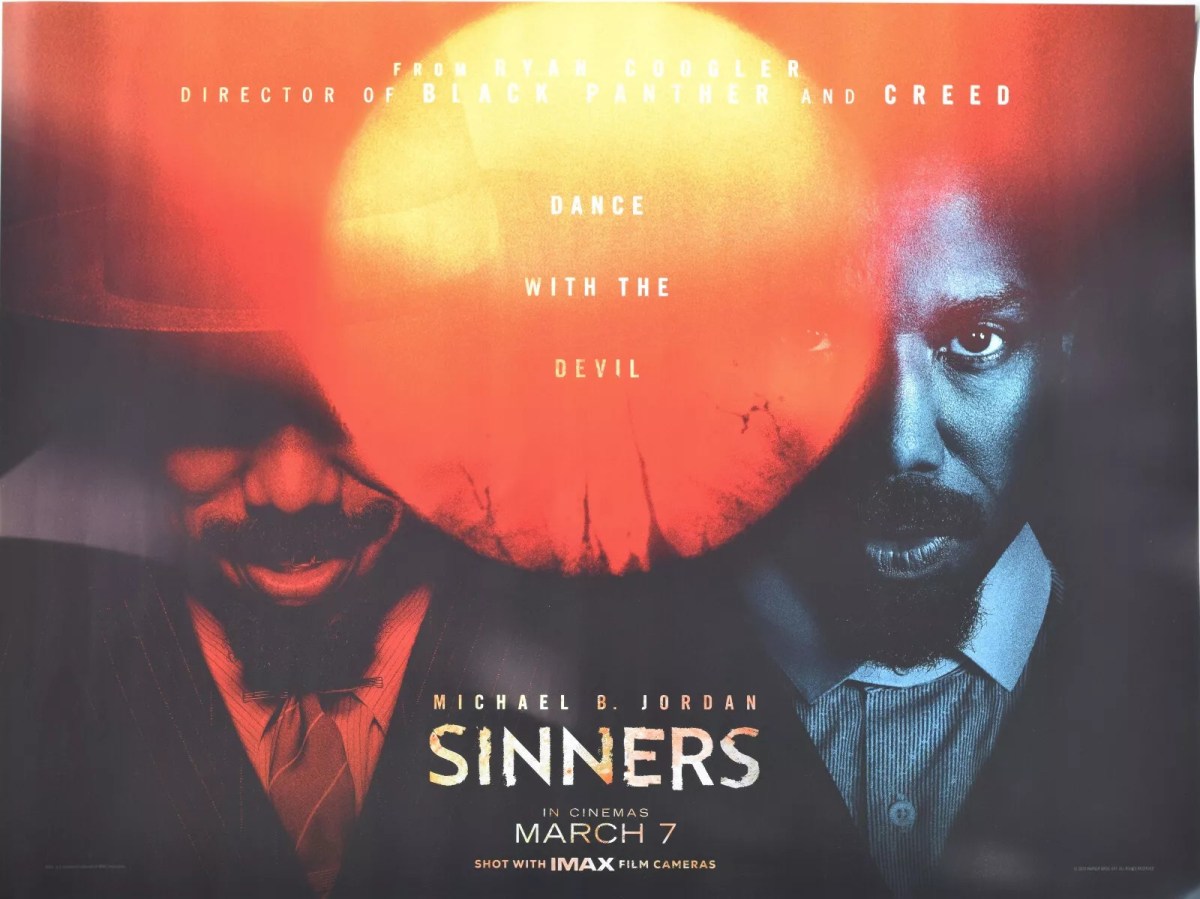
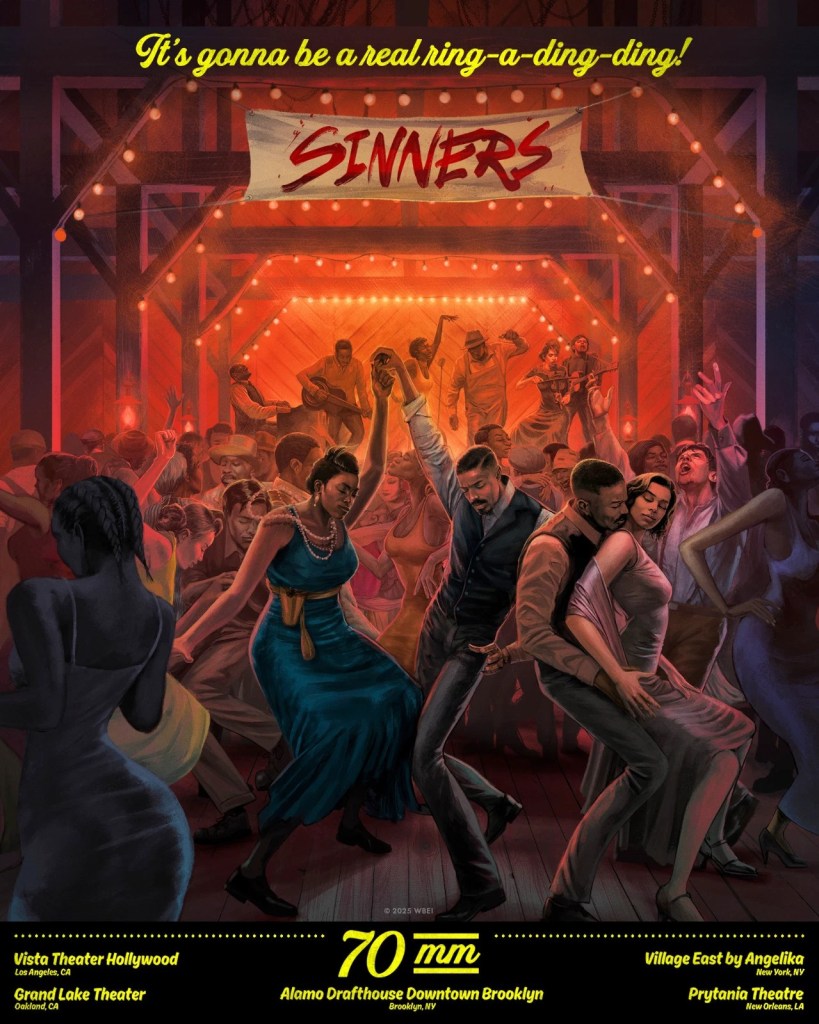
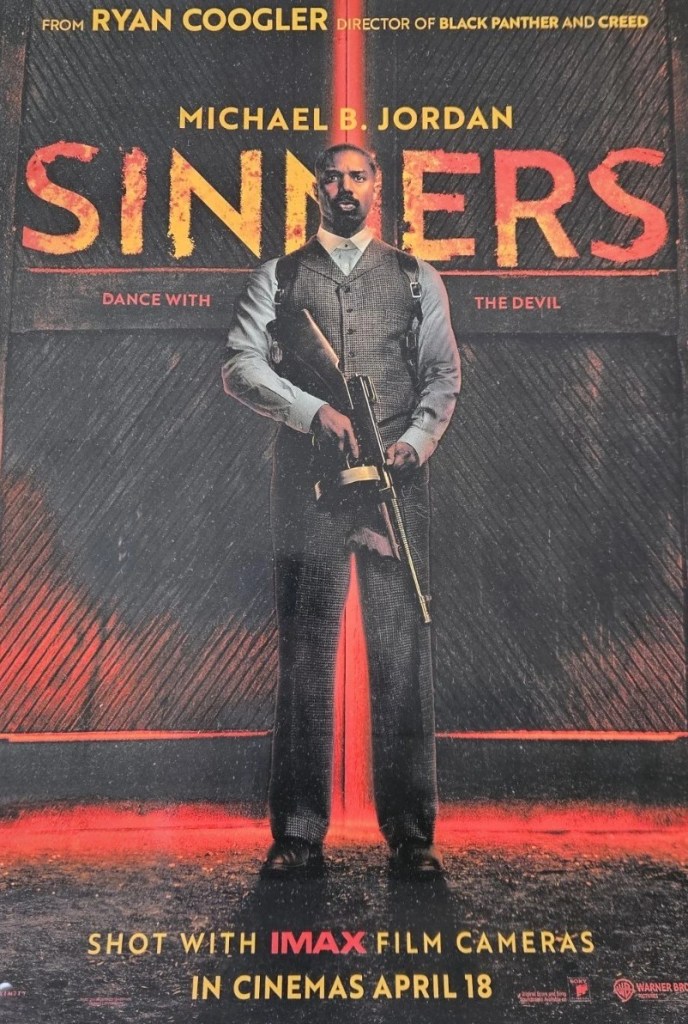
Sinners (2025) ***** – Seen (Twice) at the Cinema

A great movie is more than the sum of its parts. There’s something indefinable, something as they used to say “in the ether”, or “hits the zeitgeist” or, more aptly “hits the spot” because the area in question can never be defined, yet somehow we know it’s there. A writer from several generations past came up with “only connect.” And that’s a pretty food summation. Audiences are not really interested in movies that connect with critics – we’ve been served up too much dross too often to trust critics, Anora (2024) a recent case in point. When movies scarcely drop any percentage of revenue at the box office in the second weekend it’s not because of a ramped-up advertising budget, but because movies have hit the spot, connected with audiences, acquired that elusive word-of-mouth quality. For sure, this is going to be an Oscar contender, which probably means all the fun will be knocked, as its supporters get all preachy on us about its importance as a social document.

But a great movie comes from nowhere and sets up its own tent, creates its world, its own logic. There were gangster pictures before The Godfather (1972), westerns before The Searchers (1956) or Once Upon a Time in the West (1969) and sci fi before Avatar (2009) but what such pictures owe to their genres is derivative in a minor key. And so it here, Sinners takes the vampire movie and tosses it every which way but loose.

You got the blues, the most appealing vampires you’ll ever come across (and not in the svelte style of another game-changer, The Hunger, 1983), the need for community, the duping of the poor through religion, music than can summon up Heaven and Hell, raw sexuality, belonging, mothers, orphans, genius, cotton, a world where African Americans who fought for their country discovered their country didn’t want to fight for them, where the white man is going to take your money and then, for sport, kill you, and the plaintive despair of never feeling the warmth of the sun again as long as you live – which is forever. And connections – there’s myriad connections that will hit home.

In fact, you might not be aware you’re watching a vampire movie for roughly the first half. You might imagine this is more akin to The Godfather Part II (1974) with gangsters trying to go straight. First World War veterans identical twins Smoke and Stack – I have to confess right till the credits I didn’t realize these were both played by Michael B. Jordan (Creed, 2015) – descend on a small southern town intending to make an honest buck from a dance hall, convinced they have acquired the necessary business acumen. The motley bunch enrolled in this endeavor include neophyte bluesman Sammie (Miles Caton), veteran alcoholic bluesman (Delroy Lindo), singer Pearline (Jayme Lawson), storekeepers Grace (Li Jun Li) and Bo (Yao), bouncer Cornbread (Omar Miller), Smoke’s estranged wife Annie (Wunmi Musaki), who has knowledge of the occult, and Stack’s ex-girlfriend Mary (Hailee Steinfeld). Coming a-calling is Irish immigrant Remmick (Jack O’Connell) recruiting new members for his vampire flock.

The movie doesn’t take flight so much in the unwinding of intertwined lives, or with the rocking action, as with two dance sequences that transcend anything you’ve seen before in the cinema, the first conjuring up music of the past, present and future, the second a routine by the vampires. Trying to save himself from vampires, Sammie begins reciting the Lord’s Prayer only to hear the sacred words echoed by the undead. A guitar is buried in Remmick’s head. And there’s a fascinating coda, if you wait through the credits.

Michael B. Jordan is the obvious pick, striding across both characterizations with immense aplomb (the Oscars will be calling) but Miles Caton in his debut, Delroy Lindo (Point Break, 2025), Hailee Stainfield (The Marvels, 2023), and especially the seductive blood-lusting Jack O’Connell (Ferrari, 2023).

Writer-director Ryan Coogler came of age with Creed and the Black Panther duo but this takes him into the stratosphere, a genuine original talent, not just with something to say but the visual smarts to match. He could have harked on a lot more. Too many worthy pictures have turned virtue-signaling into an art form, but one boring beyond belief. Coogler is much more subtle, he slips in his points.  

But all the subtlety in the world wouldn’t count for a hill of beans if he couldn’t tell a story in way that connected big-time with the audience who wanted to tell their friends to go-see.

The Hunger (1983) ****

With this weekend’s Sinners claiming to reinvent the vampire picture, I thought it time to look back at a movie that genuinely did reimagine the vampire genre, though hardly acclaimed at the time.

Elegant, atmospheric, subtle. Never thought I’d be stringing those words together to describe an offering from uber-director Tony Scott (Top Gun, 1986). Add in “slow” and this is a director reinvented. Did I mention “short?” This clocks in just over the hour-and-a-half mark. So what  might have driven an audience to distraction if stretched out over a languorous two hours twenty minutes, say, or longer, as would be par for the course in these more self-indulgent times, is not an issue.

If this has become a cult, it’ll be for all the wrong reasons. A vampire picture that doesn’t play by the rules, a lesbian vampire movie that steers clear of Hammer sexploitation, a lesbian movie featuring two top marquee names, or just any picture that features David Bowie.

There’s an inherent sadness to the whole exercise, an elegiac feel comparable to the likes of The Wild Bunch (1969).  Miriam Blaylock (Catherine Deneuve) and husband John (David Bowie) are so stylish and have no truck with growing those oh-so-out-dated fangs that you are willing them to succeed especially as there’s no sign of a crucifix-wielding vampire hunter.

You might wonder why the cops haven’t been alerted to a spate of killings, throats cut in serial killer modus operandi fashion, but really there’s so much else going on – emotional, not action, you understand – that its absence isn’t worth commenting upon.

So first up is betrayal – and from a serial betrayer at that – as John realizes that while he has been promised eternal life by Miriam, who’s somewhere in the region of two millennia old, she can’t guarantee eternal beauty. So when he starts to suffer from ageing, cracks begin to show in their relationship. And whether he’s aware of this or not, she’s already lining up a replacement, the classical music student Alice (Beth Ehlers) they both tutor. And when John knocks her out of the equation, his pursuit of eternal youth or at least a reversal of the ageing process leads Miriam to a spare, scientist Sarah (Susan Sarandon).

The connection between the two women is initially so subtle that Sarah picks up the telephone imagining Miriam on the other end when the phone hasn’t even rung. Sarah is perturbed/excited to discover she has gay tendencies, especially when she’s already in a strong heterosexual relationship. And she’s not that keen, either, on discovering that she has been co-opted into the vampire fraternity.

Most of this has moved along in almost dreamy style so, that come the end, a sudden burst of twists  takes you by surprise. You’ll find echoes to  the priestess in Game of Thrones when the aged John seeks to kiss his lover. And John’s discovery at the end that’s he’s part of an undead harem carries over to the climax of Christopher Nolan’s The Prestige (2006).

Anyone looking for cheap kicks from the lesbian sex scene is going be disappointed, this is sex arthouse-style with wafting curtains getting in the way, and pleasure delivered in subtle rather than orgiastic fashion.

Tinged with a sense of loss, and pervaded by sadness, this is a complete outlier in the Tony Scott portfolio, especially the pace which is completely at odds with the fast-editing style for which he is best known. At the same time, tension remains high, in part because you don’t really know what Miriam is up to, and because these are new ground rules by which the vampires play, not least in their enjoyment of style and fashion, the kind of garb favored by the likes of Christopher Lee only employed as pretense and not by one of the main players.

Catherine Deneuve (Mayerling, 1968) was a Hollywood irregular, not seen there in six years since March or Die (1977), and it’s surprising, never mind her choice of couture, what sophistication a French accent brings to a vampire movie. Susan Sarandon was an ideal fit for the European feel of the picture, having cut her teeth with Louis Malle on Pretty Baby (1978) and Atlantic City (1981). David Bowie spends most of the movie under a sheet of make-up so you need to get in quick for your Bowie fix, and for that short period he is quintessential Bowie.

Written by debutant James Costigan and Michael Thomas (Ladyhawke, 1985) from the Whitley Streiber bestseller.

But this is Tony Scott’s (Enemy of the State, 1998) triumph, work that you’ve never seen before and never seen since, making you wonder why he never continued in this vein.


Cauldron of Blood / Blind Man’s Bluff / The Corpse Collector (1968) ***

Superior “lost” horror picture that suffered from minimal initial release and is now rapidly entering the cult dominion. Effective and occasionally very stylish entry to the genre. Apart from Boris Karloff (The Sorcerers, 1967) playing against type, it’s not populated by the usual horror actors but a surprisingly mainstream cast including suave Frenchman Jean-Pierre Aumont (Castle Keep, 1969), Swede Viveca Lindfors (Sylvia, 1965) and Mexican Rosenda Monteros (The Magnificent Seven, 1960). In keeping with a new trend mostly personified in the espionage division, a woman is the villain of the piece.

Begins with an excellent sequence that twists on audience expectation. A young woman sunbathing on a deserted beach is viewed through a telescope. A hand touches her cheek, arousing her from her slumber. You expect her to react, and she does but not as much as you would imagine. It’s only the old guy who rents out beach umbrellas telling her he’s closing shop. We cut to someone in a trench coat with a garotte. It’s not the girl he stalks, but the old fella.

Surprising number of effective scenes beginning with a terrifying nightmare sequence of a young girl being whipped and then attacked by a skeleton. Outside of the dream landscape, a mute maid is whipped.  And a clever note when a young woman pours a glass of red wine, like blood, into her bath, prefiguring trouble to come. There’s a monkey crouched in the beams of a mansion impervious to various nefarious episodes taking place below. And some trick photography of a girl running only to disappear, captured in an overhead shot. A killer dresses up in a skeleton costume.

Journo Claude (Jean-Pierre Aumont) arrives to interview blind sculptor Franz (Boris Karloff) who lives in seclusion and is cared for by wife Tania (Viveca Lindfors). Claude tackles the rumor that the reason for Franz’s very realistic sculpture is that he uses human bones, a suggestion that is batted away.

Claude makes the acquaintance of artist Valerie (Rosenda Monteros) and her nude model Elga (Dyanik Zurakowska), encounters old drunken buddy Pablo (Ruben Rojo) and unleashes his entrepreneurial instinct, planning with other villagers to buy up all the property and cash in on the tourist boom he expects to generate by his coverage of the sculptor.

It’s not just poor old guys who are disappearing; Pablo’s dog is also for the garotte. And all is not well in the sculptor’s household. He accuses his wife of trying to kill him, but botching the job, resulting in his blindness. “I am not your prisoner, you are mine,” he claims, pointing to the fact that he now requires so much care. Later, he accuses her of salting away his money.

The mansion has an underground lair where Tania bleaches bones in a cauldron (like the scene in Jaws, 1975, where sharks undergo similar treatment) and where she meets her lover Shanghai (Milo Quesada) who carries out the killings as well as the occasional rape. Franz believes his wife is merely indulging in a bit of grave robbing to supply him with carcasses for his art.

Suspicions are not raised in the village though Valerie, who turns out to have practical experience of the mechanics of sculpture, reckons too much smoke emanates from the Franz chimney. Elga and Pablo are next to fall victim. When Valerie discovers Pablo’s body, she is added to the list.

And that sets up a quite splendid three-part climax. Racing to the rescue, Claude uses his car as a battering ram to enter the house and then engages in fisticuffs with Shanghai. But, in another twist, that fight takes a helluva time to reach a conclusion so that Valerie remains trapped and with legs bound and drugged must tackle Tania on her own. Meanwhile, the blind sculptor tries to take on his wife. This is a marvelous section where she dupes him with various noises.

Jean-Pierre Aumont is outshone by both Viveca Lindfors and Rosenda Monteros.

Quadruple hyphenate Edward Mann (Island of Terror, 1966) – writer, producer, director and composer of the theme tune – has a splendid time leading the audience astray and producing some moments of sheer terror.

Horror Hotel / City of the Dead (1960) ***

The structure of this piece gives away its origins. It’s effectively a portmanteau, though limited in this instance to three connected tales. Mention the word “portmanteau” and Amicus springs to mind. While that outfit didn’t exist at this precise moment, the movie was put together by the team behind Amicus, American producers Milton Subotsky and  Max Rosenberg. The odd American accents might provide the clue that it was made entirely in Britain with British actors.

The witchcraft-zombie combo works well enough but horror mainstay Christopher Lee (Dracula, Prince of Darkness, 1966) is used sparingly. It marks the debut of Argentinian-born director John Llewellyn Moxey who has acquired something of a cult status in these parts.

We begin with a prolog set in Whitewood, Massachusetts, in 1692 at the height of the witch-burning epidemic where Elizabeth Selwyn (Patricia Jessel) is burned at the stake. Her lover Jethrow (Valentine Dyall) made a pact with the Devil to supply virgin sacrifices at a propitious time in the necromancy calendar in return for eternal life.

Three centuries later history student Nan Barlow (Venetia Stevenson), a virgin with an interest in witchcraft, sets off, at the instigation of Professor Driscoll (Christopher Lee)  and against the advice of fiancé Bill ((Tom Naylor) and brother Dick (Dennis Lotis), to investigate the happenings at Whitewood. She puts up at The Raven’s Inn whose landlady Mrs Newless bears at distinct resemblance to Elizabeth.

Had this picture carried the Amicus stamp, I might have been prepared for what happened next. Nan doesn’t get much chance to do much investigation before she is burned at the stake by the coven of Mrs Newless, revealed as Elizabeth.

So we are on to the third part of the portmanteau. Dick discovers that his missing sister’s supposed abode, The Raven’s Inn, doesn’t exist in any directory, so he ups sticks and with the fiancé sets off in pursuit. Crucially, brother and fiancé, are separated, effectively allowing the stories not so much to dovetail but to keep the fiancé out of action until he is needed.

Dick makes acquaintance with Patricia (Betta St John), antiques dealer and witchcraft expert, who warns him off. Any impending romance, such as would be de rigeur in normal circumstances, is cut off after Patricia is kidnapped and set up for the virgin sacrifice ceremony.

Two virtual last-minute entrants serve to provide a big climax. Driscoll is revealed to be a member of the coven and Bill arises from his sick-bed – he was badly injured in a car crash – to save the day, despite his cynicism knowing enough of demonic folklore to bring a cross into the proceedings. This he does by the complicated process of yanking up from a graveyard a fallen large wooden cross which inflicts the necessary damage on the coven. Though Elizabeth escapes it’s not for long.

Dodgy accents aside, and slightly discombobulated by the structure, which, given it wasn’t released in the U.S. until 1962, might have been viewed as a nod to Hitchcock’s Psycho (1960) in despatching the heroine halfway through, there’s enough here in the atmosphere and the performances to keep the enterprise afloat, if only just.

A good dose of fog always helps and the occasional appearance of the undead and the olde worlde atmosphere makes this work more than the acting which, excepting Lee, is on the basic side. Venetia Stevenson (The Sergeant Was a Lady, 1961) otherwise the pick.

This didn’t set Moxey on the way to fame and fortune but somehow in the world of cult less is more. He made only a handful of movies including Circus of Fear (1966). Written by Subotsky and George Baxt (Night of the Eagle, 1962).

A good first attempt at horror from the Amicus crowd.

Dark Intruder (1965) ***

Sumerian demons, Siamese twins separated at birth, a serial killer, oceans of fog, the flower of the mandrake, a climax that revolves around “it’s in his kiss” and a picture so shorn of light it could easily have been titled Dark Fiancé or Dark Wedding. Thematically truncated, too, and you get the feeling that with a little bit more narrative expertise and budget this could have been spun out into something that fitted in with the decade’s later spurt of horror a la Rosemary’s Baby (1968). There’s the bonus of Leslie Nielsen (Airplane, 1980) in a straight part though one which allows him a fair quota of quips.

In San Francisco 1890, occult expert and straight-down-the-line man-about-town toff Brett Kingsford (Leslie Nielsen) is surreptitiously engaged by the cops to investigate a series of brutal murders. Beside each corpse, the killer has left a memento, a tiny statuette that is traced back to Sumerian times, a demon – similar to the larger kind that turn up at the archaeological dig at the start of The Exorcist (1973) – banished from Earth and which attempts to return by entering another person’s body though presumably none of the four victims coming up to scratch.

Among the dead is Hannah, who had been involved in an archaeological expedition and later adopted a mysterious child. She has a connection to Brett’s friend, antiques dealer Robert Vandenburg (Mark Richman) who is engaged to be married to Evelyn Lang (Judi Meredith), another friend of Brett. Though Brett consults Chinese expert Chi Zang (Peter Brocco) and is attacked by the titular intruder who leaves him with claw marks on his shoulder, the bulk of the detection falls to Robert, who exhibits odd behaviour, standing in a daze, sleepwalking, going off in the wrong direction, suffering from blurred vision, and with a strange scar on his spine. He encounters the mysterious Professor Moloki (Werner Klemperer), face concealed, who tells him all will be revealed on the eve of his wedding.

The killings don’t stop, Brett no closer to catching the killer, and no further evidence forthcoming and the tale falls on the shoulders of Robert who is convinced from his own odd behavior that he is the killer. Eventually, he starts to work out the strange elements of his own life and the “invisible force” he is constantly fighting.

Turns out he was the Siamese twin separated at birth, and that Hannah had brought up the other, deformed, twin, who now wants his twin’s life – and wife. All we see of the creature is the claw, the rest of him hidden under a cloak or shuffling along behind curtains. The pair grapple in the darkness and it appears the bad twin is slain.

But is he? It’s Evelyn who gives him away, revolted by his kiss, and the matter is resolved. So really no more than the assembly of an interesting horror story. The claw is well done but as I said most of the detection comes from the mind of Robert rather than the occult detective working up the clues. But the dapper Brett is good value, keeping chatterbox Evelyn in check, and putting on his best Basil Rathbone impersonation.

As a bonus it’s insanely short, barely an hour long, which would have put it squarely in the B-feature category – but of two decades before, not of the mid-1960s. Turns out this was a pilot for a television horror series that wasn’t picked up by any of the three U.S. networks so was extended enough to be feature-length. The actors try desperately to add characterisation to their thin parts, Leslie Nielsen (Beau Geste, 1966) and Judi Meredith (Queen of Blood, 1966) best at that.

Harvey Hart (Bus Riley’s Back in Town, 1965) directed from a script by Barre Lyndon. The movie was released by Universal, who had Nielsen on an exclusive seven-year contract.

The sum of its parts without much else, but intriguing tale calling out to be extended – or remade.

The Mephisto Waltz (1971) ****

Jacqueline Bisset’s good looks often got in the way of her acting. Or, more correctly, in the way of producer perception about what she could do.  Too often she was the female lead that simply hung on the arm of the male lead. But, here, to my surprise, she is not only the narrative fulcrum, but steals the show from Alan Alda, mostly remembered these days for TV’s M*A*S*H (1972-1983) but at the start of the 1970s being heralded in Hollywood as the next big thing and top-billed.  

Alda’s character here is little more than his screen persona in embryo – glib, wise-cracking, cocky. In an earlier Hollywood he would have been the smooth-talking gangster beefing up B-pictures.

Appearing between the demonic high-spots of Rosemary’s Baby (1968) and The Omen (1976), director Paul Wendkos (Cannon for Cordoba, 1970) escapes his journeyman roots to suffuse the picture with nightmarish scenes, and clever use of the fish-eye lens, treating Satanism with the most subtle of brushes, restricted to a mark daubed in a forehead and a pentagram on the floor but minus any chorus of witches or warning from priests or sundry other holy persons.

Myles (Alan Alda), piano prodigy who never made the cut, now a journalist, is encouraged by interviewee, concert pianist Duncan Ely (Curt Jurgens), to take it up again. Under the older man’s tutelage, he thrives, promising career beckons, plus an entrée into quite a heady world of parties, sex and wealth. Wife Paula (Jacqueline Bisset) is more sceptical especially once Duncan and his buddies start buying up everything in sight in her new antiques emporium. She’s especially perturbed to see Duncan sharing an intimate kiss with his married daughter Roxanne (Barbara Parkins) never mind wondering whether her husband is going to fall prey to the daughter’s seductive technique.

Just what’s going on is never entirely obvious, making the audience work rather than bombarding them with shock scenes. I’m not sure what you’d call it in demonic terms, some kind of transference, body and soul. Once Duncan dies, Myles’s life is transformed, not just thanks to an extremely generous bequest in the old man’s will, but a dramatic increase in his piano-playing prowess, plus, almost as a bonus, the increased attentions of Roxanne.

True scares are limited, mostly a huge drooling black mastiff who may or may not be a killer, and so the tale remains more subtle and eventually boils down to whether Paula will follow her husband on his satanic journey or lose him to the wiles of Roxanne and, perhaps more importantly, never enjoy him as the personality he once was.

We all know that, where money and career is concerned, Myles has a cynical bone in his body and has already demonstrated a capacity for the finer things in life, whether they be animate or inanimate. So his character carries little dramatic tension. And so Paula carries the dramatic burden and she bears that, too, with surprising subtlety.

There’s almost a reverse Gaslight vibe to the whole exercise, Paula convincing herself that she must take this step into what would otherwise be considered madness. It’s worth noting that nobody’s pushing her. She makes the decision herself, although takes you a while (that subtlety again) before you cotton on to consequence. And while we’re on the subject of subtlety, full marks to Wendkos for treating two scenes in particular of Bisset nudity with commendable restraint.  

Quite where Satan’s apparent mission to bring classical music to the masses fits into his plans for global domination is never made clear, leanings of such an esoteric nature rarely a prerequisite of the evil mastermind.

Still, a much classier feast than I was expecting, Bisset (The Sweet Ride, 1968) the standout. Her performance served to give Hollywood notice of a classier star than merely the barely seen girlfriend of Steve McQueen in Bullitt (1968). From here on in she would catch the eye of a better grade of director, including Francois Truffaut in Day for Night (1974) though it can be arguedthat it was her looks that sent her into the stratosphere after the wet t-shirt modelling in The Deep (1977).

Alda, meanwhile, jumped straight into M*A*S*H and didn’t resurface as a creditable movie marquee name until California Suite (1978) and The Seduction of Joe Tynan (1979).  Curt Jurgens (Psyche ’59) as ever is good value, Barbara Parkins (Puppet on a Chain, 1970) his rather slinky associate and Bradford Dillman (The Bridge at Remagen, 1969) also pops up.

Wendkos in top gear. Screenplay by Ben Maddow (The Way West, 1967) from the Fred Mustard Stewart bestseller. Excellent Jerry Goldsmith score.

Well worth a look.

The Psychopath (1966) ****

As evidenced by its popularity in Italy often considered a forerunner of the giallo subgenre. While the involvement of Robert Bloch brings hints – mother-fixation, knife-wielding killer –  of his masterpiece Psycho (1960), here some of those themes as reversed. And the stolid detective and younger buddy suggests the kind of pairing that would populate British television from The Sweeney (1975-1978) onwards. Surprising, then, with all these competing tones that it comes out as completely as the vision of director Freddie Francis (The Skull, 1965), especially his use of a rich color palette that would be the envy of Luchino Visconti (The Leopard, 1963).

Theoretically mixing two genres, crime and horror, the resonance figures mostly towards the latter. Considering the crime element just for a moment, this features a serial killer, in the opposite of what we know as normal multiple murder convention, who leaves a memento at the scene of the crime rather than taking one away such as a lock of hair or something more intimate. Also, the list of suspects rapidly diminishes as they all turn into victims, still leaving, cleverly enough, a couple of contenders.

What’s most striking is the direction. Francis finds other ways rather than gore to disturb the viewer. The first death, a hit-and-run, focuses on the violin case, dropped by the victim, being crushed again and again under the wheels of the car. There’s a marvelous scene where a potential victim tumbles down a series of lifeboats.

The camera concentrates more on the villain’s armory than their impact: noose, knife, oxy-acetylene torch, jar of poison, the lifeboats, the aforementioned car. There are intriguing jump-cuts. We go from the smashed violin to a very active one, part of a string quartet. From toy dolls in rocking chair to skeletal sculpture. From a string of metal loops choking a victim to a man forking up spaghetti.

We go from the very conventional to the jarring, serene string quartet and loving daughter to wheelchair bound widow talking to the dolls, so real to her she shuts some naughty ones away in a cupboard. We move from one cripple to another, from real toys to human toys, to a human who talks like a wind-up toy.

It soon occurs to our jaded jaundiced cop Inspector Holloway (Patrick Wymark) that the victims are connected, all members of the string quartet who were on a war crimes commission during the Second World War. At each murder the memento left, a doll with the face of the victim, leads the detective to investigate doll makers and then a doll collector, Mrs von Sturm (Margaret Johnson), widow of a man the commission condemned. Could it be the simplest motive of all – revenge? But why now?

The string quartet are an odd bunch, and on their own, you wouldn’t be surprised to find all of them capable of murder – sleazy sculptor Ledoux (Robert Crewdson) with naked women in his studio, the wealthy Dr Glyn (Colin Gordon) so weary of his patients he wished he’d become a plumber instead, the selfish over-protective father Saville (Alexander Knox) whose neediness prevents his daughter Louise (Judy Huxtable) marrying. Her American fiancé, Loftis  (Don Borisenko), a trainee doctor, is also in the frame.

Mrs von Sturm could be the killer, her wheelchair a front – apparently housebound she manages a visit to Saville, though still in her chair. Her nervy son Mark (John Standing) also appears an odd fish.

As I mentioned, Holloway scarcely has to disturb his grey cells, the deaths of virtually all the suspects eventually make his job pretty darned easy. But Francis’s compositions let no one escape. Long shot is prime. Staircases fulfil visual purpose. The creepiness of the doll scenes wouldn’t be matched until Blade Runner (1982). Stunning twists at the end, and the last shot takes some beating.

Margaret Johnson (Night of the Eagle, 1962) is easily the standout, but she underplays to great effect. Patrick Wymark (The Skull, 1965) steps up to top-billing to act as the movie’s baffled center, with more of the cop’s general disaffection than was common at the time. Alexander Knox (Fraulein Doktor, 1969) knows his character is sufficiently malignant to equally underplay. The false notes are struck by Judy Huxtable (The Touchables, 1969) and Don Borisenko (Genghis Khan, 1964), both resolutely wooden.

Freddie Francis is on top form. Not quite in the league of The Skull. Commendably short, scarcely topping the 80-minute mark.

Well worth a look.

The Whip and the Flesh / The Whip and the Body (1963) ****

Has there ever been actress so skilled at displaying fear as Daliah Lavi? Where the female stars of horror movies too quickly succumbed to the scream and goggle eyes, Lavi could run a whole gamut of terror without uttering a sound and continue doing so for virtually an entire picture. Top-billed ahead of the reigning king of British horror Christopher Lee, this is another acting tour de force, not quite sustaining the intensity of The Demon (1963) but at times not far off it.

Italian director Mario Bava (Black Sabbath, 1963), here masquerading as John M. Old, has stitched together a mixture of horror, and an early form of giallo, the picture taking place in the classic old dark house, in this case a castle perched on a rock above the sea, the deaths grisly, and almost fits into the “locked room” subgenre of the detective story, where the murders appear impossible to carry out.

The disgraced Kurt Menliff (Christopher Lee) returns to his ancestral home, begging forgiveness from his father Count Vladimir (Gustavo De Nardo) and hoping to reclaim his inheritance and his betrothed Nevenka (Daliah Lavi). While his father exonerates him, Kurt is denied the rest, Nevenka already committed to marriage to his brother Christian (Tony Kendall). Other tensions are soon evident: the housekeeper Giorgia wants revenge on Kurt for the death of her daughter and Christian is in love with another, Katia (Evelyn Stewart).

Nevenka who outwardly protests how much she hates Kurt quickly reveals masochistic tendencies as she gives in to a whipping. But Kurt’s sudden inexplicable murder instigates an investigation, suspicion falling firstly on the father, then Christian and finally Giorgia.

But Nevenka is convinced Kurt is not dead, although his body has been entombed in the castle crypt. Torment creeps into her face at his funeral and we can almost see her grow gaunt in front of our eyes. In a brilliant scene where she tracks what she imagines to be the sound of a whip it turns out to be a branch lashing a window in a storm. Some of her supposed visions are easily explained, muddy footsteps leading from Kurt’s tomb actually belonging to the limping manservant Losat (Luciano Pigozzi). But how do you account for the hand, in an almost 3D shape, reaching out to her in the darkness? Or her ecstasy in still being whipped, her nightdress stripped from her back?

Although sometimes relying too heavily on atmospherics – windows swinging open at night, storm outside – Bava brilliantly marshals the real and the imagined, until the investigation into murder involves all the characters. Once the film begins, the drawbridge in a sense comes down, and nobody else enters the castle, and so we move from one character to another, each with their own motive for possibly committing dire deed. And with each passing moment we return to the demented Nevenka, who wishes Kurt dead but cannot live without him, and, craving the whip, cannot escape his sadistic power. Her faith in Kurt’s resurrection is so intense that the others are soon seeking signs that the dead man is still alive.

This is a horror superior to Hammer. Using the same leading man, the British studio generally expected Lee to be over-the-top, his innate malevolence generally very obvious from the start. Here, he is at his most handsome and although definitely sadistic, the emphasis is less on his pleasure than that of his victim. And while Bava resorts to a similar kind of set, this castle is remote, has no relationship with villagers, and exudes regal dominance rather than just the normal fear of a Dracula picture. Bava employs a more subtle color palette and the piano theme tune by Carlo Rusticelli has a romantic tone.

But for all Bava’s proven skill, this would not be the same without Lavi. I doubt if there is a single actress in the horror domain throughout the 1960s who could match the actress for portraying fright, as she marches up the scale from mere anxiety to full-blown terror. And although women in Dracula movies succumbed to vampire teeth with more than a frisson of sexuality, there is a different deeper sensuality at work here, in what must rank as one of the greatest-ever portrayals of masochism embedded in love.

As noted previously, Lavi, in stepping onto the bigger Hollywood canvas of Lord Jim (1965) and The Silencers (1966), lost the intensity she displayed here and never came close to matching this performance or that of The Demon. Christopher Lee, although claiming to dislike his experience, continued to rule the horror world until he was afforded a wider audience through James Bond, Star Wars, J.R.R. Tolkien and Tim Burton. 

Tony Kendall, making his debut, soon graduated to the Kommissar X series, spaghetti westerns (he played Django twice), horror (Return of the Evil Dead, 1973), and thrillers such as Machine Gun McCain (1969). Evelyn Stewart went down much the same route, her long career sprinkled with gems like Django Shoots First (1966), The Sweet Body of Deborah (1968) and The Psychic (1977).

Mario Bava continued to exploit the horror vein including Blood and Black Lace (1964), Planet of the Vampires (1965) and Lisa and the Devil (1973) with Telly Savalas and Elke Sommer.

Discover WordPress

A daily selection of the best content published on WordPress, collected for you by humans who love to read.

The Atavist Magazine

by Brian Hannan

WordPress.com News

The latest news on WordPress.com and the WordPress community.