Tamahine (1963) ****

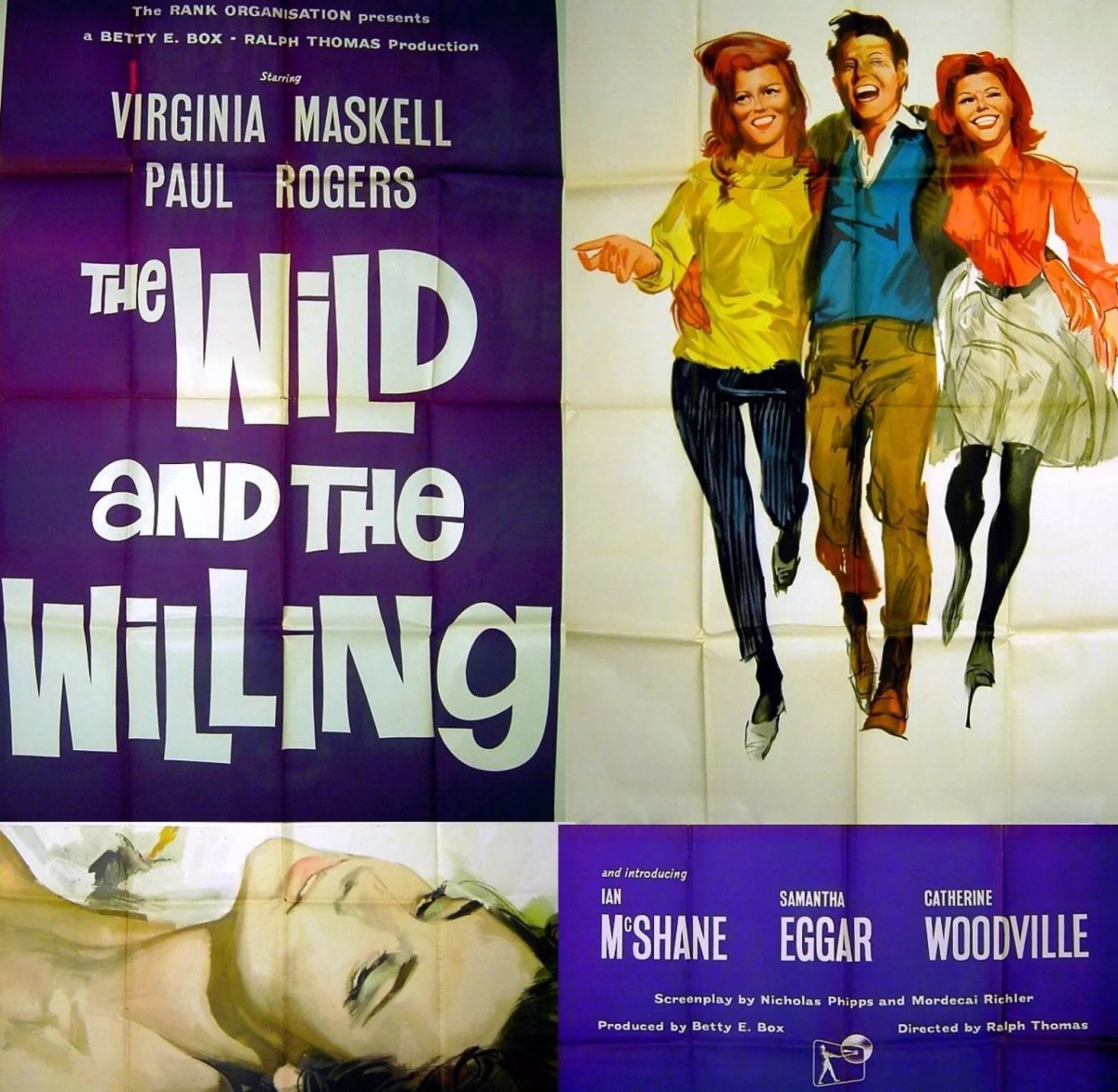
Columbia sold this as if Nancy Kwan was a Bond girl with massive images of the star in a bikini (see above) – the advert in the trade magazine comprised a drop-down A2 pull-out i.e. three times the size of a normal page. But anyone expecting a salacious time would have been in for surprise. For although Kwan swam underwater during the credits (not Helen Mirren style as in The Age of Consent, 1969) and did reveal a naked posterior, you could not have imagined a more innocent, joyous, movie.

Tahitian teenager Tamahine (Nancy Kwan) wreaks havoc on the British stiff upper lip when after the death of her father she is sent to the all-male English public school run by his cousin Poole (Dennis Price), a widower. But it’s not a sex comedy with all the misunderstandings and double entendres that genre normally entails. Instead, it’s a clash of cultures, free love and expression versus prudery and repression. Poole has trouble enough on the female front, his daughter Diana (Justine Lord) inclined to enjoy a gin-soaked afternoon and in the middle of an affair with art master Clove (Derek Nimmo).

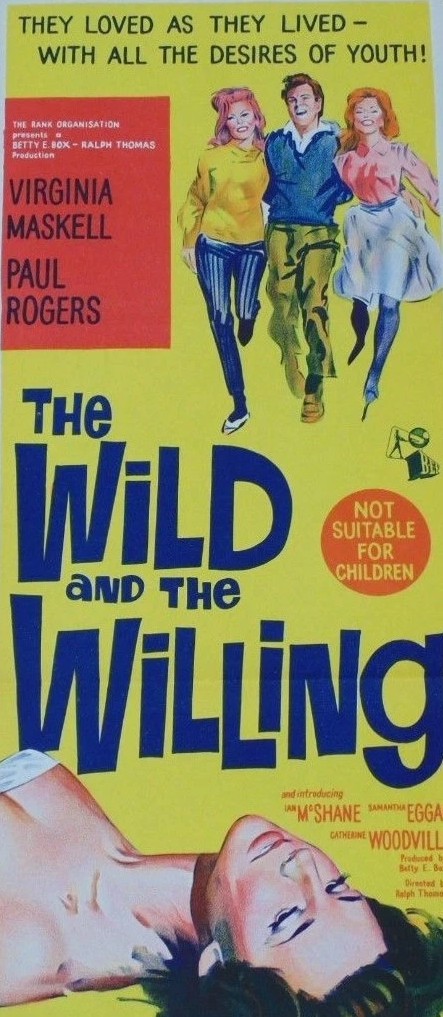
The advertising department, however, could not resist the temptation
to stick a double entendre in the poster.

Without mischievous intent, Tamahine causes chaos, assuming an artist’s model would be naked she scandalizes the petrified Clove and egged on by a gaggle of schoolboys whose hormones are off the scale she jams a chamber pot on the school weather vane. The plot, if there is one, is mostly Tamahine fending off suitors, Clove and Poole’s son Richard (John Fraser), and attempting to persuade Poole to take a paternal interest in her well-being.

But mostly it’s about how a sweet-hearted woman struggles to survive in a world where attitudes to sex remain Victorian and in which the avowed aim of education is to build character through manly pursuits such as beating the living daylights out of each other rather than teaching them to express emotion. And certainly the movie takes a more benevolent view of public schools than the later, brutal, If…(1968).

While endorsing free love, Tamahine draws the line at crossing the line in the matter of Richard, whom she deems a relation, no matter how distant. Challenging all conventions, she takes part in sports day.

But the comedy is so gentle and Tamahine so charming that this is best described as a delight. I found myself chuckling throughout and I felt I had just watched a genuine feel-good movie. On paper it certainly doesn’t sound so potentially good, especially when you consider the clichéd portrayals you might expect from the supporting cast, but in reality it exerts an extraordinary appeal.

Hardly off-screen, Kwan (The World of Suzie Wong, 1960), in only her fourth film, easily carries the movie as if she scarcely felt the weight of stardom on her shoulders and is a revelation as the imparter of tender wisdom. What aids the film enormously is that Dennis Price and Derek Nimmo play more interesting parts than their movie personas suggest. Price (Tunes of Glory, 1960), in a far cry from his Ealing comedy heyday, dispenses with his wry delivery and cynical demeanor. Unusual for a character actor, his character actually has a story arc and turns what could have been a stereotypical role into a moving performance. Before his strangulated vowels got the better off him, Derek Nimmo (The Liquidator, 1965), too, delivers probably his best performance.

Justine Lord (Night after Night after Night, 1969) is good as the rebellious daughter but James Fox offers none of the intensity he brought to the screen a year later in The Servant (1964) and neither does John Fraser (El Cid, 1961) light up the screen. In small parts you can spot Michael Gough (Batman, 1985) and Coral Browne (The Killing of Sister George, 1968).

Full marks to director Philip Leacock (The War Lover, 1962), himself a former public school boy, for not taking the easy way out with loutish comedy but instead crafting a film full of sensitivity and sensibility. Denis Cannan (Why Bother to Knock, 1961) based his screenplay on the Thelma Nicklaus novel.

You might be surprised at the four-star rating and I do confess it is a shade optimistic but it is worth more than three stars. It’s worth taking a moment to examine the whole issue of ratings. You might be asking how can Tamahine be given four stars, the same as The Battle of the Villa Florita and a tad below the very few I deem five-star pictures. The answer is I compare like with like. If the best films in your opinion must concern social comment or excel technically, then there will be little place in your world for a sheer confection like Tamahine. But if you watch a wide variety of films and recognize those that contain a high enjoyment factor then you will want to draw attention to such. Hence, the rating.

It’s true that sometimes we do want movies to tackle difficult issues or take us into other worlds, but other times there is nothing to beat an old-fashioned good-hearted picture like this.

The Comic (1969) ***

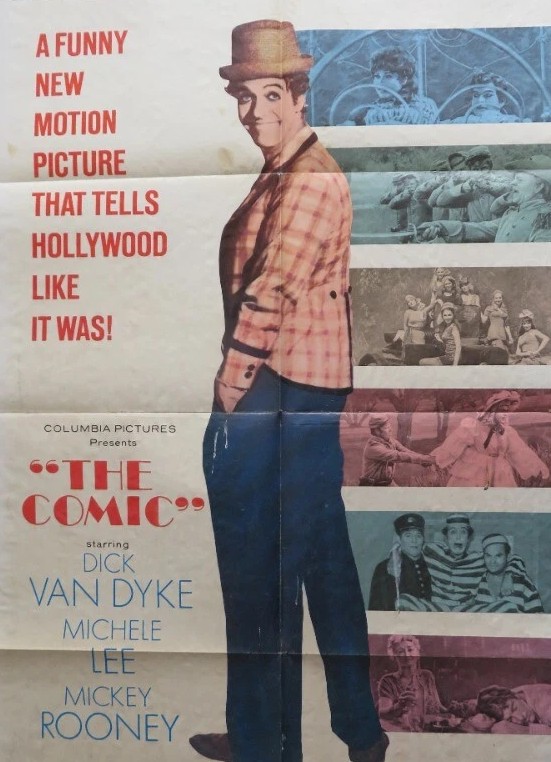
It’s a Hollywood trope that successful screen comedians invariably want to test their mettle in more dramatic circumstances. Studios tend to cave in to such self-indulgence, usually with the proviso that the star makes another couple of laff fests with them, but audiences tend to give such enterprises the thumbs down. Dick Van Dyke (Divorce American Style, 1967), on a commercial roll for most of the decade, took the, theoretically at least, easier option of limiting the drama on this one.

Silent films were also on a commercial roll, the oldies having made a comeback via compilation reissues and through slapstick homages such as It’s A Mad, Mad, Mad, Mad World (1963) and The Great Race (1965) so setting the picture in that era in Hollywood’s history seemed a sure thing.

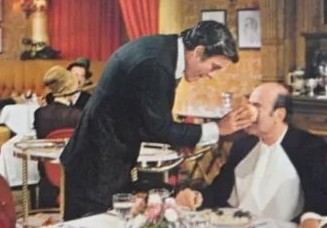
And it starts off bang on the money. A eulogy delivered at a funeral is interrupted by a pie in the face and (as seen above) that device can be utilized at any point.

I’d be telling you to give this complete misfire a miss if it wasn’t for an exceptional final third. The first two-thirds is made up of far too many silent film sequences starring Billy Bright (Dick Van Bright) who goes from vaudeville clown to major star complete with, at the height of his fame, being accorded the honor of a having a clockwork toy made of him.

When it’s not diverted into yet another silent movie sequence, which only serves to show that a modern comedian lacks whatever smarts the silent movie comedians had, the drama takes roughly the same approach, with scenes that could have come from a silent movie if not quite to the utmost.

Thanks to a multitude of affairs Billy burns his way through marriage to Mary (Michele Lee) and thanks to an overfondness for the bottle nearly kills off his career before the arrival of the talkies does that for him.

Eventually, and suddenly, we switch to an entirely different picture, a proper drama, very bold indeed for the time for its portrayal of old age and loneliness – a representation that would chime very much with today’s audiences. You don’t quite warm to this old fella because he wasn’t particularly sympathetic to begin with, but still, in its rawness, this section exerts a very emotional pull.

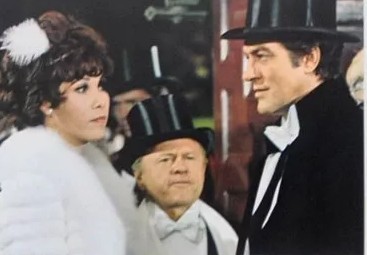
And, indeed, for Dick Van Dyke it was an incredible piece of acting. He morphs from young, tall, and fit with a head full of hair to an old bloke, bent over, shuffling and with the kind of  comb-over that would put Bobby Charlton to shame. He’s been abandoned by everyone except sidekick Martin (Mickey Rooney) whose career has also gone south. They tell lies to each other to keep up their spirits.

The highlight of Billy’s life is getting a set of false teeth and setting the alarm for 4.30am so he can get up and watch reruns of his old movies on television. He lives on boiled eggs and milk.

And he’s still dumb enough to be rooked by a gold-digger. He’s placed an ad in Variety, drawing attention to the fact that he’s still alive, which wins him a spot on a TV chat show which turns into a gig for a commercial which leads a much younger woman to think he must be loaded. He ends up marrying her while in an oxygen tent, but she vanishes when she discovers his newfound fame has led to nothing.

In theory, this is about the side effects of fame, the temptations which few can avoid, and the sudden collapse in income and public awareness when the well runs dry. But, in reality, setting aside the Hollywood overtones, the last third could have been about any lonely old man.  

A film of three thirds for the star, in the first two there’s nothing much to hold onto, in the last one he excels. Nobody else has much to do. Directed by Carl Reiner (The Jerk, 1979) and written by him and Aaron Ruben. Reiner had been the writer of The Dick Van Dyke Show so presumably that played a part in him getting the gig.

Died an absolute death at the box office. Not released outside America for decades and then only on DVD.

If it hadn’t been for the final third this would have been rated a one-star effort, it’s such an ill-conceived concept, and disastrous in its execution, but that final third makes it very worthwhile indeed if you can stick with it.

The Slender Thread (1965) ****

Hollywood paranoia in the 1970s ensured that any type of electronic surveillance was treated with suspicion. Cops, too, were almost certain to be corrupt. Although he would subscribe to such paranoia and implicit corruption in Three Days of the Condor (1973), in his movie debut director Sydney Pollack turns these concepts on their head.

Crisis center volunteer Alan (Sidney Poitier) faces a battle against time to save potential suicide Inga (Anne Bancroft), using his own powers of empathy and persuasion, but helped more than a little by dedicated policemen and the system of tracking calls. On the one hand the ticking clock ensures tension remains high, on the other Alan own’s battle with his nascent abilities brings a high level of anxiety to the proceedings especially as we learn of the particular circumstances driving Inge.

Alan is studying to be a doctor and he carries within him the arrogance of his profession, namely the power to cure. But that is within the realms of the physical. When it comes to dealing with the mental side of a patient he discovers he is ill-equipped. The intimacy he strikes up with Inga ensures he cannot seek relieve by handing over the problem to anyone else, the fear being that the minute he introduces another voice the spell will be broken. His medical training means only that he knows far better than a layman the effect of the pills the woman has taken and can accurately surmise how long she has to live. In the process he experiences a wide range of emotions from caring and sympathetic to angry and frustrated.

By sheer accident Inga’s otherwise loving husband, Mark (Steven Hill), skipper of a fishing vessel, has discovered that their son is not his. On being rejected, she has nothing to live for.

The simple plotline is incredibly effective. The two main characters never meet but we discover something of Inga’s life through flashbacks as her life gradually unravels and elements of insanity creep in. Alan, meanwhile, is shut in a room, relying on feedback from colleagues such as psychiatrist Dr Coburn (Telly Savalas) and others monitoring the police investigation attempting to discover where she is. 

The fact that there actually was a suicide crisis center operating in Seattle (where the film is set) will have come as news to the bulk of the audience for whom suicide was a taboo subject and virtually never discussed in public or in the media. The fact that the telephone network could be used so effectively to trace calls would not have been such a surprise since it was an ingredient of previous cop movies, but it had never been so realistically portrayed as here, results never instant but the  consequence  of dogged work.

Initially, the movie treats Seattle as an interesting location with aerial shots over the credits and other scenes on the shore or seafront, but gradually the picture withdraws into itself, the city masked in darkness and the principals locked in their respective rooms.

Sidney Poitier is superb, having to contain his emotions as he tries to deal with a confused woman, at various times thinking he is over the worst only to discover that he is making little headway and if the movie had gone on for another fifteen minutes might have reflected how impotent he had actually been. Anne Bancroft (The Pumpkin Eater, 1964) matches him in excellence, in a role that charts her disintegration.

The fact that their character never met and that their conversations were conducted entirely by telephone says a lot about their skills as actors in conveying emotion without being in the same room as the person with whom they are trying to communicate. Telly Savalas (The Dirty Dozen, 1967) delivers a quieter performance than you might expect were you accustomed to his screen tics and flourishes. Ed Asner (The Venetian Affair, 1966) and Steven Hill, in his last film for 15 years, are effective.

The bold decision to film in black-and-white pays off, ensuring there is no color to divert the eye, and that dialog, rather than costumes or scenery, dominates. Pollack allows two consummate actors to do their stuff while toning down all other performances, so that background does not detract from foreground.

Winning the Oscar for Lilies of the Field (1963) had not turned Sidney Poitier into a leading man and in fact he took second billing, each time to Richard Widmark, in his next two pictures.  Anne Bancroft was in similar situation after being named Best Actress for The Miracle Worker (1962) and although she took top billing in The Pumpkin Eater (1964) it was her first film after her triumph and, besides, had been made in Britain. And for both 1967 would be when they were both elevated to proper box office stardom. Written by Stirling Silliphant (In the Heat of the Night, 1967) based on a newspaper article by Shana Alexander.

Given the greater awareness of suicide today, this will strike a contemporary chord.

As the High Noon of the psychological thriller this more than delivers. Gripping stuff. And it’s worth considering the courage required to undertake such subject matter for your first movie.

o

Staircase (1969) ***

A huge flop at the time given both Richard Burton and Rex Harrison trousered $1 million. Now, primarily of historical interest, hailing from a time when homosexuals could be jailed. A man dressing up in woman’s clothing, as here, could be summoned in front of the magistrates. It’s the kind of movie that would work better if, as with the American idiom, the dialog of two people of any sex engaged in a long-term relationship was spattered with brilliant one-liners rather than a series of sarcastic putdowns.

Even so, there’s more here than originally met the eye. The fact that the hairdressers Charlie (Rex Harrison) and Harry (Richard Burton) have remained, like a married couple, together for twenty years says a lot about their enduring, if fractious, relationship. While Charlie has a daughter he never sees – and never wants to – Harry pines after a child. And there is some gentle complaint about why, in the eyes of the law, Harry would neither be permitted to adopt a child not to love a man, but those aspects are never in your face except that Charlie is awaiting his summons for the crime outlined above.

There’s not as much mincing and preening as you’d expect. Charlie is the better looking and has retained his good looks with the help of considerable pampering but Harry has lost his hair thanks to alopecia and rather than wearing a wig opts for a bandage.

It’s one of those movies where nothing happens based on a play (by Charles Dyer) where nothing happens, what little tension there is reliant on waiting (for the summons and the threat of an appearance by Charlie’s daughter). But while the stage can get away with two actors at the top of their game (Paul Scofield and Patrick Magee in London’s West End, Eli Wallach and Milo O’Shea on Broadway), that’s a far harder trick to pull off on screen.

So it’s to the credit of both actors than they make it work and we empathize with their immediate and ongoing circumstances. While Charlie sees his role as being the scathing dismissive one, leaving Harry to be supportive and apparently still in love, nonetheless his true feelings come out when he thinks his partner has had a heart attack.

In male-female terms, this would come across as just another middle-aged couple stuck in a humdrum marriage, and indeed there’s nothing elevated about the relationship between Charlie and Harry who live a very working class life in London’s East End, the former’s ambitions to become an actor long since dashed.

There’s not much director Stanley Donen (Surprise Package, 1960) can do to open up the play beyond sticking a few of the scenes outdoors and there’s one sequence that would raise eyebrows these days when Charlie ogles half-naked male teenagers playing in the sun. The worst reason for adapting a play for Hollywood is that, unless farce raises its head or there’s a string of one-liners or hilarious circumstance, the verbosity plays against the possibility of there being outstanding cinematic sequences. Luckily, it ends with one, when Harry takes a frightened Charlie by the arm.

I’m not sure I’d actually recommend it because there’s not much going on and the performances are not in the Oscar league, but it is much better than I thought. Rex Harrison (The Honey Pot, 1967) has the showier role, Richard Burton (Anne of the Thousand Days, 1969) reining himself in.

Commercially, nobody came out of this well. Rex Harrison didn’t make another film for eight years, Burton finding it more difficult to extract a million bucks from producers, and Stanley Donen continuing his run of poor box office. And harder for any British audience to take this seriously once comic pair Morecambe and Wise started sharing a bed in their sketches.

Sanctuary (1960) ***

This overheated melodrama stands as a classic example of Hollywood’s offensive attitudes to women. Nobel prize-winning author William Faulkner could hardly blame the movies for sensationalizing his misogynistic source material since if anything the movie took a softer line.  Told primarily in flashback as headstrong southern belle Temple Drake (Lee Remick) attempts to mitigate the death sentence passed on her maid Nancy (Odetta). Given that such appeals are directed at Drake’s Governor father (Howard St John), and that the maid has been condemned for murdering Drake’s infant child, that’s a whole lot of story to swallow.

Worse is to follow. Drake takes up with Prohibition bootlegger Candy Man (Yves Montand) after being raped by him and thereafter appears happy to live with him in a New Orleans brothel – the “sanctuary,” no irony intended, of the title – despite him slapping her around. The film steers clear of turning her into the prostitute of the original book, but pretty much sets up the notion that high class women will fall for a low-class tough guy whose virility is demonstrated by his brutality. In other words a “real man” rather than the dilettantes she has previously rejected.

After the Candy Man dies, Drake returns home and marries wealthy suitor Gowan Stevens (Bradford Dillman) who blames himself, rightly, for Drake falling into the clutches of the gangster in the first place. But a past threatening to engulf her precipitates the infanticide.

Faulkner was a Hollywood insider, adapting Sanctuary for The Story of Temple Drake (1933) and earning high praise for  his work on Bogart vehicles To Have and Have Not (1944) and The Big Sleep (1946). The success of The Tarnished Angels (1957) starring Rock Hudson, The Long, Hot Summer (1958) with Paul Newman and The Sound and the Fury (1959) headlined by Yul Brynner had sent his cachet rocketing. But all three were directed by Americans – Douglas Sirk and Martin Ritt – who had a distinctive visual style and an ear for what made melodrama work.

Sanctuary had been handed to British director Tony Richardson (Look Back in Anger, 1959) and he didn’t quite understand how to make the best of the difficult project. So while Lee Remick manages to suggest both strength and fragility, and makes her character’s wanton despair believable, Yves Montand is miscast and Bradford Dillman fails to convince even though portraying a weak character. Too many of the smaller roles appear as cliches. And it’s hard to believe the maid’s motivation in turning murderer.

What was acceptable steamy melodrama in the 1930s fails to click three decades on. Faulkner’s thesis that high-falutin’ women want a man to master them and furthermore will fall in love with their rapist seems to lack any understanding of the female mind and will not appeal to the modern sensibility than it did on release. Lee Remick is what holds the picture together, in part because she plays so well the role of a woman embracing degradation, and refusing – no matter how insane the idea appears – to let go of the man she believes is the love of her life. It’s not Fifty Shades of Grey, but it’s not that far off that kind of fantasy figure, and given the success of that book, it’s entirely possible there is a market for what Faulkner has to peddle.

A Child Is Waiting (1963) ****

While once the main interest in this piece would have come from fans of Judy Garland, lapping up her penultimate movie appearance, the prevalence of mental illness these days especially among the young, in part due to Covid and the scourge of social media, should switch audience attention – especially among contemporary viewers – back to the subject matter.

Garland’s stock had risen somewhat after her performance in Judgement at Nuremberg (1961), her first movie in seven years, but, given the travails of her private life, would most likely have been sympathetic to anything that cast a light on mental illness. The bulk of movies covering this ground tended towards the lurid, as exemplified by Shock Corridor (1963) and Shock Treatment, (1964) rather than the more tragic Lilith (1962). Whatever the approach, they focused on adult conditions. Here it’s the treatment of children.

Appreciation of the social conscience of star Burt Lancaster has largely gone unnoticed but this was the era when his movies touched upon crooked evangelism (Elmer Gantry, 1960), teenage gangs (The Young Savages, 1961), the Holocaust (Judgement at Nuremberg, 1961) and the effects of long-term imprisonment (The Birdman of Alcatraz, 1962). He was even an animal rights protester in The List of Adrian Messenger (1963).

Parental attitude to offspring with mental conditions is encapsulated in the opening sequence. Outside a hospital a young boy is tempted out of an automobile. Once out, the driver (the father) races off so fast the car door is still swinging open. Mentally or emotionally disturbed children were dumped, ostracized or abandoned by society, sometimes shut up in institutions along with adults, with treatment belonging to the Dark Ages.

Drawing on the ground-breaking approach of Vineland Training School in New Jersey and the Pacific Hospital in Pomona, California (pupils from the latter played the students in the film), the movie attempts to cast a light on the forgotten and to show that, with proper care and education, they need not be such victims of their circumstances.

The movie focuses on Dr Clark (Burt Lancaster), head of the Crawthorne State Training School, whose pioneering work combines tender encouragement with firm application, and the new music teacher Jean (Judy Garland) who challenges his approach. Instigating this crisis is 12-year-old Reuben, the child we see offloaded at the start, for whom Jean develops an unhealthy bond. She thinks Dr Clark is too strict and that his methods don’t work with someone as vulnerable as Reuben. Clark’s aim is to make the children so self-sufficient they are not condemned to a life in an adult institution.

Jean’s intervention creates a crisis in the child’s life but also brings home the unwelcome truth of the difficulties parents have of dealing with their children.

And while the tale is essentially confected to make the necessary points and Dr Clark and Jean epitomize opposite attitudes to handling the treatment of children, the story is really a documentary in disguise, bringing to light advances in care, and with the children not played by actors, brings a greater reality to the work.

Burt Lancaster, as ever, is good value and Judy Garland steps up to the plate. Gena Rowlands (Machine Gun McCain, 1969) and John Marley (Istanbul Express, 1968) also feature.

While this fits neatly into Lancaster’s portfolio, it stands out for the wrong reasons in the pantheon of critically-acclaimed actor-turned-director John Cassavetes (Faces, 1968). In fact, what he produced went against what producer Stanley Kramer (better known as a director – Judgment at Nuremberg, for example) wanted and the version we see is the one Kramer recut. Written by Abby Mann (Judgment at Nuremberg) from his original teleplay.

You might expect this to be awash with sentimentality but that’s far from the case.

Girl on a Chain Gang (1966) **

Trash and intentionally so, but with some unexpected merit. In the first place it was the forerunner of films set in the Deep South such as In the Heat of the Night (1967) and Mississippi Burning (1988) and where the former deals primarily in racism the latter adds Civil Rights to the equation. More pertinently, and to save us according this more acclaim than it deserves, it was the beginning of the Women in Prison genre. Writers, generally, date Jess Franco’s 99 Women (1969) as the beginning of that genre, but that’s mostly because it clicked at the box office, thanks to liberated censorship permitting more exploitation license.

To put it crudely, this is straight exploitation but given more credence because it’s not as vivid sexually in its exploitation. There’s rape and by later standards that’s discreetly done but there’s a complete absence of nudity.

Jean (Julie Ange), Ted (Ron Segal) and African American Claude (James Harvey) are stopped for speeding in Carson Landing, and subsequently arrested. Sheriff Wymer (William Watson) beats up the men in turn, fines them $150, which, luckily they can pay. They are let go but shortly afterwards arrested again on the trumped up charge of prostitution (her) and violation  of the Mann Act (the men) for transporting a sex worker across state lines.

Claude turns down the chance of freedom that would be granted should he agree to sign a confession put to him in seductive fashion by the Sheriff’s squeeze Nellie (Arlene Faber). The cops lure the guys into attempted escape by leaving a door open, which, as you might expect, results in their demise. Jean, who has the sense to not take the bait, is raped.

Jean is convicted nonetheless of prostitution and at her trial vents her feelings. “You’re nothing but a bunch of pigs and murderers…It takes a whole town plus a phony judge and jury to convict me,” she spouts.

There’s not much time for her to spend on the eponymous chain gang because she seems to spend most of her time chained up. But because she lacks a “way of showing her appreciation” and thus being rewarded with a softer job of cleaning or cooking, she’s eventually added to the chain gang. Luckily, on her first day out, another prisoner Henry (Tom Baker) helps her escape and they head for the swamps. He sacrifices himself to save her but not before showering the Sheriff with snakes. When Jean is found, she becomes a witness against the corrupt cops.

I doubt if writer-director Jess Gross (Teenage Mother, 1967) had anything more on his mind than making a quick buck in the grindhouse/drive-in exploitation market, and that anything prophetic was purely happenstance. Most movies around this time in that genre sold more on promise than what they could deliver, and he had made his marketing bones through the U.S. distribution of the first two Mondo Cane (1962/1963) films as a double bill. He only directed three pictures and was better known as a producer including the lurid Whirlpool (1969) and the more legitimate Blaxploitation Sweet Sweetback’s Baaadass Song (1971).

In part because of censorship prohibition, this carries some weight because more is imagined than shown, sexuality repressed rather than expressed, but that was not the case with violence and while it’s not marked by the bloodletting that would later be de rigeur the cops hand out some stiff beatings, exemplifying not just their racist credentials but their antipathy to liberals from the big city.

This didn’t prove a breakout movie for the stars although William Watson had a reasonable career as a tough guy – Lawman (1971), Chato’s Land (1972). Julie Ange and Ron Segal only made one more film, Teenage Mother. James Harvey didn’t make another. Arlene Faber was the star of Gross’s other two movies, the last being Female Animal (1970), and she had a small part in The French Connection (1971).

Of minor historic interest.

Live Now, Pay Later (1962) ***

Easy credit led to a boom in the standard of living but also created global recession after the sub-prime mortgage scandal. Back in the day you couldn’t borrow money except from a bank and they only lent to people with money. To get a mortgage you needed to prove you could save, you required at least a 10 per cent deposit before any bank would loan you money for a mortgage, and you needed to go through a stiff criteria test. Even then, you were at the mercy of inflation. If you were absolutely desperately you could go to money-lenders and pay back inflated sums, the notorious “vig” of the Mafia.

But then someone invented the notion of buying on credit from largely unlicensed brokers. You could live the dream – television, white goods, carpets, furnishings, a car – even if you couldn’t afford it and you didn’t have to go through any kind of procedure to qualify. Of course, you ended up paying two or three times the original price but the payments were spread over years so, theoretically at least, affordable. These days, credit cards lure people into the ease of purchasing and giving no thought to repayment. You don’t have to repay at all – or only a very small fraction – if you don’t mind your debt accruing exponentially.

In Britain it was called “hire purchase” or more colloquially the “never-never.” Nobody was called to account for selling goods to people who were inherently unable to afford it, were clearly incapable of managing money or, just as likely, were apt to get carried away.

While on the one hand this is one of the saddest movies you’ll ever see, lives crushed by debt, the tone is so mixed the reality gets lost in the characterization of the kind of chancer who would later be epitomized by the likes of Alfie (1965). But whereas the Michael Caine character has oodles of charm and eventually comes good, here equally charming  ace salesman Albert (Ian Hendry) never sees the error of his ways.

One of the dichotomies of the tale is that despite his earnings and his financial wheezes on the side Albert never has enough money to fund his lifestyle – snazzy sports car, great clothes – and lives in a squalid flat while ostensibly living the dream, string of women on the side. Like Werner Von Braun (I Aim at the Stars, 1960), he can’t face up to consequence much less take responsibility for his actions. But he’s not the only one using easy credit as a means of moving up in society, his boss Callendar (John Gregson) has taken up golf with a view to rubbing shoulders with estate agent Corby (Geoffrey Keen), whom he views as rising middle class without being aware that Corby also has unsustainable delusions of grandeur, hosting dinner parties for local politicians, ensuring his house is filled with desirable items.

Without doubt Albert is a superb salesman, adept at not only overcoming initial customer reluctance but persuading them to invest in far more than they ever dreamed. He is so good that his boss is more than willing to overlook his various pieces of chicanery.

But too often the comedy gets in the way. The idea that Albert can weasel his way out of any difficult situation – twice he dupes the man coming to repossess a car on which he has evaded payments for years – take advantage in unscrupulous fashion of any opportunity (he takes over an empty flat, steals the orders of rivals) and even offers advice on how to outwit, legally, bailiffs, sets him up as the kind of character (the little guy) who can defeat authority. But cheap laughs come at the expense of more serious purpose.

He leaves a trail of destroyed lives in his wake. He abandons his illegitimate daughter, fruit of a supposed long-term fling with Treasure (June Ritchie). One of his many married lovers, Joyce (Liz Fraser), wife of Corby, commits suicide – and he then proceeds to blackmail the husband. Albert’s boss is on the verge of losing out to a bigger rival.

For women, he is at his most dangerous when being kicked out, at his most persuasive and charming when trying to weasel his way in. He always finds some new woman and generally has a few on the go at the one time. The only time he appears to have any standards is when he walks away from one lover on discovering that her husband is a scoutmaster and therefore the seduction has required little skill.

But all Albert’s charm can’t disguise the brutality of debt. The arrival of the bailiffs strikes terror in hearts. A dream can turn to dust in an instant. Consequent shame unbearable. And there are no shortage of characters pointing out to Albert how heinous his actions are.

Ian Hendry (The Hill, 1965) captures the smooth-talking salesman. June Ritchie (The World Ten Times Over, 1963) has a meaty role as does Liz Fraser (The Family Way, 1966). John Gregson (The Frightened City, 1961) is unrecognizable while Geoffrey Keen (Born Free, 1966) essays the kind of grasping businessman that would become his forte. Nyree Dawn Porter (The Forsyte Saga, 1967) has a small part.

Directed somewhat unevenly by Jay Lewis (A Home of Your Own, 1964) from a script by Jack Trevor Story based on the bestseller by Jack Lindsay.

Prophetic.

Tornado (2025) **** – Seen at the Cinema

Cult’s a strange creature. Try to cultivate it from the outset and chances are you’ll strike out – the days of Quentin Tarantino hitting a bulls-eye are long gone. So, basically, what you’re left with these days is a picture that flopped on initial release but gradually developed exceptional word-of-mouth and maybe found a welcome home in streaming or on the retrospective circuit if that still exists. But that process takes several years, and the best hope these days is that it gives the director or star a lift. In this case, the door’s been left open for a sequel.

And on paper this sounds an awful conceit. Samurai swordsmen on the loose in antique Scotland? We’re talking 1790, for goodness sake. Were they shipwrecked, enslaved? We never find out. Back story here is in short supply and that’s all to the good because tension never dissipates.

There are only a couple of tropes – a pair of mewling nepo babies suffused with entitlement is as far as that goes.

The rest is original, intriguing and directed with authority. You’ve got gangsters, puppeteers, a circus troupe, and skeletons playing the violin. Twists are in short supply – the expectation that a knife thrower might turn into a male lead is dashed, and dust settling on the top of a piano which should give away the presence of a fugitive is ignored.

The tale is one of greed. And of the greedy feeding upon the greedy. By chance, travelling samurai puppeteer Tornado (Koki) spots the theft of a thieves’ haul of gold by a young pickpocket (Nathan Malone). She helps the boy secrete the two bags of gold in the caravan of her father Fujin (Takehiro Hira). But then she tosses him out of the moving caravan with only one gold piece for his trouble.

When the thugs led by Sugarman (Tim Roth) catch up, her father, unaware of his daughter’s complicity in the theft, is killed protecting her. So the girl and the boy go on the run. There’s none of the usual bonding of thieves.

Sugarman’s son Little Sugar (Jack Lowden) knows the girl has stolen the gold and in rebellion against his father determines to have it all to himself and not above killing off a colleague who gets in his way. Sugarman is a ruthless thug, setting fire to the encampment of the circus troupe for hiding the girl, and not above knifing his son to death.

Tornado doesn’t show the slightest sign of remorse at being the reason for her father and the boy and a strongman who protected her being killed nor for being the cause of the circus troupe being rendered homeless. She’s as amoral as the rest of them. But in the end she does put them all to the sword.

So, theoretically – and this is how it’s being marketed – it’s a revenge thriller or a samurai western (which has already been done with Red Sun, 1971) and both attempts at categorization are way off the mark. It has much more in common with Tarantino, of infighting among gangsters, but it’s so splendidly done, with terrific composition and use of the widescreen that it touches the cult mother lode, in that it is indescribable, creating a world of its own, set in a lawless world where the strong dominate and the weak run for cover. And it’s also a world where you better not get wounded, because that will be cue for someone else to take advantage.

Tornado transitions from rebellious daughter – “who put you in charge” she complains to her father – moaning about being bored and can’t take the job of being a puppeteer seriously, and she’s not that good either at paying attention when her old man tries to teach her more swordfighting. And, of course, she’s to blame for the death of her father. Her instinct is to run and hide and wait till the brouhaha dies down. And it’s only when she realizes that she can’t effectively carry two heavy sacks of gold that she decides to cut and run – with the emphasis on the cutting, slicing and dicing the gang till there’s only Sugarman left and he’s, ironically, dying anyway from a wound inflicted by her father.

So not your ideal heroine. In the old days she’d have been an innocent, guiltless, only taking up the sword or gun after her father was killed by ruthless villains. It’s all the more interesting for not going down that route.

The choices director John MacLean (Slow West, 2015) doesn’t make define the picture. There’s no love interest, Little Sugar and Tornado could as easily have conspired to make off with the dough, or some narrative device could have thrown them together. But both want all the gold for themselves. The knife expert you think is being introduced to come to her rescue. But no go there either.

Tim Roth (Rob Roy, 1995) is superb as the cold-eyed gang boss and Jack Lowden (Slow Horses, 2022-2024) as his shifty son and MTA Koki makes a startling debut.

It’ll be gone from cinemas by the time you read this review but look out for it on a streaming platform and I hope it will prick your interest as much as mine.

Anne of the Thousand Days (1969) ****

You can keep your Succession dramas with families squabbling over a mere business empire. And even the more woke Snow White (2025) doesn’t remotely tackle the realities of marriage in medieval times when the role of a woman, in an era when more children died in childbirth or soon after than actually survived, was to produce an heir. And not just random in gender. But male.

So, on the one hand, you can sympathize with the dilemma of English King Henry VIII whose Spanish wife Katherine, while eminently fertile – several babies died in childbirth – had managed only one male offspring, who died shortly after birth, and one female, Mary. All the queen had given him, rails Henry (Richard Burton), are “dead sons.” So with the future of one of the biggest kingdoms in the world at stake, Henry isn’t keen to leave it in the hands of a woman. Even if he can arrange a suitable marriage, it would inevitably mean letting the kingdom fall into the hands of someone he doesn’t trust.

But in the twisted world of inheritance, here’s the rub. Henry shouldn’t be king. His elder brother Arthur should have, except he died before he could succeed to the throne. And Katherine, married to Arthur, should have been Queen.  But Spain at that point was as powerful, if not more so, than England, so Henry decided to marry his sister-in-law, on the basis that the marriage was never consummated, and the Pope, the authority in such matters, gave the go-ahead, glossing over the technicality of what was considered in those days incest.

So, Henry comes up with a cunning plan. He will go trophy-hunting and marry a younger wife. This isn’t just because he’s fallen in love with Anne Boleyn (Genevieve Bujold). He doesn’t have to marry her to have sex with her. He’s already having sex with her mother (Valerie Gearon) with the tacit approval of her father (Michael Hordern) who receives benefits in kind.

To add complication, Anne is promised in marriage already, and deeply in love. Siring a bastard son would inevitably cause an inheritance battle. So legitimizing the relationship seems the only way forward. This time the Pope isn’t keen, mostly because the Spanish have invaded the Vatican and if he wants to survive he can hardly annoy his captors.

But when the Pope refuses, Henry takes the nuclear option, and splits from the Catholic Church, not just taking advantage of the old church vs state argument, but also made aware by Thomas Cromwell of the sudden increase in wealth acquiring the items of the Catholic Church would bring.

Sorry to bore you with a history lesson but this intriguing backdrop – as well as the dazzling performances – is what twists this away from lush costume confection into riveting drama. This was the peak of a trend in historical movies that shifted the emphasis from heroic action to the down’n’dirty. Camelot (1967) to some extent had begun the trend but only dealt with infidelity and was given something of a free pass because it focused on the iconic Knights of the Round Table and a legendary love affair. The Lion in Winter (1968) primarily concentrated on  inheritance.

Depending where your sympathies lay this was either corruption writ large or a battle to free the ordinary man from the yoke of religion.

Primarily, it works because it revolves around the human drive, the king refusing to bow the knee to anyone, Anne Boleyn seduced not just by gifts but by this older man who is much more virile and passionate than her younger somewhat effete fiancé (and who couldn’t be dazzled by a man risking his kingdom for her love?) – and the courtiers looking after number one, always seeking a way of winning the king’s favor, and as importantly, not losing it, for that could lead to banishment or execution.

No one dares stand in Henry’s way – except Sir Thomas More (William Squire) and here he’s merely a small subplot (not center stage as in A Man for All Seasons, 1966) – not even the religious hierarchy, especially Cardinal Wolseley (Anthony Quayle), head of the Catholic Church in England, who keeps a mistress.

The tragedy is that the cunning plan unravels. While Anne is fertile enough, she gives birth to a girl, Elizabeth (the later Virgin Queen). Convinced she’s not going to present him with the male heir he so desperately desires, he hatches a conspiracy that sees her executed for adultery and treachery, leaving him free to marry again and continue his mad obsession.

So we’ve got all the back-biting and bitching we expect from court, plus regal revelry, costumes, castles, and in the middle of it all a driven king and a feisty woman, not by any means a pushover, and not either going unwillingly into his bed. This would be a match made in heaven except that’s probably the last place, the way things stand, the king would be welcome. He’s very aware of excommunication and it shows the power of the Catholic Church that its teachings are so embedded in his brain that he fears that consequence.

This is rich in performance – Richard Burton (The Spy Who Came in from the Cold, 1965), Canadian Genevieve Bujold (The Thief of Paris, 1967) and Anthony Quayle (East of Sudan, 1964) were Oscar-nominated. The only significant figure in the production not to receive one of the movie’s ten nominations – including for Best Picture – was director Charles Jarrott who pulled the whole thing together. Maybe it was thought he was rusty, not having helmed a picture since Time to Remember seven years previously.

The acting is particularly well-judged by the two principals, Burton could easily have lurched into cliché, and Bujold into passivity. Others worth noting are Irene Papas (The Guns of Navarone, 1961), Michael Hordern (Khartoum, 1966), Valerie Gearon (Invasion, 1966)  and Peter Jeffrey (The Fixer, 1968).

Based on the play by Maxwell Anderson (The Bad Seed, 1963), screenwriters John Hale in his movie debut and Bridget Boland (Gaslight, 1940) manage to balance what could be dry subject matter with fragility and tragedy.

There couldn’t be a better demonstration of women used as pawns and collateral damage in male power struggles.

Totally absorbing.

Discover WordPress

A daily selection of the best content published on WordPress, collected for you by humans who love to read.

The Atavist Magazine

by Brian Hannan

WordPress.com News

The latest news on WordPress.com and the WordPress community.