It Started in Naples (1960) ***

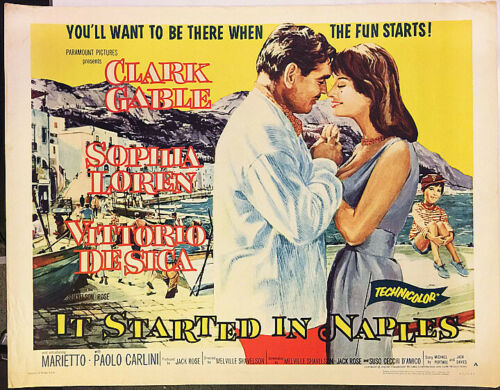
By this point in her career Sophia Loren was adopted by Hollywood primarily as a means of rejuvenating the romantic screen careers of much older male stars. John Wayne was over two decades her senior in Legend of the Lost (1957), Frank Sinatra and Gregory Peck nearly two decades older in The Pride and the Passion (1957, and Cary Grant a full three decades in Houseboat (1959). But where Grant was sprightly enough and with superb comic timing and Loren had the charm to make Houseboat work, the May-December notion lost much of its appeal when translated to her Italian homeland and an aging Clark Gable.

While engaging enough, the tale mostly relies on a stereotypical stuffy American’s encounters with a stereotypical down-to-earth Italian although Loren adds considerable zap with her singing-and-dancing numbers. Lawyer Michael Hamilton (Clark Gable), in Italy to settle his deceased brother’s affairs, discovers the dead man has left behind an eight-year-old boy Nando (Marietto) being looked after in haphazard fashion and impoverished circumstances in Capri by his aunt Lucia (Sophia Loren), a nightclub singer.  Determined to give the boy a proper American education, Hamilton engages in a tug-of-war with Lucia.

In truth, Lucia lacks maternal instincts, allowing the boy to stay up till one o’clock in the morning handing out nightclub flyers and not even knowing where the local school is. Hamilton is in turns appalled and attracted to Lucia, in some part pretending romantic interest to come to a out-of-court settlement. To complicate matters, Hamilton is due to get married back home.

At times it is more travelog than romantic comedy, with streets packed for fiestas and cafes full well into the night, a speedboat ride round the glorious bay, another expedition under the majestic caves, a cable car trip up the cliffs to view spectacular scenery, and the local population enjoying their version of la dolce vita. But the piece de resistance is Lucia’s performance in the nightclub, ravishing figure accompanied by more than passable voice as she knocks out “Tu vuo fa L’Americano” (which you might remember from the jazz club scene in The Talented Mr Ripley, 199). She has a zest that her suitor cannot match but which is of course immensely appealing.

Lucia is torn between giving the boy a better start in life, already insisting for example that he speak English, and holding on to him while street urchin Nando is intent on acting as matchmaker.  

Most of the humor is somewhat heavy-handed except for a few exceptional lines – complaining that he cannot sleep for the noise outside, Hamilton asks a waiter how do these people ever sleep only to receive the immortal reply: “together.”

Gable lacks the double-take that served Cary Grant so well and instead of looking perplexed and captivated mostly looks grumpy. But this is still Gable and the camera still loves him even if he has added a few pounds. He was a bigger global star than in the Hollywood Golden Era thanks in part to regular reissues of Gone with the Wind (1939) but mostly to a wider range of roles and he was earning far more than at MGM, in the John Wayne/William Holden league of remuneration. Loren was the leading Italian female star, well ahead in Hollywood eyes of competitors Claudia Cardinale and Gina Lollobrigida, and had the ability, despite whatever age difference was foisted upon her, to make believable any unlikely romance.

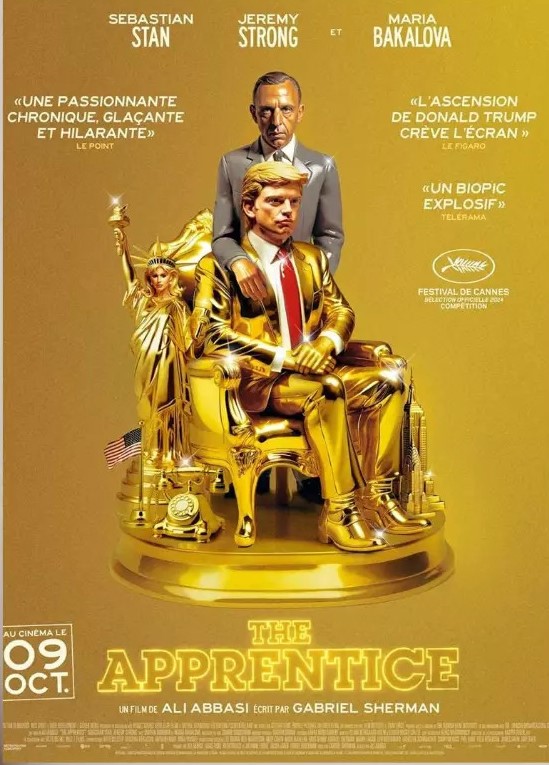
The Apprentice (2024) ***

Allow me a digression. Let me take you back to the 1950s-1960s and the construction of the Lincoln Center in New York. That was seen as a “good thing” because although it drove out an entire community, the end result was an arts center that helped redevelop a rundown area of Manhattan while at the same time driving up the price of what had now become prime real estate. Sure, thousands of poor people lost their homes, but what was that in relation to a haven for the arts? No counting how many made huge profits.

The Lincoln Center didn’t send a left-wing press howling for the blood of Robert Moses, the urban planner who reshaped pretty much the whole of New York for decades but ripped the heart out of a vibrant Puerto Rican community and a bustling jazz scene in the name of slum clearance. The 7,000 inhabitants and 800 business in San Juan Hill couldn’t afford the rent in the 4,000 apartments that replaced their homes and the promised urban relocation came to nothing. Nobody was knocking on the door of the Metropolitan Opera or the Philharmonic, among the Lincoln’s tenants, berating them for causing such catastrophic social damage. Middle-class values took precedence over working class need.

I’m familiar with Moses and the Lincoln Center story because I read Robert Caro’s scathing biography of him, The Power Broker. But the makers of The Apprentice appear to have no knowledge of how much political machination and corruption it took to get the Lincoln Center constructed and the damage it inflicted on thousands of lives.

So, the building of Trump’s first hotel, in an equally rundown area of New York, where, incidentally, no inhabitant was displaced, is apparently the opening gambit for a game of hypocrisy. I’ve no doubt Trump has a lot to answer for, but this picture doesn’t go anywhere near asking the right questions.

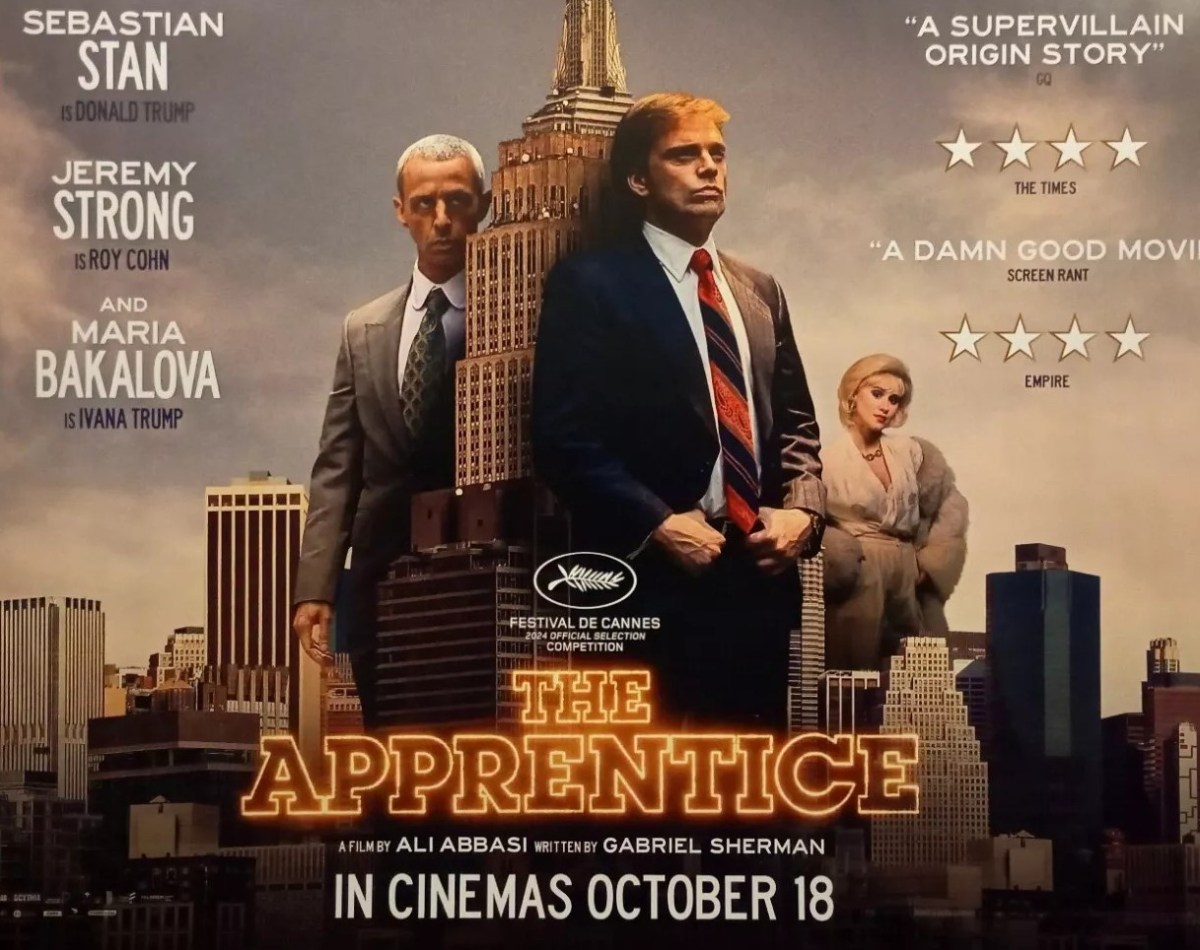
I’m not particularly convinced by Sebastian Stan’s (The 355, 2022) portrayal either. About the only thing he gets right is that moue he does with his upper lip. The thing that typifies Trump, the way it does hundreds of entrepreneurs, is energy. And that’s totalling lacking here, in a bid, I guess, to diss Trump. It feels like director Ali Abbassi (Holy Spider, 2022) has already made up his mind the character he wants to see portrayed.

But think of The Wolf of Wall Street (2013). To a man, these characters are heinous, but somehow Scorsese makes us want to watch them. Or Spielberg’s Catch Me If You Can (2002), a sleazy counterfeiter cast in a more interesting light by the playing of Leonardo DiCaprio.

I’m not saying Trump should be deified, far from it, but any business movie that’s attracted any decent box office has done so by investing a lot more in character and narrative structure. Wall Street (1987) comes to mind. This Trump doesn’t look as if he could win a prize at a state fair let alone have any chance of grabbing the golden ring.

All the best business films are able to show you the inner workings of business without boring you to death. This goes quite a way to boring you to death without going anywhere near the more interesting aspects of business.

There’s also an unusual narrative structure. Even if the portrayal of Roy Cohn (Jeremy Strong), Trump’s lawyer, rings true, it presents him as a more corrupt character than Trump. Sure, Trump uses him to get ahead, but that’s mainly because Cohn has so many corrupt politicians in his pocket.

I wasn’t convinced by Jeremy Strong (Succession) either. He came across as a Glasgow ned about to demonstrate the Glasgow kiss or one of those puppets with the wobbling heads you saw on British television series Thunderbirds.

For all the critics who felt this might just give Trump a bloody nose, my guess is he would revel in the portrayal, the buccaneering spirit, the win at all costs mentality.

Robert Caro would have got him spot on. Unfortunately, biography-wise, he’s too busy putting the final touches to his monumental biography of LBJ.

A missed opportunity.

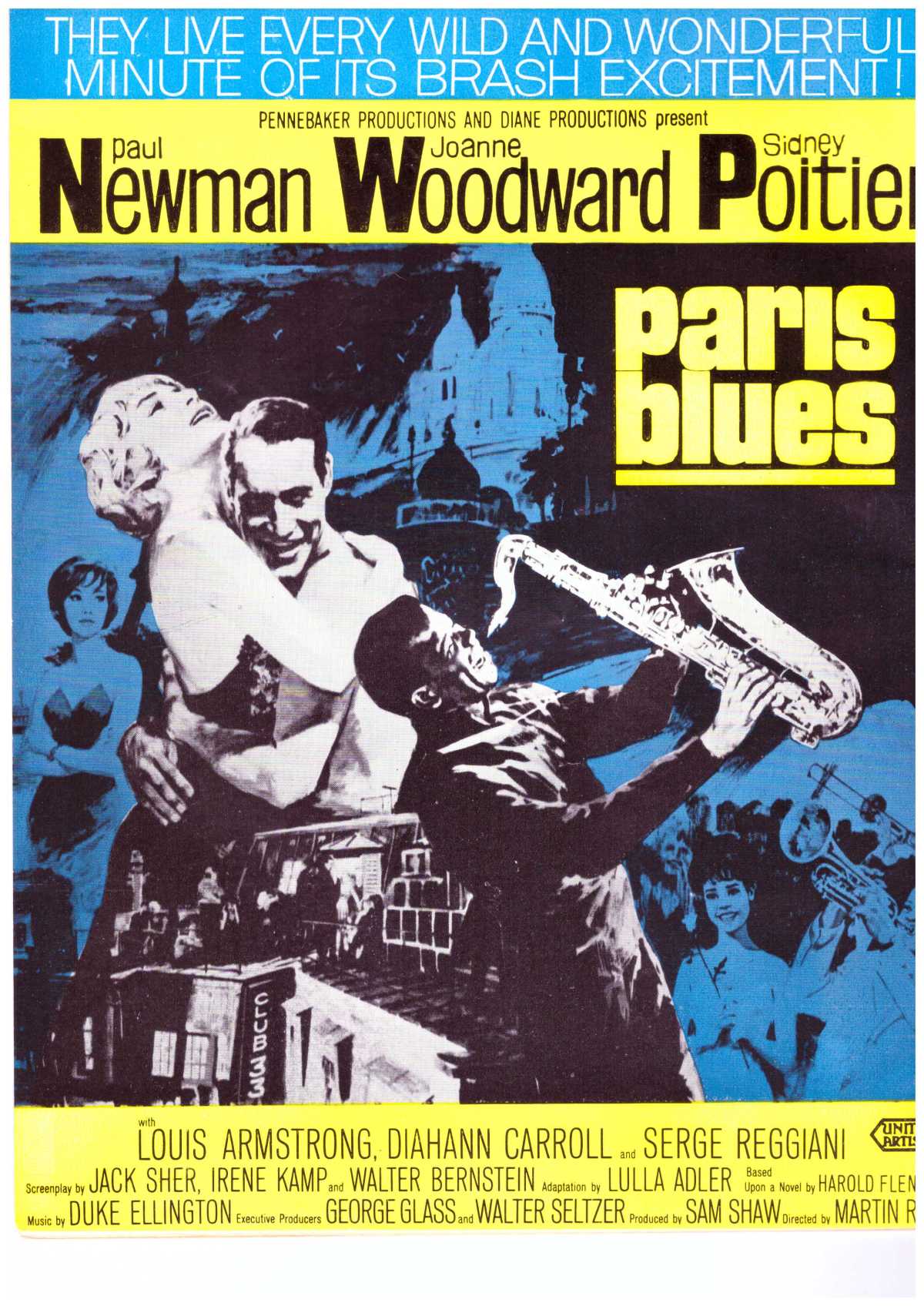
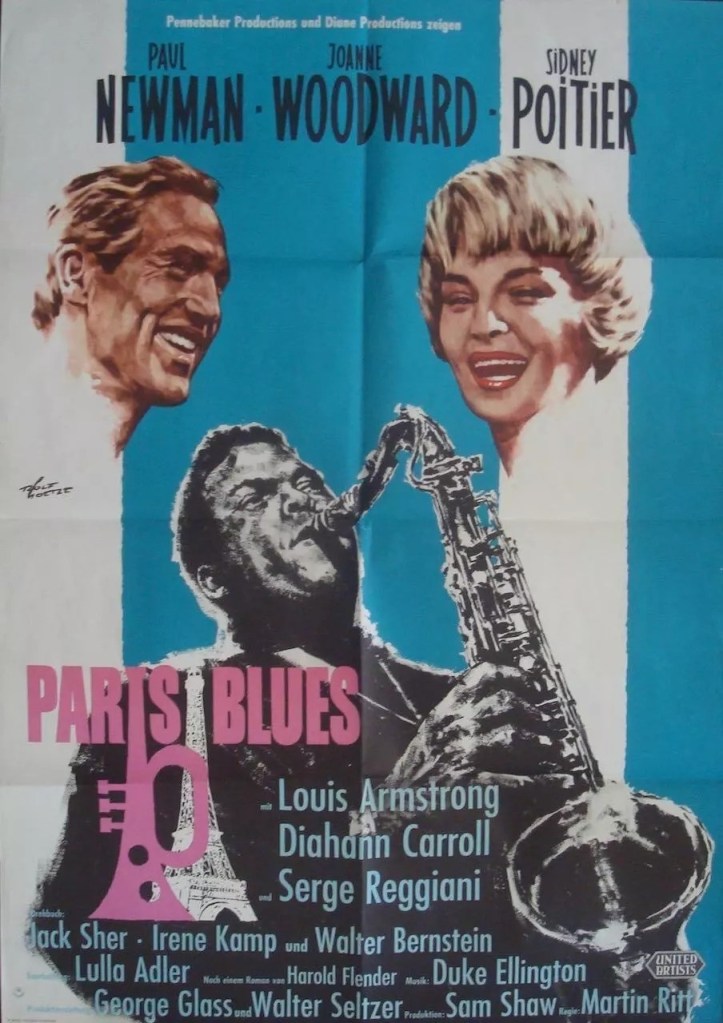
Paris Blues (1961) ****

Sometimes the stars just do align. Issue-driven drama played out against scenic Paris and host of jazz greats in support. The Walter Newman script gets quickly to the nub of a drama that focuses squarely on racism and creativity.

Jazz trombonist Ram (Paul Newman) lives for his music and fancies himself a composer as well as a player and expects women to fall in with his creative lifestyle until he comes across single mother tourist Lillian (Joanne Woodward) who ups the romantic ante by hopping into bed right away. Ram’s buddy, saxophonist Eddie (Sidney Poitier), falls for Lillian’s pal Connie (Diahann Carroll) but not only is she less promiscuous but a civil rights activist who rails against him for abandoning the cause and hiving off to Paris.

There’s a good twist on the will-she-won’t-she trope as this time around it’s the men (no surprises there) who have trouble committing. While the guys are both smitten, and at various times ready to throw up their Parisian lives and head for home, it doesn’t work out that way, so mostly what we get is argument, making up, repeat. But that’s not to suggest this falls into any kind of trap.

While Lillian uses seduction to try and winkle Ram out of his refuge, Connie, on the other hand, depends on guilt. Although Eddie’s able to verbalize the benefits for a black musician playing in Paris, he hardly needs to point it out, it’s plain to see that the innate racism he suffers at home is entirely absent in his adopted city.

If you’re a jazz enthusiast you’ll probably be more aware of the central musical conflict, the older-fashioned New Orleans style versus the modern be-pop. There’s no shortage of jazz. Duke Ellington was Oscar-nominated for the score, Louis Armstrong turns up, mobbed at the train station by fans, and every time the movie’s not cutting away to a Parisian backdrop it’s indulging in some great jazz tunes in the traditional smoky night club.

What’s really attractive here is the assured acting. Paul Newman was in the middle of a hot spurt, both at the box office and from the critics, successive Oscar noms on the way for The Hustler (1961) and Hud (1962) and endorsing his marquee credentials with From the Terrace (1960) and Exodus (1960). This is a lively performance, one in which he doesn’t have to carry the weight of the world on his shoulders or the deadweight of expectation. He’s not a snarling rebel, he doesn’t need to be, not with nightly improvisation, recognition from his peers, and a toehold on the next stage of creativity, composition. If he’s tussling with anybody it’s himself and his spats with Lillian are little more than arguments with himself about the road to take and the sacrifices that might be essential along the way.

Sidney Poitier (The Long Ships, 1964) snags a great career break, like Newman deprived of heavy duty, able to display his great charisma and charm with such a light touch. Joanne Woodward (Big Hand for a Little Lady, 1966) as ever brings a wide range to her role, sassy at times, pragmatic, not inclined to the lovelorn. Diahann Carroll has the hardest part, since she’s the evangelist for modern America, one where equality is going to be a given, so her scenes with Poitier end up mostly being argument rather than pure romance.

This would have been a lot edgier had it gone down the originally planned route of Ram falling for Connie, and that’s hinted at when they first meet, but I guess Hollywood wasn’t ready for that.

This was the second (of five) of director Martin Ritt’s collaborations with Paul Newman – they had formed a production company – and shows the pair’s preference for movies bearing social comment. Ritt (The Spy Who Came in from the Cold, 1965) marries all the various elements to produce an entertaining picture on a serious subject.

Walter Bernstein (The Money Trap, 1965), Jack Sher (Move Over, Darling, 1963) and Irene Kemp (The Lion, 1962) collaborated on the screenplay from the novel by Harold Flender.

Thought-provoking.

The Touchables (1968) **

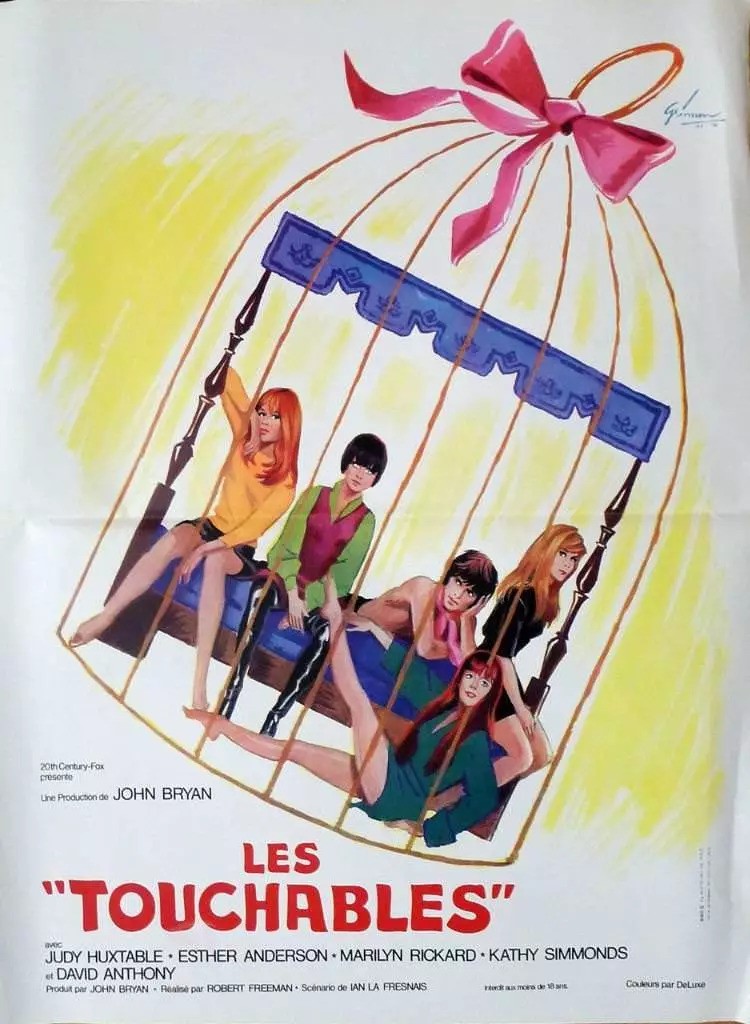
Take a giant bubble, yellow Mini, an abundance of mini-skirts, Michael Caine waxwork,  one pop star, four models, a masked wrestler, nuns, table football, a pinball machine, a circular bed, various sunsets, a shotgun and a lass milking a fake cow. And what do you get? Not much? A dry run for Performance (1971), given Donald Cammell’s involvement, but otherwise a largely soporific feature hoping for redemption on the cult circuit. But with the unsavory subject matter, even with a proto-feminist outlook, that might struggle might to win approval from a contemporary audience.

Unlike Privilege (1967) it’s not saved by ironic comment on the music scene or even anything in the way of decent performances and looks more like an attempt to guy up the nascent careers of a bunch of young actresses and get by with a day-glo pop art sensibility. At no point are we invited to disapprove of the model quartet who decide, having tried out their kidnapping skills on a Michael Caine waxwork, that they might as well go the whole hog and abduct pop star Christian (David Anthony) and tie him to a bed and take their turns having their wicked way with him.

This is all purportedly acceptable stuff because a) it’s a gender switch and b) the poor pop singer is only too happy to escape the drudgery of making millions and not have to even consort with groupies and c) is presented as if he is thoroughly enjoying the whole experience. That is, if you ignore him being chloroformed, shot, and whacked over the head, then of course it’s all very pleasant.

Naturally, these being cunning wenches, they hide him in plain sight. Who would think to look for him in a giant transparent bubble?

Although drawn with villainous strokes, as were all the managers in Privilege who put unnecessary pressure on the pop star they have created, it’s hard to view Anthony’s upper class manager Twynyng (James Villiers) as a bad guy for wanting his safe return.

So what happens once the ladies take charge of their victim? Beyond sex, not much, playing with the various items mentioned, not even any jealousy rearing its ugly head, just the kind of cinematography that might well pass for advertising.

It’s hard to see what the point of it all was. Screenwriter Ian La Fresnais (The Jokers, 1967) might have been brought in to add a touch of levity to what otherwise – kidnap, rape – was a dodgy subject based on an original by Donald and David Cammell. Even taking a comedy approach wasn’t going to work if it was saddled with little interaction between characters and nobody, to put it bluntly, who could act.

I would tend to think with the “talent” involved that this was made by a neophyte producer. But, in fact, this is the oddest part of the whole debacle. John Bryson was an Oscar-winner – admittedly for art direction for Great Expectations (1948) – but also an experienced producer, this being the last of the dozen he made. But they included Man with a Million (1954) and The Purple Plain (1954), both toplining Gregory Peck, The Spanish Gardener (1956) with Dirk Bogarde, The Horse’s Mouth (1958) starring Alec Guinness, Tamahine (1963) – reviewed in this Blog – and Peter Sellers in After the Fox (1966).

It didn’t do anything for anyone’s career, which was the least you could expect for the actors forced into such mindless cavorting. Judy Huxtable appeared in a similar lightweight advertising-led concoction Les Bicyclettes de Belsize (1968) and bit parts in the likes of Die Screaming, Marianne (1971) and Up the Chastity Belt (1972). Ester Anderson did somewhat better, female lead to Sidney Poitier in A Warm December (1973), her last movie. For Kathy Simmonds this was her first and last movie, but she was better known as a genuine pop star’s girlfriend, dating George Harrison, Rod Stewart and Harry Nilsson. Only movie of David Anthony. Seems it’s too easy to confuse Marilyn Rickard with German Monica Ringwald so she may or may not have a string of bit parts in sexploitationers. Arts presenter Joan Bakewell put in an appearance as did Michael Chow, later a famous restaurateur and artist, and wrestler Ricki Starr.

Director Roger Freeman made one more picture, Secret World (1969) with Jacqueline Bisset which at least had a decent premise.

File under awful.

Stark Fear (1962) ***

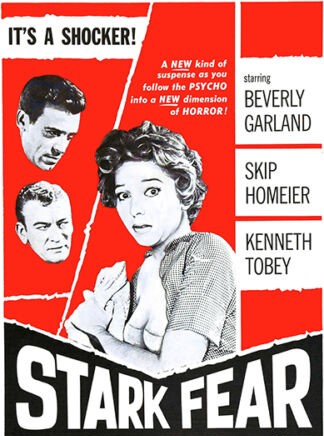
Unless you were unfortunate enough to get mix up in an international conspiracy, or your wealth induced a husband towards your murder – or a la Gaslight towards your insanity – or had taken a shower in strange motel, a wife in American movies was unlikely to live in fear of a sadistic spouse. Wife-beating aka wife-battering had never been high on the Hollywood agenda as an appropriate subject matter, so this picture not only stands out for the period but also strikes a contemporary spark. While many marital dramas of the 1960s have quickly become outdated, this has not.

Opening with an audacious cut from a woman’s eyes seen in a car’s rear-view mirror to her face in a photograph being pelted, being smashed to pieces. Ellen (Beverly Garland) has committed the grievous sin not just of going out to work but of taking up the post of secretary to oil executive Cliff Kane (Kenneth Tobey), a previous rival of husband Gerry (Skip Homeier). But Gerry’s income had unexpectedly tumbled and the couple, married just three years, need her money. He pours a drink over the terrified woman’s head, demands a divorce and promptly disappears.

Her search for him takes her to Quehada, pop. 976, a rundown town she had never heard of and whose existence her husband made no mention despite the fact it was where he grew up. Her husband’s sleazy friend Harvey takes her to the grave of Gerry’s mother (also called Ellen) where he rapes and beats her while, unbeknownst to her, her husband watches.   

Back at the office, she begins to fall for Cliff, but Gerry, even though he no longer wants her, sets out to destroy the budding romance.

Following the classic pattern of course Ellen blames herself for making Gerry unhappy and for getting raped. Her guilt fuels her husband’s sadistic streak. She is unsure whether the threat of divorce is just the most cruel taunt her husband can imagine or for real, which would be just as bad, given her low-self-esteem.

Once she realizes Gerry had an unhappy childhood and is mother-fixated, it makes it even harder for her to abandon him, regardless of the mental and physical torment he inflicts and despite the entreaties of social worker friend Ruth (Hannah Stone). Ruth, too, however, represents an alternative equally fearful future, the now-single woman who regrets separating too quickly from her husband and has no man  in her life or none who come up to scratch.

This is not a picture where men come out well. Gerry is a fiend in a suit. On the way to Quehada she is groped by other men who clearly feel it is their right. Harvey has a history of just taking what he wants. Even the relatively gentle Cliff appears to have an underlying reason for taking an interest in her.

In a world and a time where marriage meant not just financial security, but a safe haven from all the other men who would like as not press themselves upon the opposite sex at any opportunity, and not necessarily with any delicacy, director Ned Hockman presents life as a succession of traps for women. And we know now that not much has changed, and that for women fear is a constant.

Hockman directs with some singularity. He uses black-and-white not quite in the film noir manner of shadows and shafts of light but sets the subject of any night scene in a pool of light with darkness all around, which makes for some striking images. A couple of unusual backdrops include Commanche tribal dancing and a chase in a jukebox museum help place this a couple of notches above the usual B-picture.

Beverly Garland was a 1950s B-picture sci-fi and horror scream queen in movies such as It Conquered the World (1956), Curucu, Beast of the Amazon (1956) and Not of This Earth (1957) so fear was something of a default. Here, she adds something else, desolation at the position she finds herself in, confusion that her marriage is in tatters, hunting for a solution that never emerges, and unable to summon up the anger that might free herself. Hannah Stone has an intriguing role, encouraging her friend to leave her husband, knowing that being single again is not all it is cracked up to be. Unusually for a minor character in this kind of picture, primarily there to shore up the star, she enjoys a spot of lifestyle reversal.  

Heart-breaking.

The Rain People (1969) ****

You could argue that grandiose ambition sucked the life out of Francis Ford Coppola. That if he had continued along the more intimate trajectory suggested here there might have been  a more consistent output, perhaps on an even higher plane. Even if grounded in American life, this has a distinct European sensibility and while you won’t find a single memorable image you will definitely find characters of substantial depth drowning in agonizing circumstance.

That’s not to say you won’t find outstanding sequences. I defy you to find a more cruel and character-defining scene than the one where our heroine Natalie (Shirley Knight),  running away from the chains of domesticity, takes dominance to a new extreme by demanding that muscular ex-college footballer Jimmy (James Caan) crawl round on the floor beneath her feet.

There’s no excuse for such behavior except that she wants some kind of revenge on her husband, whom she accuses of trapping her into said domesticity by the old-fashioned route of making her pregnant. This is before she discovers that Jimmy is simple-minded as the result of brain damage following an American football injury, and that it’s easier now for him to obey people rather than as before argue and stand his ground.

F. Scott Fitzgerald once famously said there were no second acts in American acts. What he failed to mention was that some people barely got to the end of the first act. Jimmy is an outcast, nobody willing to take responsibilty for him, everyone dodging such commitment. Because American scoiety has no place for losers, they fall through the cracks and stay there.

As a result of his injury Jimmy was given a thousand bucks and “told to leave.” So, he went. He’s got a destination in mind, salvation of some kind, I guess, heading towards a drive-in where he has been promised a job by the father, previously a huge fan, of his ex-girlfriend Ellen (Laura Crews).

Natalie is on a road trip to find herself, firstly at the very least just to escape, secondly requiring the seclusion to decide if she wants to keep the baby, but also to have fun, pick up other men for sex. That’s how she happens upon Jimmy. But there’s no sex, not with the shame she feels after humiliating him and realizing just how dumb he now is.

But the alpha horse-riding girlfriend doesn’t want him, she’s humiliated that anyone would associate her with this shambling hulk, and the promised job flies out the window. Natalie dumps him at a reptile zoo where the duplicitous owner appropriates his thousand bucks, leaving Natalie so delighted to be rid of him she races off and is pulled over for speeding by lovelorn cop Gordon (Robert Duvall). Circumstance forces a return to the zoo where Jimmy has caused chaos by freeing all the livestock.

But she’s taken enough by Gordon and desperate for the sense of freedom that illicit sex brings that she ends up in his trailer. Only his rebellious young daughter doesn’t take kindly to him bringing home his conquests and while he’s trying to bed Natalie, initially very complicit despite the awkward presence of the awkward child, causes a ruckus outside. Natalie would still be up for it except she takes umbrage that Gordon’s unable in his lovemaking to forget his dead wife, killed along with his son in a house fire.

The scene turns ugly and she’s rescued by Jimmy who proceeds to put his football playbook moves on Gordon, picking him up and throwing him to the ground and ramming him in the stomach, none of your standard fisticuffs here. But given Gordon’s a cop, there’s a gun on the loose and the daughter picks it up and shoots Jimmy stone dead.

That last scene comes out of nowhere and stops the audience as dead as it does Jimmy and in a bitter ironic twist wraps up a scenario where the lost never find what they’re looking for. You might find similar in, despite their power, later characters such as Michael in The Godfather (1972) and Col Kurtz in Apocalypse Now (1979).

Compare the Caan and Duvall of The Godfather and you’ll think they’ve swapped their personalities from here, Caan adopting the firmness and overt masculinity of Gordon and Duvall the soft-spoken tones of Jimmy.

I mispoke when I said there were no memorable images. There are, but their meaning comes later. We see Jimmy sweeping up leaves in playful fashion and only later discover that’s all he’s fit for. We see Natalie as trapped in a phone booth as in her marriage trying to talk her way out of returning to her husband, whose tone changes from angry to whining and desperate, and all we get of him is his voice. There are a few of those lingering shots of rainwater and drab early morning scenery that you would get in an arthouse picture but this quickly grows out of them and into the meat of the situation.

James Caan is particularly superb, completely altering is screen persona. Shirley Knight (The Group, 1966) delivers on previous promise and Robert Duvall demonstrates his range. Original screneplay also by Coppola.

Lost in the acclaim for Coppola’s more grandioise efforts but well worth digging out.

The Substance (2024) **** – Seen at the Cinema

Like Tar (2022) suffers from stylistic overkill and outstays its welcome by a good 30 minutes, but otherwise a perfect antidote to Barbie (2023). While not entirely original, owing much to the likes of The Picture of Dorian Gray and The Stepford Wives and the doppelganger and split personality nrrative nonetheless a refreshing take on the ageing beauty syndrome. Shower fetish might be a homage to Brian DePalma and except that the movie is directed by Frenchwoman Coralie Fergeat (Revenge, 2017) we might be lambasting its rampant nudity for misogynistic reasons.

On the plus side, everything else about it feels new. The whole story plays out like a demonic fable, the participants only caught out because, in their greed, they refuse to play by the rules. But like all the best horror films this occupies its own world. Whoever offers this free drug and the chance to relive your life through the best possible you is a monosyllabic voice at the end of a telephone. Not only is there gruesome rebirth but a stitching-up process. The black market drug at the center of the tale can only be accessed in a deadbeat part of Los Angeles by crawling under a door, but then, suddenly we’re in a pristine room and the various constituent parts of the substance are laid out on the Ikea model with easy-to-follow instructions.

After surviving a horrific automobile accident, onetime movie star Elizabeth (Demi Moore), reduced to breakfast television exercise guru, is passed a mysterious note by an incredibly good-looking young man that takes her down this particular rabbit hole. Like Eve’s forbidden fruit or Cinderella’s toxic midnight, there’s a catch to reliving her beautiful youth. She must switch back “without exception” to her original persona every seven days.

Of course, that’s too much to ask, and as the double named Sue (Margaret Qualley) steals minutes then hours and days the effect is seen on Elizabeth, a monstrous aged finger appearing in her otherwise acceptable hands first sign that these rules cannot be broken. Warning that there are two sides to this singular personality goes ignored. Instead of acting in concert each prt of the split personality conspires againt each other until entitlement spills over into abhorrent violence.

Apart from the initial rebirth squence, and the toothless section, the best scenes are more toned down, in one Elizabeth is faced with an alternative future, the other when she re-does her make-up four times for a date, unable to decide on which face she wishes to present.

Demi Moore (Disclosure, 1994) is being touted as a shoo-in for an Oscar nomination, but that’s mostly on account of her willingness to appear without makeup and for long sections without clothing. I’m not convinced that there’s enough heartfelt acting beyond the bitterness that was often her trademark. Margaret Qualley (Poor Things, 2023) isn’t given much personality to deal with except for exuding shining beauty and horror when it starts to go wrong.

All the males are muppets, it has to be said, wheeler-dealer Harvey (Dennis Quaid) the worst kind of obnoxious male. But this doesn’t feel much like a feminist rant but a more considered examination of refusal to accept oncoming age. Everyone has the kind of vacuous personality that’s endemic in presenting the best face (and body) to the viewing (television, big screen) public.

The movie plays at such a high pitch that most of the time you can ignore the deficiencies, but the 140-minute running time is at odds with hooking a contemporary horror audience and the gore at odds with hooking the substantial arthouse crowd required to generate the returns needed to pay back acquisition rights. None of the characters has any depth, little backstory, virtually nothing in the way of the usual confrontation with others in their lives, but then Elizabeth already lives a life of isolation, clearly lamenting her longlost fame and the attention it brings.

This won at Cannes for the script and  not the direction and that feels about right. Great idea in ultimately the wrong hands, too much of the repetition that was so annoying in Tar and the determination to make every single shot different, a movie beaten into style every inch of its running time.

Coralie Fergeat has a triumph of some kind on her hands, but one that might struggle, due to excessive length, to find an audience. Not sure, either, why tis is being sold as comedy-horror, a peculiar sub-genre in the first place to make work, but I don’t remember laughing once.

However, like Saltburn (2023) this has a good chance of attracting the young crowd via word-of-mouth, the kind who are just waiting to find their own cult material.

Both facinating and repellant.

Grand Prix (1966) *****

If ever there was a case to be made for six-track stereophonic sound or, for that matter, split screen Grand Prix would form the first line of defense. That it was made in Cinerama 70mm was merely a bonus. Most roadshow movies start with an overture, a ten-minute or so musical introduction that would thematically at least give the audience some indication of the picture they were about to watch. Thrumming and roaring engines formed the montage opening to Grand Prix, a noise that almost shook a cinema to its foundations.

Cinerama had been built on its ability to create almost primeval effects. There was always a downward rush, a runaway train, a roller coaster, something to set an audience on the edge of its seat in pure exhilaration. But the visual had nothing on the aural and what set Grand Prix apart was danger, that constant thrum of engines rising to impossible crescendos. Split screen allowed the director to tell several stories at once as competitors chased each other round perilous circuits at a time when death was a racing driver’s constant companion and in fact of the thirty-two professional participants including Graham Hill, Jim Clark, Juan Fangio and Jack Brabham five were dead within two years of the movie’s completion. Nobody needed to remind an audience how hazardous the sport was, they could read about the continuous carnage in the newspapers, but what was less easy to convey, although such events were well attended, was the pure thrill of being at a race meeting. Grand Prix set out to rectify that problem.

At nearly three hours long it had room to tell several stories and in that respect it was more of an ensemble picture than something like Lawrence of Arabia (1962) which took even more time to tell just one story. Many of these stories came to an abrupt end as the character died in an accident.

Steve McQueen and Paul Newman, both racing aficionados, were front runners for the leading role but it went instead to James Garner, also a racer who did all his own driving (though not necessarily at the speeds indicated). And to properly represent the competition it required an international flavor so other drivers were played by Yves Montand (The Wages of Fear, 1953) in a part first offered to Jean-Paul Belmondo and Antonio Sabato (in his second film) with Adolfo Celi (Thunderball, 1965) as the Ferrari boss and Toshiro Mifune (Seven Samurai, 1954) as a Japanese team owner. Swedish star Harriet Andersson (Through a Glass Darkly, 1961) was cast as the female lead but dropped in favour of Eva Marie Saint (Exodus, 1960) in a role turned down by Monica Vitti (Modesty Blaise, 1966).

Garner and Saint had previously worked together in thriller 36 Hours (1964) and it said a lot for his marquee credentials that he was still best known for The Great Escape (1963). Although he had reached top billing status, films like The Art of Love (1965) and Mister Buddwing (1966) did not deliver commercially. Saint’s career had been as peripatetic after Exodus (1960) as before, star of All Fall Down (1962) but third-billed in The Sandpiper (1965) and second-billed in The Russians Are Coming, The Russians Are Coming (1966), the latter two both big hits.

Frankenheimer had directed Saint in All Fall Down and enjoyed a distinguished career with The Birdman of Alcatraz (1962), The Manchurian Candidate (1962) and Seven Days in May (1964) although the high regard in which he was generally held was somewhat tarnished by The Train (1965) and thriller Seconds (1966), the latter a spectacular flop. Grand Prix was not only the biggest film of his career, though The Train had given him a grounding in action, but also his first in color.  The movie was filmed on existing legendary circuits with Formula 3 racing cars adapted to look like Formula 1 and a thousand other incidental details including an appearance by a Shelby Mustang (with Carroll Shelby as technical adviser) that made it an accurate depiction of the sport. Eighteen cameras were used to film the races.

The narrative arc follows the Grand Prix season and while the actual competition dominates the movie it is against the background of the emotional turmoil the sport wreaks on the drivers and the wives and girlfriends who have to live with the knowledge that their partners might not come home at the end of the day. Garner is considered too reckless for the top spot in a racing team and in a bid for redemption signs for a new company. Former world champion Montand is coming to the end of his career. English actor Brian Bedford makes his mainstream movie debut as a driver recovering after a horrific crash caused by Garner. The emotional subplots comprise Garner having an affair with Bedford’s wife (Jessica Walter); Montand embarking on an affair with Saint who plays a magazine writer, with French actress  Francoise Hardy (better known as a chanteuse) involved with Sabato. In addition, there are some telling sequences in which the drivers unload about their fears.

Frankenheimer does a terrific job in marshalling all the effects and the minute details, and the fact that there is no big star in the mix makes the battles between the characters more realistic.  

Lee (2024) *** – Seen at the Cinema

Would have worked better as a documentary. Bit puzzled too by the deceit of the structural device, flashing back from her war years to being interviewed by an apparent journalist in old age at her country cottage. Seems an interesting conceit that he turns out to be her son Antony (Josh O’Connor) and she’s able to turn the tables and ask what she was like as a mother (not good, apparently, Antony grew up feeling he was an imposition). But also a standard biopic trope as he uses her famed photos to stimulate memories. But then, presumably in the interests of honesty (or who knows what) the credits blow these sequences to pieces by pointing out that her son didn’t have a scoobie about her war activities until after the death a forage in the attic turned up boxes of her photos. What the heck, artistic license and all that.

My other quibble, since I’m in that sort of mood, is that the ageing process seems to have passed our star Kate Winslet by. Sure, she’s dabbed on a bit of oldie make-up for her later years but the crow’s nest of lines around her eyes are noticeably prominent for a woman just turned thirty in the immediate pre-war year.

Still, on with the show, in which her pre-war fame as a surrealist is also ignored, as is her liaison with Man Ray, or that before she took up with another surrealist Roland Penrose (Alexander Skarsgard) she had been married to –  and not divorced from – an Egyptian businessmen. The thrust of the movie is her war years as Vogue correspondent. There’s a bit of falling back on characters skitting around in the background (Cecil Beaton, for example) and keeping us up-to-scratch on timescale, invasion imminent etc.

Misogyny is fairly rampant, the British squeamish about sending women unnecessarily to the front line, the Yanks less so. Though Lee Miller is treated, for dramatic purposes, as the only female war correspondent, breaking through the usual class ceiling, in fact the Yanks had squads of them including Martha Gellhorn and Mary Welsh, third and fourth wives of Ernest Hemingway, respectively, Kathleen Harriman, Dixie Tighe and Helen Kirkpatrick, and Tania Long, none of whom would be unknown to Miller since she posed for a photo with the gang in 1943.

There was nothing subtle about Lee Miller, she said it like it was, a hard-drinking what used to be known as a free spirit, an euphemism for embracing a love-‘em-and-leave-‘em mentality. But there’s some subtlety here, a scene of her peeling potatoes revealing more about male expectation than any verbal punch-up with any officious male, being covered with supposedly invisible paint by Roland more effective in catching sexual attraction than the rest of her let-it-all-hang-out persona.

The only problem is that the concentration camp scenario has been dealt with by any number of far superior films and her staggering back with shock at the sight of the piled-up corpses not compensation enough. I don’t know enough about war photographers to compare what she captures through the lens with the dozens of others doing the same job. By the time her photos of the Holocaust were printed in American Vogue, Richard Dimbleby and Edward Murrow had delivered radio devastating reports and anonymous military photographers supplied tons of evidence against the Nazis.

I’m not sure it actually helps her case that she took a bath, naked, in Hitler’s bath.

Kate Winslet (Ammonite, 2020) almost single-handedly keeps the movie on course, but it lacks impact as a war picture, and the idea that nobody other than Lee was taking note of the suffering of the British during the Blitz seems a bit of a stretch. Pick of the support is most definitely Andrea Riseborough as the doughty British Vogue editor, every bit as tough if not as outspoken as Miller. Josh O’Connor (Challengers, 2024) spends all his time looking soulful for no reason I can divine. Marion Cottillard (La Vie en Rose, 2007) is wasted.

Ellen Kuras directed from a script by Liz Hannah (All the Bright Places, 2020), Marion Hume (movie debut) and John Collee (Monkey Man, 2024).

Movie not as hard-nosed as Winslet.

The Critic (2024) ** – Seen at the Cinema

Can we get over all this “national treasure” (a favorite of Britain) baloney, please? If we’re going to drag our esteemed acting knights of the realm out of their armchairs (you notice I didn’t say retirement because actors almost never officially retire, Kathy Bates and Gene Hackman to the contrary) could we please give them something more than an opportunity to overact and turn themselves into ripe old hams at the age of (in this case) eighty-five. Sir Ian McKellen (Gandalf and Magneto to you and me) deserves better.

Because there’s nothing at all in this beyond Falstaffian monster Jimmy (Ian McKellen), the eponymous theater critic, relishing his power and taking revenge when’s on the verge of losing it. Frankly, if this was called The Tie-Pin Killer, the serial murderer in the book on which this is based, and Jimmy, as in that book, was relegated to a bit part, albeit a juicy one, it might have been a lot more interesting.

While it touches upon 1930s London Fascists and the plight of the homosexual (a criminal offence to participate) these are kind of tossed into the scenario as if to placate an audience who might complain this is very thin gruel indeed. Presumably, we are somehow meant sympathize with this cruel, odious, character because from time to time he finds himself confronted by blackshirts, who take a dislike to his black companion Tom (Alfred Enoch), who acts as his secretary and presumably not anything else because Jimmy prefers “rough trade.”

In revenge for being fired, he sets up actress Nina (Gemma Atterton) to seduce his employer David Brooke (Mark Strong). Blackmail’s the tool of reinstatement. Apart from general actor insecurity, it’s not entirely clear why Nina should be so determined to keep in Jimmy’s good books. There’s some unbelievable stuff about becoming attracted to acting through reading his articles, which seems quite bizarre since his nasty reviews would put people off going, as he proudly explains is one his aims.

So Nina prostitutes herself for a good review. Yep, must happen all the time. And despite her supposed success – these are, after all, West End plays she is starring in – she lives in a bedsit where hot water is rationed. But she is, romantically, in a bind. She’s just dumped her married lover Stephen (Ben Barnes) whose wife Cora (Romola Garai) just happens to be the daughter of Brooke.

And although Brooke’s wife is “bonkers” (though that’s very much on the periphery) he’s that old-fashioned upper class English gent who only feels shame at adultery when he’s caught out and then of course does the right thing which is to blow his brains out. Which leaves Nina racked with guilt which drives her, as it would, back into the arms of Stephen only for him (another adulterer with principles) to reject her on the grounds that she slept with his father-in-law. When Nina begins to talk about confessing to her role in conspiracy, what’s an upstanding chap to do but drown her in the bathtub?

In the original book Jimmy was a minor character.

Crikey, and we complain about the plotting in the multiverse. This is just bonkersverse. Presumably, Oscar-nominated screenwriter Patrick Marber (Notes on a Scandal, 2007) happened upon Anthony J. Quinn thriller Curtain Call in which Jimmy exists on the periphery of the actual narrative though as a larger-than-life character and decided to forget the whole tie-pin killer thing and rearrange the tale so it revolved around McKellen in the hope nobody would notice, in the midst of McKellen roistering and boistering to his heart’s content, the lack of any sensible tale.

You could certainly have more easily hooked it on Nina, who falls into the Patrick Hamilton category of easily-led character on the edge with impulse inclined to cut her adrift.

If you want ham, McKellen’s your man, none of the subtlety which has impelled other performances. Gemma Atterton (The King’s Man, 2021) has a few moments tormented by conscience but the part is woefully underwritten. This is the reined-in Mark Strong (Tar, 2022) rather the one with the veins standing out on his neck. Lesley Manville (Mrs Harris Goes to Paris, 2022), potentially another future national treasure, has a brief role as does Romola Garai (Atonement, 2007).

Maybe wanting to burnish his artistic credentials, director Anand Tucker (Leap Year, 2010) is predisposed to the extreme close-up and for viewing a scene in extreme long shot through a corridor, window or door.

Jimmy would give have slated this.

Discover WordPress

A daily selection of the best content published on WordPress, collected for you by humans who love to read.

The Atavist Magazine

by Brian Hannan

WordPress.com News

The latest news on WordPress.com and the WordPress community.