La Femme Infidele / Unfaithful Wife (1969) ****

Not surprising since French critics worshipped Alfred Hitchcock – the only ones who gave him their wholesale approval in the 1960s – that a French director would attempt to pick up his mantle. But where Hitchcock majored on mystery and suspense and generally an innocent entrapped in conspiracy or crime, here director Claude Chabrol mostly dispenses with mystery concentrating instead on suspense. And it’s of the kind exhibited in To Catch a Thief (1955), Vertigo (1958), North by Northwest (1959) and Marnie (1964) where you are willing a character to get away with their crime or at least find redemption. And where Hitchcock places that load on the glamorous femme fatale, here Chabrol throws us into that most mundane of crimes, the jealous husband wanting revenge on his wife’s lover.

Successful businessman Charles (Michel Bouquet) should be enjoying life, glamorous trophy wife Helene (Stephane Audran) way out of his league, big house in the country, adorable son. But there’s something amiss. When his wife, who appears loving, makes sexual overtures in bed he turns over. He has grown suspicious of the amount of time she wife spends in Paris, ostensibly visiting her hairdresser or having beauty treatments or going to the cinema. Eventually, he hires a private detective and discovers his wife has a lover, Victor (Maurice Ronet). He decides to confront the lover rather than the wife. But instead of playing  the outraged husband card, he pretends to be a man of the world, suggesting that Helene and he have an open marriage and that Victor is the latest in a long line of lovers. What he hopes to achieve from this is unclear, perhaps put Victor’s nose out of joint, perhaps cover up his own anger.

But it doesn’t go the way he planned. He spies an over-large cigarette lighter in the bedroom, a present he gave his wife for their third anniversary and kills Victor. This being the 1960s before forensics determined that you could never entirely eliminate a blood stain on a floor,  Charles, with considerable diligence, cleans up the blood, remembering to wash out the bucket and cloth, wiping his fingerprints from everything he touched, bagging up the man in bed linen and dragging him out to his car.

On the way to disposing the body he is involved in a minor road accident. Police are called. He is saved from opening the car trunk because it is damaged. But when he tries to get rid of the body, the trunk proves impossible to open. Victor had appeared such a smarmy character, you’ve got no compunction about his death, you just want Charles to get away with the murder. Eventually, he forces the trunk open and drops the body in a small algae-covered pond. For a moment air trapped in the package makes it appear unsinkable. But, then – audience enjoying a sigh of relief and perhaps a homage to Psycho (1960) – it disappears.

Whether he revels in the discomfort of his wife who is no longer able to enjoy her twice-weekly assignations with Victor and unable, of course, to explain her bouts of distress to her husband and must keep up a façade, is unclear.

This is only a perfect crime to someone who has never been involved in crime, unaware of all the means of investigation at the disposal of Inspector Duval (Michel Duchaussoy) and his evil-eyed colleague Gobet (Guy Marley) who has the kind of look that says I know you’re guilty.

Turns out Helene’s name is in Victor’s address book and she can come up with no plausible reason for it being there. Charles denies ever having met Victor. The police are not convinced and return to interrogate the pair. Any viewer will quickly realize that it’s virtually impossible for either of the pair to remain undetected, the regularity of Helene’s visits can hardly have gone unnoticed, and even on a quiet street someone might have noticed Charles’s parked car and possibly him lifting the bulky package.

Nor does Charles dissolve in a bout of guilt. There’s an air of inevitability about him. You have no idea whether he might divorce Helene. The notion that she might not just take another lover doesn’t seem to occur to him and he’s not offered the opportunity to air his suspicions. Is he just going to bump off every lover his wife takes?

His wife finds a photograph of her lover in her husband’s pocket. But instead of denouncing him to the police, she burns it, either to protect her marriage or protect herself from the humiliation of being linked to the dead man, or because she has realized the folly of her betrayal.

We never find out her intentions because at that moment the police return and take Charles away.

A marvellous pivot on Hitchcock, with none of the B-film seediness that might have attended such a femme fatale, as Chabrol sets out his stall as a purveyor of the ordinary criminal, the one who didn’t run in high-class circles or was involved in international intrigue. The crime is so commonplace, that’s the beauty of it, and Charles such an ordinary character it all works superbly.

While Stephane Audran (Les Biches, 1968) is luminous, Michel Bouquet (The Road to Cornith, 1967) is her down-to-earth opposite. Written by the director and Sauro Scavolini (Any Gun Can Play, 1967).

A director finds his metier.

Holiday in Spain / Scent of Mystery (1960) **

There were five our great reasons to see this picture. Firstly, it was in Cinerama. Secondly, it was the first attempt in that special format to tell a dramatic story rather than offer just a travelog. Though How the West Was Won (1962) was promoted at the first dramatic use of Cinerama, that was actually untrue. This came first. Third, there was a terrific gimmick – Smell-O-Vision – which allowed audiences to inhale around 30 fragrances at the same time as the onscreen characters. Fourthly, it was produced by Mike Todd Jr., son of the Oscar-winning producer of Around the World in 80 Days (1956) and second husband of Elizabeth Taylor who was instrumental in bringing Cinerama to the big screen in the first place., Lastly, it was the first top-billed appearance of rising British star Denholm Elliott.

Unfortunately, none of these hit the target and it remains a novelty in the Cinerama canon. For a start, there wasn’t much of a story – it’s a chase tale of sorts with crime novelist Oliver (Denholm Elliott) uncovering a plan to kill American heiress Sally Kennedy. In setting out to thwart it he travels all over Spain in the company of philosophic wise-cracking taxi driver Smiley (Peter Lorre). Cue travelog of scenic Spain including fiestas, dances and the running of the bulls, which appears not to have been specially staged but filmed documentary-style as it occurred with the bulls inflicting considerable damage on the humans foolish enough to think it’s a lark.

The hook is the mystery woman who can only be detected by her Schiaparelli perfume while the giveaway for the villain, hired assassin Baron saradin (Paul Lukas), is his tobacco. Cue an onslaught of scents. But the smells don’t just pop up when characters are involved. When a barrel of wine smashes, that produces another smell.

Astonishingly, the movie manages to bring in some of the Cinerama trademarks – the runaway element seen from the audience POV, not just the traditional vehicle but also  barrels of wine.

The smell gimmick worked well enough in cinemas set up for such technical aspects, but that amounted to very few screens, and outside of those the movie just seemed a random series of scenes with only panoramic views of Spain to lessen the boredom.

It did nothing for the career of Denholm Elliott and he did little for the movie. He lacked the edge or innocence required to make such a character come alive and mostly he looks as though he doesn’t know what to do. He didn’t make another movie for three years and on his return for Station Six Sahara (1963) he was no longer the star but quickly shifting into the character actor he would be for the rest of his screen career.

It was nearly the last hurrah for Peter Lorre. He suffered heart attack during filming so the real Peter Lorre is only seen in half the picture, for the other half it’s a stand-in.

The presence of Elizabeth Taylor (Butterfield 8, 1960) could conceivably have redeemed the picture but she puts in only a fleeting appearance, so speedy her distinctive features barely register. You see more of Diana Dors (Baby Love, 1969).

In the hands of Alfred Hitchcock (Psycho, 1960) or imitators like Stanley Donen (Charade, 1963) and with a more finely worked screenplay, reliant on neither visual nor olfactory gimmick, this might have worked. But it was in hands of Jack Cardiff (The Girl on a Motorcycle, 1968), famed cinematographer but only his third outing as a director, and he clearly didn’t know how to balance the various ingredients and so it limps home.

The minute the location of the source novel by Audrey Kelley and William Roos shifted  from New York to Spain and the number of investigators halved, the trouble started. The hunt for a woman whose existence is in question was a standard mystery trope and might very well have worked here minus the smells and Cinerama.

A curiosity.

King of the Roaring 20s (1961) ***

Occasionally stylish B-picture purporting to tell the story of American Prohibition-era gangster Arnold Rothstein. It’s more of drama with various nefarious figures trying to outwit each other rather than a shoot ‘em up in the style of Al Capone (1959). David Janssen (Warning Shot, 1967) is ideal casting as the thoughtful, cold, calculating and possibly gambling genius Rothstein, the opposite of an intemperate crook like Capone.

The story is told essentially in two parts, Rothstein’s rise to power in partnership with childhood pal Johnny Burke (Mickey Rooney), initially running dice games in the street and  pulling the odd con before graduating to fly-by-night horse racing operations. When the opportunity arises to move into mainstream illegal gambling, he dumps Burke. Corrupt cop Phil Butler (Dan O’Herlihy) is a constant thorn in his side and showgirl fiancée Carolyn Green (Dianne Foster) views marriage as risky – “he’s the gambler but I’m the one that’s going to be doing the gambling.”

For whatever reason, the movie dodges what was believed to be Rothstein’s biggest coup, the fixing of the baseball World Series, but one long section is devoted to how he pulls off a massive horse racing win where he ends up placing a $100,000 bet through insider information and strategic betting. Inevitably, his gambling puts the kibosh on his marriage but by far the most interesting part of the picture is the chicanery as he shakes off one partner, battles another, and without compunction sets up Burke as patsy to settle his score with Butler.

In some respects Rothstein is a template for Vito Corleone (The Godfather, 1972) in terms of his business brain and ability to out-think and out-fox opponents and certainly his facial expressions and innate coldness bear comparison with what Al Pacino brought to his characterization of Michael Corleone. Except that he didn’t trust banks, and carried round wads of cash (hence the title of the biography on which this is based – The Big Bankroll), it’s hard to get a sense of the wealth the gangster generated or, given the minimal violence,  the world of imminent peril he inhabited. 

Period detail is cursory, limited to dancing the Charleston and pouring champagne into teacups. A better idea of the flavor of the times is the wholesale corruption endemic in police departments, untrustworthy lawyers and hypocrisy run wild.  It’s not really Janssen’s fault that it’s hard to warm to such a cold-blooded character, although you could point to The Godfather and The Brotherhood (1968) for that matter as examples of Mafia hoods who do elicit audience empathy.

With occasional bravura moments involving long tracking shots and overhead shots, and a terrific image of champagne bubbles seen through a pair of binoculars, director Joseph M. Newman (This Island Earth, 1955) shows stylistic flourishes that eschew his B-movie roots. Given Janssen is called upon to show as little emotion as possible, he does very well. Dianne Foster (The Last Hurrah, 1958), though initially demure, provides the fireworks. Jack Carson (The Bramble Bush, 1960) as kingpin Tim O’Brien matches Janssen in the cool stakes and proves a worthy adversary. Rooney overacts but Dan O’Herlihy (The Night Fighters, 1960) relishes his dirty cop role.

In a rare Hollywood outing British sexpot Diana Dors (Hammerhead, 1968) puts in an unexpected and brief appearance as Carolyn’s cynical flatmate. The tremendous supporting cast includes Keenan Wynn (Point Blank, 1967), Mickey Shaughnessey (North to Alaska, 1960), Regis Toomey (The Last Sunset, 1961), Oscar-winner Joseph Schildkraut (The Diary of Anne Frank, 1959) and veteran character actor William Demerest.

Jo Swerling (It’s a Wonderful Life) delivers a pointed screenplay focusing on gangster conflict with some excellent observation of the deterioration of the Rothstein marriage and the nervousness of the usually ice-cold Rothstein when confronted by his father. This is one of those pictures that you think deserves a Netflix series, a dozen or so episodes to explore the myriad characters involved and especially to examine Rothstein in forensic detail. The movie spells out that potential and on a tight budget does it well.

Squad 36 / Bastion 36 (2025) **

Netflix appears to be going through the gears – the wrong way. But that’s what happens when you’re so dependent on content – any content. But no different really from old Hollywood, always a bucket of stinkers in the days when studios had to each greenlight 20-25 pictures just to stay in the business.

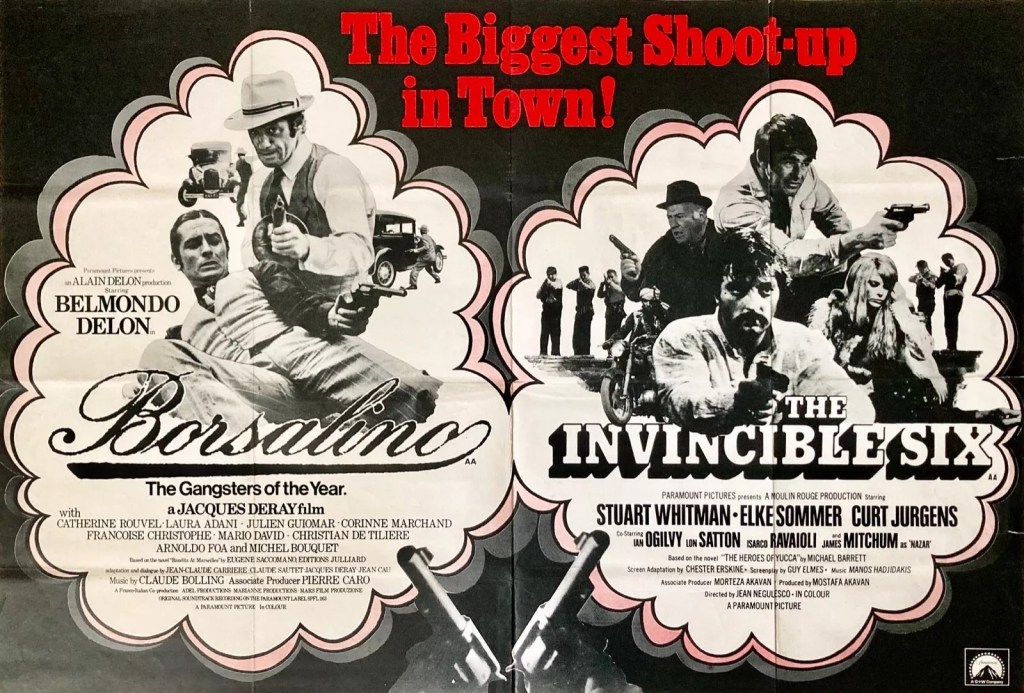
I’d been encouraged by Toxic Town (2025) and my love of French policiers to take a chance on this one. It shouldn’t have been much of gamble. Even though French gangster/crime movies don’t travel all that well, for aficionados like me, growing up on the likes of Gabin, Belmondo and Delon (and intruder Bronson)  that doesn’t matter. Still lingering in my memory are Mesrine (2008) and 36 Quai des Orfevres (2004) with Daniel Auteil and Gerard Depardieu, for example, directed by Olivier Marchal, who helms this one.

This at least gets off to a good start, a blistering chase through a rain-sodden Paris, clever interchange of personnel in cars and on motorcycle, hounding target Mahmoud through the streets. Eventually, Antoine (Victor Belmondo) has him trapped. But in the first of a series of bizarre twists the criminal gets away. How? Well, it’s simple. It’s down to bureaucracy. Instead of putting a bullet through a guy armed with a gun, presumably a crime in itself, Mahmoud effectively reminds Antoine that he doesn’t want to be seen shooting an armed man in public.

What? Double what? Mahmoud might not be resisting arrest but he’s clearly armed and dangerous. But of course there’s another reason Mahmoud can’t be arrested. Because the cops don’t have evidence to link him to criminals – the tracking is in the hope he’ll lead them to the bad guys. However true that may be, at the moment of this confrontation Mahmoud is clearly committing a criminal act, unless he’s got a license to carry a gun in public.

Then it gets even dopier. The top cop is furious because the chase has generated complaints from the good citizens of the French capital. Ooh la la! Then Antoine gets busted because – wait for it – he put in hospital three guys who ambushed him. Guilty apparently of using excessive force. That seems a tad unhinged. Is there any way to combat an attack by three thugs without putting at least a couple of them out of action?

This might have been redeemed had Antoine capitalized on his early edginess. He’s in the illegal business himself, but only to the extent of participating in underground bare-knuckle boxing matches. At one point he takes a hell of a beating – we’re talking Clint Eastwood territory – so that should have set him up for the rest of the picture.

But instead he reverts to completely dull as six months later, having been shifted to another unit, he returns to, unofficially, investigate the deaths of two members of his original squad and the disappearance of a third, Richard (Soufiane Guerrab), who has gone loopy – possibly after reading the script – but then disappeared from a psychiatric clinic.

Antoine has various leads to follow and occasionally, in case the plot is too difficult for us to follow, we pop into the lives of the other cops involved so we know full well they are up to something dodgy. Meanwhile, as with the best cop pictures, there’s a cover-up, which may be because the top brass is implicated or because it would just harm public relations if the public were to even think (perish the thought!) that there could be corruption in the police force.

This just drags on and on. It could easily do with losing a good 30 minutes. But even then it would sag. None of the actors involved take it by the scruff, the way they used to in the good old days, not even when they are presented as an old-fashioned hard-drinking hard-smoking gang. You used to be able to rely of supporting actors to steal scenes, just for the hell of it if they were older and to put down a marker for the future if they were younger, but that doesn’t seem to have occurred to anyone here.

There’s an ironic twist at the end, the kind you used to get in the paranoia thrillers of the 1970s. Cracking start, good ending, but not very much to hook you in between.

Written and directed by ex-cop ex-actor Olivier Marchal from the book by  Michel Tourscher.

Goes through the motions without hitting the spot.

Out of the Fog / Fog for a Killer (1962) ***

Unusual and unusually effective entry into the low-budget British B-film crime category. Teeters for a time on the bittersweet before plunking for ending on a  more realistic sour note. Surprising, too, in being issue-driven – the problem of the rehabilitation of criminals, or the way such efforts are blocked by the general populace wanting nothing to do with thieves and villains, especially when it comes to employment or romance.

On release from prison, George (David Sumner) is given the chance of a new life from do-gooder Tom Daniels (James Hayter) who runs a halfway house for ex-cons. George isn’t particularly grateful, since he sees life stacked up against him. But he’s making an effort and turns down the chance to join the other residents in setting up an illegal scheme. Instead, Tom finds him work as a driver for a furnishings manufacturer where he meets Muriel (Mela White). But their nascent romance is scuppered when the cops come calling, investigating a murder on the “Flats”, an area of wildland close to both the factory where he works and the pub he frequents.

When the killer strikes again, and again, the cops Det Supt Chadwick (John Arnatt) and Sgt Tracey (Jack Watson) realize the murderer is striking at the full moon. Luckily, neither of the detectives is apt to go down the werewolf route, especially as the killer tends to strike when a full moon would be of little assistance because the “Flats” are covered in thick fog (for no apparent reason except the script says so).

George becomes the chief suspect and the cops decide to set up Sgt June Lock (Susan Travers) as bait – odd how often this became a trope in these B-pictures. She’s to befriend George and, come the full moon, prevent herself being killed (the cops are keeping tabs on her) long enough to trap George as the killer.  

There’s generally little time to waste in these running-time-conscious thrillers (this only lasts 68 minutes) on any characterization beyond the obvious but here we discover George has been disowned by his mother, a rather well-off character who lives in a good-sized house in middle-class Chiswick. When he asks to be allowed home, she turns him away and when the cops come calling her first words are, “I don’t have a son.” She’s a cold fish for sure, and hardly the entire reason he’s turned to crime, but it would go some way to explain his general bitterness.

George also appears to have an artistic bent and June encourages him, going so far as lining him up for some work. Before we get to the finale, there are other treats in store, the shrewish mother Mrs Foster (Hilda Fenemore) of the sulking Lily (Coral Morphew) who escaped attack by the killer. The other occupants of the house are also well-drawn, with a villainous hierarchy in operation, and clearly much more likely than George to re-offend.

The cops, too, are more ready than usual to admit defeat. Clues are non-existent what with the fog and any attempt at forensics limited to wondering why George cleaned his shoes so assiduously, the obvious deduction being the existence of mud or grass would have put him close to the crime scene.

In truth, there’s not much to the detection, but at least, as I said, nobody falls for the werewolf line and the idea of the date bait seems to come too easily to the cops.

As it stands, it’s mostly a character study, of a young man who can’t get a break, of society’s attitude to criminals, the lack of redemption available and little chance of a second chance once your past is discovered. I’m not sure how much this was an issue at the time but George exhibits a more understandable seam of bitterness than the likes of the surly Arthur Seaton in Saturday Night and Sunday Morning (1960). The movie only scratches the surface of the affect of a child on the lack of a mother’s love, and since we don’t know what triggered George’s first crime it’s hard to go any deeper.

There’s the chance of a happy ending. June is clearly smitten with George and determined to prove him innocent rather than, as her superiors require, guilty. But bitterness wins out in the end.

Directed by Montgomery Tully (The Terrornauts, 1967) who had a hand in the screenplay along with producer Maurice J. Wilson (Master Spy, 1963) based on the novel by Bruce Graeme.

David Sumner (The Long Duel, 1967) gets his teeth into a peach of a part. Career-wise Jack Watson (The Hill, 1965) fared best though Susan Travers (Peeping Tom, 1960) had a running role in TV series Van der Valk (1972-1973)

Interesting twist on the genre.

Hard Contract (1969) ***

A hitman movie that verges on the existential is always going to be intriguing. Stone cold killer John Cunningham (James Coburn) manages to keep the world at a distance until he runs into the vibrant Sheila (Lee Remick) in Spain. The film is a curiosity of an admittedly small genre dominated by such disparate offerings as The Killers (1946 and 1964), Yojimbo (1961), Le Samourai (1967) and Stiletto (1969) in that although Cunningham does bump people off you never see the violence. We’ve come to expect hitmen to be introspective, but there’s never been anyone as closed-off as Cunningham. No romance in his life, only hookers, no apparent depth, in fact we learn very little about him.

He only runs into Sheila because for a laugh she pretends to be a sex worker. In reality she’s a wealthy divorced socialite running with a fast set that include Adrianne (Lili Palmer) and ex-Nazi Alexi (Patrick Magee) whom she loves to taunt but whose contacts allow Cunningham to be effectively stalked. And as unsavoury that might be from today’s perspective, it sheds light both on her power and whimsicality.

There’s an unusual background. Amid the extensive jet-setting in Torremolinos, Madrid and Tangiers, there are reality counterpoints, reflecting the issues of the decade – violent demonstrations with police using water cannon to control the crowds, the American elections and discussions about God, world hunger, terrorism and population growth.

No doubt the script is wordy, but there’s hardly a word that doesn’t challenge convention. It’s steeped in amorality – a touchstone of the decade – good only occurs “when evil takes a rest” and the world is “immune to murder.” And you certainly get the impression that the rich can confront anything because, not having to live in the ordinary world, they can get away with it. Conversely, this is also one of those films where you wonder who did the wardrobe (Gladys de Segonzac, since you ask, who ran fashion house Schiaparelli in the 1950s) because not only does Sheila sport clothes that would have delighted Audrey Hepburn but Cunningham gets away with wearing a white jacket.

And if Korean vet Cunningham is enigmatic, the insomniac Sheila is cut from a similar cloth, and while a potential source for redemption is as likely to have sex with a casual pickup in a filthy alley. The story does not go quite the way you would expect – Cunningham’s growing dissatisfaction with his profession revealed when he can’t perform in a Brussels brothel. And his mindset allows him to consider mass murder as a solution to an emotional problem he cannot solve.

At core, of course, is whether once Cunningham’s emotional defenses are breached he can continue as a hitman, and whether Sheila can accept his profession. The stakes rise when it transpires that (like Stiletto made the same year) retirement is not an option.

And for all the seriousness on show, there are some imaginative moments of hilarity – Cunningham’s idea of a love song is “To the Shores of Tripoli” and Adrianne proves determinedly indiscreet. In keeping with the paranoia cycle that was about to explode, you never find out why people are being murdered, or even who they are, far less the group which his boss Ramsay (Burgess Meredith) is fronting.

Far removed from the Derek Flint persona that had turned him into a star, James Coburn delved deeper into the amoral territory he had previously explored in Waterhole 3 (1967). Lee Remick (The Detective, 1968) is sheer madcap delight even when espousing her odd takes on philosophy. Lili Palmer (The Counterfeit Traitor, 1962), who by this point in her career was usually the wife or girlfriend, creates a very original character. Veteran Sterling Hayden had only made one film (Dr Strangelove, 1964) during the decade and is excellent as a contemplative retired hitman. Patrick Magee (The Skull, 1965) gives another of his tight-lipped performances. Karen Black (Easy Rider, 1969) has a small role as does Sabine Sun (The Sicilian Clan, 1969).

This marked both the debut and the demise of the directorial career of S. Lee Pogostin, best known at this point as the screenwriter of Pressure Point (1962) and Synanon (1965). In terms of argument over issues it stands comparison with Pressure Point but without that film’s intensity.

I remember being baffled by the picture when it came out and I was a teenager because the action I believed I had been promised never materialized but otherwise I could remember little about it so now it appears as an interesting antidote to the mindless action pictures.  

Rising Sun (1993) ****

Will instantly connect with the contemporary audiences for two unusual reasons. First off, it’s the initial depiction of deepfake. Secondly, a major plot point concerns an aspect of the roughest kind of sex, erotic asphyxiation. These days you’ll find many women complaining that a partner’s addiction to porn has forced them into such dangerous experiment. Here, lending fire to the idea that it’s nothing but fun, is the notion that it’s the woman who’s desperate for such.

There used to be a standard Hollywood ploy of sticking a younger rising star alongside an established bigger name. After Top Gun (1986) Tom Cruise proved the best exponent of this, working with Paul Newman in The Color of Money (1986) and Dustin Hoffman in Rain Man (1988). The idea is that the younger fella will learn from the older (Newman and Hoffman proved top-class tutors, both winning Oscars).

And in fact the narrative here actually takes up such an idea. Semi-retired cop Capt. John Connor (Sean Connery) plays mentor to Lt. Webster Smith (Wesley Snipes) when both are called out to act as liaison between investigator Tom Graham (Harvey Keitel) and the top brass of Japanese corporation Nakamoto where a murder has been committed. The death was initially dismissed as a sex game that went too far and as scarcely worth anyone’s time given the victim was a sex worker, Cheryl (Tatjana Patitz), sometime girlfriend of Japanese playboy and fixer Eddie Sakamura (Cary-Hiroyuki Tagawa).

Matters are complicated because Nakamoto is bidding to take over a key American computer manufacturer and because Senator John Morton (Ray Wise), who initially opposed the deal, is now in favor of a merger. Connor begins to suspect the Japanese have manipulated video recordings of the murder. Single father Smith, objecting to Connor’s involvement, is compromised by a secret past, exposure of which could potentially stop the investigation in its tracks. Slippery American fixer Bob Richmond (Kevin Anderson) is desperate to get a deal over the line.

While the intricate investigation is engrossing in itself, what really makes this fly, beyond another excellent performance by Connery, are the business machinations and the insights into Japanese culture. On the face of it, you might think this is an attack on the Japanese business machine, rampant at the time, but, in reality, my guess is the Japanese would love it for the way it shows American companies in their thrall.

In Japan “business is war” and companies gird themselves for battle by forming alliances that would be outlawed in America. An adept screenplay manages to seed a rich background, featuring elements of Japanese society that are both positive (criminals are generally caught plus caring for employees and “fixing the problem, not the blame”) and negative (racism is widespread). Connor, steeped in Japanese culture, able to move in the highest business circles, calling in favors, is our guide, but that’s never to the detriment of the overall picture, and instead adds welcome depth.

There’s a certain subtlety at work, too, the introduction of the single dad (treated seriously rather than for comic effect) a bit of a thematic coup for the times and Connor’s relationship with Jingo (Tia Carrere) is more fluid than you might expect, the older man leaving the “cage door open” should his younger lover find someone of her own age.

Three decades on from the cultural appropriation of A Majority of One (1961) when Hollywood elected Alec Guinness to play a Japanese man, there’s no shortage of players of Japanese descent  to supply the movie with more authenticity. Mako had been Oscar-nominated for The Sand Pebbles (1966) while Stan Egi (Come See the Paradise, 1990), Clyde Kusatsu (In the Line of Fire, 1993) and Nelson Mashita (Darkman, 1990) flesh out the ranks.

Beard aficionados will welcome Connery’s stylish cut which, once again, serves as a shortcut to character – this is a confident, fashionable man. Sean Connery (The Man Who Would Be King, 1975) drives the movie, he’s always one step ahead even when the bad guys think they have him beat. Another top-notch performance from Sean Connery. Wesley Snipes (Passenger 57, 1992) wasn’t paying much attention to the free acting lessons handed out by Connery, not learning to rein it in, and, presumably to maintain his action cojones, is permitted some unlikely karate kicking. That last wasn’t in the book. There were only two other major changes from the book – adding a couple of early scenes with the victim and giving Connors a relationship with  Jingo. Some of the book is heavily truncated for obvious reasons – you’ll wonder just what the heck is the purpose of Willy the Weasel (Steve Buscemi).

The screenplay by author Michael Crichton (Jurassic Park, 1993), director Philip Kaufman and Michael Backes in his debut, manages to fully convey the novel at the same time as squeezing in as many bon mots as possible without losing sight of the drama.

Philip Kaufman (Fearless Frank, 1967) makes the most of the rich material.

Connery scores once again.

Sol Madrid / The Heroin Gang (1968) ***

Was it David MacCallum’s floppy-haired blondness that prevented him making the jump to movie action hero because, with the ruthlessness of a Dirty Harry, he certainly makes a good stab at it in this slightly convoluted drugs thriller? Never mind being saddled with an odd moniker, the name devised surely only in the hope it would linger in the memory, Sol Madrid (David MacCallum) is an undercover cop on the trail of the equally blonde, though somewhat more statuesque, Stacey Woodward (Stella Stevens) and Harry Mitchell (Pat Hingle) who have scarpered with a half a million Mafia dollars. Mitchell is the Mafia “human computer” who knows everything about the Cosa Nostra’s dealings, Woodward the girlfriend of Mafia don Villanova (Rip Torn).

Sol tracks down Woodward easy enough and embarks on the audacious plan of using her share of the loot, a cool quarter of a million, to fund a heroin deal in Mexico with the intention of bringing down both Mexican kingpin Emil Dietrich (Telly Savalas) and, using the on-the-run pair as bait, Villanova. A couple of neat sequences light this up. When Sol and Woodward are set upon by two knife-wielding hoods in a car park, he employs a car aerial as a weapon while she taking refuge in a car watches in terror as an assailant batters down the window. Sol has hit on a neat method of transferring the heroin from Tijuana to San Diego and that is filled with genuine tension as is the hand-over where Sol with an unexpected whipcrack slap puts his opposite number in his place.

Meanwhile, Villanova has sent a hitman to Mexico and when that fails turns up himself, kidnapping Woodward and planning a degrading revenge. Most of the movie is Sol duelling with Dietrich, suspicion of the other’s motives getting in the way of the trust required to seal a deal, with Mitchell, who has taken refuge in Dietrich’s fortified lair, soon being deemed surplus to requirements. Various complications heighten the tension in their flimsy relationship.

Sol Madrid is Dirty Harry in embryo, determined to bring down the gangsters by whatever means even if that involves going outside the law he is supposed to uphold, incipient romance with Woodward merely a means to an end.

David MacCallum (The Great Escape, 1963) certainly holds his own in the tough guy stakes, whether trading punches or coolly gunning down or ruthlessly drowning enemies he is meant to just capture, and trading  steely-eyed looks with his nemesis.

It’s a decent enough effort from director Brian G. Hutton (Where Eagles Dare, 1968), but is let down by the film’s structure, the expected confrontation with Villanova taking far too long, too much time spent on his revenge with Woodward, for whom audience sympathy is slight. Just at the time when Hollywood was exploring the fun side of drug taking – Easy Rider just a year away – this was a more realistic portrayal of the evil of narcotics.

It is also quite prescient, foreshadowing both The Godfather Part II (1974) in the way Villanova has modernised the organisation, achieving respectability through money laundering, and the all-out police battles with the Narcos. And there is a bullet-through-the-glasses moment that will be very familiar to fans of The Godfather (1972), and you will also notice a similarity between the feared Luca Brasi and the Mafia hitman Scarpi (Michael Conrad) here.

The action sequences are excellent and fresh. Think Madeleine cowering in terror as the car window is battered in No Time to Die (2021) and you get an idea of the power Hutton brings to the scene of a terrified Woodward hiding in the car. Incidentally, you might think MacCallum was more of a secret agent than a cop with the cold-blooded ruthlessness with which he dispatches his enemies.

Stella Stevens (Rage, 1966) is the weak link, too shrill and not willing to sully her make-up or hair when her role requires degradation. Her role is better written (“I never met a man who didn’t want to use me”) than Stevens can deliver and she gets a clincher of final one. Telly Savalas (The Dirty Dozen, 1967) surprises by delivering a playful villain, though the trademark laugh is in occasional evidence whereas Rip Torn is all villain. Ricardo Montalban (Madame X, 1966) is Sol’s Mexican sidekick and Paul Lukas, a star of the Hollywood “golden age”, puts in a fleeting appearance. Written by David Karp (Che!, 1969) and Robert Wilder (The Big Country, 1958).

Proved a winner for Brian G. Hutton – next gig Where Eagles Dare. Less so for David MacCallum – next outing The Mosquito Squadron (1969).

Has its moments.

Unknown (2011) ****

Water contains a miraculous ingredient when it comes to assassins. A good dunking in the ocean (The Bourne Identity, 2002) or a river (here) and suddenly a) they suffer memory black-out and b) they refute their apparent careers as assassins and show such remorse they turn against their employers.

Businessman Martin Harris (Liam Neeson) and wife Liz (January Jones) arrive in Berlin for a high-tech biotech conference, but he leaves his briefcase behind at the airport and when he goes to collect it ends up in a collision on a bridge, falls into said river (the Spree), rescued by illegal immigrant taxi driver Gina (Diane Kruger). After four days in a coma, suffering from loss of memory as well as, critically, his passport, he is treated as an imposter at the hotel, his wife escorting a different Martin Harris (Aidan Quinn).

Pursued by killer Smith (Olivier Schneider) and apparent old buddy Rodney Cole (Frank Langella), only gradually, with the help of an initially reluctant Gina and a former Stasi agent Ernst (Bruno Ganz) does he begin to uncover a conspiracy in which he was to play a central role, namely the murder of Professor Bressler (Sebastian Koch) who has developed some genetically modified crop that will solve the problems of famine worldwide and rather than cashing in on his discovery plans to give it away for free. Shades of the current Day of the Jackal in how such generosity of spirit will upset the financial system.

Twists and red herrings abound, not all of them so plausible, but the movie zips along at such a pace and Martin plays such a befuddled angry patient that you are carried along with considerable zest. Expect a couple of car chases, de rigeur for the subgenre, but the identity confusion plays a large part in making this work. Add in a nascent romance between Martin and Gina, and the setting up of a false romance between Martin and Liz and it zings along quite happily.

Some of the set pieces are quite stunning. A refrigerator coming loose on the back of a lorry instigates the dousing in the river, and the rescue is superb. But there’s humanity and character at work, too, excellent scenes with Gina’s boss bemoaning his lack of insurance cover, Gina herself stuck in transient life, the virtual hovels in which transients live, cardboard walls offering no security, and always someone likely to come charging through a door or a window. Ernst is a super creation, another in need of redemption, clutching the few principles he has left.

But if you need a character to reveal depths of anguish who also needs to be fit enough to do a lot of running around then there’s no better actor than Liam Neeson. He’d done plenty of the actorly stuff earlier in his career with a few turns into action (The A-Team, Batman Begins, The Phantom Menace anybody?) that had detracted from his marquee value and he only really became big box office after the unexpected success, when well into his 50s, of Taken (2008).

Diane  Kruger had come through the ranks with Troy (2003) and National Treasure (2006) but consistent top billing had evaded her, which is a shame because she can bring considerable depths to a part, as she shows here, and she was easily the best thing about The 355 (2022). She was reunited with Neeson for Marlowe (2022).

Jaume Collet-Serra became the Neeson go-to director, re-teaming with the actor for Non-Stop (2014), Run All Night (2015) and The Commuter (2018) and he’s a past master at juggling all the narrative balls, even if some of them don’t make much sense. The detection element, as Martin tries to discover his identity, the slice-of-Berlin-life, the trapped Gina, and the unfolding chaos all make this play very well and it only falls apart in the last section when we have to accept that he’s Bourne-again and chasing redemption while the time-ticking bomb plot element is so old hat.

Still, one of my favorite action pictures.  

P.J. / New Face in Hell (1968) ****

Exceptional down-and-dirty thriller and throwback film noir woefully underrated on release but with a brilliant mystery (or two), a touch of satire, red herrings, some great lines, and believable characters. Private eye P.J. Detweiler (George Peppard) is so down on his luck he is willing to play the lover so an errant wife can be photographed in a motel room. What little he earns goes on paying is debts. So he can hardly down the chance of serious money as bodyguard to Maureen (Gayle Hunnicutt), mistress of rich businessman William Orbison (Raymond Burr), never mind that she initially treats him as a servant.

Orbison has a legendary mean streak – secretaries have to type closer to the edge of sheets of paper, he forces wife Betty (Colette Gray) to account for every dime of her allowance to the point of almost making her beg. Sadism is another character trait. He is happy not to kill off animals he has shot. The childless millionaire adds Maureen to his will for the sole purpose of upsetting every other potential heir. In front of guests at a prestigious party he forces Betty to acknowledge Maureen’s existence.

This apparently wealthy world is riddled with seedy inhabitants, whose only motivation is  greed, all desperate to retain status or inheritance and enjoying Orbison’s largesse, which, despite his miserly nature, he nonetheless flaunts. As well as Betty enduring ritual humiliation to remain his wife and enjoy a gilded lifestyle, his executive assistant Jason (Jason Evers) accepts being treated as a gofer in order to keep his position and the perks that go with it, and Maureen makes no bones about prostituting herself for temporary and future gain. Everyone has to kowtow, even the occupants of a West Indian island dependent on Orbison for investment, not only a kids choir welcoming Orbison on arrival, but a calypso performer singing a song in his praise.

As various threats, including narrowly missing a bullet, are made against Maureen, making a classical entrance in a red dress and alternating between helpless victim and femme fatale, with her creepy manservant Quell (Severn Darden) reporting on her every move, inevitably Detweiler grows closer to his client, unaware that Orbison is planning to have someone killed.

That someone turns out to be Jason, whom Orbison suspects of clandestine activity with his wife, and whom Detweiler innocently kills. As this takes place on the island, where the death is easily hushed up, Detweiler begins to wonder if he’s a patsy and, paid off by Orbison, undertakes his own investigation, quickly entering more dangerous waters, viciously beaten up at Quell’s behest in a gay bar, narrowly avoiding death in the subway and literally finding himself in the firing line.

Detweiler’s character undergoes transition, too. From begging for scraps and turning the other way so as not to jeopardize easy income, he rediscovers his suit of shining armor, walking down some pretty mean streets, a diligent private eye who can no longer be bought off, determined to get to the bottom of what turns out to be a complicated mystery.

Detweiler is no Marlowe or even Tony Rome, but rather despicable at the outset, employing all sorts of dodges, his interest in Maureen not slackening even after he knows she indulges in a quickie with Orbison. He takes too much at face value.

The unfolding mystery is superbly handled, involving proper clues and investigation, shoot-outs and fisticuffs, the outcome not what you might initially imagine. Although primarily an old school private eye picture, it’s great fun, with some wonderful comedy involving a dog, gentle satire on the West Indian island where whitewash is the order of the day, and some touching romantic foreplay.

Peppard (Pendulum, 1969) is outstanding as the dupe who rediscovers his moral code and his Detweiler is an excellent addition to the ranks of the private eye.  Raymond Burr, a far cry from his Perry Mason (1957-1966) television persona,  is easily one of the worst screen millionaires – on a par with Ralph Richardson in Woman of Straw (1964) in his contempt for humanity – and with his silver hair and bulk and scheming proves a slick adversary. Gayle Hunnicutt (Eye of the Cat, 1969) is allure on legs, brilliantly playing every man in sight, eye never diverted from the main chance.

Brock Peters (The Pawnbroker, 1964) has a standout cameo as the island’s cynical police chief. Susan Saint James (The Name of the Game, 1968-1971) makes her movie debut as Orbison’s slinky sex-mad niece.  Also putting in an appearance are Wilfrid Whyte-Hyde (The Liquidator, 1965) as the island’s accommodating governor, Colleen Gray (Red River, 1948) as the humiliated wife, Severn Darden as the odious Quell, and John Ford regular John Qualen (The Man Who Shot Liberty Valance, 1962).

This was the second of director John Guillermin’s George Peppard trilogy following The Blue Max (1966) and prior to House of Cards (1968). Generally dismissed as a journeyman, Guillermin brings a sly eye to this picture, the send-up of British colonialism, the master-servant aspects, an over-the-shoulder shot of an unknown assassin, the scenes in the bar which is effectively Detweiler’s office, and a brilliant subway death adding layers to the movie. He is bold in his use of close-ups with Hunnicutt, some scenes almost a homage to the Bogart-Bacall chemistry, and brings out a world-weary performance from the usually cocky Peppard.

Philip Reisman Jr. (All the Way Home, 1963) fashioned the screenplay, delivering one of cinema’s most memorable final lines.

Bracketed with Pendulum and House of Cards demonstrates that Peppard is under-rated.

Well worth a watch.

Discover WordPress

A daily selection of the best content published on WordPress, collected for you by humans who love to read.

The Atavist Magazine

by Brian Hannan

WordPress.com News

The latest news on WordPress.com and the WordPress community.